
What Is Logistics Network Design?
Logistics network design is the decision-making process used to configure the physical and operational structure of a logistics system. It answers a very direct question: where should logistics activities happen so that customer service is achieved at the best total cost?
A logistics network usually includes several connected elements:
- Suppliers that provide raw materials, components, or finished goods.
- Manufacturing plants or assembly points that convert inputs into products.
- Warehouses and distribution centers that store, sort, consolidate, or break bulk shipments.
- Cross-docking facilities that transfer goods quickly without long-term storage.
- Transportation lanes that connect supply, production, storage, and demand points.
- Customers, retailers, branches, industrial buyers, or final delivery zones.
Logistics network design is the structured planning of where logistics facilities should be located, how many should exist, which customers or markets they should serve, and how products should flow between suppliers, plants, warehouses, distribution centers, and customers.
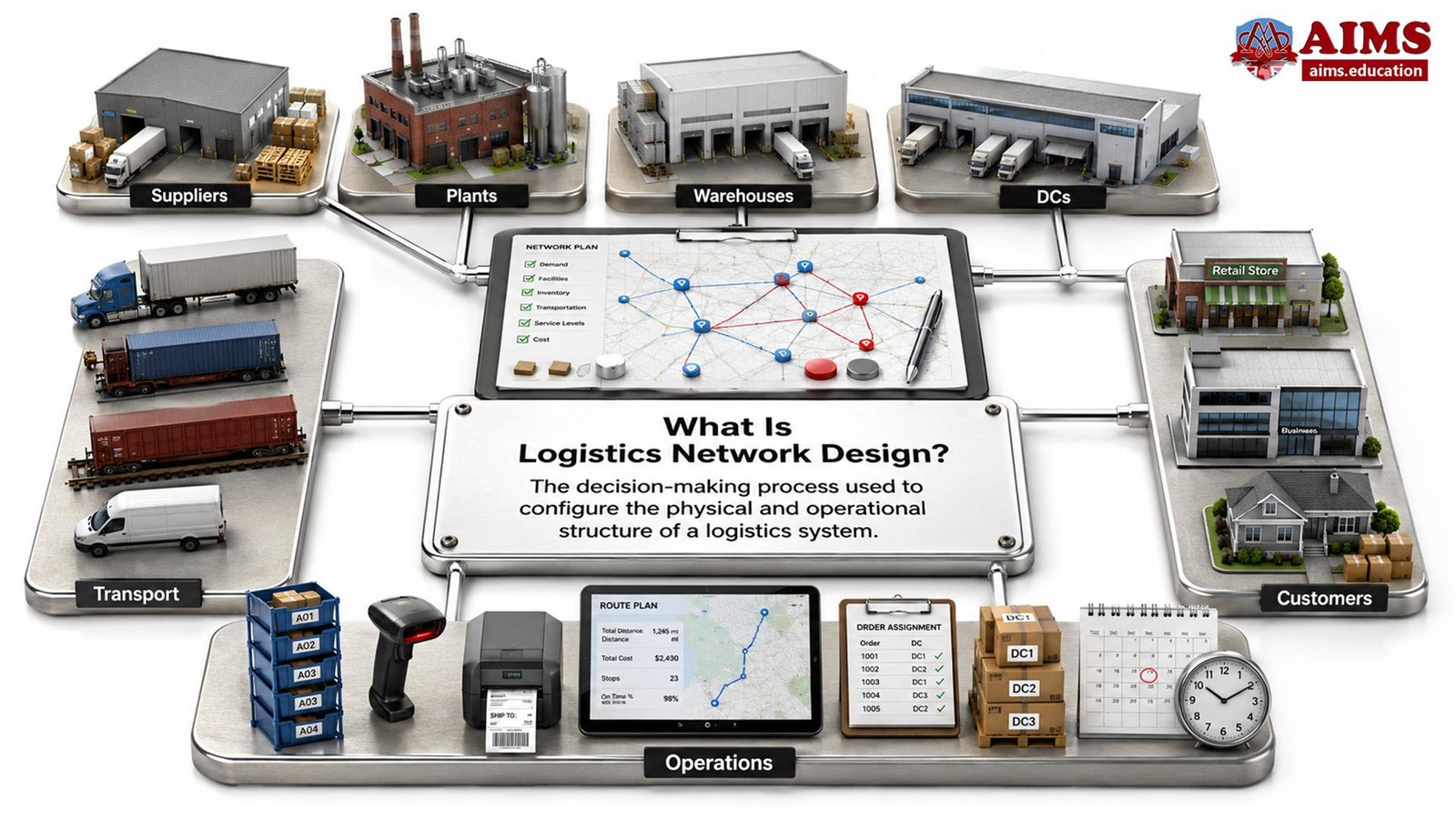
In practical terms, it helps an organization balance service speed, transportation cost, inventory cost, facility investment, flexibility, and long-term supply chain performance. A well-designed logistics network does not simply move goods from one place to another. It shapes how the whole business competes, responds to customers, absorbs change, and controls cost.
Actually, the design of this network becomes one of the most important decisions in modern logistics management and customer service planning, because the location of facilities affects transportation time, inventory levels, labor availability, responsiveness, and operating cost for many years.
Logistics Network Design Definition
Logistics network design decides the best place to put logistics facilities and the best way to connect them. A company may ask whether it should operate one national distribution center, several regional warehouses, a customer-facing network of local hubs, or a mixed design using third-party logistics providers.
The decision is not only about distance. It is about the complete cost and service picture. A warehouse close to customers may reduce delivery time, but it may increase rent, labor cost, and inventory duplication. A central warehouse may reduce fixed costs and inventory, but it may increase delivery distance. The best design depends on customer requirements, demand patterns, transportation capability, product value, and business strategy.
Good logistics network design is not the search for the cheapest warehouse. It is the search for the best total system.
Why Logistics Network Design Is Important
Logistics network design is important because it determines how efficiently and reliably a company can serve its market. Facility location, transportation lanes, inventory positioning, and customer assignments create the operating logic of the supply chain.
The need for network redesign usually appears when one or more business conditions change. These conditions include:
- Customers expect faster delivery, smaller orders, better visibility, or more flexible service options.
- Markets shift geographically, making old warehouse locations less effective.
- Suppliers move, global sourcing patterns change, or inbound lead times become more uncertain.
- Ownership changes through mergers, acquisitions, or divestitures create duplicate facilities.
- Cost pressure forces the company to reduce transportation, warehousing, inventory, or labor cost.
- Competitors improve service levels by using better facility placement or faster transportation access.
- Technology makes it possible to serve larger regions from fewer facilities.
To be honest, many logistics networks become outdated quietly. They may still function, but they no longer fit the market. Demand changes, fuel costs move, supplier locations shift, and customers become less patient. A network that was excellent five years ago may now be too slow, too expensive, or too rigid.
How Logistics Network Design Reduces Cost
Logistics network design reduces cost by improving the trade-off between transportation, inventory, warehousing, labor, and service performance. The goal is not to minimize one cost in isolation. The goal is to optimize the total logistics cost while protecting customer service.
For example, consolidating several warehouses into fewer facilities may reduce building costs, labor costs, and inventory carrying costs. On the other hand, it may increase outbound transportation cost. The redesign becomes attractive only when the total savings are greater than the additional transport expense.
This is why a good network study must be connected with practical logistics cost reduction strategies, not just with a map of warehouse locations.
Logistics Network Design vs Supply Chain Network Design
Logistics network design focuses mainly on logistics facilities, transport flows, and distribution decisions, while supply chain network design covers the broader end-to-end structure from suppliers to final customers. The two are closely related, but they are not exactly the same.
| COMPARISON POINT | LOGISTICS NETWORK DESIGN | SUPPLY CHAIN NETWORK DESIGN |
|---|---|---|
| Main Focus | Warehouses, distribution centers, transport lanes, delivery zones, and logistics service levels. | Suppliers, plants, production flows, procurement, logistics, distribution, and customer markets. |
| Typical Question | Where should distribution facilities be located and how should goods move? | How should the entire supply chain be configured to support strategy and profitability? |
| Decision Scope | More focused on logistics operations and customer service execution. | Broader and more strategic across sourcing, production, inventory, and market coverage. |
| Examples | Selecting DC locations, assigning customers to warehouses, and planning transport routes. | Redesigning suppliers, plants, DCs, flows, ownership choices, and service policies. |
Students often use the terms together because logistics is a major part of the supply chain. Still, a broader supply chain network design approach normally includes more decisions than logistics alone, especially production, supplier capacity, sourcing, and manufacturing structure.
Logistics Network Design Process
The logistics network design process is a structured method for moving from the current network to a better future network. It should be treated as a formal business project, not a casual warehouse location exercise.
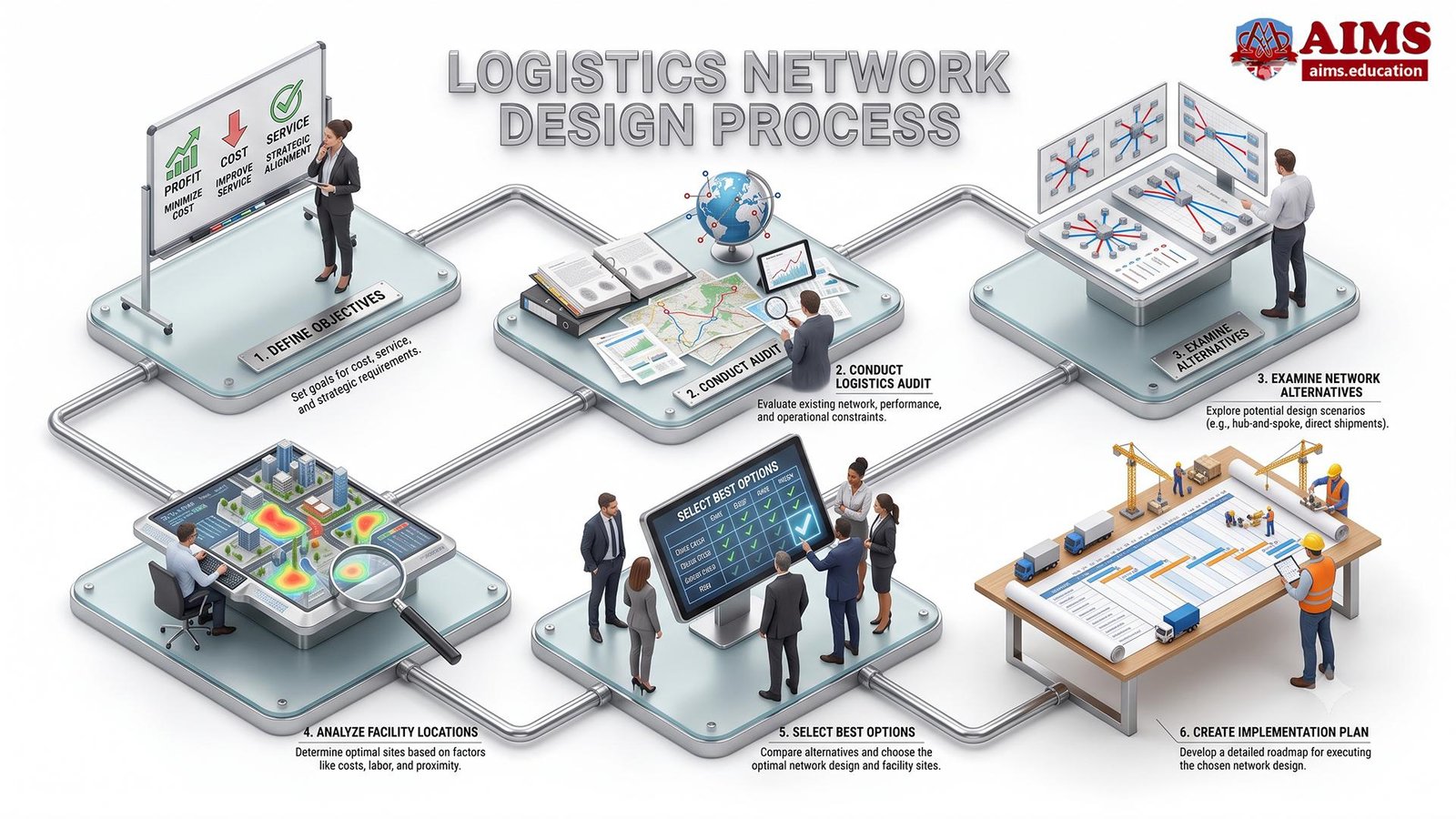
The main stages of the logistics network design process are:
- Define logistics network design objectives.
- Conduct a logistics audit.
- Examine logistics network alternatives.
- Analyze facility locations.
- Select the best network and site options.
- Create the implementation plan.
Step 1: Define the Logistics Network Design Objectives
The first step is to define what the redesigned logistics network must achieve. A network design team should understand corporate strategy, customer service requirements, expected growth, cost targets, technology constraints, and the level of change senior management is willing to support.
This stage normally includes the following actions:
- The organization forms a cross-functional logistics network transformation team.
- The team clarifies whether the goal is lower cost, faster service, market expansion, risk reduction, or better flexibility.
- The team identifies available resources, including budget, people, systems, data, and time.
- The team decides whether owned facilities, leased facilities, public warehouses, or third-party logistics providers should be considered.
For professionals developing this capability, structured study through a diploma in logistics and supply chain management can help connect network design decisions with wider supply chain strategy, planning, and operational control.
Step 2: Conduct a Logistics Audit
A logistics audit is a systematic review of the existing logistics system before redesign decisions are made. It gives the team a realistic picture of current performance, costs, constraints, service gaps, and improvement opportunities.
A strong logistics audit should collect and examine:
- Customer service requirements and key environmental factors.
- Current logistics goals, cost targets, and service-level commitments.
- Existing facilities, transportation lanes, shipment volumes, and delivery zones.
- Major logistics activities, including order processing, warehousing, transport, inventory, and returns.
- Current performance measures, such as delivery speed, fill rate, cost per shipment, and on-time performance.
- Gaps between present performance and desired logistics performance.
- Clear measurable objectives for the redesign project.
Without this audit, the company may design a future network using weak assumptions. That is risky. A network model is only as useful as the data and operating logic behind it.
Step 3: Examine Logistics Network Alternatives
The third step is to compare practical network alternatives using cost, service, capacity, geography, and risk criteria. This is where logistics network optimization, simulation, and heuristic analysis become useful.
The team may compare several alternatives, such as:
- A centralized distribution network with one or two large facilities.
- A regional distribution network with multiple facilities closer to customers.
- A hybrid design with one national hub and several market-facing facilities.
- A cross-docking network that reduces storage and speeds product flow.
- A third-party logistics model that uses external facilities and transport capability.
- A global distribution design that serves multiple countries from strategic hubs.
At this point, the purpose of modeling is not only to produce an answer. It is also to produce insight. A model can show how sensitive the network is to demand growth, fuel cost, customer service expectations, labor cost, or facility capacity.
Step 4: Analyze Facility Locations
Facility location analysis studies the specific regions, cities, and sites where logistics facilities may be placed. This stage connects the broader network design with practical site selection.
The location selection team evaluates regional and site-specific factors, including labor climate, transportation access, proximity to markets, taxes, incentives, utilities, land cost, and supplier networks. For transportation corridors in the United States, planners may also use official freight-flow data from the Federal Highway Administration Freight Analysis Framework to understand movement patterns by mode, region, and commodity.
Facility location analysis should not end with the lowest rent or cheapest land. A remote facility may look inexpensive, but it can create higher labor difficulty, weaker carrier access, longer delivery times, and greater inventory buffers.
Step 5: Select the Best Network and Site Options
The fifth step is to select the network and facility locations that best match the original design criteria. The decision should be based on both quantitative and qualitative evidence.
The decision team should ask:
- Does the selected network meet customer service expectations?
- Does it reduce total logistics cost rather than one isolated cost?
- Does it support the organization’s long-term strategy?
- Does it allow future expansion, contraction, or market shifts?
- Does it reduce operational risk and improve supply chain resilience?
- Does the plan use owned, leased, public, or outsourced facilities appropriately?
This is also where professional judgment is important. A technically attractive model output may fail if labor availability is weak, road access is poor, land expansion is impossible, or customer service requirements are misunderstood.
Step 6: Create the Implementation Plan
The final step is to develop a practical implementation plan that moves the company from the current network to the desired future network. The plan should define timelines, responsibilities, costs, risks, milestones, and communication requirements.
An implementation plan normally covers:
- Facility opening, closure, expansion, or consolidation schedules.
- Inventory transfer plans and customer transition rules.
- Carrier negotiations, lane redesign, and transport capacity planning.
- Warehouse systems, data migration, and technology integration.
- People, training, staffing, and change management.
- Service-risk controls during the transition period.
Good implementation protects service while the network changes. Poor implementation can turn a good design into a painful disruption.
Major Locational Determinants in Logistics Network Design
Locational determinants are the factors that influence where logistics facilities should be placed. They can be national, regional, or site-specific, and their importance varies by industry, product type, customer promise, and supply chain strategy.
The major determinants usually include:
- Labor climate.
- Transportation services and infrastructure.
- Proximity to markets and customers.
- Quality of life.
- Taxes and industrial development incentives.
- Supplier networks.
- Land costs and utilities.
- Company preference.
Labor Climate
Labor climate refers to the availability, cost, skill level, productivity, and employment conditions of the workforce in a potential location. It is especially important for labor-intensive logistics operations such as warehouses, fulfillment centers, cross-docks, and transport terminals.
A company should evaluate:
- The availability of warehouse, transport, technical, and supervisory workers.
- Wage levels and the likelihood of wage pressure in tight labor markets.
- Skill levels, productivity expectations, absenteeism, and work ethic.
- Unionization, labor-management relations, and local employment regulations.
- The supportiveness of local public officials and workforce development agencies.
A site with cheap land may still be a poor choice if the company cannot recruit reliable staff. In network design, people are not a soft issue. They are a capacity constraint.
Transportation Services and Infrastructure in Logistics
Transportation services and infrastructure determine how efficiently goods can move into and out of a logistics facility. This determinant includes roads, ports, airports, rail links, intermodal terminals, carrier availability, and service reliability.
For transportation network design in logistics, the location team should consider:
- Highway access and distance from major road corridors.
- Availability of truckload, less-than-truckload, parcel, air, rail, ocean, and intermodal services.
- Number of capable carriers serving the area.
- Port and airport access for import, export, and time-sensitive shipments.
- Traffic congestion, tolls, road reliability, and seasonal disruption risk.
This factor is crucial because transportation cost does not move in a perfectly straight line with distance. Rate structures, delivery time windows, carrier networks, and access to hubs can make one site much stronger than another, even when both look close on a map.
Proximity to Markets and Customers
Proximity to markets means placing logistics facilities close enough to customers to meet delivery promises at an acceptable cost. This factor is central to distribution network design because customer density, order frequency, and service expectations determine how many facilities are needed.
Near-market locations may improve:
- Same-day or next-day delivery capability.
- Customer responsiveness for urgent or high-value products.
- Freight cost for dense local markets.
- Competitive positioning in service-sensitive sectors.
On the other hand, too many market-facing facilities can increase fixed cost and inventory duplication. The design must be balanced. Fast service is valuable only when customers are willing to support the cost behind it.
Quality of Life
Quality of life affects a company’s ability to attract and retain professional, technical, and managerial employees. It is not always the top determinant for basic warehousing, but it becomes important when the operation requires engineers, analysts, planners, IT specialists, or senior logistics managers.
Quality-of-life factors may include housing, schools, healthcare, safety, commuting conditions, recreation, and general living standards. These issues matter because a facility is not operated by land and buildings. It is operated by people who must be willing to live and work in that location.
Taxes and Industrial Development Incentives
Taxes and industrial development incentives influence the financial attractiveness of a logistics location. Local and regional authorities may offer tax reductions, training support, infrastructure assistance, financing arrangements, or utility incentives to attract business investment.
These incentives can be useful, but they should not dominate the decision. A weak logistics site does not become strong just because the incentive package looks generous. The better question is: will the location still make sense after incentives expire?
Supplier Networks
Supplier networks refer to the location, capability, cost, and reliability of suppliers connected to the logistics facility. For manufacturing-related logistics, proximity to suppliers may reduce inbound lead time and support just-in-time delivery. For distribution centers, supplier location affects inbound freight cost, consolidation opportunities, and replenishment speed.
A location may be attractive when it offers:
- Shorter inbound transport distance from major suppliers.
- Better access to component manufacturers, packaging suppliers, or service providers.
- Improved inbound reliability for time-sensitive production.
- Opportunities for consolidation, sequencing, or supplier-managed replenishment.
This is also where supply chain planning systems and processes become important, because inbound and outbound decisions must be coordinated rather than optimized separately.
Land Costs and Utilities
Land costs and utilities determine whether the selected site can support current operations and future expansion at a reasonable cost. This includes land price, building costs, electricity, water, sewage, industrial waste disposal, communication infrastructure, and zoning requirements.
A facility location team should not evaluate only the current footprint. It should also ask whether the site can support growth. A warehouse that cannot expand may become a constraint when sales increase, customer regions change, or product variety grows.
Company Preference
Company preference refers to strategic, managerial, cultural, or historical reasons that make a firm favor a particular region or site. Some organizations prefer locations near existing facilities. Others prefer rural areas close to metropolitan markets, locations near competitors, or regions with strong supplier clusters.
This determinant should be used carefully. Experience and strategic preference can be valuable. But preference should not replace evidence. A location should be selected because it supports the network, not simply because it feels familiar.
Current Trends in Logistics Site Selection
Current logistics site selection is shaped by faster customer expectations, global sourcing, transport cost uncertainty, digital visibility, and greater use of specialized logistics partners. These trends are changing how companies think about facilities.
Strategic Inventory Positioning
Strategic inventory positioning places different products in different facility types based on speed, profitability, demand, and service need. Fast-moving, high-margin, or urgent products may be positioned closer to markets. Slower-moving items may be held in regional or national facilities.
This approach improves the network because not every product deserves the same service structure. A spare part needed urgently by customers may justify a market-facing location. A slow-moving product may be better held centrally.
Customer-Direct Delivery
Customer-direct delivery sends products from manufacturing or upstream supply points directly to customers, bypassing some distribution facilities. This can reduce handling, storage, and intermediate movement.
Customer-direct delivery works best when order patterns, transport economics, and service expectations support direct movement. It is not suitable for every product, but it can reduce network complexity when used selectively.
Cross-Docking Facilities
Cross-docking facilities transfer products quickly from inbound vehicles to outbound vehicles with little or no storage time. They are useful when shipments must be consolidated, sorted, mixed, or redirected quickly.
A cross-dock can help reduce inventory and speed flow, especially in retail, grocery, parcel, and high-volume distribution. However, it requires accurate scheduling, reliable inbound deliveries, disciplined execution, and strong information systems.
Airport and Ocean Port Access
Airport and ocean port access matters when logistics networks depend on import, export, express delivery, or global sourcing. Companies handling international shipments must consider customs processes, port congestion, inland drayage, and the reliability of onward transport connections.
For high-value or time-sensitive products, airport proximity can support rapid response. For bulky imported goods, ocean port access can reduce inland movement and shorten replenishment cycles.
Third-Party Logistics Providers
Third-party logistics providers can change network design by supplying external warehouses, transport capability, fulfillment operations, cross-docking, and import-export support. They allow companies to access logistics capacity without owning every facility.
This option is attractive when demand is uncertain, market entry is new, facilities are expensive, or rapid flexibility is needed. However, outsourcing does not remove managerial responsibility. The company must still define service expectations, performance measures, data visibility, and cost controls.
For a deeper professional comparison, students can review how 3PL and 4PL logistics providers support outsourced distribution networks.
Logistics Network Design Models
Logistics network design models are analytical tools used to compare network alternatives, estimate cost-service trade-offs, and support facility location decisions. The main logistics network models are optimization, simulation, and heuristic models.
| MODEL TYPE | WHAT IT DOES | BEST USE | LIMITATION |
|---|---|---|---|
| Optimization | Searches for the best solution under defined assumptions, constraints, costs, and demand conditions. | Choosing facility numbers, locations, flows, customer assignments, and capacity plans. | Requires accurate data, mathematical structure, and realistic assumptions. |
| Simulation | Replicates how a logistics network behaves under different operating conditions. | Testing cost and service performance when variables change over time. | Evaluates alternatives supplied by the user but does not guarantee the best solution. |
| Heuristics | Uses practical rules or approximations to find good solutions in complex problems. | Reducing large facility location problems to manageable alternatives. | Can produce useful answers but not necessarily mathematically optimal answers. |
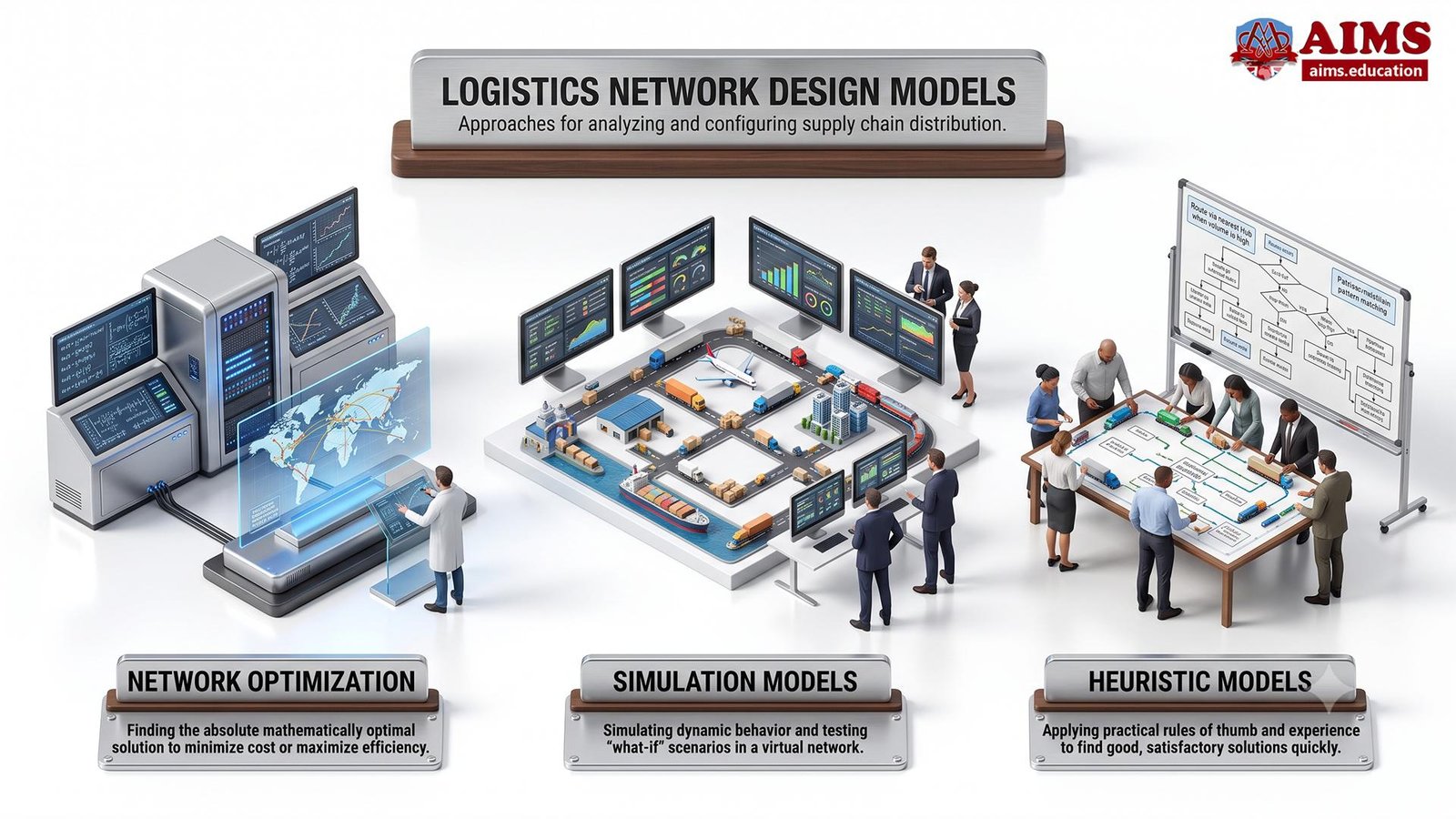
Network Optimization
Optimization models search for the best network solution within a clearly defined mathematical problem. They may minimize total cost, maximize profit, or meet a defined service target at the lowest feasible cost.
Optimization may consider:
- The number and location of suppliers, plants, production lines, and distribution centers.
- The assignment of customers to plants, warehouses, or other distribution centers.
- Facility ownership choices, such as owned, leased, or public facilities.
- Facility capacities, fixed costs, variable costs, and throughput levels.
- Transportation rates, shipment planning rules, and service requirements.
- What-if scenarios for seasonal demand, policy changes, capacity shifts, or new markets.
Optimization is powerful, but it should not be treated as magic. If the assumptions are unrealistic, the output will be misleading. The model must represent the business, not just the spreadsheet.
Simulation Models
Simulation models test how a logistics network behaves when operating conditions change. They are useful when the network includes uncertainty, time periods, variable costs, service rules, or interactions that are difficult to represent in a simple optimization model.
A simulation can evaluate:
- How different warehouse locations affect service levels and cost.
- How inventory, labor, warehousing, transport, and material handling costs interact.
- How the network responds to demand shifts, transport delays, or capacity limits.
- Whether a proposed design performs better than the current network under realistic conditions.
Simulation does not automatically find the optimum location. Instead, it evaluates the alternatives given to it. That makes it especially useful after an optimization model has produced a shortlist of possible network designs.
Heuristic Models
Heuristic models use practical decision rules to find good, workable solutions where exact optimization may be too large, expensive, or complex. They are especially useful in early screening and facility location analysis.
A heuristic might screen sites using practical rules such as:
- The warehouse must be within 20 miles of a major market.
- The site must be at least 250 miles from another company distribution center.
- The site must be within three miles of an interstate highway.
- The site must be within 40 miles of a major airport.
The grid technique is a well-known heuristic method for facility location. It estimates a practical least-cost area by considering demand points, supply points, volume, transportation cost, and geographic coordinates. It does not give the final property address. It narrows the search area so that managers can investigate real sites more carefully.
Logistics Network Design Example
An example of logistics network design is a company deciding whether to use one central warehouse or several regional distribution centers to serve customers faster and at lower total cost. The example below shows how the decision works in practice.
Example: FreshMart Appliances Redesigns Its Distribution Network
FreshMart Appliances is an imaginary home appliance distributor serving 900 retail stores across three regions. It currently operates one central warehouse in Midland City.
- FreshMart ships 18,000 units per month from the central warehouse.
- Average delivery time to distant stores is four to five days.
- Transport cost is rising because many shipments travel long distances as less-than-truckload freight.
- Retail customers are asking for two-day replenishment on fast-moving products.
The design team compares three options:
- The company keeps one central warehouse and negotiates better carrier rates.
- The company opens two regional distribution centers near its largest customer clusters.
- The company uses one central warehouse for slow-moving items and two market-facing facilities for fast-moving products.
The team finds that the third option works best:
- Fast-moving products are placed closer to major markets.
- Slow-moving items remain central to avoid excess inventory.
- Delivery time for high-demand products falls from five days to two days.
- Total inventory increases slightly, but transport cost and lost sales decline.
- The company uses a 3PL facility in one region to avoid immediate capital investment.
The practical impact is clear: FreshMart improves service speed while controlling fixed assets, inventory exposure, and transport cost.
Benefits of Logistics Network Design
The benefits of logistics network design include lower total cost, better customer service, stronger market coverage, improved flexibility, and more disciplined long-term planning. It turns logistics from a reactive operation into a strategic capability.
The main benefits are:
- Lower total logistics cost: The company can reduce unnecessary warehousing, duplicated inventory, inefficient transport lanes, and poor customer assignments.
- Better service performance: Facilities can be positioned to support customer delivery promises and response-time requirements.
- Improved inventory control: Inventory can be placed according to demand speed, product profitability, and service need.
- Greater supply chain flexibility: The network can be designed to handle demand growth, new markets, supplier shifts, or disruption.
- Stronger strategic alignment: Logistics design can support corporate goals such as expansion, cost leadership, premium service, or international growth.
- Better use of technology: Digital visibility, routing systems, warehouse systems, and analytics become more valuable when the physical network is logically designed.
Professionals who want to develop these applied skills can also explore career-focused logistics certification courses that connect facility location, transportation planning, logistics technology, and service performance.
Common Mistakes in Logistics Network Design
Common mistakes in logistics network design usually come from weak data, narrow cost thinking, unrealistic assumptions, and poor implementation planning. These mistakes can lead to a network that looks attractive in analysis but performs poorly in real life.
Mistake 1: Optimizing One Cost Instead of Total Cost
Some companies choose a location because rent is low or transport distance appears short. That is incomplete. A good network decision considers transportation, warehousing, labor, inventory, tax, technology, service, and risk together.
Mistake 2: Ignoring Future Demand and Market Shifts
A logistics facility is a long-term decision. If customer demand moves geographically, the network must remain flexible. A site that is perfect today may be weak tomorrow if the market changes.
Mistake 3: Using Poor or Incomplete Data
Bad data produces bad network decisions. Shipment history, demand forecasts, carrier rates, labor costs, customer service rules, facility costs, and product characteristics must be accurate enough to support the decision.
Mistake 4: Treating Transportation Rates Too Simply
Transportation cost is affected by distance, shipment size, rate structure, service level, carrier availability, commercial zones, port access, and handling requirements. A simple distance calculation can miss important cost realities.
Mistake 5: Forgetting Sensitivity and Robustness Analysis
A network should be tested under different scenarios. Fuel cost, demand volume, exchange rates, supplier reliability, labor cost, and customer service requirements can all change. A robust design performs acceptably under several plausible futures.
Mistake 6: Failing to Plan Implementation
Even a strong design can fail during execution. Facility transitions, inventory moves, customer reassignment, carrier changes, and system updates must be carefully sequenced. Otherwise, service may suffer during the change.
Final Words on Logistics Network Planning
Logistics network planning is a long-range strategic decision that shapes cost, service, flexibility, and competitiveness. It requires disciplined analysis, not guesswork. The best networks are designed around customer requirements, realistic transport economics, facility capability, supplier geography, technology, and future business conditions.
For students and professionals, the most important lesson is simple: logistics network design is not only about where facilities are placed. It is about how the entire logistics system behaves. When facility location, transport, inventory, service, and implementation are aligned, the network becomes a source of competitive strength.
Frequently Asked Questions
What is logistics network design?
Logistics network design is the process of deciding where logistics facilities should be located, how many facilities are needed, which markets each facility should serve, and how goods should flow between suppliers, warehouses, distribution centers, and customers.
Why is logistics network design important?
Logistics network design is important because it affects total logistics cost, delivery speed, inventory levels, warehouse investment, customer service, and long-term supply chain flexibility. A poorly designed network can increase cost even when individual operations appear efficient.
What are the steps in logistics network design?
The main steps are defining network objectives, conducting a logistics audit, examining network alternatives, analyzing facility locations, selecting the best network and site options, and creating an implementation plan for moving from the current network to the future design.
What factors affect logistics facility location?
Important facility location factors include labor climate, transportation infrastructure, proximity to customers, supplier networks, land cost, utilities, taxes, industrial incentives, quality of life, facility expansion potential, and company-specific strategic preferences.
What is the difference between logistics network design and supply chain network design?
Logistics network design focuses mainly on warehouses, distribution centers, transportation lanes, and customer service execution. Supply chain network design is broader because it also includes suppliers, plants, procurement, production flows, capacity choices, and end-to-end supply chain structure.
How does logistics network design reduce transportation costs?
Logistics network design reduces transportation costs by improving facility placement, customer assignments, shipment consolidation, carrier access, lane planning, and inventory positioning. The aim is to reduce total logistics cost, not simply to shorten distance on a map.
Why is proximity to markets important in logistics network design?
Proximity to markets is important because it can reduce delivery time, improve responsiveness, support same-day or next-day service, and strengthen customer satisfaction. However, too many market-facing facilities can raise fixed costs and inventory duplication.
What is the role of transportation infrastructure in logistics network design?
Transportation infrastructure determines how reliably and economically products can move into and out of a facility. Road access, ports, airports, rail terminals, intermodal services, carrier availability, and congestion patterns all influence facility location decisions.
What are current trends in logistics site selection?
Current trends include strategic inventory positioning, greater use of customer-direct delivery, more cross-docking, stronger attention to airport and ocean port access, use of third-party logistics providers, and more frequent redesign due to changing transport costs and customer expectations.
How do third-party logistics providers affect logistics network design?
Third-party logistics providers affect network design by giving companies access to external warehouses, transport networks, fulfillment services, cross-docking, and global logistics capabilities. They can improve flexibility, but performance expectations and cost controls must be clearly managed.
Institute of Supply Chain Management at AIMS
AIMS Education has delivered globally accessible professional education since 2005 through internationally accredited, career-focused programs. Its Institute of Supply Chain Management combines qualified faculty, industry-oriented teaching, 3D interactive learning content, and real-world case studies to develop practical supply chain competence. This educational content, along with AIMS study content and curriculum, is collaboratively developed and rigorously peer-reviewed by an academic board of qualified industry practitioners. Logistics network design strengthens professional decision-making in facility location, distribution, and service planning. Explore practical and flexible supply chain qualifications.