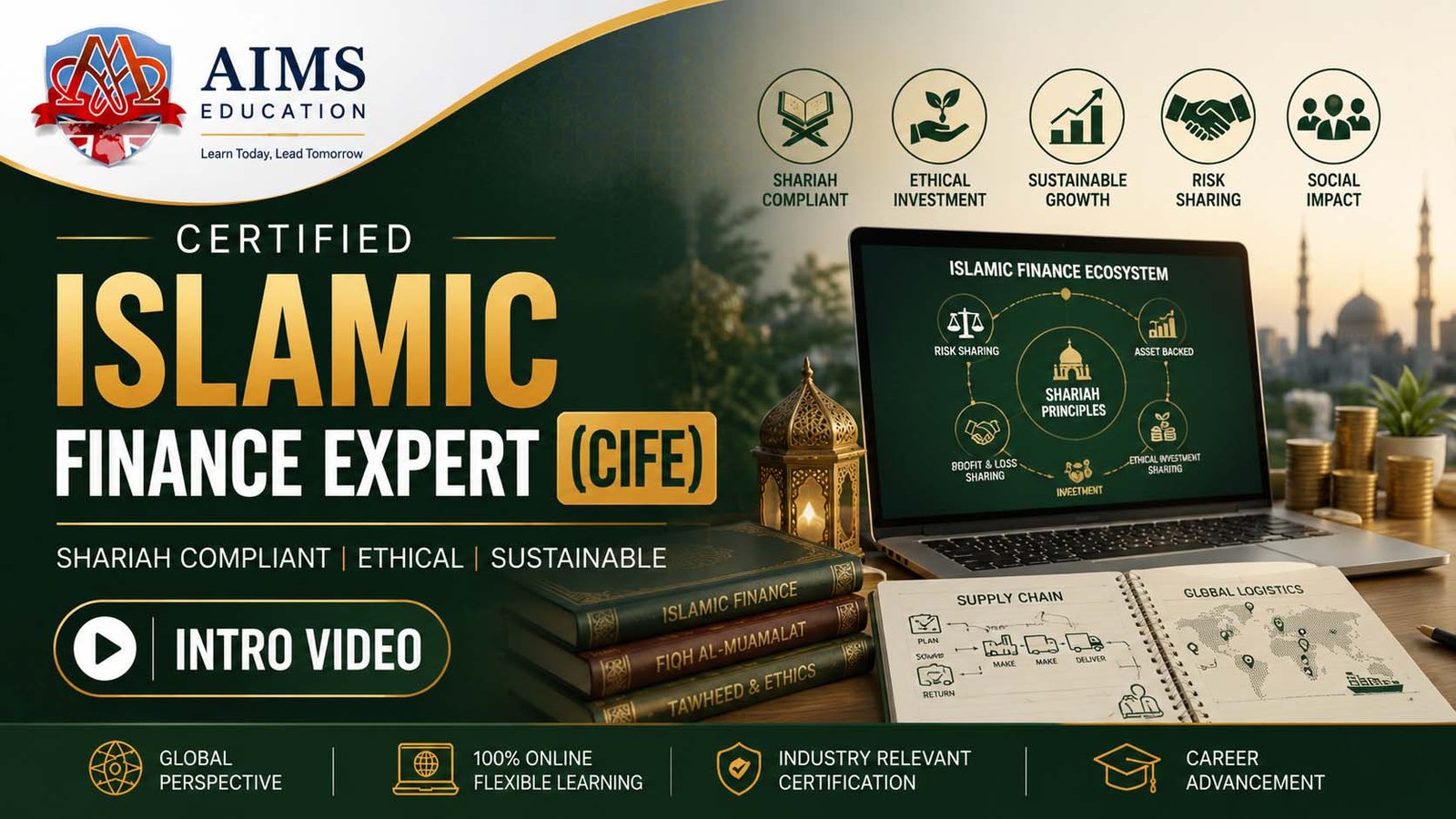
Certified Islamic Finance Expert (CIFE) is an advanced, career-focused Islamic finance certification offered by AIMS for professionals and graduates seeking structured expertise in Islamic banking and finance. Delivered through a 100% online and self-paced format, the program combines academic depth, practical relevance, and guided study across core areas of Shariah-compliant finance.

This online Islamic banking and finance certification has been offered by AIMS since 2005 and is built around five specialized courses covering Islamic economics, financial instruments, commercial banking, accounting, and Takaful. The curriculum is aligned with AAOIFI Shariah standards, while the certification itself is awarded by AIMS as an independent institutional qualification.

Islamic finance qualification

CIFE is designed for learners who want more than a basic introduction. It develops applied understanding of Islamic finance products, regulatory concepts, accounting treatment, and industry practice, while offering the flexibility needed by working professionals and international learners.
Islamic Finance Course Learning Objectives!

  • Develop a strong understanding of Shariah-compliant financial systems and their role in modern banking and finance.

  • Build specialized knowledge of Islamic financial instruments, structures, and commercial applications.

  • Study a curriculum aligned with AAOIFI standards and contemporary industry expectations.

  • Strengthen the ability to apply Islamic finance concepts in banking, investment, audit, advisory, and compliance settings.

  • Prepare for career advancement in Islamic financial institutions and related financial services roles.

  • Complete an Islamic finance expert course online at a manageable pace while continuing work and family commitments.

Level-5: Advanced Islamic Banking and Finance Certification

CIFE is a Level-5 Islamic finance certification offered by AIMS in the United Kingdom. The program carries 15 graduate-level credit hours, which may be transferred toward higher AIMS pathways such as the Diploma and MBA in Islamic Banking and Finance. It also supports academic progression by meeting the entry requirement pathway for PhD-level study in Islamic finance.

The program is presented as an internationally accredited and globally recognized Islamic finance qualification. It is supported by AIMS’ UK registration and accreditation profile, and its curriculum is structured to reflect AAOIFI Shariah standards. In practical terms, AAOIFI compliance means the course content follows recognized Islamic finance standards in the areas where they apply. It does not mean that AAOIFI awards the certification.

AIMS presents this certification with recognition points that include UKRLP registration, QAHE accreditation, UK CPD accreditation, and an AAOIFI Compliance.

Islamic Banking and Finance Courses – A Quick Review

Study mode100% online and self-paced learning.
Estimated durationMost learners complete the program in around 2 to 4 months, depending on their pace and weekly study time.
Study resourcesInteractive online lectures, five comprehensive study manuals, Islamic finance e-library access, ten online assignments, and academic guidance from Islamic finance faculty.
Number of coursesFive specialized Islamic banking and finance courses.
Weekly study requirementApproximately 10 to 12 hours a week.
Assessment and examTen assignments during study and a final online open-book MCQ examination.
Passing requirementA minimum score of 65% in the final examination.
Certification awardedCertified Islamic Finance Expert (CIFE), with Certified Islamic Banker (CIB) awarded on equivalency basis to graduates.
CIFE program summary covering study mode, duration, resources, assessment, and certification outcome.

Progression Opportunities

How to Earn the CIFE Certification Online

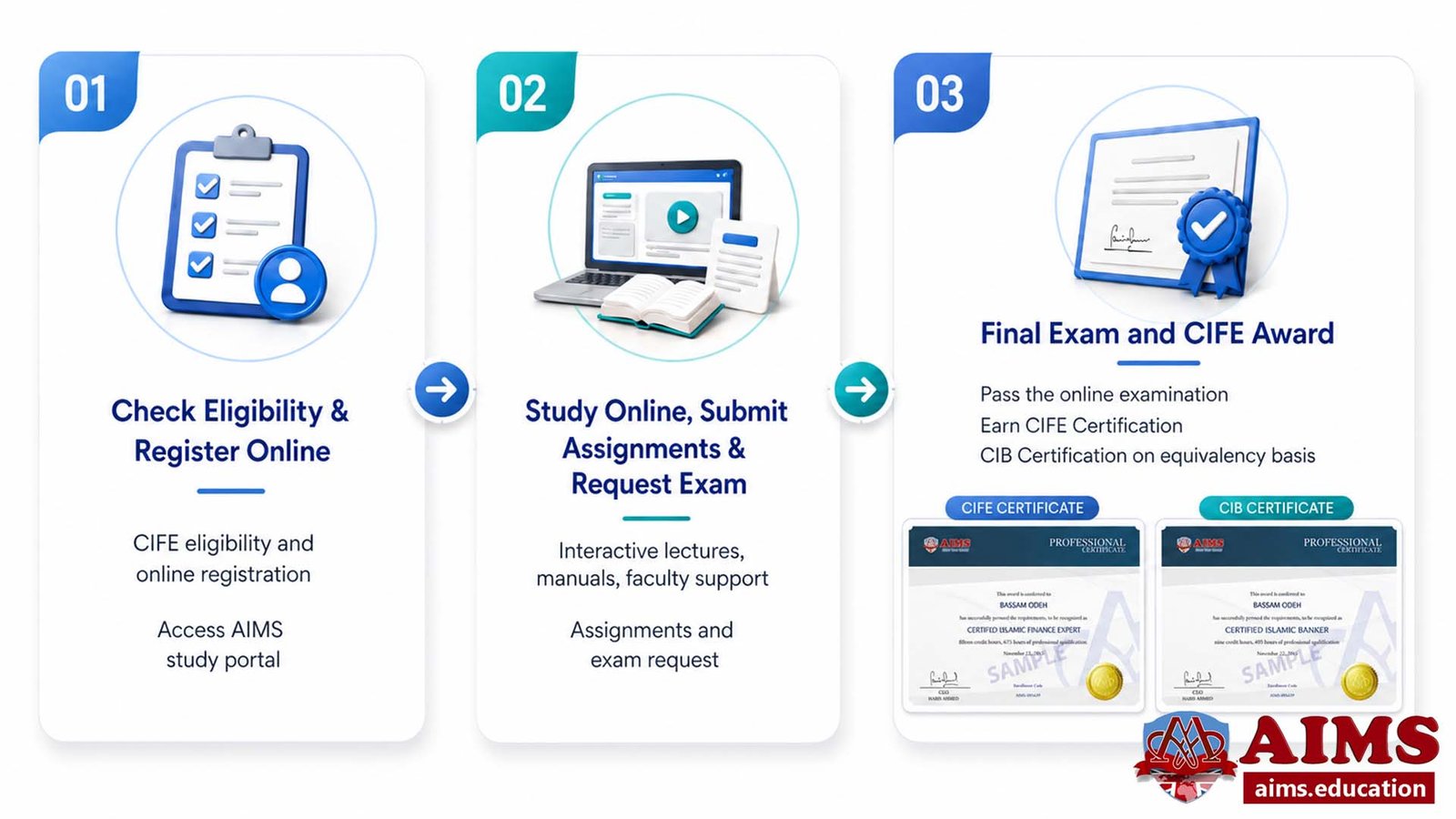
The CIFE certification process is structured in three clear stages. Learners register online, complete the required coursework and assignments through the AIMS study system, and then sit for the final examination at a convenient time.

  • Complete the online enrollment process through AIMS.
  • Receive login credentials to access the online study portal, course materials, and academic resources.
  • Begin study without needing to relocate or follow a fixed classroom schedule.
  • Study all five Islamic banking and finance courses through the self-paced online learning system.
  • Use interactive lectures, study manuals, and the Islamic finance library to build both theoretical and practical understanding.
  • Complete ten assignments in total, with two assignments for each course.
  • Access academic support during the learning process from Islamic finance faculty.
  • Request the final examination when ready.
  • Take the exam online as an open-book multiple-choice test from home or office.
  • Achieve at least 65% to earn the advanced CIFE certification.
  • Receive the Certified Islamic Banker designation on equivalency basis in addition to CIFE.
cife certification

Explore the CIFE Learning Experience

Islamic banking and finance courses

Coursework

The coursework develops advanced understanding of Islamic banking and finance through guided study, practical assignments, and carefully structured curriculum modules.

global islamic banking and finance certification

Demo Lecture

The demo lecture introduces the teaching style of the CIFE program and shows how advanced Islamic finance topics are explained through flexible online learning.

Islamic finance certification

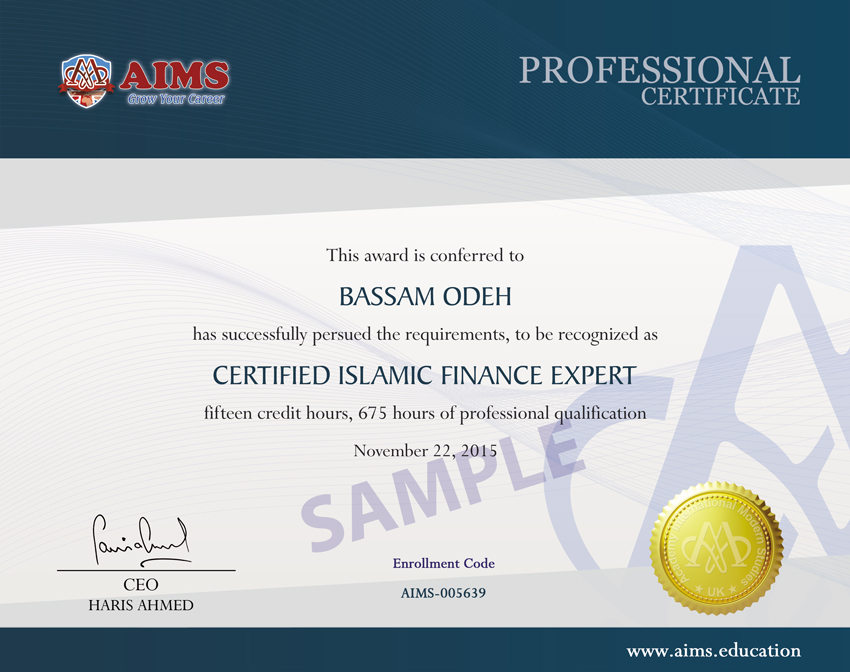
Sample Certificate

The sample certificate represents successful completion of a globally oriented Islamic finance qualification designed to support career advancement and further academic progression.

Islamic Banking and Finance Courses in the CIFE Program

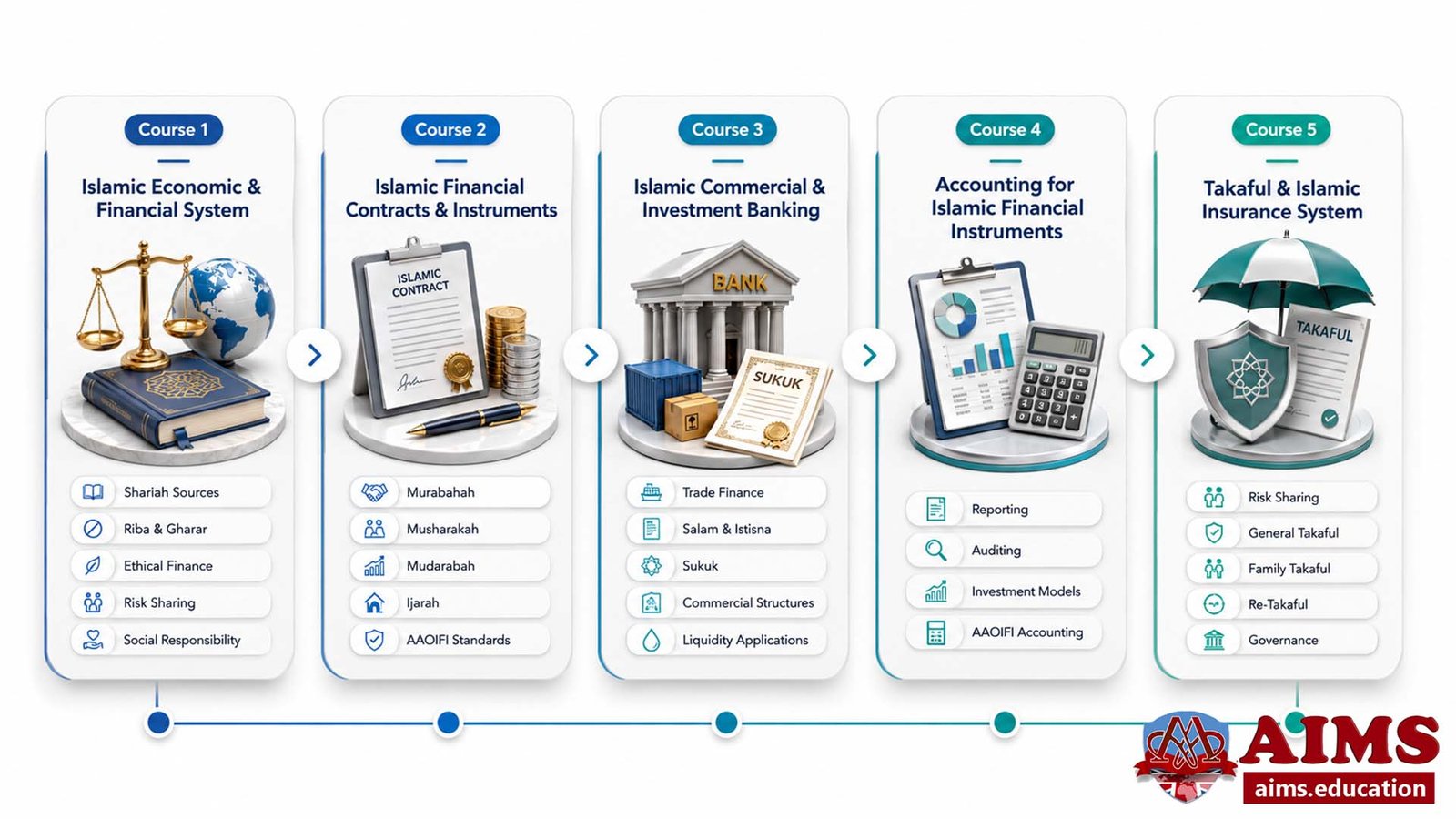
The Certified Islamic Finance Expert course includes five integrated modules. Together, they move from the foundations of Islamic economics to applied banking, accounting, and Islamic insurance.

This foundational module explains the Islamic economic framework and the principles that shape production, distribution, and financial conduct. It introduces the causes of economic imbalance, the role of ethical wealth creation, and the core prohibitions that distinguish Islamic finance from conventional practice.

  • Study the origins, principles, and structure of the Islamic economic system.
  • Examine wealth production, ownership, and distribution within a Shariah framework.
  • Understand prohibited elements such as Riba, Maysir, and Gharar.
  • Review the principles of Fiqh-ul-Muamlaat and the laws of Shirkah in business and banking.

This module focuses on the main contractual structures used in Islamic banking and finance. It explains how Islamic financial products are designed, how they differ from interest-based products, and how AAOIFI-aligned principles guide their use.

  • Study the principles and regulations of Islamic banking and finance.
  • Learn the structure and application of Murabahah, Musharakah, Mudarabah, Ijarah, Salam, Istisna, and Diminishing Musharakah.
  • Understand how Islamic instruments are used for personal, corporate, and government financing needs.
  • Review diversification approaches within Shariah-compliant finance.

This module explores how Islamic finance operates in real commercial and investment environments. It covers banking products, trade finance, project funding, and capital market instruments used by Islamic financial institutions.

  • Study Islamic financing for import, export, trade, projects, and working capital.
  • Review Sukuk structures, features, and key types.
  • Understand Shariah rules relating to shares, stock trading, and Islamic mutual funds.
  • Examine additional contracts and applications such as Tawarruq, Muzarakah, Kafalah, and Hawalah.

This accounting-focused module explains how Islamic financial institutions recognize, report, and audit financial activities within a Shariah-compliant framework. It is particularly valuable for professionals working in reporting, audit, compliance, and financial control.

  • Study accounting principles relevant to Islamic financial institutions.
  • Review reporting and auditing standards in Islamic finance.
  • Develop understanding of investment models and their accounting treatment.
  • Examine case-based applications of AAOIFI accounting standards.

The final module introduces Islamic insurance and the operational structure of Takaful. It explains how risk sharing works in a Shariah-compliant environment and how Takaful differs from conventional insurance.

  • Compare conventional insurance with Takaful principles and structures.
  • Study General Takaful, Family Takaful, and Re-Takaful concepts.
  • Understand key models, mechanisms, policy design, and governance considerations.
  • Review AAOIFI-aligned treatment for Takaful and Re-Takaful accounting.

Hear from Our Global Learners!

“The CIFE program significantly enriched my professional expertise. The curriculum was well structured, aligned with recognized standards, and made complex Islamic finance concepts easier to understand and apply.”

Ingrid Franko, Netherland

“The study materials were practical, the online lectures were clear, and the examples helped connect theory with real banking situations. It was one of the smartest professional decisions I have made.”

Hadeel Abu Loghod, Kuwait

“As a corporate banker, I was looking for an advanced Islamic finance qualification with practical value. This program helped me apply Shariah-compliant finance principles more confidently in real-world corporate scenarios.”

Muhammad Ahmed, Corporate Banker, UAE

“The flexibility, faculty support, and academic depth made AIMS’ CIFE certification a strong choice for career progression in Islamic finance.”

Sara Lim, Graduate Student, Malaysia

Key Benefits of AIMS’ Islamic Finance Qualification

  • Internationally Recognized and Professionally Relevant

    CIFE is positioned as a globally recognized advanced Islamic finance certification with institutional accreditation support and curriculum alignment to AAOIFI standards. This combination strengthens its relevance for learners who need both credibility and practical applicability.

  • Academic Support and Practical Learning Resources

    The program includes interactive lectures, detailed study manuals, online assignments, and access to academic guidance. The learning model is designed to build understanding progressively, from foundational principles to professional application.

  • Flexible, Self-Paced Online Study

    This is a fully online Islamic finance certification designed for working professionals, graduates, and international learners. The self-paced format allows learners to progress according to their availability while still working through a structured curriculum.

  • Academic Progression Beyond the Certificate

    CIFE is not a degree, but it is more than a short introductory course. With its 15 graduate-level credit hours, it can support progression toward higher AIMS qualifications in Islamic banking and finance, including diploma, MBA and PhD pathways.

  • Career Growth in Islamic Finance

    The curriculum is built for real roles across Islamic banking and financial services. It is relevant for functions involving product structuring, branch and relationship management, advisory work, compliance, Shariah review, accounting, audit, and Islamic investment operations.

    • Potential career pathways include Islamic Finance Officer, Islamic Wealth Manager, Compliance Officer, Shariah Auditor, Shariah Advisor, Branch Manager in Islamic banking, and related advisory roles.
    • Career outcomes vary by country, experience, and employer, but the qualification is designed to strengthen professional credibility and promotion readiness.
  • Who Should Attend

    • Finance professionals seeking structured expertise in Shariah-compliant finance.
    • Bankers and investment professionals expanding into Islamic financial services.
    • Graduates from finance, accounting, economics, and business backgrounds.
    • Auditors, advisors, and consultants working in financial and regulatory environments.
    • Professionals who need an advanced Islamic finance certification with flexible online delivery.

Frequently Asked Questions (FAQs)

CIFE is an advanced professional certification in Islamic banking and finance offered by AIMS. It is delivered online, built around five specialized courses, and structured for learners who want applied expertise in Shariah-compliant finance.

Within the AIMS pathway, CIFE is the broader and more advanced Islamic finance certification. It includes five specialized Islamic banking and finance courses, while graduates are also awarded the Certified Islamic Banker (CIB), an entry-level Islamic banking certificate on equivalency basis. This makes CIFE the stronger option for learners seeking wider academic and professional coverage.

AIMS presents CIFE as an internationally recognized Islamic finance qualification supported by its accreditation and institutional recognition profile. The curriculum’s AAOIFI alignment also adds relevance for employers and professionals who value standards-based Islamic finance education.

AAOIFI compliance means that the curriculum is aligned with relevant AAOIFI Shariah standards in the areas covered by the program. The certification is awarded by AIMS, not by AAOIFI.

The program is delivered through a self-paced online study system. Learners receive access to lectures, manuals, assignments, and academic support, and can study according to their own schedule from anywhere in the world.

The program is flexible. Many learners complete it in around 2 to 4 months, depending on their pace and weekly study hours. A typical weekly study commitment is around 10 to 12 hours.

Enroll online, complete the five courses, submit the required assignments, and then take the final online open-book MCQ examination. A minimum score of 65% is required to earn the CIFE certification.

CIFE is suitable for finance professionals, bankers, investment practitioners, consultants, auditors, and graduates who want structured knowledge of Islamic banking and finance. It is especially useful for learners seeking both flexibility and applied professional relevance.

Yes. The program carries 15 graduate-level credit hours, which may be transferred toward AIMS’ diploma and MBApathways in Islamic banking and finance. The qualification also supports progression toward PhD entry requirements in Islamic finance.

Yes. A 35% scholarship is currently available for this Islamic finance qualification, subject to current admissions policy and availability.

The curriculum covers Islamic economics, Islamic financial instruments, Islamic investment and commercial banking, accounting for Islamic financial instruments, and Takaful. Key topics include Murabahah, Musharakah, Mudarabah, Ijarah, Salam, Istisna, Sukuk, Islamic mutual funds, and AAOIFI-related accounting and Shariah standards.

Start Your Islamic Finance Certification

AIMS’ CIFE program offers a structured route into advanced Islamic banking and finance study through flexible online learning, standards-based curriculum, and clear academic progression. For learners seeking a recognized and professionally relevant Islamic finance qualification, register online to take a strong next step.