Certified Project Manager (CPM) certification is an internationally accredited online project management program that combines career-focused training, practical project management learning, PMP training, PMBOK 8th Edition training, and guided exam preparation for professionals who want stronger project delivery skills and recognized progression opportunities. It also provides the 35 contact hours of formal project management education required for PMP exam eligibility.

AIMS’ Certified Project Manager (CPM) Certification: An Overview

AIMS presents the program as registered with UKRLP in the United Kingdom, accredited globally by QAHE, and accredited in the UK by CPD. The Certified Project Manager program is a structured online professional qualification that develops practical project management capability through guided study, assignments, and examination. It is designed for professionals who want recognized project management training, stronger workplace performance, and a clear route into more advanced project management study.

CPM Certification Learning Objectives

The learning objectives of the CPM program focus on building job-ready project management knowledge, practical decision-making ability, and confidence in structured project delivery. Students develop the skills needed to initiate, plan, execute, monitor, control, and close projects using methods that support real workplace performance.

  • Students develop essential project management knowledge that supports stronger performance in project teams and operational environments.

  • Students learn how to evaluate project requirements, structure work, and manage delivery with greater clarity and professional discipline.

  • Students build practical understanding through case-based learning, applied examples, and scenario-driven explanations across key project topics.

  • Students gain guided PMP training and PMP exam preparation support alongside broader project management learning.

  • Students improve their readiness for higher responsibilities in project coordination, supervision, planning, and management roles.

  • Students strengthen their ability to coordinate scope, schedule, cost, risk, resources, governance, and stakeholder communication in an integrated way.

Level 4 Certified Project Manager Qualification and Recognition

The CPM program is positioned as a Level 4 project management qualification that combines professional recognition, structured curriculum, and academic progression value. It is designed to function as a serious project management credential, not merely a short introductory course, and it supports both career advancement and further study. AIMS’ recognitions support the program’s positioning for global learners seeking a credible and professionally relevant qualification.

  • AIMS presents the program as registered in the United Kingdom with UKRLP, internationally accredited by QAHE, accredited in the UK by CPD, and designed in compliance with project management standards associated with PMI and the PMBOK framework.

  • The CPM program also grants nine graduate credit hours, which strengthens its academic value. This makes the certification useful for students who want a professional award now and a pathway toward higher-level project management qualifications later.

  • Level 4 reflects a structured professional learning stage with formal study, assessment, and measurable outcomes. It indicates that the program is designed to develop practical competence in project management rather than provide only general awareness of project terminology.

CPM Certification Quick Review

Program ElementDetails
Mode of studyFlexible and convenient online learning.
Number of coursesThree structured project management courses.
Estimated durationUsually 2 to 3 months, depending on the learner’s pace.
Weekly study requirementApproximately 9 to 11 hours a week.
Study resourcesInteractive lectures, comprehensive e-manuals, faculty support, e-library access, and six online assignments.
AssessmentOnline assignments followed by a final online examination.
Additional benefitIntegrated PMP training, PMP exam preparation, mock exams, PMBOK 8th Edition training, and the 35 contact hours of formal project management education required for PMP exam eligibility.
Award achievedCertified Project Manager (CPM).
Progression valueNine graduate credit hours transferable within AIMS’ higher project management pathways.
Certified Project Manager program structure and learner expectations.

Who Should Apply for the Certified Project Manager (CPM) Certification?

The CPM program is suitable for aspiring project managers, early-career professionals, supervisors, engineers, coordinators, and experienced staff who want formal project management training. It is especially useful for learners seeking practical online study, recognized certification, and a stronger foundation for project leadership and future progression.

  • Ideal for Professionals Seeking Structured Project Management Growth

    This certification suits professionals who already contribute to projects but want a more structured understanding of project planning, governance, delivery, and control. It also supports career changers and ambitious learners who want to enter project roles with clearer professional credibility.

  • Suitable for PMP Training, 35 Contact Hours, and Career Progression

    • It is suitable for professionals working in engineering, construction, information technology, finance, logistics, healthcare, consulting, contracting, manufacturing, and public services.
    • It is appropriate for learners who want a Certified Project Manager course that combines flexible online study with practical project management teaching.
    • It is useful for professionals who want to strengthen workplace capability before moving into senior project responsibilities.
    • It is valuable for learners who want a structured route into PMP training, the 35 contact hours of formal project management education required for
      PMBOK 8th Edition PMP exam eligibility, and broader project management development.
    • It is also relevant for learners seeking a program that supports professional growth through practical training, guided exam preparation, and PDU-related learning benefits.
    • It is a strong option for students who want their certification to contribute toward diploma, MBA, and other advanced project management pathways.

AIMS’ CPM program gives students more than stand-alone PMP or PMBOK training. It combines the Certified Project Manager credential, PMP exam preparation, PMBOK 8th Edition training, 35 contact hours, practical assignments, faculty support, and progression value within one structured online program.

FeatureAIMS Certified Project Manager (CPM)Stand-Alone PMP or PMBOK Training
Main outcomeStudents earn the Certified Project Manager credential from AIMS after completing coursework, assignments, and examination.Usually focuses on exam preparation or PMBOK content review without a broader professional qualification pathway.
PMP preparationIncludes PMP training, PMP exam preparation, mock exams, and the 35 contact hours of formal project management education required for PMP exam eligibility.May provide PMP preparation, but the depth, support, assessment, and progression value depend on the provider.
Curriculum scopeCovers project fundamentals, performance domains, tools, techniques, AI applications, procurement, PMO concepts, and PMBOK 8th Edition training.Often concentrates mainly on exam topics or PMBOK content review.
Practical learningUses interactive lectures, comprehensive study manuals, assignments, case-based explanation, and practical project examples.Practical application may be limited if the course is designed mainly as a revision or exam-prep program.
Academic supportIncludes faculty support, e-library access, structured study resources, and guided learning.Support usually varies and may be limited to course access or practice questions.
Progression valueAwards nine graduate credit hours that may support progression to higher AIMS project management qualifications.Usually does not include graduate credit hours or academic progression pathways.
Comparison of AIMS’ Certified Project Manager CPM program with stand-alone PMP or PMBOK training.

How to Earn the Certified Project Manager CPM Certification

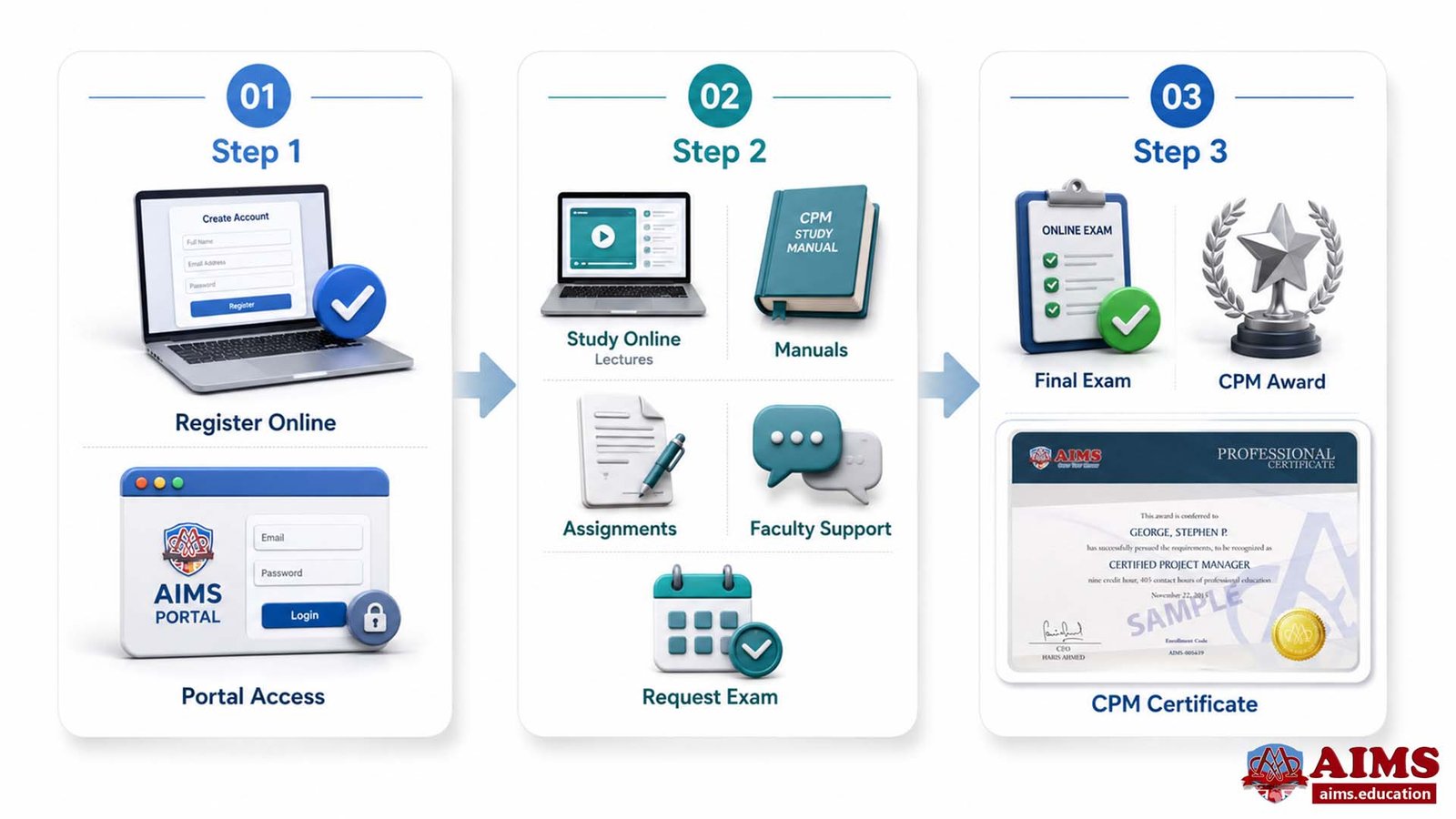
Becoming a Certified Project Manager through AIMS involves three clear stages: online enrollment, guided completion of the three-course study pathway, and successful completion of the final examination. The process is designed for convenience, flexibility, and academic structure, so students can progress without interrupting professional commitments.

Students begin by submitting the online enrollment form for the Certified Project Manager program. After admissions review and confirmation, access is provided to the study portal so learners can begin their coursework, review learning materials, and organize a study schedule that suits their circumstances.

  • Study three project management courses through a self-paced learning system.
  • Access interactive lectures designed by industry experts, featuring real-life case studies and practical examples.
  • Use comprehensive study manuals developed for each Certified Project Manager (CPM) course.
  • Explore the Project Management Library, including books, articles, journals, and case studies.
  • Get continuous academic support from our project management expert faculty.
  • Complete six online assignments (two for each course) at your own convenience.
  • Receive four mock exams for PMP training to support your PMP exam prep.

After assignments are completed, students request the final online examination on a date and time that suits them. The assessment is conducted online, and students who successfully meet the required passing standard are awarded the Certified Project Manager credential.

CPM certification steps for online study and award

Explore the CPM Learning Experience

The Certified Project Manager (CPM) program combines structured coursework, practical online learning, and recognized certification to help professionals build job-ready project management capability.

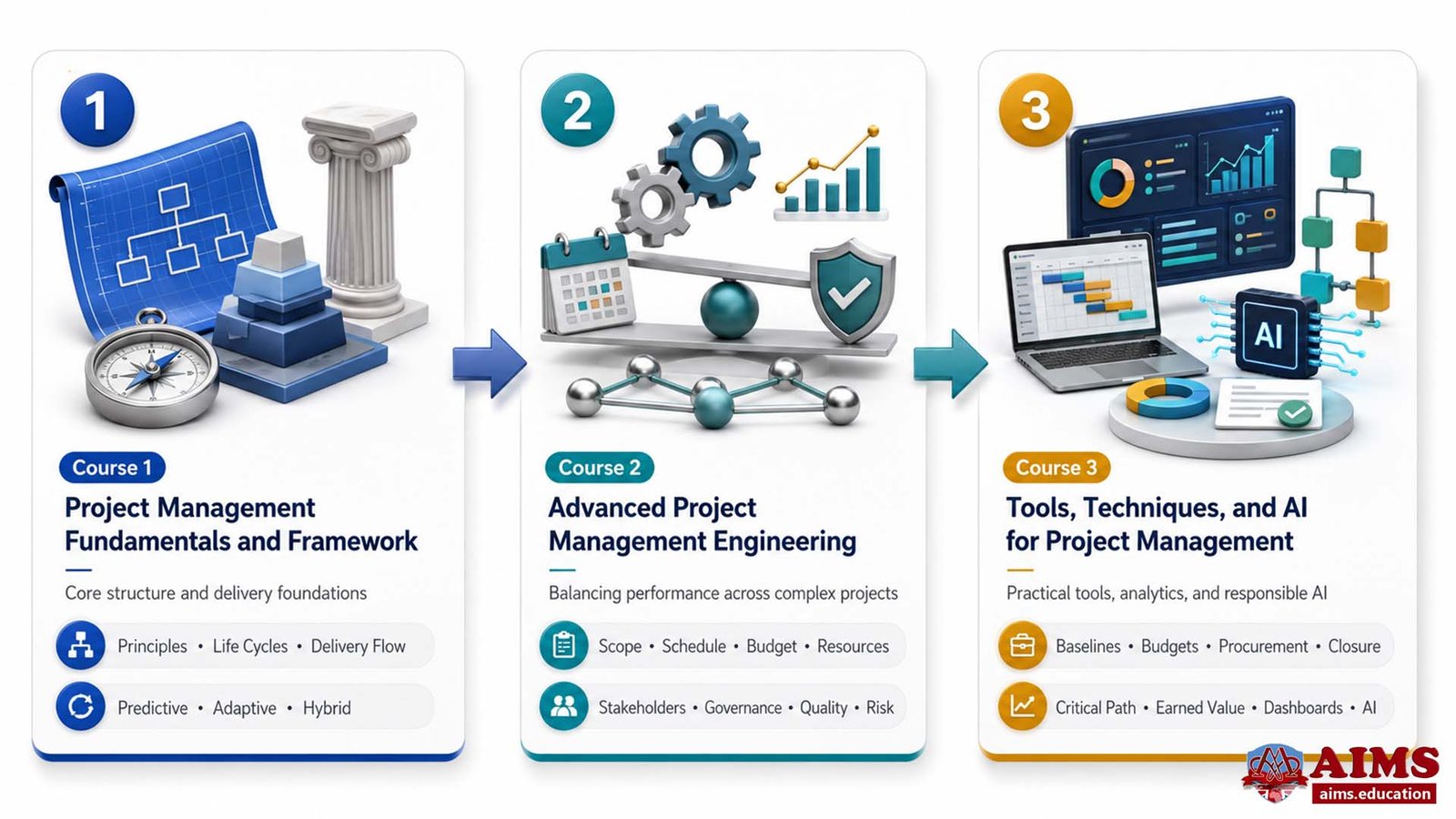
Certified Project Manager course curriculum with PMP Training and exam prep

Certified Project Manager Course Review

The coursework is structured to help learners progress from project management fundamentals to practical tools, techniques, performance domains, and applied project delivery through guided study and assignments.

certified project manager (cpm)

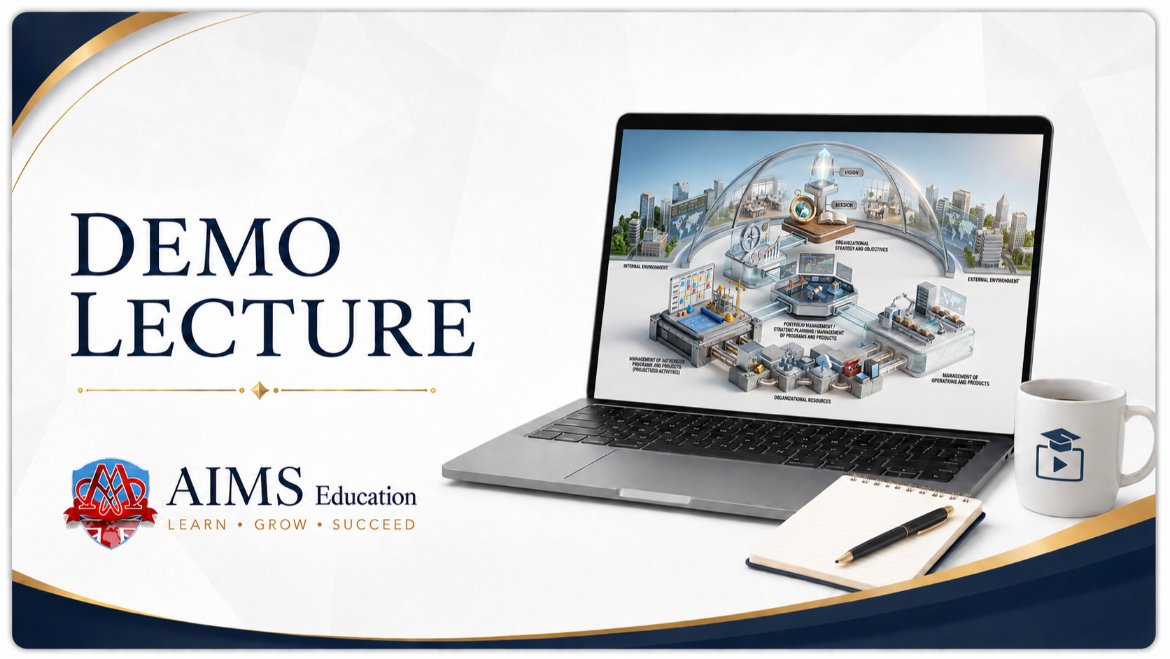
Demo Lecture

A demo lecture allows prospective learners to review the teaching approach and understand how the online Certified Project Manager course is delivered through practical, structured instruction.

Certified Project Manager CPM certification sample certificate

Certified Project Manager (CPM) Certification Sample

The awarded certificate reflects successful completion of a recognized Certified Project Manager (CPM) certification designed to support professional credibility, career growth, and academic progression.

Certified Project Manager Course Curriculum

The Certified Project Manager course curriculum contains three integrated courses covering fundamentals, performance domains, project controls, AI-enabled techniques, procurement, PMO practices, and PMP exam preparation. Each topic is taught through interactive lectures, comprehensive study manuals, practical examples, and case-based activities that connect theory with workplace project decisions.

This course introduces the foundations of professional project management. Learners study how projects create value, how project roles are structured, and how project life cycles support different delivery approaches. It builds the conceptual base needed before moving into advanced tools and performance domains.

  • Project management structural overview and the role of projects in organizational strategy.
  • Value creation, project stewardship, professional responsibility, and governance awareness.
  • Core project management principles used to guide planning, leadership, communication, and delivery.
  • Project life cycles, delivery flow, and the differences between predictive, adaptive, and hybrid approaches.
  • Practical examples showing how project objectives, constraints, and stakeholder needs are translated into project plans.

This course develops deeper understanding of the performance domains that influence project success. Learners study governance, scope, schedule, finance, stakeholders, resources, and risk in a connected way, so they can understand how decisions in one project area affect the wider project system.

  • Performance domain system and its role in integrated project delivery.
  • Governance performance domain, including oversight, decision rights, reporting, and accountability.
  • Scope performance domain, including requirements, deliverables, change control, and acceptance criteria.
  • Schedule and finance performance domains, including time planning, budget control, forecasting, and project baselines.
  • Stakeholder, resource, and risk performance domains, including engagement, team capability, uncertainty, and response planning.

This course focuses on practical project management tools used to plan, analyze, control, and improve project performance. Learners explore project documents, baselines, dashboards, estimation methods, procurement practices, PMO functions, and responsible AI use in modern project environments.

  • Tailoring project management approaches to fit project size, complexity, uncertainty, and delivery method.
  • Project inputs and outputs, including project documents, baselines, requirements, schedules, cost plans, resource plans, risk information, procurement records, and closure documentation.
  • Tools and techniques such as critical path method, earned value analysis, responsibility assignment matrix, probability and impact matrix, decision tree analysis, backlog refinement, agile release planning, burndown charts, dashboards, and retrospectives.
  • Project Management Office practices, including governance support, standards, reporting, knowledge management, and project performance oversight.
  • Artificial intelligence in the project context, including practical use cases, productivity opportunities, responsible use, data quality, and ethical concerns.
  • Procurement in project management, including sourcing decisions, make-or-buy analysis, supplier coordination, and contract-related project risks.

Why Many Learners Choose CPM Over Other Project Management Pathways

The right project management pathway depends on career stage, experience, and learning goals. AIMS’ CPM pathway is especially suitable for learners who want structured project management training, practical online study, integrated PMP preparation, and academic progression value, while PMP, CAPM, and PRINCE2 each serve narrower or more specific certification purposes.

  • PMBOK 8th Edition PMP Training, and Exam Preparation

    The CPM program includes integrated PMP training, PMBOK 8th Edition training, the 35 contact hours of formal project management education required for PMP exam eligibility, and guided exam preparation within a broader project management qualification. This gives students a stronger learning experience than isolated exam study because they build practical project capability while also strengthening readiness for professional certification goals.

  • CPM vs PMP Certification: Key Difference for Students

    This dual orientation is important for learners who want practical project competence, not only exam familiarity. Students first study project foundations, performance domains, tools, and delivery logic, and then reinforce that knowledge through assignments, mock examinations, and guided revision. That approach helps students connect project theory with the realities of workplace delivery.

PathwayBest ForMain FocusTypical Entry PositionWhy a Learner May Choose CPM Instead
AIMS Certified Project Manager (CPM)Learners who want practical project management training, flexible online study, and a pathway that also supports PMP exam preparation.Project management fundamentals, performance domains, project management tools and techniques, PMBOK 8th Edition training, and guided exam preparation.Suitable for aspiring and developing project professionals seeking structured learning and broader progression value.It combines a recognized CPM credential, practical case-based learning, faculty support, and graduate credit hours that can support higher AIMS qualifications.
PMPExperienced professionals who already meet PMI eligibility requirements and want a globally recognized advanced credential.Validation of project leadership capability across predictive, agile, and hybrid environments.Best suited to professionals who already have qualifying project leadership experience and formal project management education.CPM is often a stronger first step for learners who want guided learning, practical coursework, and a broader training pathway before relying on an advanced exam route alone.
CAPMBeginners and early-career learners who want an entry-level PMI certification.Foundational project management knowledge and entry into the PMI certification path.Suitable for learners with a secondary degree and the required project management education.CPM offers broader professional learning, practical assignments, PMP preparation support, and academic transfer value beyond an entry-level exam pathway.
PRINCE2Professionals who want a structured project management method with defined principles, roles, and process control.Method-based project management guidance focused on controlled delivery, governance, and tailoring.Often chosen by learners or organizations that specifically prefer the PRINCE2 method framework.CPM is a better fit for learners who want broader career-oriented project management training rather than a method-specific certification only.
Comparison of AIMS CPM with PMP, CAPM, and PRINCE2 project management pathways.

Hear From Our Global Learners

“I joined AIMS while working full time, and the flexibility suited my schedule very well. The online lectures explained project management clearly, and the practical teaching style made it easier to apply what I learned to real work.”

Eva Meier, Engineering Consultant, Canada

“After years in construction, I wanted a project management program that was practical and structured. The CPM curriculum helped me manage projects more strategically, and the integrated PMP preparation added real value to my development.”

Yousuf Kamal, Site Manager, Saudi Arabia

“The training was practical, job oriented, and directly useful for complex project work. It strengthened my professional profile and supported my move into a stronger project management position.”

Sarah J., Project Manager, USA

“The course materials were clear, relevant, and full of practical examples. The PMP training, mock exams, and structured study support made preparation easier and more manageable.”

Noah Salman, Engineer, France

Key Features and Benefits of the CPM Program

The CPM program combines job-oriented learning, flexible online delivery, recognized accreditation, practical teaching, and academic progression in one project management pathway. This mix makes it especially valuable for professionals who want real workplace capability, stronger career credibility, and a structured route toward further qualifications.

  • Job-Oriented Certification for Career Advancement

    The program is designed to build the knowledge and capability employers expect in project-related roles. Students learn how to plan, organize, monitor, control, and communicate project work in ways that support real organizational performance rather than purely theoretical discussion.

  • Flexible 100% Online Learning System

    The study system allows learners to progress from any location while balancing employment and personal commitments. Because lectures, manuals, assignments, and examinations are managed online, students can study with convenience while still following a clear academic structure.

  • Integrated PMBOK 8th Edition Training

    The curriculum also supports modern project management learning by engaging with current PMBOK thinking and a wide range of practical tools. Students are exposed to planning methods, stakeholder analysis, dashboards, risk techniques, Agile-related concepts, and responsible AI use in project environments.

  • Practical, Case-Based Learning

    Topics are taught through practical examples, applied explanation, and case-based learning that help students understand how project concepts work in real settings. This approach supports job-ready understanding and makes the curriculum more useful for professionals who need direct application.

  • Career Value of Certified Project Manager (CPM) Certification

    Certified Project Manager (CPM) certification supports career growth by combining practical project management skills, PMP training, PMBOK 8th Edition learning, and exam preparation in one pathway. It helps professionals strengthen job-ready capability, improve career credibility, and prepare for higher project management responsibilities across industries.

Apply for the Certified Project Manager (CPM) Certification

The next step is straightforward: review the current eligibility and fee information, complete the online enrollment process, and begin structured project management study through AIMS’ flexible online system. For professionals seeking practical skills, recognized certification, and progression opportunities, CPM offers a credible starting point.

AIMS’ Certified Project Manager program is built for learners who want professional growth grounded in real capability. It develops project management understanding through practical examples, case-based teaching, structured coursework, and guided academic support.

Students who want a recognized Certified Project Manager online pathway with integrated PMP training, PMBOK 8th Edition training, and career-focused learning can use this program as a strong foundation for immediate development and long-term advancement.

    Frequently Asked Questions

    The most important questions about CPM usually relate to recognition, curriculum, PMP preparation, online study format, and academic progression. The answers below are written in a concise, direct way so prospective students can quickly understand what the program offers and how it supports project management development.

    The Certified Project Manager certification is an online professional project management qualification offered by AIMS. It combines structured coursework, applied learning, assignments, examination, PMP training, and academic progression value within one career-focused program.

    CPM is not the same credential as PMP. CPM is AIMS’ professional certification program, while PMP is a separate credential associated with PMI. The CPM program includes PMP training and PMP exam preparation to support students who want stronger readiness for PMP-related goals.

    The program includes three project management courses, interactive lectures, study manuals, e-library access, faculty support, six assignments, mock exams, PMBOK 8th Edition training, and a final online examination. It also awards the Certified Project Manager credential upon successful completion.

    AIMS’ CPM pathway is especially valuable for learners who are still building structured project capability and want more than a certification exam target. The program combines practical project management education, applied assignments, interactive online learning, PMP training, and guided academic support in one integrated pathway.

    Yes. The CPM program provides the 35 contact hours of formal project management education required for PMP exam eligibility. Applicants must still meet PMI’s separate experience and other eligibility requirements. PMI also allows active CAPM certification as an alternative to the 35-hour education requirement.

    The program is suitable for aspiring project managers, coordinators, supervisors, engineers, and professionals across many sectors who want structured project management training, flexible online study, and a credential that supports both career growth and future academic progression.

    Most learners complete the CPM program in approximately 2 to 3 months, although actual duration depends on individual pace, schedule, and weekly study commitment.

    Level 4 indicates that the program is a structured professional qualification with formal curriculum, assessment, and progression value. It reflects organized project management learning rather than a casual short course.

    Yes. The program includes PMBOK 8th Edition training as part of its broader project management and PMP preparation structure, so students can study current project management thinking alongside practical tools and methods.

    The advantage is that students do not study PMBOK content in isolation. They learn it within a fuller project management pathway that includes assignments, faculty support, practical examples, a recognized CPM credential, and academic progression opportunities.

    AIMS presents the program as internationally accredited by QAHE, accredited in the UK by CPD, and registered with UKRLP. These recognitions support the program’s professional credibility and global positioning for learners.

    AIMS offers scholarship support on eligible programs, and applicants should review the current fee, scholarship, and admissions information provided by AIMS at the time of enrollment for the latest details.