
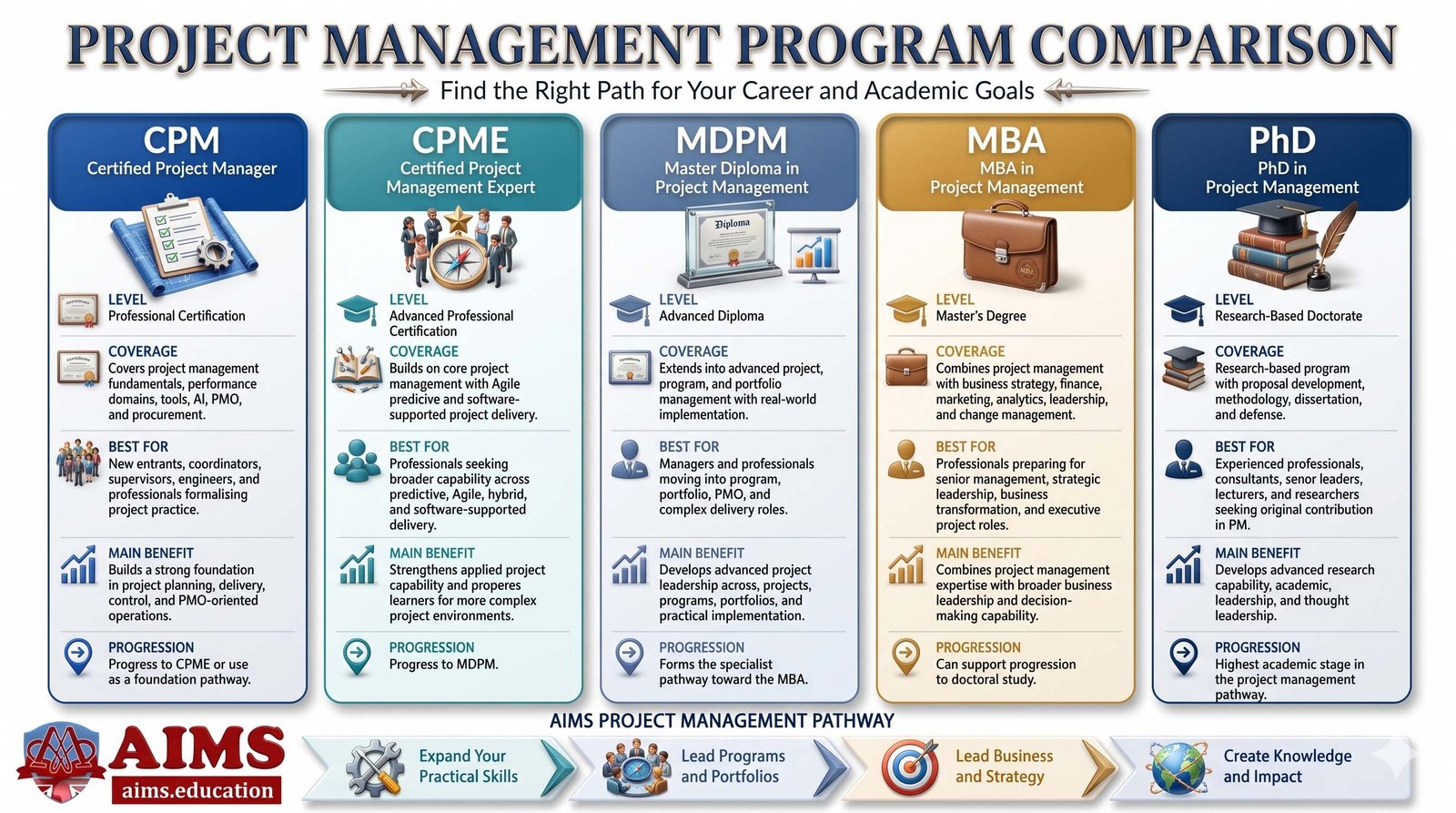
Choosing the right project management qualification depends on your current experience, academic goals, career direction, and professional responsibilities. This project management program comparison helps learners compare AIMS’ CPM, CPME, MDPM, MBA in Project Management, and PhD in Project Management so they can select the qualification that best matches their background and objectives.
AIMS offers project management qualifications for different professional and academic goals.
- Certified Project Manager (CPM): Professional certification that develops core project management capability and includes PMP® training and exam preparation.
- CPME: Advanced certification that extends learning into Agile and software-supported project delivery and includes PMP® and PMI-ACP® trainings and exam preparation.
- Master Diploma in Project Management (MDPM): Postgraduate diploma that develops advanced capability across projects, programs, and portfolios, and inlcudes PMP®, PMI-ACP®, PgMP® and PfMP® trainings and exam preparation
- MBA: Masters degree that combines advanced project management, program management and project portfolio management with PMI trainings and business leadership.
- PhD: Doctorate degree that focuses on independent doctoral research and original contribution.
The tables below compare project management programs by qualification type, curriculum coverage, PMI training and preparation, suitability, professional benefit, and optional further study. They are designed to help learners identify which project management qualification best matches their current career stage and long-term goals.
Project Management Program Comparison Table
Use this project management program comparison table to review the main differences between AIMS’ professional certifications, Master Diploma, MBA, and PhD programs, including their curriculum scope and relevant PMI certification preparation.
| Program | Qualification Type | Curriculum Coverage | PMI Training / Preparation | Best Suited For | Main Benefit | Further Study Options |
|---|---|---|---|---|---|---|
| Certified Project Manager (CPM) | Professional certification | Courses 1–3 covering project management fundamentals, performance domains, tools, techniques, AI, PMO, and procurement. | PMP® training and exam preparation, including 35 contact hours of formal project management education. PMI experience requirements apply separately. | New entrants, coordinators, supervisors, engineers, and working professionals seeking structured project management knowledge. | Develops core capability in project planning, delivery, monitoring, control, and PMP® exam preparation. | A standalone professional qualification. Learners may continue to CPME or other eligible AIMS project management study. |
| Certified Project Management Expert (CPME) | Advanced professional certification | Courses 1–5 covering CPM content together with Agile project management and project management software training. | Includes the PMP®-oriented preparation covered within CPM, together with additional Agile project management training relevant to PMI-oriented professional development. | Working professionals who need broader capability across predictive, Agile, hybrid, and software-supported project delivery. | Strengthens applied project management capability for more complex, Agile, hybrid, and technology-supported project environments. | A standalone advanced certification. Eligible learners may continue to MDPM. |
| Master Diploma in Project Management (MDPM) | Master Diploma | Courses 1–8 covering project management, Agile, project management software, program management, portfolio management, and practical implementation. | Includes training and preparation connected to PMP®, PMI-ACP®, PgMP®, and PfMP® within the relevant project, Agile, program, and portfolio management areas. | Managers and professionals developing capability for program, portfolio, PMO, and complex project delivery responsibilities. | Develops advanced capability across projects, programs, portfolios, PMO functions, and practical project implementation. | A standalone advanced qualification. Eligible learners may continue to the MBA in Project Management, with applicable completed study considered under AIMS requirements. |
| MBA in Project Management | Master’s degree | Advanced project, program, and portfolio management together with business strategy, finance, marketing, analytics, leadership, and organisational change. | Includes advanced project management training and PMI-oriented preparation incorporated through the project, Agile, program, and portfolio management components of the MBA. | Professionals preparing for senior management, strategic leadership, business transformation, and executive project responsibilities. | Combines advanced project management expertise with broader business, leadership, analytical, and decision-making capability. | May support further doctoral study, subject to the admission requirements of the selected doctoral program. |
| PhD in Project Management | Research-based doctorate | Independent doctoral research, supervised proposal development, research methodology, dissertation preparation, and defence. | Focused on doctoral research rather than professional PMI examination preparation. | Experienced professionals, consultants, senior leaders, lecturers, and researchers seeking to investigate advanced project management issues. | Develops advanced research capability and enables candidates to make an original contribution to project management knowledge or professional practice. | Designed as a standalone doctoral research qualification. |
Academic Scope of AIMS Project Management Programs
The programs differ in the depth and breadth of project management, Agile, program and portfolio management, business leadership, professional certification preparation, and research. The table below provides a detailed comparison of their academic scope.
| Academic Area | CPM | CPME | MDPM | MBA in Project Management | PhD in Project Management |
|---|---|---|---|---|---|
| Project management fundamentals | Core focus | Included | Included | Included | Research application where relevant |
| Project life cycles, principles, and delivery flow | Core focus | Included | Included | Included | Research application where relevant |
| Project performance domains and governance | Core focus | Included | Included | Included | Research application where relevant |
| Scope, schedule, cost, stakeholder, resource, and risk management | Core focus | Included | Included | Included | Research application where relevant |
| Project tools, techniques, AI, PMO, and procurement | Core focus | Included | Included | Included | Possible research area |
| PMP® training and exam preparation | Core focus, including 35 contact hours | Included | Included | Included | Not the purpose of the program |
| Agile project management and PMI-ACP® preparation | Introductory relevance | Core focus | Included | Included | Possible research area |
| Hybrid project delivery | Introductory relevance | Core focus | Included | Included | Possible research area |
| Project management software training | Not a core focus | Core focus | Included | Included | Possible research tool or topic |
| Program management and PgMP® preparation | Not included | Not a core focus | Core focus | Included | Possible research area |
| Portfolio management and PfMP® preparation | Not included | Not a core focus | Core focus | Included | Possible research area |
| Real-world project, program, or portfolio implementation | Not included | Not a core focus | Core focus | Included | May provide an applied research context |
| Business strategy and global management models | Not included | Not included | Not a core focus | Core focus | Possible research specialisation |
| Financial accounting and management | Not included | Not included | Not a core focus | Core focus | Possible research specialisation |
| Strategic marketing management | Not included | Not included | Not a core focus | Core focus | Possible research specialisation |
| Business analysis, data analysis, and digital decision-making | Not included | Not included | Not a core focus | Core focus | May support research methodology or specialisation |
| Leadership and people management | Foundation relevance | Applied relevance | Advanced relevance | Core focus | Possible leadership research area |
| Organisational change, design, and mergers | Not included | Not included | Not a core focus | Core focus | Possible transformation research area |
| Research methodology, dissertation, and original contribution | Not included | Not included | Not included | Limited academic preparation | Core focus |
Academic Guidance
- CPM and CPME focus primarily on professional project management capability.
- MDPM adds advanced program, portfolio, PMO, and implementation capability.
- The MBA adds wider business, leadership, financial, analytical, and strategic management knowledge.
- The PhD is fundamentally different because it is centred on independent research, dissertation development, and original contribution.
Professional Scope and Career Comparison
The professional relevance of each qualification depends on the learner’s experience, industry, current responsibilities, and career objectives. The table below compares how the programs relate to different project management, PMO, program, portfolio, leadership, consulting, and research roles.
| Professional Direction | CPM | CPME | MDPM | MBA in Project Management | PhD in Project Management |
|---|---|---|---|---|---|
| Project coordinator, project administrator, and project support roles | Strong fit | Strong fit | Suitable for experienced professionals | Suitable where broader management capability is required | Not the primary purpose |
| Assistant project manager and project management associate roles | Strong fit | Strong fit | Suitable with relevant experience | Suitable where broader leadership responsibilities are expected | Not the primary purpose |
| Project manager roles | Strong foundation | Strong fit | Strong fit | Strong fit with broader leadership scope | Relevant for experienced practitioners combining practice with research or advisory work |
| Agile project manager and hybrid delivery roles | Introductory relevance | Strong fit | Strong fit | Strong fit within a broader strategic context | Possible research or specialist advisory area |
| Project planner, scheduler, controller, and delivery support roles | Strong foundation | Strong fit | Strong fit | Relevant to senior coordination and governance | Possible research or governance specialisation |
| Senior project manager roles | Requires substantial professional experience | Suitable with experience | Strong fit with relevant experience | Very strong fit with relevant experience | Relevant to experienced practitioners in research, consulting, or specialist advisory work |
| Program manager and strategic program manager roles | Not the main purpose | Limited relevance | Strong fit | Very strong fit | Research or advisory relevance |
| Portfolio manager and project portfolio management roles | Not the main purpose | Limited relevance | Strong fit | Very strong fit | Research or advisory relevance |
| PMO analyst, PMO specialist, and PMO support roles | Foundation relevance | Strong fit | Strong fit | Strong fit with broader governance scope | Possible research specialisation |
| PMO manager, delivery manager, or transformation manager roles | Limited relevance | Suitable with significant experience | Strong fit | Very strong fit | Relevant to senior advisory, policy, or research work |
| Enterprise project management and organisational delivery leadership | Not the main purpose | Limited relevance | Suitable with substantial experience | Very strong fit | Research and expert advisory relevance |
| Director of projects, director of program management, or PMO director roles | Not the main purpose | Not the main purpose | Suitable with substantial management experience | Very strong fit with relevant experience | Research, consulting, or specialist advisory relevance |
| Chief project officer, global head of project management, or executive delivery roles | Not the main purpose | Not the main purpose | Relevant with extensive leadership experience | Strong fit for experienced senior leaders | May complement research, consulting, policy, or expert advisory work for experienced executives |
| Project management consulting and strategic advisory work | Foundation value | Practical consulting relevance | Strong fit for project, program, portfolio, and PMO advisory | Very strong fit for management and transformation consulting | Strong fit for research-led consulting and specialist advisory work |
| Teaching, academic research, and doctoral-level inquiry | Not the main purpose | Not the main purpose | May support further academic study | May support doctoral admission, subject to eligibility | Core academic and research direction |
Career Guidance
- Professional experience remains important for management and leadership roles.
- Industry background, employer requirements, location, and professional certifications can also influence career opportunities.
- The most suitable qualification is the one that matches both the learner’s current responsibilities and realistic future goals.
Which Project Management Program Should You Choose?
The right choice depends mainly on the type and depth of capability you want to develop:
- CPM: Core professional project management capability.
- CPME: Broader practical capability for predictive, Agile, hybrid, and software-supported delivery.
- MDPM: Advanced project, program, portfolio, and PMO management.
- MBA in Project Management: Project management combined with wider business strategy, leadership, and management.
- PhD in Project Management: Advanced research, academic development, specialist consulting, and original contribution.
Next action: Review the individual program pages for detailed curriculum, eligibility, fees, scholarships, study requirements, and registration information, or contact AIMS admissions for guidance on the project management program most suitable for your background and professional goals.