AIMS’ Online Project Management Diploma is a flexible, career-focused postgraduate program designed to build practical capability in project, program, and portfolio management through interactive lectures, structured study manuals, assignments, and a real-world project.

Registered with UKRLP, accredited by QAHE and CPD UK, and aligned with PMI standards, the program includes preparation for PMP®, PMI-ACP®, PgMP®, and PfMP® certification pathways, supported by the academic structure required for relevant contact hours and PDUs.

The curriculum extends into advanced project management training through Agile and hybrid delivery approaches, program management, project portfolio management, project management software training, AI in project management, and applied learning built around practical examples, case-based teaching, and a real-world project that strengthens job-ready capability.

diploma in project management online

Master Diploma in Project Management (MDPM): An Overview

The Master Diploma in Project Management is AIMS’ advanced online postgraduate diploma for learners who want structured, career-focused preparation in project, program, and portfolio management. It combines academic depth, practical application, and integrated certification preparation in one flexible pathway for working professionals and ambitious graduates.

Program Highlights and Benefits

  • The program is delivered 100% online through a flexible self-paced learning system.
  • Students study seven taught courses and complete one real-world project across two structured semesters.
  • Learning is supported by interactive lectures, comprehensive study manuals, assignments, faculty guidance, and an online project management library.
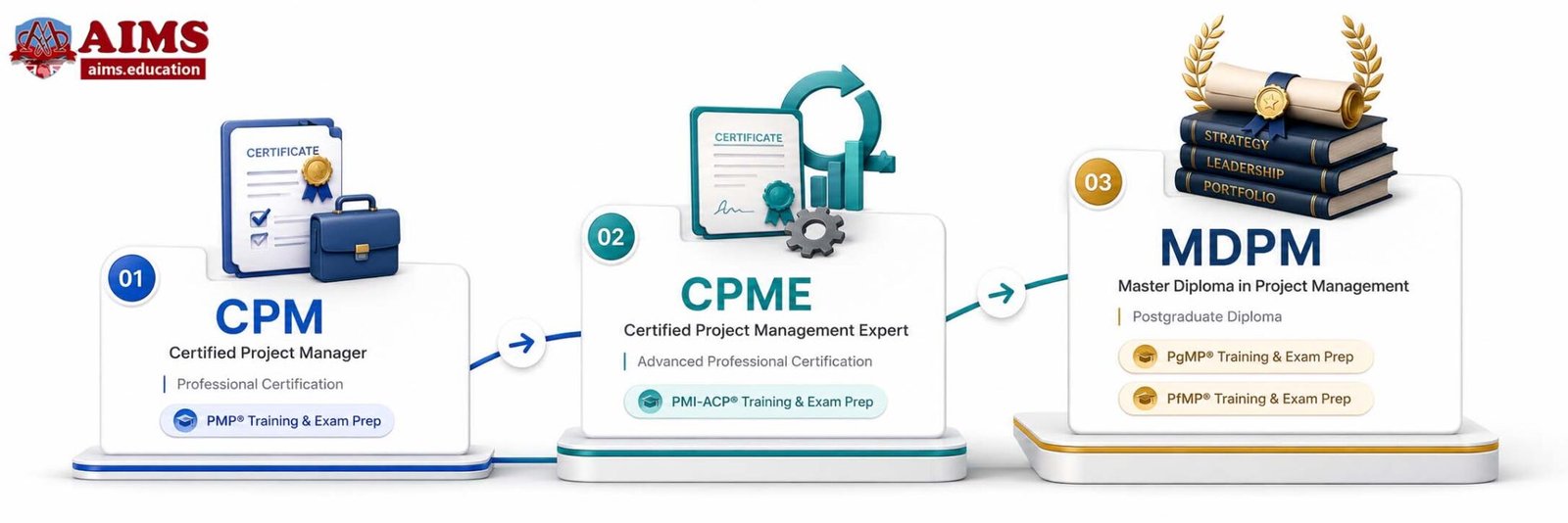
  • Students earn CPM and CPME certifications after Semester I and the MDPM award after Semester II.
  • The diploma also awards 27 graduate credit hours that support progression to advanced study in project management.
  • The curriculum develops practical capability in project delivery, Agile methods, program management, portfolio management, governance, and project software use.

Accreditation, Compliance and Level-6 Equivalence

Study Format, Duration, and Academic Support

The study format is fully online, self-paced, and built for professionals balancing work, family, and career development. Most students complete the diploma in about four to five months by studying roughly ten to twelve hours each week with access to structured resources and continuing faculty support.

Program ElementDetails
Learning methodFlexible and self-paced online learning.
Average durationApproximately 4 to 5 months.
Weekly study requirementAbout 10 to 12 hours per week.
Study resourcesInteractive lectures, online study manuals, expert faculty support, project management library access, assignments, and a real-world project.
Assessment structureFourteen MCQ-based assignments across the taught courses, semester examinations, and one final real-world project.
Semester I awardsCertified Project Manager (CPM) and Certified Project Management Expert (CPME).
Semester II awardMaster Diploma in Project Management (MDPM).
Additional valueIntegrated academic PDUs, exam preparation for major PMI-aligned certifications, and transferable graduate credit hours.
At-a-glance summary of the online project management diploma, including duration, delivery mode, study resources, assessment structure, and qualification outcomes.
  • Structured Online Learning with Expert Support

    Online study does not mean isolated study. AIMS supports learners with structured materials, expert guidance, and accessible digital resources so students can progress with clarity. The teaching approach is designed to simplify advanced concepts through clear explanations, practical examples, and case-based learning that connects theory to real project environments.

  • Flexible Online Project Management Study for Working Professionals

    This format is especially suitable for working professionals who need flexibility without sacrificing depth. Students can move through the curriculum at their own pace while still following a coherent learning route that builds from project foundations to strategic leadership and applied execution.

Curriculum and Learning Objectives

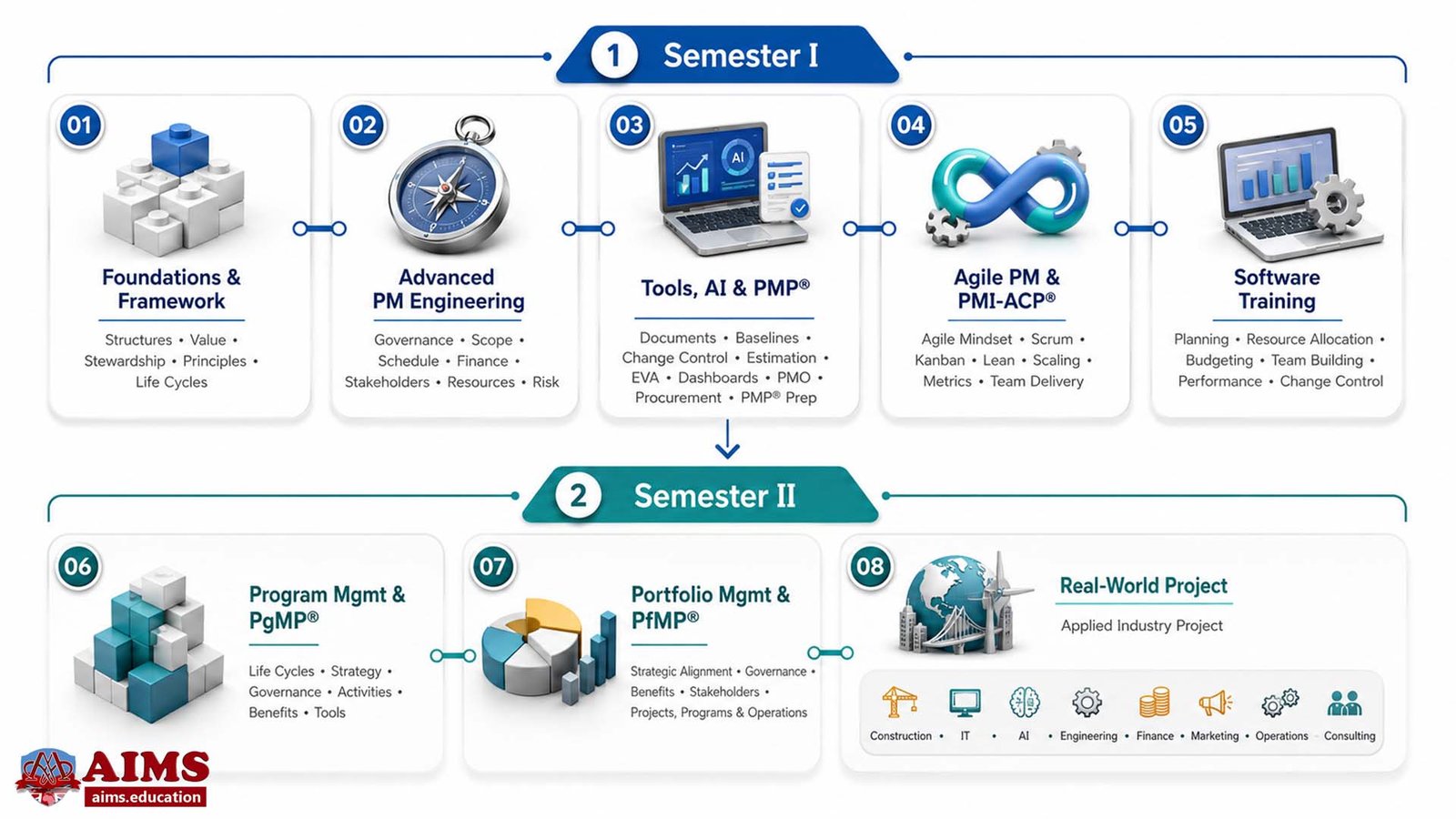
The curriculum develops broad and practical project leadership capability by combining foundational project management, advanced tools and techniques, Agile delivery, software application, program management, portfolio management, and a real-world final project. It is structured to build job-ready competence from operational execution through strategic oversight.

Semester I: Foundational Project Management Courses

Semester I establishes the core knowledge base of the diploma and prepares students for CPM and CPME certification outcomes. It covers the principles, methods, tools, and systems needed to plan, lead, monitor, and improve project performance across modern delivery environments.

This course introduces the structural overview of project management, project value, stewardship roles, project life cycles, and delivery flow. Students develop a strong conceptual foundation in how projects are initiated, governed, and managed from start to completion in professional settings.

This area strengthens analytical and managerial capability across major performance domains. Students study governance, scope, schedule, finance, stakeholder engagement, resources, and risk. The emphasis is not only on knowing the concepts, but on understanding how these domains interact in real projects and influence outcomes.

This part of the curriculum goes deep into practical execution tools. Students learn how to work with baselines, change and configuration control, requirements, schedule planning, funding, procurement, quality, risk information, and closure activities. They also study tools and techniques such as earned value analysis, critical path method, precedence diagramming, decision analysis, dashboards, information radiators, rolling wave planning, responsibility assignment matrices, and schedule compression.

The course also introduces the project management office, procurement management, and the role of artificial intelligence in project environments. Students explore common AI use cases, responsible implementation, and ethical considerations so they can evaluate new tools with professional judgment rather than blind adoption.

The Agile component explains the Agile Manifesto, mindset, life cycle selection, Agile environments, team practices, delivery approaches, and organizational agility. Students examine Scrum, Kanban, Extreme Programming, Crystal, Scrumban, Feature-Driven Development, Dynamic Systems Development Method, Agile Unified Process, and scaling frameworks. This broad coverage helps learners understand when and how Agile approaches should be used in real organizations.

Students also receive structured exposure to project management software applications, including planning, team coordination, resource allocation, budgeting, performance review, change control, and management of multiple projects. This strengthens digital fluency and supports practical readiness for software-enabled project delivery environments.

Semester II: Advanced Application and Real-World Project

Semester II moves students from strong project management practice into wider strategic leadership. It focuses on program management, project portfolio management, and practical implementation, helping learners understand how organizations align multiple initiatives, benefits, governance structures, and long-term decision-making.

The PgMP-focused portion covers the program management life cycle, principles, strategies, activities, tools, and knowledge areas associated with complex multi-project environments. Students study program performance domains and the relationship between program structure, benefits realization, governance, and organizational value creation.

The PfMP-focused course develops understanding of strategic alignment, portfolio governance, collaboration, stakeholder engagement, benefits management, and the relationship among portfolios, programs, operations, and projects. This prepares students to think beyond individual delivery and toward enterprise-level prioritization and oversight.

The final project turns learning into applied project management research and practical implementation. Students select a real project scenario from sectors such as construction, IT, AI, engineering, finance, or marketing, and apply their knowledge to a structured industry case. This stage is central to the diploma because it proves that students can move from theory to execution with confidence.

Across the full curriculum, AIMS uses interactive lectures and comprehensive manuals to explain complex topics in a clear and structured way. Practical examples and case-based learning are embedded throughout the study process so students build judgment, not just memory.

Certifications, Graduate Credits, and Professional Outcomes

The diploma delivers layered outcomes rather than a single end award. Students earn two recognized certifications after Semester I, complete the MDPM diploma after Semester II, receive integrated academic PDUs and exam preparation, and build graduate credit that supports progression into higher academic qualifications in project management.

  • Certifications Earned During the Program

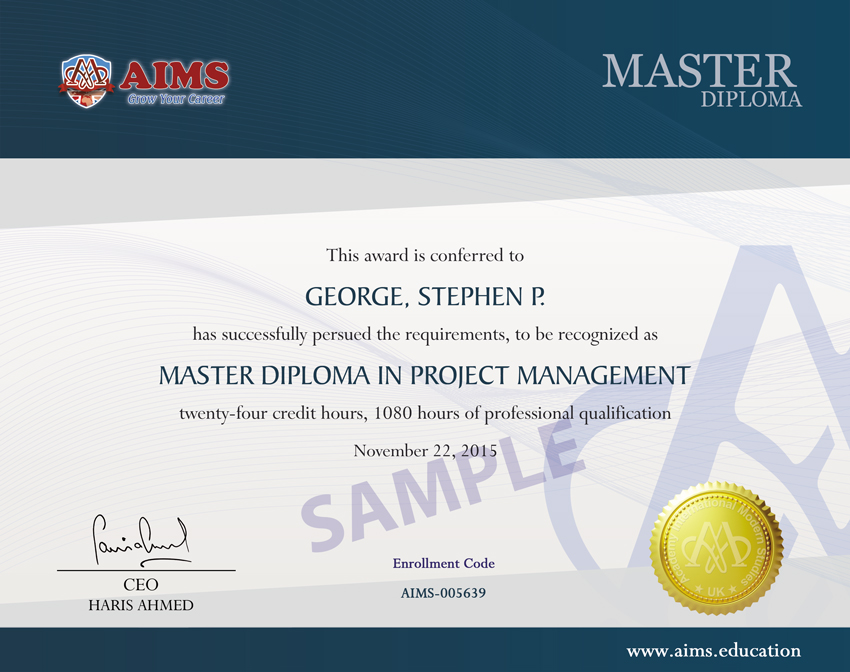
    MDPM follows a stacked qualification structure. After the successful completion of Semester I, students are awarded the Certified Project Manager (CPM) and Certified Project Management Expert (CPME) certifications. After completing Semester II, the final project, and the required assessments, students receive the Master Diploma in Project Management (MDPM) with official academic standing.

  • PMI-Aligned Preparation and Academic PDUs

    The program includes structured preparation for PMI’s PMP®, PMI-ACP®, PgMP®, PfMP®, and Microsoft Project-related pathways. This is not simply short exam coaching added at the margin. The preparation is integrated into the learning model through topic coverage, structured study, practical tools, and academic PDUs that support professional development.

  • Transferable Credit and Academic Progression

    Students earn 27 graduate credit hours during the diploma. These credits support progression into the MBA in Project Management and strengthen eligibility for higher academic routes in the same discipline, including PhD Project Management. For learners seeking a long-term pathway, MDPM works as both a standalone credential and a progression stage toward advanced project management education.

diploma in project management

Career Opportunities and Industry Relevance

The diploma prepares graduates for broader responsibility in project delivery, multi-project coordination, program leadership, portfolio oversight, and PMO-related roles. Its value lies in combining practical delivery skills with strategic management knowledge, which helps learners move toward more senior functions across multiple industries and business environments.

Career Pathways Supported by MDPM

Career PathHow the Diploma Supports It
Project ManagerBuilds strong capability in planning, scheduling, budgeting, stakeholder coordination, risk management, and project control.
Senior Project ManagerStrengthens leadership judgment, governance understanding, advanced tools use, and management of complex delivery environments.
Program ManagerDevelops expertise in program life cycle management, benefits realization, and coordination of interrelated initiatives.
Portfolio Manager or Portfolio AnalystBuilds strategic understanding of portfolio selection, governance, prioritization, and alignment with organizational goals.
PMO Leadership and Strategic Oversight RolesSupports capability in governance, reporting, frameworks, standards, dashboards, and enterprise project oversight.
Project Management ConsultantProvides a broad mix of frameworks, methods, software, and applied analysis useful for advisory and transformation assignments.
Representative career pathways supported by the Master Diploma in Project Management and the specific capabilities built through the curriculum.
  • Project Management Career Relevance Across Industries

    The curriculum is relevant across industries where structured delivery matters, including IT, construction, engineering, operations, finance, healthcare, consulting, and public-sector environments. Because students learn both execution and strategic oversight, the diploma supports progression beyond single-project roles toward multi-project and governance-based responsibilities.

  • Why Multi-Method Project Management Training Matters

    The combination of Waterfall, Agile, program, portfolio, and software training is particularly important. Employers increasingly value professionals who can work across different delivery models, interpret performance information, communicate with stakeholders, and align projects with organizational priorities rather than manage tasks in isolation.

Admissions and Learning Process

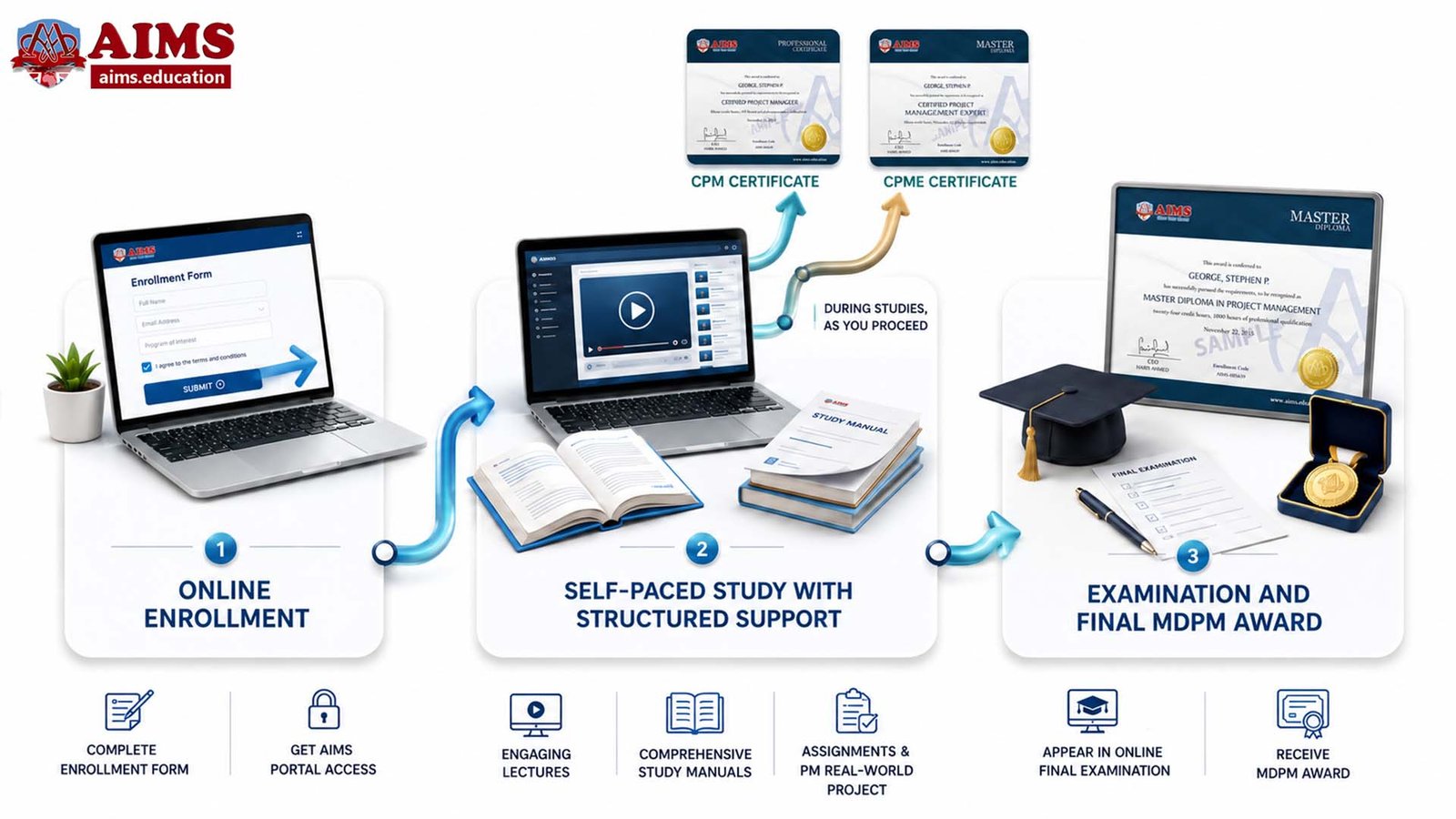
Admission and completion follow a simple online process. Students enroll through the online form, study the seven courses and supporting resources in a self-paced system, complete the required assignments and project work, and then sit the semester examinations that lead to progressive certification and final diploma award.

Who the Program Is Designed For

The diploma suits graduates, working professionals, managers, executives, entrepreneurs, career switchers, and practicing project professionals who want stronger capability and wider career options. It is particularly relevant for learners aiming to move into senior project, program, portfolio, or PMO-related roles.

Students begin by completing the online enrollment form and submitting the required fee. After the registration process is completed, access to the online study portal is typically provided within one to two working days so learning can begin without unnecessary delay.

Students then work through seven taught courses and the final project using interactive lectures, comprehensive e-manuals, faculty support, and library resources. Each course is designed to explain advanced concepts clearly through practical examples, structured explanations, and case-based learning.

Assessment during the taught phase includes two MCQ-based assignments per course, resulting in ten assignments in Semester I and four in Semester II. This steady assessment structure helps students revise consistently and build confidence before their semester examinations.

After completing the first five courses and ten assignments, students may request the Semester I examination and become eligible for CPM and CPME awards on successful completion. In Semester II, students complete the remaining taught work, submit the real-world project, and then request the final examination to earn the MDPM diploma.

All assignments and examination questions are multiple-choice, and the minimum completion benchmark is 65 percent. The final stage confirms not only theoretical understanding, but also the
learner’s ability to apply project management methods in a realistic practical context.

diploma of project management online
project management diploma online
online diploma in project management
courses

Hear from Our Global Learners

“The MDPM was a serious career investment for me. The curriculum brought together academic structure and industry relevance, and the integrated preparation for PgMP®, PfMP®, and project software pathways added real value. I use many of the strategic tools from the program in my work.”

David Thompson, Project Director, USA

“The hands-on structure of the diploma strengthened my ability to lead complex projects and programs. The course materials were rich in practical examples, and the faculty support was consistently helpful. The qualification also supported my progression toward higher managerial roles.”

Tomás González, Senior Project Manager, Canada

“The online format made it possible to balance work and study, and the final real-world project was especially valuable. It helped me apply what I learned to an actual industry challenge, while the certifications and PDUs added professional credibility.”

Ahmed Mansoor, Program Manager, UAE

“The lectures and manuals made advanced concepts easier to understand, and the learning system kept me engaged throughout the diploma. The practical examples and case-based teaching approach made the content useful far beyond exam preparation.”

Paul Conner, Lead Engineer, Middle East

Frequently Asked Questions

The most common questions about MDPM relate to what the qualification includes, how long it takes, what awards students receive, and how it supports professional growth. The answers below clarify the program structure, delivery model, certification route, and progression value in concise terms.

An online project management diploma is a structured professional and academic program delivered digitally to develop practical capability in planning, executing, and governing projects.
AIMS’ MDPM goes further by covering program and portfolio management as well, making it a broader leadership qualification.

MDPM is AIMS’ advanced postgraduate diploma in project management. It combines seven taught courses, a real-world project, progressive certifications, academic PDUs, and graduate credit hours in one integrated pathway designed for flexible online study.

Most students complete the diploma in about four to five months. The program is self-paced, and a study commitment of around ten to twelve hours each week is usually sufficient for steady progress.

After Semester I, successful students earn the Certified Project Manager (CPM) and Certified Project Management Expert (CPME) certifications. After Semester II and the final project, they receive the Master Diploma in Project Management (MDPM).

Within the program’s positioning, Level 6 indicates an advanced diploma level intended for serious professional and academic development. It signals that the qualification goes beyond introductory training and supports higher progression, but it is still distinct from the MBA degree itself.

The curriculum integrates PMI-aligned themes throughout the study route. Students cover project, Agile, program, and portfolio domains through structured coursework, academic PDUs, practical tools, and exam-focused preparation that supports later professional certification goals.

The curriculum includes project management fundamentals, advanced performance domains, tools and techniques, AI in project management, Agile methods, software training, program management, portfolio management, and a final real-world project that applies learning in a practical scenario.

Yes. The diploma is delivered through a fully online, self-paced system supported by lectures, manuals, assignments, faculty communication, and library resources. This allows students to study from anywhere while maintaining professional and personal commitments.

Yes. The diploma awards 27 graduate credit hours that support progression toward the MBA in Project Management and strengthen the pathway toward higher academic study in the discipline.

Apply for the Online Project Management Diploma

The next step is simple: review the curriculum, explore the study format, and begin enrollment when you are ready to start. MDPM is designed for learners who want a flexible but serious qualification that develops practical capability and supports long-term professional progression.

This diploma is especially suitable for professionals who want recognized structure, real-world application, and progressive certification in one coherent online program. It offers a practical route to stronger project leadership, broader managerial responsibility, and continued academic advancement.

To move forward, complete the online enrollment process to begin your MDPM study pathway.