AIMS offers Project Management Certification Courses online through its Certified Project Management Expert (CPME) program, a Level-5 qualification designed for practical, job-ready project leadership. The program combines international accreditation, UK registration context, PMI-aligned learning, and flexible self-paced study for professionals seeking recognized project management training with real workplace value.

Through five comprehensive project management courses online, students build capability in Waterfall, Agile, hybrid delivery, project tools, and software-supported project control. The curriculum is taught through interactive lectures, comprehensive study manuals, assignments, and applied case-based learning, while also supporting progression to higher qualifications in project management.

project management course online

Certified Project Management Expert (CPME): Program Objectives

AIMS’ project management certification program is designed for professionals who need broad, practical, and career-relevant training. It combines structured online learning, applied coursework, expert support, and recognized certification into one pathway that develops both managerial understanding and real workplace capability.

  • PMP®, PMI-ACP®, and Microsoft Project exam-focused preparation within the wider learning structure.
  • 35 contact hours for PMP® preparation, 28 contact hours for PMI-ACP® preparation, and relevant PDUs included in the program pathway.
  • Dual certification awards, CPM and CPME, after successful completion.
  • Interactive lectures, detailed study manuals, and ten online assignments, with two assignments for each course.
  • 24/7 educational support and access to project management learning resources.
  • Five comprehensive project management courses online.

CPME: Accreditation, Recognition and Academic Progression

The Certified Project Management Expert (CPME) is a Level-5, internationally recognized project management certification designed to build practical, job-ready capability in modern project environments. The program includes five comprehensive online project management courses, delivered through interactive lectures, detailed study manuals, assignments, and flexible self-paced learning.

  • International Accreditation, PMI Alignment, and Exam Preparation

    CPME is positioned as a globally relevant qualification with international accreditation and UK registration reflected across the program’s trust profile. The curriculum is aligned with PMI standards and includes exam-focused preparation for major professional pathways. It awards 35 contact hours for PMP® preparation and 28 contact hours for PMI-ACP® preparation, while also covering Microsoft Project training within the wider learning structure.

  • Credit Transfer and Academic Progression for Higher Studies

    On successful completion, students earn 15 graduate-level credit hours that can be transferred toward an diploma or MBA in project management. CPME also supports progression toward PhD study in Project Management, making it valuable for both immediate professional development and longer-term academic advancement.

Project Management Courses Online at a Glance

AIMS delivers these project management courses online through a flexible format that suits busy professionals, early-career managers, and learners balancing work with study. The learning model combines self-paced access, structured resources, assignment-based progress, and online assessment so students can move forward without disrupting professional commitments.

Program ElementDetails
Study methodologyOnline and self-paced learning.
Estimated durationApproximately 3 to 4 months.
Study timeAround 10 to 12 hours of study per week.
Number of coursesFive project management courses online.
Learning resourcesInteractive lectures, study manuals, e-library access, assignments, and expert support.
AssessmentTen online assignments followed by a final online examination.
Passing requirementMinimum 65% in the final online MCQ-type examination.
Certifications awardedCertified Project Manager (CPM) and Certified Project Management Expert (CPME).
Credit value15 graduate-level credit hours for progression toward higher study.
Quick review of the AIMS CPME project management certification program.

This comparison helps understand how AIMS’ CPME differs from many standalone project management certifications. CPME combines structured courses, dual certification, Agile and Waterfall training, PMP® and PMI-ACP® preparation, software learning, assessment, academic credits, and progression routes, while many alternatives focus on a narrower exam or single methodology.

FeaturesAIMS’ Certified Project Management Expert (CPME)Other Project Management Certifications
Program depthFive structured courses covering project foundations, advanced performance domains, tools, Agile methods, AI, and project management software.Often focused on one exam, one methodology, or a narrower body of knowledge.
Award outcomeAwards both Certified Project Manager (CPM) and Certified Project Management Expert (CPME).Usually awards one certificate or prepares learners for an external exam only.
PMP® preparationIncludes PMP®-focused training support, mock exams, and 35 contact hours within the wider CPME learning pathway.May require a separate PMP® exam-preparation course, separate eligibility review, and separate external examination process.
PMI-ACP® preparationIncludes PMI-ACP® training support and 28 contact hours, with Agile project management covered as a core part of the curriculum.PMI-ACP® preparation may be separate, optional, or limited to Agile exam coaching without broader project management coverage.
Agile and Waterfall coverageCovers predictive, Agile, and hybrid project environments with practical application and case-based learning.May focus mainly on either traditional project management or Agile practice.
Project management softwareIncludes project management software training, dashboards, baselines, planning tools, and advanced control techniques.Software training may be optional, separate, or not included.
Learning methodInteractive lectures, comprehensive manuals, practical examples, assignments, mock exams, and support.May rely mainly on recorded lessons, short test preparation, or self-study materials.
Progression valueProvides 15 graduate-level credit hours that may support progression to advanced AIMS project management programs.Academic progression value may be limited or unavailable.
Comparison between AIMS’ CPME and general project management certification options.

CPME Curriculum for Agile, Waterfall, Hybrid, and Software-Based Project Management

The CPME curriculum covers foundational, advanced, Agile, hybrid, and software-based project management. Each topic is taught through interactive lectures, comprehensive manuals, practical examples, and case-based explanations so students understand not only project management theory, but also how to apply it in workplace situations.

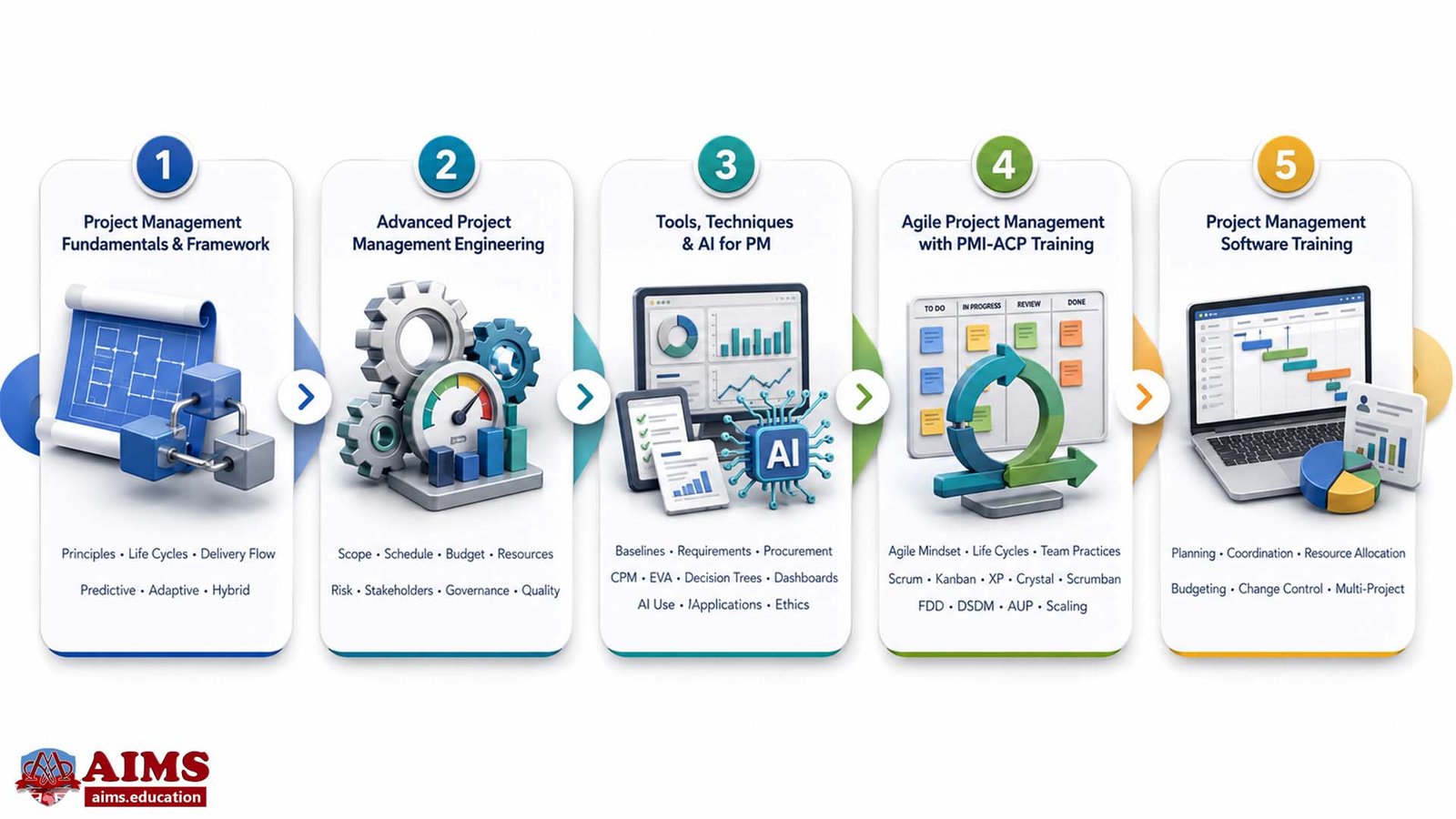
This course introduces project management structure, value delivery, stewardship roles, life cycles, delivery flow, governance basics, and the difference between project work and routine operations.

  • Project management principles, life cycles, and delivery flow.
  • Foundational understanding of predictive, adaptive, and hybrid project environments.

This course develops deeper understanding of performance domains and explains how project managers balance scope, schedule, budget, resources, risk, stakeholders, governance, and quality.

  • Scope, schedule, finance, resource, stakeholder, governance, and risk performance domains.
  • Applied techniques for managing complex projects with competing constraints.

This course explains practical tools used across planning, estimation, delivery, monitoring, control, procurement, and closure. It also introduces artificial intelligence in project contexts, including responsible use, common applications, and ethical concerns.

  • Project documents, baselines, requirements, schedules, budgets, risks, procurement inputs, and closure records.
  • Critical path method, earned value analysis, decision trees, dashboards, retrospectives, visual controls, and stakeholder analysis.

This Agile and Waterfall certification component develops practical understanding of adaptive delivery. Students study Agile values, Scrum, Kanban, Scrumban, Extreme Programming, scaling approaches, Agile measurement, team practices, and organizational conditions that support agility.

  • Agile Manifesto, Agile mindset, project life cycle selection, and hybrid delivery choices.
  • Backlogs, release planning, reviews, retrospectives, scaling, culture, procurement, and Agile change management.

The final course focuses on software-supported planning and control, including schedules, teams, resources, budgets, progress tracking, performance evaluation, change management, and multiple project coordination.

  • Project planning, scheduling, resource allocation, budgeting, and performance monitoring.
  • Advanced project management tools for reporting, tracking, control, and decision support.

PMI Exam Preparation and Professional Development Support

CPME includes PMP® training, PMI-ACP Certification Training, PMI-ACP Exam Prep Online, Microsoft Project preparation, 35 PMP® contact-hour learning support, and 28 PMI-ACP Contact Hours within the program structure.

Agile, Waterfall, Hybrid, and Software Training

The CPME program prepares learners to work across predictive, Agile, and hybrid environments rather than limiting them to one delivery style. Students learn when detailed upfront planning is appropriate, when adaptive methods are stronger, and how software tools support visibility, coordination, control, and informed project decisions.

  • Agile and Waterfall project management training

    CPME certification does not treat project management as a one-method profession. It teaches traditional planning disciplines such as scope, scheduling, cost awareness, risk, and control, while also building understanding of Agile practices, team collaboration, short delivery cycles, and adaptive response. That combination is valuable because many organizations run mixed project environments.

  • What hybrid project management training means here

    Hybrid project management is not presented as a separate certificate. It is taught as the practical ability to combine predictive structure with Agile adaptability where the project situation demands it. This helps students understand how experienced project leaders tailor methods instead of forcing one framework onto every initiative.

  • Project management software and tools training

    Software skills are positioned as part of professional execution, not a substitute for project judgment. Students learn how tools support planning, budgeting, scheduling, coordination, reporting, and portfolio visibility. This strengthens practical workplace readiness, especially for learners moving into formal project roles where digital project control is expected.

  • How AI is Transforming Project Management

    Artificial intelligence is reshaping project management by improving forecasting, planning, and decision support. In practical terms, AI helps project teams analyze patterns, identify risks earlier, automate routine scheduling tasks, and strengthen visibility across timelines, workloads, and delivery performance.

How to Achieve the Certification Online

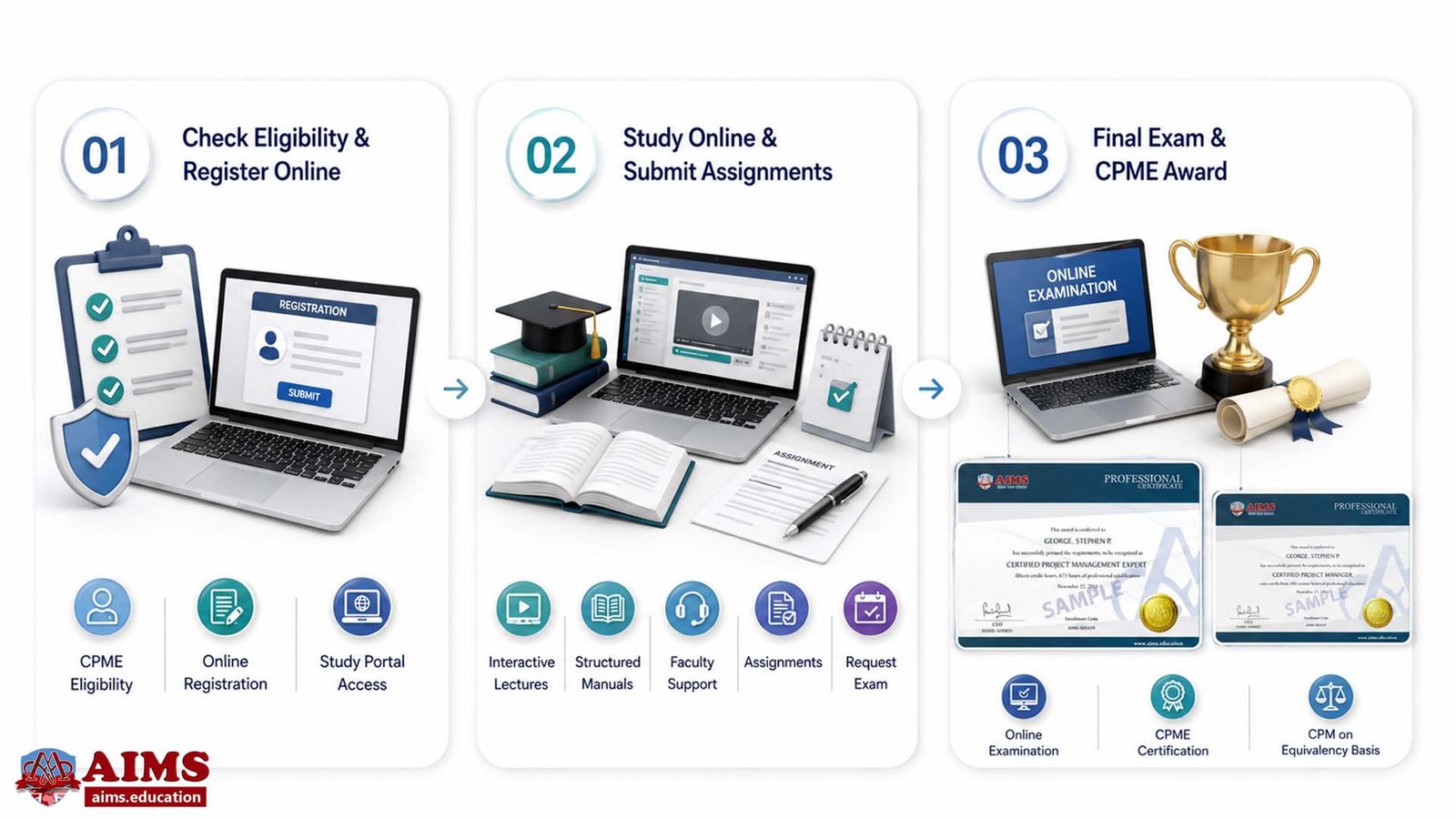
Students complete the CPME through a simple three-step process: register online, study the five courses with their supporting resources, submit the required assignments, and sit the final examination. The system is designed to be flexible, structured, and manageable for professionals studying alongside work responsibilities.

  • Complete the online enrollment form for the CPME program.
  • Applications are processed by admissions, and portal access is issued after approval.
  • Students receive login credentials to begin studying through the online learning platform.
  • Study each course online at your own pace from any location.
  • Use interactive lectures, study manuals, assignments, and additional learning support throughout the program.
  • Complete ten online assignments, with two assignments required for each course.
  • Request the final online examination after completing study requirements and assignments.
  • Take the examination online from a convenient location.
  • Pass the final MCQ-type exam with at least 65% to earn the certification awards.
  • Receive both CPM and CPME certifications on successful completion.
project management certificate

Explore the CPME Learning Experience

The Certified Project Management Expert (CPME) program combines advanced project management coursework, practical online learning, and recognized certification to help professionals build job-ready capability in Agile, Waterfall, hybrid delivery, and project management tools.

project managemen courses online

Coursework

The coursework is structured to help learners progress from project management frameworks and performance domains to Agile delivery, project tools, software applications, and applied project control through guided study and assignments.

online project management courses

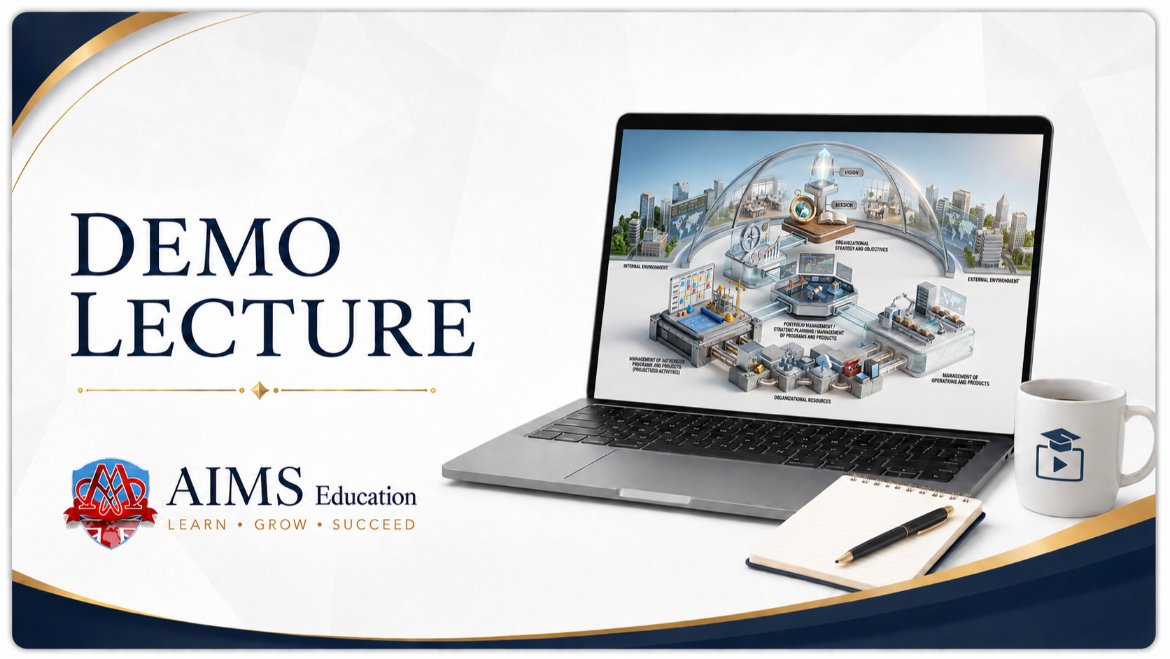
Demo Lecture

A demo lecture allows prospective learners to review the teaching approach and see how the online CPME program is delivered through practical, structured, and professionally relevant instruction.

project management certification online

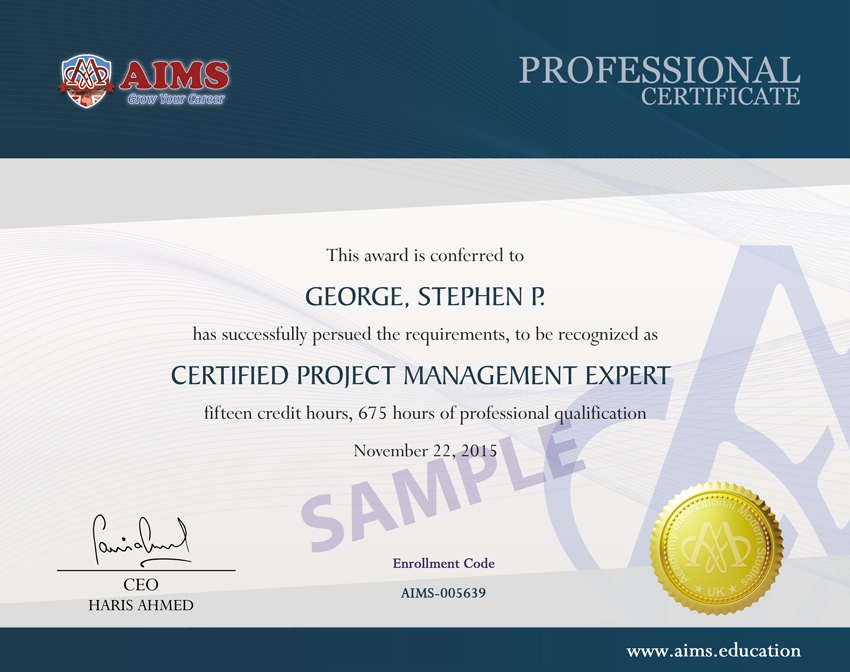
Sample Certificate

The awarded certificate reflects successful completion of the recognized Certified Project Management Expert (CPME) program, designed to strengthen professional credibility, career progression, and progression toward higher project management qualifications.

Feedback from CPME Learners

“The program helped me build expertise in both traditional and Agile frameworks while managing my studies around a demanding schedule. The study manuals, lectures, and faculty support were stronger than I expected, and the credit transfer route added real long-term value.”

Linda Johnson, Director of Operations, Canada.

“CPME was well structured and comprehensive. The online learning experience was clear and effective, and the graduate credit hours supported my progression toward further academic study in project management.”

Jennifer Smith, Project Manager, Microsoft, USA.

“The course structure, real-world examples, and practical case studies helped me move from a technical role toward project leadership. I gained skills I could use immediately at work.”

Wang Zhang, Senior Engineer, Singapore

“The program filled practical gaps in scheduling, risk, leadership, budgeting, and project software. It gave me the structure I needed to manage more complex projects with greater confidence.”

Rizwan Ahmed, Qatar, UAE.

Career Benefits and Professional Outcomes

These project management certification courses are designed to improve professional credibility, delivery capability, and promotion readiness. Graduates build skills that support planning, coordination, reporting, change control, and team leadership across real project environments, making the program relevant for both career starters and experienced professionals seeking advancement.

  • Career Value of Practical Project Management Training

    Employers rarely need theory alone. They need professionals who can translate project goals into schedules, budgets, responsibilities, communication plans, and measurable delivery. CPME addresses that need by combining foundational frameworks with case-based learning, applied tools, and software-supported project work that reflects how projects are actually managed.

  • Career Progression Beyond a Single Job Title

    The value of CPME is not limited to one role. It strengthens capability in both traditional and Agile project management, helps learners communicate more confidently with stakeholders, improves understanding of control and performance, and provides a clearer route into advanced study. That mix supports both immediate employability and longer-term leadership growth.

  • International Accreditation and Recognition

    The current program positioning highlights recognition through QAHE, UKRLP, and CPD UK. These trust signals matter because prospective students often want confirmation that an online program is professionally structured, institutionally accountable, and suitable for international learners who need credibility alongside flexibility.

  • Project Learing and Job Read Skills

    The program goes beyond narrow theory. It is designed to build job-ready skills in planning, governance, scheduling, cost awareness, stakeholder coordination, Agile delivery, risk thinking, and software-supported control. Real-world examples and case-based explanations help students understand how project decisions affect delivery outcomes in live professional settings.

  • Who Should Enroll

    The program suits project coordinators, aspiring project managers, team leaders, engineers, consultants, analysts, administrators, entrepreneurs, and professionals in sectors such as IT, construction, healthcare, logistics, operations, finance, and manufacturing. It is especially useful for learners who want broader project capability rather than a narrow, single-tool qualification.

Start Your Project Management Certification Online

CPME gives professionals a structured route to study project management online, build practical capability across Agile and predictive delivery, and earn recognized AIMS certifications. It is designed for learners who want flexibility, applied learning, academic progression, and stronger readiness for higher responsibility in project environments.

For prospective students who want the next step, the page should naturally support actions such as checking eligibility and fee details, downloading the brochure, trying free lectures, or contacting admissions. That keeps the path clear for both information seekers and ready-to-enroll applicants.

    Frequently Asked Questions

    CPME is AIMS’ advanced online project management certification program. It combines five project management courses, practical assignments, interactive lectures, study manuals, and a final examination. Successful students earn both CPM and CPME certifications while building skills in traditional, Agile, hybrid, and software-supported project management.

    The program includes five courses, ten assignments, self-paced online study, expert support, interactive lectures, study manuals, exam preparation relevant to selected professional pathways, and a final examination. It also awards 15 graduate-level credit hours that support progression to higher study within AIMS.

    Yes. The curriculum teaches both predictive project management and Agile delivery practices. Students learn how structured planning works, how Agile methods improve adaptability, and how both approaches can be combined in hybrid environments when the project context requires a tailored solution.

    Yes. The curriculum includes a dedicated software-focused course covering project planning, team coordination, budgeting, resource allocation, performance review, change management, and the handling of multiple projects. This helps connect project theory with the tools used in professional delivery settings.

    Within modern project environments, predictive analytics can help managers anticipate delays, cost pressure, resource bottlenecks, and shifting delivery risks before problems become critical. Automated scheduling tools can also support timeline adjustments, task prioritization, dependency management, and faster updates when project conditions change. In this program, AI is presented as a practical support tool that strengthens project control and informed judgment, not as a replacement for professional leadership, stakeholder management, or managerial decision-making.

    Online learning only creates value when the academic structure is strong. In CPME, learning is supported through interactive lectures, detailed manuals, assignments, expert guidance, and a formal examination process. That combination gives the program more substance than a short video course or a purely self-declared training certificate.

    CPME includes training and preparation relevant to PMP®, PMI-ACP®, and Microsoft Project certification pathways. It is important to understand that these are separate external credentials. CPME is the AIMS qualification, while external certifications are governed by their own awarding organizations and requirements.

    The estimated duration is around 3 to 4 months, depending on the learner’s pace and availability. Students generally study for about 10 to 12 hours per week, which makes the program suitable for professionals who need a structured but flexible online format.

    CPME is not only a stand-alone professional qualification. It also supports broader progression within AIMS’ project management pathway. Students earn 15 graduate-level credit hours that can be transferred toward a postgraduate diploma, MBA, or PhD in Project Management, making the program useful for both immediate career growth and longer academic advancement.

    The program is suitable for professionals seeking stronger project capability, formal recognition, or a pathway into more advanced study. It is relevant for learners across industries who want practical project management training supported by case-based learning, structured online study, and recognized awards.