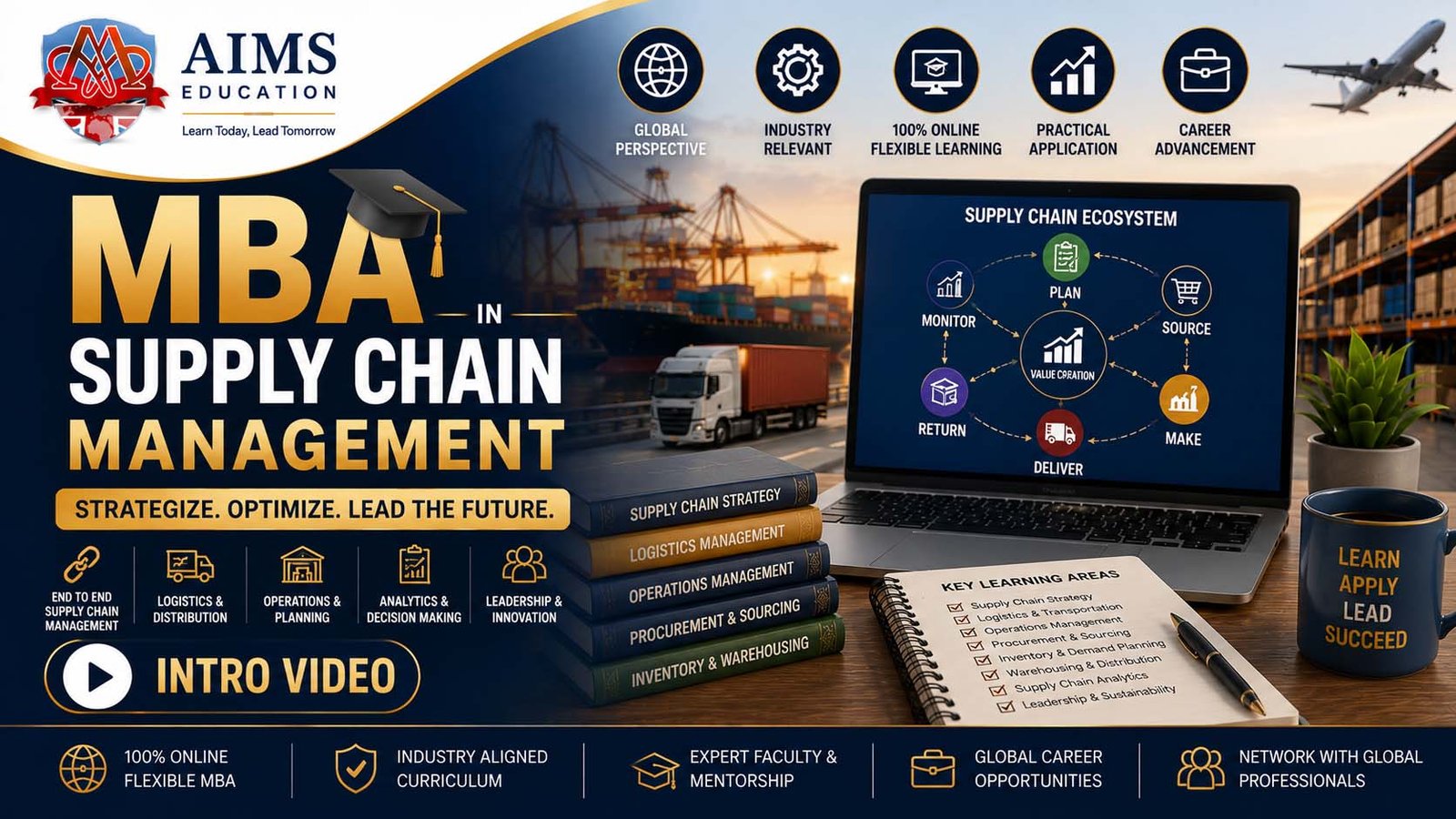
Online MBA in Supply Chain Management at AIMS is a flexible master’s degree in business administration with a specialization in supply chain, logistics, procurement, operations, analytics, and leadership. The program is delivered 100% online and is designed for professionals who want advanced business capability with practical supply chain expertise.

This MBA helps learners understand how modern supply chains operate across sourcing, planning, inventory, warehousing, transportation, technology, sustainability, finance, leadership, and strategic decision-making. The curriculum is delivered through interactive lectures, comprehensive study manuals, applied examples, case-based learning, assignments, online exams, and a real-world supply chain project.
Students also earn embedded AIMS credentials as they progress through the degree pathway, including the Certified Supply and Logistics Professional, Certified Supply Chain Expert, and Master Diploma in Supply Chain Management, before completing the final MBA requirements.

Online MBA supply chain management video overview

MBA Supply Chain Program Objectives

  • The program supports career progression into supply chain, logistics, procurement, operations, warehousing, planning, consulting, and leadership roles.
  • The curriculum covers practical supply chain subjects, business management courses, and a real-world project based on applied supply chain design.
  • The program is delivered through structured online learning, interactive lectures, study manuals, assignments, examinations, and faculty guidance.
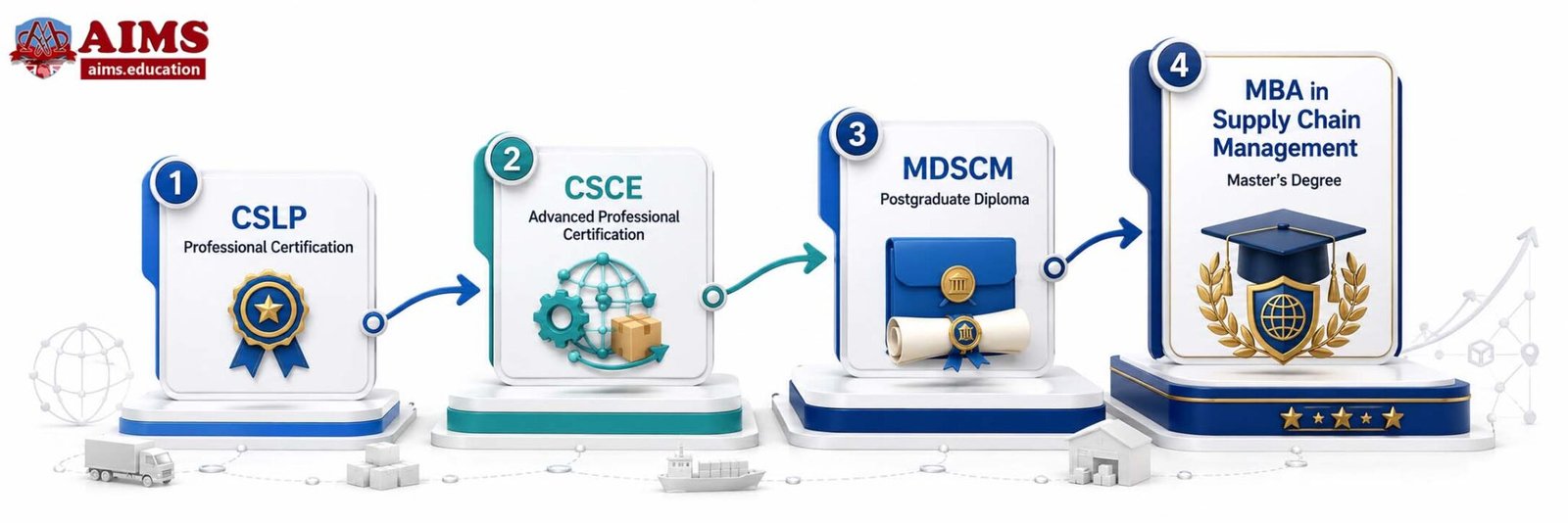
  • The qualification pathway includes CSLP and CSCE certifications, the Master Diploma in Supply Chain Management, and the final MBA degree route.

Why AIMS Is a Strong Choice for an MBA in Supply Chain Management Online

AIMS Education offers a flexible, internationally oriented MBA pathway that combines supply chain specialization, business leadership, staged credentials, applied learning, and online delivery for professionals who need credible academic progression without leaving work or relocating.

  • UK Registration, Accreditation, and Global Recognition

    AIMS Education, the Academy for International Modern Studies, is a UK-registered institution with an international online learning model. AIMS combines institutional registration, accreditation-related quality recognition, and professional development standards to support learner confidence, academic structure, and global relevance.

    The recognition profile should be understood clearly. UKRLP registration confirms provider listing as a UK learning provider. QAHE accreditation supports international quality assurance recognition. CPD accreditation functions as a professional development quality signal. These elements strengthen institutional credibility, but they should not be confused with the degree-awarding process itself.

MBA Supply Chain Management: Quick Review

Program FeatureMBA Supply Chain Management Details
Study Mode100% online and self-paced learning.
Average Duration10 to 12 months, depending on the learner’s pace and schedule.
Registration DurationTwo years of registration validity.
Program LevelLevel 7 master’s-level MBA pathway.
Study ResourcesInteractive e-lectures, detailed study manuals, online library access, faculty support, assignments, and exam preparation resources.
Program StructureTen courses and a real-world supply chain project.
Credit StructureFour supply chain specialization courses, six business management courses, and a practical project.
Recommended Study Time10 to 12 study hours per week.
AssessmentAssignments, online examinations, and a real-world project.
Staged AwardsCSLP and CSCE after Semester I, MDSCM after Semester II, and MBA degree completion after all requirements are met.
MBA Supply Chain Management quick facts, study format, duration, assessment, and qualification outcomes.

An online MBA in supply chain management is usually better for learners seeking leadership, business strategy, and cross-functional management, while a specialized masters in supply chain management online may suit learners who want a narrower technical or research-focused supply chain degree.

FeaturesAIMS’ Online MBA in Supply Chain ManagementOther Masters in Supply Chain Management Online
Main FocusCombines supply chain specialization with broader MBA-level business leadership.Often focuses more narrowly on supply chain theory, analytics, logistics, or technical specialization.
Best FitProfessionals aiming for management, leadership, consulting, operations, procurement, or transformation roles.Learners seeking deeper technical specialization or a more subject-specific academic route.
Business CoreIncludes strategy, finance, accounting, marketing, business analysis, leadership, and change management.May include fewer general management courses depending on the institution and degree design.
Supply Chain CoverageCovers logistics, procurement, inventory, warehousing, transportation, SCOR, technology, sustainability, and project work.May focus on advanced supply chain modeling, analytics, logistics systems, or research methods.
Practical LearningIncludes case-based learning, interactive lectures, study manuals, assignments, and a real-world supply chain project.Practical work varies widely and may depend on whether the program is academic, professional, or research oriented.
Progressive CredentialsIncludes CSLP, CSCE, MDSCM, and the final MBA degree route.Usually awards the final degree only.
Comparison between AIMS’ online MBA supply chain pathway and other online masters in supply chain management options.

The right choice depends on the learner’s objective. Choose AIMS’ MBA route if the goal is leadership, management credibility, business decision-making, and supply chain specialization together. Choose a specialized master’s route if the goal is narrower technical depth, research preparation, or a more discipline-specific supply chain qualification.

How to Earn the MBA in Supply Chain Management Online

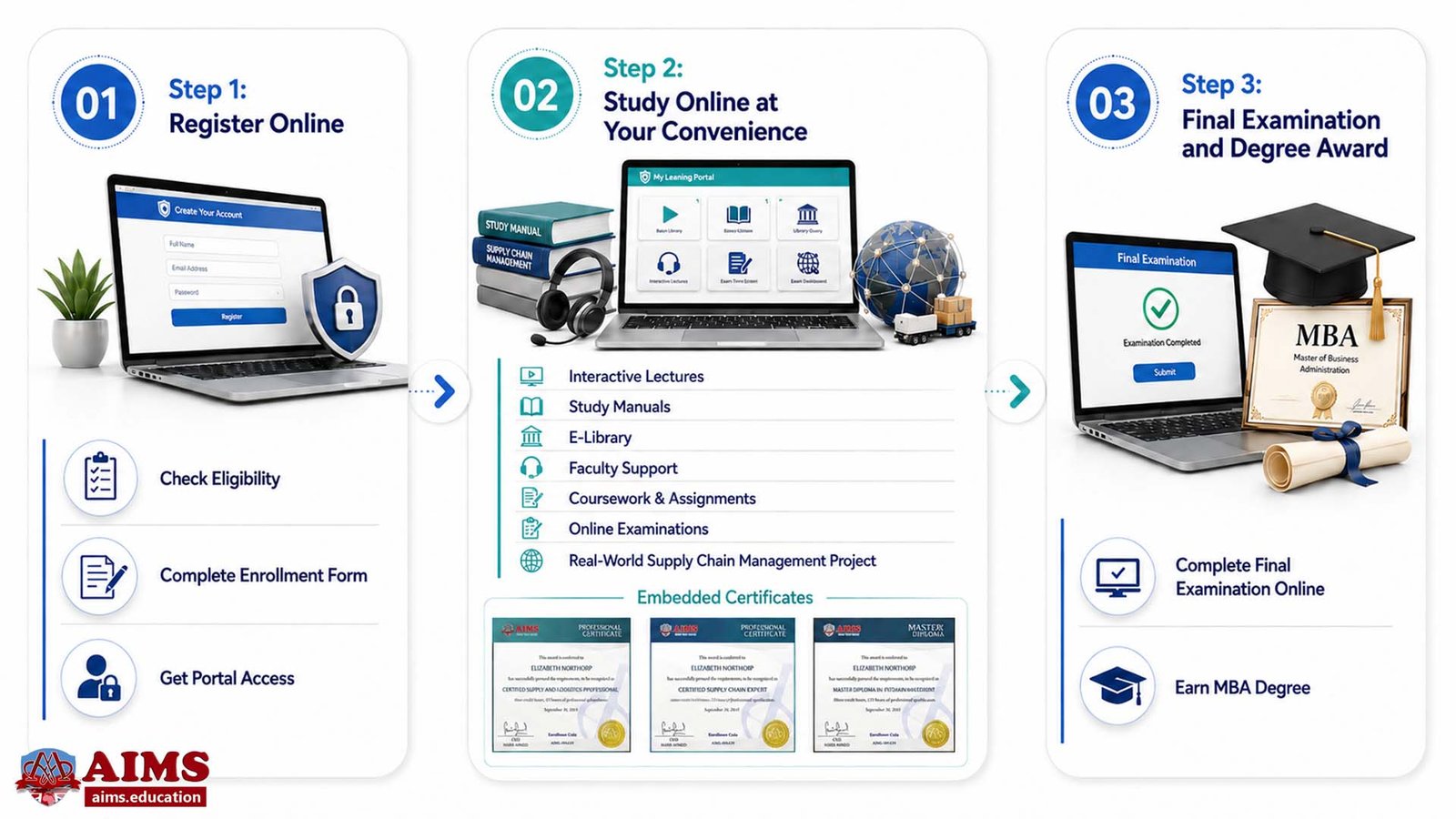
Students earn the MBA through a structured online process that begins with registration, continues through self-paced study and assessments, and concludes with semester examinations, staged awards, and a real-world supply chain project that applies learning to practical business problems.

  • Complete the online enrollment form with accurate academic and professional details.
  • The admissions team reviews the application for suitability and eligibility.
  • Successful applicants receive admission confirmation and student portal access.
  • Login credentials are normally issued after the application is reviewed and accepted.
  • Access the student portal to study interactive lectures, detailed manuals, e-library resources, and support materials.
  • Learn through structured lessons supported by practical examples, case-based learning, and supply chain applications.
  • Submit two online assignments for each course through the learning portal.
  • Complete semester examinations online according to the assessment structure.
  • Receive CSLP and CSCE certifications after Semester I and the MDSCM after Semester II.
  • Complete the required coursework, assignments, examinations, and real-world supply chain project.
  • Apply supply chain theory to a practical business case involving design, analysis, improvement, and decision-making.
  • Meet the required passing standard to qualify for the final MBA award route.
  • Use the completed MBA pathway to support career progression or future doctoral study in supply chain management.
MBA in supply chain management online three-step study process

Online Masters in Supply Chain Management: Program Structure and Qualification Ladder

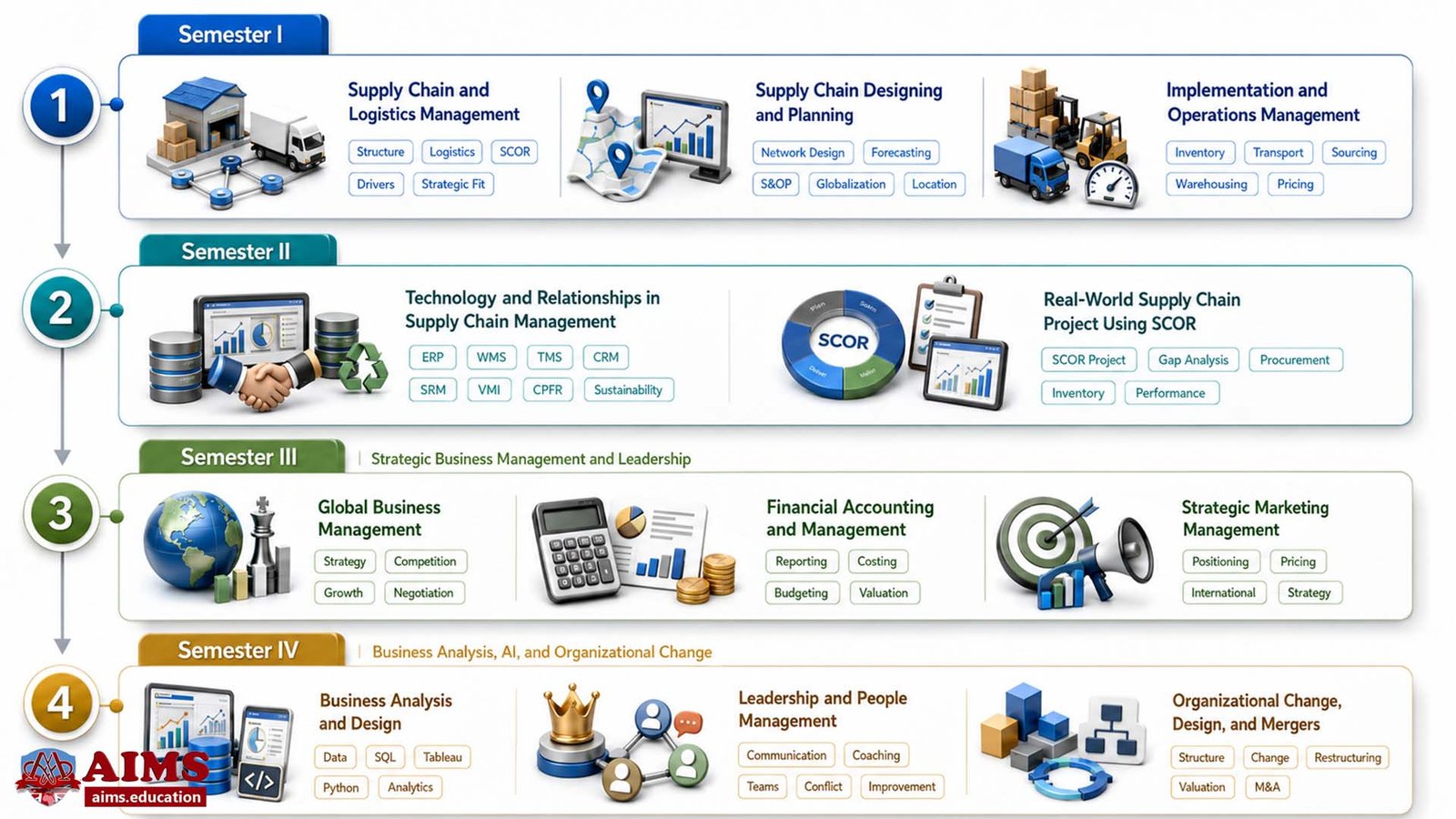
The MBA Masters in Supply Chain Management program structure is built around four semesters, with supply chain specialization first, applied project work next, and core business management courses completing the leadership pathway required for broader managerial and strategic decision-making roles.

  • Semester I: Supply Chain Certifications Stage

    Semester I builds the technical and managerial foundation for logistics and supply chain. Students study supply chain, logistics, supply chain design, planning, forecasting, distribution networks, inventory, procurement, transportation, warehouse, and operations management.

    After completing Semester I, successful students receive the Certified Supply and Logistics Professional and Certified Supply Chain Expert certifications.

  • Semester II: Master Diploma Stage

    Semester II focuses on technology, relationships, coordination, sustainability, and applied supply chain design. Students study information technology, CRM, SRM, coordination, the bullwhip effect, collaborative planning, sustainability, closed-loop supply chains, and SCOR Digital Standard based supply chain design.

    After completing Semester II, successful students receive the Master Diploma in Supply Chain Management.

  • Semesters III and IV: MBA Business Management Stage

    Semesters III and IV expand the learner’s capability beyond specialist supply chain operations. Students study global business management, financial accounting and management, strategic management, business analysis and design, leadership, people management, and organizational change.

    After completing Semester IV, students are awarded the MBA in Supply Chain Management degree, and they may progress toward a PhD in supply chain.

Online masters in supply chain management qualification structure

Curriculum for the Online MBA in Logistics and Supply Chain Management

The curriculum for the online MBA in logistics and supply chain management covers logistics, procurement, inventory, warehousing, transportation, technology, analytics, SCOR Digital Standard based supply chain design, sustainability, finance, strategy, marketing, leadership, and organizational change through structured online learning and applied examples.

Semester I: Logistics, Supply Chain Planning, Procurement, and Operations

This course introduces global, complex, and interdependent supply chains. Students examine supply chain concepts, basic supply chain structures, the SCOR model, vertical and horizontal integration, supply chain objectives, logistics objectives, and key benefits of supply chain management.

Learners also study supply chain alignment with business strategy, competitive advantage, organizational priorities, supply chain drivers, performance metrics, facilities, inventory, transportation, information, sourcing, and pricing. Logistics topics include 3PLs, 4PLs, reverse logistics, logistics relationships, and performance management.

This course develops planning capability across distribution networks, supply chain network analysis, globalization, demand forecasting, and sales and operations planning. Students learn how to assess distribution options, evaluate network design decisions, understand global trade effects, and manage predictable variability in supply and demand.

Forecasting topics include components of demand, forecasting methods, time-series analysis, forecast error, risk management, and practical forecasting decisions. S&OP topics help learners connect demand planning, supply planning, capacity decisions, and business performance.

This course focuses on day-to-day operational decisions that affect cost, speed, service quality, and reliability. Students study inventory management, cycle inventory, safety stock, service levels, reorder points, transportation networks, sourcing, procurement, supplier evaluation, total landed cost, e-sourcing, e-procurement, warehousing, and operations control.

The course helps learners understand real workplace trade-offs. For example, lower inventory may reduce holding cost, but it can also increase stockout risk. Faster transportation may improve responsiveness, but it can raise operating cost. This practical balance is central to supply chain leadership.

Semester II: Technology, Relationships, Sustainability, and Real-World Project

This course examines the technology and relationship systems that connect modern supply chains. Students study information technology, data acquisition, communication tools, supply chain optimization, interorganizational integration, electronic business, customer relationship management, supplier relationship management, and coordination across supply chain partners.

Students also examine the bullwhip effect, vendor-managed inventory, continuous replenishment, collaborative planning, forecasting and replenishment, sustainability metrics, closed-loop supply chains, and SCOR framework concepts. These topics support the practical management of digital, collaborative, and sustainable supply chain networks.

The project requires students to apply supply chain theory to a practical business scenario. Students design and configure a supply chain using the SCOR Digital Standard model, prepare data for profiling, conduct gap analysis, and develop functions for supplier management, inventory management, production planning, procurement, and related areas.

Semester-III: Strategic Business Management

Students study strategy, industry life cycle analysis, Porter’s Five Forces, competitive advantage, corporate growth, SWOT analysis, management functions, marketing strategy, accounting basics, financial statement analysis, negotiation, and business case studies.

This course covers accounting, revenue recognition, cost recognition, receivables, inventory, fixed assets, payables, financial liabilities, debt financing, equity financing, financial analysis, working capital, capital budgeting, Excel reporting, business presentations, valuation, discounted cash flow, and weighted average cost of capital.

Students study marketing strategy, internal and external assessment, business model design, pricing strategy, international marketing, and the strategic management process. This supports supply chain leaders who must understand customer value, market positioning, and commercial decision-making.

Semester-IV: Business Analysis, AI and Leadership

This course covers data science foundations, descriptive and inferential statistics, hypothesis testing, SQL, MySQL, Tableau, Python, data preprocessing, business exercises, and analytics-based decision-making. These skills support modern supply chain analytics, ERP reporting, dashboards, and data-led improvement.

Students develop leadership skills in communication, delegation, motivation, coaching, feedback, discipline, team formation, decision-making, conflict resolution, goal setting, problem solving, and process improvement. These skills are essential for managing teams across procurement, logistics, operations, and planning functions.

This course examines organizational structure, strategy, systems, styles, staff, skills, shared values, change management, restructuring, entrepreneurship, valuation, and mergers and acquisitions. It prepares learners to manage transformation in supply chain networks and business operations.

Real World Supply Chain Management Application

The supply chain management project is one of the strongest practical elements of AIMS’ MBA in supply chain management. It helps students move from knowing supply chain concepts to applying them in structured problem-solving, process improvement, and strategic supply chain design.

Explore the MBA Supply Chain Management Learning Experience

Preview how the MBA in Supply Chain Management is delivered through interactive online lectures, structured coursework, practical assignments, and real-world supply chain project work.

mba in supply chain management

Demo Lecture

A demo lecture helps prospective learners understand how supply chain, logistics, procurement, operations, analytics, and business leadership topics are taught through structured online learning.

Online MBA in logistics and supply chain management semester courses

MBA Supply Chain Coursework

The online mba in logistics and supply chain management coursework is designed to build practical logistics and supply chain management skills through guided study, applied assignments, case-based learning, and real-world supply chain analysis.
Who Should Attend the MBA Supply Chain Management Program?

This MBA is designed for graduates, working professionals, managers, career changers, entrepreneurs, consultants, and supply chain practitioners who want to develop advanced logistics, procurement, operations, analytics, and business leadership skills through flexible online study.

  • Supply chain professionals who want to move into senior management or leadership roles.
  • Logistics and operations professionals who want broader business and strategic capability.
  • Procurement and sourcing specialists who want to improve supplier, cost, and risk decisions.
  • Warehouse, inventory, and distribution professionals who want to progress beyond operational roles.
  • Business analysts and planners working with supply chain data, demand, capacity, and performance.
  • Managers in manufacturing, retail, e-commerce, healthcare, construction, technology, or service industries.
  • Entrepreneurs and consultants who want to design, improve, or advise on supply chain systems.
  • Graduates seeking a structured online MBA route with supply chain specialization and business management depth.

Hear from Our Global Learners!

“The MBA in Supply Chain Management helped me connect business management with logistics and supply chain strategy. The project work was especially valuable because it required practical problem-solving, not just theory. The combination of supply chain specialization and management courses prepared me for wider responsibility in global logistics.”

Carlos Williams, USA

“The flexible online model allowed me to study while managing work and family commitments. The SCOR-based project helped me apply the curriculum directly to workplace challenges, and the staged credentials gave me confidence as I progressed through the program.”

Sarah Johnson, UK

“The interactive lectures made complex supply chain concepts easier to understand. Faculty support was responsive, and the study manuals gave clear structure to each subject. The MBA gave me practical tools for logistics, operations, and supply chain decision-making.”

Lisa Northorpe, France

Key Features of AIMS’ MBA Supply Chain Management

  • 100% Online and Self-Paced Learning

    The online learning model allows students to study at any time and from any location. This flexibility is especially useful for working professionals, international learners, managers, parents, and entrepreneurs who need a recognized academic pathway without fixed classroom attendance. Self-paced learning does not mean unstructured learning. The program follows defined courses, assignments, examinations, project requirements, and completion standards. Students are expected to study consistently and complete each stage according to the academic requirements.

  • Interactive Lectures and Real-World Examples

    The curriculum is delivered through interactive e-lectures supported by detailed study manuals for each course. These resources are designed to explain complex topics in a structured, engaging, and practical way. Case studies, real-world examples, and applied explanations help learners connect theory with business practice. This is important because supply chain management is not only a technical discipline. It requires judgment, coordination, financial awareness, technology awareness, and leadership.

  • Career Opportunities Globally

    Roles supported by the MBA include:

    • Senior Supply Chain Manager.
    • Logistics Manager.
    • Procurement Manager.
    • Operations Manager.
    • Warehouse Manager.
    • Sourcing and Demand Planning Manager.
    • Inventory Planning Manager.
    • Business Analyst in supply chain environments.
    • Supply Chain Consultant.
    • Director of Logistics.
    • Head of Supply Chain Operations.
    • Supply Chain Transformation Manager.
    • Chief Procurement or Supply Chain leadership roles.
  • Degree Is Useful Across Various Industries

    MBA supply chain management graduates can pursue roles in logistics, procurement, operations, planning, warehousing, sourcing, consulting, analytics, transformation, and senior supply chain leadership across manufacturing, retail, services, healthcare, technology, public sector, and global trade environments.

    The degree is relevant across industries where goods, services, suppliers, data, people, and customer expectations must be coordinated effectively. These include manufacturing, retail, e-commerce, distribution, logistics services, healthcare, construction, energy, food supply, technology, consulting, government, and international trade.

  • Senior Supply Chain Roles & Career Outcomes

    This broader MBA structure is valuable because senior supply chain roles require cross-functional decision-making. A procurement decision may affect working capital. A transport decision may affect customer service. A warehouse decision may affect technology investment. A sourcing decision may affect risk, sustainability, and resilience.

    Career outcomes depend on prior experience, industry demand, geographic market, professional performance, leadership capability, and the learner’s ability to apply the program’s knowledge in real business environments. The MBA supports progression, but it does not guarantee a specific job title or salary.

  • Leadership Progression in Supply Chain

    An Online MBA in Supply Chain Management is often pursued for its high Return on Investment (ROI). Graduates in this field frequently see specialized roles in global logistics and procurement that command senior-level management salaries.

    The program supports leadership progression by combining operational expertise with business management capability. Students do not only study movement of goods. They also study finance, accounting, strategy, marketing, analytics, negotiation, people management, and change.

Start Your Online MBA in Supply Chain Management

This MBA is designed for learners who want flexible online study, master’s-level business education, practical supply chain skills, embedded credentials, and career-focused progression. It provides a structured route from supply chain learning to leadership-oriented business capability.

Review the curriculum, eligibility, fee details, scholarship options, study resources, and admissions requirements before applying. The program is a strong fit for professionals who want an MBA master’s degree with practical supply chain, logistics, procurement, operations, analytics, and leadership relevance.

Next step: Review the full curriculum, check your eligibility and fee details, request information, or begin the online application for the MBA in Supply Chain Management.

    Frequently Asked Questions

    An online MBA in supply chain management is a master’s-level business degree pathway delivered online with a specialization in supply chain, logistics, procurement, inventory, transportation, operations, analytics, and leadership. It combines business management education with practical supply chain decision-making.

    AIMS is a UK-registered institution with accreditation-related quality recognition and CPD professional development accreditation. The MBA route follows the applicable accredited and reputed partner-university degree pathway after completion of the required academic stages, while AIMS awards its own certificates and Master Diploma qualifications.

    The average completion time is 10 to 12 months, with registration validity of two years. The exact duration depends on study pace, weekly availability, assignment completion, examination readiness, project progress, and the learner’s personal or professional commitments.

    The curriculum includes supply chain and logistics management, design and planning, implementation and operations, technology and relationships, a real-world SCOR Digital Standard (SCOR-DS) based project, global business management, financial accounting, strategic marketing, business analysis, leadership, people management, and organizational change.

    Students receive the Certified Supply and Logistics Professional and Certified Supply Chain Expert certifications after Semester I. After Semester II, successful students receive the Master Diploma in Supply Chain Management. The final MBA route is completed after all required courses, assessments, and project work.

    Yes. The program is designed for working professionals because it is fully online, self-paced, and supported by interactive lectures, study manuals, faculty guidance, online assignments, examinations, and practical project work. Students can study while continuing professional responsibilities.

    Graduates may pursue roles such as supply chain manager, logistics manager, procurement manager, operations manager, warehouse manager, sourcing manager, demand planning manager, supply chain analyst, supply chain consultant, logistics director, and senior supply chain leadership roles.

    This MBA is broader and more management-oriented. It combines supply chain specialization with finance, strategy, marketing, leadership, business analysis, and change management. A specialized masters in supply chain management online may focus more narrowly on technical supply chain theory, analytics, or research.

    No. Logistics is a major part of supply chain management, but it is not the whole discipline. Logistics focuses on movement, storage, distribution, and delivery. Supply chain management also covers sourcing, procurement, planning, inventory, supplier relationships, operations, analytics, technology, sustainability, and strategy.

    Yes. The MBA in Supply Chain Management provides a strong academic and professional foundation for learners who later want to progress toward a PhD or doctorate in supply chain management, subject to the admissions requirements of the doctoral pathway.