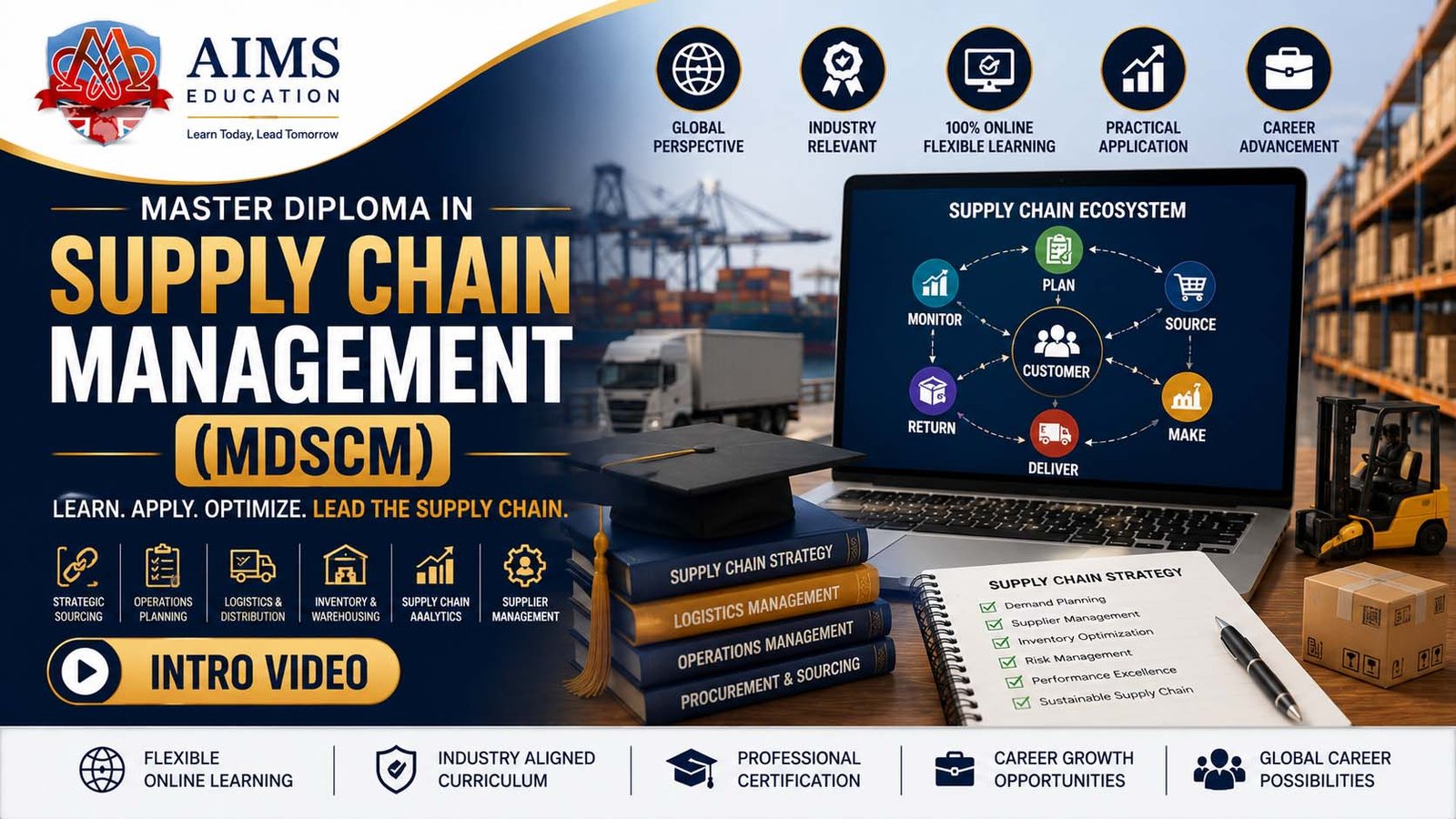
Supply Chain Management Diploma Online at AIMS is a Level 6 online diploma pathway for learners who want practical capability in logistics, procurement, planning, operations, technology, and supply chain design. The program is delivered fully online, includes the Master Diploma in Supply Chain Management (MDSCM), and supports progression from professional certification toward advanced AIMS supply chain study.

MDSCM gives learners a structured route into modern supply chain practice by combining logistics foundations with broader supply chain strategy, planning, procurement, operations, technology, and applied design skills needed in competitive business environments.

The program is designed for working professionals, graduates, supervisors, managers, consultants, and business owners who want a structured online diploma in logistics and supply chain management without pausing their career. Students study through interactive lectures, comprehensive study manuals, faculty support, online assignments, examinations, and a real-world SCOR-based supply chain project.

online diploma in supply chain management

MDSCM Course Learning Objectives

MDSCM is designed to develop practical supply chain capability through structured theory, case-based learning, interactive lectures, comprehensive manuals, and applied project work. Students build decision-making skills across logistics, procurement, operations, technology, and strategic supply chain design.

  • Students learn how to design, analyze, and optimize supply chains across global and local business settings.
  • Students develop knowledge of logistics, production, warehousing, transportation, inventory, sourcing, and procurement.
  • Students build analytical skills for improving service levels, controlling costs, and strengthening supply chain performance.
  • Students study supply chain technologies, including ERP, WMS, TMS, data acquisition tools, CRM, and SRM systems.
  • Students apply theory through practical examples, industry-style scenarios, and a real-world SCOR-based project.
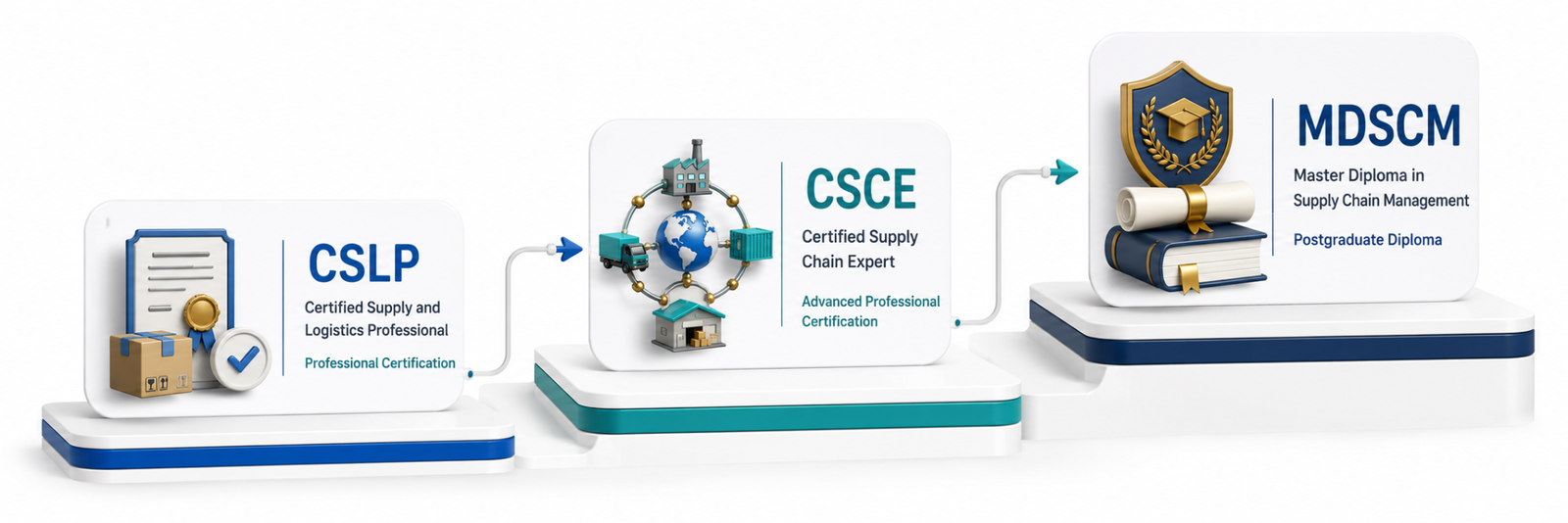
  • Students gain staged recognition through CSLP, CSCE, and the final MDSCM diploma award.

Accreditation, Career Value and Academic Progression

The recognition value of the supply chain management diploma comes from AIMS’ institutional registration, accreditation profile, structured curriculum, practical assessments, and staged certification pathway. The page should interpret recognition carefully, separating provider registration, accreditation, CPD context, and Level 6 study level.

  • UK Registration, QAHE, CPD, and Level 6 Diploma

    AIMS is registered with the UK Register of Learning Providers, holds international accreditation from QAHE, and has CPD accreditation in the United Kingdom. These signals support institutional credibility and professional learning quality. Level 6 describes the study level and should not be confused with a government-regulated master’s degree claim.

  • Career Progression in Supply Chain and Logistics

    The program supports career progression in supply chain and logistics by strengthening practical capability in planning, sourcing, inventory control, warehouse management, transport decisions, technology use, supplier coordination, and supply chain performance improvement. Relevant roles may include supply chain coordinator, logistics manager, procurement officer, operations manager, warehouse manager, supply chain analyst, and regional supply chain manager.

Supply Chain Diploma: A Quick Review

Program AreaDetails
Award NameMaster Diploma in Supply Chain Management (MDSCM)
Study Mode100% online and self-paced
Level ContextLevel 6 online diploma pathway for advanced professional development
DurationAverage completion in 4 to 5 months
Weekly Study LoadUsually 10 to 12 hours per week
Courses and ProjectFour theory courses and one real-world supply chain project
AssessmentEight MCQ-based assignments, semester examinations, and applied project work
Certifications AwardedCSLP and CSCE after Semester I, and MDSCM after Semester II
Credit Value18 AIMS credit hours for the MDSCM pathway
Progression RouteSupports progression toward the AIMS MBA in Supply Chain Management pathway where eligibility requirements are met
Quick summary of the AIMS Master Diploma in Supply Chain Management online pathway.
FeaturesAIMS’ Master Diploma in Supply Chain ManagementOther Diplomas
Study FormatFully online and self-paced for working professionals.May be online, classroom-based, fixed schedule, or blended.
Curriculum ScopeCovers logistics, procurement, planning, operations, technology, relationships, sustainability, and SCOR-based design.Often focuses on selected logistics or operations topics, depending on provider structure.
Practical LearningIncludes real-world case studies, applied examples, and a SCOR-based supply chain project.May include case studies, but project depth varies by program.
Stacked RecognitionAwards CSLP and CSCE after Semester I, and MDSCM after Semester II.May award one final diploma only, without staged certifications.
AssessmentUses assignments, semester examinations, and applied project work.Assessment may rely on exams, assignments, attendance, or project work.
ProgressionSupports progression toward AIMS’ MBA in Supply Chain Management and PhD Supply Chain pathway where eligibility requirements are met.Progression depends on the awarding structure and institutional policies.
Decision-support comparison between AIMS’ MDSCM and general diploma options available in the market.

How to Earn the Diploma in Logistics and Supply Chain Management Online

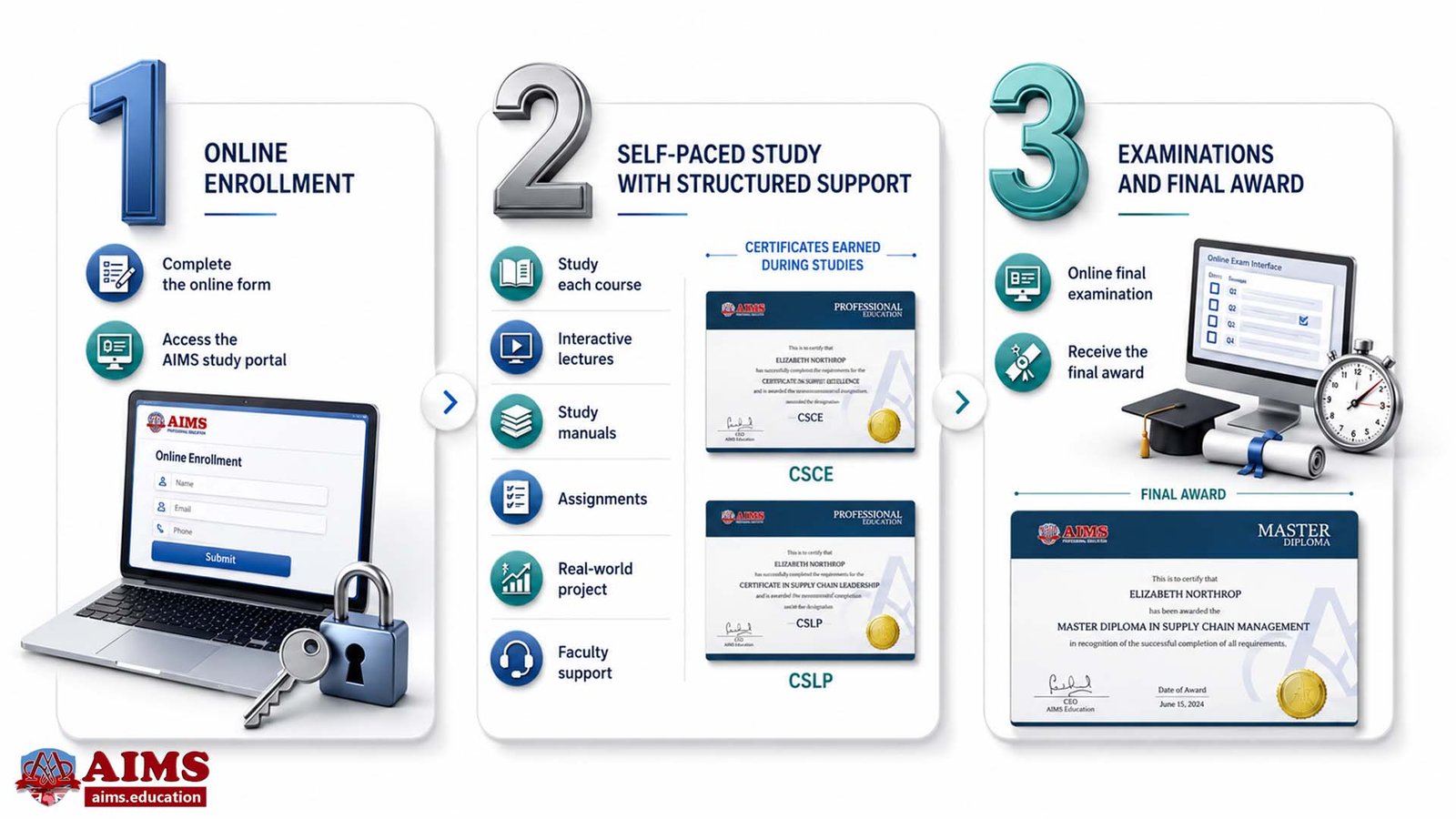
The online diploma follows a clear study process from enrollment to certification. Students receive access to the learning portal, study through interactive lectures and manuals, complete assignments, sit semester examinations, finish the SCOR project, and earn staged AIMS credentials.

Students complete the online enrollment process and submit the required fee. After registration is processed, access to the AIMS online study portal is normally provided within 1 to 2 working days, allowing students to begin the program without waiting for a fixed intake date.

Students study each course through high-quality, interactive, and engaging lectures supported by comprehensive study manuals. The materials are designed to explain concepts clearly and connect them with practical examples, real-world case studies, and job-relevant supply chain situations.

  • Students access online lectures for each course.
  • Students use comprehensive e-manuals prepared around the curriculum.
  • Students receive support from supply chain faculty.
  • Students use the supply chain e-library for additional learning.
  • Students complete two MCQ-based assignments for each theory course.

After completing the Semester I courses and assignments, students may request the first semester examination. Successful students receive CSLP and CSCE certifications. In Semester II, students complete the final course, assignments, SCOR project, final examination, and then receive the MDSCM award.

diploma in logistics

Certifications, Graduate Credits, and Academic Progression

The MDSCM is structured as a progressive qualification pathway, allowing students to earn professional certifications during the program and use the diploma toward further academic development. This gives learners both immediate career value and a clear route for continuing into higher supply chain management studies.

  • After Semester II, including the final course and real-world supply chain project, students receive the Master Diploma in Supply Chain Management (MDSCM).
diploma in supply chain management

Curriculum for the Supply Chain Management Diploma Online

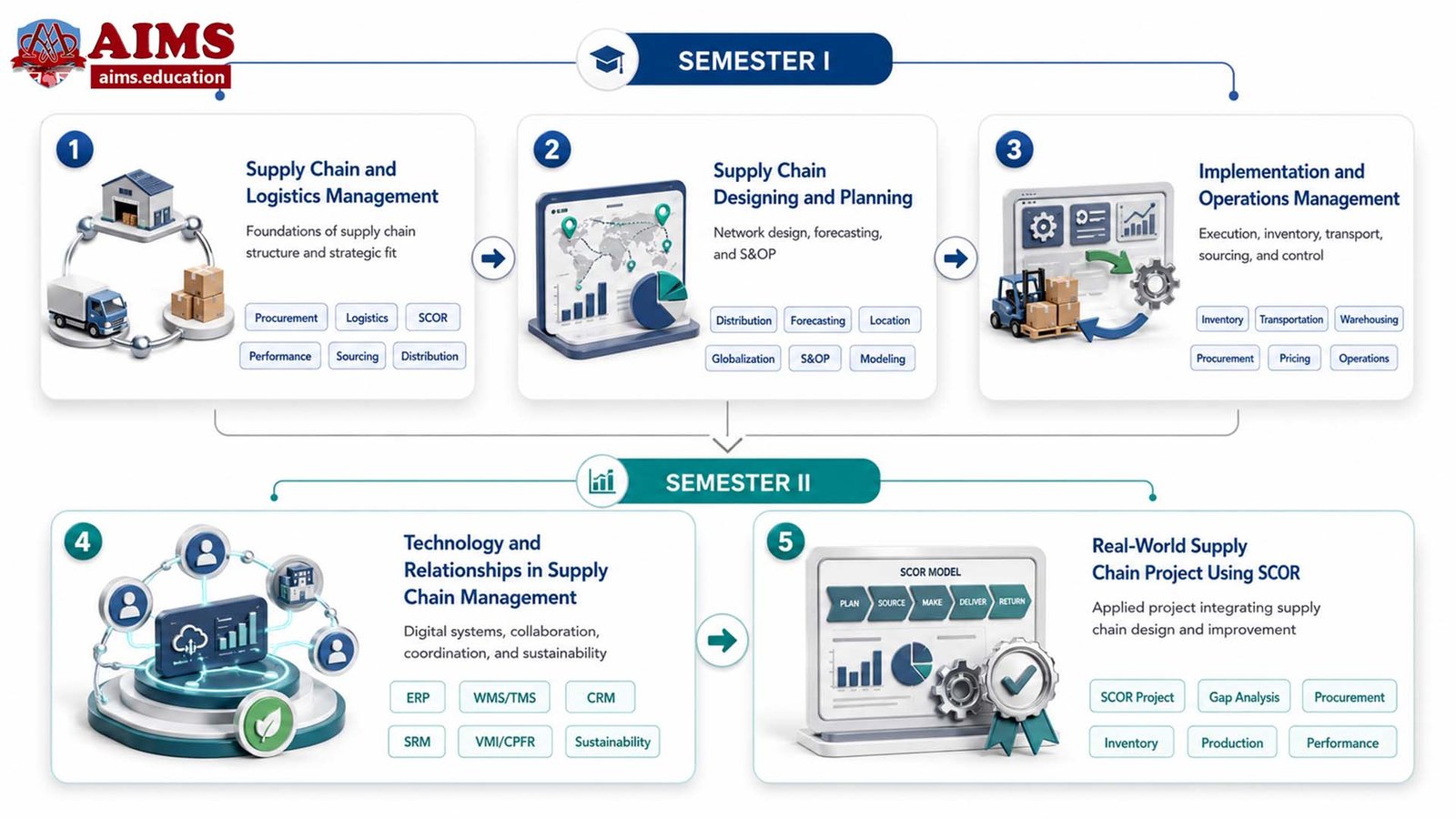
The MDSCM curriculum is divided into two semesters, moving students from supply chain foundations to advanced planning, technology, coordination, and real-world application. Each course is supported by interactive lectures, comprehensive study manuals, practical examples, and case-based learning.

Semester I: Logistics, Supply Chain Planning, Procurement, and Operations

Semester I builds the core knowledge required to understand how supply chains operate. Students study logistics fundamentals, supply chain design, forecasting, procurement, inventory, warehousing, transportation, and operational control before earning the CSLP and CSCE certifications.

This course builds the foundation of the Supply Chain Management Diploma Online by explaining how supply chains, logistics systems, business strategy, and performance objectives work together. Students learn how products, information, suppliers, facilities, transportation, and customer demand connect across modern supply networks. The course also introduces logistics relationships, third-party logistics, reverse logistics, strategic fit, and the key drivers that influence cost, service, responsiveness, and operational efficiency.

  • Core supply chain and logistics management concepts.
  • Business strategy, competitive advantage, and supply chain alignment.
  • Facilities, inventory, transportation, information, sourcing, and pricing drivers.
  • Third-party logistics, fourth-party logistics, reverse logistics, and logistics partnerships.
  • Supply chain performance, customer service, cost control, and strategic fit.

This course develops the planning skills required to design effective supply chain networks and respond to changing market demand. Students study distribution network design, facility location decisions, globalization, demand forecasting, and sales and operations planning. The course helps learners understand how companies balance cost, service, capacity, supply, and demand while building supply chains that are flexible, efficient, and aligned with business goals.

  • Distribution network design and supply chain network planning.
  • Facility location decisions, logistics modeling, and long-range planning.
  • Global supply chain challenges, trade zones, and dispersed supply and demand.
  • Demand forecasting methods, forecast error, smoothing techniques, and planning accuracy.
  • Sales and operations planning for balancing supply, demand, and capacity.

This course focuses on the operational decisions that keep supply chains productive, reliable, and cost-effective. Students examine inventory management, transportation design, sourcing, procurement, warehousing, pricing, revenue management, and operations planning. Through practical examples and case-based learning, the course connects supply chain theory with workplace decisions involving stock levels, supplier selection, warehouse flow, transport networks, capacity control, and performance improvement.

  • Inventory management, safety stock, service levels, order points, and review systems.
  • Transportation modes, network design, infrastructure, risk, and delivery decisions.
  • Sourcing, procurement, supplier selection, vendor evaluation, and total landed cost.
  • Warehouse management, storage planning, operational flow, and performance control.
  • Operations planning, capacity management, demand prioritization, and supply chain coordination.

Semester II: Supply Chain Technology, Relationships, Sustainability, and Real-World Project

Semester II develops advanced supply chain capability by focusing on technology, CRM, supplier relationship management, coordination, sustainability, SCOR framework application, and real-world supply chain design.

This course explains how technology, data, customer relationships, supplier relationships, coordination, and sustainability improve supply chain performance. Students study the digital systems and collaborative practices used to increase visibility, reduce delays, improve service, and strengthen decision-making. The course also covers CRM, SRM, supply chain integration, the bullwhip effect, collaborative planning, vendor-managed inventory, and sustainable supply chain practices.

  • ERP, WMS, TMS, data acquisition, communication tools, and optimization systems.
  • Customer relationship management and service-focused supply chain decisions.
  • Supplier relationship management, supplier alliances, and technology-enabled collaboration.
  • Coordination, the bullwhip effect, continuous replenishment, VMI, and CPFR.
  • Sustainability metrics, closed-loop supply chains, and responsible supply chain decisions.

The real-world supply chain project is the applied learning component of the MDSCM program. Students use the SCOR framework to design and configure a practical supply chain for a business scenario. This project helps learners connect logistics, procurement, inventory, supplier management, production planning, performance measurement, and operational coordination into one structured solution. It strengthens job-ready skills by requiring students to analyze gaps, organize supply chain data, design functional processes, and present a practical improvement model.

  • Apply the SCOR framework to a practical supply chain design scenario.
  • Prepare supply chain data, identify process gaps, and structure improvement priorities.
  • Design key functions for supplier management, procurement, inventory, and production planning.
  • Connect logistics, operations, technology, and performance measurement in one applied project.
  • Demonstrate practical problem-solving, analytical thinking, and supply chain design capability.

Explore the MDSCM Diploma Learning Experience

The Supply Chain Management Diploma Online at AIMS is supported by demo lectures, sample certification details, and structured coursework. These resources help learners understand the teaching style, qualification outcome, and practical curriculum before starting the program.

logistics diploma

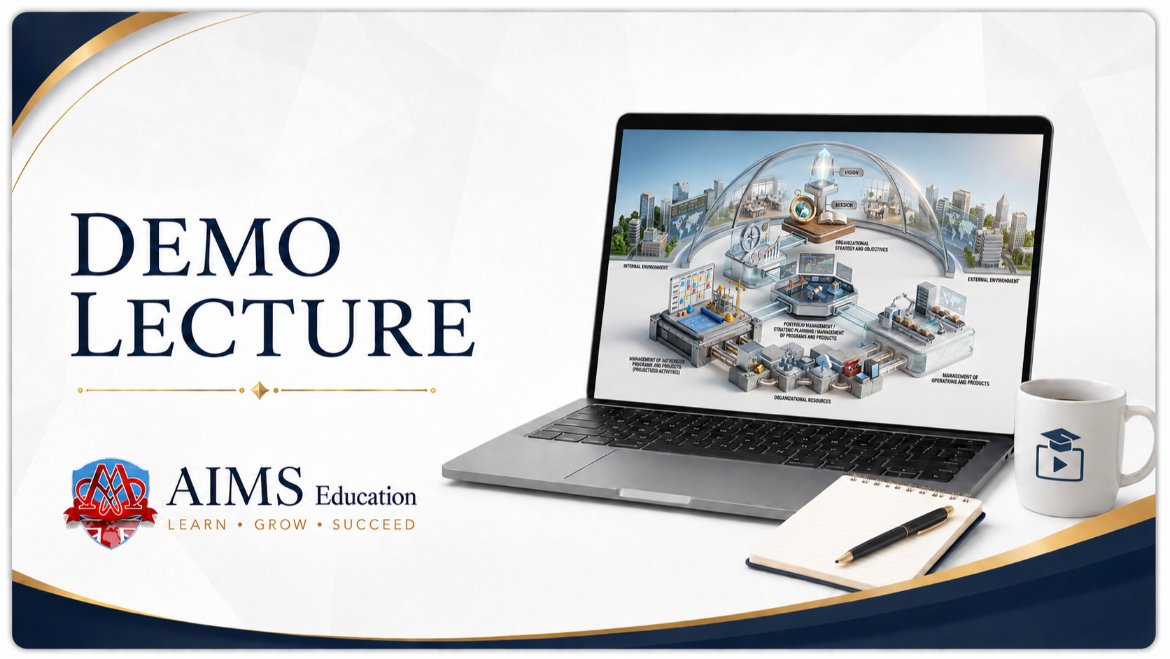
Demo Lecture

A demo lecture helps prospective learners review the online teaching approach and see how supply chain, logistics, procurement, and operations concepts are explained through clear instruction, practical examples, and case-based learning.

diploma in logistics and supply chain management online

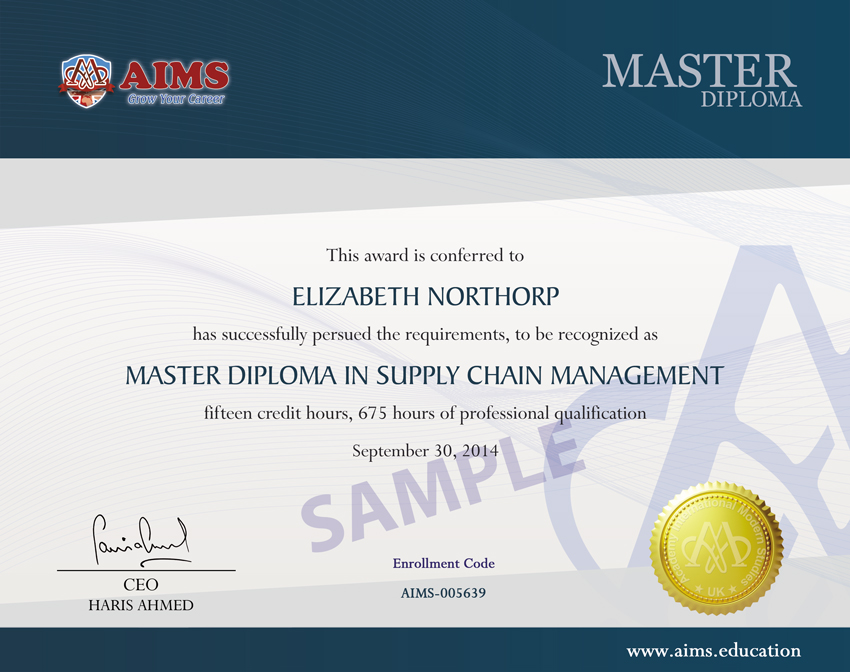
Sample Certificate

The sample certificate shows the qualification format awarded after successful completion of the Master Diploma in Supply Chain Management. It helps learners understand the professional recognition, academic value, and certification pathway connected with the MDSCM program.

curriculum of the online supply chain management diploma

Coursework

The coursework is structured to build knowledge from supply chain foundations to applied logistics, planning, procurement, inventory, warehousing, technology, sustainability, and SCOR-based project work for practical supply chain management skills.

Hear from Our Global Learners

“AIMS’ supply chain management diploma improved my approach to strategic supply chain management. The flexible online format helped me balance work and study, while the structured curriculum, interactive content, and faculty support helped me gain practical knowledge.”

Sarah Johnson, USA

“The Master Diploma in Supply Chain Management gave me the confidence to make better decisions for my company’s supply chain. The lectures, manuals, and responsive faculty made the learning process structured and manageable.”

Jamie Smith, UAE

“The online diploma in supply chain management helped me advance my career while balancing my job and family. The content was engaging, practical, and relevant to senior managerial work.”

Kemal Yılmaz, Turkey

“The diploma equipped me with industry-relevant skills and a global perspective. I was able to apply what I learned directly at work, and the flexible lectures made the program suitable for my schedule.”

Marie Dubois, France

Key Features of the Supply Chain Management Diploma

The key features of the diploma are its Level 6 positioning, online flexibility, staged certifications, practical learning model, supply chain technology coverage, SCOR-based project, and progression value. Together, these features make MDSCM stronger than a narrow logistics course.

  • Structured online learning: Students follow a clear course sequence supported by lectures, manuals, assignments, exams, and faculty guidance.
  • Practical case-based teaching: Topics are explained through real-world examples that connect theory with supply chain decisions.
  • Industry-focused curriculum: The program covers logistics, planning, procurement, warehousing, inventory, transportation, operations, technology, and sustainability.
  • SCOR project application: Students apply supply chain theory by designing and configuring a practical supply chain model.
  • Staged certification pathway: Students earn CSLP and CSCE before completing the final MDSCM diploma.
  • Progression value: The diploma supports movement toward the AIMS MBA in Supply Chain Management pathway where eligibility requirements are met.
  • Why the Supply Chain Management Diploma Online Fits Working Professionals

    AIMS’ online format allows students to study from any location and progress at a pace that suits professional and personal commitments. The learning system is structured, not informal. Students follow a defined curriculum, complete assignments, prepare for semester examinations, and apply their learning through a practical project.

  • What Makes This Diploma Different From a Short Certification

    A short certification usually focuses on a limited professional skill area. The MDSCM pathway is broader because it combines logistics, supply chain design, forecasting, procurement, warehousing, transportation, technology, coordination, sustainability, and applied SCOR-based project work within one coherent diploma structure.

Who Should Choose the MDSCM Program

  • Graduates who want to enter logistics, procurement, operations, or supply chain management.
  • Working professionals who want a broader qualification than a short logistics certificate.
  • Supervisors and managers who need stronger planning, inventory, transport, and sourcing skills.
  • Entrepreneurs and business owners who want to improve supplier, warehouse, and delivery performance.
  • Consultants and advisors who need structured knowledge of supply chain strategy and design.

Start Your Online Supply Chain Diploma with AIMS

The next step is to review the curriculum, confirm eligibility and fee details, try sample lectures, and begin the application process. MDSCM gives learners a structured route to build practical supply chain capability through flexible online study.

Start your self-paced online supply chain diploma with AIMS and build job-ready skills in logistics, procurement, planning, operations, technology, and applied supply chain design. Check eligibility, review the fee and scholarship route, explore free lectures, and enroll when ready to begin.

    FAQ About Online Supply Chain Diploma

    It is AIMS’ Level 6 online diploma pathway in logistics and supply chain management. The program covers supply chain strategy, logistics, planning, procurement, inventory, warehousing, transportation, operations, technology, sustainability, and a real-world SCOR-based project.

    Yes. The program begins with foundational supply chain and logistics concepts, so prior formal education in supply chain management is not required. Learners should meet the eligibility criteria and have working knowledge of English.

    Level 6 describes the academic and professional level of study. It signals advanced professional learning, but it should not be confused with a Level 7 master’s degree. MDSCM is a diploma pathway, not a university master’s degree.

    No. The term Master Diploma is the name of the AIMS diploma award. It is not the same as a university master’s degree. The program is positioned as a Level 6 online diploma pathway for advanced professional development.

    The average completion time is 4 to 5 months. Students usually study 10 to 12 hours per week, although the self-paced structure allows committed learners to progress according to their schedule.

    Students receive the Certified Supply and Logistics Professional (CSLP) and Certified Supply Chain Expert (CSCE) certifications after successfully completing Semester I. The final MDSCM diploma is awarded after Semester II.

    A diploma focused only on logistics usually emphasizes transportation, warehousing, distribution, and flow of goods. A broader supply chain management diploma also includes sourcing, procurement, planning, operations, supplier coordination, technology, sustainability, and strategic supply chain design.