
Choosing the right supply chain qualification depends on your current experience, professional responsibilities, career goals, and academic objectives. This comparison helps learners compare supply chain management programs offered by AIMS, including CSLP, CSCE, MDSCM, MBA in Supply Chain Management, and PhD in Supply Chain Management, before selecting the qualification that best matches their needs.
AIMS offers supply chain and logistics qualifications for different professional and academic objectives:
- Certified Supply and Logistics Professional (CSLP): Professional certification that develops practical knowledge of logistics, transportation, warehousing, inventory, distribution, and supply chain operations.
- Certified Supply Chain Expert (CSCE): Advanced professional certification that develops broader end-to-end capability across logistics, planning, procurement, inventory, operations, technology, supply chain strategy, and performance improvement.
- Master Diploma in Supply Chain Management (MDSCM): Advanced professional diploma that develops applied capability across supply chain planning, logistics, procurement, operations, technology, sustainability, SCOR concepts, and real-world supply chain improvement. The program includes the CSLP and CSCE qualifications.
- MBA in Supply Chain Management: Master’s degree that combines advanced supply chain management with business strategy, finance, analytics, leadership, marketing, organisational management, and decision-making. The program incorporates MDSCM, CSCE, and CSLP within its academic structure.
- PhD in Supply Chain Management: Research-based doctorate focused on supervised independent research, dissertation development, and original contribution to supply chain management knowledge or professional practice.
The comparison below shows how these programs differ in qualification type, learner profile, academic focus, and professional value, helping learners identify the option most appropriate for their background and long-term objectives.
Supply Chain Management Program Comparison Table
Use this table to compare supply chain management programs at AIMS and understand the main differences between professional certification, Master Diploma, MBA, and doctoral research.
| Program | Best Suited For | Qualification Type | Main Learning Focus | Professional Value |
|---|---|---|---|---|
| Certified Supply and Logistics Professional (CSLP) | Beginners, graduates, logistics staff, business owners, and professionals seeking practical knowledge of logistics and supply chain operations. | Professional certification | Logistics management, transportation, warehousing, inventory, distribution, supply chain concepts, logistics service providers, reverse logistics, and performance measures. | Develops practical capability for logistics operations, coordination, inventory, warehousing, transportation, distribution, and related supply chain responsibilities. |
| Certified Supply Chain Expert (CSCE) | Professionals and learners seeking broader capability across logistics, planning, procurement, inventory, transportation, warehousing, and operations. | Advanced professional certification | End-to-end supply chain management, network design, demand planning, S&OP, inventory, transportation, sourcing, procurement, warehousing, technology, and performance improvement. | Strengthens practical and analytical capability across multiple supply chain functions for professional, supervisory, and operational responsibilities. |
| Master Diploma in Supply Chain Management (MDSCM) | Professionals seeking advanced applied knowledge for supply chain, logistics, procurement, planning, operations, and managerial responsibilities. | Master Diploma, including CSLP and CSCE | Advanced supply chain management, logistics, procurement, planning, technology, CRM, SRM, coordination, sustainability, SCOR concepts, and a real-world supply chain project. | Develops advanced practical and managerial capability for supply chain improvement, coordination, analysis, implementation, and management responsibilities. |
| MBA in Supply Chain Management | Managers, executives, consultants, entrepreneurs, and experienced professionals seeking supply chain expertise together with broader business leadership capability. | Master’s degree, incorporating MDSCM, CSCE, and CSLP | Advanced supply chain management together with business strategy, finance, marketing, analytics, leadership, people management, organisational change, and strategic decision-making. | Combines supply chain expertise with broader business and leadership capability for management, consulting, strategic operations, transformation, and senior leadership responsibilities. |
| PhD in Supply Chain Management | Experienced professionals, researchers, academics, consultants, and senior practitioners pursuing advanced research in supply chain management. | Research-based doctorate | Supervised doctoral research, research methodology, dissertation development, evidence-based analysis, and investigation of advanced supply chain management issues. | Develops advanced research capability for academic work, specialist consulting, policy, senior advisory responsibilities, and original contribution to supply chain management knowledge or practice. |
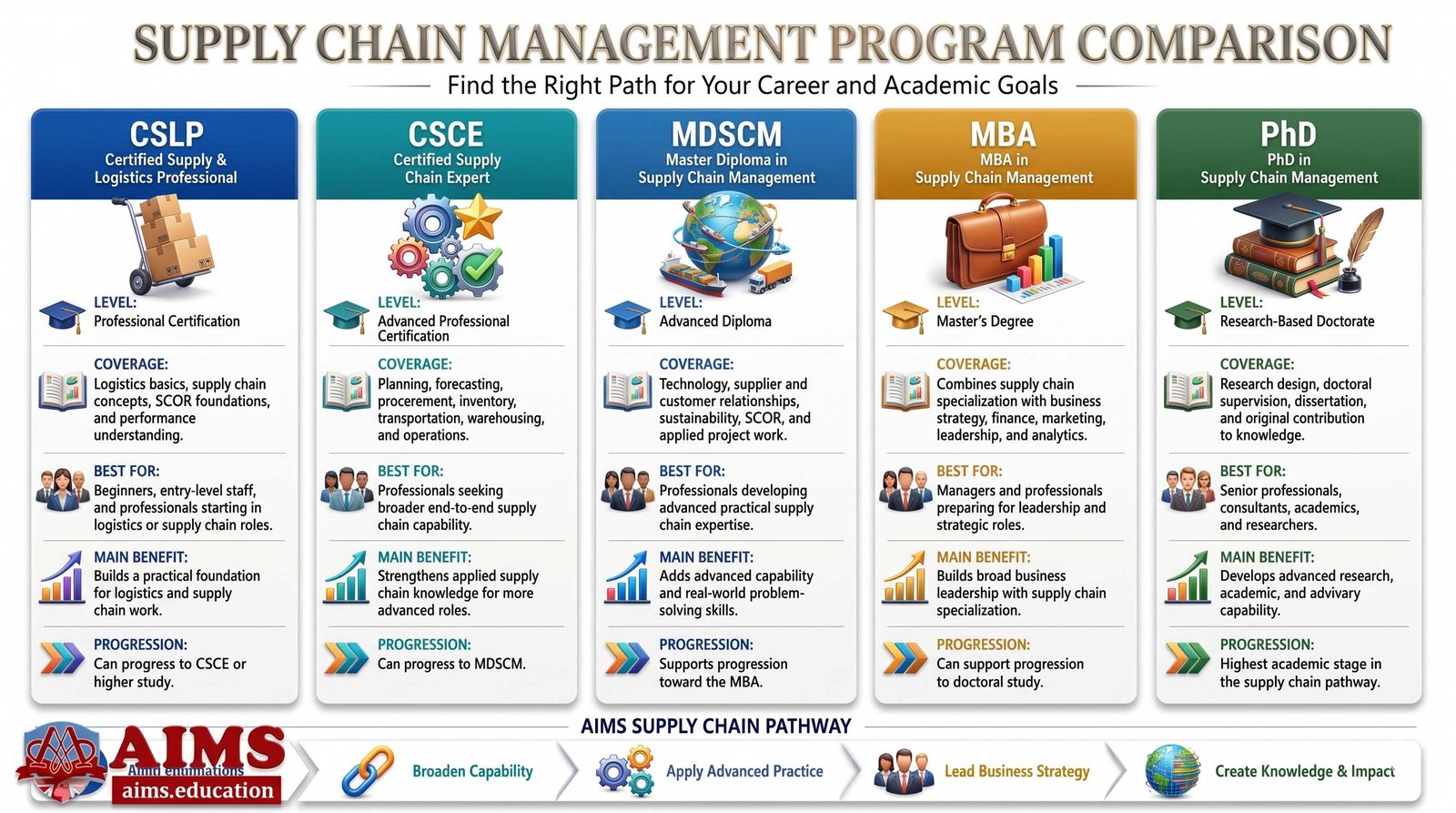
Academic Scope of AIMS Supply Chain Programs
The programs differ in the depth and breadth of logistics, planning, procurement, operations, technology, business management, applied project work, and research. The table below compares their academic scope in more detail.
| Academic Area | CSLP | CSCE | MDSCM | MBA | PhD |
|---|---|---|---|---|---|
| Supply Chain and Logistics Foundations | Core focus | Included | Included | Included | Research application where relevant |
| SCOR Model, Supply Chain Drivers, and Performance Metrics | Introductory | Applied | Advanced | Advanced application | Possible research area |
| Logistics, 3PL, 4PL, Reverse Logistics, and Service Relationships | Core focus | Included | Advanced | Advanced application | Possible research area |
| Distribution Network Design and Global Supply Chain Planning | Foundation relevance | Core focus | Advanced | Advanced application | Possible research area |
| Demand Forecasting and Sales and Operations Planning | Not a core focus | Core focus | Advanced | Advanced application | Possible research area |
| Inventory, Transportation, Procurement, Warehousing, and Operations | Introductory relevance | Core focus | Advanced | Advanced application | Possible research area |
| Technology, CRM, SRM, Coordination, and Supply Chain Sustainability | Limited coverage | Relevant coverage | Core focus | Advanced application | Possible research area |
| Real-World Supply Chain Project Using SCOR Concepts | Not included | Not included | Core requirement | Included | Not applicable as taught project work |
| Business Strategy, Finance, Marketing, Analytics, and Leadership | Not a core focus | Not a core focus | Limited | Core MBA scope | Used where relevant to research |
| Research Methodology, Dissertation, and Original Contribution | Not included | Not included | Not included | Limited academic preparation | Core requirement |
Academic Guidance
- CSLP and CSCE are professional certifications focused primarily on practical logistics and supply chain capability.
- MDSCM provides more advanced applied study and includes a real-world supply chain project using relevant SCOR concepts.
- The MBA adds substantial business strategy, finance, analytics, leadership, and management content to advanced supply chain study.
- The PhD differs from the taught programs because its primary purpose is independent doctoral research, dissertation development, and original contribution.
Professional Scope and Career Direction
The professional relevance of each qualification depends on previous experience, industry background, current responsibilities, employer requirements, and career goals. The table below shows how the programs relate to different logistics, supply chain, management, leadership, consulting, and research responsibilities.
| Program | Professional Focus | Relevant Roles | Professional Value | Longer-Term Relevance |
|---|---|---|---|---|
| CSLP | Practical logistics and operational supply chain activities. | Logistics assistant, logistics coordinator, supply chain assistant, inventory assistant, warehouse support, transportation support, and operations support roles. | Develops practical knowledge of logistics processes, transportation, warehousing, inventory, distribution, and related supply chain activities. | Useful for broader logistics responsibilities and further professional study where desired. |
| CSCE | Broader end-to-end supply chain operations, planning, and analysis. | Supply chain analyst, procurement specialist, demand planner, inventory controller, transportation planner, warehouse supervisor, sourcing officer, and operations analyst. | Develops wider capability across planning, sourcing, procurement, inventory, logistics, transportation, warehousing, technology, and operations. | Relevant to supervisory, analytical, specialist, and wider supply chain responsibilities. |
| MDSCM | Advanced applied supply chain management and managerial capability. | Supply chain manager, logistics manager, procurement manager, inventory manager, warehouse manager, supplier relationship manager, production planner, and distribution operations manager. | Strengthens practical decision-making, SCOR-based analysis, technology application, supplier and customer relationships, sustainability, and supply chain improvement. | Relevant to management, consultancy, operational improvement, and broader supply chain leadership responsibilities. |
| MBA in Supply Chain Management | Strategic supply chain management combined with broader business leadership. | Senior supply chain manager, global supply chain manager, operations manager, supply chain consultant, logistics director, head of supply chain, procurement leader, and other senior management roles. | Combines advanced supply chain expertise with strategy, finance, analytics, leadership, marketing, people management, and organisational decision-making. | Relevant to senior management, consulting, transformation, entrepreneurship, strategic operations, and executive leadership responsibilities. |
| PhD in Supply Chain Management | Independent research, academic development, specialist consulting, and senior advisory work. | Researcher, lecturer, senior consultant, policy advisor, supply chain strategist, research manager, specialist advisor, and research-led transformation consultant. | Develops advanced research methodology, evidence-based analysis, dissertation capability, and original contribution to supply chain management knowledge or professional practice. | Relevant to academic research, publication, specialist consulting, policy, and high-level advisory responsibilities. |
Career Guidance
- Professional qualifications can strengthen knowledge and capability, but career outcomes also depend on relevant experience, industry background, employer requirements, location, and individual performance.
- Management and senior leadership roles normally require substantial professional experience in addition to academic or professional qualifications.
- Learners should select a qualification that matches both their current responsibilities and the type of capability they want to develop next.
Which Supply Chain Management Program Should You Choose?
The most suitable program depends on the type and depth of supply chain capability you want to develop:
- CSLP: Practical logistics knowledge covering transportation, warehousing, inventory, distribution, and supply chain operations.
- CSCE: Broader end-to-end supply chain capability across planning, procurement, logistics, inventory, technology, operations, and performance improvement.
- MDSCM: Advanced applied supply chain management for professionals seeking deeper specialist and managerial capability.
- MBA in Supply Chain Management: Advanced supply chain expertise combined with wider business strategy, leadership, finance, analytics, and management.
- PhD in Supply Chain Management: Independent doctoral research for experienced professionals, researchers, academics, consultants, and specialists seeking an original contribution to the field.
Next actions: Review the individual program pages for detailed curriculum, eligibility, fees, scholarships, and study requirements, explore free lectures where available, request program information, or register online for the qualification that matches your goals and eligibility.