
Find clear answers about AIMS’ online Islamic banking and finance programs, including CIB, CIFE, MDIF, MBA, and PhD pathways, AAOIFI-aligned curriculum, online study, accreditation, scholarships, exams, and career opportunities.
Frequently Asked Questions About Islamic Banking and Finance Programs
What is the Institute of Islamic Banking and Finance at AIMS?
The Institute of Islamic Banking and Finance at AIMS is an internationally accredited centre for online Islamic finance education. It offers structured programs from certificate level to doctoral study, with a focus on Shariah-compliant banking, Islamic financial products, Takaful, governance, and professional development.
Which Islamic banking and finance programs does AIMS offer?
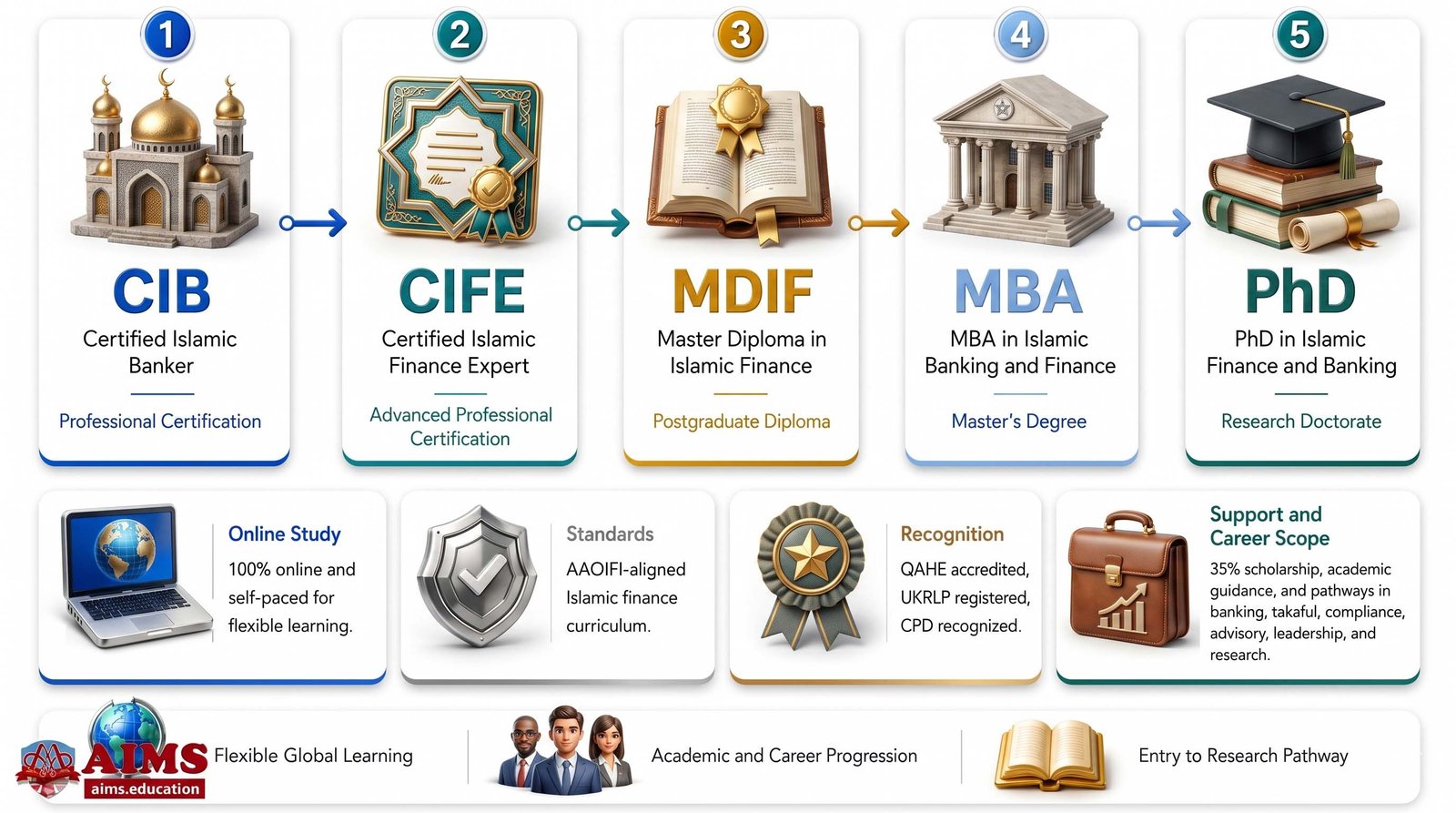
AIMS offers a complete Islamic finance education pathway, including the Certified Islamic Banker, Certified Islamic Finance Expert, Master Diploma in Islamic Finance, MBA in Islamic Banking and Finance, and PhD in Islamic Finance and Banking.
Are AIMS Islamic finance programs offered online?
Yes. AIMS Islamic banking and finance programs are delivered 100% online through a flexible and self-paced learning model. Students can study from any location and manage their progress around work, family, and professional responsibilities.
Are the Islamic finance programs suitable for beginners?
Yes. Entry-level qualifications such as the Certified Islamic Banker are suitable for beginners, graduates, and professionals moving from conventional banking to Islamic finance. Advanced qualifications follow the academic and professional expectations appropriate to their level.
Do I need to be Muslim to study Islamic banking and finance?
No. Islamic finance is a global professional field based on ethical finance, asset-backed transactions, risk sharing, and responsible financial practice. AIMS programs are open to qualified learners from different academic, professional, and cultural backgrounds.
How does AIMS align its Islamic finance curriculum with AAOIFI standards?
AIMS aligns its Islamic finance curriculum with relevant AAOIFI Shariah and accounting standards. This helps students understand Islamic finance as a distinct financial system with its own principles, contracts, governance rules, and compliance requirements.
Does AAOIFI alignment mean the certification is awarded by AAOIFI?
No. AAOIFI alignment means the curriculum is developed with reference to relevant AAOIFI standards in the areas covered by the program. The qualifications are awarded by AIMS, not by AAOIFI.
What recognition and quality assurance does AIMS hold?
AIMS highlights QAHE accreditation, UKRLP registration, and CPD recognition in the UK. Its programs are also delivered internationally, with learners from more than 178 countries.
What is the Certified Islamic Banker, or CIB, certification?
The Certified Islamic Banker is an online Islamic banking certification designed for learners who want practical and structured knowledge of Shariah-compliant banking. It covers Islamic economic principles, Islamic financial instruments, Islamic investment, commercial banking, and major Islamic contracts.
Who should enroll in the Certified Islamic Banker program?
The CIB program is suitable for bankers, finance professionals, graduates, business employees, public sector staff, and learners who want a strong foundation in Islamic banking products, Shariah principles, and Islamic financial operations.
What does the CIB curriculum include?
The CIB curriculum includes Islamic Economic System, Islamic Financial Instruments, and Islamic Investment and Commercial Banking. Students study Shariah principles, Islamic banking products, trade finance, project finance, Sukuk, and practical applications of major Islamic contracts.
Which Islamic banking contracts are covered in AIMS programs?
AIMS Islamic finance programs cover major Islamic contracts and instruments, including Murabahah, Musharakah, Diminishing Musharakah, Mudarabah, Ijarah, Salam, Istisna, Sukuk, Tawarruq, Takaful, and Islamic investment structures.
How long does the CIB certification take to complete?
Most students complete the Certified Islamic Banker program in about 2 to 3 months. Since the program is self-paced, the actual completion time depends on the student’s weekly study schedule.
What is the Certified Islamic Finance Expert, or CIFE?
The Certified Islamic Finance Expert is an advanced Islamic banking and finance certification offered by AIMS. It includes five specialized courses and is designed for learners who want broader knowledge of Islamic finance, Islamic banking, accounting, Takaful, and Shariah-compliant financial practice.
What is the difference between CIB and CIFE?
CIB is a foundation-level Islamic banking certification, while CIFE is a broader and more advanced Islamic finance certification. CIFE includes five specialized courses, and successful learners are also awarded the Certified Islamic Banker on equivalency basis.
Who should enroll in the CIFE certification?
CIFE is suitable for finance professionals, bankers, auditors, consultants, investment practitioners, graduates, researchers, and professionals who want structured expertise in Islamic banking and finance.
What topics are covered in the CIFE curriculum?
The CIFE curriculum covers Islamic economics, Islamic financial instruments, Islamic investment and commercial banking, accounting for Islamic financial instruments, and Takaful. It also includes key topics such as Sukuk, Islamic mutual funds, Murabahah, Musharakah, Mudarabah, Ijarah, Salam, Istisna, and AAOIFI-related standards.
How long does it take to complete the CIFE program?
Many learners complete CIFE in around 2 to 4 months. A typical weekly study commitment is around 10 to 12 hours, although the self-paced model allows students to study according to their own schedule.
What is the Master Diploma in Islamic Finance, or MDIF?
The Master Diploma in Islamic Finance is AIMS’ postgraduate diploma in Islamic banking and finance. It is a 100% online, AAOIFI-aligned program that develops practical knowledge of Islamic banking, Islamic financial products, Takaful, Shariah governance, and applied Islamic finance product development.
Is the MDIF a master’s degree?
No. The MDIF is a postgraduate diploma, not a full master’s degree. It is shorter and more focused than an MBA, and it awards 27 credit hours that may support progression toward higher Islamic finance study.
What certifications are included in the MDIF pathway?
After Semester I, successful students receive the Certified Islamic Finance Expert and Certified Islamic Banker certifications. After Semester II, successful students receive the Certified Takaful Professional and the Master Diploma in Islamic Finance.
What does Semester I of the MDIF cover?
Semester I covers the Islamic economic system, Riba, Maysir, Gharar, Fiqh-ul-Muamlaat, Islamic banking products, Islamic financial instruments, Sukuk, AAOIFI standards, and Takaful fundamentals.
What does Semester II of the MDIF cover?
Semester II covers Islamic microeconomics, Islamic economic planning, fiscal and monetary policy, advanced product design, Sukuk development, risk management, AAOIFI standards for Islamic financial institutions, conversion from conventional to Islamic banking, and a real-world project.
What is the MBA in Islamic Banking and Finance?
The MBA in Islamic Banking and Finance is a specialized master’s degree that combines Islamic economics, Shariah-compliant finance, Islamic banking, Takaful, and business management. It prepares learners for leadership and specialist roles in Islamic financial institutions and related sectors.
How is the MBA in Islamic Banking and Finance different from a regular MBA?
The program includes core MBA subjects such as strategy, leadership, management, financial analysis, and organizational change, while adding specialist Islamic finance content such as Murabahah, Musharakah, Sukuk, Takaful, Islamic accounting, Shariah governance, and AAOIFI standards.
What certifications are included in the MBA pathway?
Students earn CIB and CIFE after Semester I, CTP and MDIF after Semester II, and the final MBA in Islamic Banking and Finance after completing all required courses and the project.
How long does the MBA in Islamic Banking and Finance take?
The average completion time is about 12 months. The flexible study model allows students to progress at a pace that suits their professional and personal schedule.
What is the PhD in Islamic Finance and Banking?
The PhD in Islamic Finance and Banking is a research-based online doctorate focused on advanced Islamic finance study, supervised dissertation development, and original research in Islamic banking and finance.
How is a PhD in Islamic Finance different from an online DBA in Islamic Finance?
A PhD focuses on original academic research, scholarly contribution, and dissertation work. A DBA is usually more focused on applied business improvement and executive problem-solving. AIMS offers a PhD in Islamic Finance and Banking, not a DBA.
What are the admission requirements for the PhD in Islamic Finance and Banking?
Applicants normally need a master’s degree or equivalent qualification, relevant professional experience, and an Islamic finance background suitable for doctoral-level research.
How is the PhD completed?
Students select a research topic, prepare a proposal, receive faculty supervision, write the dissertation, and complete a thesis defense online or in the UK, depending on the selected completion route.
How are assignments and examinations conducted in AIMS Islamic finance programs?
Assignments and examinations are generally conducted online. Many programs use MCQ-based assignments and examinations, and a minimum passing score of 65% is required for successful completion.
Can Islamic finance credits be transferred toward higher qualifications?
Yes. AIMS Islamic finance programs follow a progression pathway. Credit hours from selected certifications and diploma programs may support progression toward higher qualifications, including postgraduate and MBA pathways in Islamic banking and finance.
What careers can Islamic banking and finance qualifications support?
Graduates may pursue or strengthen careers in Islamic banking, Shariah compliance, Islamic finance product development, Takaful, Sukuk, investment management, risk management, treasury, audit, advisory, research, training, and academic roles.
Are scholarships available for Islamic banking and finance programs?
Yes. AIMS offers a 35% scholarship for eligible applicants on selected Islamic banking and finance programs, subject to current admissions policy and availability.
How do I apply for an Islamic banking and finance program at AIMS?
Students can begin by registering online. After admissions review and confirmation, they receive access to the online study portal and can start their program according to the approved study plan.