
PhD in Islamic Finance and Banking at AIMS is a 100% online, research-based doctorate for professionals who want to develop advanced expertise in Islamic banking, Shariah-compliant finance, and the global Islamic financial services industry. The Islamic Finance PhD focuses on original doctoral research in areas such as Islamic financial institutions, Shariah governance, ethical finance, fintech, sukuk, takaful, Islamic capital markets, and banking regulation.
- Candidates develop a focused research proposal, conduct supervised doctoral research, complete a dissertation, and defend their work as part of the doctoral assessment process.
- The program is designed for professionals with backgrounds in finance, banking, business, economics, Islamic finance, or related fields who want to contribute new knowledge to academic or professional practice.
- The doctoral program is ideal for professionals who want to strengthen Islamic finance practice and progress toward senior academic, advisory, regulatory, policy, or institutional leadership roles.
The PhD in Islamic Banking and Finance provides a platform for advanced research that can contribute to the development of Islamic financial institutions, industry practices, policy, and Shariah-compliant financial innovation.
PhD in Islamic Finance at a Glance
| Program Name | PhD in Islamic Finance and Banking |
| Mode of Study | Online |
| Qualification Level | Doctoral-level qualification |
| Average Duration | Approximately 2 years, depending on research progress and dissertation completion |
| Study Requirement | Approximately 10 to 12 hours per week |
| Registration Duration | 3 years of registration validity, with extensions available upon request |
| Academic Requirement | Supervised doctoral dissertation in Islamic finance and banking |
| Language of Study | Multilingual study supported |
| Eligibility Criteria | Master’s degree or equivalent, work experience, and relevant banking, finance, or Islamic finance background |
Key Features of AIMS’ PhD in Islamic Finance
PhD in Islamic Finance: Research and Career Objectives
The program develops advanced research capability and subject expertise that can support leadership, academic, advisory, and professional roles in Islamic banking and finance. During this program, candidates:
Research Areas and Dissertation Topics in Islamic Finance
The doctoral program is centred on independent research, supervised dissertation development, and advanced inquiry in Islamic finance. Candidates investigate contemporary challenges in Islamic banking and finance, examine the application of Shariah principles to modern financial practice, and produce original research with academic and professional value.
The dissertation is the central academic requirement of this research-based doctorate. Candidates are encouraged to develop research topics that connect academic theory with challenges faced by Islamic banks, Shariah boards, regulators, investors, fintech firms, takaful operators, and other Islamic financial institutions.
Examples of Research Areas in Islamic Banking and Finance
- Islamic banking models, product development, and Shariah-compliant financial innovation.
- Shariah governance, audit, compliance, and institutional accountability in Islamic financial institutions.
- Sukuk structures, Islamic capital markets, investment risk, and investor protection.
- Takaful operations, Islamic insurance governance, and ethical risk-sharing models.
- Islamic fintech, digital banking, blockchain, and financial technology under Shariah principles.
- Artificial intelligence, machine learning, data analytics, AI-driven Islamic fintech, RegTech and SupTech.
- Shariah screening, and Islamic banking decision-making. Shariah compliance monitoring, and digital risk governance.
- Islamic microfinance, financial inclusion, poverty alleviation, and ethical development finance.
- Comparative studies of Islamic and conventional banking systems, performance, and governance.
- Islamic accounting, regulatory harmonisation, cross-border Islamic finance, and relevant international standards, including AAOIFI standards where applicable.
- Ethical investment, halal portfolio screening, and sustainable Islamic finance.
How to Complete Your PhD in Islamic Finance Online with AIMS
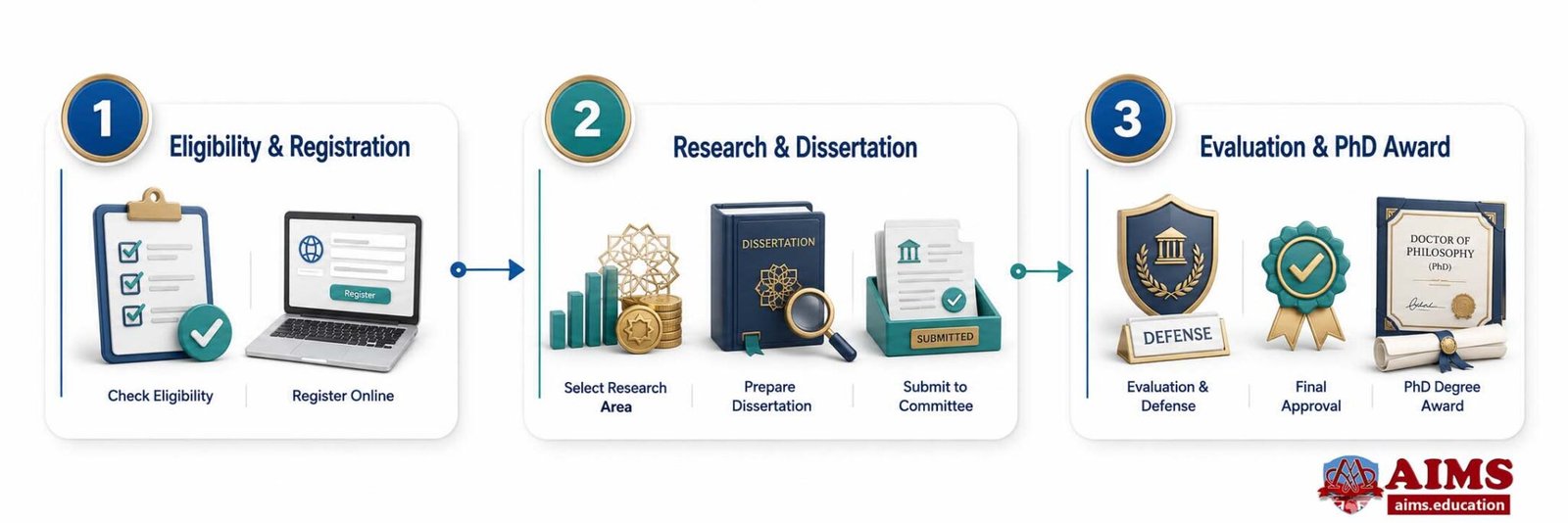
The online PhD in Islamic Finance and Banking follows a structured process from eligibility review and research topic approval to proposal development, supervised dissertation research, final defense, and degree completion.
Language of Study
The PhD in Islamic Finance program supports multilingual study, allowing candidates to conduct their research and complete their dissertation in a language of their choice.
Global Islamic Finance Industry Outlook
According to the ICD–LSEG Islamic Finance Development Report 2025, global Islamic finance assets reached US$5.98 trillion in 2024 and are projected to reach US$9.7 trillion by 2029. Continued industry growth increases the relevance of advanced expertise in Shariah-compliant finance, regulation, governance, financial innovation, and institutional decision-making.
Career Outcomes and Ideal Candidates
AIMS’ PhD graduates are working in senior professional and academic positions across well-known Islamic financial institutions, leading financial organisations, governments, corporations, and universities worldwide. Many have advanced into leadership, advisory, research, policy, and senior teaching roles, reflecting the doctorate’s relevance to both professional practice and higher education.
The PhD in Islamic Finance is suitable for professionals seeking achievements in senior leadership, academia, research, advisory, consulting, Shariah governance, and related areas of Islamic banking and finance.
International Accreditation and Industry Standards
AIMS is registered with the UK Register of Learning Providers (UKRLP), globally accredited by QAHE, and accredited by CPD in the UK. These credentials support AIMS’ commitment to quality, professional education, and internationally oriented learning.

Registered in the United Kingdom with UKRLP
Globally Accredited by QAHE

UK Accredited by CPD
Hear from Our Gobal Learners
Apply for the PhD in Islamic Finance and Banking
Applicants should review the admission criteria, tuition fee, and available scholarship information before submitting a doctoral application. Those who satisfy the admission requirements may then complete registration in PhD in Islamic Finance program.
Key Eligibility Requirements
- Master’s degree or equivalent qualification.
- Minimum 5 years of professional experience.
- Islamic Finance qualification or experience.
Steps from Eligibility to Degree Completion
- Review the PhD in Islamic Finance and Banking eligibility, fee, and scholarship details.
- If you meet the eligibility criteria, complete the online registration form to provide your details, confirm your eligibility, and pay the applicable fee.
- If you are unsure about your eligibility, use the form below to share details of your academic qualifications and relevant professional experience for an eligibility assessment.
- Submit your Islamic finance research proposal to the PhD Committee for review, feedback, and refinement.
- Complete the supervised doctoral research and dissertation, successfully defend your research, and earn the PhD degree.