
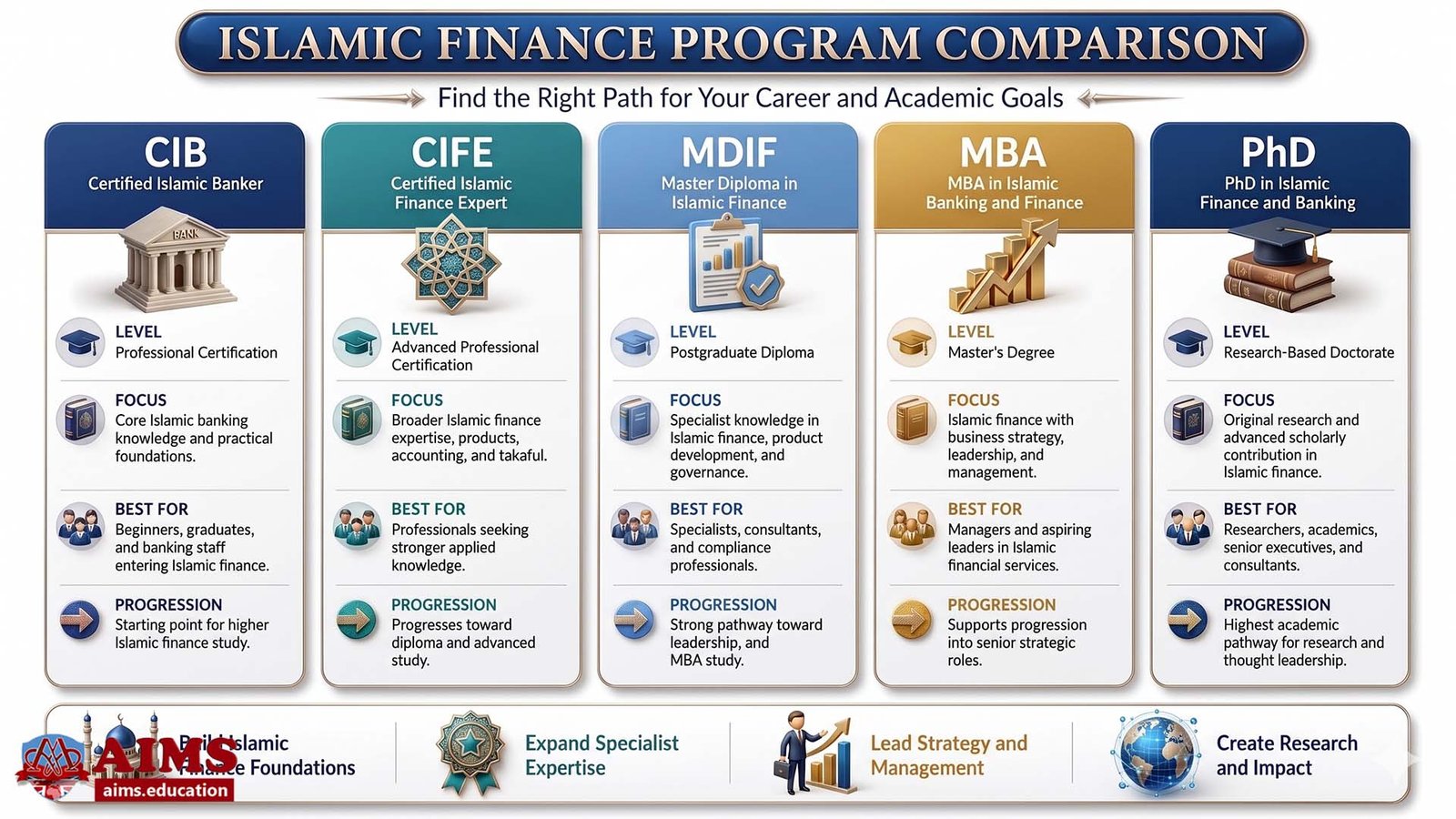
Choosing the right Islamic finance qualification depends on your current knowledge, career goal, academic level, and long-term professional direction. AIMS offers a structured online pathway in Islamic banking and finance, starting from professional certification and progressing toward diploma, MBA, and doctoral research.
This comparison guide helps you understand the academic scope, professional scope, and practical value of each AIMS Islamic finance program, including the Certified Islamic Banker, Certified Islamic Finance Expert, Master Diploma in Islamic Finance, MBA in Islamic Banking and Finance, and PhD in Islamic Finance and Banking.
Program Comparison Table: AIMS Islamic Finance Pathways
The table below helps students select the most suitable Islamic banking and finance program according to their background, learning need, academic ambition, and professional scope. The PhD is included as a research-based pathway for experienced professionals, academics, consultants, and senior Islamic finance specialists.
| Program | Best For | Academic Level and Purpose | Main Learning Focus | Typical Outcome |
|---|---|---|---|---|
| Certified Islamic Banker (CIB) | Beginners, graduates, banking staff, and professionals entering Islamic finance. | Foundation-level Islamic banking certification for practical entry into the field. | Islamic banking principles, Islamic economic foundations, Shariah-compliant contracts, and Islamic commercial banking. | Builds the knowledge needed for entry-level Islamic banking, operations, support, and finance-related roles. |
| Certified Islamic Finance Expert (CIFE) | Finance professionals, bankers, auditors, consultants, and graduates seeking stronger Islamic finance expertise. | Advanced professional certification for broader technical and applied understanding. | Islamic financial instruments, Takaful, Islamic accounting treatment, AAOIFI standards, and applied Islamic finance practice. | Strengthens professional capability for Islamic finance, compliance, advisory, investment, and product-related roles. |
| Master Diploma in Islamic Finance (MDIF) | Specialists, consultants, product development professionals, compliance staff, and learners seeking deeper diploma-level expertise. | Postgraduate diploma pathway for advanced professional development in Islamic banking and finance. | Islamic finance product design, Shariah governance, Sukuk, risk management, Takaful, AAOIFI standards, and real-world Islamic finance applications. | Prepares learners for specialist, supervisory, consultancy, product development, and Shariah-compliance roles. |
| MBA in Islamic Banking and Finance | Managers, aspiring leaders, finance professionals, entrepreneurs, and Islamic finance specialists seeking business leadership capability. | Master’s-level qualification combining Islamic finance specialization with business and management education. | Islamic banking and finance, business strategy, leadership, financial management, marketing, organizational change, analytics, and applied project work. | Supports progression into management, strategic, advisory, governance, product, and leadership roles in Islamic financial institutions. |
| PhD in Islamic Finance and Banking | Researchers, senior executives, academics, policy professionals, consultants, and experienced Islamic finance specialists. | Research-based doctorate for original scholarly contribution and advanced Islamic finance inquiry. | Supervised dissertation research in areas such as Shariah governance, Sukuk, Takaful, Islamic fintech, risk management, regulation, and Islamic banking strategy. | Supports academic, research, policy, senior advisory, doctoral consulting, and high-level institutional leadership opportunities. |
Academic Scope of AIMS Islamic Finance Programs
The academic scope table shows how each qualification builds Islamic banking and finance knowledge at a different depth. The CIB introduces the core foundations, CIFE expands professional expertise, MDIF develops specialist application, the MBA combines Islamic finance with management leadership, and the PhD focuses on independent research.
| Academic Area | CIB | CIFE | MDIF | MBA | PhD |
|---|---|---|---|---|---|
| Islamic Economics and Financial System | Foundation | Advanced | Specialist | Strategic | Research Area |
| Shariah Principles, Riba, Gharar, and Maysir | Foundation | Advanced | Specialist | Strategic | Research Area |
| Islamic Banking Contracts and Modes of Finance | Core | Advanced | Specialist | Strategic | Research Area |
| Murabahah, Musharakah, Mudarabah, Ijarah, Salam, and Istisna | Core | Advanced | Specialist | Strategic | Research Area |
| Islamic Commercial and Investment Banking | Core | Advanced | Specialist | Leadership | Research Area |
| Sukuk and Islamic Capital Market Structures | Introductory | Applied | Advanced | Strategic | Research Area |
| AAOIFI Shariah Standards | Introduced | Applied | Advanced | Strategic | Research Framework |
| AAOIFI Accounting Standards and Islamic Accounting Treatment | Introductory | Core | Advanced | Advanced | Research Area |
| Takaful and Islamic Insurance | Not Primary | Core | Advanced | Advanced | Research Area |
| Risk Management and Shariah Governance | Introductory | Applied | Specialist | Strategic | Research Area |
| Islamic Product Development and Bank Conversion | Not Primary | Applied | Specialist | Strategic | Research Area |
| Islamic Economic Planning, Fiscal Policy, and Monetary Policy | Introductory | Applied | Advanced | Strategic Context | Research Area |
| Business Management, Leadership, Marketing, Accounting, and Analytics | Not Primary | Not Primary | Limited | Core MBA Scope | Used Where Relevant |
| Research Methodology, Dissertation, and Original Contribution | Not Primary | Not Primary | Project-Based | Applied Project | Core Requirement |
Professional Scope and Career Direction
The professional scope of each Islamic finance qualification depends on the student’s previous education, work experience, location, employer requirements, and career objective. The table below shows the most suitable program direction for common Islamic banking and finance roles.
| Career Direction | CIB | CIFE | MDIF | MBA | PhD |
|---|---|---|---|---|---|
| Entry-Level Islamic Banking, Customer Support, and Operations | Best Fit | Strong Fit | Strong Fit | Overqualified for Entry Role | Not Primary |
| Islamic Finance Documentation and Product Support | Good Fit | Strong Fit | Specialist Fit | Leadership Fit | Research or Advisory Fit |
| Shariah Compliance Support and Islamic Finance Control Roles | Foundation Fit | Strong Fit | Specialist Fit | Managerial Fit | Senior Advisory Fit |
| Islamic Accounting, Audit, and Shariah Review Roles | Foundation Fit | Strong Fit | Specialist Fit | Managerial Fit | Research or Policy Fit |
| Relationship Management, Wealth Management, and Advisory Services | Introductory Fit | Strong Fit | Specialist Fit | Leadership Fit | Senior Advisory Fit |
| Trade Finance, Investment Analysis, and Shariah-Compliant Asset Roles | Introductory Fit | Strong Fit | Specialist Fit | Strategic Fit | Research or Specialist Fit |
| Takaful, Risk Management, and Islamic Insurance Roles | Not Primary | Good Fit | Strong Fit | Leadership Fit | Research or Advisory Fit |
| Islamic Product Development and Structuring | Foundation Fit | Applied Fit | Specialist Fit | Strategic Fit | Research and Innovation Fit |
| Branch, Corporate Banking, Treasury, and Portfolio Management | Not Primary | Good Fit | Strong Fit | Leadership Fit | Senior Advisory Fit |
| Compliance Manager, Shariah Audit Manager, and Product Development Manager | Not Primary | Good Fit | Strong Fit | Leadership Fit | Senior Specialist Fit |
| Head of Islamic Banking, Chief Compliance Officer, Chief Risk Officer, or Senior Executive Roles | Not Primary | Supportive | Supportive | Best Professional Fit | Best Strategic or Advisory Fit |
| Consulting, Training, Policy, and Institutional Advisory Roles | Foundation Fit | Professional Fit | Specialist Fit | Leadership Fit | Best Research and Advisory Fit |
| University Teaching, Doctoral Research, and Academic Scholarship | Not Primary | Preparatory | Preparatory | Academic Progression Fit | Best Fit |
How to Choose the Right Islamic Finance Program
If you are new to Islamic banking and finance, the Certified Islamic Banker is the most suitable starting point. If you already work in finance or banking and want broader technical expertise, the Certified Islamic Finance Expert provides a stronger professional route.
Students who want diploma-level specialization in Islamic finance, Takaful, Shariah governance, product development, and AAOIFI-aligned practice may choose the Master Diploma in Islamic Finance. Professionals preparing for leadership, management, and strategic roles should consider the MBA in Islamic Banking and Finance.
Experienced professionals, researchers, academics, consultants, and senior Islamic finance specialists who want to produce original research should consider the PhD in Islamic Finance and Banking. This doctorate is research-based and is designed for advanced scholarly contribution rather than taught-course study.
Next step: Review the program that matches your current level and professional objective, then check the eligibility, fee, scholarship, and registration details before applying online.