Certified Islamic Banker – Global Islamic Banking Certification Course

The Certified Islamic Banker, or CIB, is a career-focused Islamic banking certification designed for learners who want structured, practical, and globally relevant knowledge of Shariah-compliant banking. Introduced by AIMS in 2005, the CIB certificate is designed in compliance with AAOIFI Shariah standards and developed to help learners understand Islamic banking operations, Islamic banking products, Islamic commercial banking practices, and investment structures.

The Islamic banking courses are delivered through a flexible online learning model that combines interactive 3D lectures, comprehensive study manuals, online assignments, faculty support, and a final examination. It is designed for bankers, graduates, finance professionals, and early-career learners who want an entry-level Islamic banking qualification with clear academic progression and practical value in the Islamic finance industry.

CIB course develops the knowledge needed to work with Islamic banking products, understand Shariah principles in real banking environments, and build a strong foundation for higher qualifications. It also suits professionals moving from conventional banking into Islamic banking, because it explains how core banking activities are structured within a Shariah-compliant framework.

Islamic Banking Courses – Learning Objectives

Earn a globally recognized Islamic banking certification designed to strengthen career progression.

  • Manage Islamic banking products and apply Shariah-compliant practices in day-to-day banking operations.

  • Understand how Islamic principles shape commercial banking, investment banking, and financial transactions.

  • Develop the ability to contribute to the setup, operation, and growth of Islamic banking institutions.

  • Build practical knowledge of Islamic banking products, contracts, and case-based applications.

Level-4 Global Islamic Banking Course

The Certified Islamic Banker is a career-oriented qualification with international recognition and strong academic progression. The three Islamic banking courses included in the program are structured as nine graduate-level credit hours, which can be transferred toward higher qualifications in Islamic banking and finance. This makes CIB certificate suitable both for immediate professional development and for learners who want to continue toward advanced study.

The Islamic banking certification is supported by recognized institutional trust signals, including UKRLP registration, QAHE accreditation, CPD accreditation, and an A-rated academic excellence profile. The CIB Islamic banking courses are aligned with AAOIFI Shariah standards, which are widely respected in Islamic banking and financial institutions.
Our Islamic Banking Course – A Quick Review

Quick review of the Certified Islamic Banker program, including study mode, duration, curriculum structure, credit hours, support resources, and certification outcome.
Study Mode100% online and self-paced learning.
DurationUsually completed in 2 to 3 months, depending on study pace.
Number of CoursesThree online Islamic banking courses.
Credit HoursNine graduate-level credit hours.
Weekly Study RequirementAbout 10 to 12 hours a week.
Study ResourcesInteractive online lectures, three study manuals, academic support from the Islamic Banking faculty, an online Islamic finance library, and six online assignments.
ScholarshipA 35% scholarship on fee is available.
Certification AwardedCertified Islamic Banker, CIB.

AIMS’ Islamic banking courses give learners a structured, credit-bearing, AAOIFI-compliant Islamic banking certification with interactive lectures, study manuals, assignments, and progression options. Compared with many general certificates, the Certified Islamic Banker (CIB) program provides stronger academic structure, practical product coverage, and clearer advancement into real-world Islamic banking practices.

Comparison of AIMS’ CIB certificate with general Islamic banking certifications.

FeaturesAIMS’ Certified Islamic Banker (CIB)Other Certifications
Program FocusFocused Islamic banking qualification covering Shariah foundations, contracts, commercial banking, and investment banking applications.Generally focus on general Islamic finance awareness, short professional training, or selected banking topics.
Curriculum DepthThree structured Islamic banking courses with detailed coverage of Islamic economics, financial contracts, product structures, and banking operations.Curriculum depth varies and do not include detailed product documentation, Shariah controls, or contract-level applications.
Standards AlignmentDesigned in compliance with AAOIFI Shariah and accounting standards used across Islamic financial institutions.May not clearly state alignment with recognized Islamic finance standards or industry compliance frameworks.
Learning MethodInteractive 3D lectures, comprehensive manuals, assignments, online library resources, and expert Islamic banking faculty support.Rely mainly on flat recorded lessons, reading material, or short assessments with limited academic support.
Practical LearningUses real-world examples and case-based learning to explain Islamic banking products and professional applications.Practical is mostly limited to theory or introductory explanations.
Progression OptionsNine credit hours that support progression toward CIFE, MDIF, MBA, or PhD routes in Islamic finance where eligibility is met.Progression routes may be unclear, non-credit-bearing, or disconnected from higher academic progression.

Who the CIB Islamic Banking Course Is For

  • Bankers who want to transition from conventional banking to Islamic banking.
  • Graduates who want to begin a professional path in Islamic finance.
  • Finance professionals who want a practical and recognized Islamic banking certification.
  • Corporate and government sector employees who want structured knowledge of Islamic banking products and services.

Academic Progression in Islamic Finance

The Certified Islamic Banker serves as an entry-level Islamic banking certification and a strong starting point for continued study. The Islamic banking courses covered in the CIB certificate support progression toward higher qualifications such as CIFE advanced Islamic Finance Course, Islamic Finance Diploma, Islamic Finance MBA, and Doctorate of Philosophy in Islamic banking.

How to Become a Certified Islamic Banker (CIB)
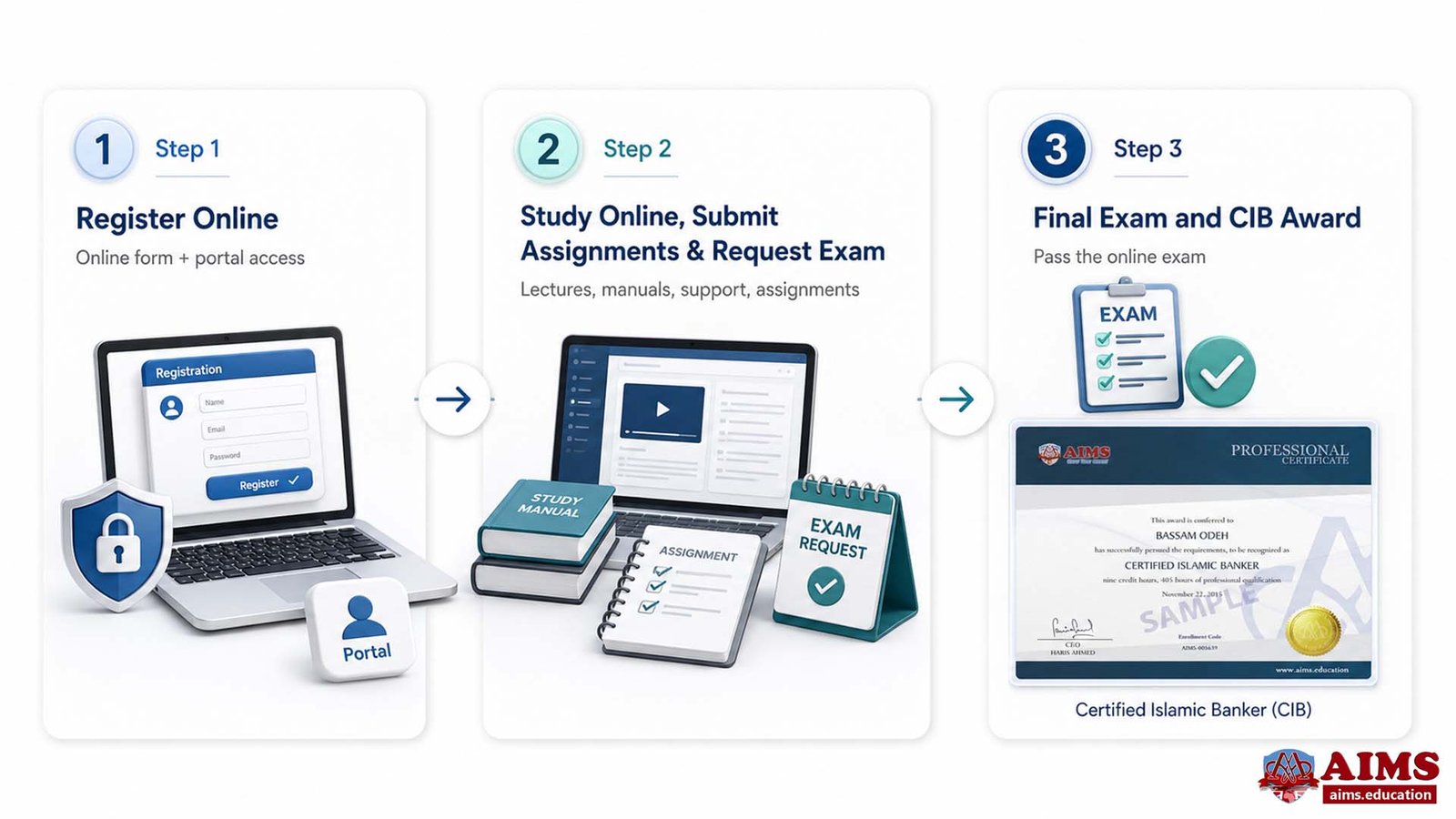
Register online to begin the program. After registration, access to the study portal is normally provided within 24 to 48 hours, allowing learners to start their Islamic banking courses without delay.

Students complete three Islamic banking courses online, with each course carrying three credit hours. Every Islamic banking course includes a study manual and 3d interactive online lectures that explain concepts through practical examples and case-based learning. Learners may study from home, office, or any location that suits their schedule.

  • Complete three structured online Islamic banking courses.
  • Use manuals and lectures for guided learning.
  • Complete two assignments for each course, making six assignments in total.

After completing all assignments, students may request the final online examination. The assignments and final examination use a multiple-choice format. A minimum score of 65% is required to successfully earn the CIB certificate.

Certified Islamic Banker CIB registration study exam process

Explore the CIB Learning Experience

Islamic banking courses covered in the CIB course curriculum

Islamic Banking Courses

The CIB curriculum comprises three online Islamic banking courses, helping learners move from foundational principles toward applied Islamic banking practices through guided study and assignments.
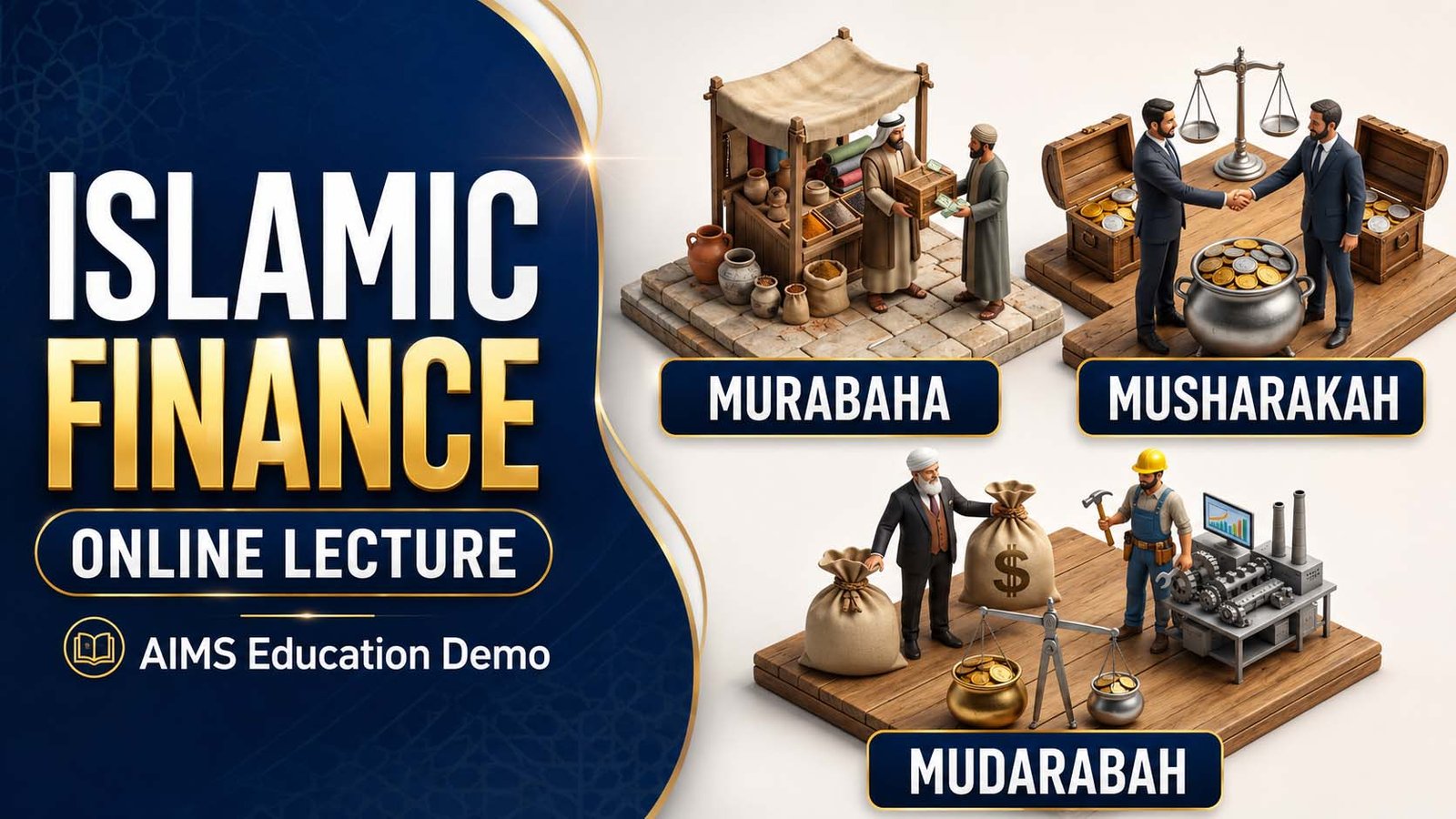
Islamic banking and finance demo lecture

Demo Lecture

A demo lecture allows prospective learners to review the teaching approach and understand how the online Islamic banking courses are delivered.
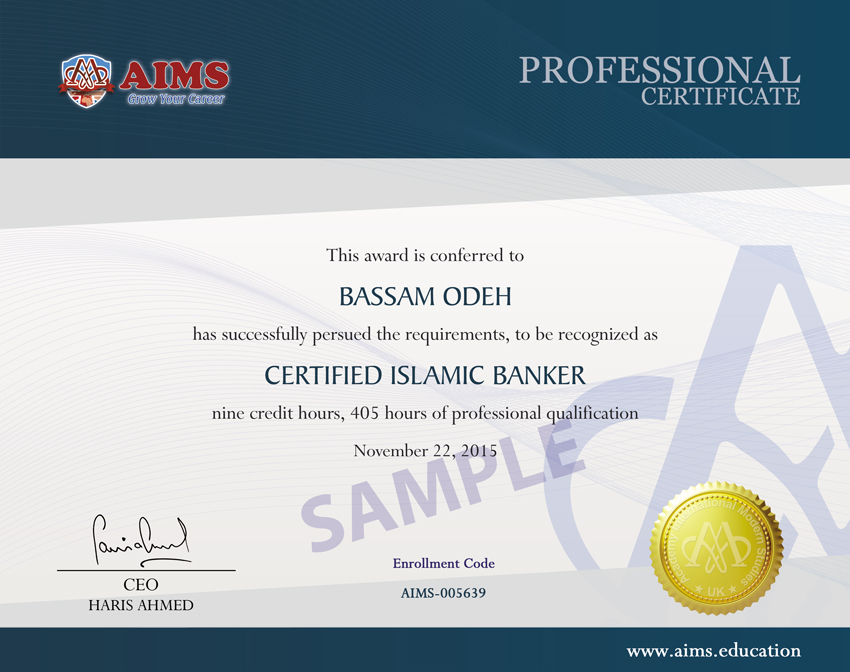
Islamic banking certification awarded on completion of Certified Islamic Banker (CIB) program

Sample CIB Certificate

The awarded CIB certificate reflects successful completion of a recognized Islamic banking certification designed for professional and career growth.

Islamic Banking Courses and Topics Covered

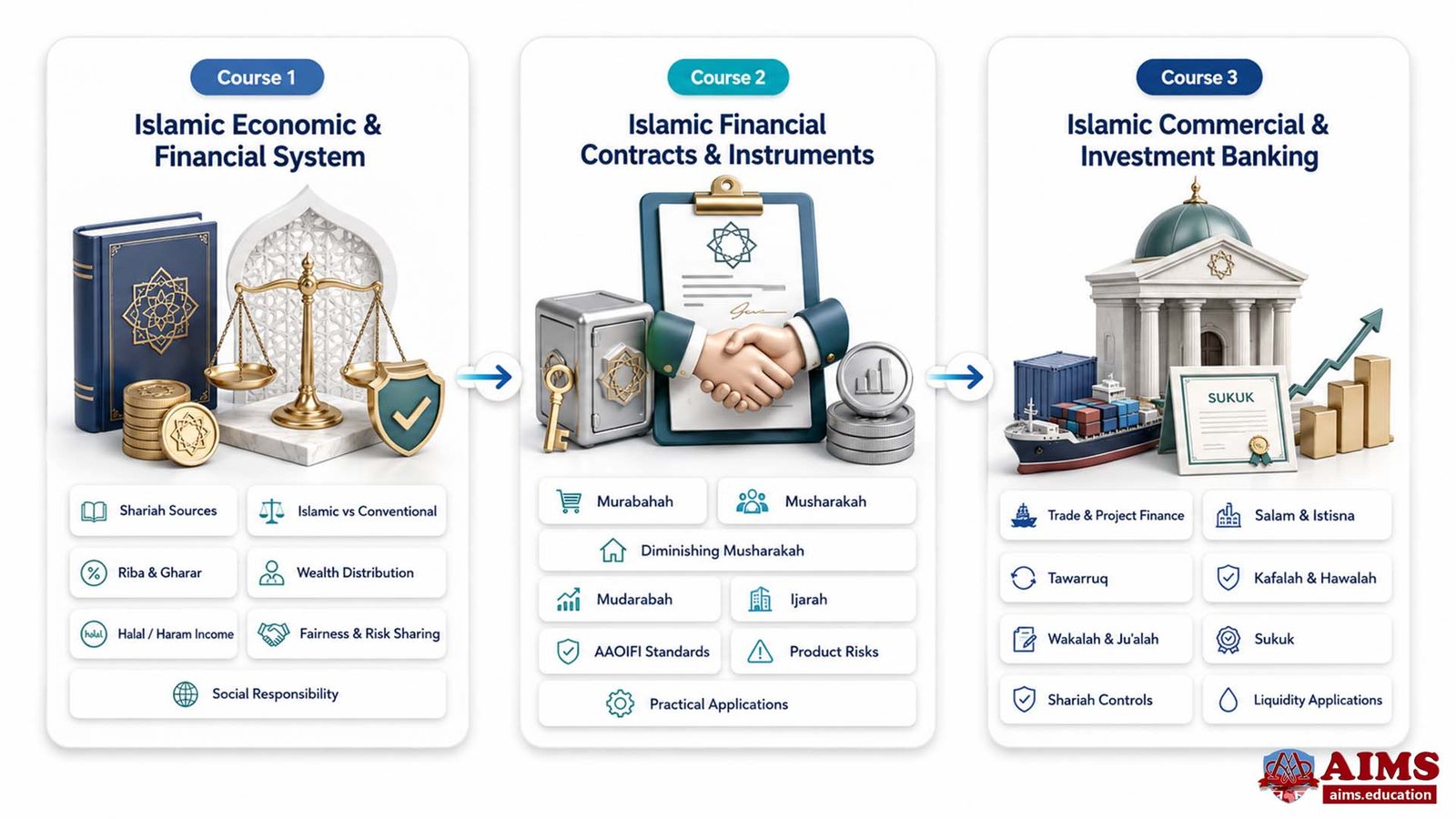
The CIB certificate includes three online Islamic banking courses covering Islamic economics, Islamic financial contracts, and Islamic commercial and investment banking. Together, these career-focused courses build a practical understanding of Shariah principles, Islamic banking products, AAOIFI-aligned practices, and real-world banking applications.

This Islamic course explains the foundations of Islamic banking within the broader Islamic economic framework. It builds the conceptual base learners need before studying Islamic contracts, instruments, product structures, and banking operations.

  • Study the foundational principles of Islamic banking and finance.
  • Understand the sources of Shariah and their role in Islamic financial decision-making.
  • Compare Islamic economic principles with conventional financial systems.
  • Understand Riba, Gharar, gambling, and other prohibited elements in the Islamic economy.
  • Study wealth distribution, moderation, halal and haram income, and ethical commercial conduct.
  • Learn how Islamic economic values support fairness, asset-backing, risk-sharing, and social responsibility in banking.

This Islamic banking course focuses on the contracts and product structures used in Islamic banking and finance. Learners study how Shariah-compliant financing works in real business environments through practical examples and case-based product analysis.

  • Learn the principles and regulations of Islamic banking and finance.
  • Study alternatives to conventional loans, bonds, deposits, insurance, and fixed-income products.
  • Explore Murabahah, which is a cost-plus sale contract used in asset financing.
  • Study Musharakah and Diminishing Musharakah, which are partnership-based financing methods.
  • Understand Mudarabah, which is a profit-sharing partnership between capital and management.
  • Learn Ijarah, which is a leasing structure used in Islamic finance.
  • Review Islamic contract types, documentation requirements, product risks, and AAOIFI Shariah standards.
  • Apply Islamic financial contracts through practical examples and real-world banking scenarios.

The third Islamic banking course in CIB certificate connects Islamic banking theory with commercial banking operations, trade finance, investment activity, and Islamic capital markets. It helps learners understand how Islamic banking products are structured, managed, and controlled in institutional practice.

  • Understand import, export, and project financing through Islamic banking principles.
  • Study Salam and Istisna, including their use in forward sale, manufacturing, construction, and trade-related transactions.
  • Examine Tawarruq, Kafalah, Hawalah, Wakalah, Ju’alah, and other commercial banking structures.
  • Study Sukuk, which are Shariah-compliant investment certificates used in Islamic capital markets.
  • Review share trading rules, Shariah controls, documentary credit, syndicated financing, and liquidity-related applications.
  • Learn how Islamic investment products are structured and managed in line with Shariah requirements.

Overview of CIB Study Resources

Hear from Our Global Learners

“The Islamic banking courses offered by AIMS develop expertise for anyone eager to enter the rapidly expanding Islamic banking sector. Earning a Certified Islamic Banker (CIB) certificate is a noteworthy achievement, especially for professionals in the conventional banking industry who are willing to start an Islamic banking career.”

Tovah T. Mutukura, Chief Advisor, Kubota Australia Finance, Australia.

“After becoming a Certified Islamic Banker, I was able to navigate the complexities of the Islamic banking industry with greater confidence. The online Islamic banking course gave me practical skills that opened more career opportunities in Islamic finance.”

Sarah Jamil, Islamic Finance Consultant, UK

“This internationally recognized Islamic banking certificate significantly advanced my career. The in-depth coverage of Islamic banking products and the real-world management training strengthened my expertise and helped me perform a broader advisory role.”

Laiba Shaikh, Banking Advisor, Saudi Arabia

“The CIB certificate from AIMS was a crucial stepping stone for me. It helped me secure an important role in a leading Islamic financial institution and gave me a stronger professional direction in Islamic banking.”

Omar Khan, Corporate Banker, Singapore

Key Features of Our Islamic Banking Course

  • Job-Oriented Qualification

    The CIB certificate combines theory with practical application. Learners not only study principles, but also learn how Islamic banking products, contracts, and services operate in commercial practice. This practical orientation makes our Islamic banking courses valuable for those seeking a professional Islamic Banking Certificate with real-world relevance.

  • Leads to Higher Qualifications

    Certified Islamic Banker (CIB) also builds the knowledge required for advanced Islamic finance study. The three Islamic banking courses carry nine graduate-level credit hours, and graduates can also use the CIB certificate for progression toward higher qualifications in Islamic finance and banking.

  • Globally Standardized Practices

    The curriculum follows AAOIFI Shariah and accounting standards that are widely used across Islamic financial institutions. This gives learners a standardized understanding of Islamic banking practices and strengthens the global relevance of the qualification.

  • Internationally Accredited and Recognized

    The CIB course is backed by recognized accreditation and institutional credibility. Its combination of QAHE accreditation, UKRLP registration, CPD accreditation, and AAOIFI-aligned curriculum strengthens confidence in the academic and professional value of the certification.

  • Career Value in Islamic Banking

    After completing the Certified Islamic Banker or CIB course, graduates may strengthen their profile for roles such as Islamic Banking Specialist, Shariah Auditor, Islamic Investment Advisor, Islamic Wealth Management Advisor, and other banking or finance roles that require working knowledge of Shariah-compliant financial structures.

  • Start Your CIB Journey

    AIMS’ Islamic banking course is designed for learners who want a flexible, credible, and career-focused Islamic banking certification. With flexible online study, practical case-based learning, 3D interactive lectures, support from Islamic banking faculty, and a 35% scholarship on the course fee, the CIB certificate provides a clear path for building specialist knowledge in one of the fastest-growing areas of global finance.

Apply for the Certified Islamic Banker (CIB)

CIB is an ideal choice for professionals and students seeking a job-oriented and flexible route into an Islamic banking career. Our Islamic banking certification combines self-paced learning, academic support, and a 35% scholarship opportunity, making professional Islamic banking courses more accessible.

The CIB course is suitable for learners who want clear structure, recognized institutional support, and practical Islamic banking knowledge. Prospective students can:

  • Review the course structure and learning outcomes before applying.
  • Assess the study format, time commitment, and progression value of the qualification.
  • Use the inquiry route for clarification on the study process, support, and admission guidance.
  • Register online to begin a structured pathway into Islamic banking and finance.

    Frequently Asked Questions

    The Certified Islamic Banker is a globally relevant Islamic banking certification designed by AIMS for learners who want practical and structured knowledge of Shariah-compliant banking. It is delivered 100% online and developed in compliance with AAOIFI Shariah standards.

    The Islamic banking course is suitable for bankers moving from conventional banking to Islamic banking, graduates entering Islamic finance, finance professionals seeking specialization, and corporate or public sector employees who want a strong grounding in Islamic banking products and operations.

    No. CIB course is designed as a specialized professional Islamic banking certification for professionals, students, and conventional bankers seeking a career-focused Islamic banking course. CIB suits both newcomers to Islamic finance and working professionals who want formal, structured knowledge.

    Register online, study three Islamic banking courses, complete six assignments, and pass the final examination with at least 65%. This step-by-step structure makes the learning path clear and manageable for online learners and working professionals.

    The CIB curriculum includes three Islamic banking courses: Islamic Economic System, Islamic Financial Instruments, and Islamic Investment and Commercial Banking. These courses cover Shariah principles, Islamic banking products, Islamic investment methods, Sukuk, trade and project financing, and case-based applications of major Islamic contracts.

    The Certified Islamic Banker (CIB) program covers major Islamic financial instruments and contracts, including Murabahah, Musharakah, Diminishing Musharakah, Mudarabah, Ijarah, Salam, Istisna, Sukuk, and Tawarruq.

    Yes. The curriculum is designed in compliance with AAOIFI Shariah standards, which are widely respected across Islamic financial institutions and help standardize Shariah-compliant banking practice.

    Most learners complete the program in about 2 to 3 months. Since the learning model is self-paced, completion time depends on how many hours a student can dedicate each week.

    The assignments and final examination use a multiple-choice format. A minimum score of 65% is required to earn the Certified Islamic Banker certification.

    AIMS offers a 35% scholarship on fee for the CIB certificate program.

    CIB can support career growth in Islamic banking and finance roles such as Islamic Banking Specialist, banking manager in Islamic institutions, Shariah Auditor, Islamic Investment Advisor, Islamic Wealth Management Advisor, and risk-focused roles in Islamic finance.

    Yes. The three Islamic banking courses in the CIB certificate includes nine graduate-level credit hours that can support progression toward higher qualifications in Islamic banking and finance.