
Iqtisad in Islam means balanced, ethical, and responsible use of wealth. It teaches Muslims to earn lawfully, spend wisely, save responsibly, avoid waste, and share with others through Zakat, Sadaqah, and social support. It is not poverty, harsh austerity, or rejection of comfort. It is the disciplined middle path between extravagance and miserliness.
In simple terms, Iqtisad connects money with morality. A Muslim is not asked to abandon worldly needs, but to manage wealth with justice, gratitude, restraint, and accountability before Allah. This is why moderation in spending in Islam is not only a personal budgeting habit. It is part of a wider Islamic economic vision that protects individuals, families, markets, and society from greed, waste, exploitation, and imbalance.
Iqtisad Meaning
Iqtisad means moderation, balance, and upright conduct in economic life. The Arabic word اقتصاد carries the sense of taking a balanced path, avoiding extremes, and acting with sound judgment. In Islamic usage, it applies to the way wealth is earned, spent, saved, protected, and distributed.
What Is Iqtisad in Islam?
Iqtisad in Islam is the ethical middle way between wasteful extravagance and harmful miserliness. It teaches that wealth should be used for lawful needs, family welfare, social responsibility, and beneficial purposes without falling into vanity, greed, or neglect of others.
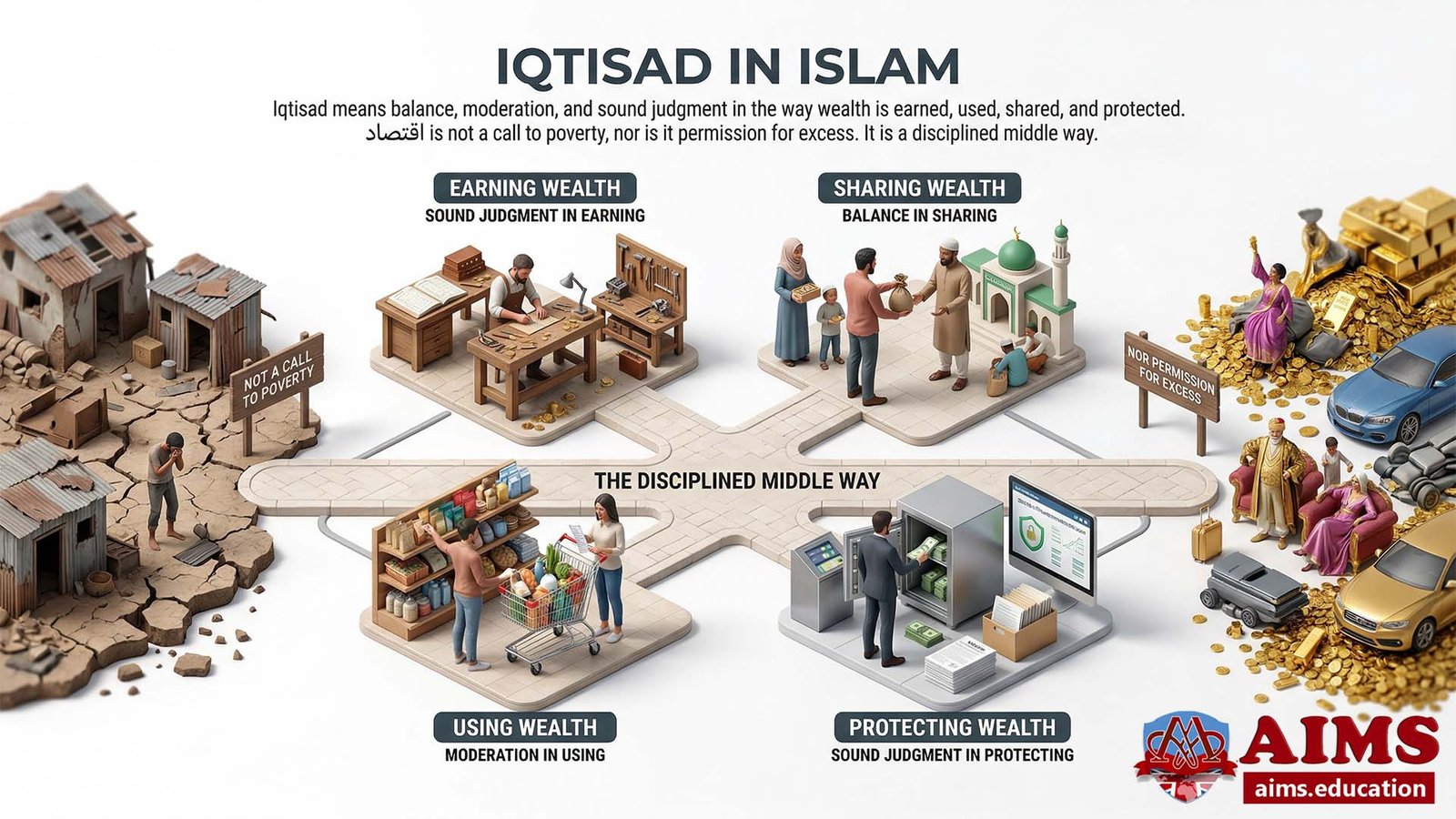
The idea includes several connected duties:
- A Muslim should earn income through lawful and fair means.
- A Muslim should spend on genuine needs without confusing every desire with necessity.
- A Muslim should protect wealth from waste, destruction, and reckless risk.
- A Muslim should fulfill financial duties toward family, the poor, and society.
- A Muslim should avoid both showy luxury and hard-hearted withholding.
This balanced approach makes Iqtisad meaning in Islam wider than simple cost control. It is a moral discipline that shapes the heart, the household, the marketplace, and the wider economy.
Why Iqtisad Is More Than Saving Money
Iqtisad is more than saving money because it is about using wealth correctly, not merely spending less. A person may save money but still be selfish, unjust, or neglectful. Another person may spend generously but still remain moderate if the spending is lawful, purposeful, and socially beneficial.
To be honest, this is where many people misunderstand the term. Iqtisad is not a command to be cheap. It is a command to be wise.
- Saving becomes good when it protects future obligations and prevents dependency.
- Spending becomes good when it serves lawful needs, dignity, and benefit.
- Charity becomes good when it purifies wealth and supports those with genuine need.
- Investment becomes good when it avoids Riba, deception, and exploitation.
- Enjoyment becomes acceptable when it does not become arrogance, waste, or neglect of duty.
So, Iqtisad does not ask the believer to reject wealth. It asks the believer to discipline wealth.
Iqtisad and Islamic Economics
In Islamic economics, Iqtisad means a balanced economic order guided by justice, lawful earning, responsible consumption, fair distribution, and social welfare. It is not limited to personal spending. It also influences markets, trade, finance, public welfare, and the circulation of wealth.
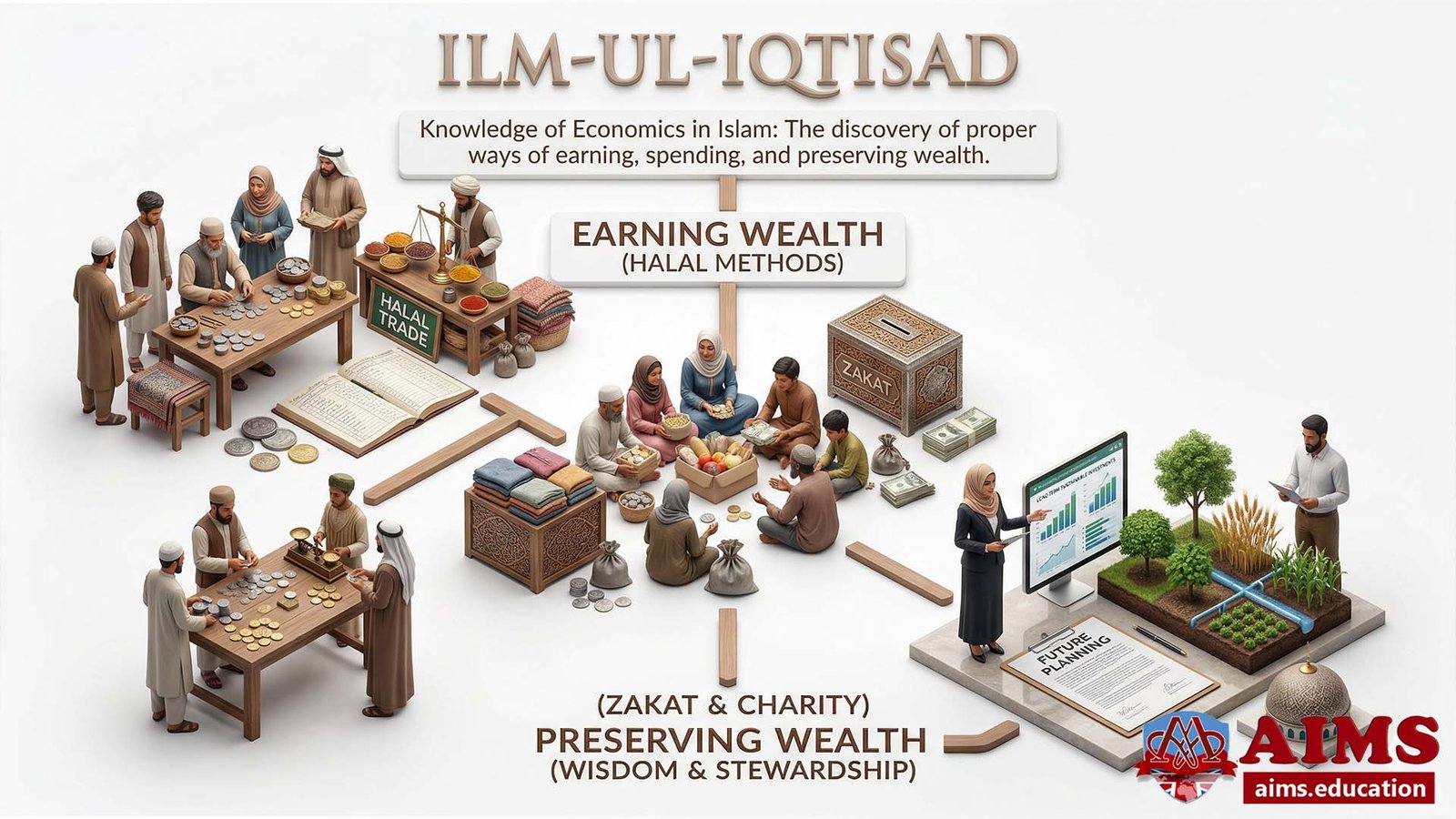
Iqtisad as Balance and Justice
Iqtisad is balance joined with justice. Balance controls personal behavior, while justice protects other people from harm. A person who spends moderately but earns through exploitation is not practicing true Iqtisad. Similarly, a person who avoids extravagance but refuses Zakat, family support, or fair payment is still outside the spirit of Islamic moderation.
This is why Islamic financial ethics matter. Wealth is not treated as morally neutral. It may become a blessing when used rightly, or a test when used selfishly.
The balanced Islamic view includes:
- Rights of ownership, but not absolute selfish control.
- Freedom of trade, but not fraud, Riba, Gharar, or injustice.
- Permission to enjoy wealth, but not waste or pride.
- Encouragement to save, but not hoard without responsibility.
- Duty to give, but not in a way that destroys one’s own obligations.
This creates a serious moral framework for understanding the Islamic economic system as a balanced social order.

Iqtisad and the Islamic Economic System
Iqtisad supports the Islamic economic system by keeping wealth connected to worship, justice, family responsibility, and public welfare. It does not allow economic life to become a race for consumption, status, and accumulation.
The Islamic economic system is built on several foundations:
- Allah is the ultimate owner of all wealth and resources.
- Human beings use wealth as trustees, not absolute masters.
- Economic activity must remain lawful and beneficial.
- Wealth should circulate and should not become concentrated among a small group.
- The weak, poor, indebted, and vulnerable have recognized financial claims through Zakat and other duties.
Actually, this is what makes Iqtisad and Islamic economics inseparable. Iqtisad gives the personal discipline, while Islamic economics gives the wider social and institutional framework.
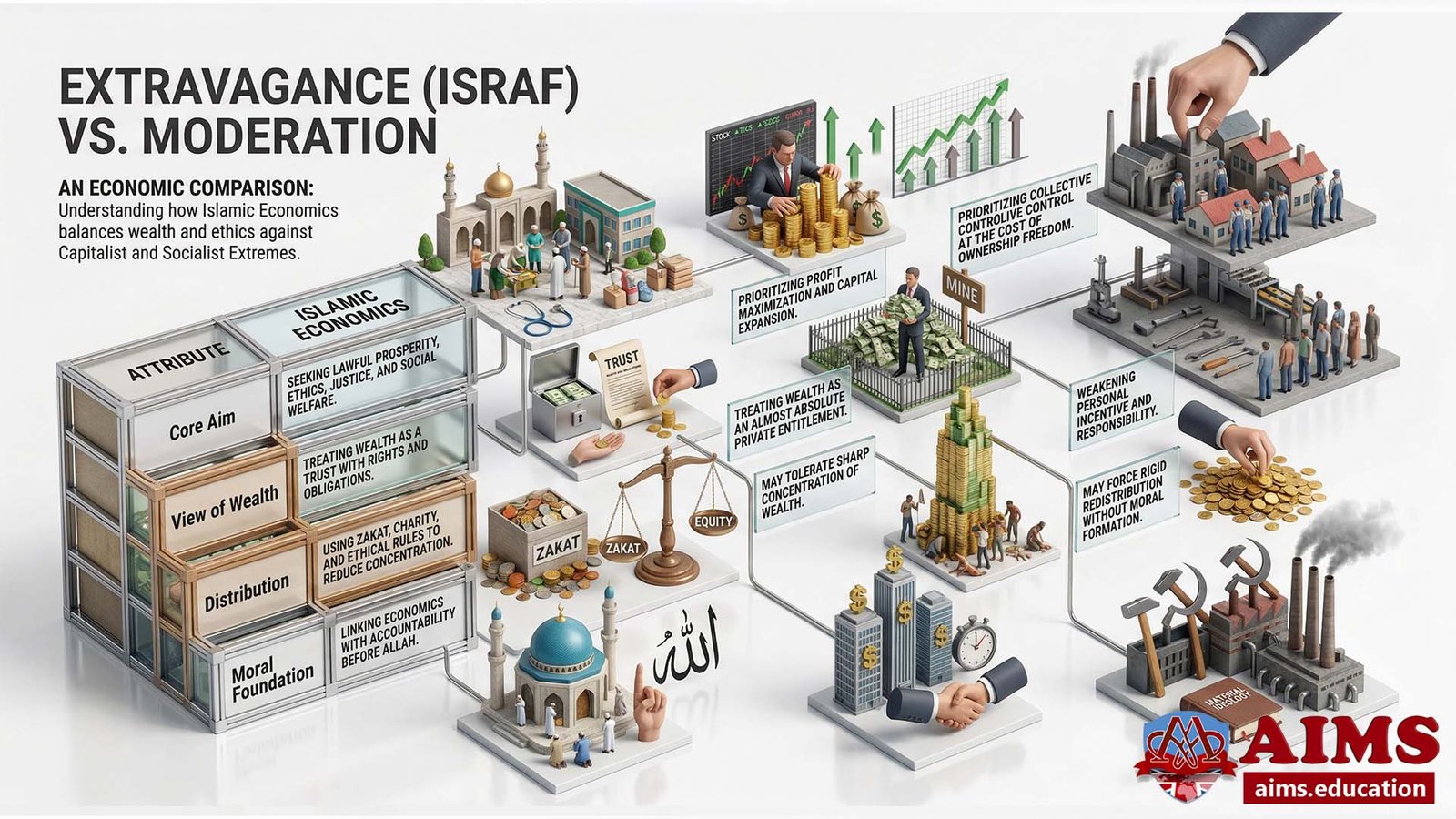
Difference Between Iqtisad and Modern Economics
The main difference is that modern economics often studies choice, scarcity, production, and consumption, while Iqtisad studies economic life through moral purpose, lawful conduct, and accountability before Allah. Modern economics may ask, “How can resources be used efficiently?” Iqtisad also asks, “Is this earning lawful, is this spending responsible, and does this wealth serve justice?”
| COMPARISON POINT | IQTISAD IN ISLAM | MODERN ECONOMICS |
|---|---|---|
| Main Focus | Connects earning, spending, saving, and distribution with Islamic ethics. | Usually focuses on production, consumption, markets, incentives, and scarcity. |
| View of Wealth | Treats wealth as a trust with rights, duties, and accountability. | Often treats wealth as a resource, asset, or measure of economic value. |
| Moral Boundary | Requires lawful earning, fair trade, Zakat, charity, and avoidance of waste. | May separate technical efficiency from moral and spiritual accountability. |
| Social Aim | Seeks justice, dignity, welfare, and balanced circulation of wealth. | May prioritize growth, efficiency, utility, profit, or welfare depending on the model. |
The difference is not that Islam ignores efficiency. The difference is that Islam refuses to make efficiency the highest value when justice, lawful conduct, and human dignity are at stake.
Importance of Iqtisad in Islam
Iqtisad is an important factor in Islam because money affects worship, character, family stability, social justice, and the health of the wider economy. A person’s financial behavior can reveal gratitude, greed, discipline, compassion, or negligence.
Islam does not treat spending as a small private matter. Spending can support family and society, or it can create debt, pride, waste, and injustice. That is why the Quran praises those who spend without falling into either extreme:
“Who, when they spend, are neither extravagant nor miserly but keep the golden mean between the two extremes.”
Quran, Surah Al-Furqan, Verse 67
Islamic moderation in wealth is also built on the belief that provision ultimately comes from Allah. Human beings earn, trade, save, and spend, but they do not own creation in an absolute sense. They are trustees who must use resources with gratitude, justice, and responsibility.
“The responsibility for all that walk on the earth is Allah’s.”
Quran, Surah Hud, Verse 6
“He it is Who has created for all of you together what is in the earth.”
Quran, Surah Al-Baqarah, Verse 29
These verses give Iqtisad its wider economic meaning. Wealth, land, food, capital, and resources should not be treated as tools of pride or monopoly. They are blessings that must serve lawful benefit, family stability, social welfare, and justice.
Israf and Tabdhir in Islam
Israf means extravagance or excess, while Tabdhir means wasteful misuse of resources. Both are opposed to Iqtisad because they show a loss of discipline, gratitude, and purpose.
The difference can be understood simply:
- Avoiding Israf means avoiding excessive spending, even on something that may originally be lawful.
- Avoiding Tabdhir means avoiding waste, misuse, or careless destruction of wealth and resources.
- Israf often appears in luxury, status spending, overeating, overbuying, and unnecessary display.
- Tabdhir often appears when money, food, time, property, or opportunities are wasted without benefit.
A family dinner is lawful. Turning it into a display of ego, debt, and waste moves it away from Iqtisad. A business investment is lawful. Entering it recklessly, without knowledge or ethical concern, may also become wasteful.
How Iqtisad Prevents Miserliness and Greed
Iqtisad prevents miserliness by teaching that wealth must be used for rightful obligations, not merely stored for personal security. Islam rejects extravagance, but it also rejects cold-hearted withholding.
This point is very important. Some people think moderation means spending as little as possible. That is not Islamic balance. If a person refuses to support dependents, avoids Zakat, neglects guests, underpays workers, or ignores the needy while having capacity, that person is not moderate. That person is miserly.
The balanced Muslim learns three financial instincts:
- Spend where spending is a duty.
- Save where saving is responsible.
- Give where giving is morally and socially needed.
This is the ethical center of avoiding miserliness in Islam.
How Iqtisad in Islam Promotes Family and Social Responsibility
Iqtisad promotes family and social responsibility by making wealth serve people before it serves vanity. A balanced household pays its obligations, supports dependents, plans for future needs, and keeps space for charity.
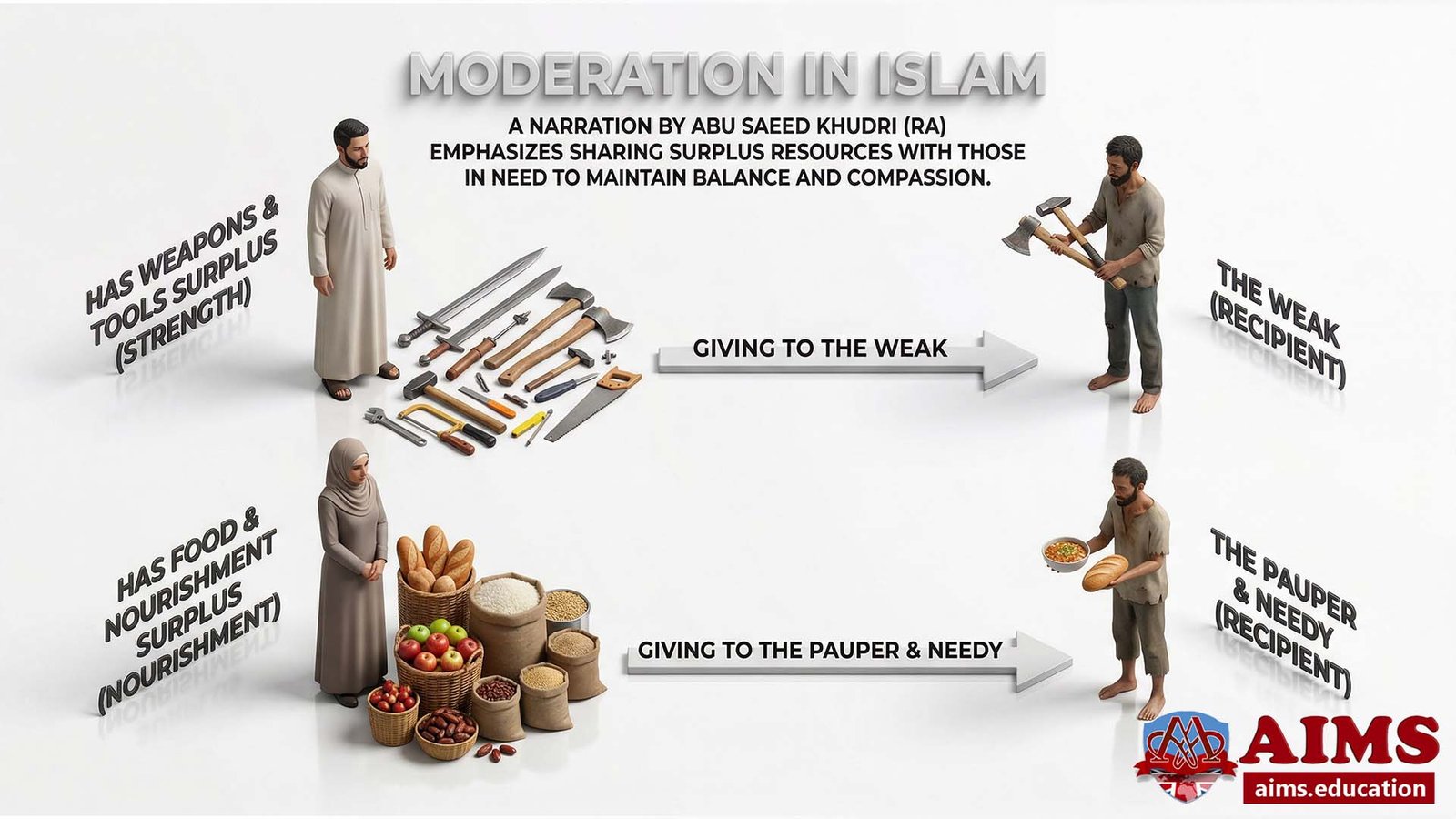
The Prophetic model also teaches that surplus wealth and resources carry responsibility. A narration reported through Abu Saeed Khudri emphasizes that what exceeds personal need should support those who are weak, poor, or in difficulty.
“He who has weapons and tools more than his needs and strength should give them to the weak; and he who has food and nourishments above his needs should give them to the pauper and the needy.”
Muhalla Ibn Hazm
This teaching does not cancel private ownership. Rather, it corrects selfish ownership. It reminds the believer that surplus is not only a personal privilege, but also a field of mercy, service, and accountability.
In family life, Iqtisad encourages:
- Clear separation between needs, comforts, and luxuries.
- Responsible budgeting for food, housing, education, healthcare, and debt repayment.
- Protection from unnecessary borrowing for status competition.
- Care for relatives, neighbors, and vulnerable members of society.
- Regular giving through Zakat, Sadaqah, and other beneficial causes.
In society, the same principle supports Zakat based fiscal responsibility and public welfare in Islamic economics.
Main Principles of Iqtisad in Islam
The main principles of Iqtisad in Islam are lawful earning, wise spending, responsible saving, sharing wealth, and avoiding extravagance. These principles work together. If one is ignored, the balance becomes weak.
The major principles are:
- Lawful earning.
- Wise spending.
- Responsible saving.
- Sharing wealth.
- Avoiding extravagance.
Lawful Earning
Lawful earning means income must come from Shariah-compliant, fair, and beneficial activity. A person cannot claim economic moderation while earning through Riba, fraud, gambling, deception, theft, bribery, or exploitation.
Lawful earning requires several disciplines:
- The income source must be permissible in Islam.
- The transaction must be based on fair consent and truthful disclosure.
- The seller must avoid cheating, manipulation, and artificial scarcity.
- The financier must avoid Riba and unjust guaranteed gain.
- The worker, trader, or investor must not harm others for private benefit.
For modern finance, this principle connects directly with the Islamic prohibition of Riba in banking and finance.
Example of Lawful Earning in Islamic Finance
A small business owner named Bilal wants to expand his halal food shop. He has two options:
- He can take an interest-bearing loan that guarantees extra payment to the lender regardless of business outcome.
- He can use a Shariah-compliant partnership where profit is shared according to agreement and loss is treated according to capital contribution.
- He compares both options and chooses the partnership because it links finance to real trade and risk sharing.
- He keeps clear records, prices honestly, and avoids artificial shortages during peak demand.
The practical impact is that Bilal’s growth remains connected to lawful trade, fairness, and shared responsibility.
Wise Spending
Wise spending means using money according to need, priority, benefit, and moral responsibility. It allows comfort, but it does not allow wasteful display.
Wise spending begins with order. A Muslim should normally prioritize:
- Basic needs such as food, clothing, shelter, education, and healthcare.
- Obligations toward spouse, children, parents, and dependents.
- Debt repayment and lawful commitments.
- Zakat, Sadaqah, and support for the needy.
- Reasonable comfort and recreation within ethical limits.
- Luxury only when it does not harm duties, humility, or financial stability.
This approach is closely related to the principles of consumption in Islam for responsible daily spending.
Responsible Saving
Responsible saving means preserving wealth for genuine future needs without turning savings into fear, greed, or hoarding. Islam does not condemn planning. It condemns selfish accumulation that ignores obligations and social rights.
Responsible saving includes:
- Keeping emergency funds for family needs.
- Planning for education, healthcare, housing, and business obligations.
- Avoiding impulsive spending that creates future hardship.
- Ensuring savings do not prevent Zakat, charity, and rightful support.
- Using saved wealth in lawful and productive ways where possible.
This is where saving money in Islam differs from hoarding. Saving prepares for responsibility. Hoarding may block circulation and weaken compassion.
Sharing Wealth
Sharing wealth means recognizing that others have rights in one’s surplus, especially through Zakat, Sadaqah, family support, and public benefit. Wealth is not praised merely because it is accumulated. It is praised when it is earned lawfully and directed wisely.
Zakat and Sadaqah perform different but connected roles:
- Zakat is an obligatory act of purification and redistribution for eligible recipients.
- Sadaqah is voluntary giving that develops generosity and mercy.
- Family support protects dependents from neglect.
- Community giving supports education, relief, health, and public welfare.
This is why zakat and wealth are inseparable in Islamic finance ethics. Zakat reminds the owner that wealth carries rights beyond the self.
The Quran also distinguishes between wealth that grows through exploitation and wealth that grows through purification, charity, and sincerity. This distinction is central to Islamic financial ethics because Islam does not treat every form of financial increase as morally equal.
“That which ye give in usury in that may increase on other people’s property hath no increase with Allah; but that which ye invest as zakat, seeking Allah’s countenance, hath increase manifold.”
Quran, Surah Ar-Rum, Verse 39
This verse connects Iqtisad with Zakat, lawful growth, and moral accountability. Financial increase gained through unjust means is not the same as wealth purified through giving and social responsibility.
Avoiding Extravagance
Avoiding extravagance means refusing spending that is excessive, vain, wasteful, or harmful to one’s duties. Islam permits lawful enjoyment, but it does not permit wealth to become a servant of ego.
Extravagance may appear in obvious and subtle forms:
- Buying luxury items mainly to impress others.
- Borrowing money for unnecessary status purchases.
- Wasting food, clothing, energy, or household resources.
- Upgrading possessions frequently without real need.
- Spending heavily on appearances while neglecting charity or family duties.
Avoiding extravagance in Islam does not remove beauty from life. It removes arrogance and waste from beauty.
Iqtisad vs Israf, Tabdhir, and Miserliness
Iqtisad is the balanced middle path, while Israf is excess, Tabdhir is waste, and miserliness is wrongful withholding. These terms are often discussed together because they describe the financial extremes Islam wants believers to avoid.
| TERM | MEANING | PRACTICAL EXAMPLE | ISLAMIC CORRECTION |
|---|---|---|---|
| Iqtisad | Balanced and responsible use of wealth. | Buying what is needed, saving responsibly, and giving regularly. | Continue lawful moderation with gratitude and social responsibility. |
| Israf | Excessive spending beyond proper limits. | Hosting a costly event mainly for status while ignoring debts. | Reduce excess and restore priority to obligations. |
| Tabdhir | Wasteful misuse or destruction of resources. | Throwing away usable food, goods, money, or time without benefit. | Use resources purposefully and prevent avoidable waste. |
| Miserliness | Wrongful withholding despite capacity and obligation. | Refusing Zakat, family support, or fair payment while having wealth. | Give what is due and treat wealth as a trust. |
The safest rule is simple: spend where there is rightful need, stop where there is waste, save where there is responsibility, and give where there is duty.
Examples of Iqtisad in Daily Life
Iqtisad in daily life means making financial decisions that are lawful, purposeful, balanced, and socially responsible. It appears in personal spending, family budgeting, business conduct, and community welfare.
Iqtisad in Personal Spending
Iqtisad in personal spending means controlling desires without denying genuine needs. A person practicing Iqtisad does not buy everything he can afford. He buys what is useful, lawful, and proportionate.
Example of Balanced Spending in Islam
Hamza earns $2,000 per month and wants to buy a new phone for $900. His current phone still works well.
- He first checks his rent, food, transport, and family obligations.
- He confirms that his Zakat and debt payments are not being delayed.
- He realizes that the new phone is a desire, not a need.
- He postpones the purchase for three months and saves part of the amount.
- He gives $100 to help a student with books and keeps the rest for future needs.
The practical impact is that Hamza protects his finances while training his desires to follow judgment.
Iqtisad in Family Budget
Iqtisad in a family budget means organizing income so that household needs, future security, and social duties are all respected. A balanced family budget should not be built only around bills and shopping. It should also include savings, charity, and emergency planning.
Example of Islamic Budgeting for a Household
Ahmed and Maryam earn a combined monthly income of $3,500. They want to manage it according to Iqtisad.
- They allocate $1,200 for rent and utilities.
- They allocate $700 for food and household essentials.
- They allocate $300 for transport and $300 for education and healthcare.
- They save $400 for emergency needs.
- They reserve $250 for Zakat planning and voluntary Sadaqah over time.
- They postpone a $1,100 luxury furniture purchase because their current furniture is usable.
The practical impact is that their family budget protects dignity, reduces waste, and keeps generosity possible.
Iqtisad in Business
Iqtisad in business means earning profit through lawful, fair, transparent, and socially responsible activity. A business may pursue growth, but it should not use deception, exploitation, hoarding, artificial scarcity, or interest-based injustice.
A business guided by Iqtisad should:
- Sell lawful goods and services.
- Price fairly without exploiting emergencies.
- Pay workers on time and with fairness.
- Avoid false advertising and hidden defects.
- Use capital productively instead of wastefully.
- Support community needs where possible.
This connects Iqtisad with ethical principles of business in Islam for fair commercial conduct.
Example of Islamic Economic Moderation in Community Business
Five shop owners in a Muslim neighborhood agree to improve their business conduct during Ramadan.
- Each shop owner contributes $200 per month into a small relief fund.
- The fund helps widows, students, and families facing emergency expenses.
- The owners agree not to inflate prices during peak demand.
- They avoid creating artificial shortages to force higher sales.
- One owner who earns unusually high profits contributes extra food packages.
The practical impact is that private business success becomes a source of public benefit and trust.
Benefits of Practicing Iqtisad
The benefits of practicing Iqtisad include personal financial stability, spiritual discipline, social justice, better wealth circulation, and stronger Islamic financial ethics. These benefits appear gradually because moderation reforms both behavior and intention.
Iqtisad and Personal Financial Stability
Iqtisad improves personal financial stability by reducing impulsive spending, unnecessary debt, and lifestyle pressure. A person who practices moderation is less likely to confuse income with freedom to consume without limits.
It supports stability through:
- Clearer budgeting.
- Better control over desires.
- Lower risk of debt for vanity purchases.
- More regular saving for emergencies.
- Greater ability to give without panic or resentment.
This is practical Islamic personal finance. It does not merely ask, “Can I afford this?” It asks, “Is this wise, lawful, necessary, and balanced?”
Spiritual Discipline
Iqtisad builds spiritual discipline by teaching the believer to control wealth before wealth controls the believer. Money can easily become a test of pride, fear, rivalry, or attachment.
Moderation trains the soul in several ways:
- Gratitude replaces entitlement.
- Contentment replaces constant comparison.
- Generosity replaces selfish accumulation.
- Restraint replaces impulsive desire.
- Accountability replaces careless consumption.
This is closely connected with qana’ah in Islam, the contentment that helps a person enjoy blessings without becoming enslaved by them.
Social Justice
Iqtisad supports social justice by preventing wealth from becoming isolated from human need. When people give Zakat, practice Sadaqah, pay fairly, avoid exploitation, and reduce waste, wealth begins to serve society more effectively.
Social justice in this context does not mean hostility to ownership. It means ownership with moral responsibility. A person may own, trade, invest, and enjoy wealth, but not in a way that damages others or ignores rightful claims.
Better Wealth Circulation
Iqtisad improves wealth circulation by discouraging hoarding, waste, Riba-based exploitation, and selfish accumulation. Wealth should move through lawful trade, family support, charity, investment, wages, and public benefit.
The Quranic outlook reminds believers that provision belongs ultimately to Allah and that human access to wealth carries responsibility:
“He it is Who has created for all of you together what is in the earth.”
Quran, Surah Al-Baqarah, Verse 29
Balanced circulation is one reason scholars discuss Iqtisad together with the Islamic concept of capital as a trust and productive resource.
Stronger Islamic Financial Ethics
Iqtisad strengthens Islamic financial ethics by linking financial decisions to Shariah, justice, transparency, and real economic benefit. It helps prevent Islamic finance from becoming a technical label without moral substance.
In modern Islamic banking and finance, Iqtisad supports:
- Asset-linked financing instead of purely money-for-money gain.
- Risk sharing where appropriate.
- Avoidance of Riba, Gharar, Maysir, and deception.
- Purposeful investment in real economic activity.
- Socially responsible treatment of customers and communities.
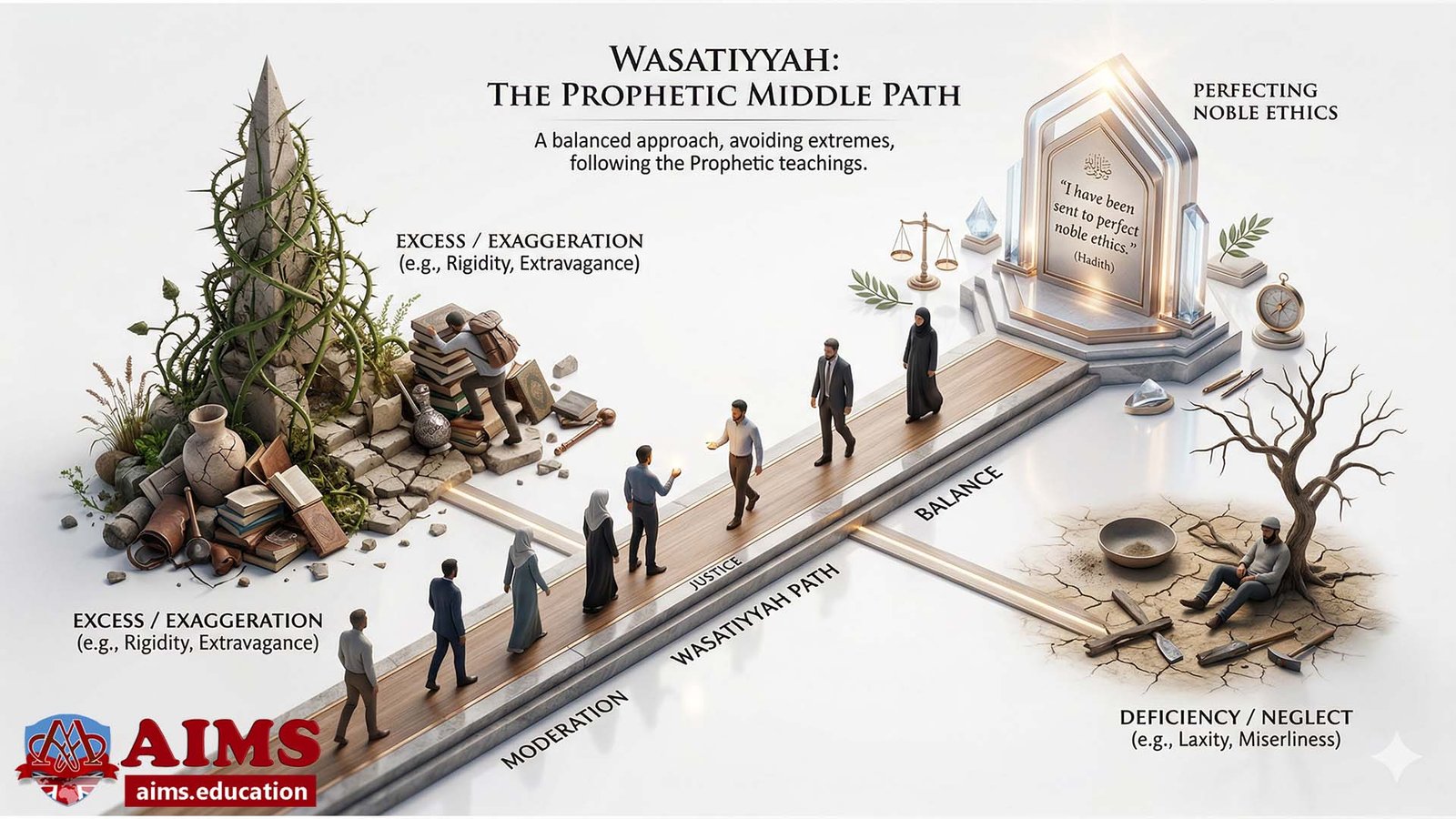
The Prophetic mission itself was deeply ethical, and that ethical mission includes financial conduct. Spending, trading, lending, investing, and giving are not separate from character. They reveal whether a person is guided by justice, mercy, honesty, and restraint.
“I have been sent to perfect noble ethics.”
Hadith
This is why Iqtisad should not be reduced to a household budgeting technique. It is part of noble conduct. When wealth is managed with moderation, it strengthens dignity, protects society, and keeps economic life connected to faith.
Students who want to study these applied rules more formally may explore career-focused Islamic finance certification courses or continue into a structured diploma in Islamic banking and finance. For professional standards, the AAOIFI Shariah standards for Islamic financial institutions provide an important reference point for institutional practice.
Common Mistakes About Iqtisad
The most common mistakes about Iqtisad are thinking it means poverty, thinking wealth is bad, confusing frugality with miserliness, and ignoring Zakat or social responsibility. These mistakes weaken the true meaning of Islamic moderation.
Thinking Iqtisad Means Poverty
Iqtisad does not mean poverty. Poverty is lack of resources, while Iqtisad is disciplined use of resources. A poor person may practice Iqtisad, and a wealthy person may also practice Iqtisad if wealth is earned lawfully and used responsibly.
Islam does not praise forced deprivation for its own sake. It praises gratitude, lawful provision, moderation, and concern for others.
Thinking Wealth Is Bad in Islam
Wealth is not bad in Islam when it is earned lawfully and used correctly. Wealth becomes harmful when it leads to arrogance, greed, injustice, waste, or neglect of Allah’s commands.
A wealthy Muslim can support family, create jobs, invest in halal business, fund education, give Zakat, give Sadaqah, and serve society. The issue is not wealth itself. The issue is the character and conduct surrounding wealth.
Confusing Frugality With Miserliness
Frugality is careful and purposeful spending, while miserliness is wrongful withholding despite capacity and obligation. Islam appreciates thrift when it protects balance, but it does not approve of refusing legitimate duties.
The difference is easy to see:
- Frugality delays a luxury purchase to pay school fees.
- Miserliness refuses school fees despite having ability.
- Frugality reduces waste at a family event.
- Miserliness refuses hospitality that one can reasonably afford.
- Frugality saves for future responsibility.
- Miserliness uses saving as an excuse to avoid giving what is due.
This is why frugality in Islam and thrift in Islam must remain connected to mercy, duty, and fairness.
Ignoring Zakat and Social Responsibility
Iqtisad is incomplete if Zakat, Sadaqah, and social responsibility are ignored. A person may budget carefully and still fail Islamic moderation if wealth never reaches those who have a rightful claim.
Sadaqah and spending soften the heart. Zakat purifies wealth and protects society. Family support preserves dignity. Public giving strengthens the community. Together, these duties prevent Iqtisad from becoming a selfish personal finance method.
Final Words on Iqtisad in Islam
Iqtisad in Islam offers a balanced financial ethic for personal life, family responsibility, business conduct, and social justice. It begins with moderation in spending, but it extends into lawful earning, responsible saving, fair exchange, Zakat, Sadaqah, and the moral circulation of wealth.
The strongest lesson is this: Islam does not ask people to hate wealth, and it does not allow people to worship wealth. It teaches believers to manage wealth as a trust, use it with wisdom, and direct it toward lawful benefit. That is why Iqtisad remains deeply relevant for students of Islamic finance, Muslim households, business owners, and anyone seeking an ethical approach to money.
Frequently Asked Questions
What is Iqtisad in Islam?
Iqtisad in Islam means balanced and responsible use of wealth. It teaches Muslims to earn lawfully, spend wisely, save responsibly, avoid extravagance, give Zakat and Sadaqah, and stay between the two extremes of wastefulness and miserliness.
What does Iqtisad mean in English?
Iqtisad may be translated as moderation, balance, economy, or sound financial judgment. In Islamic usage, it means ethical balance in earning, spending, saving, and distributing wealth according to Shariah principles.
What is the difference between Iqtisad and Islamic economics?
Iqtisad is the principle of moderation and balance in economic behavior. Islamic economics is the wider system that includes ownership, trade, finance, Zakat, distribution, public welfare, market ethics, and social justice under Islamic guidance.
Is Iqtisad the same as moderation in spending?
Iqtisad includes moderation in spending, but it is wider than spending alone. It also includes lawful earning, responsible saving, fair business conduct, charity, Zakat, avoidance of Riba, and protection of wealth from waste and injustice.
Why is Iqtisad important in Islam?
Iqtisad is important because wealth affects worship, character, family stability, and social justice. It helps Muslims avoid waste, greed, miserliness, debt for vanity, and neglect of the poor while allowing lawful comfort and prosperity.
What is the difference between Iqtisad and Israf?
Iqtisad means balanced and purposeful use of wealth, while Israf means extravagance or excess. Buying what is needed with gratitude is Iqtisad. Spending beyond proper limits for pride, display, or desire is Israf.
How can Muslims practice Iqtisad in daily life?
Muslims can practice Iqtisad by budgeting carefully, separating needs from wants, avoiding waste, paying Zakat, giving Sadaqah, saving for genuine needs, avoiding unnecessary debt, earning lawfully, and refusing spending driven by status competition.
Does Iqtisad mean being poor or avoiding comfort?
No. Iqtisad does not mean poverty or rejection of comfort. Islam allows lawful comfort, good clothing, decent housing, family care, and prosperity, as long as wealth is earned lawfully and used without waste, arrogance, or neglect of duty.
What does Islam say about wasting money?
Islam discourages wasting money because wealth is a trust from Allah. Wasteful spending, careless destruction of resources, and unnecessary extravagance oppose gratitude, moderation, and social responsibility.
How does Iqtisad relate to Zakat, Sadaqah, and wealth distribution?
Iqtisad requires wealth to be used responsibly, and Zakat and Sadaqah are major ways to achieve that. Zakat purifies wealth and supports eligible recipients, while Sadaqah develops generosity and helps wealth circulate through society.
About AIMS’ Institute of Islamic Banking and Finance
AIMS’ Institute of Islamic Banking and Finance has advanced global Islamic finance education since 2005 through internationally accredited, career-focused, and industry-oriented programs. Its qualified faculty combine classical Shariah principles with modern finance, 3D interactive learning content, practical skills, and real-world case studies. This educational content, along with AIMS’ study content and curriculum, is collaboratively developed and rigorously peer-reviewed by an academic board of qualified industry practitioners. Understanding Iqtisad strengthens ethical financial judgment for Islamic finance professionals. Explore practical and flexible Islamic finance professional education.