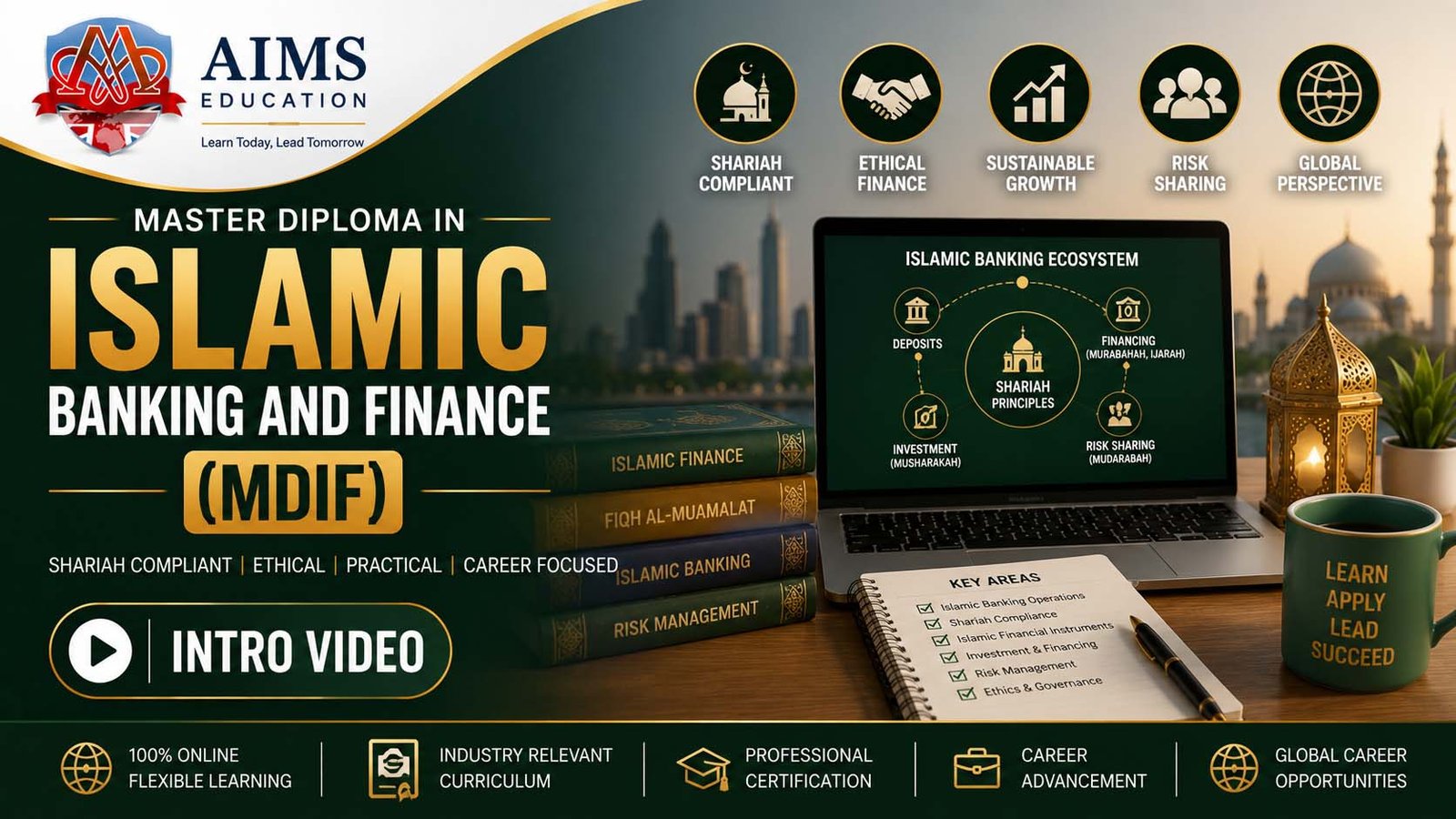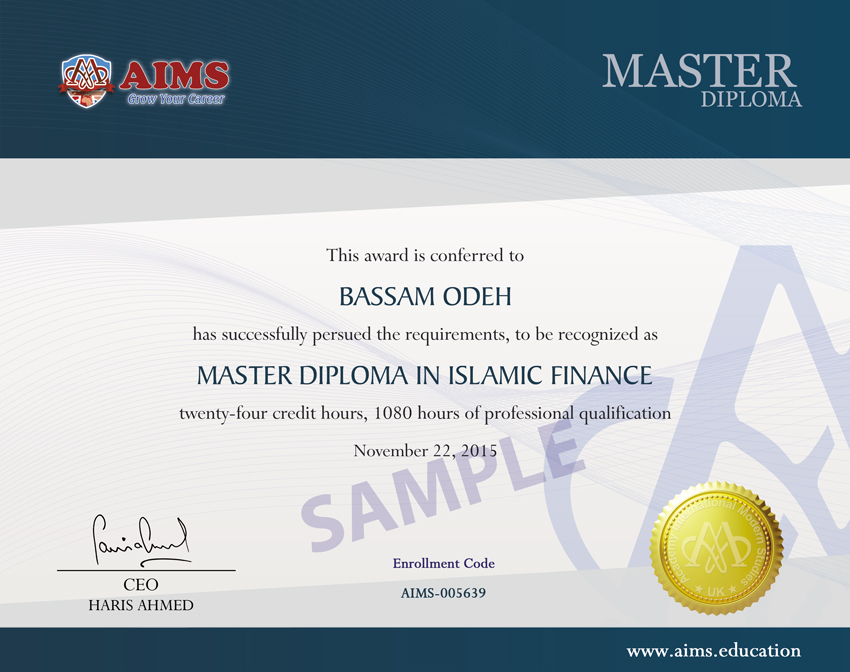
Earn AIMS™ Master Diploma in Islamic Finance (MDIF), a globally recognized, 100% online diploma in Islamic banking and finance designed for practical career growth in Shariah-compliant financial services.

The MDIF is a structured postgraduate diploma developed to prepare learners for the growing Islamic finance sector, where Islamic banks, Takaful operators, and other Islamic financial institutions need professionals who understand Shariah principles, Islamic financial products, governance requirements, and applied industry practice.

No prior education or experience in Islamic finance is required. The program starts with foundational concepts and then progresses to advanced topics, applied assignments, and a real-world project. It is a focused postgraduate diploma rather than a full master’s degree, yet the program awards 27 credit hours that may be transferred toward higher study in Islamic finance.

diploma Islamic banking and finance

Master Diploma in Islamic Finance (MDIF)

The Master Diploma in Islamic Finance is AIMS’ online diploma in Islamic banking and finance for learners who want a practical, academically structured route into Islamic commercial banking, Islamic investment, Takaful, Islamic financial product development, and consultancy.

Islamic finance is one of the world’s fastest-growing financial sectors. AIMS presents the MDIF as a job-oriented and internationally recognized qualification aligned with AAOIFI standards, making it relevant for professionals who want to work with Shariah-compliant financial products such as Murabaha, Musharaka, Salam, Istisna, Ijarah, Sukuk, and Takaful.

The program combines theoretical knowledge with applied learning. Students study seven theory courses, complete online assignments, and finish a real-world project focused on the design and implementation of an Islamic financial product or service.

MDIF Course & Learning Objectives!

Through this Islamic finance diploma, graduates learn to build a strong working understanding of Islamic banking operations, Islamic financial instruments, governance expectations, and practical product design.

  • Design, implement, and manage Islamic commercial and investment banking products and services.

  • Understand Islamic economics, Islamic microeconomics, and AAOIFI Shariah rulings.

  • Design and manage General and Family Takaful products and services.

  • Apply contractual mechanisms and AAOIFI accounting standards to Islamic finance products and services.

  • Develop practical competence through a real-world Islamic finance project.

  • Apply financial engineering concepts, manage risk effectively, and follow AAOIFI auditing guidelines for Islamic financial institutions.

Level-6 Postgraduate Diploma in Islamic Banking and Finance

AIMS is officially registered with the UKRLP and holds international accreditation. The Master Diploma in Islamic Finance is equivalent to a Level-6 Islamic Finance diploma and fully complies with AAOIFI Shariah Standards. The program also carries accreditation and professional recognition associated with QAHE and CPD.

AAOIFI standards are important in Islamic finance because they provide recognized Shariah, accounting, auditing, ethics, and governance guidance for Islamic financial institutions. Alignment with these standards strengthens the practical value of a diploma in Islamic banking and finance, especially for learners who plan to work in product development, operations, compliance, advisory, or Islamic financial consultancy.

The MDIF awards 27 credit hours. These credits can be transferred toward a master’s or PhD pathway in Islamic finance within its academic progression structure.

Islamic Finance Diploma: A Quick Review

Study Mode100% online through self-paced learning.
Estimated DurationApproximately 4 to 5 months.
Number of CoursesEight courses in total, divided into two semesters, including one practical project.
Study RequirementsAround 10 to 12 hours of study per week.
Entry RouteThe program begins with fundamentals, so prior Islamic finance education or work experience is not required.
Study ResourcesInteractive online lectures, comprehensive study manuals, 24/7 educational support, an Islamic banking and finance library, online assignments, and a real-world project.
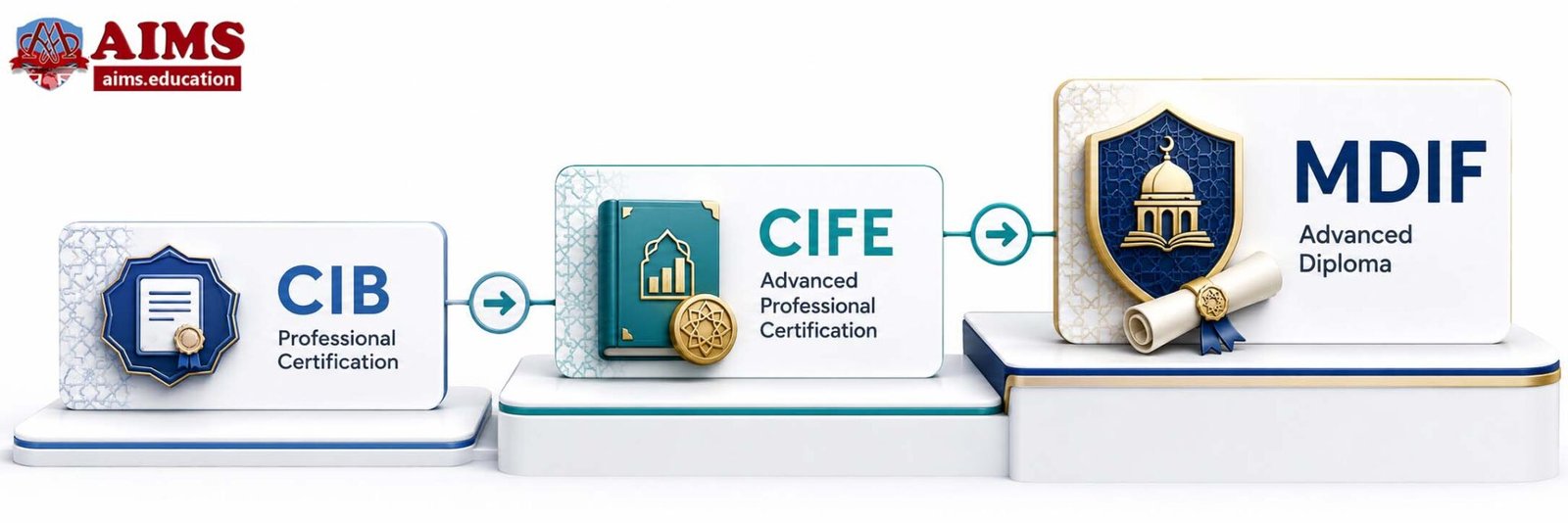
Qualifications AwardedCertified Islamic Banker (CIB) and Certified Islamic Finance Expert (CIFE) after Semester I, then Certified Takaful Professional (CTP) and Master Diploma in Islamic Finance (MDIF) after Semester II.
Credit Value27 credit hours that may be transferred toward higher study in Islamic finance through the AIMS progression pathway.
ScholarshipA 35% fee scholarship is available.
Quick review table for the Postgraduate Diploma in Islamic Finance, including study format, duration, resources, qualifications, and scholarship information.

How to Earn the Master Diploma in Islamic Finance

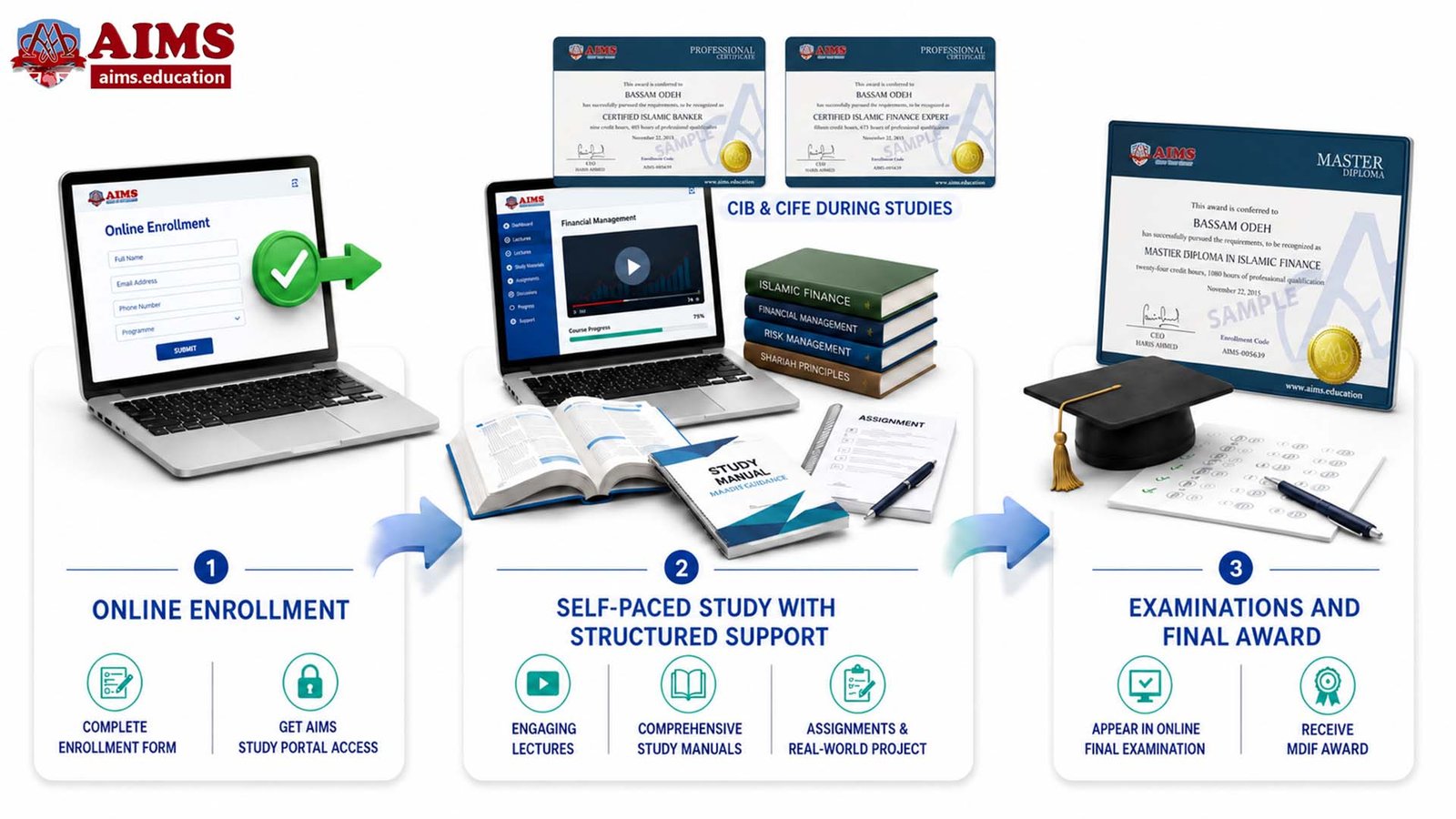
The MDIF follows a simple three-step structure. Students enroll online, study the required courses with guided resources, complete assignments and a project, and then sit for the relevant examinations.

  • Complete the online enrollment form for the postgraduate diploma in Islamic finance.
  • After submission of the required information and fee, access to the online portal is typically provided within 24 to 48 hours.

Students study seven theory courses and complete one final project. Learning materials are accessible online, allowing flexible study from any location.

  • Interactive lectures explain key Islamic finance concepts with practical examples and case-based learning.
  • Comprehensive study manuals connect theory with real Islamic finance applications.
  • Faculty support is available by email.
  • Students can use the Islamic finance library for additional study.
  • Each course includes MCQ-type assignments, with 10 assignments in Semester I and 4 assignments in Semester II.
  • After completing the first five courses and ten assignments, students request the Semester I examination.
  • Successful Semester I candidates receive the CIFE and CIB certifications.
  • In Semester II, students complete the remaining assignments, finish a real-world Islamic finance project, and request the Semester II examination.
  • All assignments and examinations are MCQ-based and can be scheduled at the student’s convenience.
  • A minimum score of 65% is required to pass.
  • After successful completion of Semester II, students receive the CTP certification and the Master Diploma in Islamic Finance.
post graduate diploma in islamic banking and finance

MDIF Program Structure

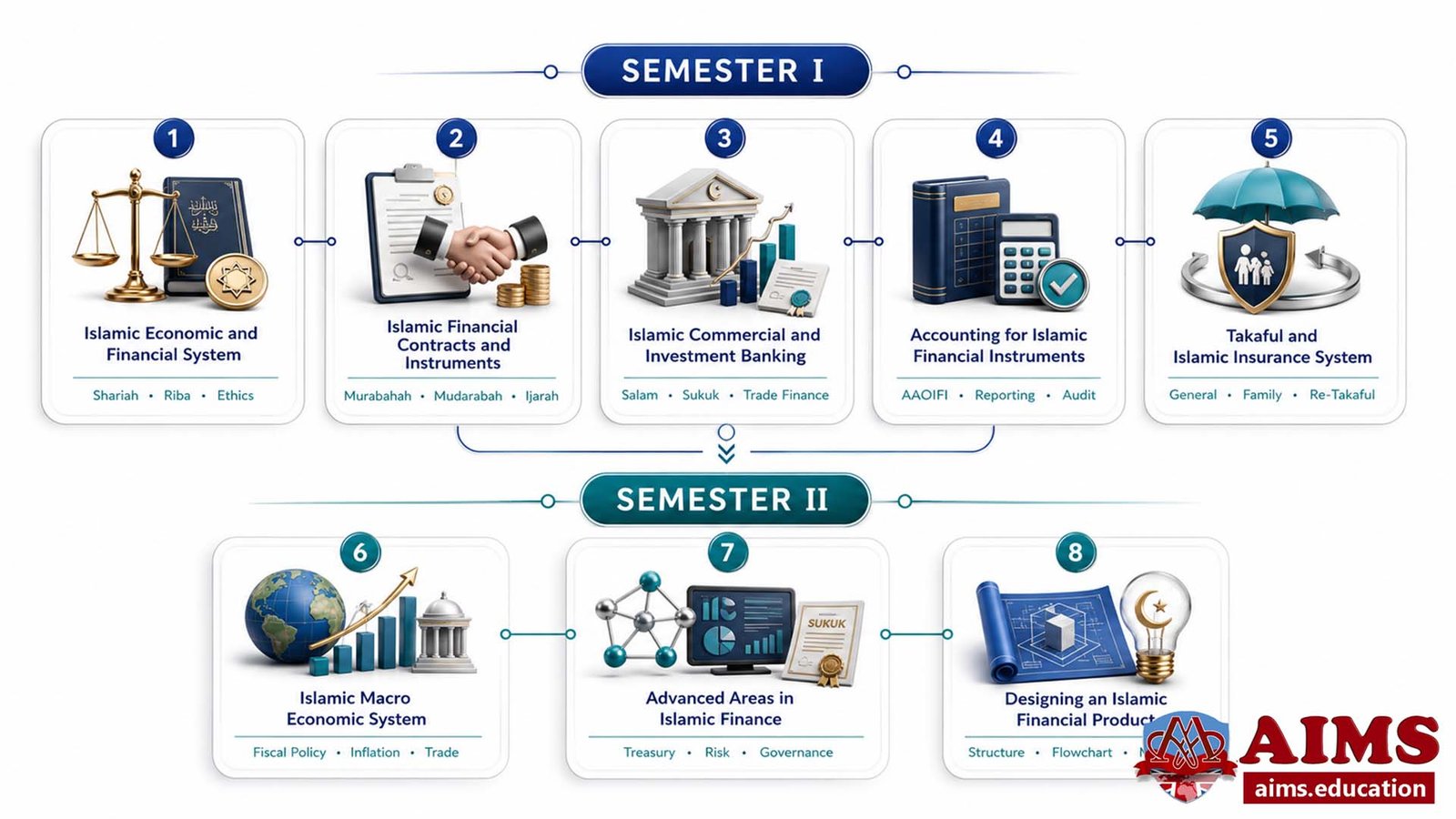
The Master Diploma in Islamic Finance consists of eight courses divided into two semesters. This structure allows learners to gain recognized qualifications progressively while building from fundamentals to advanced application.

diploma in Islamic banking
  • After completing Semester I, students are awarded the Certified Islamic Banker and Certified Islamic Finance Expert certifications.

  • After completing Semester II, students earn the Certified Takaful Professional certification and the Master Diploma in Islamic Finance.

  • The 27 credit hours earned through MDIF are positioned as transferable toward advanced Islamic finance study.

Islamic Finance Diploma Curriculum Overview

Professionals searching for an advanced diploma in Islamic finance or an executive diploma in Islamic finance usually want a qualification that combines flexibility, practical depth, and progression value. The MDIF is designed around that combination.

Semester I of the Master Diploma in Islamic Finance covers the following areas:

  • Principles and origins of the Islamic economic system.
  • Shariah prohibited elements such as Riba, Maysir, and Gharar.
  • Shariah-compliant transactions (Fiqh-Ul-Muamlaat).
  • Islamic financial instruments, including Murabahah, Musharakah, Salam, Istisna, and Ijarah.
  • Shariah-compliant investment and commercial banking systems.
  • Sukuk (Islamic Bonds) and Project Financing products.
  • AAOIFI Shariah and Accounting standards
  • Takaful (Islamic Insurance) – system, products, and services.

Semester II of AIMS’ diploma in Islamic banking and finance covers advanced areas of Islamic finance and a real-world project. It includes a detailed study of:

  • Islamic Microeconomics.
  • Islamic Economic Planning.
  • Fiscal policy, Islamic monetary policy, and Bait-Ul-Maal.
  • Advanced Islamic financial services and product design.
  • Development of Islamic securities and Sukuk.
  • Risk management in Islamic banking and finance.
  • AAOIFI Shariah standards and accounting standards for IFIs.
  • Conversion from a conventional to an Islamic bank.
  • A real-world project that requires students to design and implement an Islamic financial product.
Islamic finance diploma
diploma in islamic finance and banking

Hear from Our Global Learners!

“I earned my MDIF from AIMS, and it far exceeded my expectations. Throughout my postgraduate diploma in Islamic banking and finance studies, I experienced a truly unique learning approach. AIMS’ training methodology combines both theoretical knowledge and practical applications seamlessly. I appreciated the flexibility to complete my studies at my own pace, which made the learning experience stress-free yet effective. The assignments provided at the end of each module were particularly valuable in reinforcing key concepts. I highly recommend this Islamic banking diploma to anyone aiming to build a high-value, rewarding career in Islamic finance.”

Dr. Hajer Zarrouk Ouafi, Lecturer, Emirates College of Technology, UAE.

“My experience with AIMS’ diploma in Islamic banking and finance has been truly exceptional. The course materials are comprehensive, well-organized, and cover all essential topics in depth. I was particularly impressed by the additional resources—such as presentations, articles, and books—that allowed me to explore each area of study far beyond the core curriculum. I can confidently apply theory in real-world financial environments. Communication with AIMS has been outstanding. The team is always responsive, professional, and genuinely dedicated to supporting students.”

Małgorzata Berłowska, Product Manager, Digital Bank, Saudi Arabia

“AIMS has truly transformed my career with its diploma in Islamic banking and finance. The flexible program structure allowed me to balance work and study seamlessly. After graduating, I feel confident in my knowledge and skills, fully prepared to advance in the Islamic finance industry. I highly recommend AIMS to anyone seeking a thorough, practical, and convenient learning experience.”

Aisha Khan, USA

Key Benefits of AIMS’ Islamic Finance Diploma

  • Globally Recognized Qualification

    The postgraduate diploma in Islamic Banking and Finance from the AIMS Institute for Islamic Banking and Finance has enjoyed an outstanding reputation since 2008. Our graduates hold leading roles in Islamic banks, Takaful companies, and other Islamic financial institutions worldwide.

  • Leads to Higher Education

    After successfully finishing Semester I, students earn the prestigious Certified Islamic Banker (CIB) and Certified Islamic Finance Expert (CIFE) certifications. Upon completing Semester II, they are awarded the Certified Takaful Professional (CTP) certification and the Master Diploma in Islamic Finance (MDIF). MDIF graduates may transfer 27 credits towards a Master’s degree in Islamic Finance.

  • Who Should Attend MDIF?

    This diploma in Islamic banking and finance is ideal for individuals seeking specialization in Shariah-compliant finance. Whether you’re already part of the Islamic financial services industry or looking to enter it, the AIMS’ Islamic finance diploma equips you with practical skills and internationally respected credentials.

    The MDIF is particularly suitable for:

    • Bankers & Investment Professionals
    • Insurance & Takaful Experts
    • Finance Regulators & Legal Advisors
    • Financial Consultants
    • Academicians & Researchers
    • Graduates & Job Seekers
    • Entrepreneurs & Business Owners.
  • Develop Real World Expertise

    Students enrolled in our diploma in Islamic finance and banking must complete a hands-on project to strengthen their real-world skills. The practical Islamic finance project enables them to understand the design and implementation of Islamic banking products and services.

  • MDIF Salary Outlook

    Here’s a closer look at the attractive salary prospects after completing a post graduate diploma in Islamic banking and finance from AIMS:

      Mid-Level Managers Salary
    $110,000 – $160,000
      Senior Managers Salary
    $160,000 – $220,000
      Director Salary
    $220,000 – $300,000
  • Career Opportunities for MDIF Graudates

    MDIF graudates are well-positioned for diverse and rewarding roles in the global Islamic finance industry. Some of the prominent career paths after completing AIMS’ postgraduate diploma in Islamic banking and finance include:

    • Product Development Manager
    • Director of Islamic Investment
    • Islamic Financial Consultant
    • Shariah Advisor (for those with an Islamic Studies)
    • Islamic Financial Analyst
    • Islamic Financial Advisor
    • Financial Manager at IFIs
    • Senior Manager in Islamic banks or Takaful companies
    • Legal Counsel for IFIs (for those with a law degree)
    • Lecturer or Professor in Islamic finance.

Inquiry Form!

    Frequently Asked Questions

    AIMS’ internationally accredited Master Diploma in Islamic Finance (MDIF) is designed to meet this growing market need. Our postgraduate diploma in Islamic Banking and Finance is job-oriented, globally recognized, AAOIFI-compliant, and 100% online, making it ideal for professionals seeking higher career prospects.

    Leading scholars and practitioners developed AIMS’ Islamic finance diploma, and it does not require any prior education or experience. AIMS’ Master Diploma in Islamic Finance (MDIF) begins with fundamental concepts, so no prior experience or education in Islamic Finance is required.

    On average, students complete the program in 4 to 5 months. Since the MDIF program is flexible, you can progress at your own pace and easily balance your Islamic finance diploma studies with work or other commitments.

    Students are required to submit two MCQ-type assignments per course (10 in Semester I, 4 in Semester II). All assignments and exams are MCQ-type, and students may schedule them at their convenience. A minimum score of 65% is required to pass.

    After completing the first 5 courses and 10 assignments, students request the Semester I exam. Upon passing Semester I, they are awarded the Certified Islamic Finance Expert (CIFE) and Certified Islamic Banker (CIB) certifications. Upon successful completion, receive the Certified Takaful Professional (CTP) certification and the Master Diploma in Islamic Finance (MDIF).

    Semester I of the Master Diploma in Islamic Finance covers the following areas: Principles and origins of the Islamic economic system. Shariah prohibited elements such as Riba, Maysir, and Gharar. Shariah-compliant transactions (Fiqh-Ul-Muamlaat). Islamic financial instruments, including Murabahah, Musharakah, Salam, Istisna, and Ijarah.

    Semester II of AIMS’ diploma in Islamic banking and finance covers advanced areas of Islamic finance and a real-world project. It includes a detailed study of: Islamic Microeconomics. Islamic Economic Planning. Advanced Islamic financial services and product design. Development of Islamic securities and Sukuk. Risk management in Islamic banking and finance.

    AIMS is officially registered with the UKRLP and holds international accreditation. The Master Diploma in Islamic Finance (MDIF) is equivalent to the Level-6 Islamic Finance diploma and fully complies with the AAOIFI Shariah Standards.

    Students enrolled in our diploma in Islamic finance and banking must complete a hands-on project to strengthen their real-world skills. A real-world project that requires students to design and implement an Islamic financial product.

    Graduates of AIMS’ postgraduate diploma in Islamic banking and finance are well-positioned for diverse and rewarding roles in the global Islamic finance industry. Some of the prominent career paths include: Product Development Manager in Islamic financial institutions. Shariah Advisor. Islamic Financial Analyst. Islamic Finance Consultant for conventional banks willing to enter the Shariah-compliant market.

    Yes, AIMS is offering a 35% fee scholarship in addition to our already subsidized fees, making quality education more accessible. This scholarship is part of our commitment to providing an affordable path for individuals aiming to enhance their careers in Islamic banking and finance.

    This diploma in Islamic banking and finance is ideal for individuals seeking specialization in Shariah-compliant finance. Whether you’re already part of the Islamic financial services industry or looking to enter it, the AIMS’ Islamic finance diploma equips you with practical skills and internationally respected credentials.