
What Is Project Stakeholder Management?
Project stakeholder management is a structured approach for understanding who has an interest in a project, how each party can influence its progress, what they expect from the outcome, and how the project team should engage with them.
- Project stakeholder management is the continuous process of identifying, analyzing, planning for, engaging, and monitoring the people, groups, and organizations that can affect or be affected by a project.
- It helps the project manager understand interests, influence, expectations, and possible resistance so that decisions, communication, and relationships support the project’s objectives.
In practice, stakeholder management in project management is not limited to sending progress reports. It combines project stakeholder engagement, expectation management, negotiation, conflict resolution, and relationship building throughout the different phases of a project management. When applied effectively, it improves decision-making, reduces resistance, exposes risks earlier, and builds the support needed to deliver useful project outcomes.
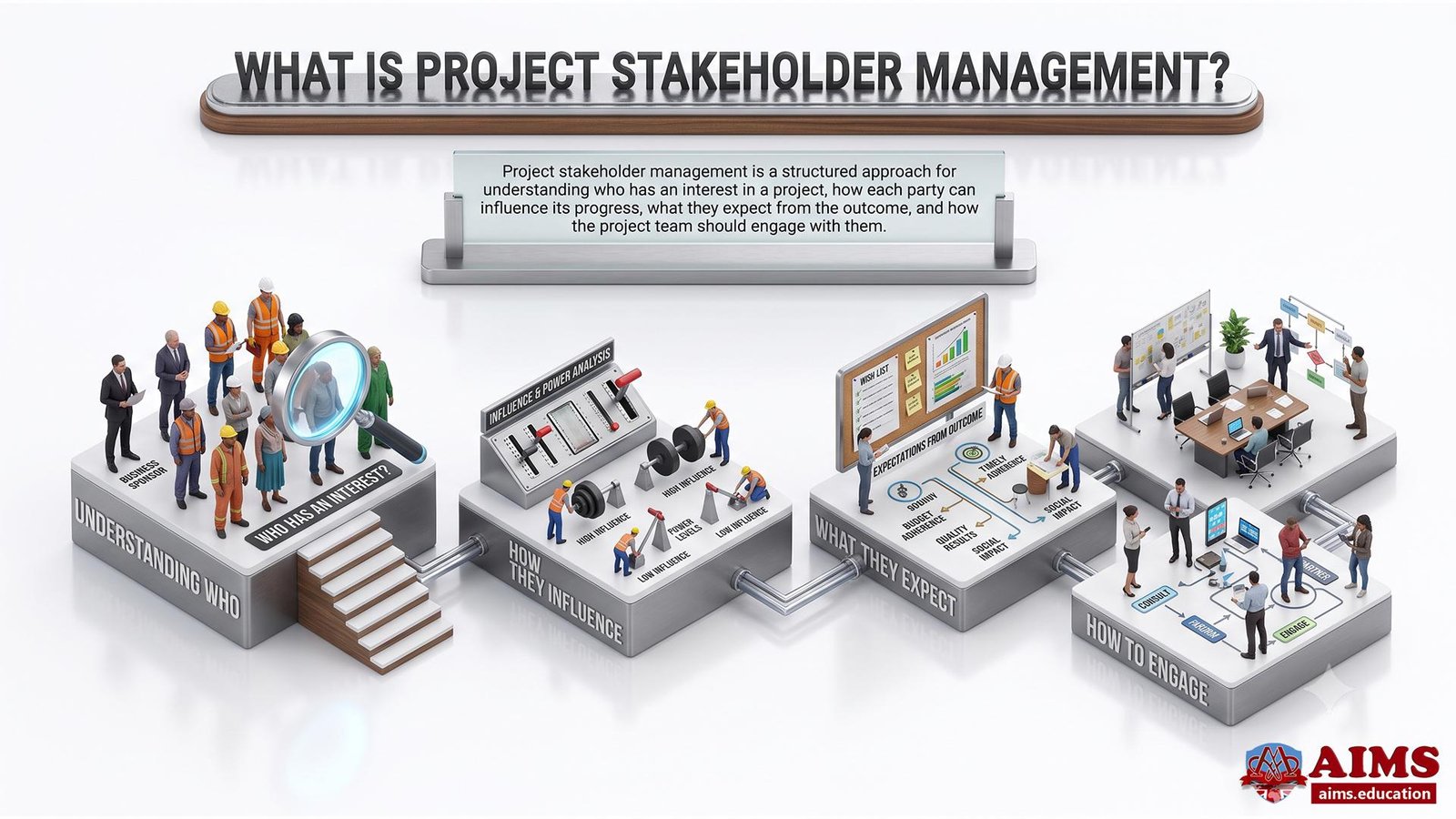
A stakeholder may be directly involved in project work, affected by its deliverables, responsible for approving decisions, or capable of influencing resources, priorities, acceptance, and public perception. Stakeholders can support the project, oppose it, remain neutral, or change their position as circumstances develop.
A project manager does not manage stakeholders as resources. The manager builds relationships, aligns expectations, addresses concerns, and creates conditions in which stakeholders can contribute constructively.
The question what is stakeholder management in project management? is therefore best answered by viewing it as a continuous management system. It connects identification, analysis, planning, communication, engagement, issue resolution, and monitoring rather than treating each activity as an isolated administrative task.
Effective Stakeholder Management in Project Management
Effective stakeholder management in project management is important, because projects depend on decisions, resources, cooperation, information, approvals, and acceptance from people who may have different priorities. A technically sound project can still struggle when influential stakeholders are ignored, expectations remain unclear, or resistance is discovered too late.
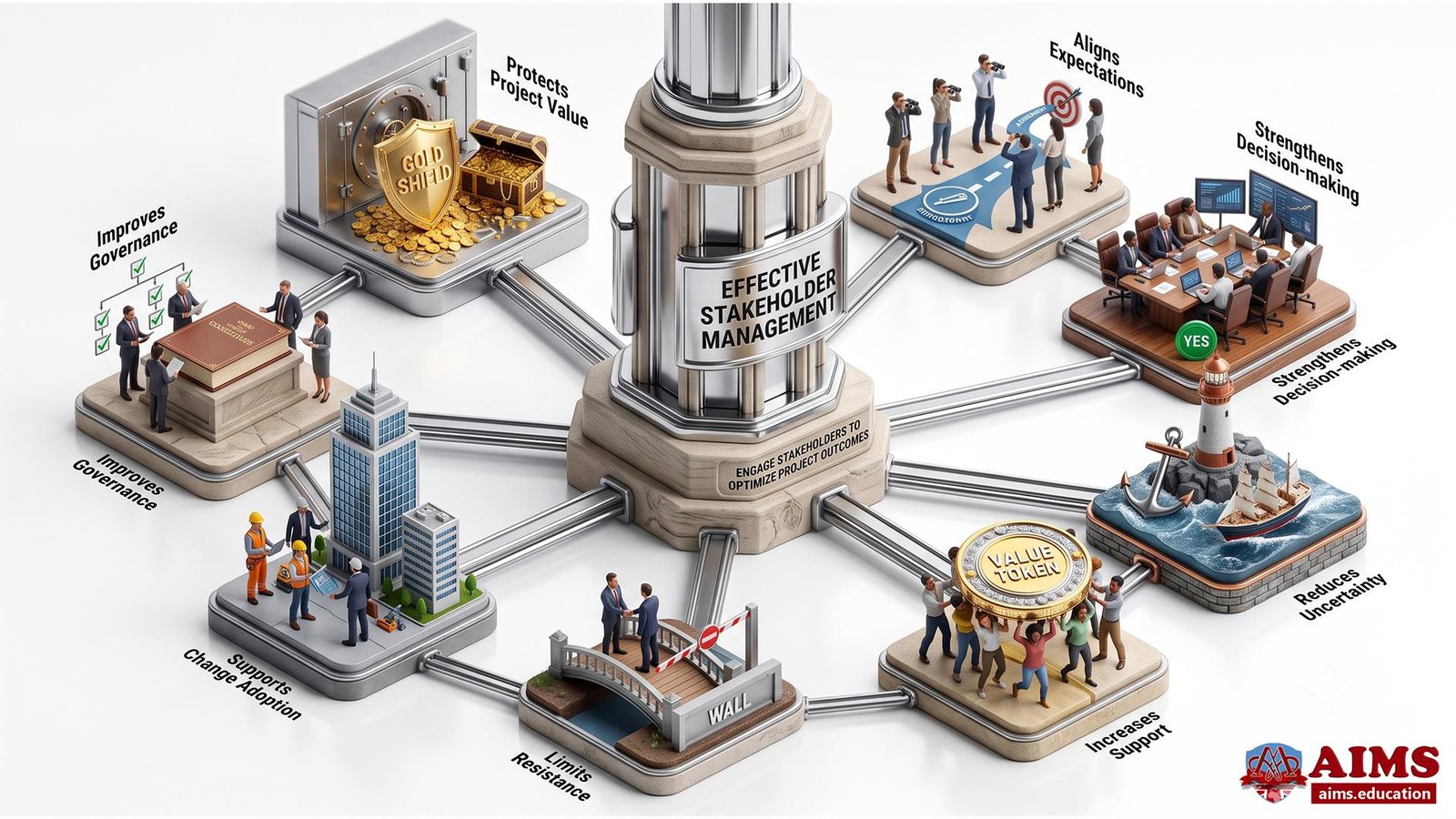
Effective stakeholder management supports project success in several connected ways:
- It aligns expectations. Stakeholders gain a realistic understanding of the
project’s scope, benefits, constraints, responsibilities, and expected outcomes. - It strengthens decision-making. The project team receives timely knowledge from sponsors, users, specialists, suppliers, regulators, and operational managers.
- It reduces uncertainty. Stakeholder concerns can reveal assumptions, dependencies, threats, and opportunities that should be addressed through appropriate project risk management practices.
- It increases support. Stakeholders who understand the project and see how their interests are considered are more likely to contribute positively.
- It limits resistance. Early dialogue allows the project manager to understand why a person or group is concerned rather than labeling every objection as uncooperative behavior.
- It supports change adoption. Users and operational teams are more likely to accept a new system, process, or product when they participate meaningfully in its development.
- It improves governance. Decision rights, escalation routes, approvals, and accountabilities become clearer.
- It protects project value. The team can focus not only on completing deliverables but also on producing outcomes that stakeholders can use and support.
Stakeholder satisfaction should therefore be treated as an important project objective. This does not mean that every stakeholder receives everything requested. It means that expectations, decisions, trade-offs, and unresolved concerns are handled transparently and professionally.
Who Are the Stakeholders in a Project?
A project stakeholder is any person, group, or organization that can influence the project, participate in it, or experience a positive or negative effect from its activities or outcomes.
Stakeholders may be classified in several ways. These classifications are not mutually exclusive because one stakeholder can belong to several categories at the same time.
- Internal and external stakeholders
- Primary and secondary stakeholders
- Decision-making and advisory stakeholders
- Supportive, neutral, resistant, or leading stakeholders
- High-power and low-power stakeholders
- High-interest and low-interest stakeholders
- Directly affected and indirectly affected stakeholders
Internal Stakeholders
Internal and external stakeholders are distinguished by their relationship with the organization conducting the project. Internal stakeholders operate within that organization and are often directly connected to governance, delivery, resources, or operational adoption.
Common internal stakeholders include:
- The project sponsor
- The project manager
- Project team members
- Senior executives
- Functional and departmental managers
- Finance, procurement, legal, quality, and human resource teams
- Employees and operational users affected by the project
- Portfolio, programme, or project management office personnel
External Stakeholders
External stakeholders operate outside the performing organization but may supply resources, impose requirements, receive deliverables, influence public acceptance, or experience the
project’s effects.
Common external stakeholders include:
- Customers and clients
- Contractors and suppliers
- Consultants and professional advisers
- Government departments and regulators
- Financial institutions and investors
- Local communities
- Professional associations
- Business partners and distributors
- Members of the public affected by the project
| CLASSIFICATION | COMMON EXAMPLES | TYPICAL INTERESTS | MANAGEMENT FOCUS |
|---|---|---|---|
| Internal stakeholders | Sponsor, project team, executives, department managers and employees | Strategic value, budget, workload, authority, performance and operational effects | Clarify responsibilities, decisions, resources, expectations and organizational impacts |
| External stakeholders | Customers, suppliers, regulators, consultants and communities | Quality, compliance, contractual obligations, service continuity and social impact | Manage agreements, consultation, compliance, acceptance and external dependencies |
| Primary stakeholders | Sponsor, customer, project team and directly affected users | Project decisions, deliverables, benefits and immediate consequences | Maintain active involvement and resolve concerns promptly |
| Secondary stakeholders | Professional bodies, media, wider communities and indirectly affected groups | Reputation, standards, indirect effects and longer-term outcomes | Monitor influence and engage when their interest or impact becomes significant |
Example of Stakeholders in a Software Implementation Project
Consider Atlas Retail, an imaginary company implementing a new enterprise resource planning system across six branches. Its stakeholders would include:
- The chief executive, who sponsors the project and expects strategic efficiency.
- The finance director, who requires stronger financial controls and reliable reporting.
- Department managers, who must allocate employees for testing and training.
- End users, whose daily work will change when the new system is introduced.
- The technology team, which must integrate the system with existing infrastructure.
- The software supplier, which is responsible for configuration and technical support.
- Customers, who may experience temporary service changes during deployment.
- Regulators, who expect data handling and financial processes to remain compliant.
Recognizing this wider stakeholder community prevents the project team from focusing only on the sponsor and technical supplier.
The Project Stakeholder Management Process
The stakeholder management process is a repeating cycle through which the project team identifies stakeholders, evaluates their importance, plans appropriate engagement, works with them, and adjusts its approach as relationships and project conditions change.
A practical process contains five connected stages:
- Identify the people, groups, and organizations connected to the project.
- Analyze and prioritize their interests, influence, expectations, and possible impacts.
- Plan the engagement and communication approach for each important stakeholder.
- Manage participation, expectations, relationships, concerns, and conflicts.
- Monitor stakeholder conditions and adapt the strategy throughout the project.
Some project management frameworks combine identification and analysis within one process. Others use different names for planning, managing, and monitoring engagement. The underlying management logic remains consistent.
| STAGE | MAIN QUESTION | KEY ACTIVITIES | MAIN OUTPUTS |
|---|---|---|---|
| 1. Identify | Who can affect or be affected by the project? | Review documents, consult experts, interview known stakeholders and examine organizational relationships | Initial stakeholder list and stakeholder register |
| 2. Analyze | What does each stakeholder expect, and how much influence does each have? | Assess interest, power, impact, attitude, relationships, urgency and legitimacy | Priorities, stakeholder maps and engagement requirements |
| 3. Plan | How should the project engage each stakeholder? | Define objectives, messages, responsibilities, methods, frequency and escalation routes | Stakeholder engagement plan and communication arrangements |
| 4. Engage | How will the project build support and address concerns? | Communicate, listen, negotiate, involve, resolve conflict and manage expectations | Decisions, feedback, resolved issues, commitments and change requests |
| 5. Monitor | Is the engagement approach still effective? | Review relationships, feedback, issues, stakeholder changes and engagement gaps | Updated register, plans, issue log and management actions |
Stage 1: Identify Project Stakeholders
Stakeholder identification is the process of finding and documenting the people, groups, and organizations that may influence the project or experience an effect from its decisions, activities, deliverables, or outcomes.
Identification should begin as early as possible. Stakeholder influence is often greatest when major decisions about objectives, scope, funding, governance, and delivery approach are still being made. However, identification must continue because new stakeholders may emerge later.
Sources Used to Identify Stakeholders
A project manager can begin by examining the following sources:
- Project authorization documents: These usually identify the sponsor, customer, project manager, strategic owner, and participating departments.
- Contracts and procurement documents: These reveal suppliers, contractors, consultants, customers, and parties with contractual responsibilities.
- Organizational charts: These help the manager locate decision-makers, functional authorities, affected departments, and reporting relationships.
- Business cases and requirements: These identify benefit owners, users, customers, subject matter experts, and groups affected by proposed changes.
- Regulatory and industry requirements: These reveal government bodies, professional authorities, auditors, and compliance specialists.
- Historical information: Previous stakeholder registers, issue logs, and lessons learned may reveal recurring sources of support or resistance.
- Expert consultation: Sponsors, senior managers, experienced project managers, technical specialists, and known stakeholders can identify parties the team has overlooked.
Practical Stakeholder Identification Questions
When considering how to manage project stakeholders, begin with questions that reveal who belongs in the stakeholder community:
- Who authorizes, funds, governs, or approves the project?
- Who performs the work or supplies essential resources?
- Who will use, operate, maintain, or support the final deliverable?
- Whose role, workload, authority, income, process, or working conditions may change?
- Who can delay, reject, redirect, or publicly influence the project?
- Which regulators, suppliers, customers, communities, or partners are affected?
- Who possesses knowledge that the project requires?
- Which stakeholders may appear during later project phases?
- Who else do already identified stakeholders believe should be consulted?
Example of Identifying Stakeholders
Atlas Retail begins its software project by reviewing the business case, supplier contract, department structure, system architecture, and data-protection obligations.
- The project manager identifies the sponsor, finance director, technology director, branch managers, end users, supplier, and compliance officer.
- Each person is asked which other groups depend on the existing system.
- The interviews reveal two overlooked stakeholders: the external payroll provider and the customer-service team.
- Both are added because system integration failures could interrupt salary processing and customer support.
Early identification prevents important operational dependencies from becoming expensive surprises during implementation.
Creating and Maintaining a Stakeholder Register
A stakeholder register is a controlled project document that records stakeholder identities, roles, interests, expectations, influence, attitudes, communication requirements, and relevant engagement information.
The register gives the project team one structured source of stakeholder knowledge. It should contain enough information to support decisions without becoming an uncontrolled collection of personal opinions.
What a Stakeholder Register Should Include
| INFORMATION CATEGORY | EXAMPLES | MANAGEMENT PURPOSE |
|---|---|---|
| Identification information | Name, role, organization, department and contact details | Clarifies who the stakeholder is and how the person can be reached |
| Project relationship | Sponsor, user, supplier, regulator, decision-maker or adviser | Shows how the stakeholder is connected to project work and outcomes |
| Interests and expectations | Expected benefits, concerns, requirements and success criteria | Supports expectation alignment and message development |
| Influence and impact | Decision authority, resource control, expertise and degree of impact | Helps the project manager prioritize attention and engagement |
| Current attitude | Unaware, resistant, neutral, supportive or leading | Reveals the present relationship and possible need for intervention |
| Engagement requirements | Information needs, preferred channel, frequency and participation level | Guides communication and involvement decisions |
| Timing | Project phase or decision point when involvement is most important | Ensures engagement occurs when stakeholder input can still influence outcomes |
The stakeholder register may contain sensitive assessments about authority, interests, resistance, relationships, and possible management strategies. Access should therefore be limited to people who have a legitimate project need, and subjective comments should be written professionally.
Stage 2: Analyze and Prioritize Stakeholders
Stakeholder analysis is the structured evaluation of each
stakeholder’s interests, expectations, influence, attitude, relationships, and potential impact on the project.
Identification tells the manager who the stakeholders are. Analysis explains why they matter and how the project should respond to them. Without analysis, every stakeholder may receive the same information and level of attention even though their needs and influence are very different.
Steps in Stakeholder Analysis
A useful analysis follows three broad steps:
- Collect relevant information. Record the stakeholder’s role, knowledge, expectations, authority, concerns, communication needs, and relationship with the project.
- Evaluate potential influence and impact. Consider how the stakeholder could support, delay, redirect, reject, or improve the project.
- Anticipate likely responses. Assess how the stakeholder may react to decisions, changes, risks, delays, or trade-offs so that the project can prepare an appropriate approach.
Analysis should focus on observable information and evidence. Personal assumptions can be misleading, particularly when they are based on job titles rather than actual authority, informal influence, technical knowledge, or control over resources.
Stakeholder Mapping
Stakeholder mapping places stakeholders into meaningful categories so the project manager can decide where to concentrate attention. Common mapping models include:
- Power-interest grid
- Power-influence grid
- Influence-impact grid
- Stakeholder direction of influence
- Support-resistance classification
- Salience analysis based on power, legitimacy, and urgency
No model provides a permanent label. A stakeholder’s position can change when new risks emerge, organizational responsibilities shift, or the project enters a different phase.
Using a Power-Interest Grid
A power-interest grid categorizes stakeholders according to their authority or influence and their level of interest in the project. It helps the project manager allocate limited engagement time according to stakeholder significance.
| POWER AND INTEREST | RECOMMENDED APPROACH | PRACTICAL ACTIONS |
|---|---|---|
| High power, high interest | Manage closely | Involve in important decisions, maintain frequent dialogue and resolve concerns quickly |
| High power, low interest | Keep satisfied | Provide concise strategic information and consult them on decisions requiring their authority |
| Low power, high interest | Keep informed | Provide relevant updates, invite feedback and involve representatives in suitable activities |
| Low power, low interest | Monitor proportionately | Maintain accessible information and review whether their interest or influence changes |
The grid guides attention, but it should not be used to dismiss people in the low-power categories. A low-power user group may possess critical operational knowledge, and its collective resistance may create a serious adoption problem.
Software Project Stakeholder Analysis Example
Atlas Retail analyzes its main stakeholders before finalizing the implementation approach.
| STAKEHOLDER | MAIN INTEREST | INFLUENCE | KEY EXPECTATION | MAIN RISK | ENGAGEMENT APPROACH |
|---|---|---|---|---|---|
| Chief executive | Strategic efficiency | High | Visible organizational benefits | Loss of sponsorship if benefits appear unclear | Monthly benefit review and decision briefings |
| Finance director | Financial control | High | Accurate reports and strong approval controls | Rejection of the proposed configuration | Detailed design workshops and formal sign-off |
| Branch employees | Usability and workload | Medium collectively | Simple processes and adequate training | Low adoption or workarounds | User representatives, demonstrations, testing and feedback |
| Software supplier | Contract delivery | High technically | Timely decisions and access to specialists | Delay caused by unresolved requirements | Weekly delivery meeting and managed decision log |
| Compliance officer | Data and regulatory compliance | High in specialist matters | Evidence that controls meet requirements | Late compliance objections | Early design review and control testing |
This analysis gives Atlas Retail a reasoned basis for deciding who should be consulted, informed, involved, or asked to approve work.
Stage 3: Plan Stakeholder Engagement
Planning stakeholder engagement means determining how the project will build and maintain appropriate relationships with stakeholders based on their interests, influence, expectations, attitudes, and potential effects on project success.
A stakeholder engagement plan converts stakeholder information into an actionable relationship strategy. It explains the desired level of participation, the actions required to achieve it, and the responsibilities of the people who will manage each relationship.
What a Stakeholder Engagement Plan Should Include
The level of detail should reflect the project’s complexity, sensitivity, and stakeholder environment. A practical plan normally includes:
- The stakeholder’s current and desired engagement levels
- Specific engagement objectives
- Key interests, concerns, expectations, and information needs
- The effect that project changes may have on the stakeholder
- Stakeholder relationships, dependencies, and areas of possible conflict
- Methods for consultation, participation, negotiation, and decision-making
- Information content, format, language, channel, and level of detail
- The timing and frequency of engagement activities
- The project team member responsible for the relationship
- Escalation routes for unresolved concerns and decisions
- Measures used to evaluate whether engagement is effective
- The method and timing for reviewing and updating the plan
Stakeholder Engagement Plan and Communication Plan
A stakeholder communication plan defines what information will be communicated, why it is required, who will receive it, when it will be distributed, and which communication method will be used. It forms an important part of broader project communication management.
Communication supports engagement, but the two are not identical. Engagement may also require workshops, consultation, negotiation, participation in decisions, conflict resolution, relationship building, and action based on stakeholder feedback.
| DOCUMENT | PRIMARY PURPOSE | TYPICAL CONTENT |
|---|---|---|
| Stakeholder register | Records who the stakeholders are and why they matter | Identity, role, interests, influence, attitude, requirements and contact information |
| Stakeholder engagement plan | Defines how relationships, involvement, expectations, and support will be managed | Current and desired engagement, objectives, strategies, responsibilities and review measures |
| Communication plan | Defines how project information will be created, shared, received, and controlled | Audience, message, purpose, sender, channel, format, frequency and escalation arrangements |
Stakeholder Engagement Levels
A stakeholder engagement assessment matrix compares a stakeholder’s current engagement with the level required for project success. A common five-level scale is:
| ENGAGEMENT LEVEL | MEANING | POSSIBLE MANAGEMENT RESPONSE |
|---|---|---|
| Unaware | The stakeholder does not know about the project or its potential effects | Provide relevant awareness information and explain why the project matters |
| Resistant | The stakeholder knows about the project but opposes or questions it | Investigate concerns, correct misunderstandings and involve the stakeholder in suitable decisions |
| Neutral | The stakeholder is aware but neither supports nor actively resists the project | Maintain relevant communication and identify what could increase constructive participation |
| Supportive | The stakeholder understands and supports the proposed change or outcome | Maintain commitment and provide meaningful opportunities to contribute |
| Leading | The stakeholder actively promotes and helps the project succeed | Use the stakeholder’s credibility and expertise without overloading or misusing the relationship |
Example of Planning Stakeholder Engagement
Atlas Retail finds that branch employees are currently neutral, but the project requires them to become supportive before user acceptance testing.
- The project appoints one user representative from each branch.
- Representatives join process-design workshops and review early system demonstrations.
- A monthly user bulletin explains decisions, training dates, and responses to employee feedback.
- A testing schedule gives employees protected time to assess realistic business scenarios.
- The project manager measures participation, recurring concerns, and readiness for adoption.
The plan moves employees from passive awareness toward informed participation and practical ownership of the new system.
Stage 4: Manage Stakeholder Engagement
Managing stakeholder engagement is the active process of communicating and working with stakeholders to understand expectations, address concerns, resolve issues, build support, and sustain appropriate participation throughout the project.
Managing stakeholders in projects requires more than distributing approved information. It involves listening, negotiation, influence, facilitation, trust building, conflict management, and timely action.
Stakeholder Management Strategies for Project Managers
Stakeholder management strategies for project managers should be adapted to the specific person, group, decision, and project phase. Useful strategies include:
- Engage early. Consult important stakeholders while their knowledge can still influence requirements, priorities, designs, and delivery choices.
- Clarify expectations. Explain what the project can deliver, what it cannot deliver, what remains uncertain, and what decisions are still open.
- Match communication to the stakeholder. Senior executives may need concise decision-focused reports, while technical users may require detailed demonstrations and working sessions.
- Listen before attempting to persuade. A stakeholder’s objection may reveal a legitimate operational, commercial, technical, or ethical risk.
- Separate interests from stated positions. A manager who says “do not change the process” may actually be concerned about service disruption, accountability, or insufficient training.
- Involve stakeholders proportionately. Participation should reflect influence, knowledge, impact, and the decision being made.
- Record commitments and decisions. Clear records reduce later disagreement about responsibilities, approvals, and agreed actions.
- Use escalation carefully. Escalation is appropriate when authority is required, but it should not replace direct professional dialogue.
- Demonstrate responsiveness. Stakeholders should see how their feedback was considered, even when the project cannot accept every request.
- Protect trust. Communicate difficult information promptly rather than allowing stakeholders to discover it indirectly.
Communication and Interpersonal Skills
Project managers use several interpersonal and management skills to sustain effective engagement:
- Active listening and constructive questioning
- Clear written and verbal communication
- Emotional awareness and cultural sensitivity
- Facilitation and consensus building
- Negotiation and expectation management
- Conflict resolution and problem-solving
- Influencing without relying only on formal authority
- Building trust through consistency and follow-through
- Adapting communication to professional knowledge and information needs
These capabilities form part of the wider competence developed through career-oriented and practical project management certification, particularly for managers responsible for cross-functional teams and organizational change.
How to Handle Difficult or Conflicting Stakeholders
A difficult stakeholder is usually a stakeholder whose interests, expectations, behavior, or level of influence creates a challenge for the project. The project manager should diagnose the source of the difficulty before selecting a response.
A practical approach is to:
- Understand the underlying interest. Ask what the stakeholder is protecting, seeking, or trying to avoid.
- Verify the facts. Distinguish legitimate concerns from incomplete information, assumptions, and personal disagreement.
- Identify shared objectives. Reconnect the discussion to project value, customer needs, compliance, safety, or organizational priorities.
- Develop options. Explore solutions that address the
stakeholder’s core concern without undermining project objectives. - Clarify decision authority. Confirm who may recommend, approve, reject, or escalate the matter.
- Document the outcome. Record agreed actions, owners, dates, unresolved points, and consequences.
- Monitor the relationship. Check whether the agreement has reduced the concern or merely postponed it.
Resistance should also be considered alongside broader change management in project environments. People may resist because they anticipate lost authority, increased workload, reduced competence, operational disruption, or insufficient support.
Conflict Resolution Example
During the Atlas Retail project, the sales director requests rapid order entry with minimal approval steps. The finance director insists on additional controls to prevent unauthorized discounts.
- The project manager holds a facilitated workshop to separate each director’s position from the underlying business need.
- The sales director explains that delays could cause customers to abandon purchases.
- The finance director explains that uncontrolled discounts could reduce margins and weaken auditability.
- The team designs automatic approval thresholds based on discount value and employee authority.
- Both directors review a prototype and approve measurable service and control requirements.
The conflict produces a stronger solution because the project manager investigates both interests instead of choosing one
department’s position.
Stage 5: Monitor and Adapt Stakeholder Engagement
Monitoring stakeholder engagement is the continuous evaluation of stakeholder relationships, attitudes, concerns, participation, and communication effectiveness so that the project can adjust its plans and actions.
Stakeholders do not remain static. Their influence, expectations, responsibilities, and attitudes may change because of organizational restructuring, project performance, leadership changes, emerging risks, revised requirements, or external events.
What Should Be Monitored?
The project manager should monitor indicators such as:
- Attendance and participation in required meetings
- Speed and quality of stakeholder decisions
- Recurring questions, complaints, objections, or misunderstandings
- Unresolved items in the issue and decision logs
- Changes in stakeholder authority, role, interest, or availability
- Feedback from demonstrations, workshops, surveys, and reviews
- Adoption readiness and resistance to proposed changes
- Communication reach, understanding, and usefulness
- New stakeholders, suppliers, regulators, or affected groups
- Differences between current and desired engagement levels
How Often Should Stakeholder Documents Be Updated?
The stakeholder register and engagement plan should be reviewed at planned governance points and whenever a meaningful stakeholder change occurs. There is no single update frequency suitable for every project.
Useful review triggers include:
- The beginning or end of a major project phase
- Approval of a significant scope, schedule, budget, or design change
- Appointment or departure of an influential stakeholder
- Introduction of a new supplier, regulator, partner, or user group
- Emergence of conflict, resistance, complaints, or repeated communication failures
- Identification of a new risk, dependency, requirement, or operational impact
- Preparation for testing, deployment, transition, or project closure
- Evidence that the current engagement strategy is not achieving its intended result
Stakeholder Monitoring Example
Atlas Retail initially classifies branch managers as supportive. Two months before deployment, meeting attendance declines and managers repeatedly postpone employee training nominations.
- The project manager interviews three branch managers and discovers concern about losing employees during the busiest sales period.
- The engagement assessment is changed from supportive to resistant for the affected managers.
- The training schedule is revised to use shorter sessions across several weeks.
- Temporary operational cover is approved by the sponsor.
- Participation and readiness are reviewed every two weeks until deployment.
Monitoring reveals a practical constraint that routine status reporting alone would not have resolved.
Project Stakeholder Engagement vs. Project Stakeholder Management
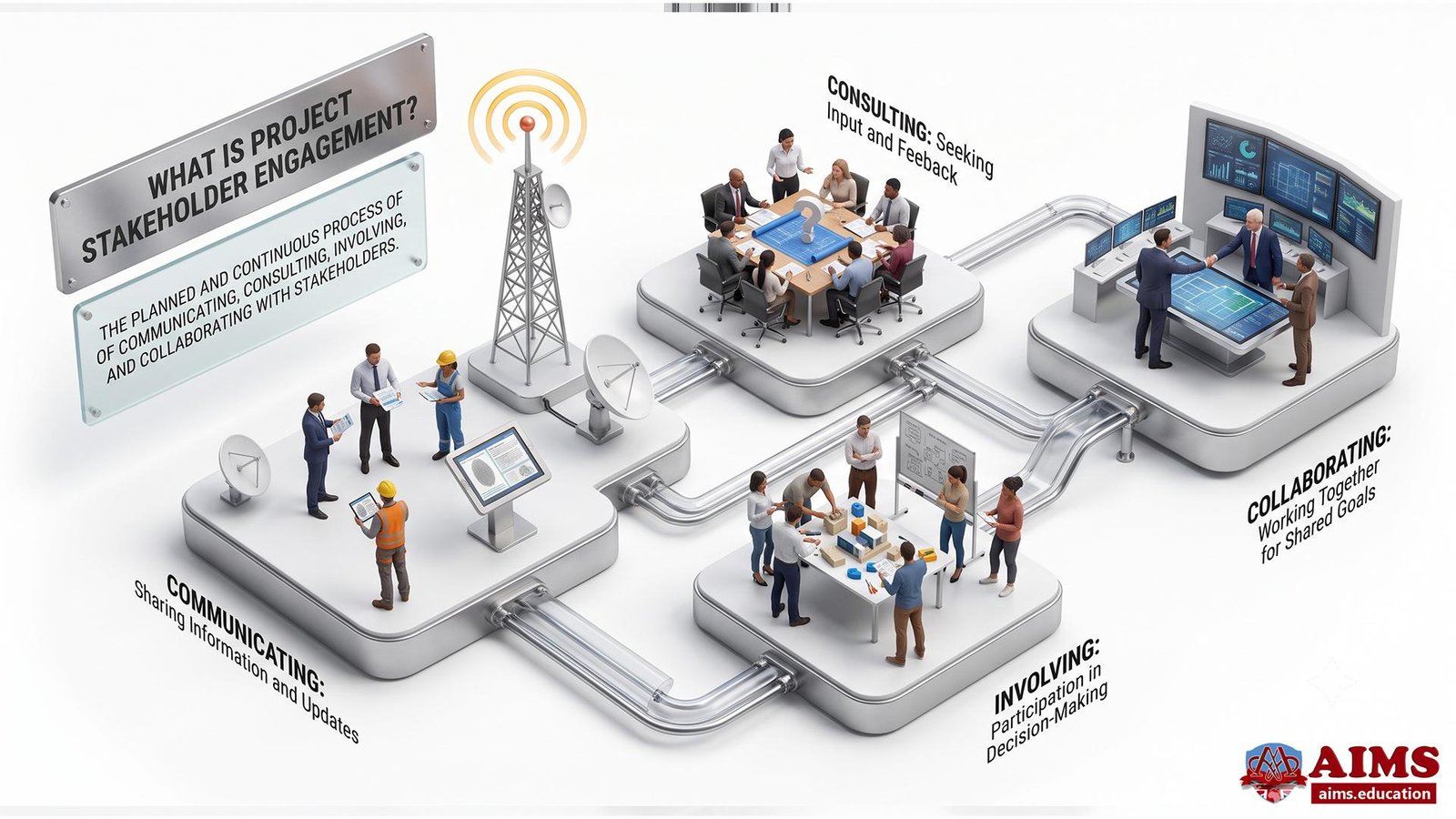
Project stakeholder engagement is the planned and continuous process of communicating, consulting, involving, and collaborating with people or groups who influence a project or are affected by its outcomes. Its purpose is to understand expectations, address concerns, build support, reduce resistance, and secure the participation needed for informed decisions and successful project delivery.
The distinction expressed in stakeholder management vs stakeholder engagement concerns scope. Stakeholder management is the broader system used to identify, analyze, plan for, engage, and monitor stakeholders. Stakeholder engagement is the relationship-centered work used to communicate, consult, involve, influence, negotiate, and collaborate with them.
| COMPARISON AREA | STAKEHOLDER MANAGEMENT | STAKEHOLDER ENGAGEMENT |
|---|---|---|
| Scope | The complete system for understanding and managing the stakeholder environment | The practical interaction and relationship-building component of that system |
| Main focus | Analysis, prioritization, strategy, governance, planning and monitoring | Dialogue, participation, communication, influence, trust and collaboration |
| Typical outputs | Stakeholder register, maps, strategies, plans and updated assessments | Feedback, decisions, agreements, support, resolved concerns and active participation |
| Success question | Does the project understand and manage its stakeholder environment effectively? | Are stakeholders participating and responding at the level the project requires? |
The terms are sometimes used interchangeably, but engagement should not be reduced to one-way communication. Genuine engagement requires the project team to receive information, respond to concerns, and involve stakeholders in suitable decisions.
Common Stakeholder Management Mistakes
Stakeholder management mistakes usually occur when the process is treated as a one-time planning exercise or when project teams assume that communication alone will produce support.
1. Identifying Only the Most Obvious Stakeholders
Teams often list the sponsor, customer, and project team but overlook operational users, support functions, regulators, suppliers, communities, or groups indirectly affected by the outcome.
2. Treating the Stakeholder Register as a Static Document
A register prepared during initiation loses value when roles, attitudes, influence, and project conditions change. It must be reviewed and updated throughout the lifecycle.
3. Confusing Information Distribution with Engagement
Sending reports does not prove that stakeholders understand, accept, or support the project. Engagement requires dialogue, feedback, participation, and responsive action.
4. Communicating the Same Information to Everyone
Executives, technical specialists, suppliers, users, and regulators need different levels of detail. Standardized communication can create overload for some stakeholders and information gaps for others.
5. Ignoring Low-Power Stakeholders
Low formal authority does not mean low importance. Users, customers, and communities may possess essential knowledge or create significant collective resistance.
6. Assuming Resistance Is Irrational
Resistance may reveal genuine concerns about safety, compliance, workload, service continuity, cost, quality, or organizational readiness. Dismissing it can remove an important source of project intelligence.
7. Allowing Expectations to Remain Ambiguous
Stakeholders may assume that an unconfirmed feature, date, or benefit is guaranteed. The project manager should clarify assumptions and document agreed expectations.
8. Engaging Stakeholders Too Late
Consultation after a decision has effectively been finalized can damage trust. Important stakeholders should be engaged while meaningful options remain available.
9. Recording Unprofessional or Unsupported Judgments
Stakeholder documents should describe relevant evidence, concerns, influence, and engagement needs. Personal criticism or careless labels may damage relationships if disclosed.
10. Failing to Measure Engagement Effectiveness
A project may conduct many meetings without improving decisions, support, readiness, or issue resolution. Engagement should be evaluated according to outcomes, not only activity volume.
A Practical Stakeholder Management Checklist
Project managers can use the following checklist to test whether stakeholder management remains complete and useful:
- Have all people and groups affected by project decisions and outcomes been considered?
- Has each important stakeholder’s interest, influence, attitude, and expected impact been assessed?
- Does the stakeholder register contain current and professionally written information?
- Are stakeholder priorities based on evidence rather than title or assumption?
- Has the project defined the current and desired engagement level for key stakeholders?
- Does each major stakeholder have an appropriate communication and involvement approach?
- Are communication methods adapted to stakeholder knowledge, authority, and preferences?
- Are important concerns linked to risks, issues, decisions, requirements, or change actions?
- Are conflicts addressed through interests, evidence, options, and clear decision authority?
- Can stakeholders see how their feedback has influenced decisions?
- Are engagement results reviewed at phase boundaries and when project conditions change?
- Are lessons learned being recorded for future projects?
These practices strengthen the professional judgment required for complex stakeholder environments. They can be developed further through a project management diploma focused on applied management competence.
Final Words
Project stakeholder management is a continuous discipline that connects people, decisions, risks, communication, and project outcomes. Its purpose is not to eliminate every disagreement or satisfy every request. Its purpose is to understand stakeholder interests, establish appropriate relationships, make expectations visible, and create informed support for responsible project decisions.
The process begins with broad identification, develops through evidence-based analysis and engagement planning, and continues through communication, negotiation, issue resolution, and monitoring. When the project manager treats stakeholder knowledge as a living management resource, the team becomes better prepared to anticipate resistance, resolve conflict, improve adoption, and deliver outcomes that stakeholders can understand and use.
Frequently Asked Questions
What is stakeholder management in project management?
Stakeholder management is the continuous process of identifying, analyzing, planning for, engaging, and monitoring people or groups that can influence a project or be affected by it. It helps project managers align expectations, obtain useful input, address concerns, build support, and adapt relationships as project conditions change.
Why is stakeholder management important for project success?
Projects depend on stakeholder decisions, resources, knowledge, approvals, cooperation, and acceptance. Effective stakeholder management reduces misunderstanding and resistance, identifies risks earlier, improves decision quality, supports organizational change, and increases the likelihood that completed deliverables will produce benefits that users and sponsors value.
Who are the stakeholders in a project?
Project stakeholders can include the sponsor, project manager, team members, customers, users, executives, department managers, suppliers, contractors, regulators, professional advisers, investors, communities, and anyone else who can influence the project or experience an effect from its activities and outcomes.
What are the main types of project stakeholders?
Stakeholders are commonly classified as internal or external, primary or secondary, supportive or resistant, and high or low in power and interest. These categories describe different aspects of a stakeholder. For example, an external regulator may also be a high-power, low-interest stakeholder during a particular project phase.
What are the steps in the project stakeholder management process?
The main steps are to identify stakeholders, analyze and prioritize them, plan appropriate engagement, manage communication and participation, and monitor relationships throughout the project. The cycle is repeated because stakeholder roles, influence, concerns, and engagement needs may change as the project progresses.
How do project managers identify and prioritize stakeholders?
Project managers review authorization documents, contracts, organizational charts, requirements, regulatory obligations, and lessons learned. They also consult sponsors, team members, experts, and known stakeholders. Prioritization then considers each stakeholder’s power, interest, impact, attitude, urgency, knowledge, and importance to particular project decisions.
What should a stakeholder management plan include?
A stakeholder management or engagement plan should record current and desired engagement levels, stakeholder concerns, engagement objectives, communication requirements, responsibilities, timing, participation methods, escalation routes, and measures of effectiveness. It should also explain when and how the plan will be reviewed and updated.
What is the difference between stakeholder management and stakeholder engagement?
Stakeholder management is the broader system that includes identification, analysis, prioritization, planning, engagement, and monitoring. Stakeholder engagement is the relationship-focused part of that system and includes communication, consultation, participation, negotiation, influence, feedback, and collaboration with stakeholders.
How should a project manager handle difficult or conflicting stakeholders?
The project manager should first understand the stakeholder’s underlying interests and verify the facts behind the disagreement. The manager can then identify shared objectives, develop workable options, clarify decision authority, document agreements, and monitor the relationship. Legitimate concerns should be addressed rather than dismissed as resistance.
How often should the stakeholder register and engagement plan be updated?
They should be reviewed at major governance or phase points and whenever a significant change occurs. Common triggers include new stakeholders, revised scope, leadership changes, emerging risks, unresolved conflict, new suppliers, regulatory changes, deployment activities, or evidence that the current engagement approach is ineffective.
What are the most common stakeholder management mistakes?
Common mistakes include overlooking less visible stakeholders, using outdated stakeholder information, confusing reports with engagement, communicating identically with every audience, ignoring low-power groups, consulting stakeholders too late, dismissing resistance, leaving expectations unclear, and measuring meeting activity instead of engagement outcomes.
Project Management Education at AIMS Project Management Academy
AIMS’ Project Management Academy has delivered internationally accredited, career-focused education since 2005 to learners worldwide. Its internationally
standardized curriculum is developed by qualified faculty and industry practitioners, combining practical skill development, 3D interactive learning content, and real-world case studies. This educational resource, together with AIMS study content and curriculum, is collaboratively developed and rigorously peer-reviewed by an academic board of qualified industry practitioners. Stakeholder competence strengthens project leadership and delivery. Explore AIMS’ practical, accredited and flexible project management qualifications.