
What is Change Management in Project Management?
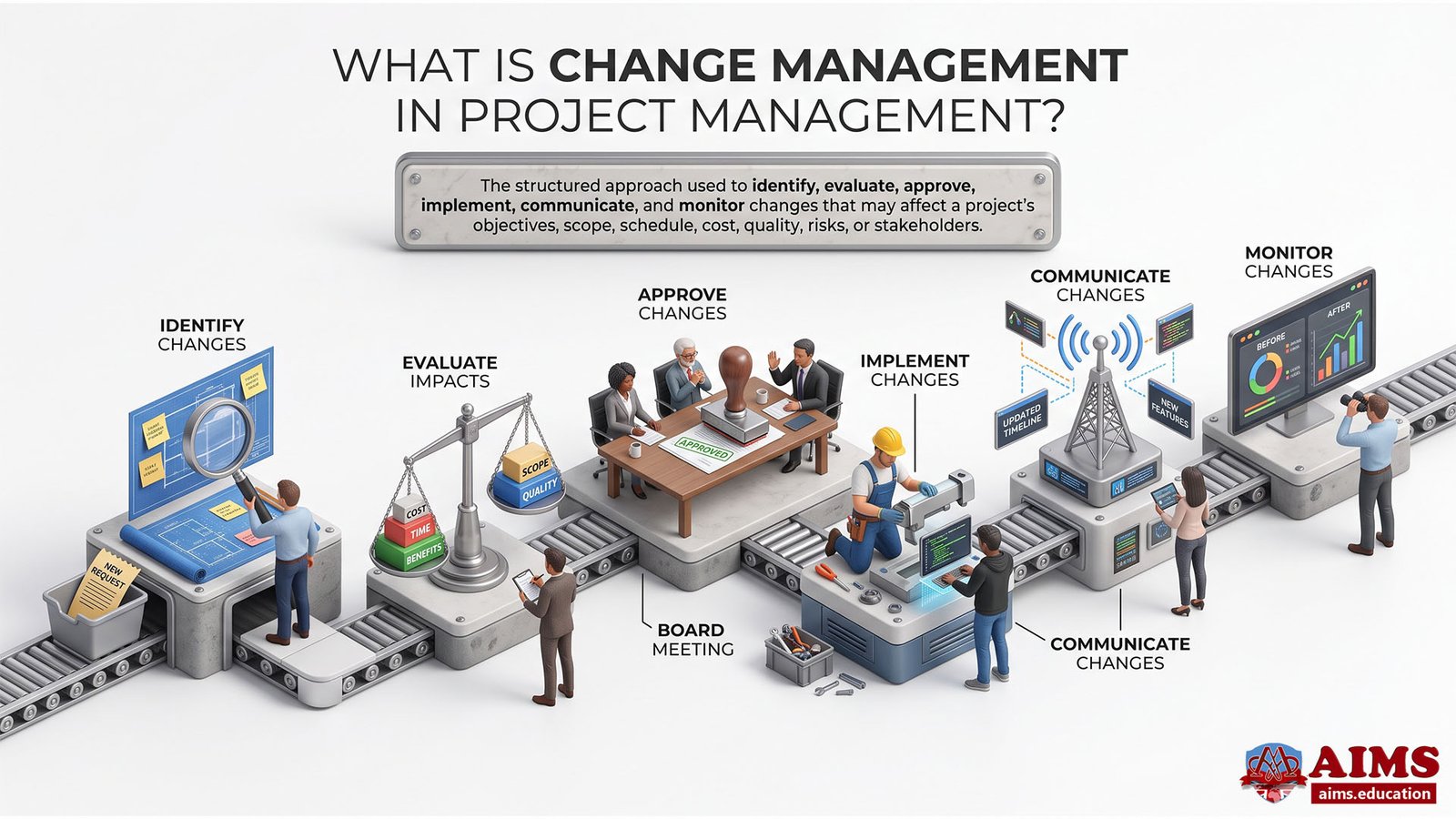
Change management in project management is the structured approach used to identify, evaluate, approve, implement, communicate, and monitor changes that may affect a project’s objectives, scope, schedule, cost, quality, risks, or stakeholders. It combines formal change control with the people-focused activities needed to help stakeholders understand and adopt approved changes without losing control of the project.
In practice, project change management prevents necessary adjustments from becoming uncontrolled disruption. A proposed change is documented, its impact is assessed, an authorized decision-maker approves, rejects, or defers it, and approved changes are reflected in project plans before implementation. This disciplined approach allows a project to adapt while protecting agreed objectives and maintaining accountability.
Why Is Change Management Important in Project Management?
Change management is important because projects rarely proceed exactly as originally planned, yet every change can create consequences elsewhere in the project. New stakeholder requirements, technical discoveries, regulatory conditions, resource constraints, risks, and business priorities can all create legitimate reasons for change.
The objective is not to prevent change. It is to ensure that the project team understands the consequences before committing resources or altering an approved direction.
- A controlled approach reduces unauthorized scope expansion and helps protect the project’s approved objectives.
- Impact assessment shows how a proposed change may affect scope, schedule, cost, quality, resources, risks, dependencies, and expected benefits.
- Defined approval authority prevents individuals from making significant project commitments without appropriate governance.
- Documented decisions create traceability so stakeholders can understand what changed, why it changed, who authorized it, and what consequences were accepted.
- Planned communication helps affected stakeholders understand both the change itself and the reason behind it.
Because one adjustment can affect several areas simultaneously, effective change management is closely connected with coordinating project integration and interconnected management processes.

Change Management vs Change Control in Project Management
Change management is broader than change control. Change management addresses how change is prepared for, governed, implemented, communicated, and adopted, while change control focuses specifically on evaluating and deciding proposed changes to an approved project baseline.
This distinction is important because the terms are frequently treated as interchangeable. Change control in project management is a controlled decision process, whereas change management may also address stakeholder readiness, communication, training, transition, resistance, and adoption.
| ASPECT | CHANGE MANAGEMENT | CHANGE CONTROL |
|---|---|---|
| Definition | A structured approach for preparing, governing, implementing, communicating, and supporting change. | A formal process for capturing, evaluating, and deciding requests to change an approved baseline. |
| Primary Focus | Successful transition and effective implementation of change, including stakeholder adoption where required. | Control over proposed modifications to approved project requirements, scope, schedule, cost, or other baselines. |
| Typical Activities | Planning, stakeholder engagement, communication, implementation support, training, monitoring, and transition activities. | Change request documentation, impact analysis, review, approval or rejection, baseline updates, and change logging. |
| Key Question | How will the approved change be introduced and successfully adopted? | Should this proposed change be authorized, rejected, or deferred? |
| Relationship | Provides the broader framework for managing change. | Provides the governance mechanism for controlling changes to approved project baselines. |
For this reason, good project governance needs both disciplines. A project may approve the technically correct change through change control but still experience poor results if affected stakeholders do not understand or adopt it.
Change Management vs Project Management
Project management organizes the work required to achieve defined project objectives, while change management focuses on introducing and supporting change so that the intended transition can be implemented effectively. They overlap when a project creates changes that affect processes, technology, roles, behaviors, or established ways of working.
| ASPECT | CHANGE MANAGEMENT | PROJECT MANAGEMENT |
|---|---|---|
| Definition | Manages the transition from a current state toward a desired future state, including the human and organizational implications of change. | Plans, organizes, executes, monitors, controls, and completes temporary work undertaken to achieve defined objectives. |
| Primary Objective | Enable the change to be introduced, understood, adopted, and sustained where appropriate. | Deliver agreed project outcomes while managing constraints, resources, risks, and stakeholder expectations. |
| Primary Focus | Readiness, communication, stakeholder engagement, transition, training, resistance, and adoption. | Scope, schedule, cost, quality, resources, risk, procurement, integration, and delivery performance. |
| Success Measures | May include readiness, adoption, proficiency, stakeholder acceptance, and realization of intended change outcomes. | Depends on achievement of agreed objectives, requirements, constraints, quality expectations, benefits, and stakeholder needs. |
| Relationship to Change | Helps people and organizations transition when a project introduces a significant change. | Uses governance and control processes to evaluate and manage modifications arising during project delivery. |
The two disciplines therefore complement each other rather than compete. Project management can deliver the new system, process, facility, or service, while change management helps affected stakeholders transition to the new way of operating.
What Is a Change Request in Project Management?
A change request in project management is a documented proposal to modify an approved or planned aspect of a project. Depending on the project’s governance arrangements, a request may concern requirements, deliverables, scope, schedule, budget, quality expectations, resources, contracts, technical specifications, corrective action, or another controlled project element.
A change request should provide enough information for an informed decision. It commonly identifies the requested change, the reason for it, the expected benefit or necessity, the affected project components, the requesting stakeholder, and any initial assumptions or constraints.
Example of a Project Change Request
Suppose Northbridge Analytics is developing a financial reporting platform. Halfway through the project, the client requests an additional real-time reporting dashboard.
- The client submits a formal request explaining the new reporting requirement.
- The project team estimates that the additional work will require three more weeks and approximately £18,000 of additional development and testing expenditure.
- The team identifies technical integration risks and evaluates whether existing resources can complete the additional work.
- The authorized decision-makers review the expected business value against the additional cost, schedule impact, and risk.
- If approved, the project manager updates the affected plans and controlled baselines before implementation begins.
The request therefore becomes a controlled project decision rather than an informal instruction that unexpectedly increases work.
What Is Change Control in Project Management?
Change control is the formal process used to capture, assess, decide, track, and implement proposed modifications to controlled project elements. Its purpose is to ensure that significant changes are not introduced simply because somebody requests them.
A disciplined change control process protects the project from uncontrolled modifications while still allowing justified changes. It is particularly important when a change affects approved project scope and requirements management, contractual obligations, budget, deadlines, or major deliverables.
In baseline-driven environments, this coordinated evaluation may also be described as integrated change control. The principle is important because a scope adjustment rarely exists in isolation. It can affect schedule, cost, resources, risks, quality expectations, procurement, and stakeholder commitments.
What Is a Change Control Board?
A change control board, commonly abbreviated as CCB, is a formally authorized group that reviews specified categories of change requests and decides whether they should be approved, rejected, deferred, or escalated.
The board may include the project sponsor, customer representatives, project manager, technical specialists, financial representatives, operational stakeholders, or other people with appropriate authority and expertise. Its composition depends on project size, complexity, risk, contractual conditions, and governance requirements.
Importantly, not every project requires a separate CCB, and not every change must be approved by one. The project’s governance arrangements should define who has authority at different decision thresholds. A project manager may approve minor changes within delegated tolerances, while significant changes may require a sponsor, steering committee, client, or CCB decision.
Who Approves Changes in a Project?
Changes should be approved by the person or governance body given the appropriate authority in the project’s change management arrangements. Approval authority should be established before major requests arise so that project decisions remain consistent and accountable.
- The project manager may approve changes that fall within explicitly delegated limits.
- The project sponsor may authorize changes that materially affect project objectives, funding, or business commitments.
- A Change Control Board may evaluate changes requiring cross-functional or formal governance review.
- A client or project owner may need to approve changes affecting contractual requirements or accepted deliverables.
- A steering committee or senior governance body may decide changes that exceed established project tolerances.
Clear authority prevents uncertainty and ensures that the people accepting the consequences of a change also have the mandate to authorize it.
What Is a Project Change Management Plan?
A project change management plan explains how proposed project changes will be submitted, evaluated, authorized, communicated, implemented, tracked, and closed. It establishes a predictable decision process before the project team faces competing requests or urgent pressure to alter agreed work.
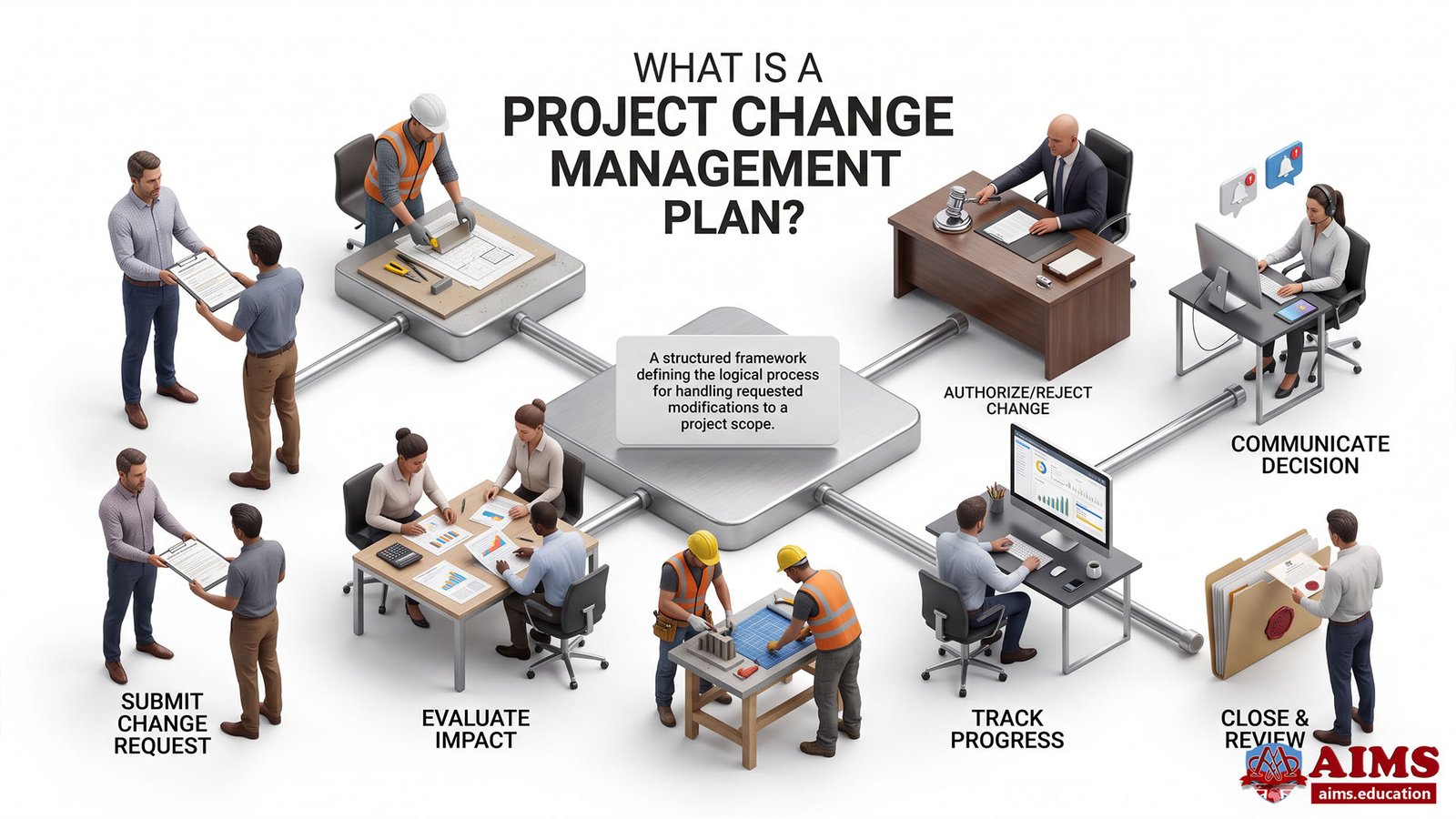
The level of detail should be appropriate to the project. A small internal initiative may use a simple procedure and change log, while a complex contractual or regulated project may require detailed approval thresholds, configuration controls, audit records, and formal governance meetings.
Key Components of a Change Management Plan
- Roles and responsibilities: The plan should identify who may raise change requests, who performs impact analysis, who makes decisions, and who implements approved changes.
- Change categories and thresholds: The plan should define which changes require formal review and which can be managed within delegated authority.
- Change request format: A standardized request should capture the proposed change, reason, expected value, affected areas, requester, urgency, and supporting information.
- Impact assessment criteria: Reviewers should examine scope, schedule, cost, quality, resources, risks, dependencies, contracts, benefits, and stakeholder implications where relevant.
- Approval process: The plan should explain whether decisions are made by the project manager, sponsor, CCB, client, or another governance authority.
- Change log: All formal requests and their status should be recorded so that the project retains a reliable decision history.
- Baseline and document updates: The plan should specify which project documents are updated after approval and who controls the revised versions.
- Communication arrangements: Relevant stakeholders should know what was decided, why it was decided, and what actions or responsibilities follow.
- Implementation and closure: Approved changes should be tracked until implementation is verified and the request can be formally closed.
The plan should also coordinate with project cost planning and control when financial baselines are affected and with risk management in project management practices when a proposed change creates, removes, or modifies project risks.
Change Management Process in Project Management
The change management process in project management moves a proposed change from identification through documented evaluation, authorization, implementation, monitoring, and closure. The exact procedure varies between projects, but a disciplined process makes decisions traceable and prevents unauthorized changes from entering project work.
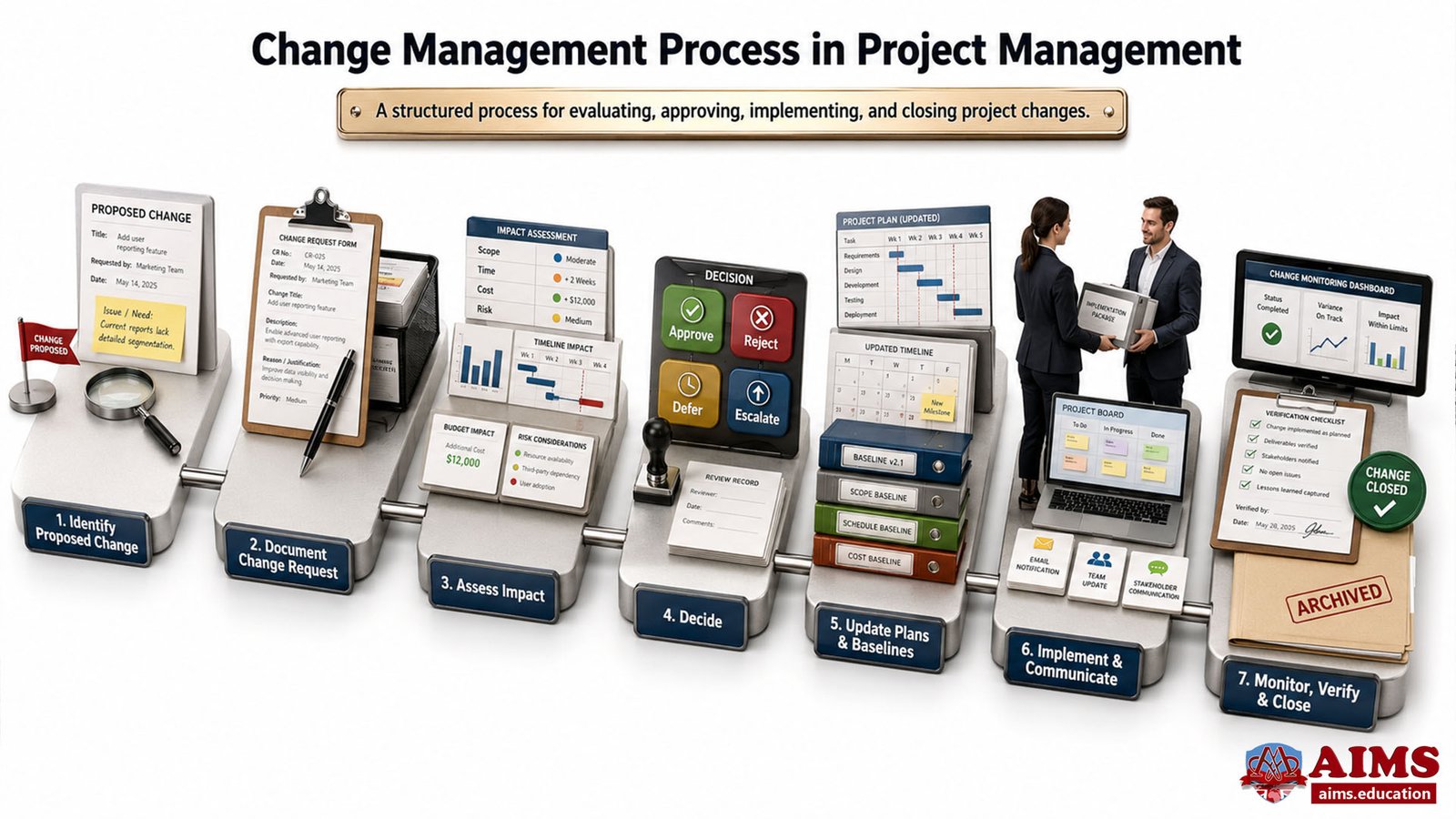
1. Identify the Proposed Change
The process starts when a stakeholder, project team member, customer, supplier, manager, or project control activity identifies a need for change. The need may arise from a new requirement, risk response, defect, regulatory requirement, technical discovery, resource constraint, or changed business priority.
2. Document the Change Request
The proposed change should be formally recorded. The request explains what is changing, why the change is needed, who requested it, its urgency, and what project areas may be affected.
Documentation prevents important decisions from being based only on informal conversations, messages, or undocumented instructions.
3. Assess the Impact of the Change
Impact assessment determines what the project would gain, lose, spend, delay, expose, or need to reorganize if the proposed change were accepted. The depth of the assessment should match the significance of the request.
- Scope: The project team determines which requirements, deliverables, activities, or acceptance criteria would change.
- Schedule: The team evaluates whether additional work changes activity durations, dependencies, milestones, or the completion date.
- Cost: The assessment estimates additional expenditure, savings, funding requirements, and effects on the cost baseline.
- Resources: Reviewers determine whether additional people, equipment, expertise, suppliers, or materials will be required.
- Quality: The team evaluates whether specifications, testing, acceptance criteria, or quality expectations need to change.
- Risk: The assessment considers new threats and opportunities as well as changes to existing risks.
- Stakeholders: Reviewers identify who will be affected and whether expectations, responsibilities, training, or acceptance may change.
- Dependencies and contracts: The team checks whether the proposed change affects suppliers, interfaces, approvals, procurement commitments, or external obligations.
This analysis should connect naturally with stakeholder management in project management because a technically small change can still create significant effects for customers, users, sponsors, suppliers, or operational teams.
4. Approve, Reject, Defer, or Escalate the Change
The authorized decision-maker reviews the change request and impact assessment. The proposed change can then be approved, rejected, deferred until more information is available, or escalated when the decision exceeds the authority of the current governance level.
A good decision considers not only whether the proposed change is desirable, but whether its expected value justifies its total impact on project objectives and commitments.
5. Update Project Plans and Baselines
Approval alone does not complete the control process. Relevant plans, schedules, budgets, requirements, registers, technical documents, contracts, responsibilities, and baselines should be updated before the team treats the revised position as authorized.
An approved change should become part of the controlled project plan, not remain a separate decision that the project documentation fails to reflect.
6. Implement and Communicate the Approved Change
The team implements the authorized work according to the revised plan. Stakeholders should receive information appropriate to their roles, particularly when the change affects responsibilities, deadlines, processes, interfaces, expected outputs, or ways of working.
Effective project communication management – planning and information flow is therefore an important part of implementation. Explaining why a change has been approved can be just as important as explaining what has changed.
7. Monitor, Verify, and Close the Change
The project manager monitors implementation to confirm that the approved change has produced the intended result and that unexpected consequences are identified. Actual cost, schedule, quality, risk, and stakeholder effects should be compared with the assumptions used during approval where appropriate.
Once implementation has been verified, records can be updated and the change formally closed. This history provides useful evidence for audits, lessons learned, future estimates, and later project decisions.
Project Change Management Examples
Project change management examples show how a request moves from an idea or requirement to an evaluated and authorized project decision. The following scenarios demonstrate the same control logic in two different industries.
Example 1: Software Project Change Management Process
Northbridge Analytics is developing an accounting platform for a commercial client. After development has started, the client asks for a new real-time financial reporting dashboard.
- The client submits a documented change request explaining the reporting requirement and expected business benefit.
- The project team determines that the dashboard requires additional development, data integration, security testing, and user acceptance testing.
- The impact analysis estimates an additional £18,000 cost, three weeks of work, and a moderate integration risk.
- The authorized change board compares the expected benefit with the additional cost, schedule impact, and technical risk.
- The request is approved because the client accepts the revised budget and delivery date.
- The project manager updates the requirements, schedule, budget, risk information, responsibilities, and affected project baselines.
- The team develops and tests the dashboard while the project manager monitors the approved change until completion.
The formal process allows the client to obtain additional value without allowing the new requirement to become uncontrolled scope expansion.
Example 2: Construction Project Change Control
Greenfield Civic Authority is renovating a public administration building. After exterior materials have been ordered, the project owner requests a different exterior finish.
- The project manager records the requested finish change and documents the owner’s reason for requesting it.
- The construction team determines that some ordered materials can no longer be used and replacement materials will cost approximately £6,500.
- The schedule analysis identifies a possible four-day delay because the revised material has a longer delivery lead time.
- The team reviews contractual, supplier, quality, cost, and schedule implications before presenting the request for approval.
- The owner accepts the additional cost and revised milestone, so the authorized change is approved.
- The project manager updates the relevant specifications, procurement information, budget, schedule, and contractor instructions.
- The approved finish is implemented and monitored during subsequent construction work.
Change control converts a seemingly simple design preference into a documented decision that accounts for its wider project consequences.
Managing Project Change Without Creating Scope Creep
Project teams prevent scope creep by separating authorized project change from informal additions to project work. A useful idea is not automatically an approved requirement. Proposed work should enter the agreed control process whenever it exceeds established authority or alters a controlled project commitment.
This is especially important because scope changes can influence time and cost simultaneously. Understanding how project scope is defined and controlled helps teams recognize when a requested adjustment changes the agreed work rather than merely clarifying it.
Practical control depends on several habits: document requests early, evaluate the full impact before promising delivery, apply agreed authority thresholds, update plans only after authorization, communicate decisions clearly, and keep a traceable change log.
Professional Learning for Effective Project Change Management
Professional project management education helps practitioners understand change as part of a wider governance system involving integration, scope, cost, risk, stakeholders, communication, and decision authority.
Professionals who want structured project management training can explore the practical CPM certification with PMP training and exam prep. Managers seeking broader business and leadership development may consider an online MBA in Project Management for advanced managerial roles.
Experienced professionals who want to develop advanced research capability in project, program, portfolio, governance, or organizational change topics can also review the doctoral PhD in project management by research.
Final Words on Change Management in Project Management
Effective project change management allows a project to adapt without surrendering control. The project manager should ensure that significant changes are documented, assessed for their wider impact, reviewed by the appropriate authority, reflected in project plans, communicated to affected stakeholders, and monitored after implementation.
Communication remains particularly important. Stakeholders usually need more than notification that something has changed. They need to understand why the decision was made, what consequences it creates, and what actions are expected from them.
For this reason, the strongest change processes combine disciplined governance with clear human communication. Projects can then respond to legitimate new requirements while protecting objectives, resources, accountability, and stakeholder confidence.
Frequently Asked Questions
What is change management in project management?
Change management in project management is the structured approach used to identify, assess, authorize, implement, communicate, and monitor changes affecting a project. It helps the project adapt to legitimate needs while controlling the impact on scope, schedule, cost, quality, risk, resources, and stakeholders.
What is the project change management process?
The project change management process normally involves identifying a proposed change, documenting the request, assessing its impact, obtaining an authorized decision, updating relevant plans and baselines, implementing and communicating the approved change, and monitoring it through completion and closure.
Why is change management important in project management?
Change management is important because project changes can affect several interconnected areas at once. A controlled process helps decision-makers understand the consequences before approving additional work, protects project objectives, reduces unauthorized scope expansion, creates accountability, and helps stakeholders prepare for approved changes.
What is change control in project management?
Change control is the formal process for capturing, evaluating, deciding, recording, and tracking proposed changes to controlled project elements or approved baselines. Its purpose is to make sure significant modifications are properly assessed and authorized before they become part of project work.
What is the difference between change management and change control?
Change management is the broader discipline concerned with preparing for, implementing, communicating, and supporting change. Change control is narrower and focuses on deciding whether proposed modifications to controlled project elements should be approved, rejected, deferred, or escalated.
What is a change request in project management?
A change request is a documented proposal to modify some aspect of a project. It normally explains the requested modification, why it is needed, who requested it, what project areas may be affected, and the information required to evaluate whether the request should be authorized.
What is a project change management plan?
A project change management plan defines how changes will be requested, documented, assessed, approved, communicated, implemented, tracked, and closed. It also establishes roles, decision authority, change records, impact assessment criteria, approval thresholds, and procedures for updating project documents and baselines.
Who approves changes in a project?
Approval depends on the project’s governance arrangements. Minor changes may fall within the project manager’s delegated authority, while significant changes may require approval from a project sponsor, client, Change Control Board, steering committee, or another authorized governance body.
How does a project manager evaluate the impact of a change?
A project manager evaluates how the proposed change affects scope, requirements, schedule, cost, resources, quality, risks, dependencies, contracts, benefits, and stakeholders. The analysis should show decision-makers both the expected value of the change and the consequences of accepting it.
What is the difference between change management and project management?
Project management organizes and controls temporary work undertaken to achieve defined objectives. Change management focuses on helping an organization or group transition from a current state to a desired future state. They work together when project outputs require people, processes, or organizations to change.
Project Management Academy: Industry-Focused Professional Education
Since 2005, AIMS’ Project Management Academy has supported a global learner community through internationally accredited, standardized, and career-focused project management education. Its qualified faculty combines industry-oriented teaching with practical skill development, 3D interactive learning content, and qualifications built around real-world case studies. Educational content and curriculum are collaboratively developed and rigorously peer-reviewed by an academic board of qualified industry practitioners. Understanding controlled project change strengthens professional competence in governance and delivery. Explore globally recognized and career-focused project management education.