
What Is Project Quality Management?
Project quality management is the systematic management of quality policies, objectives, responsibilities, standards, processes, and controls throughout a project. It ensures that the project and its deliverables meet validated requirements rather than relying on subjective opinions about what appears to be good.
Effective quality management in project management protects both the way a project is performed and the outputs it creates.
- It reduces avoidable rework, supports compliance, improves customer acceptance, and helps the team balance scope, time, cost, risk, and performance.
- The objective is not to make every deliverable expensive or feature-rich.
It is to ensure that each deliverable conforms to clearly defined requirements and performs reliably in its intended context.
Quality should be planned into project processes and deliverables from the beginning, not treated as a final inspection activity.
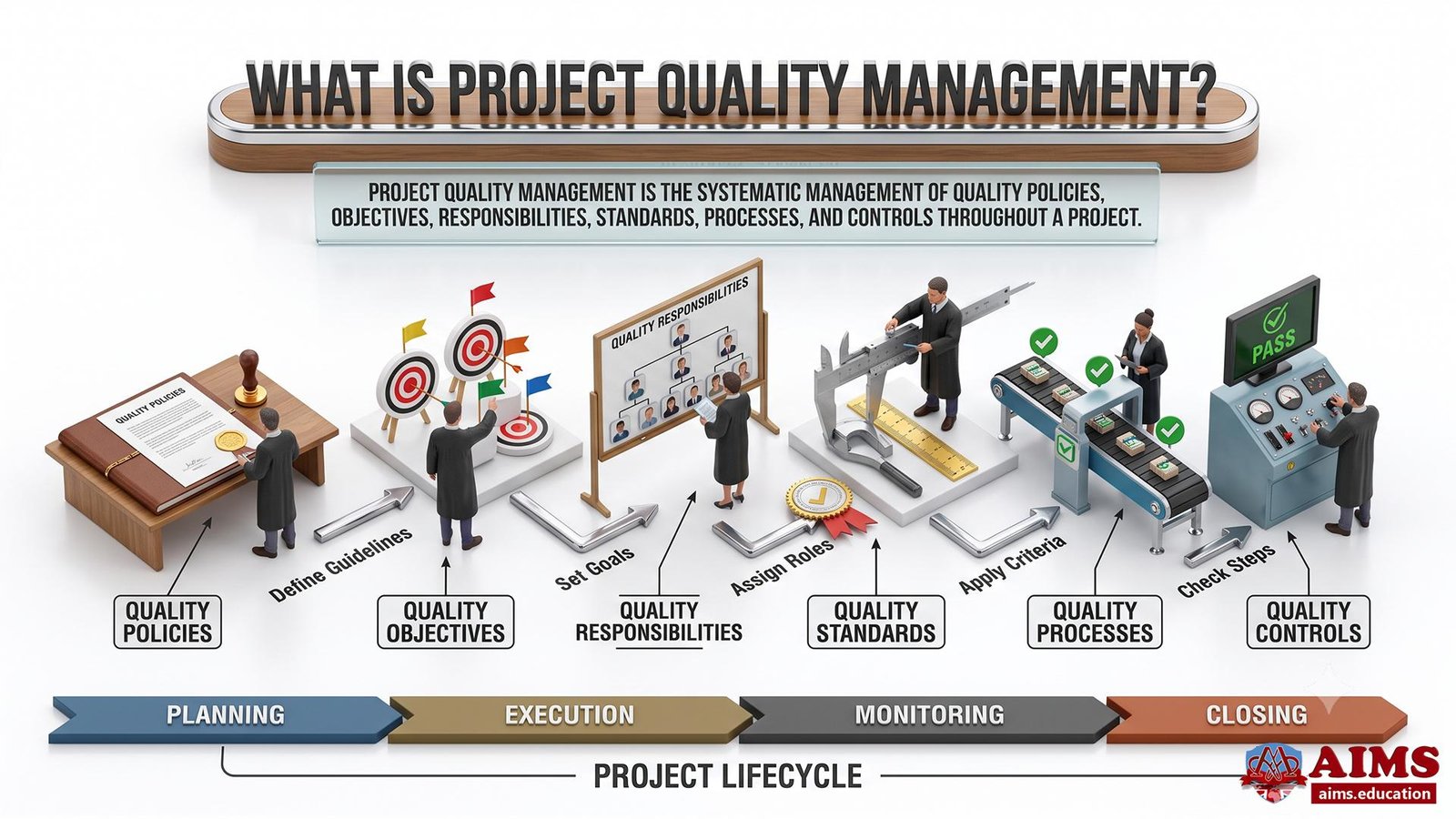
The project quality management process applies to every sector, but the measures used depend on the deliverable. A software project may measure defect density, response time, security performance, and test coverage. A construction project may measure material strength, dimensional tolerance, workmanship, and compliance with approved drawings.
Project Quality and Product Quality
Project quality concerns both management performance and deliverable performance. These two dimensions are connected, but they are not identical.
- Project-management quality examines whether planning, communication, decision-making, change control, risk responses, and other project processes are effective and consistently applied.
- Product or deliverable quality examines whether the resulting product, service, document, system, or capability conforms to its technical and functional requirements.
For example, a project may finish on time but still produce an unreliable deliverable. Conversely, the final product may perform well even though the team experienced excessive rework, unmanaged overtime, and inefficient processes. Sound quality management addresses both outcomes.
Quality vs. Grade
Quality means conformance to requirements, while grade describes the category or level of features offered by products that serve a similar function. A lower-grade product can still be high quality when it consistently meets its stated requirements.
| CONCEPT | MEANING | PROJECT EXAMPLE |
|---|---|---|
| Quality | The degree to which agreed requirements are fulfilled. | A basic scheduling application performs every promised function without critical defects. |
| Grade | The category assigned according to features, technical characteristics, or performance level. | A premium scheduling application includes advanced analytics, automation, and portfolio features. |
| High quality, lower grade | Limited features, but dependable conformance to the stated specification. | A simple mobile tool performs its limited functions accurately and consistently. |
| High grade, low quality | Many advanced features, but poor reliability or failure to meet requirements. | A feature-rich platform crashes frequently and produces inaccurate reports. |
The practical lesson is clear: every deliverable should achieve the required quality, regardless of its grade or feature level.
Accuracy vs. Precision
Accuracy describes closeness to the correct or target value, while precision describes how closely repeated measurements agree with one another. A process can be accurate without being precise, precise without being accurate, both, or neither.
- Accurate and precise: Repeated measurements are tightly grouped around the target.
- Accurate but not precise: Measurements vary, but their overall pattern remains close to the target.
- Precise but not accurate: Measurements are tightly grouped, but consistently miss the target.
- Neither accurate nor precise: Measurements vary widely and remain far from the target.
Example of Accuracy and Precision in a Project
A fabrication team must produce metal rods with a target length of 10.000 metres.
- The first sample measures 10.490, 10.495, 10.500, 10.505, and 10.510 metres.
- The measurements are close to one another, so the process is precise.
- They are far from the target, so the process is not accurate.
- The team should recalibrate the equipment rather than merely repeat the same production method.
Understanding both concepts prevents a consistently wrong process from being mistaken for a controlled and acceptable process.
Importance of Quality Management in Project Management
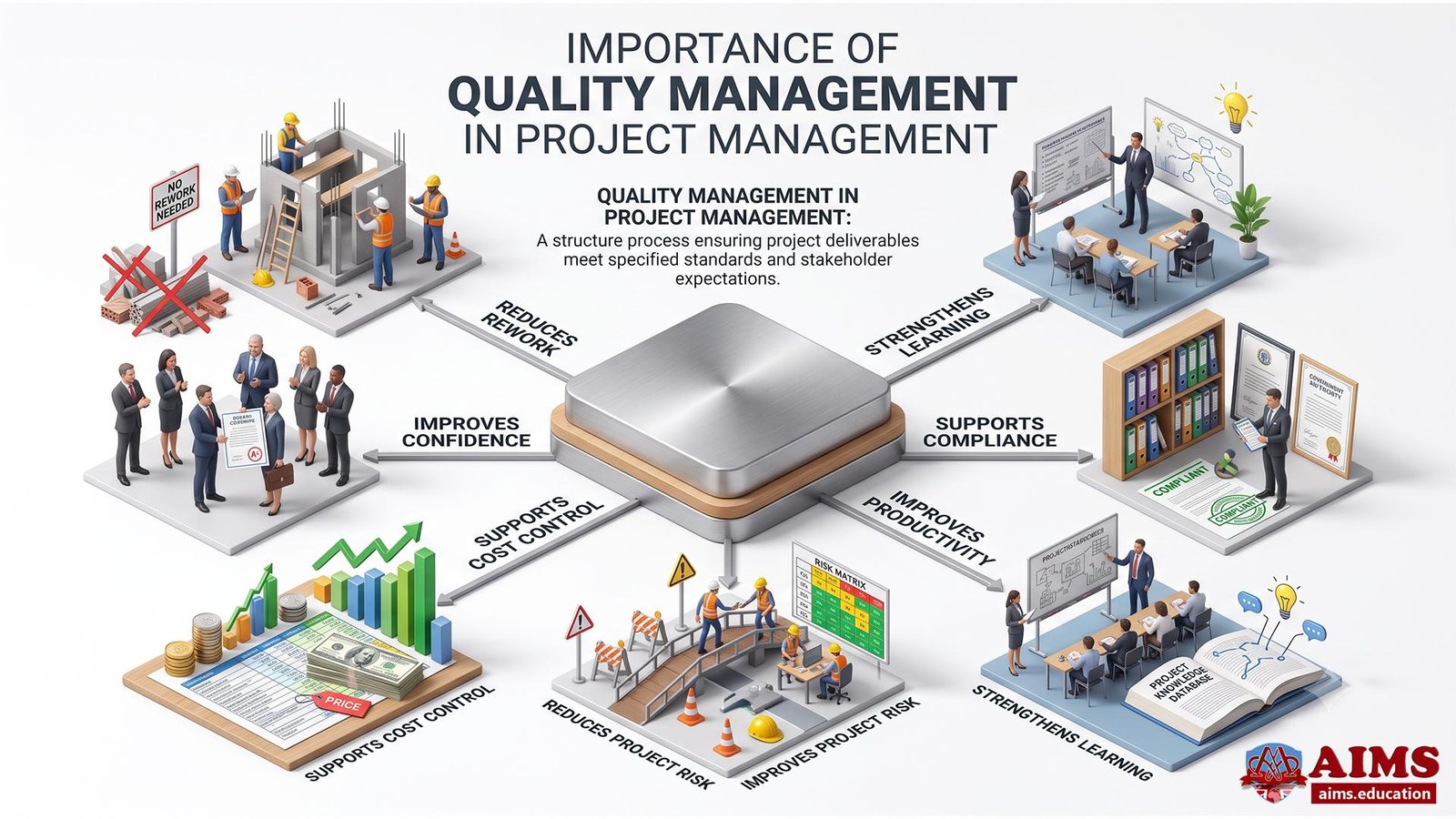
Quality management in project management is important because it converts stakeholder expectations into measurable requirements and dependable project results. Without it, teams may complete activities and deliver outputs that appear finished but remain unsuitable, noncompliant, unreliable, or unacceptable to the customer.
Quality management supports several practical outcomes:
- It reduces rework by identifying requirements and prevention activities before defects spread.
- It improves customer and sponsor confidence by connecting deliverables to explicit acceptance criteria.
- It supports cost control because preventing defects usually requires fewer resources than correcting failures after delivery.
- It reduces project risk by exposing process weaknesses, technical variation, and nonconformance early.
- It improves productivity by removing inefficient steps and clarifying how work should be performed.
- It supports compliance with contracts, regulations, internal policies, and relevant industry standards.
- It strengthens learning by converting audit findings, defect data, and corrective actions into reusable lessons.
Quality also interacts directly with project cost management principles for controlling rework and failure costs and with project risk management practices for preventing unacceptable outcomes. Poor quality rarely remains an isolated technical issue. It usually creates schedule delays, cost overruns, disputes, reputational damage, or operational risk.
Four Principles That Support Project Quality
The following principles provide a practical foundation for quality management in projects:
- Customer and stakeholder satisfaction: The project must understand stated requirements, implied needs, fitness for use, and acceptance conditions.
- Prevention over inspection: The team should design reliable processes that prevent defects instead of depending only on final testing.
- Management responsibility: Project teams perform quality activities, while organizational leaders must provide authority, resources, systems, and support.
- Continuous improvement: The team should use measurement, analysis, lessons learned, and corrective action to improve both current and future performance.
Main Components of Project Quality Management
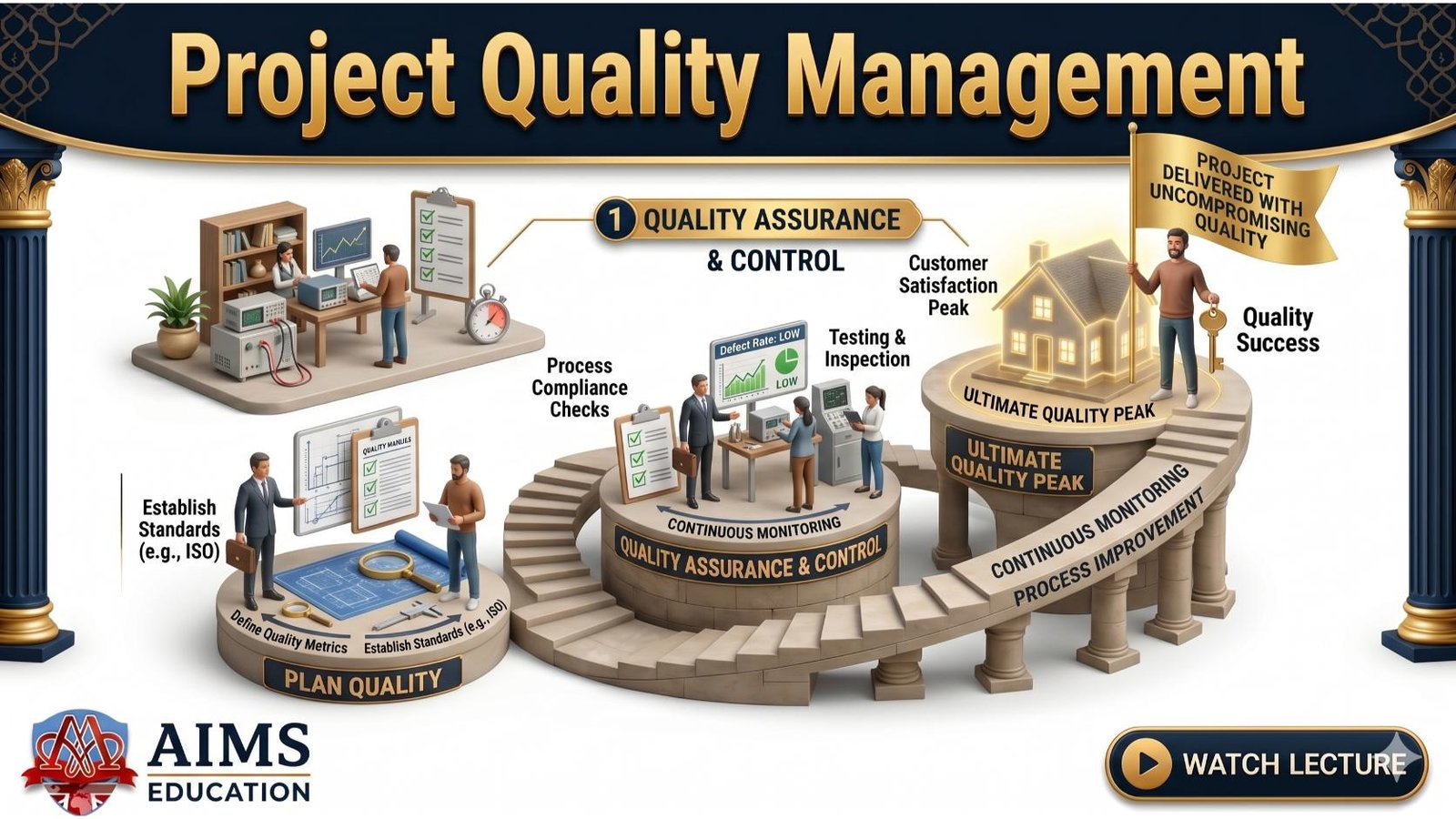
The main components are quality planning, quality assurance or quality management, and quality control. Together, they define what acceptable quality means, improve the processes used to create results, and verify whether completed work conforms to requirements.
- Plan quality management: Identify standards, requirements, acceptance criteria, metrics, responsibilities, methods, and records.
- Manage or assure quality: Evaluate and improve the processes used to produce deliverables, often through audits, process analysis, facilitation, and preventive action.
- Control quality: Inspect, measure, test, and record results against predefined criteria, then recommend correction when results do not conform.
| COMPONENT | PRIMARY PURPOSE | TYPICAL ACTIVITIES | KEY OUTPUTS |
|---|---|---|---|
| Quality planning | Define how quality will be achieved and demonstrated. | Identify standards, acceptance criteria, metrics, responsibilities, testing methods, and reporting rules. | Quality management plan, metrics, checklists, and process-improvement actions. |
| Quality assurance or manage quality | Improve confidence that suitable processes are being used effectively. | Quality audits, process analysis, root-cause analysis, facilitation, and preventive improvement. | Improvement recommendations, change requests, updated procedures, and lessons learned. |
| Quality control | Determine whether results conform to requirements and acceptance criteria. | Inspection, measurement, testing, sampling, defect recording, and verification of approved corrections. | Verified results, validated changes, accepted or rejected items, defect records, and corrective recommendations. |
Terminology can vary across methods and editions of professional guidance. However, the underlying logic remains stable: define quality, improve the process, and verify the result.
Project Quality Management Plan
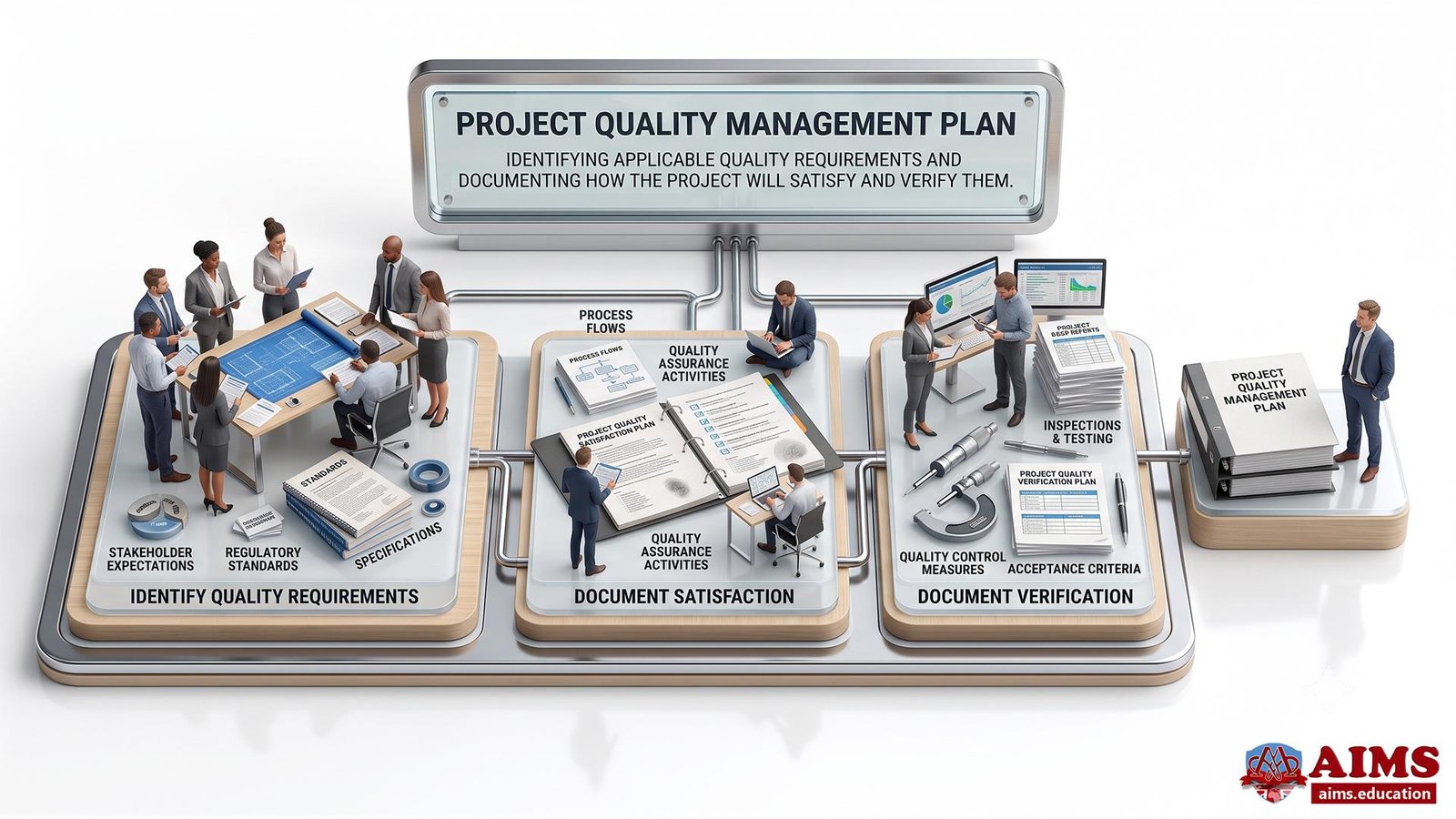
Project Quality Management Plan is the process of identifying applicable quality requirements and documenting how the project will satisfy and verify them. It converts broad expectations into operational standards, measurable targets, responsibilities, procedures, and acceptance evidence.
Inputs to Quality Planning
Effective planning begins with reliable project information. Common inputs include:
- Scope baseline: The approved scope explains what must be delivered and identifies technical characteristics that may affect quality.
- Requirements documentation: Requirements translate stakeholder needs into conditions that the project and deliverables must satisfy.
- Stakeholder information: The team identifies who influences quality, who approves results, and whose expectations require active management.
- Risk information: Threats and opportunities may change inspection intensity, tolerances, testing priorities, supplier controls, or contingency arrangements.
- Enterprise conditions: Laws, regulations, industry rules, working conditions, market expectations, and technical standards may constrain the quality approach.
- Organizational knowledge: Policies, templates, historical data, lessons learned, audit findings, and approved procedures provide reusable guidance.
Quality planning should remain aligned with core project management principles that guide responsible decisions. A technically correct metric is not useful when it ignores stakeholder value, project context, or the practical cost of measurement.
Project Quality Standards and Acceptance Criteria
Project quality standards define the rules or expected levels of performance, while acceptance criteria specify the conditions a deliverable must satisfy before approval. Standards may originate from contracts, regulations, organizational policies, technical specifications, professional guidance, or customer requirements.
Example of Standards and Acceptance Criteria
A project team is developing a customer-service portal.
- The quality standard requires secure access, reliable operation, accessible navigation, and accurate transaction records.
- The performance criterion requires 95 percent of common pages to load within two seconds under the agreed test load.
- The reliability criterion permits no unresolved critical defects before release.
- The user-acceptance criterion requires approval from designated business representatives after scripted testing.
- The evidence includes automated test reports, security review records, defect logs, and signed acceptance results.
Clear criteria convert vague expectations into objective decisions about whether the deliverable is ready for acceptance.
How to Create a Project Quality Management Plan
A project quality management plan explains how quality requirements will be achieved, measured, assured, controlled, reported, and improved throughout the project. It should be proportionate to the project’s complexity and integrated with scope, schedule, cost, risk, procurement, communications, and change management.
- Confirm the project scope and intended outcomes. Clarify what the project must deliver, how the deliverables will be used, and what failure would mean for stakeholders.
- Identify applicable requirements and standards. Review contracts, regulations, technical specifications, internal policies, customer expectations, and relevant guidance.
- Define acceptance criteria. State measurable conditions for approval, including thresholds, tolerances, pass or fail rules, and authorized approvers.
- Select quality metrics. Decide what will be measured, how it will be measured, how often data will be collected, and what range is acceptable.
- Assign roles and responsibilities. Identify who performs the work, reviews processes, conducts tests, approves results, manages defects, and authorizes corrective action.
- Plan assurance and control activities. Schedule audits, peer reviews, inspections, tests, sampling, supplier reviews, and verification of approved changes.
- Define reporting and escalation rules. Explain how defects, nonconformities, trends, audit findings, and unresolved quality risks will be recorded and communicated.
- Plan continuous improvement. Establish how root causes, corrective actions, lessons learned, and process-improvement opportunities will be evaluated and incorporated.
Essential Contents of a Quality Management Plan
| PLAN ELEMENT | WHAT IT SHOULD EXPLAIN |
|---|---|
| Quality objectives | The outcomes that quality activities must achieve for the project and its deliverables. |
| Standards and criteria | Applicable requirements, specifications, tolerances, policies, regulations, and acceptance conditions. |
| Metrics and thresholds | What will be measured, the measurement method, target value, acceptable range, frequency, and data owner. |
| Roles and authority | Responsibilities for planning, assurance, inspection, testing, approval, escalation, and corrective action. |
| Assurance activities | Audits, process reviews, peer reviews, process analysis, and preventive improvement activities. |
| Control activities | Inspections, tests, sampling, checklists, measurements, defect recording, and verification procedures. |
| Nonconformance process | How defects are classified, analyzed, corrected, retested, accepted, rejected, or escalated. |
| Improvement process | How lessons, trends, root causes, and approved changes will improve current and future work. |
Quality Assurance in Project Management
Quality assurance in project management provides confidence that the project is using appropriate processes and that those processes are capable of producing conforming results. It focuses primarily on prevention, process effectiveness, and systematic improvement rather than only examining finished deliverables.
Common assurance activities include:
- Reviewing whether the project follows approved methods, policies, and quality procedures.
- Auditing the use of requirements, checklists, reviews, testing methods, and change controls.
- Analyzing recurring defects to identify weak processes rather than treating each defect as an isolated event.
- Examining whether quality metrics are meaningful, correctly collected, and used in decision-making.
- Sharing effective practices and converting audit findings into preventive or corrective improvements.
Quality Audits
A quality audit is a structured and sufficiently independent review of project activities, processes, records, and compliance. Its purpose is not simply to find fault. A useful audit identifies effective practices, nonconformities, process gaps, improvement opportunities, and lessons that can strengthen future performance.
Example of Quality Assurance in a Supplier Project
A company is introducing a new packaging supplier for a product launch.
- The project team audits the supplier’s approval process before mass production begins.
- The audit finds that design revisions are stored in separate email threads without a controlled master version.
- The team introduces a single approved specification register and requires formal sign-off for every revision.
- A pilot batch confirms that production teams are using the latest specification.
- The project prevents a likely packaging mismatch before thousands of units are manufactured.
The assurance activity improves the process that creates the deliverable, reducing the likelihood of repeated defects.
Quality Control in Project Management
Quality control in project management is the inspection, measurement, testing, and recording of work results against predefined requirements and acceptance criteria. It identifies whether a deliverable conforms, whether a process remains stable, and whether corrective action or defect repair is required.
Quality control is not the complete quality-management function. Testing alone cannot define requirements, assign responsibilities, improve weak processes, or establish a prevention strategy. It is one essential component within a broader system of planning, assurance, measurement, and improvement.
Typical Quality Control Activities
- Inspecting materials, components, documents, code, configurations, or completed deliverables.
- Testing functional, technical, safety, usability, reliability, and performance requirements.
- Comparing actual measurements with tolerances, specifications, control limits, and acceptance thresholds.
- Recording defects, nonconformities, test results, rejected items, and retest outcomes.
- Reviewing whether approved change requests and defect repairs were implemented correctly.
- Recommending corrective action when results fall outside acceptable conditions.
Example of Quality Control in Construction
A construction project requires concrete to achieve a specified compressive strength.
- The requirement and test method are defined in the quality plan.
- Samples are taken from selected pours according to the approved sampling procedure.
- A laboratory tests the samples after the defined curing period.
- Results are compared with the acceptance threshold.
- A failed result triggers investigation, structural review, corrective action, and additional verification.
The control process provides objective evidence for accepting the work or initiating a technically justified response.
Quality Assurance vs. Quality Control
Quality assurance improves and verifies the processes used to create results, while quality control evaluates the results themselves against defined criteria. Assurance is mainly prevention-oriented and process-based. Control is mainly detection-oriented and deliverable-based.
| COMPARISON AREA | QUALITY ASSURANCE | QUALITY CONTROL |
|---|---|---|
| Main focus | The suitability and effectiveness of processes. | The conformity of work results and deliverables. |
| Primary orientation | Prevention and process improvement. | Detection, verification, and correction. |
| Typical timing | Throughout planning and execution, before process weaknesses create repeated defects. | During production, at defined control points, and before acceptance or release. |
| Typical methods | Audits, process analysis, peer reviews, root-cause analysis, and improvement workshops. | Inspection, measurement, testing, sampling, checklists, and defect verification. |
| Typical evidence | Audit findings, process evaluations, improvement actions, and updated procedures. | Test results, inspection records, measured values, defect logs, and acceptance decisions. |
| Simple question | Are we using a capable and appropriate process? | Does this result meet the agreed requirement? |
Projects need both. Assurance without control may leave actual defects undiscovered, while control without assurance may repeatedly detect problems without correcting the process that causes them.
Project Quality Management Tools and Techniques
Project quality management tools and techniques help teams define requirements, analyze variation, identify root causes, measure performance, prioritize problems, and improve processes. The best tool depends on the decision being made and the type of data available.
Cost-Benefit Analysis
Cost-benefit analysis compares the expected value of a quality activity with the resources required to perform it. The team should consider whether an inspection, automated test, design review, audit, training programme, or preventive control is justified by reduced rework, lower risk, improved productivity, and stronger stakeholder acceptance.
Example of a Quality Cost-Benefit Decision
- A software team can spend GBP 4,000 automating a regression test suite.
- Manual regression testing currently costs GBP 1,200 per release across eight planned releases.
- Automation also reduces inconsistent coverage and releases testers for higher-risk exploratory work.
- The expected direct saving is GBP 5,600 before considering the value of earlier defect detection.
- The team approves the automation investment and includes maintenance effort in the plan.
The decision supports prevention when the expected quality and efficiency benefits exceed the total implementation cost.
Cost of Quality in Project Management
Cost of quality in project management is the total cost of achieving conformance and dealing with nonconformance. It includes planned spending on prevention and appraisal, together with internal and external failure costs caused by defects or unmet requirements.
| CATEGORY | PURPOSE | EXAMPLES |
|---|---|---|
| Prevention costs | Avoid defects by building capability and clarity into the process. | Training, quality planning, design reviews, process documentation, supplier qualification, and suitable equipment. |
| Appraisal costs | Assess whether work and deliverables conform to requirements. | Inspection, testing, audits, sampling, peer review, and test-environment operation. |
| Internal failure costs | Correct failures discovered before the customer receives the deliverable. | Rework, scrap, retesting, downtime, defect analysis, and schedule disruption. |
| External failure costs | Respond to failures discovered after delivery or release. | Warranty work, returns, penalties, liability, emergency support, lost business, and reputational damage. |
Prevention and appraisal are costs of conformance. Internal and external failures are costs of nonconformance, often called the cost of poor quality.
Benchmarking
Benchmarking compares current or proposed performance with a relevant reference point. The reference may come from previous projects, internal best performance, industry data, supplier capability, or an agreed target. Benchmarking should guide improvement rather than encourage blind imitation.
Design of Experiments
Design of experiments is a structured statistical method for examining how multiple variables influence an outcome. It helps teams identify influential factors and evaluate combinations efficiently, particularly when changing one variable at a time would require too many trials.
Statistical Sampling
Statistical sampling examines a selected portion of a population to draw conclusions about the whole. Sampling is useful when testing every item is too costly, time-consuming, destructive, or unnecessary. The sampling approach must reflect the level of risk and the consequences of an incorrect conclusion.
Seven Basic Quality Tools
The seven basic quality tools provide accessible visual methods for collecting data, understanding processes, examining variation, and finding causes of defects. They are widely useful because teams can apply them without advanced statistical modelling.
| TOOL | PRIMARY USE | PROJECT EXAMPLE |
|---|---|---|
| Cause-and-effect diagram | Organize possible causes of a problem into logical categories and support root-cause analysis. | Explore whether recurring software defects arise from methods, skills, tools, environments, data, or requirements. |
| Flowchart | Show process steps, decisions, handoffs, loops, and potential failure points. | Map a change-approval process to identify duplicate review stages and unclear responsibility. |
| Check sheet | Collect and organize occurrence data consistently at the point of observation. | Record defect types found during daily inspection of manufactured components. |
| Pareto chart | Rank categories by frequency or impact so the team can prioritize the most significant contributors. | Show which defect categories account for most customer complaints. |
| Histogram | Display the distribution, central tendency, spread, and shape of measured data. | Examine the distribution of task completion times across repeated work packages. |
| Control chart | Track process performance over time and distinguish normal variation from signals requiring investigation. | Monitor weekly defect rates to detect an unusual shift after a process change. |
| Scatter diagram | Explore whether two variables appear related, without automatically proving causation. | Compare training hours with inspection accuracy to assess whether a relationship may exist. |
Additional Quality Planning and Improvement Tools
- Brainstorming: Generate possible causes, risks, requirements, or improvement ideas before evaluation.
- Affinity diagram: Group related ideas into meaningful themes after brainstorming or research.
- Nominal group technique: Generate, discuss, and rank ideas in a structured manner that limits domination by a few participants.
- Force-field analysis: Examine the forces supporting and resisting a proposed quality improvement.
- Root-cause analysis: Investigate the underlying conditions that produced a defect or process failure.
- Process analysis: Examine boundaries, steps, handoffs, constraints, measures, and inefficiencies to identify improvements.
How Is Quality Measured in a Project?
Quality is measured by comparing reliable data with predefined metrics, tolerances, targets, specifications, and acceptance criteria. Measurement should produce evidence that supports decisions, not merely generate attractive reports.
Project Quality Metrics
Project quality metrics define what will be measured and how the measurement will be performed. Each useful metric should specify the data source, calculation method, frequency, owner, target, acceptable range, and action threshold.
Examples include:
- Defect density per release, component, or work package.
- First-pass acceptance rate.
- Percentage of requirements covered by verified tests.
- Rework hours as a percentage of total effort.
- Mean time between failures and mean time to repair.
- Inspection pass rate and supplier rejection rate.
- Audit findings closed within the agreed period.
- Customer-reported defects after release.
- Variance between target and actual technical performance.
Metrics should also connect with practical project performance indicators (KPIs) used for management decisions. A metric becomes useful when it reveals performance, triggers action, or tests whether an improvement has worked.
Attribute and Variable Measurements
- Attribute measurement classifies a result into categories such as pass or fail, conforming or nonconforming, present or absent.
- Variable measurement records an actual numerical value such as response time, weight, strength, duration, temperature, or defect count.
Variable data usually provides more information about the size and direction of variation, while attribute data can support simple and efficient acceptance decisions.
Control Limits vs. Specification Limits
Specification limits describe what the customer, contract, design, or standard will accept. Control limits describe the expected behaviour of a process based on observed performance. A stable process can still produce unacceptable results when its natural output remains outside specification. Likewise, a process may temporarily meet specifications while showing an unstable trend that requires investigation.
Control-chart rules can also detect non-random patterns. For example, a sustained sequence of points on one side of the centre line may indicate a process shift even when every point remains within the control limits. The exact investigation rules should be defined by the organization’s chosen statistical method.
A Worked Project Quality Management Example
A complete quality-management example should show how planning, assurance, and control work together rather than treating testing as an isolated activity. Consider a project that is developing an online professional-training platform for 8,000 learners.
Step 1: Plan Quality
- The team defines functional requirements for enrolment, course access, assessments, progress tracking, and certificate generation.
- Acceptance criteria require successful completion of critical user journeys, no unresolved critical security defects, and accurate recording of assessment results.
- Performance criteria require common learner pages to meet the agreed response-time threshold under the planned concurrent load.
- Quality metrics include critical-defect count, test-pass rate, requirement coverage, page-response time, and failed certificate-generation attempts.
- Roles are assigned for code review, testing, security review, business acceptance, defect approval, and release authorization.
Step 2: Assure and Improve Quality
- A process audit finds that developers can merge code without evidence of peer review.
- The team updates the workflow so every change requires review and automated checks before integration.
- Root-cause analysis shows that repeated assessment errors arise from inconsistent interpretation of grading rules.
- The product owner creates one controlled grading specification with examples and version approval.
- The assurance activities strengthen the development process before final acceptance testing.
Step 3: Control Quality
- Testers execute functional, integration, performance, accessibility, and security tests.
- Actual results are compared with the predefined acceptance criteria.
- A performance test reveals that the assessment page exceeds the permitted response time under peak load.
- The team corrects an inefficient database query, repeats the test, and records the validated result.
- Business representatives complete user-acceptance testing and approve the release evidence.
The integrated approach prevents repeated errors, verifies actual performance, and provides objective evidence for a responsible release decision.
How Quality Management Differs in Agile and Traditional Projects
Traditional projects often define major quality baselines and formal control points early, while Agile projects distribute quality activities across short, iterative delivery cycles. Both approaches still require clear requirements, acceptance criteria, capable processes, verification, stakeholder feedback, and continuous improvement.
| QUALITY AREA | TRADITIONAL APPROACH | AGILE APPROACH |
|---|---|---|
| Planning | Quality requirements, reviews, and test stages may be documented extensively before execution. | Quality criteria are established at product and iteration levels, then refined as learning increases. |
| Verification | Formal inspections and test phases may occur at defined milestones. | Testing, review, integration, and stakeholder feedback occur continuously within short cycles. |
| Acceptance | Acceptance may concentrate around completed phases or major deliverables. | Each increment should satisfy agreed acceptance criteria and the team’s definition of done. |
| Improvement | Lessons may be reviewed at phase gates, audits, or project closure. | Retrospectives and frequent feedback create repeated opportunities for process improvement. |
| Change | Approved baselines and formal change control protect stability. | Priorities and details can evolve, while quality constraints and acceptance discipline remain explicit. |
Teams exploring iterative delivery can study what is Agile project management and how it integrates feedback and incremental delivery. Agile does not remove quality planning. It moves much of the planning, verification, and improvement closer to the work.
Who Is Responsible for Project Quality Management?
Project quality is a shared responsibility, although accountability and decision authority must be assigned clearly. The project manager coordinates the system, but quality cannot be delegated to one inspector or testing team.
- Senior management provides policies, resources, governance, competent personnel, and organizational support.
- The sponsor or customer clarifies expected value, approves key requirements, and participates in acceptance decisions.
- The project manager integrates quality with scope, schedule, cost, risk, procurement, communications, and change control.
- Technical and delivery teams build quality into daily work, follow approved methods, perform reviews, and correct identified problems.
- Quality specialists or auditors provide independent review, measurement expertise, process analysis, and assurance support where appropriate.
- Suppliers and contractors remain responsible for meeting contractual standards and providing required evidence.
- Users and subject-matter experts validate usability, fitness for purpose, technical accuracy, and operational suitability.
Professionals who need deeper integration of these responsibilities can strengthen their capability through an advanced diploma in practical project management or explore career-focused online project management certification.
ISO 10006 and Quality Management in Projects
ISO 10006 provides guidance for applying quality management to projects of different sizes, durations, sectors, and levels of complexity. It addresses quality-management systems in projects, management responsibility, resources, realization processes, measurement, analysis, and improvement.
The standard is guidance for quality management in project environments rather than a complete project-management method.
How ISO 10006 Can Support a Project
- It provides a recognized framework for discussing quality responsibilities and processes.
- It encourages a systematic approach that connects stakeholder satisfaction with process management and improvement.
- It can help organizations align project-specific quality planning with broader quality-management systems.
- It supports tailoring because quality arrangements must reflect the project’s environment, risks, deliverables, and interested parties.
Using the standard does not replace technical specifications, contractual requirements, sector regulations, or the judgement of competent professionals.
Continuous Improvement in Project Management
Continuous improvement in project management uses evidence from performance, audits, defects, feedback, and lessons learned to make processes more effective and results more dependable. Improvement is not a one-time correction. It is a disciplined cycle of learning and adjustment.
The Plan-Do-Check-Act Cycle
- Plan: Identify the problem or opportunity, analyze causes, define the desired result, and select an improvement.
- Do: Implement the improvement on a controlled or appropriately limited basis.
- Check: Measure the result and compare it with the expected outcome.
- Act: Standardize the successful change, modify it, or investigate further when the result is insufficient.
Example of Continuous Quality Improvement
- A project records repeated document rejections because mandatory approval fields are missing.
- The team finds that contributors are using several uncontrolled templates.
- A single approved template with required fields is introduced and included in the document workflow.
- The rejection rate is measured for the next four reporting cycles.
- When the rate falls and remains stable, the template becomes the organizational standard.
The improvement removes a recurring process cause instead of correcting the same document error repeatedly.
Common Project Quality Management Mistakes
Most quality failures begin with unclear requirements, weak prevention, poor measurement, or fragmented responsibility rather than a complete absence of testing. The following mistakes deserve particular attention.
- Equating quality with premium features: A deliverable can be simple and still achieve high quality when it meets its stated requirements reliably.
- Treating testing as the whole quality system: Inspection detects some defects, but planning and assurance prevent repeated failures.
- Using vague acceptance criteria: Terms such as “fast,” “user-friendly,” or
“high standard” need measurable definitions before objective acceptance is possible. - Measuring what is easy instead of what matters: Large metric dashboards can conceal the absence of useful information about risk, performance, or stakeholder value.
- Inspecting too late: Final-stage discovery increases rework, delay, and failure cost.
- Ignoring process variation: Meeting an average target may hide unstable performance or unacceptable individual results.
- Assigning quality to one person: A quality specialist can guide and verify, but every contributor influences quality.
- Correcting symptoms without finding causes: Repeated defect repair wastes resources when the underlying process remains unchanged.
- Rushing inspections to protect the schedule: Skipping planned controls may create larger delays and operational risks after release.
- Overworking the team to satisfy requirements: Unsustainable effort can increase fatigue, attrition, errors, and rework, reducing overall project performance.
Final Words on Project Quality Management
Project quality management succeeds when a team defines quality clearly, designs capable processes, measures meaningful results, and improves performance using evidence. Planning establishes standards and acceptance criteria. Assurance strengthens the methods used to produce results. Control verifies deliverables through inspection, measurement, and testing.
The strongest quality systems remain proportionate to project risk and complexity. They do not add documentation for its own sake. Instead, they reduce uncertainty, support informed decisions, protect stakeholder value, and provide credible evidence that the project has produced a fit-for-purpose result.
Frequently Asked Questions
What is project quality management?
Project quality management is the coordinated planning, assurance, control, measurement, and improvement of quality throughout a project. It ensures that project processes and deliverables satisfy agreed requirements, standards, acceptance criteria, and stakeholder expectations.
Why is quality management important in project management?
It reduces rework, supports compliance, improves customer acceptance, controls failure costs, and lowers delivery risk. It also gives the team objective evidence for deciding whether processes are effective and deliverables are fit for their intended purpose.
What are the main components of project quality management?
The three practical components are quality planning, quality assurance or manage quality, and quality control. Planning defines requirements and methods, assurance improves the processes used to create results, and control verifies actual work through inspection, measurement, and testing.
What is quality planning in project management?
Quality planning identifies applicable standards, stakeholder requirements, acceptance criteria, metrics, responsibilities, assurance activities, control methods, and improvement procedures. Its main output is a quality management plan explaining how the project will achieve and demonstrate acceptable quality.
What is the difference between quality assurance and quality control?
Quality assurance is primarily process-based and prevention-oriented. It uses activities such as audits and process analysis to improve how work is performed. Quality control is primarily deliverable-based and detection-oriented. It uses inspection, measurement, sampling, and testing against predefined criteria.
How do you create a project quality management plan?
Confirm the scope, identify requirements and standards, define acceptance criteria, select metrics, assign responsibilities, plan audits and tests, define defect and escalation procedures, and establish continuous-improvement arrangements. The plan should integrate with other project-management plans.
What tools and techniques are used in project quality management?
Common tools include cost-benefit analysis, cost of quality, benchmarking, design of experiments, statistical sampling, cause-and-effect diagrams, flowcharts, check sheets, Pareto charts, histograms, control charts, scatter diagrams, audits, inspection, and root-cause analysis.
How is quality measured in a project?
Quality is measured by comparing reliable data with defined metrics, targets, tolerances, specifications, control limits, and acceptance criteria. Measures may include defect density, test-pass rate, first-pass acceptance, rework effort, reliability, response time, and customer-reported failures.
Who is responsible for project quality management?
Quality is a shared responsibility. Senior management provides systems and resources, the project manager integrates quality activities, delivery teams build quality into their work, specialists provide assurance and measurement support, and customers or users participate in requirements and acceptance.
What is the cost of quality in project management?
The cost of quality includes prevention and appraisal costs used to achieve conformance, plus internal and external failure costs caused by nonconformance. Effective planning seeks an economical balance that reduces the total cost of defects, rework, support, and failure.
How does quality management differ in Agile and traditional projects?
Traditional projects may use detailed upfront plans and formal milestone controls, while Agile projects integrate testing, review, acceptance, and improvement into short iterations. Both still require explicit quality criteria, capable processes, objective verification, and stakeholder feedback.
What is ISO 10006, and how does it apply to project quality management?
ISO 10006 provides guidance for applying quality management in projects across different sectors, sizes, durations, and levels of complexity. Organizations can use it to shape quality responsibilities, project quality plans, measurement, analysis, and improvement while tailoring practices to context.
Build Quality-Focused Project Management Expertise with AIMS Project Management Academy
AIMS Project Management Academy has supported professional education since 2005, combining international accreditations with global learner reach and an internationally standardized, career-focused curriculum. Qualified faculty use industry-oriented teaching, practical skill development, 3D interactive learning content, and real-world case studies. This educational content, together with AIMS study materials and curriculum, is collaboratively developed and rigorously peer-reviewed by an academic board of qualified industry practitioners. Project quality management strengthens dependable delivery and professional judgement. Explore our globally recognized project management qualifications.