
What Is Project Management
Project management is the application of knowledge, skills, tools, and techniques to project activities so that a defined result is delivered within agreed requirements, constraints, and stakeholder expectations. It gives temporary work a clear structure, accountable leadership, measurable objectives, and a controlled path from idea to completion.
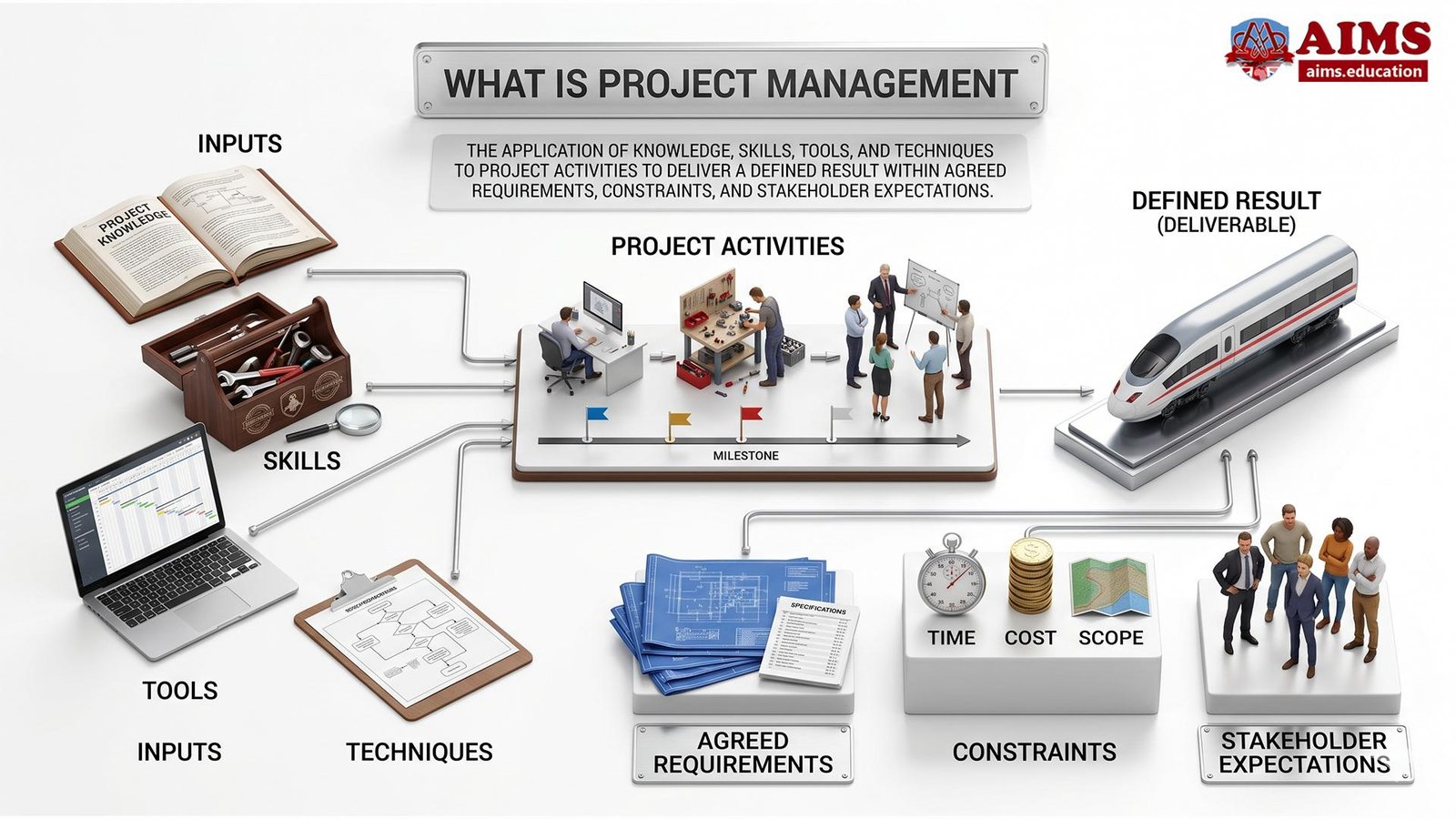
Project Management Definition
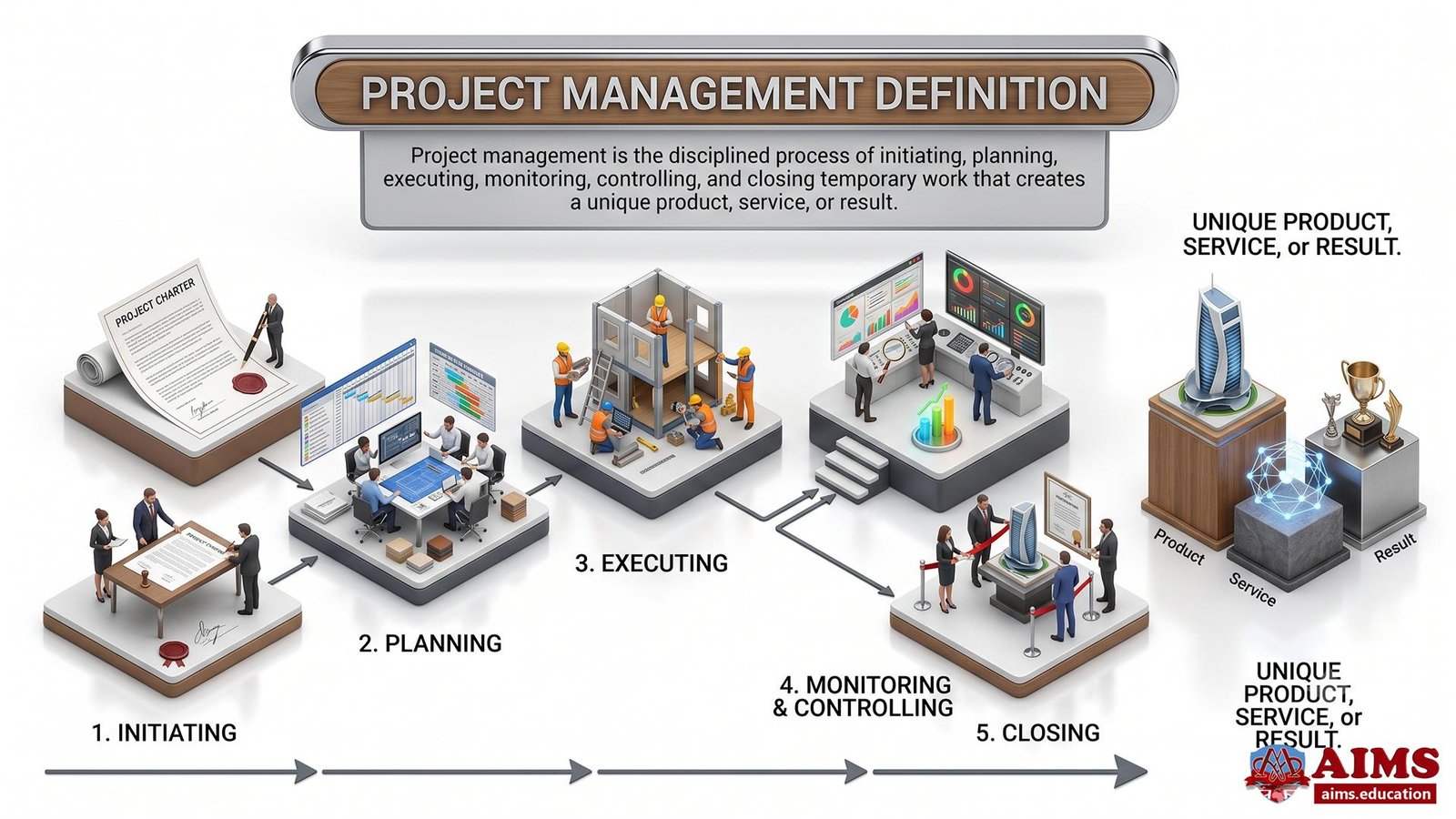
Project management is defined as the disciplined process of initiating, planning, executing, monitoring, controlling, and closing temporary work that creates a unique product, service, or result. This project management definition includes both technical control and human leadership, because projects succeed through people as much as through plans.
The project management also includes value creation. A project may produce a building, website, training system, compliance upgrade, product feature, or public service, but its deeper purpose is to create a useful change for customers, sponsors, users, or the wider organization.
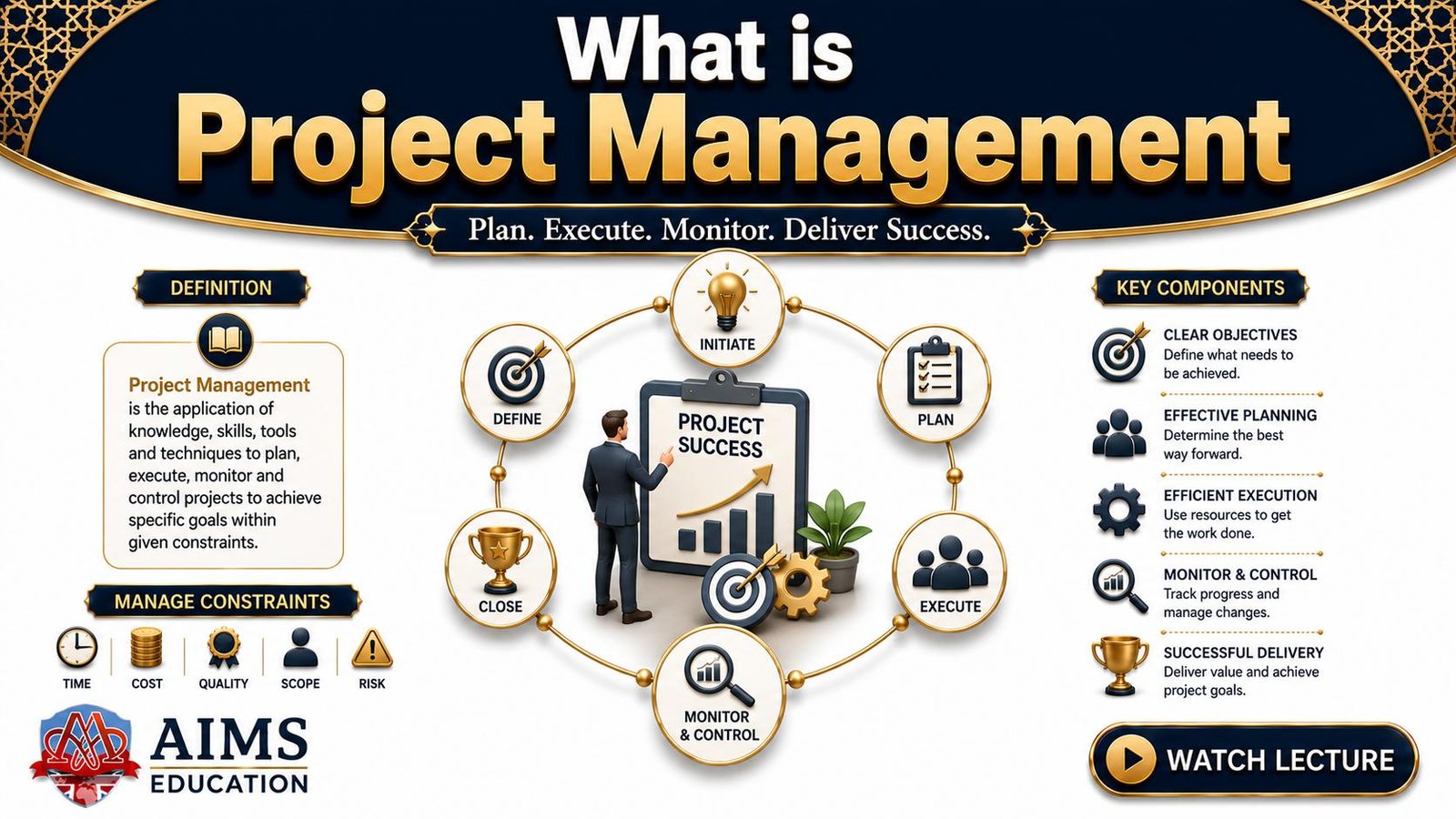
Project Management Meaning in Practical and Academic Terms
- In practical terms, project management means converting an approved need into organized work.
- In academic terms, it is a governance-based discipline that aligns temporary initiatives with strategic objectives, resource limits, stakeholder expectations, and measurable value.
For example, a company may decide to replace its outdated customer support system. Without project management, the work may become scattered across IT, operations, finance, and customer service. With project management, the organization defines scope, assigns responsibility, creates a schedule, estimates cost, manages risks, monitors progress, and prepares the support team for handover.
- The sponsor approves the business need and expected value.
- The project manager defines the work, team, budget, risks, and communication plan.
- The team configures, tests, and launches the new system.
- Operations receives the final system and maintains it after closure.
This example shows how project management turns a strategic decision into controlled delivery and sustainable organizational change.
What Is a Project and Why Projects Are Temporary and Unique
A project is a temporary endeavor undertaken to create a unique product, service, or result. Temporary means the project has a defined beginning and end, even when its output lasts for years. Unique means the project has a specific context, scope, stakeholders, risks, resources, and success criteria.
A project may end because its objectives have been achieved, its resources are exhausted, its purpose no longer exists, or a sponsor or governing body decides that it should be terminated. The temporary nature applies to the project work, not necessarily to the result. A school building, software platform, bridge, or national monument may last long after the project has closed.
Projects vs Operations
Projects and operations both create value, but they do so differently. Projects are temporary and unique, while operations are ongoing and repetitive. Implementing new payroll software is a project. Running payroll every month after implementation is an operation.
| ATTRIBUTE | PROJECT | OPERATION | PROGRAM | PORTFOLIO |
|---|---|---|---|---|
| Purpose | A project creates a unique result within a defined period. | An operation sustains repeatable business activity over time. | A program coordinates related projects to achieve combined benefits. | A portfolio selects and prioritizes initiatives to maximize strategic value. |
| Duration | A project has a clear start and finish. | An operation continues as part of regular business. | A program continues while related benefits are being realized. | A portfolio continues as long as strategic investment decisions are needed. |
| Management Focus | Project management focuses on scope, schedule, budget, quality, risk, and stakeholders. | Operations management focuses on efficiency, consistency, capacity, and service continuity. | Program management focuses on dependencies, benefits, and coordinated change. | Portfolio management focuses on selection, prioritization, funding, and alignment. |
| Success Measure | Success is measured by delivered value, acceptance, quality, timeliness, and learning. | Success is measured by stable performance and reliable service delivery. | Success is measured by collective benefits that individual projects could not deliver alone. | Success is measured by strategic contribution and optimized resource allocation. |
Project vs Program Management and Where Portfolios Fit
Project management delivers one defined outcome. Program management coordinates related projects to achieve benefits that are not available when each project is managed separately. Portfolio management sits above both by selecting and balancing projects, programs, and operations according to strategy, funding, risk, and expected value.
This distinction matters because a program is not just a large project. A digital transformation program, for example, may include software migration, process redesign, staff training, data governance, and customer experience projects. Each project has its own deliverable, but the program manages the combined organizational change.
Project Management Objectives
Project management basics include defining the objective, clarifying scope, identifying stakeholders, planning time and cost, assigning resources, managing risks, communicating progress, and closing the work properly. These fundamentals help teams deliver useful outcomes instead of merely completing activities without clear value, ownership, or acceptance.
The Main Objectives of Project Management
The project management basics begin with objectives. Project management objectives are concrete targets that guide decisions from approval to closure. They normally include solving a specific problem, delivering measurable value, satisfying stakeholder requirements, completing work on time, controlling cost, managing quality, and preparing the result for use.
Here are the core project management objectives:
- A project should solve a defined business, social, technical, regulatory, or operational problem.
- A project should deliver measurable value to sponsors, customers, users, or communities.
- A project should satisfy agreed stakeholder requirements within realistic limits.
- A project should finish with a usable result, not just a completed activity list.
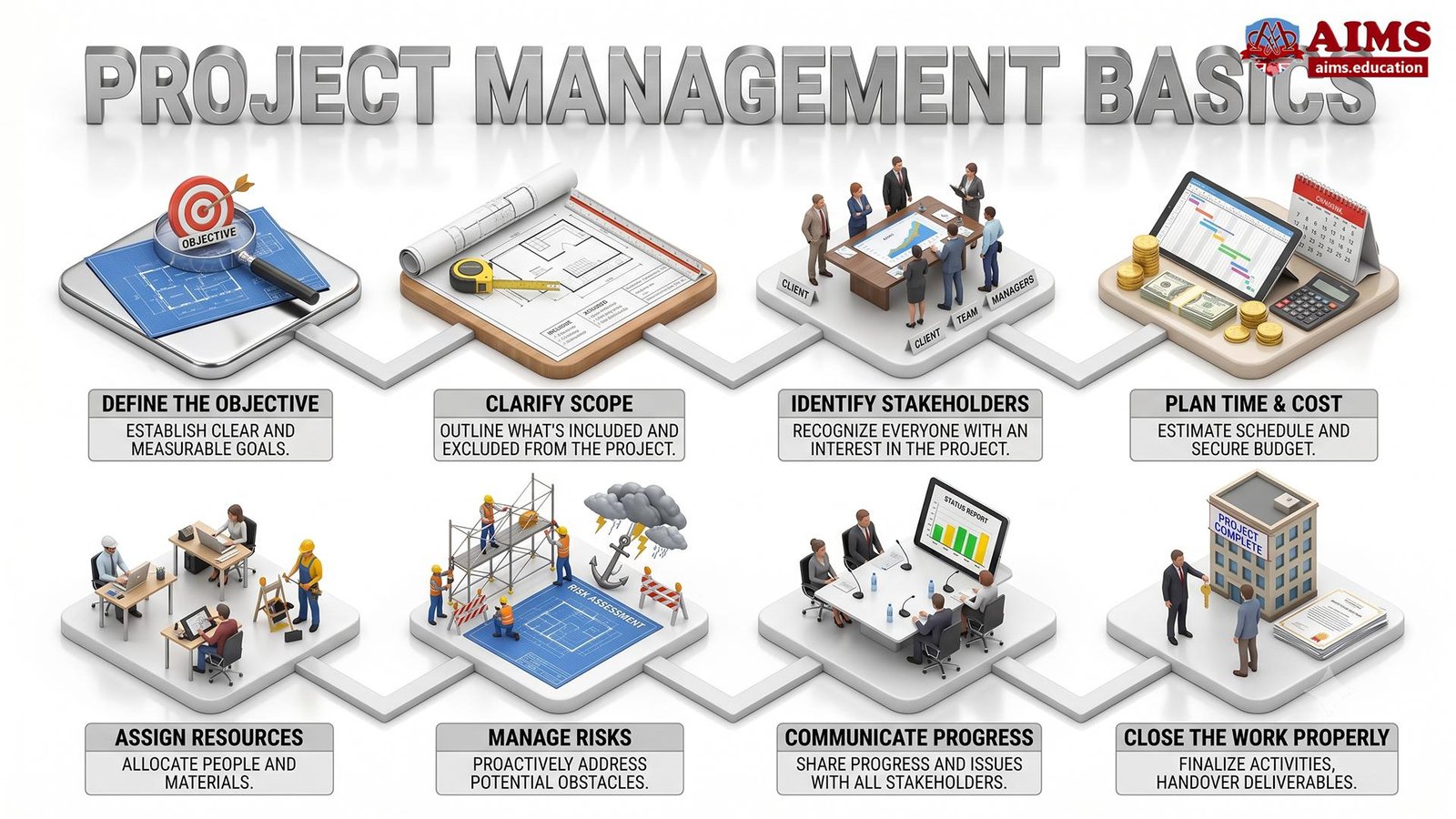
These project management basics protect the project from becoming unfocused. When objectives are vague, teams often confuse effort with progress and deliver work that is technically complete but strategically weak.
Project Scope and Deliverables
Project scope defines what the project will deliver and what it will not deliver. Deliverables are the tangible or intangible outputs created by the project, such as a report, application, facility, training package, compliance process, or service improvement.
Clear scope protects the project from uncontrolled expansion. If you need need deeper detail, you can review how scope defines what a project will and will not deliver, because weak scope definition is one of the most common causes of budget pressure, missed deadlines, and stakeholder disappointment.
The Project Management Triangle of Scope, Time, and Cost
The project management triangle explains the relationship among scope, time, and cost. If the scope increases, the team may need more time, more budget, or both. If the deadline is shortened, the sponsor may need to reduce scope, add resources, or accept higher risk.
This project management triangle is useful because it makes trade-offs visible. For a practical explanation, see balancing scope, time, and cost in real project decisions. However, modern project success requires more than the iron triangle.
Why Quality, Risk, and Stakeholder Value Also Matter
Quality, risk, and resources strongly affect scope, time, and cost. A project may technically finish on time and within budget, yet still fail if users reject the result, quality is poor, risks were ignored, or the deliverable cannot be sustained by operations.
A project is not successful merely because work was completed. It is successful when the delivered result creates value, is accepted by stakeholders, and can be sustained after handover.
Assumptions and Constraints in Project Planning
An assumption is something the team believes to be true for planning purposes. A constraint is a limitation imposed on the project. Assumptions may include expected resource availability, supplier readiness, or market conditions. Constraints may include fixed deadlines, legal requirements, budget limits, or mandatory quality standards.
For example, a construction team may assume that trained workers will be available during a certain season. If that assumption proves false, the schedule and cost plan may change. A constraint may require that 25 percent of the work be completed within 30 days, even if resources are limited.
The Project Management Process from Initiation to Closure
The project management process is the structured flow of work that moves a project from approval to delivery and closure. It typically includes initiation, planning, execution, monitoring and controlling, and closure, while continuously managing requirements, communication, risk, change, resources, and stakeholder expectations.
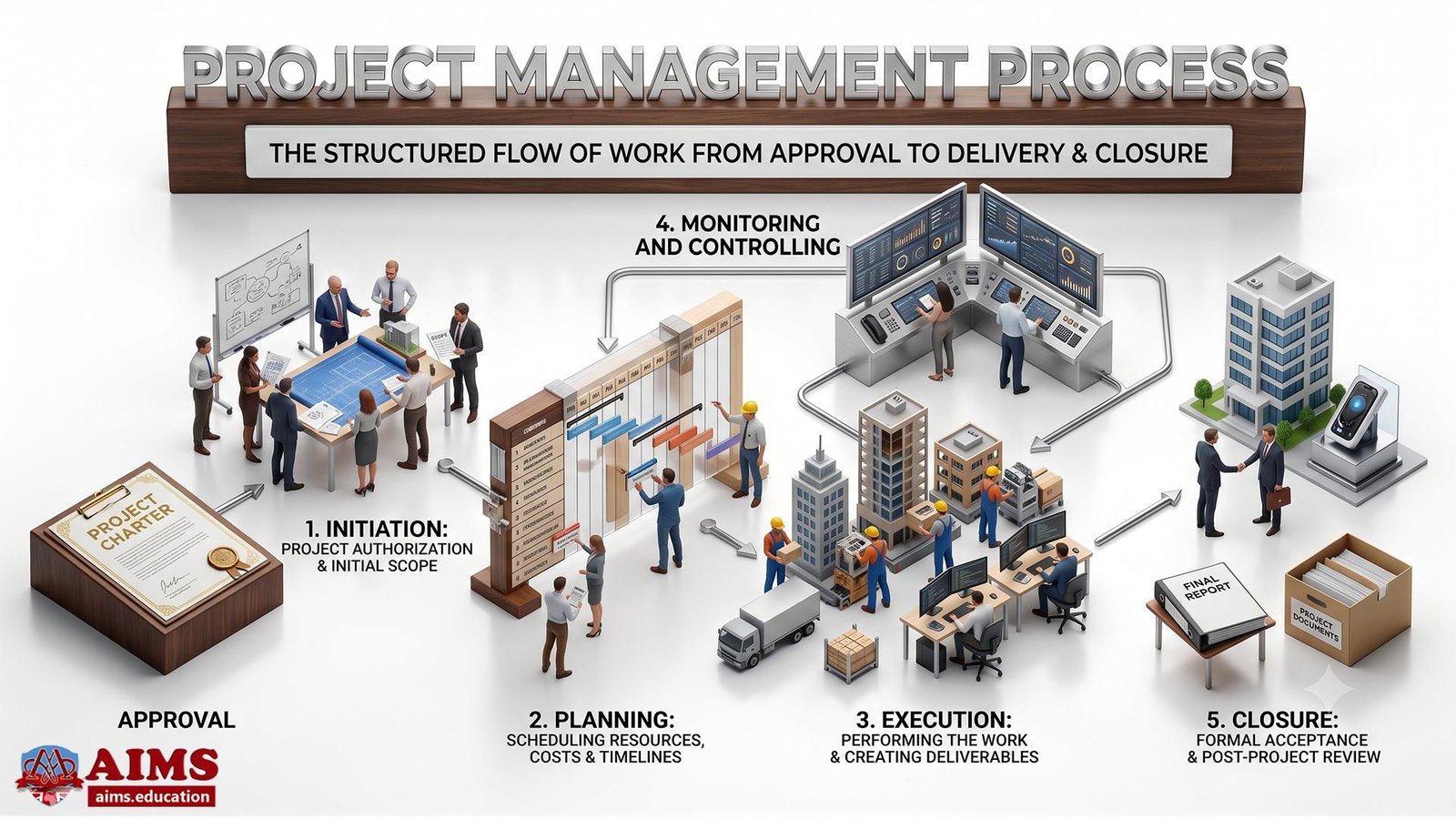
The project management process gives temporary work discipline. It does not remove uncertainty, but it helps teams recognize uncertainty early, plan responses, and make informed decisions before small issues become expensive failures.
How the Project Management Life Cycle Structures Delivery
The phases of project management usually describe how the work progresses from concept to completion. A common life cycle includes initiation, planning, execution, monitoring and controlling, and closure. A deeper explanation of the five project stages that move work from initiation to closure can help beginners connect theory with practical delivery.
Initiation and Business Case Approval
Initiation confirms why the project exists. Leaders authorize projects in response to strategic objectives, stakeholder needs, regulatory demands, business improvements, product changes, or service problems. A project charter, business case, sponsor approval, and initial stakeholder analysis are commonly developed at this stage.
For example, a university may approve a campus Wi-Fi upgrade because student demand, online learning needs, and cybersecurity requirements have changed. The initiation stage defines the purpose, expected benefits, preliminary scope, budget range, and decision authority.
Planning Scope, Schedule, Budget, Quality, and Risk
Planning translates the approved idea into an actionable route. A good project management process identifies requirements, creates a work breakdown, estimates time and cost, assigns responsibilities, plans communication, defines quality expectations, and records risks.
Planning should also define how changes will be approved. Without change control, every new request can appear reasonable in isolation but collectively damage the schedule, budget, and original value promise.
Execution, Communication, and Coordination
Execution is where the project plan is put into action. The project manager coordinates people, suppliers, information, decisions, and deliverables so that the team can produce the agreed result. Communication becomes critical because different stakeholders often have different priorities.
For example, IT may care about system security, finance may care about cost control, operations may care about service continuity, and users may care about ease of use. The project manager must coordinate these expectations without losing sight of the approved objectives.
Monitoring, Control, and Change Management
Monitoring and controlling compare actual performance against the plan. The project manager tracks schedule progress, budget use, risks, issues, quality results, and stakeholder feedback. In practice, the project management process often requires corrective action, change requests, reforecasting, or escalation to governance bodies.
Closure, Handover, and Lessons Learned
Closure confirms that the project has delivered what was accepted, records lessons learned, releases resources, closes contracts, and hands the result to operations or the customer. Closure is important because a project can produce a deliverable that still fails if users are not trained, support is not ready, or benefits are not tracked.
Project Life Cycle Phases Versus PMI Process Groups
Project life cycle phases describe the stages a project passes through. Process groups describe categories of management activity, such as initiating, planning, executing, monitoring and controlling, and closing. These ideas are related, but they are not the same.
Process groups can occur within several life cycle phases. Planning, monitoring, communication, and risk management are not single moments; they often continue throughout the project.
Project Management Methodologies and Delivery Approaches
Project management methodologies are structured approaches for planning and delivering work under different levels of certainty, complexity, regulation, and change. The most common delivery approaches include predictive or waterfall-style planning, agile project management, and hybrid project management, each suited to different project environments.
Predictive Project Management and Waterfall-Style Planning
Predictive project management works best when requirements are stable, the output can be defined early, and major changes are expected to be limited. Construction, regulated infrastructure, compliance implementations, and many engineering projects often benefit from predictive planning because sequence, approval, documentation, and control are important.
In a predictive approach, the team usually defines scope, schedule, budget, quality standards, and risks before extensive execution begins. This can improve control, but it may become rigid when customer needs change rapidly.
Agile Project Management and Iterative Delivery
Agile project management is useful when requirements are evolving, users need frequent feedback, and the final solution becomes clearer through iteration. Software development, digital products, innovation projects, and customer-facing service improvements often benefit from agile delivery.
Agile does not replace project management. It is one way of delivering project work. The project still needs objectives, stakeholder engagement, prioritization, risk awareness, quality control, and value measurement.
Hybrid Project Management for Mixed Environments
Hybrid project management combines predictive control with agile adaptability. It is often suitable when part of the work must follow a fixed plan, while another part requires iteration. For example, a hospital system implementation may use predictive planning for compliance, data migration, and training, while using agile iterations for user interface improvements.
Professionals comparing methods can explore choosing among waterfall, agile, and other project delivery methods. For a broad standards-aware perspective, the international guidance on project management under ISO 21502 also supports a method-neutral view of project management across organizations and project types.
| CRITERION | PREDICTIVE | AGILE | HYBRID |
|---|---|---|---|
| Best Fit | Predictive delivery fits stable requirements and sequential work. | Agile delivery fits changing requirements and frequent user feedback. | Hybrid delivery fits projects that need both control and flexibility. |
| Planning Style | Planning is detailed early and controlled through formal changes. | Planning is iterative and refined through short delivery cycles. | Planning combines baseline controls with adaptive workstreams. |
| Risk | Risk is managed through early analysis, documentation, and approvals. | Risk is reduced through feedback, increments, and fast learning. | Risk is managed differently across stable and uncertain work areas. |
| Main Weakness | Predictive delivery can become slow when requirements change. | Agile delivery can lose control without strong prioritization and governance. | Hybrid delivery can become confusing if roles and decision rules are unclear. |
How to Choose among Project Management Methodologies
Choose the method according to uncertainty, regulation, stakeholder availability, delivery speed, dependency complexity, and the cost of change. Stable work favors predictive planning. Evolving work favors agile delivery. Mixed environments favor hybrid models. The best project management methodologies support the project context rather than forcing the project into a fashionable framework.
Project Manager Roles and Responsibilities in Practice
A project manager plans, coordinates, monitors, communicates, and guides project work so that the agreed result is delivered with acceptable value, quality, risk, and stakeholder satisfaction. The role combines leadership, governance, planning, problem solving, negotiation, documentation, team coordination, and disciplined decision support.
Project Manager Roles and Responsibilities Across the Life Cycle
A project manager does not simply assign tasks. The role begins by understanding the objective, sponsor expectations, constraints, assumptions, stakeholders, and success criteria. During delivery, the project manager protects scope, manages trade-offs, communicates progress, resolves issues, escalates decisions, and prepares closure.
For a deeper role-based explanation, see the day-to-day responsibilities that sit with a project manager.
What a Project Manager Actually Does Each Day
Daily work varies by project, but common responsibilities include reviewing progress, removing blockers, updating plans, speaking with stakeholders, tracking risks, checking quality, approving changes, managing suppliers, supporting the team, and reporting status to sponsors or governance boards.
- The project manager clarifies what must be delivered and why it matters.
- The project manager keeps the team aligned with scope, time, cost, quality, resources, and risk.
- The project manager ensures that communication remains active, accurate, and collaborative.
- The project manager helps stakeholders make timely decisions when priorities conflict.
Skills, Documents, and Tools Commonly Used in Project Work
Important skills include leadership, communication, scheduling, budgeting, negotiation, risk thinking, analytical judgment, stakeholder management, and adaptability. Common documents include the project charter, scope statement, schedule, budget, risk register, issue log, stakeholder register, communication plan, status report, change request, acceptance record, and lessons learned summary.
These tools do not manage the project by themselves. They support judgment. A schedule is useful only when it reflects real dependencies. A risk register is useful only when risks are reviewed and acted upon. A status report is useful only when it helps stakeholders understand decisions, not just activity.
Project Management Examples Across Industries
Project management examples show that the same fundamentals apply across industries, even when the deliverables, risks, methods, and stakeholders are different. Construction projects, software launches, healthcare programs, education upgrades, product development, public services, research initiatives, and marketing campaigns all require structured planning and controlled delivery.
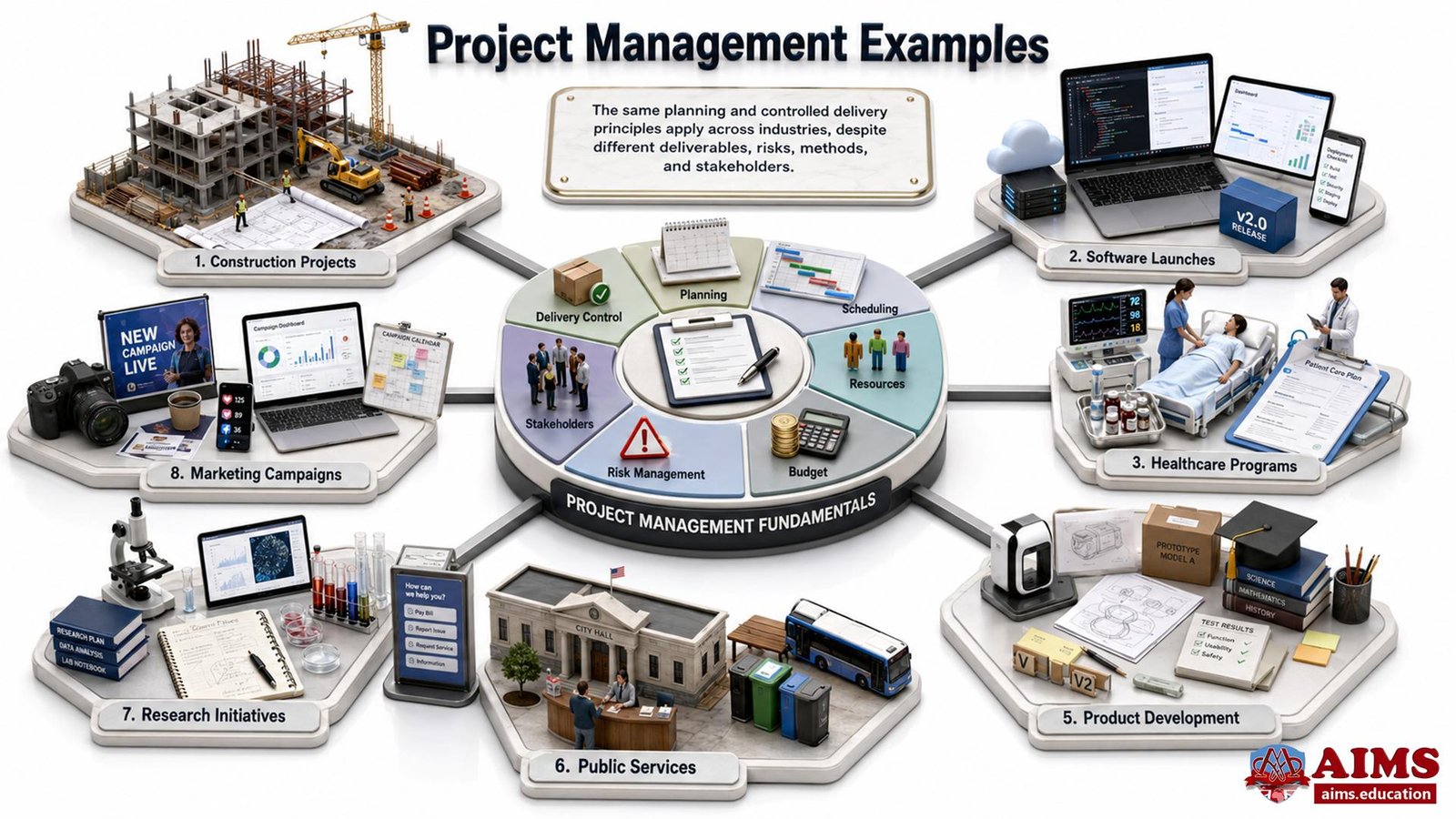
Project Management Examples in Construction, IT, Healthcare, and Education
Project management examples may include building a house, launching a website, implementing a hospital booking system, upgrading a university network, developing a new pharmaceutical product, redesigning a retail store layout, or introducing a national health initiative. Each example has a defined goal, temporary effort, resources, stakeholders, uncertainty, and a unique result.
In construction, project management often emphasizes design, permits, procurement, safety, sequence, cost, and quality. In IT, it may emphasize requirements, user stories, integration, testing, cybersecurity, and deployment. In healthcare, it may emphasize compliance, patient safety, training, adoption, and operational continuity.
A Simple Real-World Example from Idea to Delivery
Consider a training company that wants to launch a new online learning portal within four months with a budget of GBP 45,000.
- The sponsor defines the goal as improving learner access, tracking progress, and reducing manual administration.
- The project manager confirms scope, including platform setup, course migration, payment integration, reporting, testing, and staff training.
- The team identifies risks, including data migration errors, supplier delays, user resistance, and payment gateway issues.
- The project manager tracks weekly progress, manages change requests, and reports budget use to the sponsor.
- The final portal is tested, accepted, handed over to operations, and reviewed after launch.
This example shows how the project management process connects objectives, resources, risks, decisions, and final value in a practical delivery environment.
How the Same Project Changes under Predictive, Agile, and Hybrid Models
The same learning portal could be delivered in different ways. A predictive model would define the full scope before build. An agile model would deliver features in iterations and adjust after user feedback. A hybrid model could fix compliance, payment, and data migration requirements while iterating learner dashboard features.
This is why project management examples should not be studied as rigid templates. They should be studied as decision environments where the manager selects the best structure for the work, stakeholders, risk level, and desired value.
Benefits, Limits, and Real-World Challenges of Project Management
Project management improves coordination, visibility, accountability, risk control, communication, and value delivery, but it does not guarantee success by itself. Projects still fail when sponsorship is weak, scope is unclear, resources are unrealistic, decisions are delayed, stakeholders are ignored, or methods are poorly matched to uncertainty.
Why Is Project Management Important?
Why is project management important? It is important because organizations rarely have unlimited time, money, people, or tolerance for failure. Project management helps leaders choose priorities, organize work, control trade-offs, communicate decisions, reduce uncertainty, and deliver results that stakeholders can actually use.
Strong project management also improves transparency. Sponsors can see whether the project is healthy, teams understand what matters most, and stakeholders know when their input is needed. This prevents hidden problems from becoming late-stage crises.
Common Limitations, Trade-Offs, and Failure Points
Project management cannot remove every risk or satisfy every stakeholder demand. It also cannot compensate for an impossible deadline, unrealistic budget, unclear strategy, or absent sponsor. The discipline is powerful, but it works best when governance, leadership, and organizational support are present.
Common failure points include vague objectives, uncontrolled scope changes, poor estimates, weak communication, late stakeholder engagement, ignored risks, insufficient resources, and incomplete handover. These failures are not just technical problems; they are often leadership and decision problems.
Why Scope, Sponsorship, and Communication Decide Outcomes
Clear scope tells the team what to deliver. Strong sponsorship gives the project authority, funding, and strategic direction. Effective communication keeps stakeholders aligned when constraints compete. When these three elements are weak, even skilled teams may struggle to deliver value.
Professionals who want to build structured capability may consider an online project management certification for practicing and aspiring project professionals or a career focused project management diploma for higher career prospects, especially when they need formal preparation for planning, governance, risk, and stakeholder-driven delivery.
FAQs About What Is Project Management
These questions answer the most common beginner and professional doubts about project management, including definition, basics, process, phases, methodologies, roles, operations, programs, objectives, and documents. Each answer is concise enough for quick understanding while preserving the key distinctions needed for accurate learning.
What is project management definition in one sentence?
Project management is the structured application of knowledge, skills, tools, and techniques to temporary work so that a unique product, service, or result is delivered within agreed requirements, constraints, and stakeholder expectations.
What are the project management basics every beginner should know?
The project management basics include defining objectives, clarifying scope, identifying stakeholders, planning schedule and budget, assigning resources, managing risks, communicating progress, controlling changes, ensuring quality, and closing the project through acceptance and handover.
What is the project management process from start to finish?
The project management process usually moves through initiation, planning, execution, monitoring and controlling, and closure. These stages help teams approve the need, plan the work, deliver the result, manage performance, and formally complete the project.
What is the project management life cycle and how does it work?
The project management life cycle is the sequence of stages through which a project progresses from concept to completion. It structures decision-making, planning, delivery, monitoring, acceptance, handover, and lessons learned.
Why is project management important in every industry?
Project management is important because every industry faces limited resources, deadlines, risk, stakeholder expectations, and the need for measurable value. It helps organizations coordinate work, control uncertainty, and deliver useful results.
What does a project manager do day to day?
A project manager plans work, coordinates the team, communicates with stakeholders, tracks progress, manages risks and issues, controls changes, reports status, resolves obstacles, and keeps the project aligned with its objectives.
Is project management the same as program management?
No. Project management delivers a specific project outcome, while program management coordinates related projects to achieve broader benefits. Programs manage dependencies, combined value, and strategic change across multiple connected initiatives.
What is the difference between project management and operations?
Project management handles temporary and unique work, while operations manage ongoing and repetitive business activities. Building a new system is a project; maintaining and using that system every day is an operation.
Which project management methodologies are most common?
The most common project management methodologies include predictive or waterfall-style planning, agile project management, and hybrid delivery. Predictive suits stable requirements, agile suits evolving requirements, and hybrid suits mixed environments.
What is the project management triangle?
The project management triangle explains the relationship among scope, time, and cost. When one changes, the others are usually affected. Quality, risk, resources, and stakeholder value also influence project success.
Is project management only for large projects?
No. Project management applies to small, medium, and large projects. A one-month website launch, a classroom technology upgrade, a marketing campaign, and a multiyear infrastructure project all benefit from structured delivery.
What documents are commonly used in project management?
Common project documents include a project charter, scope statement, schedule, budget, risk register, issue log, stakeholder register, communication plan, status report, change request, acceptance record, and lessons learned summary.
Conclusion
Project management is the discipline that gives temporary work direction, structure, control, and value. It connects strategy with execution by defining objectives, managing constraints, guiding people, controlling risk, communicating decisions, and ensuring that the final result is accepted, useful, and sustainable after delivery.
The strongest project managers understand both the technical and human sides of delivery. They know that plans, schedules, tools, and reports matter, but they also know that sponsorship, stakeholder trust, team coordination, and practical judgment often decide whether a project creates real value.
About AIMS’ Institute of Project Management
AIMS’ Institute of Project Management has supported professional project management education since 2005, serving global learners through internationally standardized, career-focused curriculum, qualified faculty, industry-oriented teaching, 3D interactive learning content, and real-world case studies. This content, along with AIMS’ study content & curriculum, is collaboratively developed and rigorously peer-reviewed by an academic board of qualified industry practitioners. These strengths support job-ready qualifications in project, program, and project portfolio management. Explore career-focused project management qualifications for advancing professionals.