
Project scope management is the disciplined process of defining, documenting, validating, and controlling all work required to deliver an agreed project result, while excluding work that does not belong. It establishes project boundaries, converts stakeholder requirements into deliverables, creates a scope baseline, and provides a controlled method for evaluating changes and preventing scope creep.
Effective scope management helps project managers protect schedules, budgets, resources, quality expectations, and stakeholder relationships. It answers three essential questions: What must the project deliver? What work is necessary to produce it? How will proposed changes be evaluated, approved, and incorporated without losing control?
A well-managed project includes all the work required for success, and only the work that has been properly authorized.
What Is Project Scope Management?
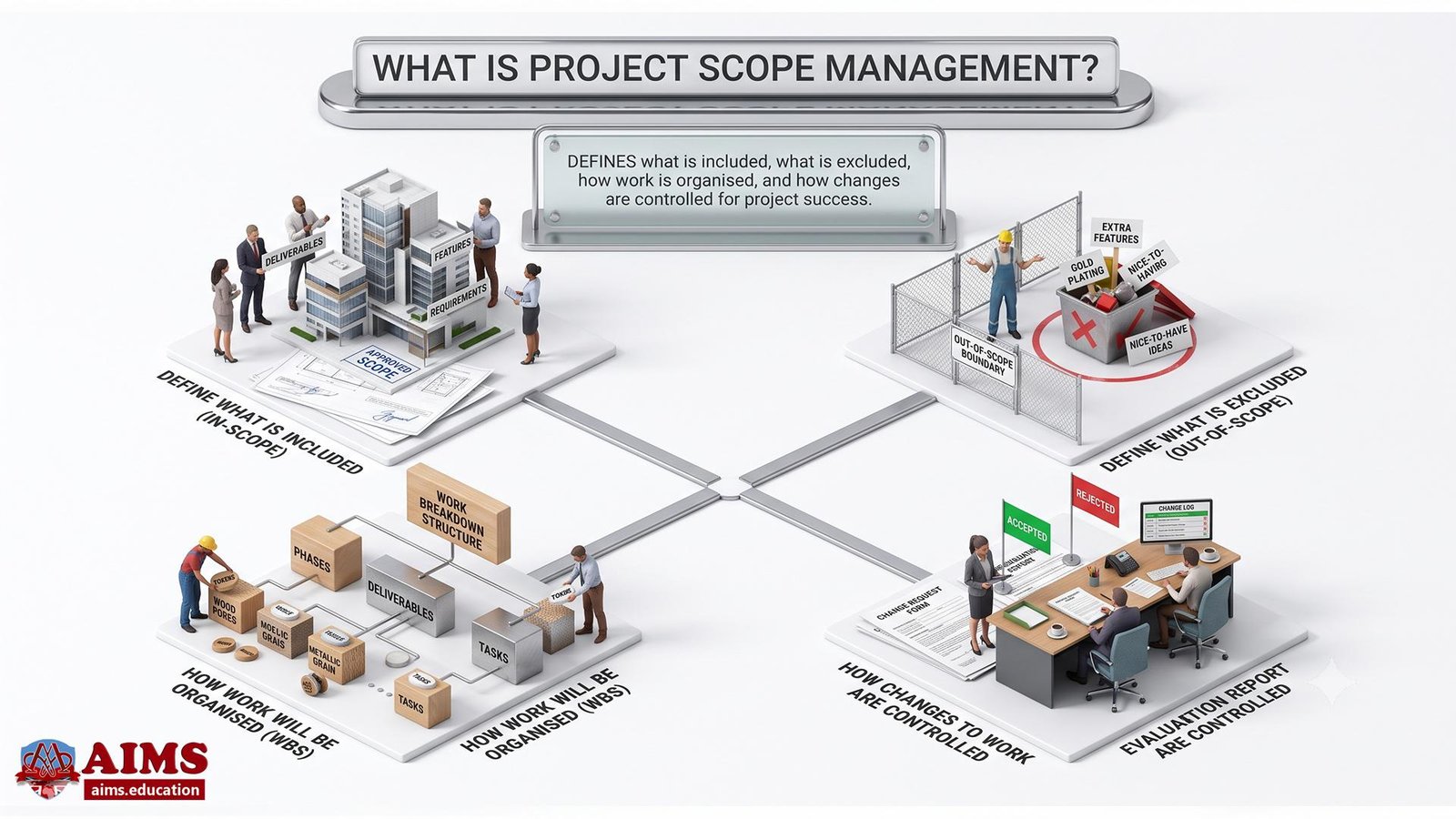
Project scope management defines what is included in a project, what is excluded, how the required work will be organized, and how changes to that work will be controlled.
When professionals ask what is project scope management, they are asking how a project team converts an initial idea into an agreed set of deliverables, requirements, boundaries, work packages, acceptance criteria, and control procedures.
Scope is not merely a list of activities. It connects stakeholder needs with the product or service being created and the work required to create it. Effective scope management in project management therefore covers both the intended result and the effort needed to produce that result.
The two main dimensions of scope are:
- Product scope: The features, functions, characteristics, and capabilities of the product, service, or result being delivered.
- Project scope: The work that the project team must perform to create and deliver the agreed product, service, or result.
Project Scope vs Product Scope
| COMPARISON AREA | PRODUCT SCOPE | PROJECT SCOPE |
|---|---|---|
| Primary focus | The characteristics and capabilities of the final product, service, or result. | The work required to produce and deliver the agreed result. |
| Main question | What must the completed product do or contain? | What work must the project team perform? |
| Measured against | Product requirements, specifications, and acceptance criteria. | The approved scope statement, WBS, WBS dictionary, and scope baseline. |
| Example | A school building with 20 classrooms, a laboratory, offices, toilets, and a playground. | Planning, design, procurement, construction, inspection, approval, and handover work. |
Project Scope Management Example: Constructing a School
A school construction project provides a simple way to understand the distinction.
- A client requests a school with 20 classrooms, two laboratories, administrative offices, a playground, defined safety features, and an agreed completion date.
- These characteristics describe the product scope because they define what the completed school must contain.
- The project team then prepares designs, obtains permissions, purchases materials, hires contractors, schedules construction, monitors quality, and completes inspections.
- These activities and deliverables form the project scope because they represent the work required to create the school.
- The completed building is checked against the approved requirements before it is formally handed over.
Clear separation of product and project scope prevents teams from confusing required outcomes with the work used to achieve them.
Importance of Scope Management in Project Management
Scope management in project management is important because unclear boundaries lead to uncontrolled work, unrealistic expectations, rework, delays, cost overruns, resource conflicts, and disputes over acceptance.
Strong project scope planning and control creates a common understanding among the sponsor, customer, project manager, team, and other stakeholders. Everyone can see what the project has committed to deliver and what lies outside that commitment.
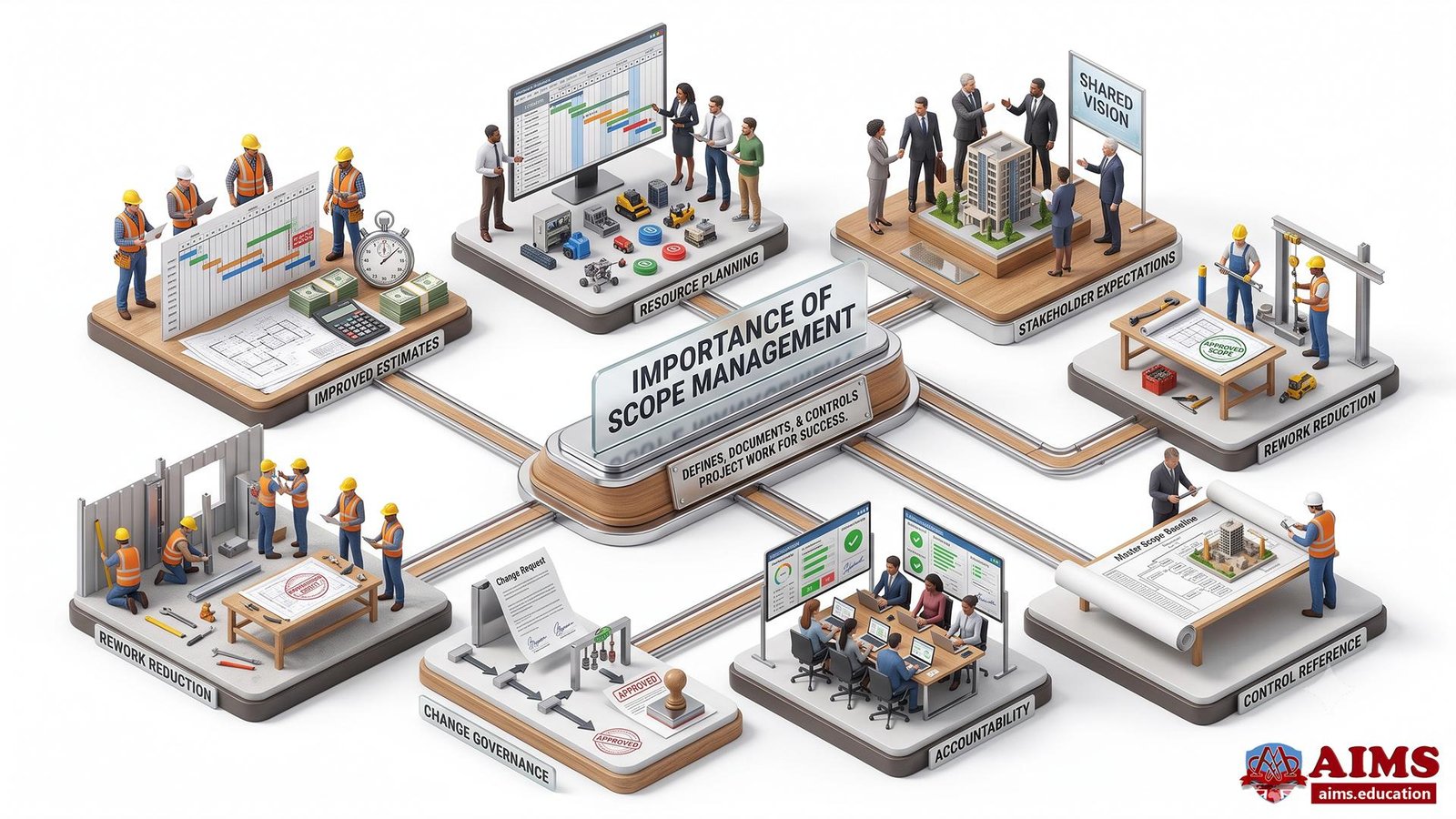
Effective scope management supports the project in several ways:
- It clarifies project boundaries. The team understands which requirements, deliverables, and activities belong in the project.
- It improves cost and schedule estimates. Reliable estimates depend on knowing the complete amount of authorized work.
- It supports resource planning. Managers can assign people, equipment, materials, and funding to defined work packages.
- It aligns stakeholder expectations. Customers know what they will receive and what acceptance conditions will apply.
- It reduces rework. Early clarification prevents teams from building something that stakeholders did not request or cannot accept.
- It strengthens change governance. New requests are evaluated rather than informally added to the team’s workload.
- It improves accountability. Deliverables and work packages can be assigned to responsible owners.
- It provides a control reference. Actual work can be compared with the approved baseline throughout delivery.
Scope also interacts directly with time, cost, quality, resources, and risk. A requested increase in scope may require additional funding, a later completion date, more people, or a revised technical approach. This relationship is explained further through the relationship between project scope, time, and cost constraints.
What Are the Main Project Scope Management Processes?
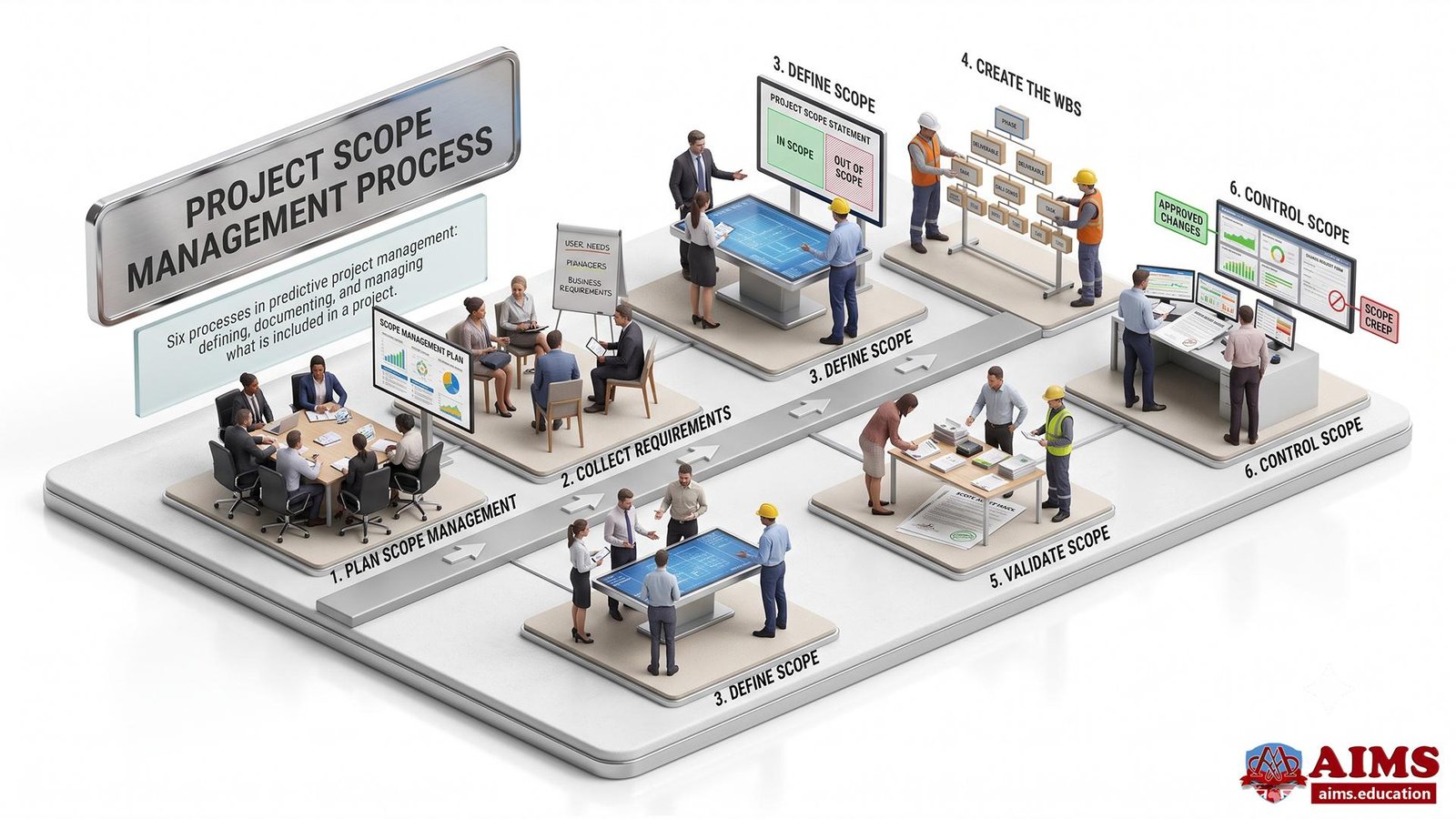
In predictive project management, scope is managed through six connected processes: plan scope management, collect requirements, define scope, create the WBS, validate scope, and control scope.
These project scope management processes form a continuous system rather than six isolated administrative tasks. Planning establishes the method, requirements identify stakeholder needs, scope definition sets the boundaries, the WBS organizes the work, validation secures acceptance, and control governs change.
| PROCESS | MAIN PURPOSE | KEY RESULT |
|---|---|---|
| 1. Plan Scope Management | Decide how scope and requirements will be defined, approved, validated, and controlled. | Scope management and requirements management approaches. |
| 2. Collect Requirements | Identify, analyze, prioritize, and document stakeholder needs and expectations. | Requirements documentation and a requirements traceability matrix. |
| 3. Define Scope | Select the approved requirements and describe the project’s boundaries and deliverables. | Project scope statement. |
| 4. Create WBS | Decompose deliverables into manageable components and work packages. | WBS, WBS dictionary, and scope baseline. |
| 5. Validate Scope | Present completed deliverables for formal stakeholder review and acceptance. | Accepted deliverables or documented change requests. |
| 6. Control Scope | Monitor scope performance and process proposed changes through formal governance. | Performance information, change requests, and approved baseline updates. |
The sequence provides a practical summary of the main project scope management steps. In real projects, however, some activities are repeated as new information becomes available or approved changes affect the baseline.
Step 1: Create the Project Scope Management Plan
A project scope management plan explains how the project team will define, develop, approve, validate, monitor, and control scope.
The project scope management plan is a management document. It does not describe every deliverable in detail. Instead, it establishes the rules and procedures the team will follow when making scope-related decisions.
A practical scope management plan should explain:
- How stakeholder requirements will be collected, analyzed, documented, and prioritized.
- Who has authority to approve requirements and scope decisions.
- How the detailed project scope statement will be prepared.
- How deliverables will be decomposed into a work breakdown structure.
- How the WBS and WBS dictionary will be reviewed and approved.
- How the scope baseline will be established and maintained.
- How completed deliverables will be inspected and formally accepted.
- How scope changes will be submitted, analyzed, approved, rejected, and communicated.
- How scope performance and variances will be monitored.
- Which records, templates, tools, and reporting methods the project will use.
Scope Management Plan vs Project Scope Statement
These documents are related, but they serve different purposes.
| COMPARISON AREA | SCOPE MANAGEMENT PLAN | PROJECT SCOPE STATEMENT |
|---|---|---|
| Purpose | Explains how scope will be planned, defined, validated, and controlled. | Describes the project’s deliverables, boundaries, exclusions, assumptions, and constraints. |
| Nature | A procedural and governance document. | A descriptive statement of the authorized scope. |
| Main question | How will we manage scope? | What exactly will the project deliver and exclude? |
| Typical content | Roles, methods, approval routes, validation procedures, and change-control rules. | Product description, deliverables, acceptance criteria, exclusions, constraints, and assumptions. |
| Relationship to baseline | Explains how the baseline will be created and controlled. | Becomes one of the three components of the approved scope baseline. |
Example of a Scope Management Planning Decision
Consider a company implementing an online customer portal.
- The sponsor will approve the high-level scope.
- Department managers will approve requirements affecting their business areas.
- The project manager will maintain the requirements traceability matrix and scope baseline.
- The customer representative will formally accept each major release.
- Any request affecting cost, completion date, security, or agreed functionality must be reviewed by the change control authority.
This planning decision prevents individuals from adding requirements without understanding their wider impact.
Step 2: Collect and Document Project Requirements
Requirements collection identifies the conditions, capabilities, features, and acceptance expectations that a project must satisfy to achieve its objectives.
Requirements collection is more than asking stakeholders what they want. Project teams must discover needs, clarify vague expectations, resolve conflicts, test feasibility, assign priorities, and obtain approval.
Requirements may describe:
- Business needs and the reason the project was initiated.
- Project objectives and intended organizational benefits.
- Functional capabilities that the product must provide.
- Non-functional expectations such as security, reliability, speed, availability, or usability.
- Quality standards and performance tolerances.
- Regulatory, contractual, or policy obligations.
- Acceptance and testing criteria.
- Training, support, maintenance, and transition needs.
- Departments, customers, suppliers, and systems affected by the project.
- Known assumptions, dependencies, and constraints.
Project Requirements Collection Techniques
Different stakeholders express knowledge in different ways. A project manager should therefore select techniques according to the complexity, audience, uncertainty, and type of project.
Interviews
Interviews are structured or informal discussions with stakeholders, users, specialists, sponsors, and experienced team members.
- The interviewer prepares key questions before the meeting.
- The discussion explores needs, current problems, desired outcomes, and acceptance expectations.
- Follow-up questions help reveal assumptions or requirements that were not initially obvious.
- The project team records responses and confirms its interpretation with the interviewee.
Focus Groups
Focus groups bring selected users or specialists together to discuss needs, preferences, concerns, and reactions to a proposed solution.
A trained facilitator keeps the discussion focused and ensures that dominant participants do not prevent others from contributing.
Facilitated Workshops
Facilitated workshops are especially useful when a project affects several departments or stakeholder groups.
- Representatives describe their individual needs.
- The group identifies conflicts, overlaps, dependencies, and shared requirements.
- Participants prioritize requirements and resolve misunderstandings together.
- The facilitator records decisions and unresolved issues.
Group Creativity and Decision Techniques
Teams can use brainstorming, mind mapping, affinity grouping, nominal group techniques, and expert consultation to generate and organize requirements.
Group decisions may be reached through:
- Unanimity: Everyone supports the decision.
- Majority: More than half of the group supports the decision.
- Plurality: The largest subgroup determines the decision when no majority exists.
- Designated authority: One authorized person makes the final decision after considering available information.
Questionnaires and Surveys
Questionnaires help collect information from a large or geographically distributed stakeholder population. They are efficient when the team needs standardized responses that can be categorized or statistically analyzed.
Observation
Observation, sometimes called job shadowing, allows the analyst to watch users perform their work in the real environment.
This technique frequently reveals practical needs that users may forget to mention because the activities have become routine.
Prototypes
A prototype is a working model, screen design, sample, mock-up, or early version of the intended product.
- Users interact with the prototype.
- They identify missing features, usability problems, and incorrect assumptions.
- The project team revises the prototype.
- The cycle continues until the requirements are sufficiently understood.
Requirements Documentation
Requirements documentation records each approved need in enough detail for the team to design, build, test, trace, and obtain acceptance of the corresponding deliverable.
The format may range from a structured requirements specification to a categorized list. Whatever format is selected, each requirement should be clear, measurable where possible, testable, traceable, feasible, and approved by an authorized stakeholder.
Requirements Traceability Matrix
A requirements traceability matrix links each requirement to its source, business objective, deliverable, WBS component, test method, approval status, and final result.
The matrix prevents requirements from disappearing between early discussions and final delivery. It also supports change analysis because the team can identify which deliverables, tests, objectives, costs, and activities may be affected by a proposed modification.
| ID | REQUIREMENT | SOURCE | PRIORITY | VERIFICATION | STATUS |
|---|---|---|---|---|---|
| CP-001 | Customers must be able to reset their account password securely. | Customer support manager | Essential | Security and user-acceptance test | Approved |
| CP-002 | The portal must display the customer’s previous 12 months of transactions. | Finance department | High | Functional test against approved records | Approved |
| CP-003 | The portal should support three interface languages. | Regional sales director | Desirable | Language and usability review | Deferred to second release |
The matrix makes clear that collecting a request does not automatically place it within the approved project scope.
Step 3: Define the Project Scope
Project scope definition develops a detailed description of the project, its deliverables, its product boundaries, and the work that will and will not be performed.
The project scope definition process uses approved requirements, project objectives, constraints, assumptions, and organizational knowledge to determine the final boundaries of the project.
Not every collected requirement will necessarily be included. Some requirements may be:
- Rejected because they do not support the approved business objective.
- Deferred to a later project or release.
- Excluded because the available budget, time, technology, or resources cannot support them.
- Combined with similar requirements.
- Rewritten to make them measurable and testable.
- Included conditionally, subject to a regulatory, technical, or commercial decision.
Inputs Used to Define Scope
The team commonly considers:
- The project charter and its high-level objectives.
- Approved requirements documentation.
- Stakeholder expectations and priorities.
- Organizational policies, templates, lessons learned, and historical records.
- Technical options, product analysis, and alternative delivery approaches.
- Known assumptions, dependencies, risks, and constraints.
Project Scope Statement
A project scope statement is the detailed agreement describing what the project will deliver, the work boundaries that apply, and the conditions under which the result will be accepted.
The project scope statement becomes a central reference for planning and future change decisions. When a stakeholder asks for additional work, the project manager can compare the request with the approved statement rather than relying on memory or informal discussions.
What Should a Project Scope Statement Include?
A complete scope statement should address the following components.
1. Product Scope Description
The product scope description explains the characteristics, capabilities, or results the project will create.
For a customer portal, it could describe account access, transaction history, payment functions, security controls, supported devices, and user groups.
2. Acceptance Criteria
Acceptance criteria define the measurable conditions that a deliverable must satisfy before an authorized stakeholder accepts it.
- Criteria should be specific and testable.
- The responsible approver should be identified.
- The required evidence or test result should be clear.
- Approval conditions should be agreed before the deliverable is completed.
3. Project Deliverables
Deliverables are specific, measurable, and verifiable outputs produced by the project.
Examples include an approved design, configured software, training materials, a completed building, an inspection report, a tested prototype, or an operational business process.
4. Project Exclusions
Exclusions state what the project will not provide.
Exclusions are essential because stakeholders may otherwise assume that related work is included. For example, a portal implementation may exclude replacement of the organization’s accounting system and long-term operational support after the agreed warranty period.
5. Project Constraints
Constraints restrict the choices available to the project team.
Common constraints include:
- Maximum approved budget.
- Required completion date.
- Limited availability of specialist resources.
- Mandatory technology or supplier.
- Regulatory and contractual conditions.
- Quality, security, or performance limits.
6. Project Assumptions
Assumptions are conditions believed to be true for planning purposes, although they have not yet been fully verified.
A construction project may assume that specific equipment, materials, permits, or specialists will be available when needed. Because an invalid assumption can create risk, assumptions should be documented, reviewed, and validated as the project progresses.
7. Approval Requirements
Approval requirements identify who will approve major deliverables, management documents, phase transitions, and the completed project result.
For example, a sales director may approve a customer-facing prototype before development continues, while an information-security manager approves the production system before launch.
Example of a Project Scope Statement
For the customer portal project, the scope statement could establish that:
- The project will create a secure web portal for existing customers.
- The portal will provide account access, profile updates, transaction history, electronic statements, and password recovery.
- It will integrate with the existing customer database and payment gateway.
- It will include testing, user training, technical documentation, and production deployment.
- It will not replace the accounting system or provide a separate mobile application during the first release.
- The authorized sponsor must accept the portal after functional, security, performance, and user-acceptance tests are completed successfully.
Publishing and approving the scope statement converts informal expectations into an accountable project commitment.
Step 4: Create the Work Breakdown Structure
A work breakdown structure is a deliverable-oriented hierarchy that decomposes the total approved project scope into smaller, manageable components.
The work breakdown structure, commonly called the WBS, organizes the project according to what must be delivered. Each descending level provides more detail until the work can be estimated, assigned, scheduled, monitored, and controlled reliably.
The WBS is not simply a task list, project schedule, organization chart, or list of responsible employees. It is a structured representation of the complete authorized scope.
Project managers can explore a more detailed explanation of WBS levels, decomposition, and practical examples. The Project Management Institute’s guidance on work breakdown structure principles also emphasizes that a WBS defines the project scope and contains the complete scope of work.
How Deliverables Are Decomposed
Decomposition breaks large deliverables into smaller components that can be planned and controlled.
- Identify major deliverables. Begin with the final product, phases, subprojects, or major result categories.
- Organize the WBS. Select a logical hierarchy based on deliverables, phases, locations, systems, or another suitable structure.
- Decompose each component. Break major deliverables into smaller sub-deliverables.
- Continue to the work-package level. Stop when the work can be estimated, assigned, monitored, and accepted effectively.
- Assign identification codes. Give each component a unique reference for planning, accounting, reporting, and traceability.
- Verify completeness. Confirm that the hierarchy includes all authorized work and no unauthorized work.
The 100 Percent Rule
The 100 percent rule means that the WBS must contain all the work required to complete the approved scope, including project management work, but no work outside that scope.
At every level, the lower-level components should represent the complete content of the parent component. If a major deliverable has four child components, those four components collectively must represent the entire deliverable.
WBS Levels and Work Packages
The first WBS level may represent the complete project. The next level may contain major deliverables or phases. Lower levels provide increasing detail.
The lowest level used for effective management is called the work package. A work package should be detailed enough to support:
- Cost and duration estimation.
- Resource assignment.
- Responsibility allocation.
- Quality and acceptance criteria.
- Progress monitoring.
- Risk identification.
- Change-impact assessment.
Customer Portal WBS Example
| LEVEL 1 | LEVEL 2 | LEVEL 3 WORK PACKAGES |
|---|---|---|
| Customer Portal Project | Requirements and Design | Approved requirements, user journeys, interface design, architecture, and security design. |
| Customer Portal Project | Portal Development | Account access, profile management, transaction history, statements, and password recovery. |
| Customer Portal Project | Systems Integration | Customer database interface, payment gateway connection, and notification service. |
| Customer Portal Project | Testing and Acceptance | Functional testing, security testing, performance testing, and user-acceptance testing. |
| Customer Portal Project | Deployment and Transition | Production deployment, documentation, training, support handover, and launch approval. |
WBS Dictionary
The WBS dictionary provides detailed information about each WBS component and work package.
A WBS diagram alone may not provide enough information for reliable execution. The dictionary can document:
- The WBS identification code.
- A detailed description of the work and deliverable.
- The accountable team or organizational unit.
- Associated milestones and schedule activities.
- Required resources and estimated cost.
- Quality requirements.
- Acceptance criteria.
- Technical references.
- Relevant assumptions, constraints, and contract information.
The WBS and its dictionary improve planning because the schedule, budget, resources, procurement needs, quality controls, and risks can be developed from a clearly defined body of work.
Step 5: Establish the Scope Baseline
A scope baseline is the formally approved version of the project scope statement, WBS, and WBS dictionary that is used to measure and control scope performance.
The scope baseline consists of three connected components:
- Approved project scope statement: Describes the deliverables, boundaries, exclusions, acceptance criteria, constraints, and assumptions.
- Approved WBS: Organizes the complete authorized scope into a deliverable-oriented hierarchy.
- Approved WBS dictionary: Provides detailed information about individual WBS components and work packages.
Once approved, the baseline becomes the official reference for answering questions such as:
- Is this requested work already included?
- Has a required deliverable been omitted?
- Is the team performing unauthorized work?
- Does a proposed change affect other deliverables?
- Will the change alter cost, schedule, resources, quality, risk, or acceptance conditions?
How the Scope Baseline Supports Other Plans
The scope baseline provides the foundation for:
- Breaking work packages into schedule activities.
- Estimating durations and sequencing activities.
- Estimating costs and establishing the project budget.
- Assigning people and other resources.
- Identifying procurement requirements.
- Defining quality-control and acceptance activities.
- Identifying risks associated with individual deliverables.
- Measuring performance and evaluating change requests.
A weak baseline produces weak estimates. A complete baseline makes the project easier to plan, explain, monitor, and defend.
Step 6: Validate and Control Project Scope
Scope validation obtains formal acceptance of completed deliverables, while scope control monitors the baseline and manages proposed or actual changes.
Scope validation and scope control are sometimes confused because both examine deliverables and requirements. Their decision purposes, however, are different.
Validate Scope vs Control Scope
| COMPARISON AREA | VALIDATE SCOPE | CONTROL SCOPE |
|---|---|---|
| Main purpose | Obtain formal customer or sponsor acceptance of completed deliverables. | Monitor scope status and govern changes to the approved baseline. |
| Main question | Does the completed deliverable satisfy the agreed acceptance criteria? | Is actual or requested work consistent with the approved scope? |
| Primary focus | Stakeholder acceptance. | Baseline integrity and change governance. |
| Possible result | Accepted deliverable or documented request for correction or change. | Performance information, corrective action, change request, or approved baseline update. |
| Timing | When a deliverable or phase result is ready for review. | Throughout project execution and monitoring. |
Scope Validation Is Not the Same as Quality Control
Quality control determines whether a deliverable is correct and conforms to technical or quality specifications, while scope validation determines whether the authorized stakeholder accepts it.
A software feature could pass technical testing but still fail stakeholder acceptance because it does not support the agreed business process. Conversely, a stakeholder should not be asked to accept a deliverable that has not completed the necessary quality checks.
How Project Scope Changes Are Evaluated and Controlled
Change is normal. Uncontrolled change is the problem.
A practical change-control sequence includes:
- Record the request. Document the proposed change, its source, purpose, urgency, and expected benefit.
- Confirm whether it is already included. Compare the request with the requirements documentation, scope statement, WBS, and WBS dictionary.
- Analyze the impact. Assess effects on deliverables, schedule, cost, resources, quality, risk, procurement, contracts, and expected benefits.
- Develop options. The team may recommend approval, rejection, deferral, substitution, or inclusion in a later release.
- Obtain an authorized decision. The sponsor, customer, product owner, or change control authority decides according to the governance structure.
- Update approved documents. If approved, revise the affected baseline, requirements, schedule, budget, risk records, and supporting plans.
- Communicate the decision. Inform affected stakeholders and team members.
- Track implementation. Verify that the approved change is completed, tested, documented, and accepted.
Formal change control is closely related to wider change management practices used to evaluate and implement project changes.
Variance Analysis in Scope Control
Variance analysis compares actual project performance with the approved scope baseline to identify differences, causes, consequences, and required action.
When a variance is found, the team should determine:
- What work or deliverable differs from the baseline.
- Why the variance occurred.
- Whether the difference is acceptable.
- How the variance affects cost, time, resources, risk, quality, and benefits.
- Whether corrective action, preventive action, defect repair, or a formal change request is required.
Typical Outputs of Scope Control
Scope control may produce:
- Work performance information: Contextual information about scope progress, variances, causes, and forecast consequences.
- Change requests: Proposals for corrective action, preventive action, defect repair, or scope enhancement.
- Scope baseline updates: Revisions to the scope statement, WBS, or WBS dictionary following approved changes.
- Plan and document updates: Revisions to requirements, schedules, budgets, risk records, lessons learned, and other affected information.
What Is Scope Creep?
Scope creep is the uncontrolled expansion of project or product scope without proper evaluation, authorization, or corresponding adjustment to time, cost, resources, and other project constraints.
Scope creep may begin with a seemingly small request. A customer asks for one additional report, a manager requests a new approval step, or a team member adds a feature that appears easy to build. Repeated informal additions gradually increase the project’s workload and complexity.
Common Causes of Scope Creep
- An incomplete or ambiguous scope statement.
- Poorly documented requirements.
- Stakeholders who were not adequately consulted.
- Informal requests made directly to team members.
- A weak or ignored change-control process.
- Unclear authority for approving changes.
- Miscommunication among stakeholders and project staff.
- Failure to define exclusions and acceptance criteria.
- External changes involving regulation, technology, markets, suppliers, or customer expectations.
- A project culture in which saying yes is easier than evaluating consequences.
Consequences of Scope Creep
Uncontrolled scope can cause:
- Schedule delays.
- Cost overruns.
- Resource overload.
- Reduced quality.
- Additional defects and rework.
- Increased technical and operational risk.
- Confusion over priorities.
- Conflict between the customer and project team.
- Failure to complete essential deliverables.
- Project cancellation in severe cases.
How to Prevent Scope Creep
- Develop complete, testable, and approved requirements.
- Create a clear scope statement with explicit exclusions.
- Build a deliverable-oriented WBS that captures the complete authorized scope.
- Establish measurable acceptance criteria.
- Maintain a requirements traceability matrix.
- Define who can submit, evaluate, and approve changes.
- Prevent team members from accepting informal scope requests.
- Review scope status regularly with stakeholders.
- Analyze the full impact of each proposed change.
- Update time, cost, resources, and other plans when an approved scope change requires it.
An approved change that is properly analyzed and accompanied by necessary adjustments is controlled change, not scope creep.
What Is Gold Plating in Project Management?
Gold plating means intentionally adding features, functions, quality, or work that the customer did not request and the approved scope did not authorize.
Gold plating is often performed with good intentions. A team member may want to impress the customer, demonstrate technical ability, or compensate for another weakness. Nevertheless, the additional feature consumes resources and introduces risk without an approved business justification.
Why Gold Plating Is Harmful
- The customer may reject the unauthorized feature.
- The additional work may introduce defects or security problems.
- The team may divert attention from required deliverables.
- The extra effort can increase cost and delay completion.
- The customer may expect similar extras in future projects.
- The change may affect maintenance, documentation, training, or regulatory compliance.
- The project manager loses control over what the team is building.
Scope Creep vs Gold Plating
| COMPARISON AREA | SCOPE CREEP | GOLD PLATING |
|---|---|---|
| Meaning | Uncontrolled expansion of scope without proper approval or corresponding plan adjustments. | Unauthorized extra features or work intentionally added beyond the approved scope. |
| Common source | Customers, sponsors, managers, external conditions, or accumulated informal requests. | Project manager, technical specialist, designer, or another team member. |
| Typical intention | Respond to emerging demands without following the formal process. | Impress the customer, demonstrate skill, or add perceived value. |
| Correct response | Evaluate the request and process it through authorized change control. | Do not perform the additional work unless it is formally requested, justified, and approved. |
Neither customer pressure nor good intentions should bypass the agreed scope-management system.
Project Scope Management in Agile
Agile projects manage scope through an evolving, prioritized backlog, short delivery cycles, continuous stakeholder feedback, explicit acceptance criteria, and disciplined decisions about what enters each iteration or release.
Project scope management in Agile does not mean eliminating scope control. It means managing scope at the appropriate level of detail while accepting that learning and customer feedback may change priorities.
Readers can review the wider principles of agile project management and iterative value delivery to understand why detailed product scope may evolve throughout development.
How Agile Teams Manage Scope
- Product vision: Establishes the problem, users, intended value, and overall product direction.
- Product roadmap: Organizes major outcomes, capabilities, or releases over time.
- Product backlog: Maintains a prioritized list of features, improvements, defects, technical work, and learning activities.
- User stories or backlog items: Express requirements in small units that can be discussed, estimated, tested, and delivered.
- Acceptance criteria: Define the conditions each item must satisfy.
- Backlog refinement: Clarifies, divides, estimates, reorders, and removes items as the team learns.
- Iteration planning: Selects a realistic amount of prioritized work for the next delivery cycle.
- Reviews and demonstrations: Allow stakeholders to inspect working results and provide feedback.
- Product-owner decisions: Determine priority and protect the team from uncontrolled additions during an iteration.
Predictive vs Agile Scope Management
| COMPARISON AREA | PREDICTIVE APPROACH | AGILE APPROACH |
|---|---|---|
| Initial scope detail | A substantial amount of scope is defined and baselined before execution. | Overall objectives and high-level boundaries are established, while detailed scope evolves. |
| Primary scope structure | Scope statement, WBS, WBS dictionary, and scope baseline. | Product vision, roadmap, prioritized backlog, release goals, and iteration commitments. |
| Change handling | Proposed changes are evaluated against the approved baseline. | New or revised items are evaluated, prioritized, and placed appropriately in the backlog. |
| Stakeholder feedback | Often concentrated around defined reviews, milestones, and acceptance points. | Collected frequently through iteration reviews, demonstrations, and ongoing collaboration. |
| Control principle | Protect the approved baseline and authorize necessary changes. | Protect iteration commitments while allowing controlled reprioritization of future work. |
A new stakeholder request should not be inserted automatically into work already in progress. It should be clarified, estimated, prioritized, and balanced against existing commitments.
Practical Project Scope Management Techniques
Effective scope-management techniques convert stakeholder expectations into clear, traceable, measurable, and controllable project commitments.
The following project scope management techniques are especially valuable when deciding how to manage project scope in a real organization.
1. Use a Structured Requirements Approach
Combine interviews, workshops, observation, surveys, document analysis, and prototypes rather than relying on a single meeting or email.
2. Define Measurable Acceptance Criteria
Replace vague words such as fast, user-friendly, high-quality, and secure with measurable conditions that can be tested and approved.
3. Record Explicit Exclusions
Documenting what the project will not deliver is one of the strongest ways to prevent assumptions from becoming informal obligations.
4. Maintain Requirements Traceability
Connect requirements to objectives, owners, deliverables, WBS components, tests, and acceptance decisions.
5. Apply Deliverable-Oriented Decomposition
Use the WBS to expose missing work, duplicated work, unclear responsibilities, and oversized deliverables before detailed scheduling begins.
6. Establish a Clear Scope Baseline
Ensure that the scope statement, WBS, and WBS dictionary are aligned, approved, version-controlled, and available to relevant stakeholders.
7. Separate Request Submission from Approval
Anyone may identify a useful change, but only authorized decision-makers should commit the project to additional work.
8. Conduct Impact Analysis Before Approval
Evaluate every significant request against time, cost, resources, quality, risk, contracts, benefits, technical design, and other deliverables.
9. Review Scope Performance Regularly
Use status reviews, deliverable inspections, backlog reviews, variance analysis, and stakeholder checkpoints to identify divergence early.
10. Keep Scope Decisions Visible
Record approvals, rejections, deferrals, assumptions, exclusions, and change decisions so that the project does not repeatedly debate the same issue.
Common Project Scope Management Mistakes
Most scope failures begin when teams rely on assumptions, informal conversations, vague acceptance conditions, or undocumented changes.
Mistake 1: Treating Scope as a Task List
A task list describes activities. Scope connects business objectives, requirements, product characteristics, deliverables, boundaries, acceptance criteria, and the work required to produce them.
Mistake 2: Assuming Every Stakeholder Request Must Be Included
A request is an input for analysis, not automatic authorization. It must be assessed against objectives, value, feasibility, constraints, risks, and existing commitments.
Mistake 3: Beginning Detailed Scheduling Before Defining Scope
A schedule built on incomplete scope will omit work, underestimate resources, and create misleading completion dates.
Mistake 4: Writing Vague Acceptance Criteria
Statements such as “the customer should be satisfied” do not provide an objective basis for testing or approval.
Mistake 5: Allowing Informal Changes
Verbal instructions, chat messages, and direct customer requests should not replace formal evaluation and authorization.
Mistake 6: Confusing Validation with Quality Control
Technical correctness and stakeholder acceptance are related but distinct decisions. Both should be planned.
Mistake 7: Believing Agile Projects Do Not Need Scope Control
Agile methods permit learning and reprioritization, but they still require clear goals, acceptance criteria, backlog ownership, iteration boundaries, and disciplined decisions.
Mistake 8: Believing an Approved Baseline Can Never Change
A baseline can change when an authorized request is approved and the affected documents and plans are updated. The purpose of a baseline is controlled comparison, not permanent inflexibility.
End-to-End Project Scope Management Example
A complete project scope management example shows how requirements move from stakeholder expectations to approved deliverables, structured work, acceptance, and controlled change.
The following project scope management example uses a company called Northstar Services, which wants to introduce an online customer portal.
Stage 1: Plan the Scope Approach
- The sponsor approves the scope-management method.
- The project manager maintains requirements and baseline documents.
- Department managers approve requirements affecting their operations.
- The customer-service director accepts user-facing deliverables.
- A governance committee decides requests affecting budget, deadline, security, or major functionality.
Stage 2: Collect Requirements
- Customer-service staff are interviewed about frequent customer requests.
- Customers complete a survey about desired online services.
- Finance and information-security representatives attend facilitated workshops.
- A portal prototype is tested with selected users.
- Requirements are recorded, prioritized, tested for feasibility, and linked to business objectives.
Stage 3: Define Scope
- The first release includes account access, transaction history, electronic statements, profile updates, and password recovery.
- A mobile application and multilingual interface are deferred.
- The scope statement defines security standards, acceptance tests, exclusions, assumptions, and approval responsibilities.
- The sponsor and relevant operational managers approve the statement.
Stage 4: Create the WBS
- The project is divided into requirements and design, development, integration, testing, deployment, and transition deliverables.
- Each deliverable is decomposed into manageable work packages.
- The WBS dictionary defines responsibilities, milestones, resources, quality conditions, and acceptance criteria.
Stage 5: Establish the Scope Baseline
- The approved scope statement, WBS, and WBS dictionary become the baseline.
- The project schedule, resource assignments, and budget are developed from the work packages.
- The team uses baseline identifiers in progress reports and change requests.
Stage 6: Evaluate a Scope-Change Request
During development, the sales director requests a multilingual interface for the initial launch.
- The project manager records the request rather than instructing the team to begin immediately.
- The team estimates additional design, translation, development, testing, and support work.
- The analysis shows that the feature requires an additional six weeks and a higher budget.
- The governance committee compares the commercial benefit with the cost and launch impact.
- It approves two languages for the first release and defers the third language.
- The scope baseline, requirements, schedule, budget, risk register, and testing plan are updated.
Stage 7: Validate Deliverables
- The technical team completes functional, security, and performance testing.
- Selected users perform acceptance tests against approved criteria.
- Identified defects are corrected and retested.
- The customer-service director formally accepts the completed portal.
- The project team records the acceptance and completes the transition to operations.
This example demonstrates that effective scope management supports necessary change without allowing the project to lose its boundaries.
Professional Importance of Project Scope Management
Scope-management competence enables project professionals to convert uncertain stakeholder expectations into realistic, authorized, measurable, and deliverable commitments.
The discipline supports cost control, schedule reliability, resource planning, risk management, procurement decisions, stakeholder communication, and project governance. It is therefore essential for project managers, coordinators, business analysts, planners, product owners, consultants, technical leads, and project-management office professionals.
Professionals seeking broader competence in planning, governance, risk, scheduling, and delivery can develop these capabilities through a job-oriented diploma for advanced project management practice. Those seeking a shorter professional path can explore online project management professional development courses.
Final Words
Project scope management is a complete decision system for determining what a project must deliver, organizing the work required, obtaining acceptance, and controlling change. Its central elements include approved requirements, a detailed scope statement, a deliverable-oriented WBS, a WBS dictionary, an established scope baseline, formal validation, and continuous scope control.
Projects do not succeed by rejecting all change. They succeed by distinguishing necessary, valuable, and authorized change from uncontrolled additions. When scope boundaries and decision rights are clear, teams can respond to new information while protecting cost, schedule, quality, resources, and stakeholder confidence.
Frequently Asked Questions
What is project scope management?
Project scope management is the process of defining, documenting, validating, and controlling all work required to achieve a project’s approved objectives. It establishes what the project includes, what it excludes, which deliverables must be produced, how acceptance will occur, and how proposed changes will be evaluated.
Why is scope management important in project management?
Scope management protects the project from unclear expectations, omitted work, unauthorized additions, rework, schedule delays, and cost overruns. It also improves estimating, resource planning, stakeholder alignment, deliverable acceptance, risk management, and accountability for scope-related decisions.
What are the main project scope management processes?
The six commonly recognized predictive processes are plan scope management, collect requirements, define scope, create the WBS, validate scope, and control scope. Together, they establish the management approach, document stakeholder needs, define boundaries, organize work, secure acceptance, and govern changes.
How do you create a project scope management plan?
Create the plan by defining how requirements will be collected, how the scope statement and WBS will be developed, who will approve them, how deliverables will be validated, how scope performance will be monitored, and how proposed changes will be submitted, analyzed, authorized, and documented.
What should a project scope statement include?
A project scope statement should include the product scope description, acceptance criteria, project deliverables, explicit exclusions, constraints, assumptions, and approval requirements. It should describe the project’s boundaries clearly enough to guide planning and support future change decisions.
What is the difference between project scope and product scope?
Product scope describes the characteristics, features, functions, or capabilities of the product, service, or result. Project scope describes the work required to create and deliver that result. Product completion is measured against product requirements, while project completion is measured against the approved project scope.
What is the difference between a scope statement and a scope management plan?
The scope management plan explains how scope will be defined, approved, validated, monitored, and controlled. The scope statement describes the actual deliverables, boundaries, exclusions, assumptions, constraints, and acceptance criteria. One establishes the management method; the other defines the authorized scope.
What is a scope baseline in project management?
A scope baseline is the approved project scope statement, WBS, and WBS dictionary. These three documents collectively describe the authorized project scope and provide the reference against which actual work, completed deliverables, variances, and proposed changes are evaluated.
How does a work breakdown structure support scope management?
A WBS decomposes the complete approved scope into a hierarchy of deliverables and manageable work packages. It helps teams identify missing or duplicated work, estimate time and cost, assign responsibility, plan resources, define acceptance conditions, and evaluate the effect of proposed changes.
What is scope creep, and how can it be prevented?
Scope creep is uncontrolled expansion of project or product scope without proper approval or corresponding changes to time, cost, and resources. It can be prevented through clear requirements, explicit exclusions, an approved scope baseline, measurable acceptance criteria, traceability, stakeholder communication, and formal change control.
How are project scope changes evaluated and controlled?
A proposed change is documented, compared with the baseline, and analyzed for its effects on deliverables, schedule, cost, resources, quality, risk, contracts, and expected benefits. An authorized decision-maker then approves, rejects, modifies, or defers it. Approved changes are incorporated into affected plans and baselines.
How is scope management handled in Agile projects?
Agile teams manage scope through a product vision, roadmap, prioritized backlog, acceptance criteria, backlog refinement, iteration planning, reviews, and product-owner decisions. Detailed scope may evolve as stakeholders learn, but new requests are still evaluated and prioritized rather than automatically added to current work.
Develop Practical Project Management Expertise with AIMS Project Management Academy
Since 2005, AIMS Project Management Academy has delivered internationally accredited, career-focused education to learners worldwide. Its internationally standardized curriculum is developed by qualified faculty and industry practitioners, combining practical skill development, 3D interactive learning, and real-world case studies. This educational content, together with AIMS study resources and curricula, is collaboratively developed and rigorously peer-reviewed by an academic board of qualified industry practitioners. Scope-management competence strengthens planning, governance, and delivery performance. Explore
AIMS’ practical and accredited project management qualifications.