
Project cost management is the disciplined process of planning, estimating, budgeting, funding, monitoring, and controlling project expenditure so the approved scope can be delivered within an authorized budget. It connects financial decisions with the work breakdown structure, schedule, resources, risks, and performance data, enabling managers to identify variances early and take informed corrective action.
In practice, effective cost management in project management begins before work starts and continues through project closing. It turns project costing assumptions into an approved budget and a project cost baseline, then compares planned value with actual cost and earned value. This guide explains the process, cost types, estimation methods, budgeting decisions, control techniques, formulas, and practical actions that help prevent overruns.
What Is Project Cost Management?
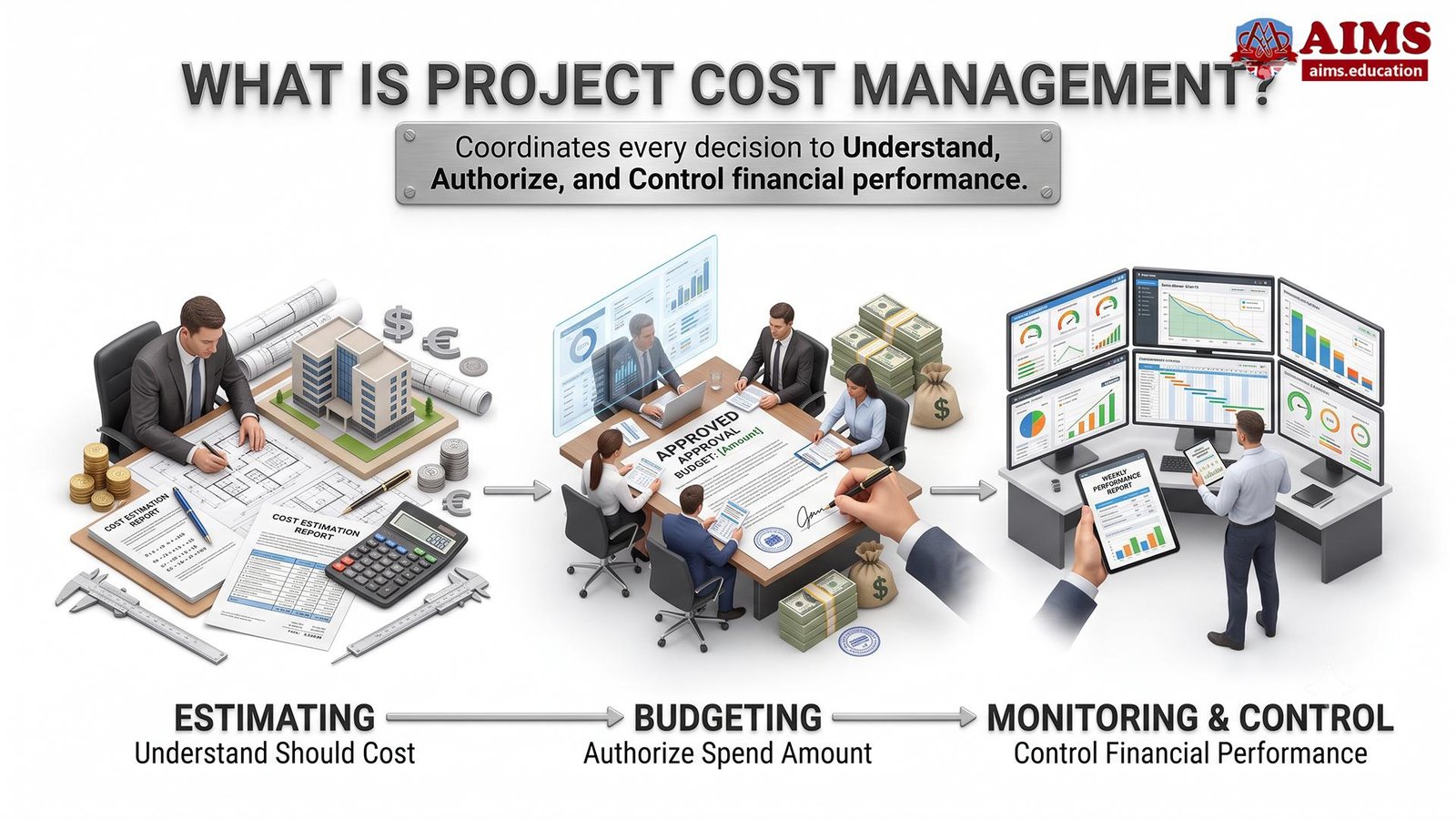
Project cost management coordinates every decision needed to understand what a project should cost, authorize how much may be spent, and control financial performance while the work is being delivered. It is not a single budgeting exercise. It is a continuous management system that links scope, time, resources, procurement, quality, risk, and change.
The central objective is to complete the agreed project work within the approved budget without creating hidden downstream costs. A project may appear financially successful because it met its initial budget, yet still generate excessive warranty work, defect correction, support effort, operational disruption, or rework. For this reason, reliable cost analysis considers the full project life cycle and the consequences of cost-related trade-offs.
Finishing within the initial budget does not prove cost success when deferred defects, support work, or rework were excluded.
International guidance on integrating scope, schedule, and cost performance is provided in ISO 21508 guidance for earned value management.
- What resources and activities will create project expenditure?
- How much is each activity, work package, and deliverable likely to cost?
- When will funding be required during the project schedule?
- How will actual performance be measured against the approved plan?
- What action should be taken when costs or forecasts move outside acceptable limits?
Importance of Cost Management in Project Management
Cost management in project management is important because a technically successful deliverable can still fail commercially when expenditure, cash flow, risk exposure, or financial benefits are poorly managed. Good cost management strengthens decision-making before money is committed and provides early warning after execution begins.
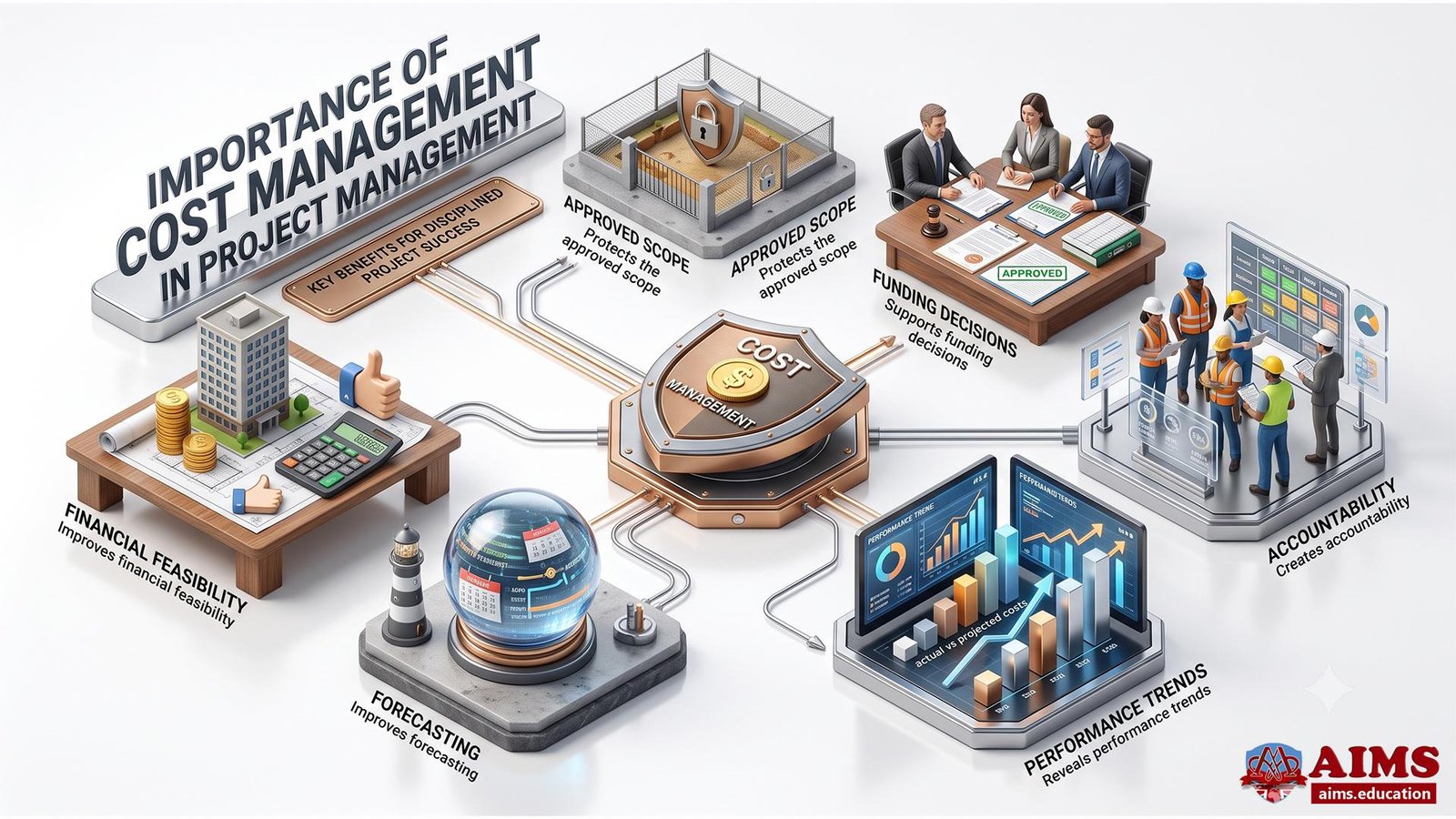
- It improves financial feasibility. Decision-makers can compare expected costs with benefits, funding limits, and strategic priorities before authorizing major commitments.
- It protects the approved scope. A credible budget reduces pressure to remove essential quality, testing, documentation, or risk-response work merely to create the appearance of savings.
- It supports funding decisions. A time-phased budget shows when cash is needed, not only the total amount required.
- It creates accountability. Work packages, control accounts, cost owners, thresholds, and reporting rules make financial responsibility visible.
- It reveals performance trends. Variances and indices show whether the project is becoming more or less cost-efficient over time.
- It improves forecasting. Current performance can be used to estimate the likely final cost before the project reaches completion.
Project Cost Management vs. Cost Control
Project cost management covers the complete financial management cycle, while cost control is the monitoring and corrective-action component within that wider cycle. Controlling costs does not simply mean cutting expenditure. It means protecting value by comparing approved plans with actual performance, understanding the cause of differences, forecasting the outcome, and processing necessary changes.
| COMPARISON AREA | PROJECT COST MANAGEMENT | PROJECT COST CONTROL |
|---|---|---|
| Scope | Covers planning, estimating, budgeting, funding, monitoring, forecasting, and control. | Focuses on measuring performance, managing variances, forecasting outcomes, and controlling approved changes. |
| Timing | Begins during early planning and continues throughout the project life cycle. | Becomes especially active after the cost baseline is approved and work performance data becomes available. |
| Main question | How should project money be planned, authorized, used, and governed? | Are current costs and forecasts acceptable, and what corrective action is required? |
| Typical outputs | Cost management plan, estimates, budget, cost baseline, funding requirements, forecasts, and updates. | Variance information, forecasts, change requests, corrective actions, and baseline updates after approval. |
Project Cost Management Process
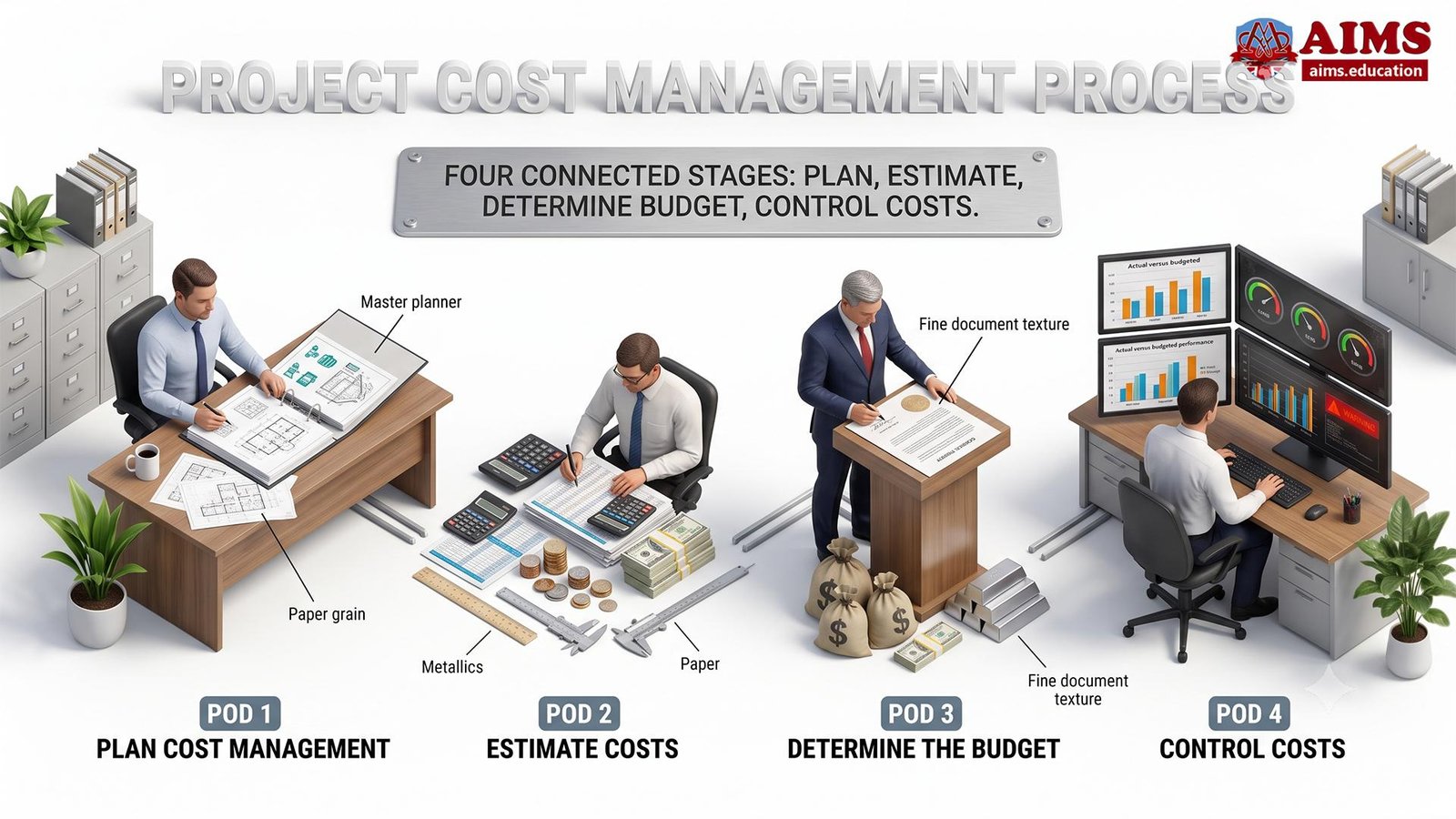
The project cost management process can be taught as four connected stages: plan cost management, estimate costs, determine the budget, and control costs. Some source materials concentrate on the three operational processes after the planning approach has been established. The four-stage model is useful because it makes the governing rules explicit before estimates and budgets are produced.
- Plan Cost Management: Define how costs will be estimated, structured, approved, measured, reported, and changed.
- Estimate Costs: Approximate the monetary resources required for activities, work packages, and deliverables.
- Determine the Budget: Aggregate approved estimates, allocate reserves, time-phase expenditure, and establish the authorized cost baseline.
- Control Costs: Monitor performance, analyze variances, forecast final results, and manage approved changes to the baseline.
| PROCESS | PRIMARY PURPOSE | KEY MANAGEMENT QUESTION | TYPICAL OUTPUT |
|---|---|---|---|
| Plan Cost Management | Establish the rules, methods, responsibilities, thresholds, and reporting approach. | How will project costs be governed? | Project cost management plan. |
| Estimate Costs | Calculate probable resource and activity costs using suitable data and techniques. | What is the work likely to cost? | Activity cost estimates and basis of estimates. |
| Determine the Budget | Aggregate and authorize costs across the schedule and funding periods. | How much may be spent, and when? | Cost baseline and funding requirements. |
| Control Costs | Compare planned and actual performance, forecast outcomes, and govern changes. | Are costs under control, and what action is needed? | Performance information, forecasts, and change requests. |
Project Cost Management Plan
A project cost management plan defines how project costs will be estimated, budgeted, measured, reported, controlled, and changed. It is a governance document rather than the budget itself. The resulting cost management plan ensures that estimators, work-package owners, finance personnel, sponsors, and project-control specialists use consistent rules.
What a Project Cost Management Plan Includes
A practical plan should address the following elements:
- Units of measure: Define whether resources will be measured in labour hours, days, material quantities, equipment hours, currencies, or other units.
- Level of precision and accuracy: State how estimates will be rounded, the expected range of uncertainty, and the confidence level appropriate to each project stage.
- Work breakdown and control accounts: Identify the WBS levels at which estimates, budgets, actual costs, and performance will be consolidated. Managers can strengthen this foundation by building a work breakdown structure that supports cost estimation.
- Estimating methods: Specify when analogous, parametric, bottom-up, three-point, vendor-bid, or other methods should be used.
- Cost categories: Explain how direct, indirect, fixed, variable, capital, operating, contingency, and management-reserve amounts will be treated.
- Control thresholds: Establish the variance or index levels that trigger investigation, escalation, corrective action, or formal change control.
- Performance measurement rules: Define how planned value, earned value, actual cost, cost variance, and performance indices will be calculated.
- Reporting arrangements: Set the reporting frequency, formats, data owners, cut-off dates, approval workflow, and stakeholder distribution.
- Funding and currency rules: Address funding limits, inflation assumptions, exchange rates, financing costs, tax treatment, and cash-flow timing where relevant.
- Risk and reserve rules: Explain how identified cost risks will be quantified and connected with project risk management and budget reserves.
- Change-control rules: Clarify who may approve budget changes and how approved changes will alter the cost baseline.
Example of a Project Cost Management Plan
Assume Horizon Learning Ltd. is developing an online training platform with an initial funding limit of $180,000. Its cost management plan could establish the following rules:
- The WBS work-package level will be the primary level for estimating and accountability.
- Labour will be estimated in hours using approved role-based rates.
- Vendor costs above $10,000 will require at least three comparable quotations.
- Known risk exposure will be assessed and supported through contingency reserves.
- A cost variance greater than 5 percent at a control account will require investigation.
- A forecasted final overrun above $9,000 will be escalated to the sponsor.
- Cost reports will be produced every two weeks using the same status date as schedule reporting.
- Only approved change requests may modify the cost baseline.
This plan makes cost decisions consistent, traceable, and actionable before financial pressure begins to influence project behaviour.
Types of Project Costs
The main types of project costs classify expenditure according to traceability, behaviour, timing, accounting treatment, and risk. A single cost may belong to several categories. For example, a specialist contractor’s fee may be direct, variable, externally procured, and recurring during a particular phase.
The search phrase direct cost project management generally refers to identifying and controlling expenditure that can be traced to a specific activity, work package, deliverable, or project objective. Direct costs often provide clearer accountability than overhead allocations, but both direct and indirect costs must be treated consistently.
| COST TYPE | DEFINITION | PROJECT EXAMPLE | MANAGEMENT IMPLICATION |
|---|---|---|---|
| Direct cost | A cost that can be traced to a particular project activity, work package, or deliverable. | Developer hours, construction materials, equipment hire, or a project-specific vendor. | Assign the cost to the responsible work package and cost account. |
| Indirect cost | A shared cost that cannot be economically traced to one project alone. | Office rent, shared administration, utilities, or departmental management. | Apply a consistent and documented allocation method. |
| Fixed cost | A cost that remains stable within a relevant range of project activity. | A fixed-price design contract or software licence fee. | Confirm assumptions, exclusions, and change conditions in the agreement. |
| Variable cost | A cost that changes with usage, volume, duration, or output. | Cloud consumption, units of material, travel days, or hourly labour. | Use credible quantity drivers and monitor actual consumption. |
| Recurring cost | A cost incurred repeatedly during the project or operational transition. | Monthly platform hosting, equipment rental, or temporary facilities. | Align recurrence with the schedule and forecast duration changes. |
| Non-recurring cost | A one-time cost associated with a particular event or acquisition. | Initial setup, specialist testing, mobilisation, or a one-off permit. | Confirm the event, timing, approval, and responsible owner. |
| Contingency reserve | Budget allocated for identified uncertainty and known risk exposure. | Allowance for probable rework, price volatility, or quantified schedule risk. | Link the reserve to identified risks and define release authority. |
| Management reserve | Funding held for unforeseen work within project scope but outside the approved cost baseline. | An allowance controlled by senior management for unanticipated conditions. | Use formal authorization before transferring it into the baseline. |
Example of Direct and Indirect Project Costs
Suppose Atlas Engineering is installing a production-control system:
- The dedicated engineer’s labour is a direct cost because it can be traced to the installation work package.
- The purchased control hardware is a direct cost assigned to the equipment work package.
- The company’s shared finance department is an indirect cost allocated across several projects.
- The office lease is an indirect overhead unless a separate project facility is rented exclusively for the work.
- A fixed vendor installation fee is direct and fixed, while hourly commissioning support is direct and variable.
This classification helps managers assign accountability, choose estimating methods, and prevent overhead from disappearing inside unexplained allowances.
Project Cost Estimation
Project cost estimation is the process of approximating the monetary resources required to complete project activities, work packages, deliverables, and supporting obligations. The estimate should include more than visible labour and materials. It may also require equipment, services, facilities, financing, inflation, currency effects, quality work, risk responses, warranty support, licences, compliance, and contingency.
Reliable estimates begin with a clear scope and sufficient schedule and resource information. They also state the assumptions, constraints, confidence level, range, data sources, and method used. An estimate expressed as $50,000 plus or minus 10 percent communicates uncertainty more honestly than an unsupported single-point figure.
Inputs Needed to Estimate Project Costs
The most useful estimating inputs include:
- Scope baseline: The scope statement, WBS, and WBS dictionary identify deliverables, boundaries, assumptions, constraints, and work packages.
- Project schedule: Activity timing and duration influence labour, equipment, facilities, escalation, and recurring costs.
- Resource requirements and staffing information: Quantities, capabilities, rates, calendars, recognition arrangements, and availability affect the estimate.
- Risk information: Identified threats and opportunities indicate whether risk-response costs or contingency should be included.
- Market conditions: Availability, supplier terms, commercial rates, inflation, and procurement conditions influence resource pricing.
- Historical information: Similar completed projects, lessons learned, templates, and actual cost records improve realism when appropriately adjusted.
- Contracts and policies: Contract terms, accounting rules, estimating standards, and organizational procedures shape the approved approach.
Project Cost Management Techniques for Estimation
The most useful project cost management techniques combine expert knowledge, historical evidence, quantitative relationships, detailed work-package analysis, risk adjustment, and market validation. No single technique is best in every situation. Early estimates often use faster top-down methods, while later estimates can use detailed bottom-up calculations.
| ESTIMATING TECHNIQUE | HOW IT WORKS | BEST USE | MAIN LIMITATION |
|---|---|---|---|
| Expert judgement | Uses informed assessment from people with relevant technical, commercial, or project experience. | Novel work, ambiguous assumptions, and validation of other estimates. | Can be biased or inconsistent without evidence and documented assumptions. |
| Analogous estimating | Uses the actual cost of a similar past project and adjusts for size, complexity, timing, and conditions. | Early-stage estimates when detailed information is limited. | Accuracy depends on genuine comparability and sound adjustment. |
| Parametric estimating | Multiplies a measurable quantity by a validated unit rate or statistical relationship. | Repeatable work such as cost per square metre, test case, user, kilometre, or labour hour. | Weak parameters or outdated rates produce misleading precision. |
| Bottom-up estimating | Estimates individual activities or components and aggregates them through work packages and control accounts. | Detailed planning when the scope and WBS are sufficiently developed. | Time-consuming and vulnerable to omitted work or inconsistent detail. |
| Three-point estimating | Uses optimistic, most likely, and pessimistic values to reflect uncertainty. | Risk-sensitive activities with a meaningful range of possible outcomes. | Inputs may still reflect subjective judgement. |
| Reserve analysis | Quantifies allowance for uncertainty and identified risk exposure. | Projects with material technical, schedule, price, or delivery risk. | Unexplained percentage additions can become hidden padding. |
| Cost of quality | Considers prevention, appraisal, and failure-related costs required to meet quality expectations. | Work where testing, inspection, defects, warranty, or rework can materially affect total cost. | Teams may underestimate downstream failure costs. |
| Vendor bid analysis | Compares supplier quotations, assumptions, scope coverage, commercial terms, and risk allocation. | Externally procured goods and services. | The cheapest bid may omit scope or transfer risk back to the buyer. |
| Estimating software | Uses spreadsheets, databases, simulation, rate libraries, or integrated platforms to calculate and test alternatives. | Large data sets, scenarios, repeated calculations, and rapid updates. | Automation cannot correct weak scope, assumptions, or source data. |
Bottom-Up Project Cost Estimation Example
Nova Digital is estimating a customer-service portal. The team estimates each work package before aggregating the total:
- Requirements and design require 140 hours at $50 per hour, producing an estimated cost of $7,000.
- Development requires 420 hours at $65 per hour, producing an estimated cost of $27,300.
- Testing requires 160 hours at $45 per hour, producing an estimated cost of $7,200.
- Security review and licences add $5,500.
- Training and deployment add $4,000.
- Quantified contingency for identified risks adds $4,500.
The bottom-up estimate is therefore $55,500. The basis of estimates should record rates, quantities, exclusions, assumptions, reserve logic, and confidence ranges.
This detailed estimate improves traceability because each amount can be challenged, updated, assigned, and compared with actual performance.
Estimate Costs Outputs
The Estimate Costs process normally produces three practical results:
- Activity cost estimates: Quantitative assessments of probable costs for labour, materials, equipment, services, facilities, technology, financing, inflation, currency exposure, and contingency where applicable.
- Basis of estimates: Supporting detail that explains the method, assumptions, constraints, data, exclusions, accuracy range, and confidence level.
- Project document updates: Revisions to risk information, schedules, assumptions, resource requirements, and other records affected by the estimate.
Project Cost Budgeting and the Cost Baseline
Project cost budgeting converts approved estimates into an authorized, time-phased financial plan against which performance can be measured. This is the point where separate activity and work-package estimates are aggregated, aligned with the schedule, reconciled with funding limits, and organized into a cost baseline.
The wider discipline of project budgeting and cost control depends on a clear distinction between an estimate, a budget, and a baseline. Confusing these terms can produce false approvals, weak accountability, and misleading variance reports.
Cost Estimate Versus Project Budget
| FEATURE | COST ESTIMATE | PROJECT BUDGET |
|---|---|---|
| Meaning | A forecast of the probable monetary resources required to complete defined work. | The authorized financial provision approved for project execution and governance. |
| Status | May remain preliminary, comparative, ranged, or subject to refinement. | Represents an approved limit, usually governed through formal authority. |
| Structure | Often developed by activity, resource, work package, or deliverable. | Aggregated through control accounts and time-phased across the schedule and funding periods. |
| Use | Supports option evaluation, planning, negotiation, and budget preparation. | Authorizes spending, supports cash-flow planning, and establishes financial accountability. |
| Change treatment | Refined as information improves. | Changed only through approved governance and change-control procedures. |
Inputs Used to Determine the Project Budget
Budget development draws on the following information:
- Activity and work-package cost estimates.
- The basis of estimates, including assumptions about indirect costs and reserves.
- The scope baseline and WBS control-account structure.
- The schedule, milestones, start dates, finish dates, and expenditure timing.
- Resource calendars that show when people, equipment, and facilities are required.
- Contracts and procurement commitments.
- Organizational budgeting policies, reporting methods, templates, and approval limits.
Budgeting Techniques
- Cost aggregation: Sum activity estimates into work packages, control accounts, major deliverables, and the total project.
- Reserve analysis: Determine appropriate contingency for identified uncertainty and management reserve for unforeseen work within scope.
- Expert judgement: Validate allocations, assumptions, funding timing, and commercial realism.
- Historical relationships: Use reliable analogous or parametric relationships to check total project costs.
- Funding limit reconciliation: Adjust timing or work sequencing when planned expenditure exceeds available funding during a period.
What Is a Project Cost Baseline?
A project cost baseline is the approved, time-phased budget used to measure and control cost performance. It distributes authorized expenditure across activities, work packages, control accounts, and calendar periods. Because spending is cumulative, the baseline is often presented as an S-curve: slow expenditure during mobilization, faster spending during execution, and a slower rate near completion.
A useful professional distinction is that contingency reserves for identified risks are generally included in the cost baseline, while management reserve is held outside the baseline but within the overall project budget. When management reserve is authorized for specific work, the approved amount is transferred through change control and the baseline is updated.
Cost Baseline, Project Budget, and Funding Requirements
- Cost baseline: The approved time-phased performance budget used for measurement.
- Project budget: The cost baseline plus management reserve and any other formally authorized budget components.
- Funding requirements: The timing and amount of money needed to meet planned expenditure, liabilities, and approved reserve releases.
Example of a Time-Phased Project Budget
Suppose Meridian Services has an approved cost baseline of $120,000 for a six-month implementation:
- Month 1 requires $12,000 for design, mobilization, and initial licences.
- Month 2 requires a cumulative $30,000 as configuration begins.
- Month 3 requires a cumulative $58,000 as development activity accelerates.
- Month 4 requires a cumulative $86,000 during integration and testing.
- Month 5 requires a cumulative $108,000 for deployment and training.
- Month 6 reaches the $120,000 baseline after closure and acceptance work.
The organization also holds a $10,000 management reserve, making the total project budget $130,000. Funding may be released monthly even though authorization covers the complete project.
Time-phasing connects the budget with the schedule, allowing managers to detect both financial variance and cash-flow pressure early.
Project Cost Control
Project cost control is the process of monitoring financial performance, updating cost information, forecasting final expenditure, and managing approved changes to the cost baseline. Effective control identifies why a variance exists and whether it reflects timing, productivity, price, scope, quality, risk, error, or an authorized change.
Core Responsibilities in Cost Control
- Influence the factors that could create unauthorized cost changes.
- Ensure that change requests are reviewed and resolved promptly.
- Prevent expenditure from exceeding authorized funding without approval.
- Compare actual cost and earned value with the approved cost baseline.
- Understand the causes and consequences of cost and schedule variances.
- Monitor the relationship between physical progress and funds expended.
- Forecast the final cost and bring potential overruns within acceptable limits.
- Communicate performance information to sponsors, finance teams, work-package owners, and other stakeholders.
Inputs to the Control Costs Process
- Cost baseline: Provides the approved reference for comparison with actual and earned performance.
- Funding requirements: Show planned expenditures, timing, liabilities, and available funding.
- Work performance data: Identifies completed work, progress, authorized costs, incurred costs, and deliverable status.
- Cost management plan: Defines thresholds, measurement rules, reporting requirements, and control authority.
- Organizational process assets: Include control procedures, reporting standards, templates, data systems, and lessons learned.
Project Cost Management Techniques for Control
Cost control commonly uses earned value analysis, forecasting, the to-complete performance index, performance reviews, trend analysis, variance analysis, and project-management systems. Teams should select tools that fit project complexity rather than creating reports that are more sophisticated than the underlying data.
Digital tools can automate calculations, compare versions, consolidate actual costs, and display trends. However, managers must still verify data quality, cut-off dates, accruals, scope alignment, and coding. A practical starting point is selecting project management software that supports cost and performance reporting.
Planned Cost Versus Actual Cost
Planned cost represents the approved budget for work scheduled by the status date, while actual cost records what has been incurred for work performed by that date. Comparing planned cost directly with actual cost can be misleading because it ignores how much work was actually completed. Earned value adds that missing dimension.
| MEASURE | QUESTION ANSWERED | INTERPRETATION |
|---|---|---|
| Planned Value | How much budgeted work should have been completed by the status date? | The authorized value of scheduled work. |
| Earned Value | How much budgeted value has actually been completed? | The approved budget value of performed work. |
| Actual Cost | How much has the completed work actually cost? | The expenditure incurred for performed work. |
Earned Value Management for Project Cost Control
Earned value management integrates scope, schedule, and cost data to measure how much planned value has been produced for the money spent. It provides a more reliable view than comparing the budget with expenditure alone because it also considers physical progress.
Three Core Earned Value Measures
- Planned Value (PV): The authorized budget assigned to work scheduled for completion by the measurement date.
- Earned Value (EV): The authorized budget value of work actually completed by the measurement date.
- Actual Cost (AC): The cost actually incurred for the work completed by the measurement date.
At an interim status date, earned value may be higher than planned value when the project is ahead of schedule. For an unchanged total scope, cumulative earned value cannot exceed the budget at completion.
Cost and Schedule Variance Formulas
Cost variance measures whether completed work has cost more or less than its budgeted value. Schedule variance measures whether the budgeted value of completed work is ahead of or behind the planned value at the status date.
- Cost Variance: CV = EV – AC. A positive result is favourable; a negative result indicates that completed work has cost more than its budgeted value.
- Schedule Variance: SV = EV – PV. A positive result indicates progress ahead of plan; a negative result indicates progress behind plan in value terms.
Performance Index Formulas
The cost performance index measures the cost efficiency of completed work, while the schedule performance index measures progress efficiency against plan.
- Cost Performance Index: CPI = EV / AC. A CPI above 1.00 is favourable; a CPI below 1.00 indicates cost inefficiency.
- Schedule Performance Index: SPI = EV / PV. An SPI above 1.00 indicates progress ahead of plan; an SPI below 1.00 indicates progress behind plan.
These metrics should be interpreted with context. A favourable CPI may result from genuine productivity, delayed invoices, omitted accruals, incomplete quality work, or underreported progress. Managers should investigate the cause rather than celebrating a number automatically. Linking financial measures with well-designed project management KPIs creates a broader performance view.
Forecasting Final Project Cost
Cost forecasting estimates the probable final expenditure by combining actual performance with assumptions about the remaining work. The appropriate formula depends on whether past variance is expected to continue and whether the remaining work will be re-estimated.
| MEASURE | FORMULA | PURPOSE |
|---|---|---|
| Cost Variance | CV = EV – AC | Shows whether completed work is under or over its budgeted cost. |
| Schedule Variance | SV = EV – PV | Shows whether earned progress is ahead of or behind planned progress. |
| Cost Performance Index | CPI = EV / AC | Measures cost efficiency for completed work. |
| Schedule Performance Index | SPI = EV / PV | Measures schedule efficiency in value terms. |
| Estimate at Completion | EAC = AC + bottom-up ETC | Uses a fresh estimate of remaining work when the original assumptions are no longer reliable. |
| Estimate at Completion | EAC = AC + BAC – EV | Assumes remaining work will be completed at the original budgeted rate. |
| Estimate at Completion | EAC = BAC / CPI | Assumes current cost efficiency will continue for the remaining work. |
| Estimate to Complete | ETC = EAC – AC | Forecasts the additional money required from the status date to completion. |
| Variance at Completion | VAC = BAC – EAC | Shows the forecasted final under-run or overrun against the approved budget. |
| To-Complete Performance Index | TCPI = (BAC – EV) / (BAC – AC) | Shows the cost efficiency required on remaining work to achieve the original BAC. |
| To-Complete Performance Index | TCPI = (BAC – EV) / (EAC – AC) | Shows the cost efficiency required on remaining work to achieve an approved EAC. |
Worked Project Cost Management Example
Among practical project cost management examples, consider Northstar Ltd., which is delivering a twelve-month system implementation with a Budget at Completion of $100,000. At the six-month status date, the plan expected 50 percent completion, actual completion is 40 percent, and actual expenditure is $60,000.
- Calculate Planned Value. PV = 50 percent of $100,000 = $50,000.
- Calculate Earned Value. EV = 40 percent of $100,000 = $40,000.
- Record Actual Cost. AC = $60,000.
- Calculate Cost Variance. CV = $40,000 – $60,000 = -$20,000. The project is over budget for the work completed.
- Calculate Schedule Variance. SV = $40,000 – $50,000 = -$10,000. The project is behind planned progress.
- Calculate CPI. CPI = $40,000 / $60,000 = 0.67. The project is earning approximately $0.67 of budgeted value for every $1.00 spent.
- Calculate SPI. SPI = $40,000 / $50,000 = 0.80. Progress is occurring at 80 percent of the planned value rate.
- Forecast EAC if cost efficiency continues. EAC = $100,000 / 0.67 = approximately $149,254.
- Calculate VAC. VAC = $100,000 – $149,254 = approximately -$49,254.
The project manager should not react by cutting expenditure blindly. The team should identify whether the problem comes from poor productivity, underestimated effort, scope growth, defects, procurement prices, resource capability, or incorrect progress measurement. Corrective action should address the cause and protect the required outcomes.
The worked calculation converts cost data into an early forecast, allowing management to act before the remaining budget is exhausted.
How to Manage Project Costs Step by Step
The practical answer to how to manage project costs is to connect scope definition, estimating discipline, funding decisions, performance measurement, forecasting, and controlled change in one repeatable cycle. The following sequence can be scaled for small, medium, or complex projects.
- Define the complete project scope. Clarify deliverables, acceptance criteria, exclusions, assumptions, constraints, and required supporting work.
- Build the WBS and assign cost ownership. Decompose deliverables into manageable work packages and identify responsible managers or teams.
- Identify resources and cost categories. Determine labour, materials, equipment, services, facilities, procurement, compliance, quality, financing, and risk-related needs.
- Select appropriate estimating methods. Match analogous, parametric, bottom-up, three-point, vendor-bid, or other methods to the available information.
- Document the basis of estimates. Record quantities, rates, assumptions, exclusions, ranges, data sources, confidence, and reserve logic.
- Aggregate estimates into the budget. Consolidate activity estimates through work packages and control accounts.
- Time-phase the cost baseline. Align planned expenditure with activity dates, milestones, procurement timing, and resource calendars.
- Reconcile the plan with funding limits. Confirm that required cash is available when commitments and expenditure will occur.
- Measure cost and progress consistently. Use common status dates, reliable actual costs, accruals, physical progress rules, and earned value where suitable.
- Analyze variance and forecast completion. Examine the cause, impact, trend, EAC, ETC, VAC, and required future efficiency.
- Take proportionate corrective action. Improve productivity, resequence work, renegotiate procurement, resolve defects, clarify scope, or adjust resources according to evidence.
- Control changes and update records. Use formal change management within the project environment so only approved changes alter the baseline.
- Capture lessons learned. Compare estimates with actual results and preserve rate, productivity, risk, and supplier information for future projects.
Common Cost-Control Decision Logic
When a variance appears, the project manager should move through a clear decision sequence:
- Confirm that the data is complete, correctly coded, and aligned to the same status date.
- Determine whether the variance is caused by timing or represents a genuine performance problem.
- Identify the affected work package, resource, supplier, assumption, risk, or change.
- Assess whether the variance is recoverable and whether it will continue.
- Update the forecast before selecting corrective action.
- Evaluate consequences for scope, schedule, quality, risk, benefits, and stakeholders.
- Implement corrective action within authority or submit a formal change request.
- Track whether the action improves the next reporting period’s trend.
Project Cost Overrun: Causes and Prevention
A project cost overrun occurs when actual or forecasted expenditure exceeds the authorized budget or cost baseline for the relevant work. Overruns are usually symptoms of deeper problems rather than isolated accounting events. Preventing them requires better assumptions, scope discipline, risk management, progress measurement, and decision speed.
| COMMON CAUSE | EARLY WARNING SIGN | PREVENTIVE OR CORRECTIVE RESPONSE |
|---|---|---|
| Incomplete scope | Repeated clarification, missing deliverables, and unplanned activities. | Improve requirements, WBS detail, acceptance criteria, and scope validation before commitment. |
| Optimistic estimates | Single-point estimates with weak evidence and no uncertainty range. | Use reference-class data, three-point estimates, bottom-up validation, and documented assumptions. |
| Uncontrolled change | Extra work begins before cost and schedule impacts are approved. | Enforce change authority, impact analysis, baseline control, and traceable decisions. |
| Low productivity | Actual hours rise faster than completed work. | Investigate capability, workflow, dependencies, tools, supervision, and rework. |
| Quality failure | Defects, retesting, rejected deliverables, warranty issues, or repeated correction. | Invest in prevention, clear standards, early reviews, testing, and root-cause correction. |
| Procurement weakness | Ambiguous bids, exclusions, claims, price escalation, or supplier delay. | Compare complete commercial offers, define scope, allocate risk, and monitor commitments. |
| Risk underestimation | Frequent surprises with no funded response. | Quantify exposure, assign owners, fund responses, and review reserves regularly. |
| Weak cost data | Late invoices, missing accruals, inconsistent codes, or disputed progress. | Set data cut-offs, coding rules, accrual procedures, and progress-measurement standards. |
| Schedule delay | Extended labour, facilities, equipment rental, financing, or overhead duration. | Analyze critical activities, remove constraints, and evaluate the cost of acceleration versus delay. |
Misconceptions That Weaken Cost Management
- A cost estimate is not the approved budget. Estimates predict probable cost; budgets authorize financial provision.
- Cost control is not the whole discipline. It is one component of planning, estimating, budgeting, funding, and governance.
- Cutting cost does not always improve cost performance. Removing design, testing, documentation, or risk work may create larger downstream costs.
- Spending less than planned is not automatically favourable. The project may also have completed less work than planned.
- A detailed spreadsheet is not proof of estimate quality. Accuracy depends on scope, assumptions, evidence, and professional judgement.
- Reserves are not hidden profit or casual spending allowances. They require defined purposes, ownership, monitoring, and authorization.
Professional Relevance of Cost Management in Project Management
Cost management competence enables professionals to translate technical progress into financially credible decisions. It is relevant to project managers, project controllers, cost engineers, planners, estimators, finance teams, procurement specialists, PMOs, sponsors, and portfolio decision-makers.
Project managers do not need to perform every specialist calculation personally, but they must understand the estimating process, challenge assumptions, integrate cost with scope and schedule, interpret performance, and communicate forecasts. Those developing broader capability can explore career-focused online project management certification courses or progress toward advanced
online diploma in project management study.
At portfolio level, reliable project forecasts allow leaders to compare investment needs, funding pressure, expected value, risk exposure, and strategic priority. Weak project estimates do the opposite: they make underfunded projects look attractive and delay difficult decisions until much of the budget has already been committed.
Conclusion: Project Cost Management Without Sacrificing Value
Successful project cost management combines disciplined planning with timely evidence-based control. The project manager must define cost rules, estimate complete life-cycle requirements, authorize a time-phased budget, measure physical progress against expenditure, forecast the likely final outcome, and manage changes through formal governance.
The strongest approach does not treat cost as an isolated accounting figure. It connects money with scope, schedule, quality, risk, procurement, and benefits. When teams understand why a variance exists and act before it becomes irreversible, cost control protects both the approved budget and the value the project was created to deliver.
Frequently Asked Questions
What is project cost management?
Project cost management is the process of planning, estimating, budgeting, funding, monitoring, and controlling project expenditure. Its purpose is to complete the approved scope within an authorized budget while maintaining reliable financial forecasts and governing changes to the cost baseline.
Why is project cost management important?
It helps organizations assess feasibility, allocate funding, control commitments, identify financial problems early, forecast final expenditure, and protect project value. Without it, teams may underestimate resources, hide downstream costs, approve unrealistic budgets, or discover overruns too late for effective corrective action.
What are the four processes of project cost management?
The four commonly taught processes are Plan Cost Management, Estimate Costs, Determine the Budget, and Control Costs. Some learning materials focus mainly on the last three operational processes after the overall cost-management approach has already been established.
What is included in a project cost management plan?
A project cost management plan normally defines estimating methods, units, accuracy, WBS control levels, cost categories, reserve rules, performance measures, variance thresholds, reporting arrangements, funding assumptions, approval authority, and the process for changing the cost baseline.
How do project managers estimate project costs?
Project managers coordinate estimates using scope, schedule, resources, market rates, risk data, contracts, and historical information. Common methods include analogous, parametric, bottom-up, three-point, expert judgement, reserve analysis, cost-of-quality analysis, vendor bids, and estimating software.
What is the difference between cost estimation and cost budgeting?
Cost estimation predicts the probable cost of activities and resources. Cost budgeting aggregates and authorizes those estimates, allocates reserves, aligns expenditure with the schedule, reconciles funding limits, and establishes the time-phased cost baseline used for performance measurement.
What is the difference between project cost management and cost control?
Project cost management covers the full cycle of planning, estimating, budgeting, funding, forecasting, and controlling costs. Cost control is the narrower process of measuring financial performance, analyzing variances, forecasting outcomes, taking corrective action, and managing approved baseline changes.
What is a project cost baseline, and how is it used?
A project cost baseline is the approved time-phased budget used to measure cost performance. Managers compare planned value, earned value, and actual cost against it, analyze variances, forecast completion costs, and update it only when authorized changes are approved.
How does earned value management help control project costs?
Earned value management compares planned value, earned value, and actual cost. It shows whether completed work is cost-efficient and whether progress is ahead of or behind plan. It also supports forecasts such as estimate at completion and variance at completion.
What are the main types of project costs?
Common types include direct and indirect costs, fixed and variable costs, recurring and non-recurring costs, labour, materials, equipment, services, facilities, financing, quality-related costs, contingency reserves, and management reserves. The categories may overlap depending on the accounting and control purpose.
What causes project cost overruns, and how can they be prevented?
Common causes include incomplete scope, optimistic estimates, uncontrolled changes, low productivity, defects, supplier problems, schedule delay, weak data, and underestimated risks. Prevention depends on realistic assumptions, detailed planning, risk funding, disciplined change control, reliable progress measurement, and prompt corrective action.
What is a simple example of project cost management?
A team may estimate a software project at $100,000, distribute that amount across six months, and approve it as the cost baseline. At each status date, the manager compares completed work with planned value and actual expenditure, then updates the forecast and addresses any variance.
About AIMS’ Project Management Academy
Since 2005, AIMS’ Project Management Academy has delivered internationally accredited, career-focused education to learners worldwide. Its internationally standardized curriculum is taught by qualified faculty through industry-oriented instruction, practical skill development, 3D interactive learning content, and qualifications built around real-world case studies. This educational resource, together with AIMS’ study content and curricula, is collaboratively developed and rigorously peer-reviewed by an academic board of qualified industry practitioners. Cost-management knowledge strengthens professional planning and control competence. Explore AIMS’ accredited and career-focused project management programs.