
Agile vs Waterfall vs Hybrid compares three project delivery approaches: Waterfall emphasizes predictable sequential delivery, Agile emphasizes adaptive and iterative delivery, while Hybrid combines selected predictive and adaptive practices according to the needs of the project.
The best choice depends on requirement stability, governance needs, stakeholder involvement, delivery cadence, risk, and how much change the project must absorb. In practice, there is no universally superior approach. This comparison explains how Agile project management, Waterfall project management, and hybrid project management work, where their strengths and limitations differ, and how project managers can select an approach that fits the work rather than forcing every project into the same model.
The three approaches can be understood as follows:
- Agile: Work develops iteratively, with frequent stakeholder feedback and the ability to respond to changing requirements.
- Waterfall: Work progresses through planned phases, with requirements and major deliverables defined as clearly as possible before execution.
- Hybrid: Different parts of the project use different levels of predictive structure and adaptive delivery according to uncertainty, governance, dependencies, and stakeholder needs.
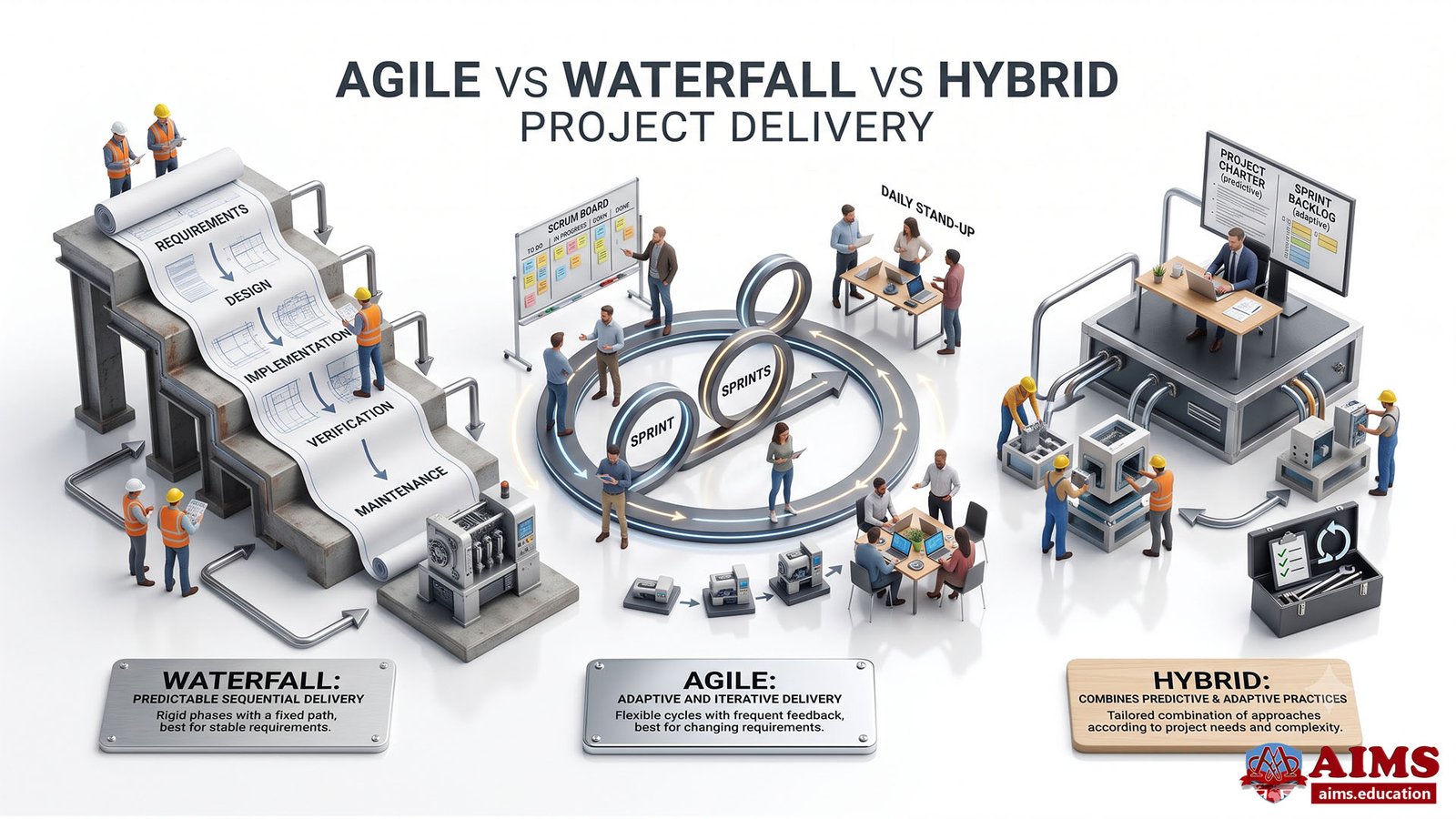
Agile and Waterfall methodologies are sometimes presented as opposing choices. In reality, project managers can select from a wider range of project management methodologies and selection criteria and tailor their way of working to the project environment.
| COMPARISON AREA | AGILE | WATERFALL | HYBRID |
|---|---|---|---|
| Planning | Planning evolves as the team learns more about the product and stakeholder needs. | Detailed planning is concentrated toward the beginning of the project. | High-level planning may be predictive while selected work is planned iteratively. |
| Requirements | Requirements can evolve throughout delivery. | Requirements should be relatively stable and well understood. | Some requirements can remain fixed while others are allowed to evolve. |
| Delivery | Value is commonly delivered through short iterations or increments. | Major deliverables usually follow planned phases or a defined sequence. | Delivery can combine milestones with iterative releases or work packages. |
| Change | Change is expected and incorporated through reprioritization and feedback. | Changes are controlled carefully because late changes can disrupt the established plan. | Change is flexible in selected areas while controlled more formally in others. |
| Stakeholder Involvement | Frequent stakeholder interaction is normally important. | Stakeholders are heavily involved at key planning, approval, review, and acceptance points. | Stakeholder involvement varies by workstream and level of uncertainty. |
| Documentation | Documentation is sufficient to support delivery, collaboration, control, and future use. | Documentation is often more extensive because requirements and approvals are established formally. | Documentation is tailored according to governance and delivery needs. |
| Flexibility | High when teams can continuously adapt priorities and requirements. | Lower when scope and sequencing have been established in advance. | Selective flexibility is introduced where it creates value. |
| Best Suited To | Evolving products, uncertain requirements, innovation, and feedback-intensive work. | Stable requirements, predictable dependencies, fixed deliverables, and strongly governed work. | Projects containing both stable and uncertain elements or requiring governance alongside iterative delivery. |
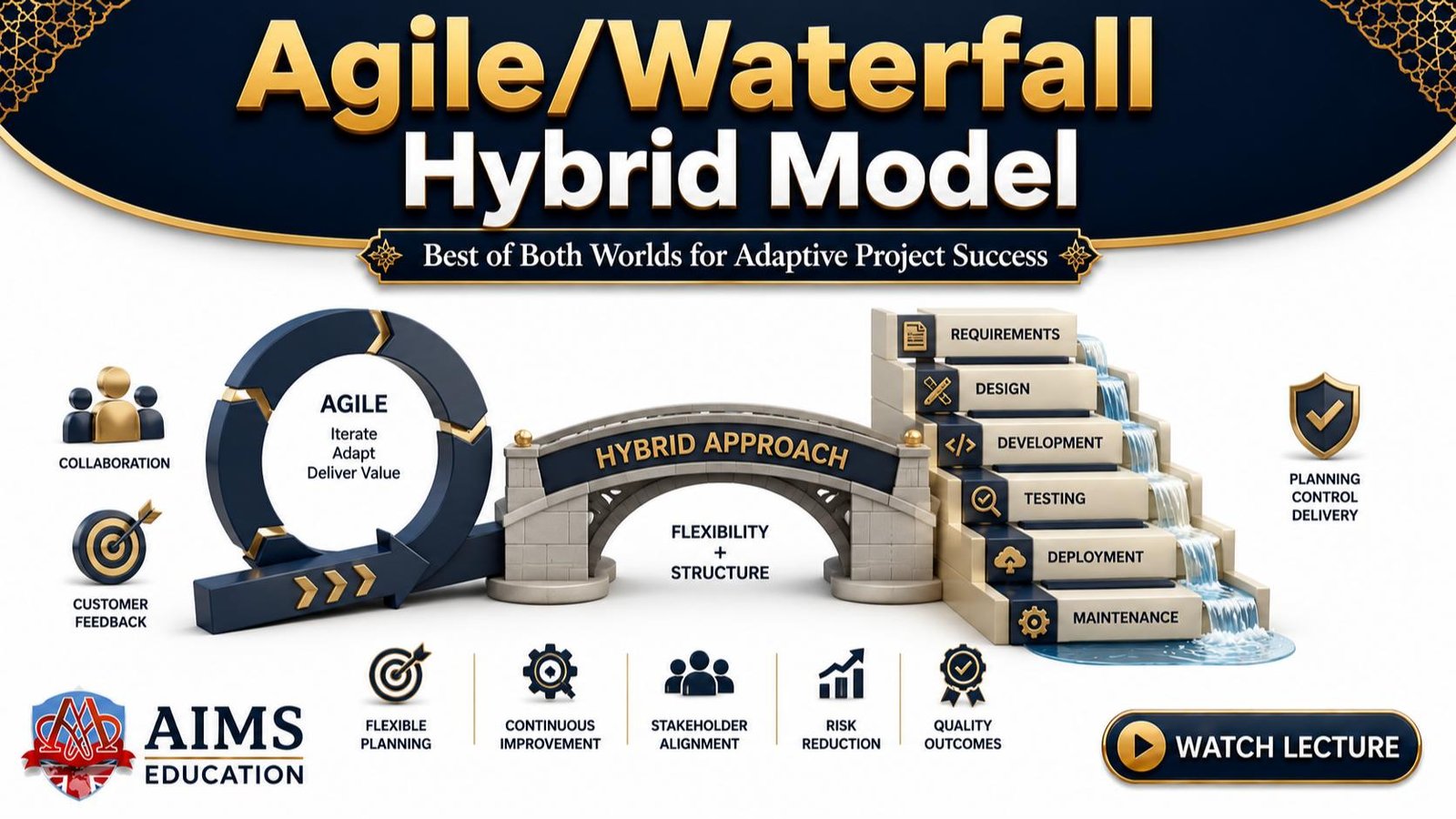
What Is Agile Project Management?
Agile project management is an adaptive approach in which teams develop solutions iteratively, gather frequent feedback, and adjust priorities as requirements and conditions change.
Rather than attempting to define every detail at the beginning, Agile encourages teams to learn through delivery. Work is commonly divided into smaller increments, allowing useful results to be reviewed before the entire solution is complete.
Key characteristics include:
- The team breaks complex work into smaller, manageable increments.
- Stakeholders provide regular feedback on evolving outputs.
- The team can reprioritize work when requirements, risks, or business conditions change.
- Planning continues throughout delivery rather than occurring only at the beginning.
- Cross-functional collaboration supports faster problem solving and decision-making.
Agile is not one single methodology. It represents a broader adaptive way of working supported by practices and frameworks such as Scrum and Kanban. If you want a deeper foundation, you can explore how Agile project management works in practice.
Agile Project Management Example
Suppose a company called NovaTech is developing a customer mobile application, but customers’ preferred features are still uncertain.
- The team identifies the highest-priority features for an initial release.
- Developers complete selected features during short iterations.
- Users test early versions and provide feedback.
- The product owner reprioritizes future work based on feedback and business value.
- The team continues improving the application through additional increments.
The iterative approach allows NovaTech to learn from users before committing resources to features that may provide limited value.
What Is Waterfall Project Management?
Waterfall project management is a predominantly sequential and predictive approach in which the project progresses through planned phases based on requirements defined as clearly as possible in advance.
Unlike the original idea that Waterfall is a recursive process, its defining characteristic is sequence. Requirements, design, implementation, testing, deployment, or equivalent project stages generally follow an established order, although real projects may still include reviews and approved changes.
Waterfall is particularly useful when:
- The project requirements are stable and unlikely to change substantially.
- Major dependencies require work to proceed in a defined sequence.
- Contracts, regulations, or governance processes require formal documentation and approvals.
- Project outputs can be specified with reasonable confidence before execution begins.
- Late changes would create significant cost, disruption, or technical rework.
The approach is closely associated with linear and sequential project management planning, although project managers should still monitor assumptions and respond appropriately when circumstances change.
Waterfall Project Management Example
Consider NorthBridge Construction, which is delivering a warehouse based on approved architectural drawings and regulatory requirements.
- The organization establishes the scope, design specifications, schedule, and budget.
- Required approvals are obtained before major construction activities begin.
- Foundation work is completed before dependent structural work proceeds.
- Construction follows the approved sequence and technical specifications.
- Inspection and final acceptance occur against predefined requirements.
Because major dependencies and specifications are known early, sequential planning provides strong coordination and control.
What Is Hybrid Project Management?
Hybrid project management is a tailored approach that deliberately combines predictive and adaptive practices so that different parts of a project can be managed according to their level of certainty, complexity, and need for flexibility.
This hybrid project management methodology should not be understood as simply using 50 percent Agile and 50 percent Waterfall. There is no single universal Hybrid framework. Instead, project managers determine which practices should remain structured and predictive and which areas benefit from iterative development, frequent feedback, or evolving requirements.
For example, a Hybrid project might use:
- Predictive budgeting, procurement, contractual milestones, and regulatory approvals.
- Adaptive product development, prototyping, testing, or customer-facing design.
- Formal governance at project level combined with iterative delivery within individual teams.
- Fixed completion dates while allowing selected features to be reprioritized.
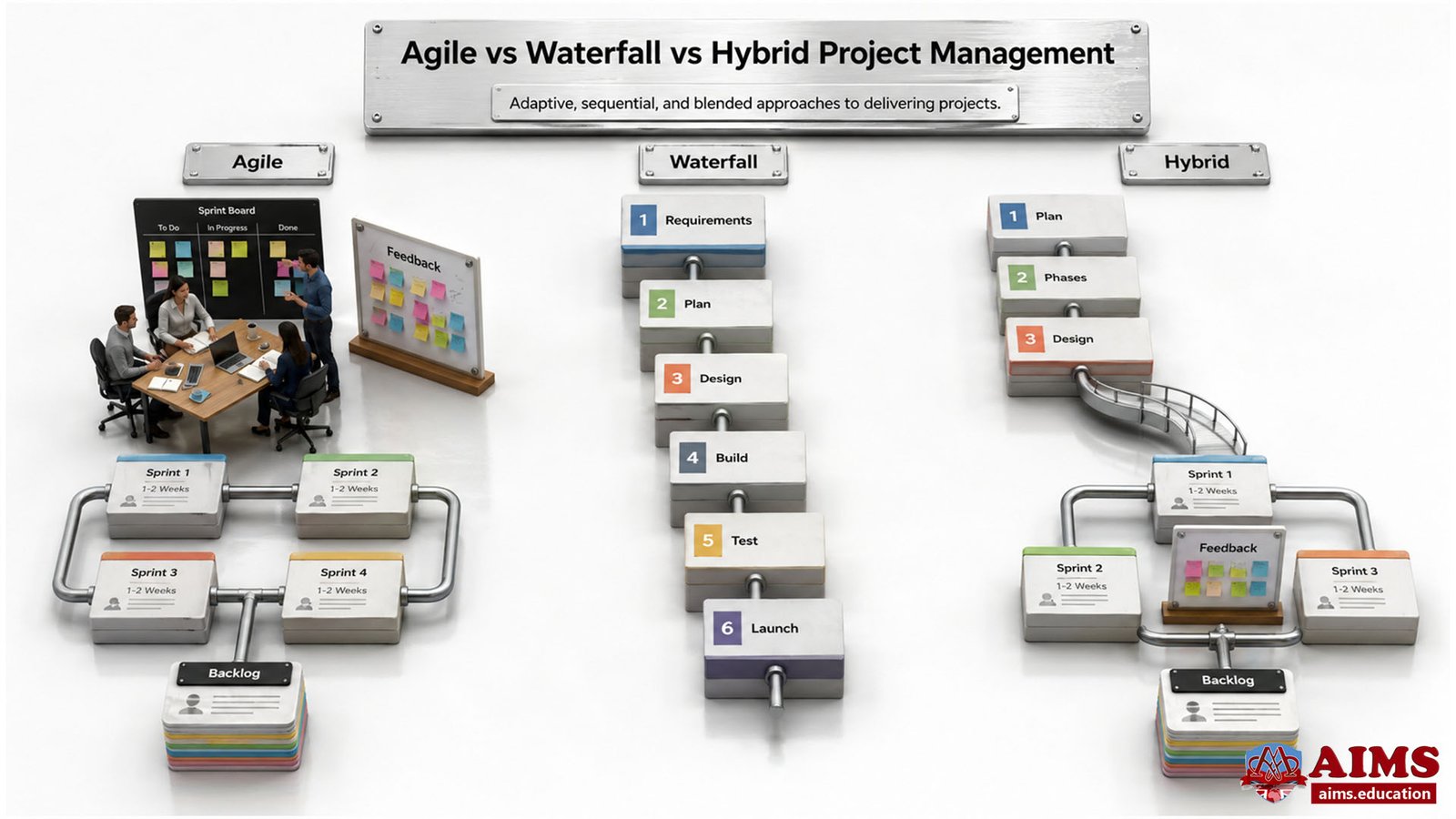
This makes Agile Waterfall Hybrid project management particularly useful when uncertainty is not distributed evenly across the project.
Hybrid Agile Waterfall Example in an IT Project
A practical example can be found in projects that combine hardware and software development.
- The hardware team may follow a predominantly Waterfall approach because manufacturing specifications, procurement lead times, and physical dependencies require early decisions.
- The software team may use Agile iterations because features can be tested and modified more frequently.
- Both teams establish agreed integration points so that hardware and software remain compatible.
- Project-level governance monitors overall budget, milestones, dependencies, quality, and risk.
- Software feedback is incorporated without unnecessarily disrupting stable hardware commitments.
The result is not an informal compromise. It is a deliberate division of management practices according to the needs of each workstream.
Predictive vs Adaptive vs Hybrid Project Management
Predictive approaches plan more of the project in advance, adaptive approaches progressively refine plans as learning occurs, and Hybrid approaches combine both when different project conditions require different levels of certainty and flexibility.
The distinction between predictive vs adaptive project management provides a useful professional lens for understanding Waterfall, Agile, and Hybrid. Waterfall commonly sits toward the predictive end, while Agile represents an adaptive way of working. Hybrid can operate between these positions or apply different approaches to different components of the same project.
The PMI guidance on predictive, adaptive, and hybrid project approaches similarly emphasizes that each approach has advantages in different project scenarios. Therefore, methodology selection should be based on project context rather than organizational habit.
When Should You Use Agile, Waterfall, or Hybrid?
Use Agile when uncertainty and feedback are high, Waterfall when requirements and dependencies are stable, and Hybrid when the project contains both predictable and evolving elements.
When deciding when to use Agile vs Waterfall, or whether Hybrid is more suitable, project managers should consider several conditions.
Use Agile When
- Requirements are expected to evolve as the team learns more.
- Customers or users can provide regular feedback.
- Useful outputs can be delivered incrementally.
- Innovation and experimentation are important.
- The team needs to respond quickly to changing priorities.
Use Waterfall When
- Requirements are clear, stable, and measurable from the beginning.
- Work has strong sequential dependencies.
- Formal approvals and documentation are important.
- The project is governed by fixed specifications or contractual commitments.
- The cost of changing completed work is particularly high.
Use Hybrid When
- Some project components are predictable while others remain uncertain.
- The organization requires formal governance but delivery teams need flexibility.
- Hardware, infrastructure, procurement, or compliance activities must coordinate with adaptive digital or product development.
- Fixed milestones must coexist with iterative product development.
- Stakeholders need both management visibility and frequent opportunities to influence evolving outputs.
Methodology selection should also consider project risk management across different delivery approaches and the level of ongoing project stakeholder engagement that the work requires.
Advantages and Disadvantages of Agile, Waterfall, and Hybrid
Each approach offers different strengths and trade-offs, so its value depends on how well those characteristics match the project environment.
| APPROACH | MAIN ADVANTAGES | MAIN CHALLENGES |
|---|---|---|
| Agile | Supports changing requirements, frequent feedback, incremental value delivery, and continuous learning. | Requires active stakeholder participation, disciplined prioritization, collaborative teams, and tolerance for evolving plans. |
| Waterfall | Provides clear phases, strong upfront planning, defined documentation, and predictable governance when requirements are stable. | Late changes can be expensive, and problems with assumptions may remain hidden until later stages. |
| Hybrid | Combines governance and predictability with flexibility where adaptation creates value. | Can become unnecessarily complex if teams mix practices without clear decision rules, ownership, or integration points. |
A common Hybrid mistake is adding Agile ceremonies to an unchanged Waterfall process and assuming the project has become adaptive. Effective Hybrid management requires deliberate tailoring, clear responsibilities, appropriate governance, and a shared understanding of how different workstreams will interact.
How Does an Agile-Waterfall Hybrid Model Work?
An Agile-Waterfall Hybrid works by deciding which elements require predictive control and which benefit from adaptive delivery, then coordinating both through shared governance, responsibilities, feedback cycles, and integration points.
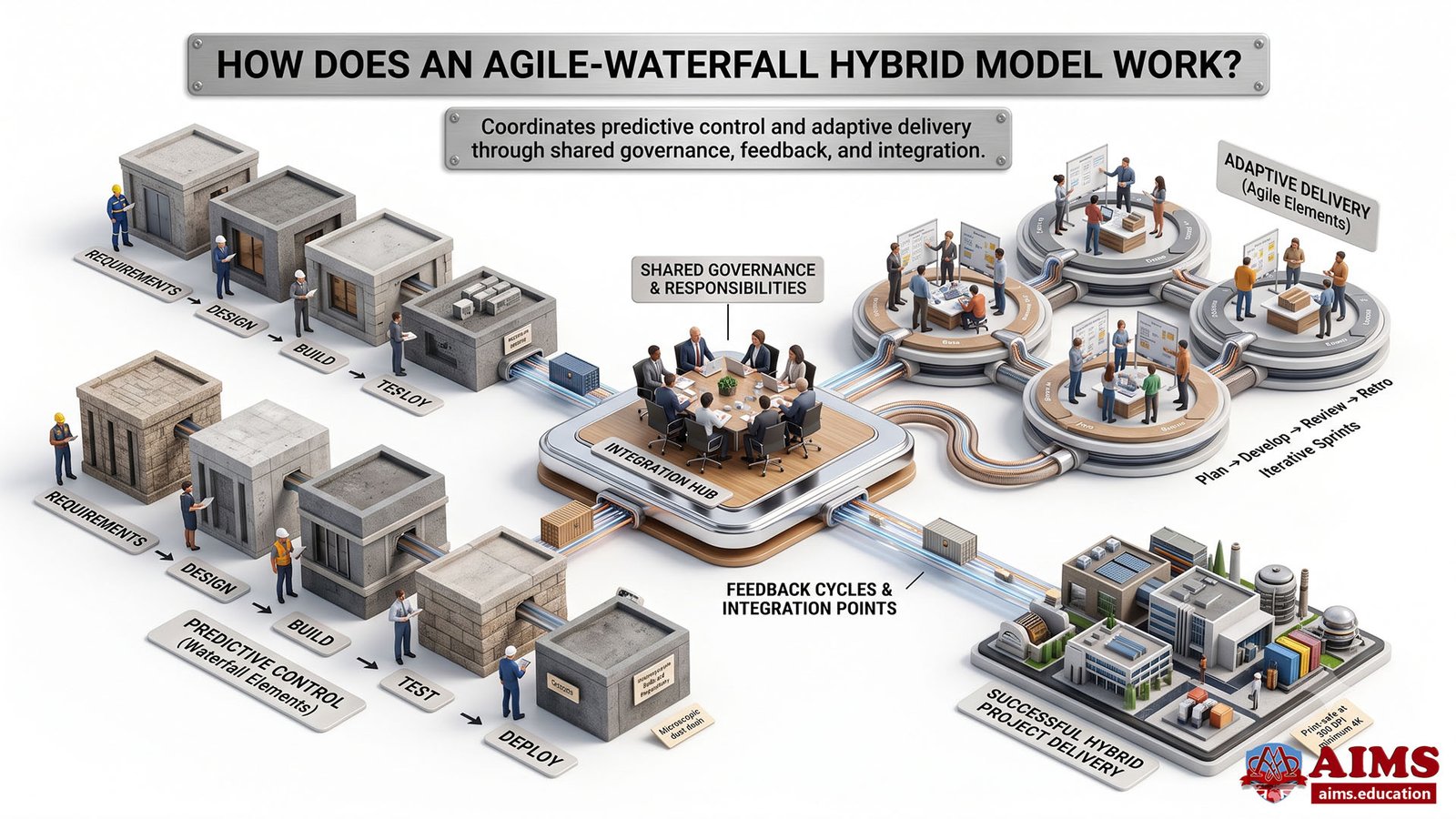
The original five-step implementation logic remains useful, but it works best when applied as a tailoring process rather than simply making Waterfall more Agile.
Step 1: Define the Working Process
Start by identifying how the project should move from planning to delivery.
- Identify the activities that require stable plans, formal approvals, documentation, or sequential execution.
- Identify the areas where requirements are uncertain and iterative delivery would improve learning.
- Define how requirements, planning, testing, approval, and delivery will operate across both types of work.
- Establish integration points between predictive and adaptive workstreams.
- Remove unnecessary processes rather than combining every Agile and Waterfall practice.
The objective is to design one coherent delivery system rather than operate two disconnected methodologies.
Step 2: Establish Roles and Responsibilities
Hybrid projects require clear ownership because teams may operate with different planning and decision-making patterns.
- Define who owns project-level governance, scope, schedule, budget, risk, and major approvals.
- Clarify who can prioritize or reprioritize adaptive work.
- Define responsibilities for coordination between predictive and Agile teams.
- Make escalation and decision rights visible to everyone involved.
- Avoid micromanagement by defining outcomes and authority as clearly as individual tasks.
Step 3: Establish an Appropriate Meeting Structure
Communication should support the delivery approach rather than impose the same ceremony on every team.
- An Agile workstream may use short daily coordination meetings where they add value.
- A predictive workstream may rely more heavily on milestone, progress, or stage reviews.
- Cross-team meetings should focus on shared dependencies, risks, decisions, and integration points.
- Project-level reporting should provide management visibility without interrupting adaptive team delivery unnecessarily.
This structure gives teams sufficient autonomy while maintaining coordination across the wider project.
Step 4: Build Short Feedback and Testing Cycles
Feedback loops allow Hybrid teams to discover problems before they affect major project commitments.
- Use prototypes, demonstrations, testing sessions, or early reviews where uncertainty is high.
- Test functionality before investing heavily in detailed refinement.
- Capture stakeholder feedback while changes are still practical.
- Escalate feedback that could affect fixed milestones, contractual commitments, or dependent workstreams.
- Use formal methods for managing project change in a controlled way when proposed changes affect established baselines or governance commitments.
Early feedback reduces the risk of discovering major usability or functional problems only after significant work has been completed.
Step 5: Establish a Shared Vision and Working Principles
A shared project vision helps teams make consistent decisions even when they use different delivery practices.
- Define the value and outcomes the overall project is expected to deliver.
- Agree which project elements are fixed and which can evolve.
- Establish shared standards for quality, collaboration, transparency, and decision-making.
- Ensure predictive and adaptive teams understand their dependencies on one another.
- Review the Hybrid design when project conditions change significantly.
Shared principles prevent individual teams from optimizing their own work at the expense of overall project performance.
Professional Relevance of Agile, Waterfall, and Hybrid Skills
Project managers benefit from understanding all three approaches because professional project environments rarely present the same level of uncertainty, governance, stakeholder involvement, and technical dependency.
Knowing only one methodology can encourage managers to apply familiar techniques even when project conditions require a different approach. Professionals should instead understand the logic behind predictive and adaptive planning, recognize where each works well, and know how to tailor practices responsibly.
AIMS’ CSCE is an online project management certification course helps professionals strengthen their understanding of project delivery approaches, while Executive MBA degree in project management can provide broader managerial context for methodology selection, governance, leadership, and complex project decision-making.
Final Words on Agile vs Waterfall vs Hybrid
Agile, Waterfall, and Hybrid are most effective when selected according to project conditions rather than treated as competing management philosophies.
Waterfall provides strong predictive structure when requirements and dependencies are stable. Agile supports learning and adaptation when requirements evolve. Hybrid allows project managers to deliberately combine these strengths when different parts of the same project require different ways of working.
Therefore, the most important question is not whether Agile, Waterfall, or Hybrid is universally better. The better question is which combination of planning, governance, feedback, flexibility, and control will give a particular project the strongest chance of delivering its intended value.
Frequently Asked Questions
What is the difference between Agile, Waterfall, and Hybrid project management?
Waterfall is predominantly sequential and predictive, Agile is adaptive and iterative, and Hybrid deliberately combines predictive and adaptive practices. Waterfall works well with stable requirements, Agile supports evolving requirements, and Hybrid is useful when a project contains both predictable and uncertain elements.
What is Agile project management?
Agile project management is an adaptive approach that organizes work into smaller increments, uses frequent stakeholder feedback, and allows priorities and requirements to evolve as the team learns more during delivery.
What is Waterfall project management?
Waterfall project management is a predominantly predictive approach in which work progresses through planned phases based on requirements and deliverables defined as clearly as possible before execution.
What is Hybrid project management?
Hybrid project management combines selected predictive and adaptive practices according to project needs. It may use formal governance and fixed milestones for some activities while allowing iterative planning, testing, and delivery in areas where requirements are more uncertain.
Is Hybrid project management simply a combination of Agile and Waterfall?
Hybrid can combine Agile and Waterfall practices, but it is not simply a fixed mixture of the two. An effective Hybrid approach is tailored according to uncertainty, governance, dependencies, stakeholder needs, and the characteristics of different project components.
When should you use Agile, Waterfall, or Hybrid?
Use Agile when requirements are evolving and frequent feedback is valuable. Use Waterfall when requirements and dependencies are stable and predictable. Use Hybrid when the project requires both structured governance and flexibility across different components or workstreams.
Which is better: Agile, Waterfall, or Hybrid?
None is universally better. The appropriate approach depends on factors such as requirement stability, technical dependencies, stakeholder availability, regulatory constraints, delivery cadence, risk, team capability, and the cost of making changes later in the project.
What is the difference between predictive, adaptive, and Hybrid project management?
Predictive project management defines more scope and planning in advance. Adaptive project management progressively refines plans as learning occurs. Hybrid project management uses predictive and adaptive practices together when different aspects of the project require different levels of certainty and flexibility.
Can Agile and Waterfall be used together in the same project?
Yes. For example, a hardware workstream may follow a predictive sequence because physical specifications and procurement decisions must be established early, while a software workstream uses Agile iterations and frequent feedback. The teams then coordinate through shared milestones and integration points.
How do you choose the right project management approach?
Assess requirement certainty, stakeholder involvement, technical dependencies, governance obligations, delivery frequency, risk, regulatory requirements, team capability, and the expected level of change. Select and tailor the approach that best fits these conditions rather than automatically using the organization’s most familiar methodology.
Develop Practical Project Management Expertise with AIMS
Since 2005, AIMS’ Project Management Academy has delivered internationally accredited, career-focused project management education to learners worldwide. Its internationally standardized curriculum combines qualified faculty, industry-oriented teaching, practical skill development, 3D interactive learning content, and real-world case studies. AIMS educational content, study materials, and curriculum are collaboratively developed and rigorously peer-reviewed by an academic board of qualified industry practitioners. Understanding Agile, Waterfall, and Hybrid approaches strengthens professional methodology-selection skills. Explore the Academy’s practical and flexible project management qualifications.