
Project risk management is the structured process of identifying uncertain events or conditions, assessing their probability and impact, selecting appropriate responses, assigning ownership, and monitoring results throughout a project. It protects scope, schedule, cost, quality, and wider objectives while helping teams recognize and strengthen opportunities that may improve project outcomes.
In practice, risk management in project management turns uncertainty into informed action. A sound project risk management process helps managers distinguish risks from active issues, prioritize limited resources, prepare contingency plans, and communicate clearly with sponsors, teams, suppliers, and stakeholders. This explanation covers risk planning, identification, qualitative and quantitative analysis, the risk register, response strategies, and lifecycle monitoring through practical examples.
A project risk is uncertain. A project issue has already occurred and requires immediate action.

What Is Project Risk Management?
Project risk management is a proactive and continuous approach for understanding uncertainty and deciding what should be done before, during, and after a risk event affects project objectives.
A project risk is an uncertain event or condition that may influence one or more objectives. Its effect may be negative, such as a supplier delay increasing project costs, or positive, such as new technology allowing the team to complete work earlier than planned.
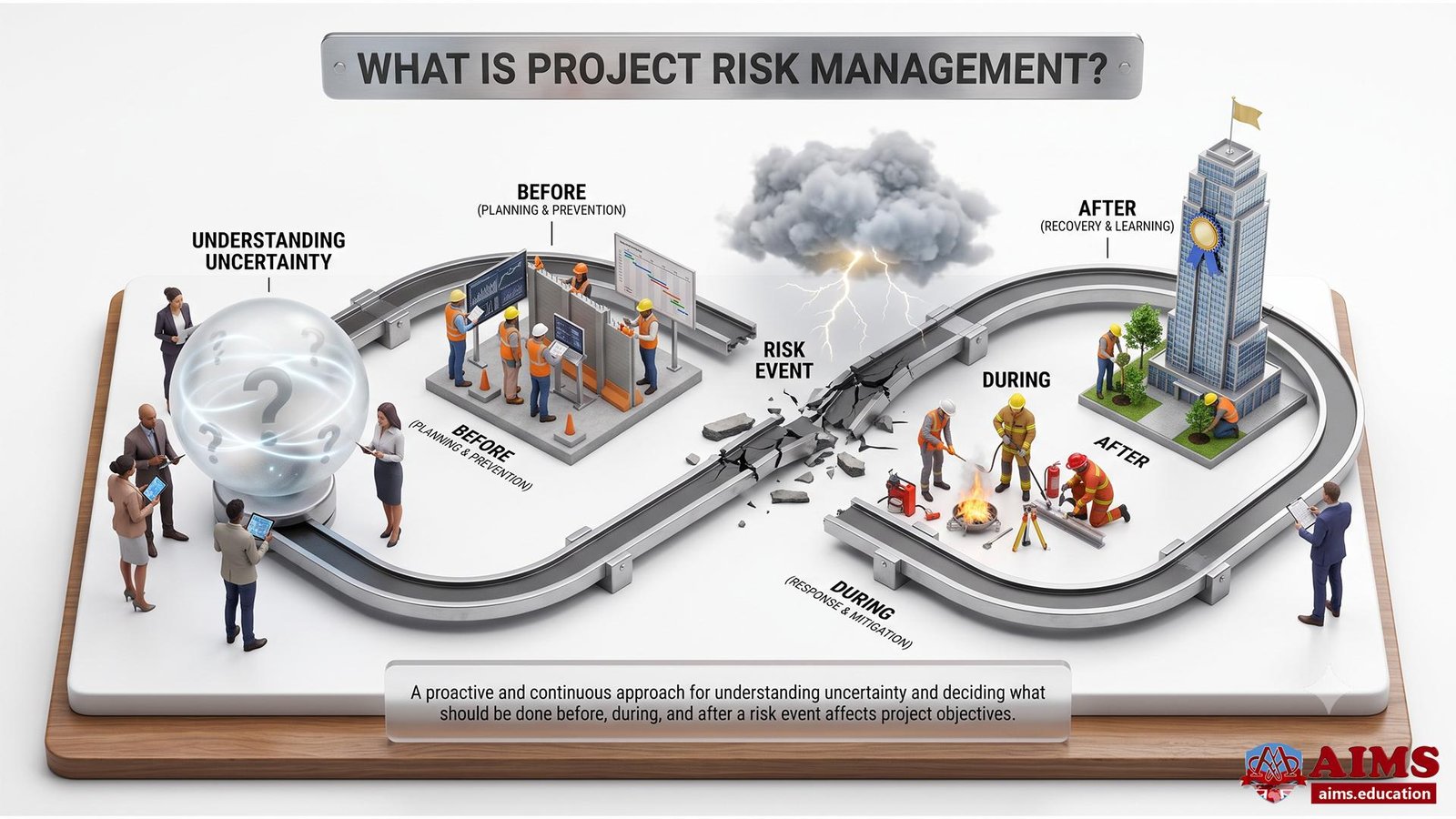
Effective managing risks in projects therefore addresses both:
- Threats: Uncertain events that could damage scope, schedule, cost, quality, safety, benefits, reputation, or stakeholder confidence.
- Opportunities: Uncertain events that could create savings, improve quality, shorten delivery time, increase benefits, or strengthen the final outcome.
The purpose is not to eliminate every uncertainty. That would rarely be possible or economically sensible. The purpose is to understand exposure, make proportionate decisions, and improve the probability of achieving project objectives.
Project Risk vs Project Issue
A risk may happen in the future, while an issue is a present condition that has already happened or is currently affecting the project.
| ATTRIBUTE | PROJECT RISK | PROJECT ISSUE |
|---|---|---|
| Status | The event or condition is uncertain. | The event or condition already exists. |
| Management question | What could happen, and what should we do about it? | What has happened, and how will we resolve it? |
| Typical documentation | Risk register, risk analysis, response plan, and contingency plan. | Issue log, action plan, change request, or corrective action. |
| Example | A specialist may leave before system testing begins. | The specialist resigned this morning. |
| Management approach | Assess probability and impact, assign an owner, and prepare a response. | Contain the effect, assign actions, resolve the cause, and update the project plan. |
When a risk occurs, it stops being merely uncertain. It becomes an issue, change, opportunity, or realized event that must be managed through the appropriate project controls.
Importance of Risk Management in Project Management
Risk management in project management helps the project team act before uncertainty becomes uncontrolled disruption.
Projects operate through assumptions about requirements, resources, suppliers, technology, approvals, estimates, market conditions, and stakeholder behavior. Even a well-developed plan cannot remove all uncertainty because every project combines unique objectives, people, constraints, and environmental conditions.
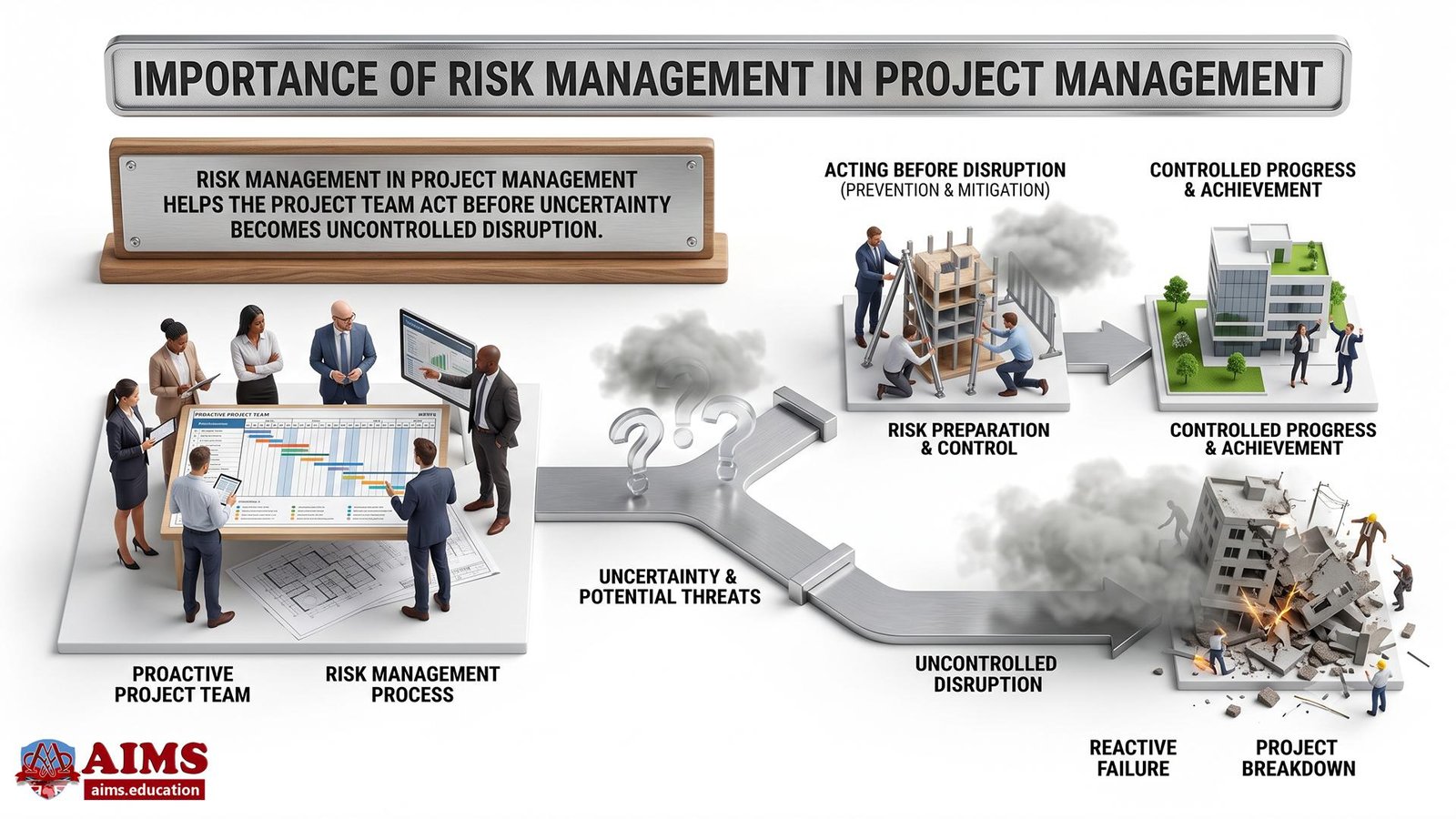
Systematic project risk assessment and management improves the project in several ways:
- It exposes threats before they become expensive problems.
- It helps managers prioritize resources according to probability, impact, and urgency.
- It supports realistic cost estimates, schedules, reserves, and commitments.
- It protects deliverables by connecting risk decisions with effective project scope management practices.
- It strengthens financial control by connecting uncertain cost exposure with structured project cost management.
- It creates clear responsibility through named risk owners and agreed actions.
- It improves communication between project managers, sponsors, teams, suppliers, and customers.
- It identifies opportunities that may improve benefits, quality, speed, or commercial value.
- It reduces surprise by preparing contingency and fallback plans in advance.
- It gives decision-makers a clearer basis for approving changes, allocating reserves, or adjusting priorities.
Risk management also improves honesty in planning. Instead of presenting one optimistic cost or completion date as certain, managers can explain the assumptions, ranges, confidence levels, and events that may change the result.
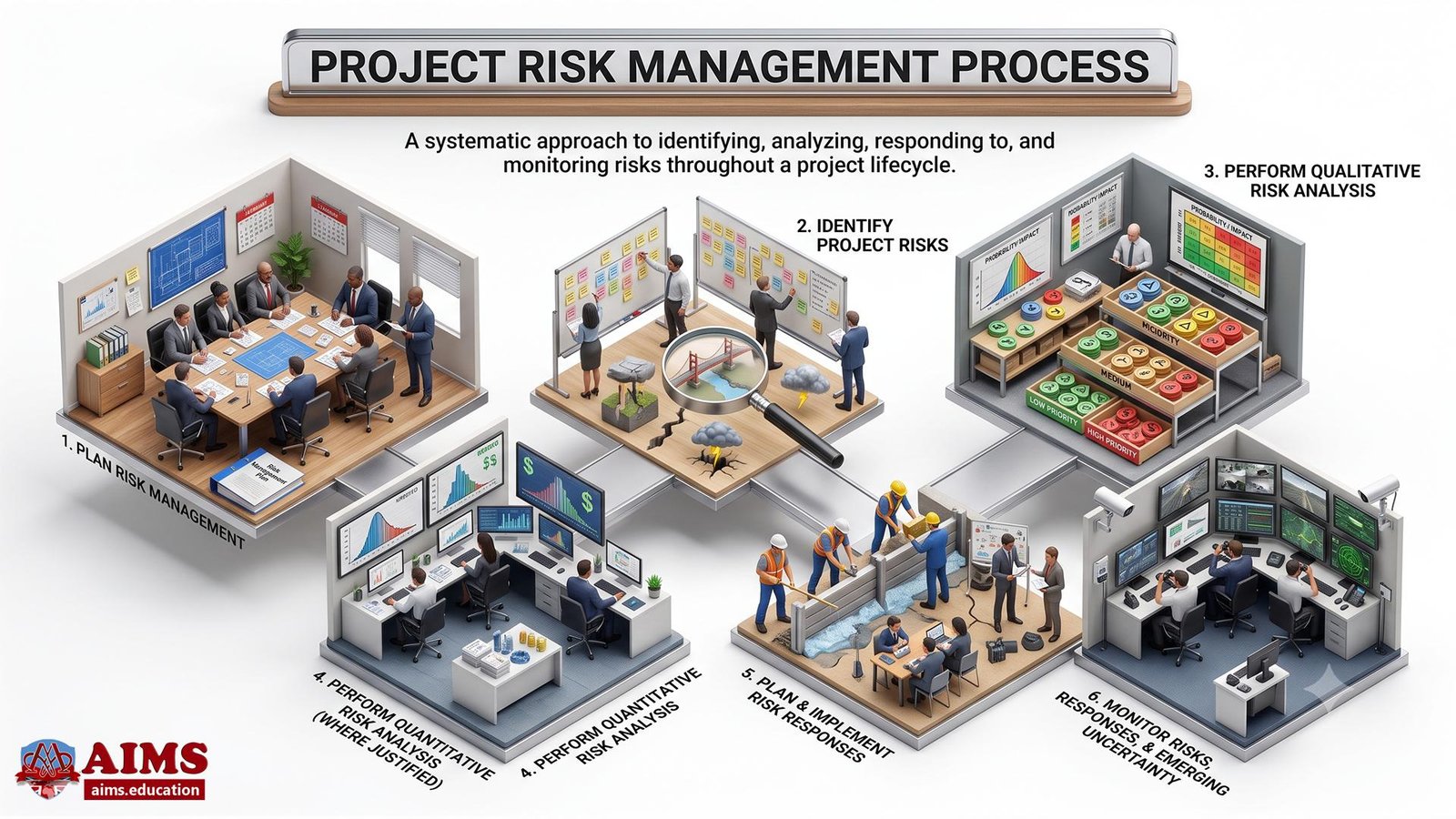
The Project Risk Management Process
The project risk management process consists of connected activities for planning the approach, identifying uncertainty, analyzing exposure, selecting responses, implementing actions, and monitoring changing conditions.
Organizations may group or name these activities differently. A practical teaching sequence contains six core stages:
- Plan risk management.
- Identify project risks.
- Perform qualitative risk analysis.
- Perform quantitative risk analysis where justified.
- Plan and implement risk responses.
- Monitor risks, responses, and emerging uncertainty.
| STAGE | MAIN QUESTION | KEY OUTPUT |
|---|---|---|
| 1. Plan risk management | How will risk management be conducted? | Risk management plan. |
| 2. Identify risks | What uncertain events or conditions could affect the project? | Initial risk register. |
| 3. Qualitative analysis | Which risks require the most attention? | Prioritized and categorized risks. |
| 4. Quantitative analysis | What is the numerical effect on project objectives? | Probabilistic forecasts and quantified exposure. |
| 5. Plan responses | What will be done, by whom, and under what conditions? | Agreed response, owner, actions, reserves, and contingency plans. |
| 6. Monitor risks | Are risks, assumptions, responses, and reserves still valid? | Updated register, actions, change requests, and lessons learned. |
1. Plan Risk Management
Project risk planning defines how the project team will identify, analyze, respond to, communicate, and monitor risk.
The risk management plan establishes the rules for managing uncertainty. It is not the list of individual project risks, and it does not provide a detailed response for every risk. Instead, it explains the methodology, responsibilities, scales, timing, reporting arrangements, and decision thresholds that will be used.
Inputs to Risk Management Planning
Planning should consider the wider project environment and approved project information, including:
- The project charter and high-level risks.
- The project management plan and approved baselines.
- Scope, schedule, cost, quality, and resource information.
- The stakeholder register and stakeholder responsibilities.
- Organizational risk policies and governance requirements.
- Previous project records and lessons learned.
- Standard templates, definitions, reporting formats, and risk categories.
- Stakeholder attitudes, tolerances, and escalation expectations.
What Should a Project Risk Management Plan Include?
A practical project risk management plan normally defines:
- Methodology: The methods, tools, models, data sources, and workshops that will be used.
- Roles and responsibilities: Who facilitates risk activities, approves responses, owns risks, and reports results.
- Budgeting: The resources and costs allocated to risk management and response actions.
- Timing: When identification, assessment, reassessment, auditing, and reporting will occur.
- Risk categories: The classification structure used to organize potential sources of uncertainty.
- Probability and impact definitions: Agreed meanings for low, medium, high, or numerical ratings.
- Probability and impact matrix: The method used to combine probability and consequence.
- Reporting formats: The structure of the risk register, reports, dashboards, and escalation notices.
- Tracking: How decisions, changes, response effectiveness, audits, and lessons learned will be recorded.
- Stakeholder thresholds: The exposure level that requires action, escalation, approval, or rejection.
Risk Appetite, Risk Tolerance, and Risk Threshold
Risk appetite expresses broad willingness to take risk, risk tolerance defines an acceptable range of variation, and a risk threshold identifies the point at which exposure requires attention or action.
| CONCEPT | MEANING | PROJECT EXAMPLE |
|---|---|---|
| Risk appetite | The general amount and type of uncertainty an organization is willing to pursue or retain in expectation of value. | A technology company accepts substantial experimentation risk to develop an innovative product. |
| Risk tolerance | The acceptable variation around a project objective or performance target. | Management may tolerate schedule movement between five and ten working days. |
| Risk threshold | A defined exposure level that triggers action, escalation, or a different decision. | Any forecast cost overrun above GBP 20,000 must be escalated to the sponsor. |
Project Risk Planning Example
Apex Systems is preparing a GBP 400,000 software implementation project. During its risk planning meeting, the team agrees that:
- Every risk will have a named owner.
- Probability and impact will each be scored from one to five.
- Risks scoring fifteen or above will be escalated to the sponsor.
- The risk register will be reviewed every two weeks.
- A separate review will occur before testing, migration, and launch.
- Cost and schedule contingency reserves will be reviewed monthly.
This shared threshold enables faster decisions and prevents personal risk preferences from overriding agreed project priorities.
2. Identify Project Risks
Project risk identification is the iterative process of discovering uncertain events, conditions, assumptions, and sources that may affect project objectives.
Risk identification is not a one-time workshop. New risks emerge as requirements become clearer, suppliers are appointed, technical work progresses, stakeholders change, and external conditions develop.
Main Categories of Project Risk
Before examining individual risks, teams should organize uncertainty into categories. Common categories include:
- Technical, quality, or performance risks.
- External, regulatory, supplier, market, or environmental risks.
- Organizational, funding, dependency, or resource risks.
- Project management, estimating, planning, communication, or control risks.
A risk breakdown structure organizes these categories hierarchically. It performs a function similar to a work breakdown structure used to organize project work, but focuses on sources of uncertainty rather than deliverables.
Project Risk Identification Techniques
Several methods should be combined because no single technique will identify every possible risk.
Documentation Reviews
Documentation reviews examine the charter, plans, requirements, estimates, contracts, assumptions, schedules, specifications, and lessons learned. Gaps, contradictions, weak estimates, and incomplete information may reveal uncertainty.
Brainstorming
Brainstorming brings team members, specialists, stakeholders, and risk practitioners together to generate possible risks. One
participant’s observation may stimulate another risk that would otherwise remain hidden.
Delphi Technique
The Delphi technique gathers expert opinions through several anonymous rounds. A facilitator consolidates the responses and returns them for further review until greater agreement is achieved. Anonymity helps reduce dominance and group pressure.
Interviews
Interviews use structured questions to obtain risk information from project managers, users, customers, suppliers, technical experts, operational teams, and people who have managed similar work.
Root Cause Analysis
Root cause analysis examines why a risk might arise rather than recording only its visible symptom. Understanding the cause usually produces a more effective response.
Checklist Analysis
Checklists use knowledge from previous projects, industry experience, and organizational records. They improve speed and consistency, but should not replace fresh investigation because every project contains unique uncertainty.
Assumption Analysis
Assumption analysis tests whether planning assumptions are valid, complete, consistent, and sufficiently supported. The team should also consider the consequences if an assumption proves false.
Diagramming Techniques
Useful diagrams include:
- Cause-and-effect diagrams: These connect a possible effect with its underlying causes.
- Process flowcharts: These reveal dependencies, decision points, bottlenecks, interfaces, and failure paths.
- Influence diagrams: These show relationships among decisions, uncertainties, variables, and outcomes.
SWOT Analysis
SWOT analysis examines strengths, weaknesses, opportunities, and threats. Strengths and weaknesses often reveal internal sources of positive or negative uncertainty, while opportunities and threats frequently reflect external conditions.
Expert Judgment
Experienced specialists can recognize patterns that are not obvious in project documents. Their advice remains valuable, but the team should identify possible bias, overconfidence, commercial interest, or dependence on outdated experience.
How Should a Risk Be Written?
A useful risk statement connects a cause, an uncertain event, and its possible effect on project objectives.
A practical structure is:
Because of a possible cause, an uncertain event may occur, resulting in a defined effect on one or more project objectives.
For example:
Because the data migration tool has not been tested with legacy records, conversion errors may occur, causing additional correction work and delaying system launch.
This format is clearer than writing only “data migration risk,” because the team can see why the risk exists and what it could affect.
Project Risk Identification Example
Nova Retail is implementing a new inventory system. During risk identification, the team discovers that:
- The selected software depends on an interface that has not been tested with the existing finance platform.
- The interface supplier has not confirmed availability during integration testing.
- A failed interface could delay testing by three weeks.
- The delay could also increase consultant costs and postpone staff training.
The team records the cause, uncertain event, affected objectives, possible trigger, initial owner, and suggested response in the risk register.
The team can now act before the dependency becomes a delay, rather than reacting after disruption occurs.
3. Perform Qualitative Risk Analysis
Qualitative project risk analysis evaluates and prioritizes identified risks by examining their probability, impact, urgency, data quality, and other agreed characteristics.
This is usually the most frequently applied form of project risk analysis because it is relatively fast and can be repeated throughout the project. Its purpose is to identify which risks deserve immediate response, further numerical analysis, continued observation, or placement on a low-priority watch list.
Probability and Impact
Probability estimates how likely a risk is to occur, while impact estimates the consequence if it occurs.
Probability may be described using words such as rare, unlikely, possible, likely, and almost certain. It may also be represented numerically, such as a value between 0 and 1.
Impact should be assessed against relevant objectives, including:
- Scope and requirements.
- Schedule and milestone dates.
- Cost and funding.
- Quality and technical performance.
- Safety, compliance, or security.
- Benefits, reputation, or stakeholder confidence.
Impact scales must be defined before assessment. A “high” cost impact on a small internal project may be materially different from a “high” cost impact on a national infrastructure program.
Probability and Impact Matrix
A probability and impact matrix combines likelihood and consequence to produce an agreed risk rating or priority.
A simple numerical approach multiplies probability by impact:
Risk score = probability score × impact score
The resulting score may be classified as low, medium, or high according to organizational thresholds. The matrix supports prioritization, but it should not replace professional judgment. A moderate score may still require urgent action if the risk is close to occurring, affects safety, or has irreversible consequences.
Other Qualitative Assessment Factors
- Risk urgency: How soon the risk may occur and how much time is available for a response.
- Risk proximity: The expected time before the event could affect the project.
- Data quality: Whether the available information is reliable, accurate, complete, and unbiased.
- Manageability: Whether the project team has authority and practical options to influence the risk.
- Detectability: Whether warning signs are likely to appear before the event occurs.
- Connectivity: Whether one risk could trigger or intensify several other risks.
- Stakeholder sensitivity: Whether the event would create unusual concern, reputational damage, or governance attention.
Qualitative Project Risk Assessment Example
A construction team identifies a risk that approval of revised structural drawings may be delayed.
- The team assigns a probability score of four out of five.
- The schedule impact is rated four because the delay could affect critical activities.
- The combined score is sixteen.
- The project threshold classifies scores of fifteen or above as high priority.
- The risk is assigned to the design manager for immediate response planning.
The ranking directs limited management attention toward risks most likely to threaten critical project objectives first.
4. Perform Quantitative Risk Analysis
Quantitative risk analysis numerically evaluates how uncertainty may affect project cost, schedule, scope, benefits, or other measurable objectives.
Not every project or risk requires detailed numerical modeling. Quantitative analysis is most useful when the project is large, complex, commercially significant, highly uncertain, or dependent on important cost and completion commitments.
Qualitative Versus Quantitative Risk Analysis
| ATTRIBUTE | QUALITATIVE ANALYSIS | QUANTITATIVE ANALYSIS |
|---|---|---|
| Purpose | Prioritizes risks for attention and response. | Measures numerical exposure and possible project outcomes. |
| Typical inputs | Expert ratings, probability, impact, urgency, and data quality. | Numerical estimates, ranges, distributions, dependencies, costs, and durations. |
| Typical outputs | Low, medium, or high ratings and a prioritized risk list. | Probability distributions, expected values, confidence levels, and forecast ranges. |
| Time and cost | Usually faster and less expensive. | Usually requires more data, expertise, time, and analytical effort. |
| Typical use | Most projects and regular risk reviews. | Major decisions, complex projects, important estimates, and high-priority exposure. |
| Examples | Probability and impact matrix, urgency assessment, and expert workshops. | Expected monetary value, decision trees, sensitivity analysis, and Monte Carlo simulation. |
Data Gathering and Probability Distributions
Quantitative analysis often uses interviews and three-point estimates:
- Optimistic estimate: The favorable outcome that remains reasonably possible.
- Most likely estimate: The outcome expected under normal conditions.
- Pessimistic estimate: The unfavorable outcome that remains reasonably possible.
These values may be represented through probability distributions. Triangular and beta distributions are commonly associated with three-point estimates, while other models may use normal, lognormal, uniform, or discrete distributions depending on the uncertainty being examined.
Sensitivity Analysis
Sensitivity analysis identifies which uncertain variables have the greatest influence on a project outcome.
A tornado diagram commonly presents the variables from greatest to least influence. This helps managers focus response planning on the cost elements, durations, assumptions, or risk drivers capable of changing the project result most significantly.
Expected Monetary Value Analysis
Expected monetary value estimates the average financial effect of an uncertain outcome by multiplying its probability by its monetary impact.
Expected monetary value = probability × monetary impact
Positive values normally represent financial opportunities, while negative values represent potential losses. Several possible outcomes can be calculated and combined when evaluating a decision.
Decision Tree Analysis
Decision trees display alternative decisions, uncertain events, probabilities, costs, and possible results. They are especially useful when management must select between competing options under uncertainty.
Modeling and Monte Carlo Simulation
Simulation repeatedly calculates a project model using different values drawn from defined probability distributions. Monte Carlo simulation can produce a range of possible completion dates or total costs together with the probability of meeting a particular target.
For example, a schedule simulation may show that the planned completion date has only a 45 percent probability of achievement. Management can then consider additional resources, revised sequencing, risk responses, or a more realistic commitment date.
Expected Monetary Value Example
Vertex Engineering is choosing between two specialist suppliers.
- Supplier A costs GBP 80,000 and has a 20 percent probability of causing a GBP 30,000 delay.
- The expected delay exposure is 0.20 × GBP 30,000, which equals GBP 6,000.
- Supplier A therefore has a simplified risk-adjusted cost of GBP 86,000.
- Supplier B costs GBP 84,000 and has a 5 percent probability of causing a GBP 20,000 delay.
- The expected delay exposure is 0.05 × GBP 20,000, which equals GBP 1,000.
- Supplier B therefore has a simplified risk-adjusted cost of GBP 85,000.
The calculation gives decision-makers a comparable financial basis for selecting the option with better risk-adjusted value.
5. Plan Project Risk Responses
Project risk response planning selects proportionate actions for reducing threats, increasing opportunities, assigning ownership, and preparing for uncertain events.
The response should reflect the risk’s priority, urgency, impact, cost, feasibility, and stakeholder tolerance. Spending more on a response than the risk could reasonably cost is rarely sensible unless safety, legal, ethical, or strategic considerations justify the additional effort.
Response Strategies for Negative Risks or Threats
The main threat response strategies are:
- Avoid.
- Transfer.
- Mitigate.
- Accept.
Avoid
Risk avoidance removes the threat or protects the project by changing the plan so that the uncertain event can no longer affect the objective.
A team may avoid a threat by changing technology, removing uncertain scope, extending the schedule, clarifying requirements, using a proven method, or eliminating the underlying cause.
Transfer
Risk transfer shifts responsibility for managing a threat and its financial consequences to a third party.
Insurance, warranties, guarantees, performance bonds, and contractual arrangements are common transfer mechanisms. The risk does not disappear, and transfer normally carries a cost. Contract selection must also be considered carefully because different contract types distribute exposure differently between buyer and seller.
Mitigate
Risk mitigation reduces the probability of a threat, its impact, or both to an acceptable level.
Mitigation may include additional testing, early prototypes, redundancy, stronger quality control, improved training, alternative suppliers, earlier approvals, simpler processes, or more reliable technology.
Accept
Risk acceptance acknowledges the uncertainty without attempting to avoid, transfer, or materially reduce it.
Passive acceptance involves taking no advance action beyond monitoring. Active acceptance may involve contingency reserves, prepared actions, additional time, or resources that become available if the risk occurs.
Response Strategies for Positive Risks or Opportunities
The main opportunity response strategies are:
- Exploit.
- Share.
- Enhance.
- Accept.
Exploit
Opportunity exploitation takes action to make a desirable uncertain event occur.
A project manager might assign highly skilled resources to ensure early completion or adopt a proven technology that can deliver a substantial performance advantage.
Share
Opportunity sharing allocates ownership to a party that can best capture the benefit.
A joint venture, specialist partnership, incentive agreement, or shared-benefit arrangement may allow organizations to combine capabilities and increase the probability of success.
Enhance
Opportunity enhancement increases the probability or positive impact of a favorable event.
The team identifies and strengthens the causes, conditions, or triggers that make the opportunity more likely or more valuable.
Accept
Opportunity acceptance means remaining willing to benefit if the opportunity arises without actively pursuing it.
| RISK TYPE | STRATEGY | PURPOSE | SIMPLE EXAMPLE |
|---|---|---|---|
| Threat | Avoid | Remove the threat or its cause. | Use proven technology instead of an unstable experimental platform. |
| Threat | Transfer | Shift responsibility or financial exposure. | Use insurance or a contract assigning specified exposure to a supplier. |
| Threat | Mitigate | Reduce probability or impact. | Create and test a prototype before full production. |
| Threat | Accept | Acknowledge and monitor the exposure. | Retain a small reserve for a low-impact disruption. |
| Opportunity | Exploit | Make the opportunity occur. | Assign expert resources to secure an early delivery bonus. |
| Opportunity | Share | Use a capable partner to capture value. | Form a specialist partnership to enter a new market. |
| Opportunity | Enhance | Increase probability or positive impact. | Expand training so more teams can adopt a productivity tool. |
| Opportunity | Accept | Benefit if the opportunity arises. | Use an optional supplier discount if market conditions make it available. |
Contingency Plans and Fallback Plans
A contingency plan defines what will be done if a specified risk occurs, while a fallback plan is used when the primary response proves ineffective.
Contingency planning differs from mitigation. Mitigation attempts to reduce probability or impact before the event. A contingency plan is activated when an agreed trigger shows that the risk is occurring or about to occur.
Contingency reserves may include:
- Additional budget for identified uncertainty.
- Schedule allowances for known risks.
- Backup resources or specialist support.
- Alternative suppliers, locations, technologies, or operating methods.
Residual and Secondary Risks
A residual risk remains after a response has been implemented, while a secondary risk arises because of the response itself.
For example, transferring work to an external supplier may reduce internal resource exposure but create a secondary risk involving supplier coordination, confidentiality, or contractual dependence.
Project Risk Response Example
Orion Health is preparing a system launch, but a key data migration tool may fail under full transaction volume.
- The team mitigates the threat by conducting an early high-volume test.
- A technical specialist is assigned as the risk owner.
- Failure rates above the agreed limit act as the trigger.
- The contingency plan uses a slower but proven migration method.
- Additional weekend support is reserved if the contingency plan is activated.
- The fallback plan delays nonessential data migration until after the main launch.
Combining mitigation, contingency, and ownership reduces disruption while preserving a clear path for rapid operational recovery.
6. Monitor Project Risks Throughout the Lifecycle
Risk monitoring tracks identified risks, searches for new uncertainty, evaluates response effectiveness, reviews triggers, and updates decisions throughout the project lifecycle.
Risk management does not end when the initial plan and register are approved. Probability, impact, urgency, ownership, assumptions, and response feasibility can change as the project progresses.
Risk Monitoring Activities
Regular monitoring should include:
- Reviewing high-priority and near-term risks.
- Checking whether warning signs or triggers have appeared.
- Confirming that risk owners are completing agreed actions.
- Evaluating whether implemented responses are working.
- Reassessing probability, impact, urgency, and priority.
- Identifying new risks and closing risks that are no longer relevant.
- Reviewing residual and secondary risks.
- Comparing remaining contingency reserves with remaining exposure.
- Assessing technical or performance deviations that may indicate emerging risk.
- Escalating risks that exceed authority or agreed thresholds.
Risk Reassessment
Risk reassessment is a scheduled review of identified risks, response plans, priorities, assumptions, and new information. It may require repeating qualitative or quantitative analysis when exposure changes significantly.
Risk Audits
Risk audits examine whether the risk management approach and individual responses are being implemented effectively. An audit should consider both compliance with the agreed process and whether the process is producing useful decisions.
Technical Performance Measurement
Technical performance measurement compares actual results with planned technical targets. A material variance may reveal an emerging risk involving quality, scope, integration, reliability, or performance.
Reserve Analysis
Reserve analysis compares the contingency budget or time remaining with the amount of risk exposure remaining. A reserve that appeared sufficient during planning may become inadequate after new risks emerge or assumptions change.
Risk Reviews and Status Meetings
Risk should be a regular agenda item in project status meetings. The amount of discussion should reflect the project’s current exposure, rather than treating every risk as equally important.
Clear risk communication is closely connected with effective project communication management. Stakeholders need concise information about exposure, decisions, owners, triggers, required support, and changes to expected outcomes.
Project Risk Monitoring Example
A supplier disruption risk was originally rated medium because delivery was expected in twelve weeks. Six weeks later:
- The supplier reports a regional transport restriction.
- The probability increases from medium to high.
- The expected delay grows from three days to two weeks.
- The risk owner activates the alternative logistics plan.
- The project manager updates the schedule forecast and remaining contingency reserve.
- The sponsor receives an escalation because the revised exposure exceeds the agreed threshold.
Regular review keeps the response proportionate as probability, impact, ownership, and available reserves change over time.
What Is a Project Risk Register?
A project risk register is a controlled record used to document, assess, assign, respond to, monitor, and communicate individual project risks.
The register begins during risk identification and becomes more detailed as analysis and response planning progress. It should remain a working management tool rather than an administrative document that is completed once and ignored.
What Should a Project Risk Register Contain?
A useful register may include:
- A unique reference number.
- The risk category.
- A clear cause-event-effect description.
- The objectives or deliverables that may be affected.
- Probability and impact ratings.
- The overall score or priority.
- The risk owner.
- Warning signs or triggers.
- The selected response strategy.
- Actions, deadlines, and responsible individuals.
- Contingency and fallback plans.
- Required cost or schedule reserves.
- Residual and secondary risks.
- Current status, review date, and closure information.
Project Risk Register Example
| RISK TYPE | EXAMPLE | POSSIBLE IMPACT | OWNER | RESPONSE |
|---|---|---|---|---|
| Technical | New software may not integrate with the finance platform. | Testing delay, rework, and additional specialist cost. | Technical lead. | Build and test an early integration prototype. |
| Supplier | A component supplier may miss the required delivery date. | Installation delay and idle labor. | Procurement manager. | Confirm capacity, identify an alternative supplier, and monitor delivery triggers. |
| Resource | A specialist may become unavailable during testing. | Reduced productivity and delayed defect resolution. | Resource manager. | Cross-train a backup specialist and document critical procedures. |
| Regulatory | A new reporting requirement may be introduced before launch. | Scope change, redesign, and approval delay. | Compliance lead. | Monitor regulatory developments and maintain design flexibility. |
| Opportunity | Automation technology may reduce testing time. | Earlier completion and lower operating cost. | Quality manager. | Run an early pilot and expand its use if agreed performance criteria are met. |
A well-maintained register turns separate concerns into visible decisions, accountable actions, and timely escalation for stakeholders.
Common Types of Risks in a Project
Project risks commonly arise from technical work, external conditions, organizational capability, and project management decisions.
The following categories provide a useful starting point, although each project should tailor its categories to its industry, objectives, complexity, and operating environment.
Technical, Quality, and Performance Risks
Technical risks arise from requirements, design, integration, reliability, security, interfaces, technology maturity, testing, or performance limitations.
Examples include:
- Unclear or unstable requirements.
- Failure of an interface between systems.
- Technology that cannot achieve the required capacity.
- Design errors discovered during testing.
- Quality results below customer acceptance criteria.
External Risks
External risks originate outside the project team’s direct control.
Examples include:
- Supplier or subcontractor disruption.
- Regulatory change.
- Market movement or exchange-rate exposure.
- Customer decisions or approval delays.
- Political, legal, weather, or environmental events.
Organizational Risks
Organizational risks arise from internal priorities, structures, resources, funding, governance, or dependencies.
Examples include:
- Competing projects requiring the same specialists.
- Delayed funding approval.
- Weak executive sponsorship.
- Unclear authority between departments.
- Changing organizational priorities.
Project Management Risks
Project management risks result from weak estimating, planning, control, coordination, decision-making, or communication.
Examples include:
- Unrealistic cost or schedule estimates.
- Incomplete stakeholder analysis.
- Uncontrolled scope change.
- Poor dependency management.
- Weak reporting or delayed escalation.
- No clear ownership of important risks.
Practical Project Risk Management Examples
Project risk management examples show how uncertainty can be translated into causes, consequences, owners, triggers, and practical responses.
Software Implementation Delay
A software project depends on customer data being cleaned before migration.
- Risk: Data cleansing may take longer than estimated.
- Impact: Migration testing and launch may be delayed.
- Owner: Data migration manager.
- Mitigation: Run an early data-quality assessment and automate repetitive cleansing tasks.
- Trigger: More than ten percent of sampled records fail agreed quality checks.
- Contingency: Migrate priority customer records first and postpone historical records.
Early testing converts an uncertain data problem into measurable work that can be managed before launch.
Construction Cost Increase
A construction project is exposed to uncertain material prices.
- Risk: Steel prices may rise before the purchase order is placed.
- Impact: The approved budget may be exceeded.
- Owner: Commercial manager.
- Response: Obtain fixed-price quotations, purchase critical material earlier, and maintain a cost contingency.
- Trigger: The supplier index rises beyond the agreed percentage.
The response protects the budget while preserving management choice if market prices remain favorable.
Supplier Disruption
A manufacturing project depends on a single supplier for a specialist component.
- Risk: The supplier may experience production or transport disruption.
- Impact: Assembly and testing could stop.
- Owner: Procurement manager.
- Mitigation: Review supplier capacity, inspect progress, and qualify a second source.
- Contingency: Activate the alternative supplier if agreed milestones are missed.
Dual sourcing reduces dependency and gives the project a prepared route for maintaining production continuity.
Resource Shortage
A technical project relies on one cybersecurity specialist during final testing.
- Risk: The specialist may become unavailable.
- Impact: Security testing and approval may be delayed.
- Owner: Technical project manager.
- Mitigation: Cross-train another team member and arrange external support in advance.
- Trigger: Planned availability falls below the required testing commitment.
Cross-training protects delivery while reducing the operational risk created by dependence on one individual.
Regulatory Change
A financial system project may be affected by a new reporting obligation.
- Risk: The regulator may introduce additional reporting requirements before launch.
- Impact: Design, testing, documentation, and approval may require revision.
- Owner: Compliance lead.
- Mitigation: Monitor official consultations and design configurable reporting fields.
- Contingency: Deliver the new report through a controlled interim process.
Regulatory monitoring gives the team more time to adapt before compliance changes become urgent issues.
Opportunity Created by New Technology
A project team discovers an automation tool that may shorten testing.
- Opportunity: Automated testing may reduce repetitive manual work.
- Positive impact: Earlier completion, improved consistency, and lower testing cost.
- Owner: Quality manager.
- Enhancement action: Conduct a controlled pilot using high-volume test cases.
- Exploitation action: Assign skilled resources and expand deployment if the pilot succeeds.
A controlled pilot captures potential value without committing the whole project to unproven technology immediately.
Common Project Risk Management Mistakes
Project risk management fails when teams treat it as paperwork instead of a recurring decision-making discipline.
Treating Every Risk as Negative
Risk includes both threats and opportunities. Focusing only on failure can cause the team to overlook savings, faster delivery, improved performance, and beneficial partnerships.
Confusing Risks With Issues
A future supplier delay is a risk. A missed delivery is an issue. The distinction matters because risks require probability-based planning, while issues require immediate resolution.
Completing the Risk Register Only Once
A register becomes unreliable when it is not updated. Risks should be reassessed as estimates, assumptions, stakeholders, suppliers, designs, and external conditions change.
Using Vague Risk Descriptions
Descriptions such as “technical risk” or “resource risk” do not support useful action. A clear statement should identify the cause, uncertain event, and possible effect.
Assigning No Risk Owner
A risk without an owner is unlikely to receive consistent attention. Ownership should include authority, responsibility, review expectations, and clear escalation routes.
Relying Only on a Checklist
Historical checklists are valuable, but they cannot contain every risk for a unique project. Teams should combine them with workshops, interviews, assumption analysis, diagrams, and expert judgment.
Using Uncalibrated Probability and Impact Ratings
Different participants may interpret “high” or “medium” differently. The risk management plan should define rating criteria that reflect the project’s scale and objectives.
Ignoring Data Quality and Bias
A sophisticated model cannot correct unreliable assumptions or poor data automatically. Teams should test the source, completeness, independence, and accuracy of important estimates.
Planning a Response That Costs More Than the Exposure
Responses should normally be proportionate. The team should compare the expected effect of the risk with the cost, time, and secondary risks created by the response.
Failing to Define Triggers
A contingency plan has limited value when nobody knows when to activate it. Each important contingency should have an observable trigger, owner, authority, and communication route.
Roles and Responsibilities in Project Risk Management
Effective risk management requires shared participation, but every significant risk and response must have clear ownership.
Project Manager
The project manager coordinates the risk process, facilitates reviews, integrates responses into the project plan, communicates exposure, and escalates matters outside project authority.
Project Sponsor
The sponsor defines or approves major tolerances, authorizes significant reserves and responses, resolves escalated exposure, and protects alignment with organizational objectives.
Risk Owner
The risk owner monitors a specific risk, maintains current information, leads agreed responses, checks triggers, and reports changes in exposure.
Action Owner
An action owner completes a defined response task. The action owner may be different from the risk owner, who remains accountable for the overall risk.
Project Team and Subject Matter Experts
Team members and specialists identify uncertainty, assess technical consequences, estimate responses, report warning signs, and contribute lessons from previous work.
Project Management Office
A PMO may provide templates, governance, assurance, facilitation, portfolio-level reporting, risk aggregation, audit support, and organizational lessons learned.
Stakeholders, Customers, and Suppliers
External and internal stakeholders provide information about requirements, dependencies, constraints, market conditions, acceptance criteria, and operational effects that may not be visible to the core team.
Professional Relevance of Project Risk Management
Project risk management strengthens professional judgment by helping managers make transparent decisions under uncertainty.
Risk competence is relevant to project managers, program managers, PMO professionals, sponsors, consultants, engineers, commercial managers, procurement specialists, and operational leaders. It supports more credible estimates, stronger business cases, clearer governance, and better stakeholder communication.
Professionals who want broader structured learning can examine AIMS’ recognized and accredited online project management certification courses. Those seeking applied management capability may also review the Certified Project Manager with professional PMP training.
Final Words on Managing Project Risk
Project risk management transforms uncertainty from an unmanaged source of surprise into a visible basis for planning, responsibility, and informed action.
The process begins by defining how risk will be managed. It then identifies threats and opportunities, prioritizes them through qualitative assessment, applies quantitative analysis where greater precision is valuable, and develops proportionate responses with clear owners and triggers.
The work continues throughout the project. Risks change, responses may become ineffective, new uncertainty emerges, and contingency reserves may no longer match the remaining exposure. For this reason, regular reassessment, communication, auditing, and learning are essential.
The strongest approach does not attempt to predict the future perfectly. It prepares the project team to recognize change early, make better decisions, and respond with discipline when uncertainty becomes reality.
Frequently Asked Questions
What is project risk management?
Project risk management is the structured process of identifying uncertain events, assessing their probability and impact, planning responses, assigning ownership, and monitoring exposure throughout a project. It covers both negative threats and positive opportunities that may affect project objectives.
Why is risk management important in project management?
Risk management helps project teams act before uncertainty becomes uncontrolled disruption. It protects scope, schedule, cost, quality, benefits, and stakeholder confidence by improving estimates, prioritizing resources, assigning responsibility, and preparing contingency actions.
What are the main steps in the project risk management process?
The main steps are planning the risk approach, identifying risks, performing qualitative analysis, conducting quantitative analysis where justified, planning and implementing responses, and monitoring risks throughout the project lifecycle.
What are the common types of risks in a project?
Common categories include technical and quality risks, external and regulatory risks, organizational and resource risks, and project management risks involving estimates, scope, schedules, communication, dependencies, and controls.
How do project managers identify and assess project risks?
Project managers use documentation reviews, workshops, brainstorming, interviews, checklists, assumption analysis, root cause analysis, SWOT analysis, diagrams, and expert judgment. Identified risks are then assessed according to probability, impact, urgency, data quality, and agreed thresholds.
What is a project risk register, and how is it used?
A project risk register records identified risks, causes, effects, ratings, owners, triggers, responses, actions, contingency plans, and current status. It is used to prioritize exposure, monitor changes, communicate decisions, and maintain accountability.
What is the difference between qualitative and quantitative risk analysis?
Qualitative analysis prioritizes risks through descriptive or scored ratings such as probability, impact, and urgency. Quantitative analysis uses numerical methods such as expected monetary value, decision trees, sensitivity analysis, or simulation to estimate measurable project exposure.
What are the main project risk response strategies?
Threats may be avoided, transferred, mitigated, or accepted. Opportunities may be exploited, shared, enhanced, or accepted. Important risks may also require contingency plans, fallback plans, reserves, triggers, and named owners.
What is the difference between a project risk and an issue?
A project risk is an uncertain event that may occur in the future. An issue has already occurred or is currently affecting the project. Risks require probability-based planning, while issues require immediate action and resolution.
Can project risks create positive opportunities?
Yes. A project risk may create a favorable effect, such as lower costs, earlier completion, better quality, or increased benefits. Opportunity strategies include exploiting, sharing, enhancing, or accepting the positive uncertainty.
What are some practical examples of project risks?
Examples include software integration failure, supplier disruption, construction material price increases, specialist resource shortages, regulatory changes, unclear requirements, weather delays, and opportunities created by automation or new technology.
How should project risks be monitored throughout the project lifecycle?
Teams should conduct regular risk reviews, reassess probability and impact, monitor triggers, verify response actions, review reserves, identify new risks, close outdated risks, audit response effectiveness, and communicate significant changes to decision-makers.
About AIMS Project Management Academy
Since 2005, AIMS Project Management Academy has delivered internationally standardized, career-focused education to learners across more than 178 countries. Its internationally accredited qualifications combine qualified faculty, industry-oriented teaching, practical skill development, 3D interactive learning content, and real-world case studies. AIMS educational content, study material, and curricula are collaboratively developed and rigorously peer-reviewed by an academic board of qualified industry practitioners. Project risk management strengthens professional planning, judgment, and decision-making. Explore AIMS’ practical and flexible project management programs.