
What Is WBS in Project Management?
A Work Breakdown Structure (WBS) in project management is a hierarchical representation of the complete project scope, decomposed from the overall project into major deliverables, smaller components, and ultimately manageable work packages. Each descending level provides greater detail while remaining connected to the scope represented by the level above it.
In practical terms, a WBS Project Management converts a large project into smaller units that can be understood and managed. The project manager and team begin with the total project and progressively decompose its deliverables until the lowest useful planning level is reached.
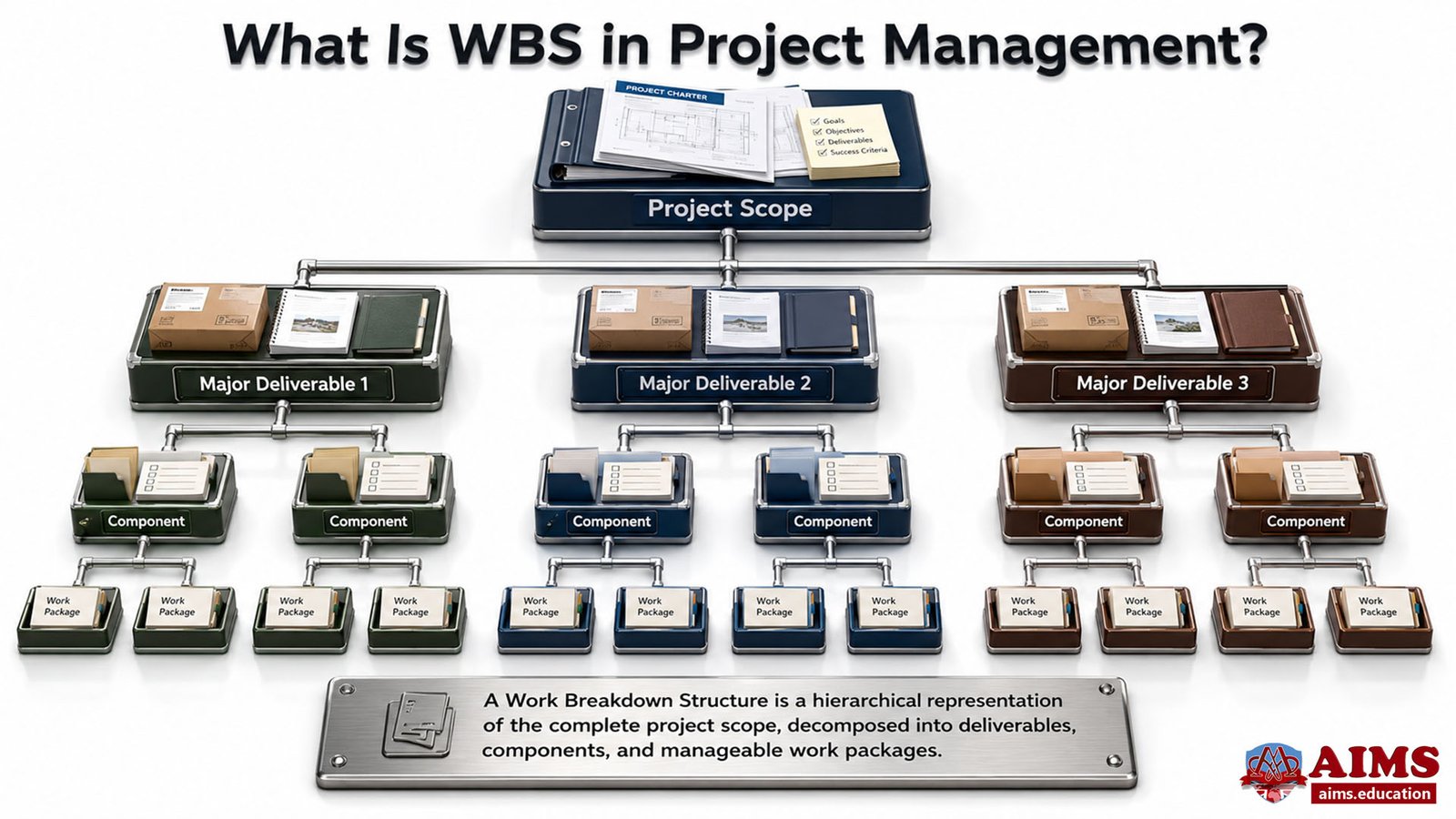
This relationship makes WBS closely connected with structured project scope management and control. Once the scope is organized through the WBS, the resulting work packages can support later estimating, activity definition, scheduling, budgeting, monitoring, and control.
A WBS primarily describes what the project must deliver. It is not, by itself, a project schedule or a simple list of activities.
A WBS therefore answers an important planning question: What exactly must the project deliver? Rather than beginning with dates or individual activities, the project team first organizes the required project outcomes into a logical hierarchy. This makes the work breakdown structure in project management especially valuable when a project contains multiple deliverables, teams, technical components, or areas of responsibility.
What Is the Purpose of a WBS in Project Management?
The main purpose of a WBS is to organize 100% of the project scope into manageable components so that the work can be understood, estimated, assigned, planned, and controlled more effectively.
A well-developed project management WBS helps the project team to:
- Define the boundaries of the project scope more clearly.
- Break complex deliverables into manageable components.
- Identify work that might otherwise be overlooked.
- Create a logical basis for estimating time, cost, and resources.
- Clarify ownership and accountability for packages of work.
- Provide input for project schedules and budgets.
- Improve risk identification at specific areas of the project.
- Establish a common scope reference for stakeholders and project team members.
- Support monitoring and control by relating performance to defined areas of project work.
For professionals developing these capabilities formally, job oriented online project management course can provide broader training in scope, planning, scheduling, risk, cost, and project control techniques.

Understanding Work Breakdown Structure (WBS) Levels
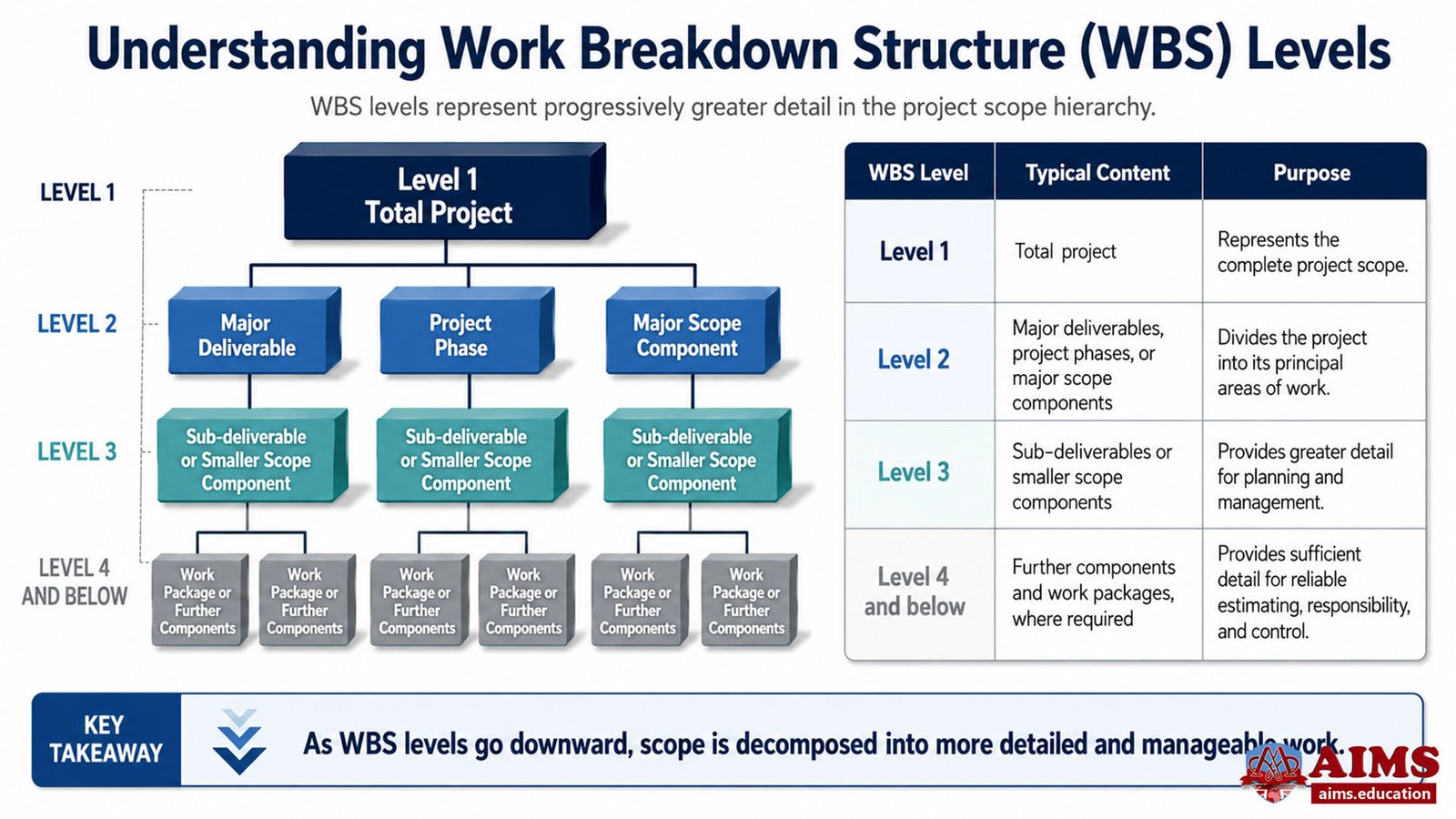
WBS levels represent progressively greater detail in the project scope hierarchy. The top level represents the complete project, while lower levels progressively decompose that scope until the project team reaches work packages that can be planned and controlled effectively.
There is no universal rule requiring every WBS to have exactly three, four, or five levels. The appropriate depth depends on project complexity, management needs, risk, estimating requirements, and the level at which meaningful responsibility and control can be established.
| WBS LEVEL | TYPICAL CONTENT | PURPOSE |
|---|---|---|
| Level 1 | Total project | Represents the complete project scope. |
| Level 2 | Major deliverables, project phases, or major scope components | Divides the project into its principal areas of work. |
| Level 3 | Sub-deliverables or smaller scope components | Provides greater detail for planning and management. |
| Level 4 and below | Further components and work packages, where required | Provides sufficient detail for reliable estimating, responsibility, and control. |
What Is a Work Package in Project Management?
A work package in project management is the lowest level of the WBS at which the project team intends to manage a defined portion of project work. It represents a manageable scope component that can subsequently support estimating, scheduling, responsibility assignment, monitoring, and control.
A work package should be detailed enough for effective management but should not be decomposed simply for the sake of producing more detail. Excessive decomposition increases administrative effort and can make the WBS unnecessarily difficult to maintain.
Example of a Work Package
Suppose a project includes the major deliverable Customer Website. Its decomposition could include:
- Customer Website
- User Interface
- Approved Page Designs
- Responsive Interface Package
- Customer Account System
- Registration Module
- Authentication Module
- User Interface
The work packages provide clearly bounded pieces of scope from which detailed project activities can later be developed.
What Information Does a WBS Contain?
A WBS primarily contains hierarchically organized scope components such as deliverables, sub-deliverables, and work packages. It should not be confused with all the information contained in the project schedule, resource plan, cost estimate, or responsibility matrix.
The most important WBS components normally include:
- Project: The complete scope appears at the highest level of the hierarchy.
- Major deliverables or phases: These create the principal branches of the WBS.
- Sub-deliverables: These progressively define the components required to produce larger deliverables.
- Work packages: These represent the lowest level selected for management and control.
- WBS identifiers: Numbering or coding systems can identify the position of each component within the hierarchy.
Activities, dependencies, start dates, finish dates, milestones, and resource assignments may be developed from WBS components, but they should not automatically be treated as structural elements of the WBS itself.
What Is a WBS Dictionary?
A WBS dictionary is a supporting document that provides detailed information about individual WBS components, especially work packages. The graphical WBS shows the hierarchy, while the dictionary explains what each important component actually includes.
Depending on the project and organizational methodology, a WBS dictionary may document information such as:
- WBS identification code.
- Description of the work or deliverable.
- Scope boundaries.
- Responsible organization or owner.
- Important assumptions and constraints.
- Expected deliverables.
- Acceptance criteria.
- Applicable technical references.
- Relevant milestones or planning information.
The WBS dictionary is particularly useful when the name of a work package alone is not sufficient to communicate its exact scope. It reduces ambiguity and helps different stakeholders interpret the WBS consistently.
How to Create a Work Breakdown Strucutre in Project Management
To create a Work Breakdown Structure in project management, define the project scope, identify its major deliverables, select a logical decomposition approach, progressively break those deliverables into smaller components, establish work packages, and verify that the hierarchy represents the complete scope without unnecessary duplication.
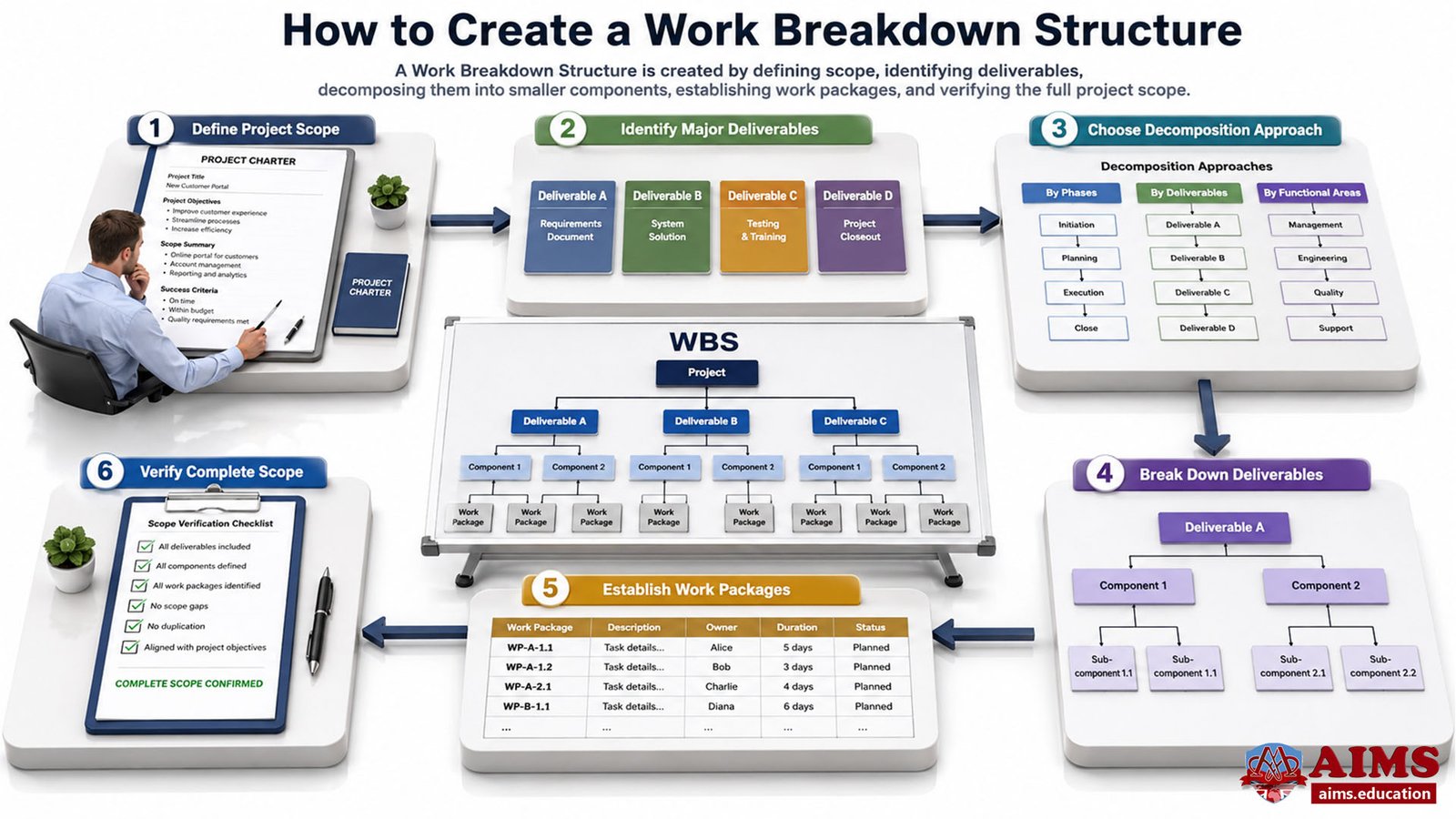
The following process provides a practical answer to how to create a WBS.
Step 1: Confirm the Project Scope and Objectives
Begin by understanding what the project is expected to accomplish and deliver. Review the agreed objectives, requirements, major deliverables, assumptions, constraints, and important scope boundaries.
A weak or incomplete understanding of scope will usually produce an equally weak WBS.
Step 2: Identify the Major Deliverables
Identify the major outputs required to achieve the project objectives. Depending on the project, these may be products, systems, facilities, documents, services, or other verifiable results.
For example, a mobile application project might initially identify:
- User interface.
- Application functionality.
- Database environment.
- Testing and release package.
Step 3: Select the WBS Organization
Decide how the upper levels will be structured. A project may be organized primarily around major deliverables or, where appropriate, around major project phases that contain their respective deliverables.
The structure should reflect how the project team can most clearly define and manage the project scope.
Step 4: Decompose Major Components
Decomposition means progressively breaking a larger scope component into smaller and more manageable components. Each lower level should provide a more detailed representation of the scope contained within its parent.
For example:
- User Interface
- Navigation System
- Dashboard Interface
- Profile Interface
The team continues decomposition until further breakdown would no longer provide meaningful management value.
Step 5: Define the Work Packages
Determine the lowest components that can be estimated, assigned, monitored, and controlled with reasonable confidence. These become the work packages.
The project team can then use those packages as inputs when developing project time and schedule planning and project cost estimating and control.
Step 6: Assign WBS Codes and Prepare the WBS Dictionary
A logical coding structure makes individual WBS components easier to identify and reference. For example, a numbering system such as 1.0, 1.1, 1.1.1, and 1.1.2 can communicate the relationship between parent and child components.
Where additional explanation is required, document the scope and management details in the WBS dictionary.
Step 7: Validate the Complete WBS
Review the WBS with relevant team members and stakeholders. Confirm that all required project scope is represented, nothing outside the approved scope has been added, work has not been duplicated between branches, and each work package is sufficiently clear for planning and control.
Validation at this stage can prevent major estimating, scheduling, responsibility, and control problems later in the project.
Three Important Rules for an Effective WBS
An effective WBS should completely represent the project scope, avoid overlapping scope between components, and focus primarily on deliverables or outcomes rather than becoming a list of scheduled actions.
1. The 100% Rule in WBS
The 100% rule in WBS means that the WBS should include 100% of the work required by the defined project scope and no work outside that scope.
The rule also applies at each level of decomposition. Together, the child components beneath a parent should represent the complete scope of that parent. If the parent represents the entire website, for example, its child components collectively must represent the entire website scope assigned to that branch.
2. Avoid Overlapping Scope
Each WBS component should have a clear scope boundary. The same work should not appear under two different branches because duplication can distort budgets, estimates, ownership, and performance reporting.
Mutually exclusive components make the hierarchy easier to understand and reduce the risk of double counting project work.
3. Focus on Outcomes Before Activities
A WBS should primarily describe project scope rather than become a detailed activity list. For this reason, deliverable-oriented descriptions are generally clearer at the WBS level.
For example:
- Deliverable: Approved braking system.
- Activity: Calibrate brake components.
The braking system describes an outcome within the project scope. Calibration is an action that may later appear in the activity or schedule information associated with that work package.
Types of Work Breakdown Structure
The two most useful ways to organize the upper levels of a WBS are deliverable-based and phase-based structures. The appropriate choice depends on how the project scope can be communicated and controlled most clearly.
These types of work breakdown structure describe the primary logic used to organize the hierarchy rather than entirely different project management methods.
| FEATURE | DELIVERABLE-BASED WBS | PHASE-BASED WBS |
|---|---|---|
| Primary organization | Major project deliverables or products. | Major project or product life-cycle phases. |
| Main focus | What the project must produce. | How scope is grouped across major stages. |
| Typical Level 2 examples | Building, IT system, training package, documentation. | Design, development, testing, implementation. |
| Best suited when | Major outputs provide the clearest representation of project scope. | The project naturally progresses through distinct stages and deliverables can be organized within those stages. |
Deliverable-Based WBS
A deliverable-oriented WBS organizes project scope around the major outputs that the project must produce. Each major deliverable is decomposed into smaller deliverables or components until work packages are reached.
This format keeps attention on project outcomes and is particularly useful when the final product contains clearly identifiable systems, components, facilities, documents, or services.
Phase-Based WBS
A phase-based WBS organizes the upper hierarchy around major phases and then identifies the relevant deliverables within those phases. This can be useful where the life cycle itself provides a logical way to organize project scope.
However, phases should not turn the WBS into a chronological task list. Deliverables within each phase still need to define the scope being produced.
Is Responsibility-Based WBS a Separate Type?
Organizations sometimes organize project information according to responsible departments or teams. However, responsibility is more directly represented through an Organizational Breakdown Structure or responsibility assignment mechanism.
A WBS should remain focused on organizing project scope. Responsibility can then be mapped to individual WBS components and work packages.
Work Breakdown Structure Example
A work breakdown structure example shows how one large project can be progressively decomposed into major deliverables, smaller components, and manageable work packages.
Consider the mining development project used in the original discussion. A company plans to establish a processing operation in a remote area where substantial supporting infrastructure is also required.
Example: WBS for a Remote Mining Development Project
- Level 1: Remote Mining Development Project
- Level 2: Processing Facility
- Extraction System
- Processing System
- Power and Utilities
- Level 2: Transport Infrastructure
- Access Roads
- Rail Connection
- Airstrip
- Level 2: Community Infrastructure
- Employee Housing
- Medical Facilities
- Education Facilities
- Level 2: Project Support
- Project Management
- Regulatory Documentation
- Site Support Services
- Level 2: Processing Facility
The project team would continue decomposing selected branches until suitable work packages were established. Cost estimates, schedules, resources, procurement requirements, and risks could then be developed with much greater precision.
Breaking the project into manageable scope components therefore transforms an otherwise overwhelming project into a structure that can be systematically planned and controlled.
WBS vs Gantt Chart
A WBS organizes project scope, while a Gantt chart organizes project activities against time. The two tools are closely related but serve different purposes, which is why treating a Gantt chart as the WBS itself creates an important project planning misconception.
The distinction between WBS vs Gantt chart can be summarized as follows.
| FEATURE | WORK BREAKDOWN STRUCTURE | GANTT CHART |
|---|---|---|
| Main purpose | Defines and organizes project scope. | Displays project activities and timing. |
| Primary question | What must the project deliver? | When will project activities occur? |
| Structure | Hierarchical decomposition. | Activities displayed against a timeline. |
| Lowest planning component | Work package. | Scheduled activities or tasks. |
| Timing information | Not its primary purpose. | Shows planned dates, durations, sequencing, and often dependencies. |
| Relationship | Provides structured scope from which activities can be developed. | Can schedule activities derived from WBS work packages. |
Once activities have been developed from work packages, a Gantt chart for project scheduling and activity timing can show when those activities will occur and how they relate over time.
How WBS Supports Estimating, Scheduling, and Project Control
The WBS provides a common scope structure that can connect several project management processes without replacing those processes. This is one of its greatest practical advantages.
Cost Estimating and Budgeting
Estimators can calculate costs for manageable work packages and then aggregate those estimates to higher WBS levels. This bottom-up relationship can improve transparency because managers can see where major areas of project cost originate.
Scheduling
Work packages provide a logical starting point for defining the activities required to produce each scope component. Activities can then be sequenced, given durations, assigned resources, and incorporated into the project schedule.
Responsibility Assignment
Managers can assign ownership to specific work packages or control points. Responsibility therefore becomes connected to clearly defined project scope rather than vaguely worded project objectives.
Risk Management
The WBS also gives teams a structured way to examine where project uncertainty may occur. Reviewing risks by major deliverable or work package can complement a broader project risk identification and response process.
Performance Monitoring
Because the WBS organizes scope consistently, progress, cost, schedule information, and other performance measures can be related to clearly identifiable project components.
How WBS Helps Control Scope Creep and Gold Plating
A well-defined WBS supports scope control by making approved project work visible and establishing boundaries around individual deliverables and work packages.
Scope creep occurs when project scope expands without appropriate evaluation and control. Gold plating occurs when unnecessary features or work are intentionally added even though they were not part of the agreed scope. Both can introduce additional cost, time, risk, and complexity.
The WBS helps by giving managers a structured reference against which proposed work can be assessed. If a requested deliverable cannot be connected to approved project scope, the team should determine whether a formal change is required rather than automatically performing the additional work.
Can a WBS Be Used in Agile Project Management?
Yes. A WBS can be used in Agile environments when it is tailored to the level of scope definition and progressive elaboration appropriate to the project.
The PMI Practice Standard for Work Breakdown Structures explicitly addresses the application of WBS across agile, iterative, predictive, and incremental project life cycles.
In a predictive project, considerable scope decomposition may be completed during planning. In an adaptive environment, higher-level outcomes may initially be defined while lower-level detail evolves as the team learns more about the product and upcoming work.
For example, an Agile team might maintain higher-level product or release outcomes while detailed features, backlog items, and iteration work evolve progressively. The important principle is that the WBS should support scope understanding without forcing an inappropriate level of early detail.
This tailoring is consistent with the broader logic of adaptive and Agile project management practices, where planning and elaboration continue as information becomes available.
Tools and Formats for Creating a WBS
A WBS can be represented graphically, as an indented outline, in a table, or through project management software. The best format is the one that communicates the hierarchy clearly and remains practical to maintain.
Common formats include:
- Tree diagram: Displays the project at the top and progressively branches into lower-level components.
- Indented outline: Presents the WBS as numbered hierarchical levels such as 1.0, 1.1, 1.1.1, and 1.1.2.
- Tabular structure: Organizes WBS codes, components, descriptions, and related information in rows and columns.
- Project management software: Allows WBS components to connect with schedules, budgets, assignments, or other project information.
- Reusable template: A suitable work breakdown structure template can provide a starting hierarchy, although it must still be tailored to the actual project scope.
Kanban boards, calendars, and Gantt charts may subsequently use work that has been derived from the WBS, but they should not be treated as alternative forms of the WBS itself.
Complementary Project Breakdown Structures
Other hierarchical structures can complement the WBS by examining resources, risks, or organizational responsibility from different perspectives. They should not be confused with the scope-oriented purpose of the WBS.
Resource Breakdown Structure
A Resource Breakdown Structure organizes project resources into hierarchical categories such as people, equipment, materials, or facilities. It can help managers understand the types of resources needed to perform project work.
Risk Breakdown Structure
A Risk Breakdown Structure organizes identified sources or categories of project risk hierarchically. Instead of decomposing project scope, it provides a structured view of uncertainty and exposure.
Organizational Breakdown Structure
An Organizational Breakdown Structure represents organizational units, departments, teams, or reporting relationships. WBS components can be mapped to this structure when managers need to establish responsibility for specific work packages.
Common WBS Mistakes to Avoid
The most common WBS problems occur when teams omit scope, duplicate work, confuse deliverables with activities, decompose to an impractical level, or treat the WBS as a schedule.
- Missing scope: Required deliverables are absent from the hierarchy.
- Duplicate scope: The same work appears in multiple branches and may be estimated or assigned twice.
- Activity-oriented structure: The WBS becomes a list of actions rather than an organized representation of project scope.
- Too little decomposition: Work packages remain too large or unclear for reliable planning and control.
- Too much decomposition: Excessive detail creates unnecessary administration and maintenance.
- Weak work package definitions: Teams interpret the same work package differently because its boundaries or outputs are unclear.
- Ignoring the 100% rule: The hierarchy either excludes required work or introduces work outside the approved scope.
- Confusing WBS with scheduling: Dates and dependencies begin driving the structure instead of the project’s required scope.
Professional Importance of WBS Project Management
WBS competence enables project professionals to translate broad objectives into clearly structured, manageable project scope. That ability influences estimating, budgeting, scheduling, accountability, communication, risk analysis, and project control.
Project managers who understand decomposition also become better equipped to connect project scope with other planning disciplines. For learners seeking broader academic development, an diploma in project management that includes PMP, PMI-ACP, PgMP and PfMP Trainings can develop these interconnected planning and control capabilities.
At a more advanced management level, an online and accredited MBA in project management can place scope structuring and project planning within a wider strategic, managerial, and organizational context.
Final Words on Work Breakdown Structure
A Work Breakdown Structure converts the total project scope into an organized hierarchy that project teams can understand and manage. Its real value comes from disciplined decomposition: beginning with the project, identifying major deliverables, breaking them into smaller scope components, defining suitable work packages, and ensuring that the complete hierarchy satisfies the 100% rule.
Most importantly, the WBS should remain a scope-management structure. Activities, durations, dependencies, resources, and schedules can be developed from it, but they serve different planning purposes. When this distinction is understood, the WBS becomes a powerful foundation for professional project planning and control.
Frequently Asked Questions
What is a Work Breakdown Structure (WBS) in project management?
A Work Breakdown Structure is a hierarchical decomposition of the complete project scope into progressively smaller components. The hierarchy normally begins with the total project and continues through major deliverables and sub-deliverables until manageable work packages are defined.
What is the purpose of a WBS in project management?
The purpose of a WBS is to organize the complete project scope into manageable components. This provides a structured foundation for estimating, scheduling, budgeting, responsibility assignment, risk analysis, monitoring, communication, and project control.
How do you create a Work Breakdown Structure?
Start by confirming the project scope and objectives, identify major deliverables, select an appropriate hierarchy, decompose each major component, define manageable work packages, assign WBS codes where useful, prepare supporting WBS dictionary information, and verify that the hierarchy represents 100% of the required scope.
What are the different levels of a WBS?
Level 1 usually represents the entire project. Level 2 contains major deliverables, phases, or scope components. Lower levels progressively provide more detail until the work package level is reached. The required number of levels depends on the project’s management and control needs.
What is a work package in a WBS?
A work package is the lowest WBS component selected for project management and control. It represents a clearly defined portion of scope that can support estimating, activity definition, scheduling, responsibility assignment, monitoring, and cost control.
What is the 100% rule in a Work Breakdown Structure?
The 100% rule means that the WBS must represent all work required by the defined project scope and no work outside it. At every parent level, its child components should collectively represent 100% of the scope contained within that parent.
What is a WBS dictionary and why is it important?
A WBS dictionary provides supporting information about WBS components, especially work packages. It can clarify descriptions, boundaries, ownership, assumptions, acceptance criteria, references, and other details that cannot be communicated adequately by the WBS hierarchy alone.
What are the different types of Work Breakdown Structures?
Two common organizational approaches are deliverable-based and phase-based WBS structures. A deliverable-based WBS organizes scope around major project outputs, while a phase-based WBS organizes the upper hierarchy around major life-cycle stages and identifies the relevant deliverables within those stages.
What is the difference between a WBS and a Gantt chart?
A WBS organizes and decomposes project scope, while a Gantt chart displays scheduled activities against time. Work packages from the WBS can provide a basis for defining activities that are later scheduled and displayed in a Gantt chart.
What is the difference between deliverable-based and phase-based WBS?
A deliverable-based WBS organizes the project primarily according to what must be produced. A phase-based WBS uses major project or product life-cycle stages at the upper level and then organizes the relevant deliverables within those stages.
What is an example of a Work Breakdown Structure?
A mining development project might be divided into major deliverables such as processing facilities, transport infrastructure, community infrastructure, and project support. Each major deliverable would then be progressively decomposed into smaller components until manageable work packages were established.
Can a WBS be used in Agile project management?
Yes. A WBS can be tailored for Agile and other adaptive environments. Higher-level outcomes can be structured first, while lower-level detail is progressively elaborated as the team learns more about requirements, releases, features, and upcoming work.
Project Management Education at AIMS
Since 2005, AIMS’ Project Management Academy has supported a global community of learners through internationally accredited, standardized, and career-focused project management education. Its qualified faculty combines industry-oriented teaching with practical skill development, 3D interactive learning content, and real-world case studies. AIMS educational content, study materials, and curriculum are collaboratively developed and rigorously peer-reviewed by an academic board of qualified industry practitioners. Understanding WBS strengthens the professional competence required for effective scope planning and project control. Explore AIMS’ practical and career-focused project management education.