
Sprint project management is a practical way of organizing complex work into short, fixed-length cycles called Sprints, with each cycle focused on a clear goal and a usable result. In Scrum, a Sprint lasts one month or less and contains Sprint Planning, Daily Scrums, Sprint Review, and Sprint Retrospective, creating a repeatable rhythm for inspection, adaptation, and value delivery.
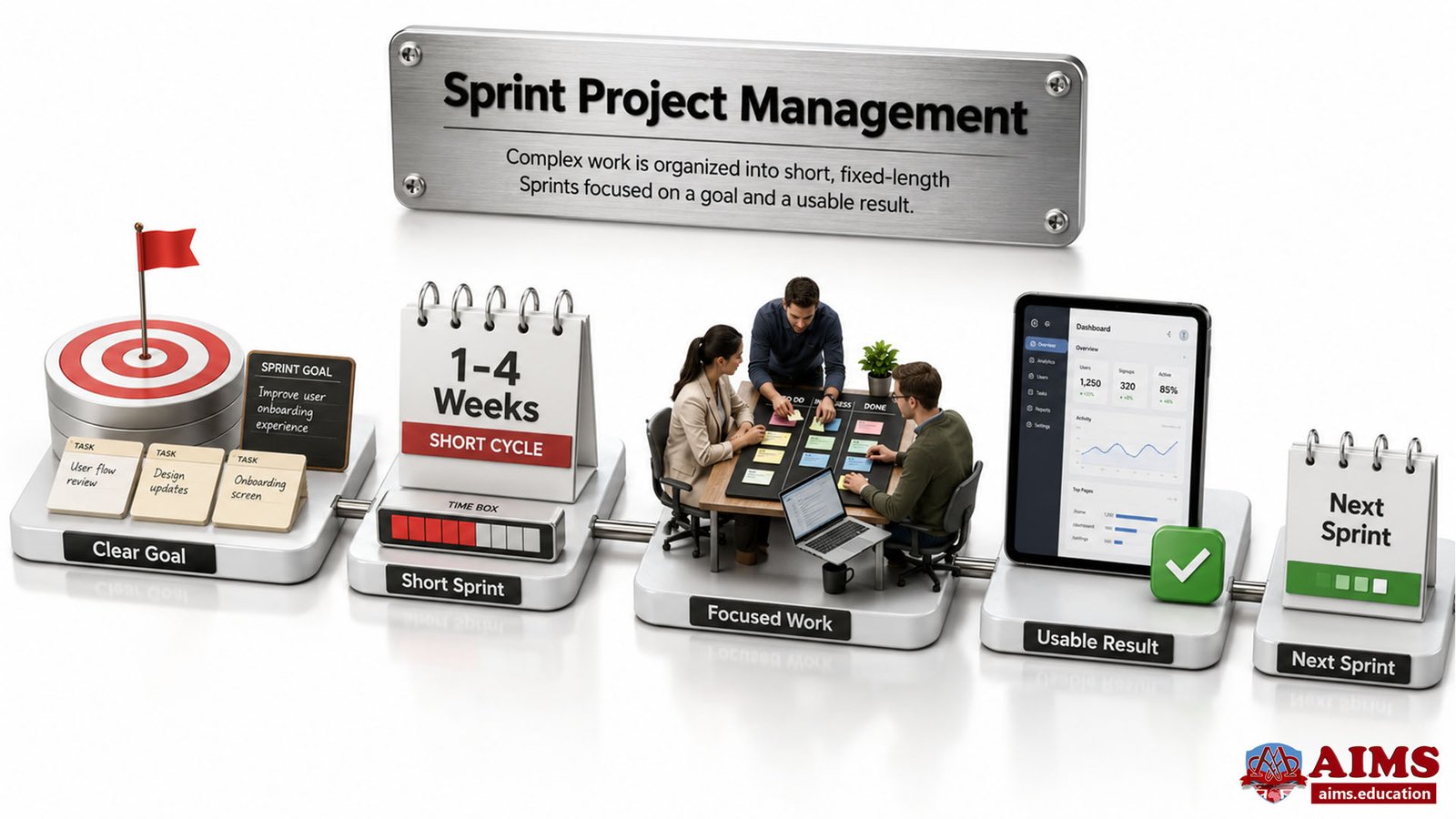
An Agile sprint is most closely associated with Scrum, although not every Agile approach uses Scrum-style Sprints. The key idea is disciplined short-cycle learning: the team selects valuable work, plans how to complete it, inspects progress frequently, produces a usable Increment, and learns from stakeholder feedback before beginning the next cycle.

What Is a Sprint in Project Management?
A Sprint is a fixed-length Scrum event in which a team works toward a single Sprint Goal and creates one or more usable Increments of value. Official Scrum guidance limits the sprint duration to one month or less, and a new Sprint begins immediately after the previous Sprint ends.
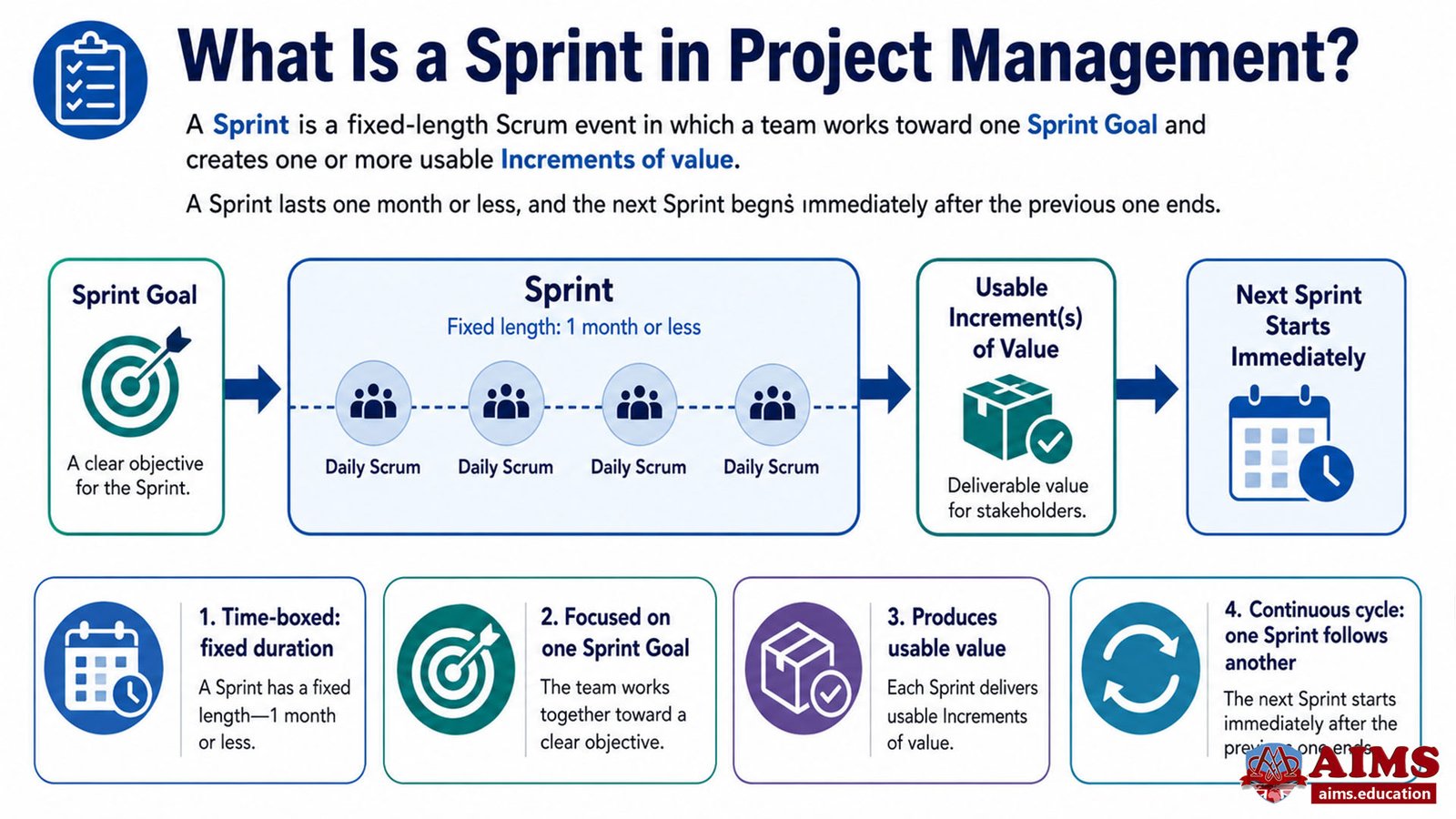
The phrase project management sprint is often used more broadly to describe a short cycle of focused delivery. In formal Scrum, however, the Sprint has a specific place in the framework. It contains the other Scrum events and provides the regular cadence within which the Scrum Team plans, works, inspects outcomes, and adapts.
Sprints are the heartbeat of Scrum, where ideas are turned into value.
A Sprint has several defining characteristics:
- The Sprint has a fixed length of one month or less, creating a consistent planning and learning rhythm.
- The Scrum Team works toward one Sprint Goal, which gives the cycle a coherent purpose.
- No change should be introduced that would endanger the Sprint Goal.
- Quality should not decrease in order to finish more work.
- The Product Backlog can be refined as new information emerges.
- Scope can be clarified and renegotiated with the Product Owner as the team learns, provided the Sprint Goal remains protected.
- The Sprint produces a usable Increment that satisfies the Definition of Done.
This makes a Sprint more than a short deadline. It is an empirical control cycle designed to convert learning into better decisions. If you need the wider context, you can review Guide on Agile project management – How it works? and compare it with other project management methodologies used for different delivery conditions.
How Does Sprint Project Management Work in Scrum?
Sprint-based work in Scrum operates through empiricism: teams make work visible, inspect actual progress, and adapt their plans based on what they learn. The source framework describes three empirical pillars, transparency, inspection, and adaptation, supported by the Scrum values of Commitment, Focus, Openness, Respect, and Courage.
This matters because a Scrum sprint is not simply a compressed project schedule. It creates a controlled environment for complex work, where complete prediction is difficult and decisions improve through frequent feedback.
The Scrum Team During a Sprint
The Scrum Team is a small, cross-functional, self-managing unit consisting of one Product Owner, one Scrum Master, and Developers. The team is collectively accountable for creating a valuable and useful Increment each Sprint, while each accountability has a distinct contribution.
- The Product Owner maximizes product value, orders the Product Backlog, communicates the Product Goal, and remains accountable for effective backlog management.
- The Developers create the Sprint Backlog, maintain quality through the Definition of Done, adapt the daily plan toward the Sprint Goal, and hold one another professionally accountable.
- The Scrum Master helps establish Scrum, supports team effectiveness, coaches self-management, helps remove impediments, and ensures Scrum events remain productive and within their timeboxes.
For a fuller explanation of how the framework fits together, see AIMS’ guide to Scrum project management framework.
Sprint Methodology – Stages of a Sprint Cycle
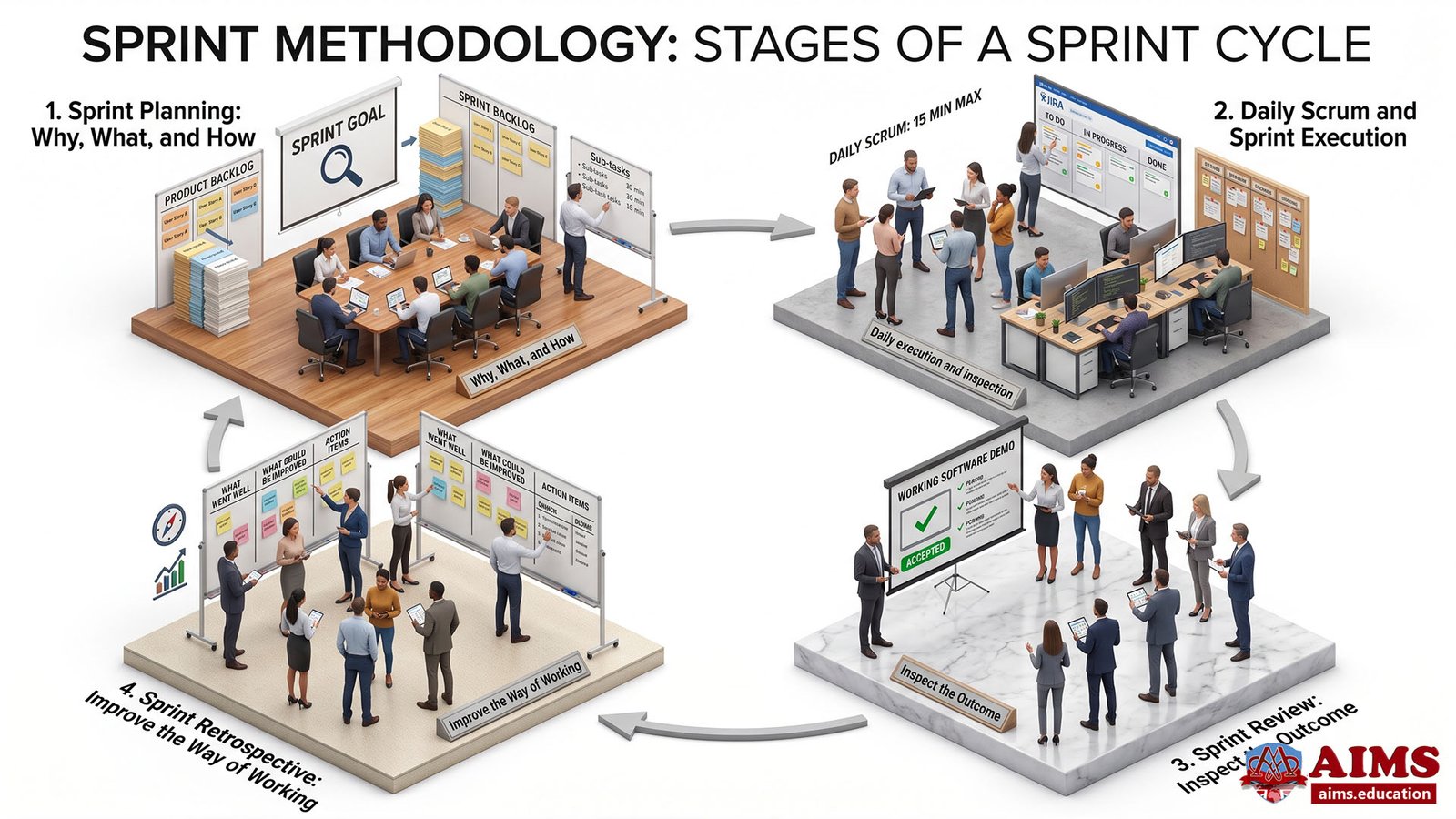
The sprint cycle begins with Sprint Planning, continues through daily execution and inspection, examines the outcome in the Sprint Review, and closes with the Sprint Retrospective. All of these activities occur inside the Sprint, rather than being separate phases outside it.
| SCRUM EVENT | PRIMARY PURPOSE | TIMING OR TIMEBOX | KEY PARTICIPANTS | MAIN OUTCOME |
|---|---|---|---|---|
| Sprint Planning | Define why the Sprint is valuable, what can be done, and how the selected work will be delivered. | At the start of the Sprint. Maximum eight hours for a one-month Sprint, usually shorter for shorter Sprints. | Entire Scrum Team, with invited advisers where useful. | Sprint Goal and Sprint Backlog. |
| Daily Scrum | Inspect progress toward the Sprint Goal and adapt the upcoming work. | Every working day. Fifteen minutes. | Developers. Product Owner or Scrum Master participates as a Developer when actively working on Sprint Backlog items. | An actionable plan for the next day of work. |
| Sprint Review | Inspect the Sprint outcome with stakeholders and determine useful future adaptations. | Near the end of the Sprint. Maximum four hours for a one-month Sprint. | Scrum Team and key stakeholders. | Shared understanding of results, changed conditions, and possible Product Backlog adjustments. |
| Sprint Retrospective | Plan improvements in quality and effectiveness. | Concludes the Sprint. Maximum three hours for a one-month Sprint. | Scrum Team. | Actionable improvements for future work. |
1. Sprint Planning: Why, What, and How
Sprint Planning initiates the Sprint by creating a collaborative plan for the work to be performed. It answers three connected questions: Why is this Sprint valuable? What can be done this Sprint? How will the chosen work get done?
- The Product Owner proposes how the product could increase in value and helps the team connect the Sprint to the Product Goal.
- The Scrum Team collaboratively defines the Sprint Goal, which expresses the value and purpose of the Sprint.
- The Developers select Product Backlog items they believe can be completed, considering previous performance, available capacity, and the Definition of Done.
- The Developers plan how to create a usable Increment, often decomposing selected backlog items into smaller pieces of work.
The output is the Sprint Backlog, which combines the Sprint Goal, the selected Product Backlog items, and the actionable plan for delivering them.
2. Daily Scrum and Sprint Execution
The Daily Scrum is a 15-minute event used by Developers to inspect progress toward the Sprint Goal and adapt the Sprint Backlog. Its purpose is not to produce a management status report. It should improve focus, communication, self-management, quick decision-making, and the team’s plan for the next working day.
During execution, Developers can re-plan whenever necessary. The Daily Scrum provides a formal daily cadence, but it does not prevent the team from having more detailed discussions or adapting work throughout the day.
3. Sprint Review: Inspect the Outcome
The Sprint Review is a working session in which the Scrum Team and stakeholders inspect what was accomplished and discuss what should happen next. The team presents results, considers changes in the environment, discusses progress toward the Product Goal, and may adapt the Product Backlog to capture new opportunities.
The Review should not be reduced to a demonstration or approval ceremony. Scrum treats it as a collaborative inspection and adaptation event, and a usable Increment may be delivered before the Review when appropriate.
4. Sprint Retrospective: Improve the Way of Working
The Sprint Retrospective examines how the Sprint went and identifies changes that can improve quality and effectiveness. The Scrum Team considers people, interactions, processes, tools, assumptions, and the Definition of Done. It identifies what worked, what created problems, and which improvements would have the greatest impact.
The most useful improvement actions should be addressed quickly. Some may be added directly to the next Sprint Backlog, making continuous improvement part of the delivery system rather than a separate management exercise.
Sprint Goal, Sprint Backlog, Increment, and Definition of Done
A Sprint works because its purpose, work, and quality expectations are connected through the Sprint Goal, Sprint Backlog, Increment, and Definition of Done. These elements make progress visible and give the team a shared basis for inspection and adaptation.
What Is a Sprint Goal?
The Sprint Goal is the single objective for the Sprint. It gives the Developers flexibility in the exact work required while keeping the team aligned around one purpose. If the work proves different from what was expected, Developers can collaborate with the Product Owner to adjust Sprint Backlog scope without damaging the Sprint Goal.
What Is Included in a Sprint Backlog?
The Sprint Backlog contains the Sprint Goal, the Product Backlog items selected for the Sprint, and the actionable plan for delivering the Increment. It is a real-time plan by and for the Developers, and it is updated as the team learns more during the Sprint.
What Is the Increment?
An Increment is a usable, verified step toward the Product Goal. Multiple Increments can be created within one Sprint, but work only becomes part of an Increment when it meets the Definition of Done. This shared quality standard creates transparency about what is genuinely complete.
Sprint Project Management Example: A Two-Week Product Sprint
A two-week Sprint can show how a team turns a broad product objective into a focused, inspectable cycle of work. Consider Northstar Services, an imaginary company improving the online appointment process for its customers.
Example of a Two-Week Sprint
- Product context: Northstar wants customers to book and reschedule appointments more easily.
- Sprint Goal: Enable customers to select an available appointment slot and receive immediate confirmation.
- Selected backlog items: The Developers select availability display, slot selection, confirmation messaging, and basic validation work.
- Planning: The team decomposes the selected work, identifies technical dependencies, and confirms what can reasonably satisfy the Definition of Done within two weeks.
- Daily work: Developers inspect progress each working day, surface impediments, and adjust the plan while keeping the Sprint Goal stable.
- Review: At the end of the Sprint, stakeholders inspect the working booking flow and suggest improvements to cancellation and reminder options.
- Retrospective: The team identifies that late clarification of validation rules caused rework, so it agrees to refine similar rules earlier in the next Sprint.
- Increment: The completed booking flow meets the Definition of Done and is usable, even though other appointment features remain in the Product Backlog.
The practical impact is a short feedback cycle that converts stakeholder learning into a usable result and a better next plan.
How Long Should a Sprint Be?
In Scrum, a Sprint lasts one month or less, and teams may choose shorter Sprints when faster learning and lower exposure to risk are useful. The appropriate length should be short enough to preserve focus and learning, yet long enough for the team to create meaningful value consistently.
A longer horizon can allow the Sprint Goal to become less relevant as conditions change, while complexity and risk may increase. Shorter Sprints can produce more learning cycles and limit the cost and effort exposed before feedback arrives. Consistency also matters because a stable cadence helps teams and stakeholders build predictable working habits.
Sprint vs Scrum vs Iteration vs Traditional Project Phase
A Sprint is not the same as Scrum, and it should not automatically be treated as identical to every Agile iteration or traditional project phase. These concepts overlap in discussions of project delivery, but they serve different purposes.
| CONCEPT | MEANING | KEY DISTINCTION |
|---|---|---|
| Sprint | A fixed-length Scrum event of one month or less that contains the other Scrum events and focuses work on a Sprint Goal. | It is one component of Scrum, not the entire framework. |
| Scrum | A lightweight framework for generating value through adaptive solutions to complex problems. | Scrum includes accountabilities, events, artifacts, commitments, values, and empirical principles. |
| Iteration | A general term for repeating a cycle of work, learning, or development. | A Scrum Sprint is iterative, but the word iteration can be used in approaches that do not follow Scrum’s specific rules. |
| Traditional project phase | A lifecycle segment that commonly groups related work such as planning, design, execution, or closure. | A Sprint is a recurring timebox that can contain different types of work needed to produce a usable Increment. |
This distinction also explains why the phrase sprint methodology or sprint project management methodology should be used carefully. A Sprint is formally an event within Scrum. It is not, by itself, a complete project management methodology. For broader delivery choices, compare Agile vs Waterfall vs Hybrid project management approaches.
Benefits and Limitations of Sprint-Based Project Management
Sprint-based management can improve focus, feedback, transparency, and risk control when teams face complex work, but it depends on disciplined goals, empowered teams, and genuine inspection and adaptation. Short cycles are useful only when the organization uses them to learn and make better decisions.
| POTENTIAL BENEFIT | PRACTICAL LIMITATION OR RISK |
|---|---|
| Frequent inspection can reveal problems and changed conditions earlier. | Frequent events become wasteful if teams treat them as ceremonies without adaptation. |
| A single Sprint Goal improves focus and coherence. | Too many competing objectives can fragment the team’s attention. |
| Short horizons can reduce exposure to cost and effort before feedback. | Poorly selected Sprint lengths can create either unnecessary overhead or delayed learning. |
| A visible Sprint Backlog supports transparency and self-management. | Micromanagement undermines the Developers’ accountability for planning how the work is done. |
| The Definition of Done protects a shared understanding of quality. | Reducing quality to meet the timebox contradicts the discipline of Scrum. |
Best Practices for Effective Sprint Management
Effective Sprint management protects the Sprint Goal, keeps work transparent, uses realistic planning, maintains quality, and converts inspection into practical adaptation. The following practices reinforce the logic of Scrum rather than adding unnecessary process.
- Define one clear Sprint Goal that explains why the Sprint matters, rather than treating the Sprint as a container for unrelated tasks.
- Select work based on evidence such as previous performance, current capacity, and the Definition of Done, rather than optimistic pressure.
- Break selected Product Backlog items into understandable pieces that support daily inspection and timely problem solving.
- Use the Daily Scrum to inspect progress and adapt the plan, not as a reporting meeting for a manager.
- Keep the Sprint Backlog current so it reflects the Developers’ best understanding of the work still required.
- Protect quality throughout the Sprint and do not count unfinished work as part of the Increment.
- Run the Sprint Review as a collaborative working session with stakeholders, not merely as a presentation.
- Turn retrospective learning into concrete improvements that can influence the next Sprint.
These habits connect Sprint discipline with effective project management practices for reliable delivery, especially where teams must balance adaptation with accountability.
Common Sprint Management Mistakes
The most common Sprint mistakes occur when teams preserve the terminology of Scrum but weaken its purpose. A calendar full of Scrum events does not create empirical management unless transparency, inspection, adaptation, and team accountability are actually present.
- Treating every urgent request as permission to disrupt the Sprint Goal reduces focus and predictability.
- Using Sprint Planning to assign tasks to individuals weakens self-management and the Developers’ responsibility for the plan.
- Turning the Daily Scrum into a status meeting shifts attention away from progress toward the Sprint Goal.
- Using the Sprint Review only to demonstrate completed work misses the opportunity to inspect market, stakeholder, or environmental changes.
- Holding retrospectives without implementing improvements converts learning into discussion without adaptation.
- Counting work as complete before it meets the Definition of Done creates false transparency and can hide quality problems.
Can Sprints Be Used Outside Software Development?
Sprint-based work can be applied beyond software when teams are dealing with complex problems that benefit from short planning horizons, stakeholder feedback, and incremental value creation. Scrum’s definition of a product is broad enough to include a service, a physical product, or something more abstract.
For example, a service-improvement team could use a two-week Sprint to redesign one part of a customer onboarding process, test it with stakeholders, inspect the outcome, and refine the next set of improvements. A research team could organize an exploratory Sprint around a clearly defined learning objective. The important condition is not the industry. It is whether short empirical cycles genuinely improve decision-making and delivery.
Professional Relevance of Sprint Project Management
Understanding Sprints helps project professionals manage adaptive work without confusing flexibility with a lack of discipline. The most transferable capabilities include goal setting, backlog thinking, stakeholder collaboration, team facilitation, empirical decision-making, quality discipline, and continuous improvement.
Professionals who want a broader academic foundation can connect Sprint practice with AIMS’ job-oriented diploma for applied project management skills. Those focusing on structured professional development can explore best online project management certification course for working professionals or review the Certified Project Manager (CPM) pathway with professional PMP training.
Final Words on Sprint Project Management
Sprint project management is most useful when it is understood as disciplined short-cycle management, not simply faster project execution. In Scrum, every Sprint connects a clear goal, a transparent plan, daily inspection, stakeholder feedback, quality standards, and team learning. This structure gives professionals a practical way to manage uncertainty while preserving accountability. The Sprint therefore becomes a repeatable mechanism for turning complex work into usable value, evidence, and better decisions for the next cycle.
Frequently Asked Questions
What is a sprint in project management?
A Sprint is a fixed-length period used in Scrum to pursue a Sprint Goal and create a usable Increment. It lasts one month or less and contains Sprint Planning, Daily Scrums, Sprint Review, and Sprint Retrospective.
What is sprint project management?
Sprint project management is a practical description of managing work through short, focused delivery cycles. In formal Scrum, the Sprint is an event within the framework, not a standalone methodology.
How does a sprint work in Agile project management?
A Sprint begins with a goal and plan, continues through daily work and inspection, produces a usable Increment, and ends with review and retrospective learning. Scrum is an Agile framework that defines this Sprint structure explicitly.
How long is a Sprint in Scrum?
A Scrum Sprint has a fixed length of one month or less. Teams may use shorter Sprints to create faster learning cycles, limit risk exposure, and receive feedback sooner.
What are the stages of a project management Sprint?
The main flow includes Sprint Planning, execution with Daily Scrums, Sprint Review, and Sprint Retrospective. These events all occur within the Sprint, while backlog refinement and adaptation can also occur as needed.
What is the difference between a Sprint and Scrum?
Scrum is the complete framework. A Sprint is one event within Scrum and acts as the container for Sprint Planning, Daily Scrum, Sprint Review, and Sprint Retrospective.
What is the difference between a Sprint and an iteration?
An iteration is a general term for a repeated cycle of work or learning. A Scrum Sprint is a specifically defined iteration with a fixed length, Sprint Goal, Scrum events, artifacts, and commitments.
What happens during Sprint Planning?
The Scrum Team determines why the Sprint is valuable, what work can be completed, and how the Developers will create the Increment. The result is a Sprint Goal and Sprint Backlog.
What happens at the end of a Sprint?
The team inspects the outcome with stakeholders during the Sprint Review and then examines its own effectiveness during the Sprint Retrospective. The Retrospective concludes the Sprint, and the next Sprint starts immediately afterward.
Can Sprints be used outside software development?
Yes. Sprint-based work can support services, physical products, research, and other complex work when short feedback cycles, incremental value, and empirical adaptation are appropriate.
Project Management Academy at AIMS
Since 2005, AIMS’ Project Management Academy has supported global learners through internationally standardized, career-focused education backed by international accreditations, qualified faculty, and industry-oriented teaching. Its curriculum emphasizes practical skill development through 3D interactive learning content and real-world, case-study-based qualifications. Educational articles, study content, and curriculum are collaboratively developed and rigorously peer-reviewed by an academic board of qualified industry practitioners. Sprint-based delivery strengthens professional competence in adaptive planning and team leadership. Explore AIMS’ practical and flexible project management educational programs.