
Islamic banking products are Shariah-compliant financial products that connect funding to real assets, real trade, real services, or shared business risk. Instead of earning interest on pure lending, Islamic institutions earn profit through sale, lease, partnership, or investment structures linked to genuine economic activity. This is why Islamic banking products are built around ownership, possession, usufruct, partnership, and commercial responsibility rather than interest-bearing debt alone.
In practice, Islamic financial instruments are not all of one kind. They are:
- Trade based,
- Partnership based, and
- Lease based.
A few are best suited for working capital, some for manufacturing and agriculture, and others for equipment, property, or long-term business development.
Understanding these Islamic finance products is essential for students, researchers, and practitioners who want to see how Shariah principles shape financial transactions in the modern economy. For readers seeking a deeper academic foundation, AIMS offers an internationally accredited and globally recognized Islamic Finance course and an Masters degree in Islamic Banking and Finance that explore these structures in greater depth.
What Are Islamic Finance Products?
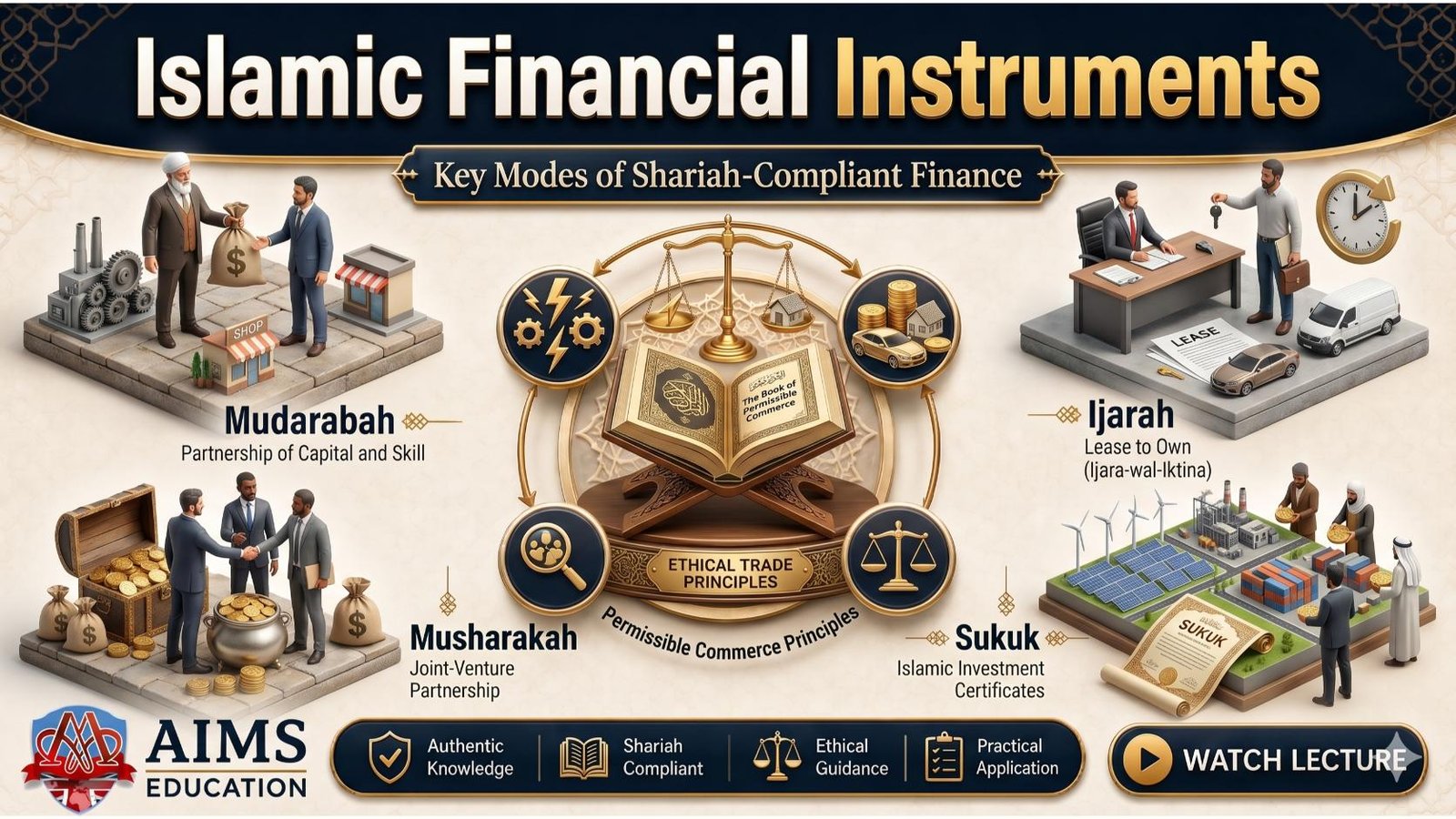
Islamic finance products are contractual methods used to provide funding, investment, trade finance, leasing, and business partnership in a way that complies with Islamic law. Their core feature is that return must arise from lawful trade, lease, investment, or risk sharing, not from riba, which means a prohibited increase over debt.
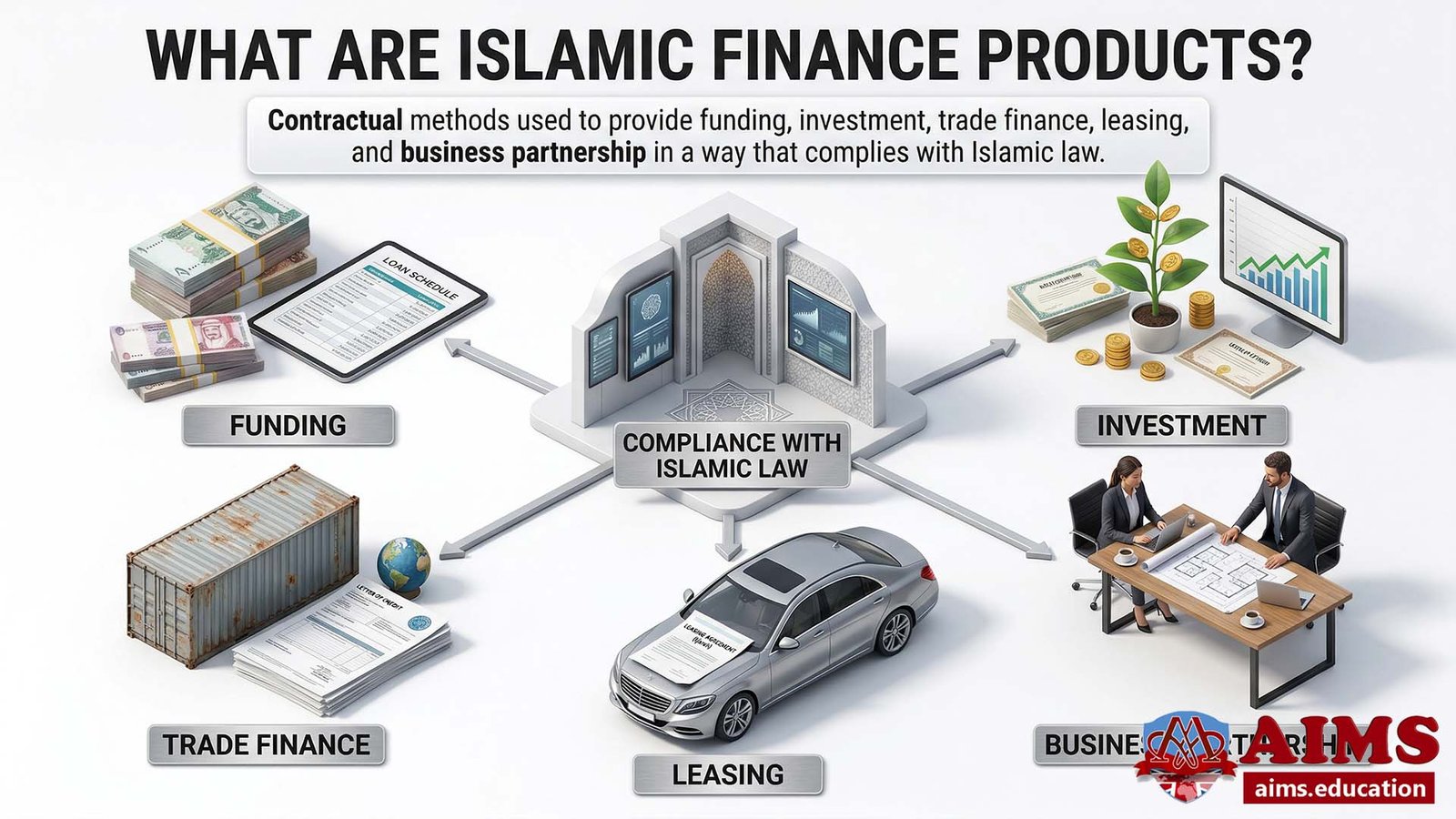
In simple terms, Shariah compliant financial products allow a bank or financier to earn profit only after taking a legitimate commercial role. That role may be seller in Murabaha, lessor in Ijarah, partner in Musharakah, or capital provider in Mudarabah. This is what distinguishes Islamic financial instruments from a conventional loan where money itself is rented for interest.
Many Islamic finance contracts also require that the subject matter be clearly known, that price or rent be properly determined, and that the rights and liabilities of all parties be clear. This reduces uncertainty and strengthens contractual fairness. These Shariah-compliant financial contracts are therefore not only legal forms, they are part of a broader ethical framework.
Shariah Principles Behind Islamic Banking Products
Prohibition of Riba and Asset-Backed Finance
The most important point is that Islam does not permit a guaranteed return on a pure loan simply because time has passed. That is why Islamic finance products do not treat money as a commodity that can earn interest by itself. Instead, finance must be linked to trade, leasing, manufacturing, agriculture, or partnership.
This principle explains why understanding riba in Islamic finance is essential before studying the various modes. It also explains the importance of an asset-backed Islamic financial model, where profit is tied to ownership, possession, use, or real entrepreneurial exposure.
Risk Sharing and Ownership in Shariah-Compliant Finance
Islamic banking products are based on a simple commercial logic: lawful return follows lawful exposure. If a financier sells an asset, it must own and bear risk in that asset before sale. If it leases an asset, it remains the owner and bears ownership-related liabilities. If it enters a partnership, profit may be shared by agreement, but loss follows the capital contribution or the contractual rules of the partnership.
This is also why Islamic financial instruments differ from conventional debt in a deeper way than terminology alone. The structure changes the source of profit. Profit comes from sale margin, rent, or actual business outcome, not from a time-linked charge on cash lending.
To understand the legal and ethical basis more clearly, it helps to study the key Shariah principles of Islamic banking before moving into the specific modes.
Categories of Shariah Compliant Financial Products
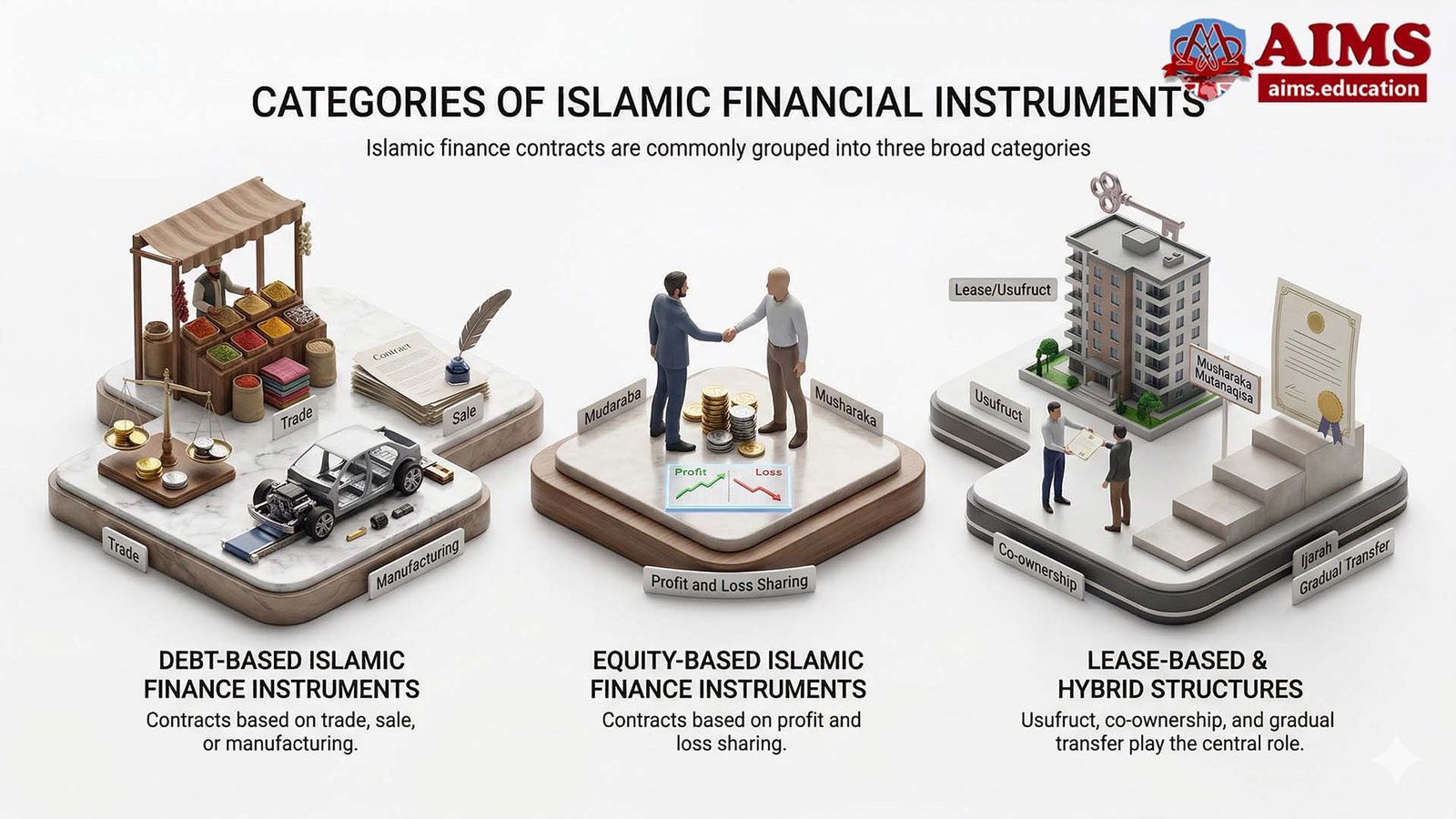
Shariah compliant financial products are commonly grouped into three broad categories.
- Debt-based Islamic finance instruments based on trade, sale, or manufacturing.
- Equity-based Islamic finance instruments based on profit and loss sharing.
- Lease-based and hybrid structures where usufruct, co-ownership, and gradual transfer play the central role.
This classification makes the field easier to understand, although some structures overlap in practice.
Debt-Based Islamic Finance Instruments
Murabaha
Murabaha is a cost-plus sale in which the seller discloses cost and sells the asset at a known markup. In banking use, the financier first purchases the asset, takes ownership and possession, then sells it to the client for a deferred price. The key point is that Murabaha is a sale, not a cash loan.
These Islamic finance products can only be used where a real commodity or asset is being purchased. The financier should ideally buy the asset directly, although agency structures are sometimes used. Even then, the goods must remain at the financier’s risk before resale. Once the Murabaha sale is concluded, the deferred price becomes a debt, and that debt cannot be increased because of late payment. Penalties for deliberate delay may be directed to charity, not treated as bank income.
For a fuller treatment, see Murabaha (cost-plus sale) financing contract.
Example of Murabaha
- A school needs computers worth $20,000.
- An Islamic bank buys the computers from the supplier.
- The bank takes ownership and assumes the asset risk before resale.
- The bank then sells the computers to the school for $23,000 on deferred payment over 12 months.
- The price is fixed once and cannot be increased later because of delay.
This example shows how Murabaha turns financing into a genuine sale transaction linked to a real asset.
Musawamah
Musawamah is also a sale, but unlike Murabaha, the seller does not disclose its original cost. The parties negotiate only the final price. All other major conditions remain similar, including ownership, possession, and the seller’s exposure to asset risk before sale.
Among Islamic banking products, Musawamah is especially useful where detailed cost disclosure is impractical or unnecessary. It can suit large transactions in which the buyer mainly cares about the final commercial price rather than the seller’s underlying acquisition cost.
For details, refer to a detailed guide on Musawamah contract.
Example of Musawamah
- An airline seeks to acquire specialized equipment.
- An Islamic bank purchases the equipment first.
- The bank and the airline negotiate a final deferred sale price without disclosing the bank’s detailed cost breakdown.
- The transaction is completed as a negotiated credit sale.
This example shows how Musawamah works where bargaining on the final price is commercially more practical.
Bai Salam
Bai Salam is a forward sale in which the buyer pays the full price in advance and the seller delivers specified goods later. It is especially relevant for agriculture and commodities where producers need upfront financing before harvest or production.
Among Islamic financial instruments, Salam has strict conditions. The price must be fully paid at the time of contract, the goods must be clearly specified, and the goods must be of a type whose quality and quantity can be precisely determined. This makes Salam useful, but carefully structured.
For more details, learn a detailed guide on Bai Salam Contract in Islamic Banking and Finance.
Example of Salam Contract
- A farmer needs $15,000 before the planting season.
- An Islamic bank enters a Salam contract for 10 tons of wheat to be delivered after harvest.
- The bank pays the full agreed price upfront.
- The farmer uses the funds for seeds, labor, and irrigation.
- At delivery, the wheat is supplied according to the agreed specifications.
This example shows how Salam provides early liquidity while keeping the contract tied to real goods.
Istisna
Istisna is an order to manufacture or construct something for delivery in the future. It is used for projects such as buildings, roads, plants, machinery, and other manufactured or constructed assets. Unlike Salam, the price in Istisna does not need to be paid fully in advance. It may be paid in installments according to the construction or production schedule.
This makes Istisna one of the most practical Islamic finance contracts for long-term project finance. The item must be properly specified, the price must be known, and the delivery arrangement must be clear. Because it suits staged production, it is widely used where immediate spot delivery is impossible. For a fuller explanation, see our detailed guide to the Istisna contract in Islamic banking and finance.
Example of Istisna
- A hospital wants a customized diagnostic unit built to exact technical specifications.
- An Islamic bank enters an Istisna arrangement with a manufacturer.
- The unit price, delivery timeline, and specifications are agreed at the outset.
- Payments are released in stages as manufacturing milestones are completed.
- The finished equipment is delivered on the agreed future date.
This example shows how Istisna supports manufacturing and construction through staged, specification-based financing.
Equity-Based Islamic Finance Products
Mudarabah
Mudarabah is a partnership in which one party provides capital and the other provides entrepreneurial effort, management, or expertise. Profit is shared according to a pre-agreed ratio, while financial loss is borne by the capital provider unless the manager is negligent, dishonest, or in breach of mandate.
Among Islamic finance products, Mudarabah is central because it reflects the spirit of profit and loss sharing. The manager cannot take a guaranteed return, and profit must be a percentage of actual profit, not a fixed amount. This is why Mudarabah (profit-sharing partnership) contract remains so important in Islamic banking and investment theory.
Example of Mudarabah
- An investor provides $100,000 to a halal food startup.
- The entrepreneur contributes management, market knowledge, and daily operations.
- They agree that any actual profit will be shared 60:40.
- If the venture earns $20,000 profit, it is distributed according to that ratio.
- If the business suffers a normal commercial loss without negligence, the capital loss falls on the investor, while the entrepreneur loses time and effort.
This example shows how Mudarabah aligns return with real entrepreneurial performance rather than a guaranteed fixed charge.
Musharakah
Musharakah is a joint partnership in which two or more parties contribute capital to a business or venture. Profit may be distributed according to an agreed ratio, but loss must follow the proportion of capital contribution. Partners may all participate in management, or some may become sleeping partners.
Islamic banking products based on Musharakah are especially useful for working capital, business expansion, project finance, and joint ventures. They embody shared ownership and shared commercial exposure more directly than debt-based structures. This makes Musharakah one of the most authentic equity-based Islamic financial instruments. For more detail, see our guide to the Musharakah contract in Islamic banking and finance
Example of Musharakah
- Partner A contributes $70,000 and Partner B contributes $30,000 to launch a packaging business.
- They agree to share profit 55:45 because Partner B will manage operations full time.
- If the business makes $40,000 profit, that profit is shared by agreement.
- If the business suffers a capital loss, it is borne 70:30 because loss follows capital contribution.
This example shows how Musharakah allows flexible profit distribution while preserving the Shariah rule on loss sharing.
Leasing and Hybrid Islamic Finance Products
Ijarah
Ijarah is an Islamic leasing, where the lessor keeps ownership of the asset and transfers only the right of use to the lessee for an agreed rent and period. The rent may be fixed or structured through a clear formula. Ownership-related liabilities remain with the lessor, while normal operating use belongs to the lessee.
This point is crucial. In valid Islamic finance products based on Ijarah, the lessor must bear ownership-related risk, major maintenance, and takaful-related obligations. If the arrangement shifts the full risks and rewards of ownership to the lessee while keeping only the form of lease, it loses its Shariah character. To learn more, refer to our guide to Ijarah contract in Islamic banking.
Example of Ijarah
- A manufacturing firm needs a machine worth $80,000.
- An Islamic bank purchases the machine and leases it to the firm for five years.
- The firm pays agreed rent for use of the machine.
- The bank remains owner during the lease and bears ownership-related obligations.
- If the lease ends and the parties want transfer of title, that transfer is handled through a separate agreement.
This example shows how Ijarah finances use of an asset without converting rent into disguised interest.
Diminishing Musharakah
Diminishing Musharakah combines co-ownership with gradual transfer of shares. One party, often the financier, progressively sells its ownership units to the client over time. Where the financier’s share is also leased, the client pays rent on the financier’s remaining share, and the rent decreases as ownership is gradually transferred.
These Islamic finance contracts are especially popular in housing and other fixed assets. The structure normally requires separate components for partnership, lease, and sale, so that each legal relationship remains clear and independent. For details, refer to our guide to diminishing musharakah in Islamic banking and finance.
Example of Diminishing Musharakah
- A family wants to purchase a home worth $200,000.
- The family contributes $40,000 and an Islamic bank contributes $160,000.
- Both become co-owners of the home.
- The bank leases its share to the family, so the family pays rent on the bank’s portion.
- Each month, the family buys additional ownership units from the bank.
- As the bank’s share declines, the rent also declines.
This example shows how Diminishing Musharakah combines ownership, leasing, and gradual acquisition in a structured way.
Applications of Islamic Banking Products
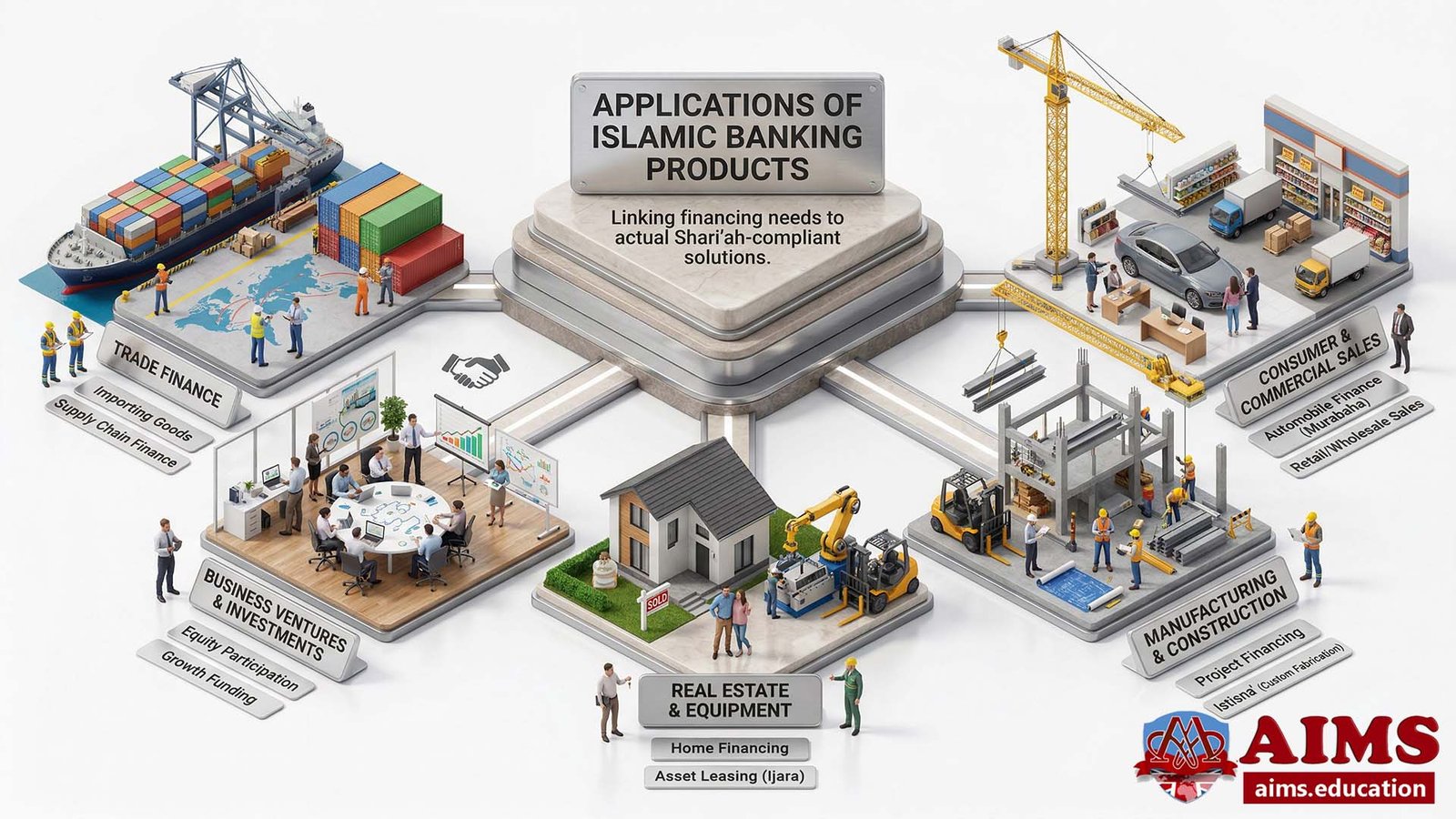
The applications of Islamic banking products become clearer when they are linked to actual financing needs.
- Trade finance: Murabaha and Salam are commonly used where businesses need inventory, commodities, or pre-delivery financing.
- Business ventures and investments: Musharakah and Mudarabah suit startup finance, joint ventures, and profit-sharing enterprise development.
- Real estate and equipment: Ijarah and Diminishing Musharakah work well for machinery, vehicles, commercial equipment, and housing.
- Manufacturing and construction: Istisna is especially effective where assets must be manufactured or constructed over time.
- Consumer and commercial sales: Murabaha and Musawamah can structure deferred purchases where real goods are involved.
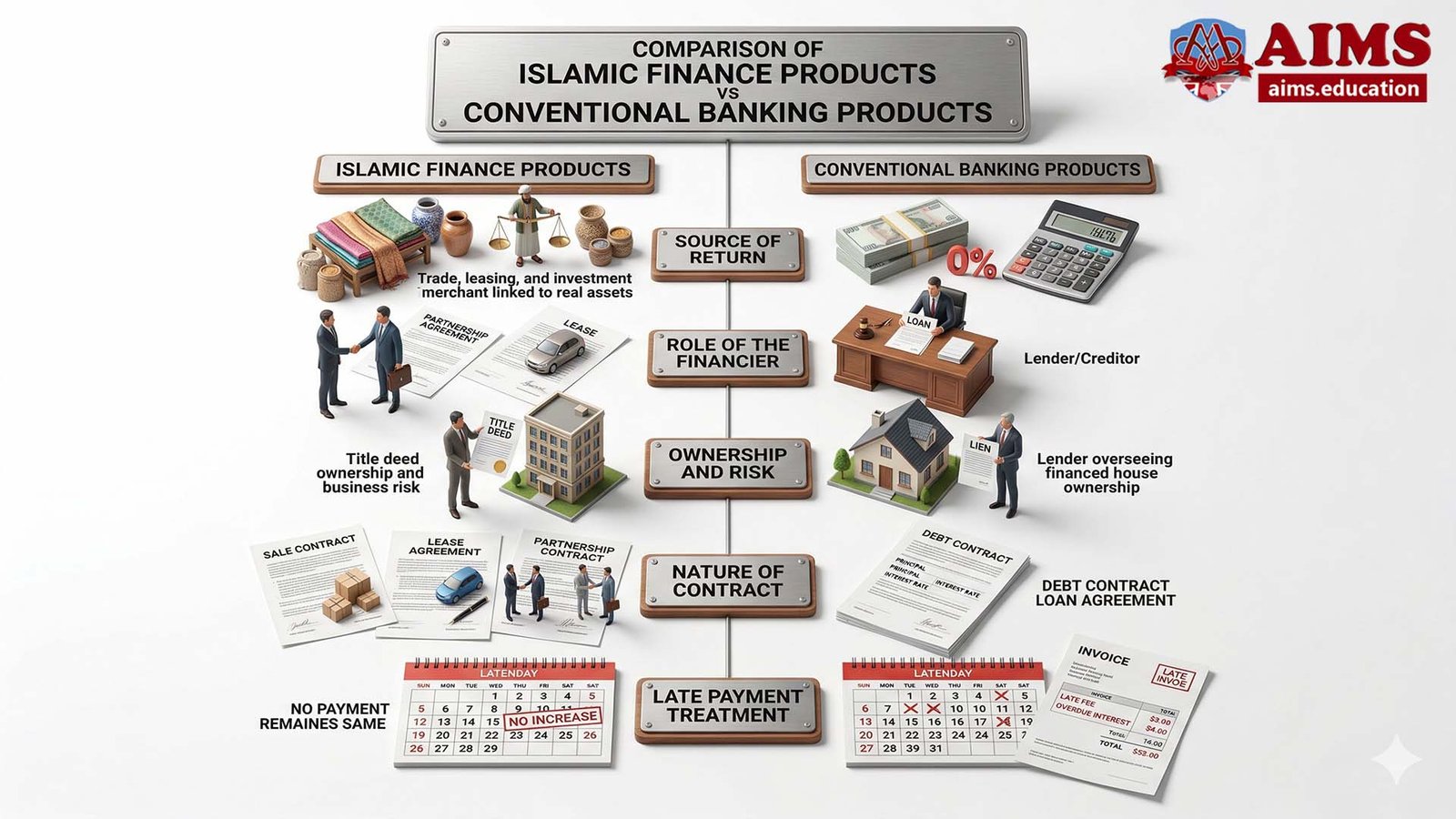
Islamic Banking Products vs Conventional Banking Products
| POINT OF DIFFERENCE | ISLAMIC FINANCE PRODUCTS | CONVENTIONAL BANKING PRODUCTS |
|---|---|---|
| Source of Return | Return comes from trade, leasing, partnership, or investment linked to real assets or real services. | Return commonly comes from interest charged on lending money. |
| Role of the Financier | The financier acts as seller, lessor, investor, or partner in a real transaction. | The financier mainly acts as lender or creditor. |
| Ownership and Risk | Ownership, possession, usufruct, or business risk must exist where profit is claimed. | The lender usually claims return without ownership of the financed asset. |
| Nature of Contract | The contract is structured around sale, lease, construction, or partnership. | The contract is usually structured around debt and interest. |
| Late Payment Treatment | Debt created by sale or lease cannot be increased merely because of delay. | Additional charges or interest may be imposed on overdue balances. |
Refer to our detailed guide explaining the key differences between Islamic banking and conventional banking.
Benefits and Limitations of Shariah Compliant Financing
Benefits
- Islamic financial instruments encourage a closer link between finance and the real economy. They promote contractual clarity, discourage pure speculative debt growth, and create room for partnership-based investment. They also support ethical screening by requiring lawful commercial activity.
- Another strength is conceptual fairness. These Islamic banking products recognize that reward should follow commercial responsibility. That principle can improve discipline in structuring finance and can create stronger alignment between financier and client.
Limitations
- At the same time, Islamic finance products can be more complex to structure and monitor.
- Ownership transfer, documentation, asset verification, and sequencing of contracts often require greater care than in a conventional loan.
- Differences among Shariah boards can also affect standardization, interpretation, and product design.
There is also a common misunderstanding that all Islamic finance contracts guarantee the same kind of return. That is incorrect. Sale and lease structures may produce predictable cash flows, but Mudarabah and Musharakah are based on actual business performance and therefore involve genuine variability.
Frequently Asked Questions
What Are Islamic Banking Products?
Islamic banking products are Shariah-compliant finance contracts that generate lawful return through trade, leasing, partnership, or investment rather than through interest on pure lending.
What Are the Main Types of Islamic Finance Products?
The main types of Islamic finance products are trade-based modes such as Murabaha, Musawamah, Salam, and Istisna, equity-based modes such as Mudarabah and Musharakah, and lease-based or hybrid modes such as Ijarah and Diminishing Musharakah.
How Does Murabaha Work in Islamic Financial Instruments?
In Murabaha, the financier first purchases and owns the asset, then resells it to the client at a disclosed markup, usually on deferred payment terms. Because it is a sale, not a loan, the profit is tied to ownership and transfer of the asset.
How Is Musharakah Different From Mudarabah?
In Musharakah, all partners contribute capital and may participate in management. Profit may be shared by agreement, but loss follows capital contribution. In Mudarabah, one party provides capital and the other provides effort or management. Financial loss falls on the capital provider unless there is negligence or misconduct by the manager.
When Are Salam and Istisna Used?
Salam is used when payment is made fully in advance for goods that will be delivered later, especially in agriculture and commodities. Istisna is used for manufacturing and construction where an asset must be produced or built over time and payment may be staged.
Why Is Ownership and Risk So Important in Islamic Finance Contracts?
Ownership and risk matter because Islamic law does not allow profit without genuine commercial exposure. A seller must own and bear risk in what it sells, a lessor must remain owner of what it leases, and an investor must accept business risk where return depends on enterprise performance.
Conclusion
Islamic finance products are not merely renamed versions of conventional loans. They are distinct legal and commercial structures built on sale, lease, manufacturing, partnership, and co-ownership. When properly applied, Islamic banking products connect finance to real economic activity and align profit with responsibility. That is what gives Islamic financial instruments their academic significance and practical relevance in modern banking and finance.
About AIMS’ Institute of Islamic Banking and Finance
AIMS’ Institute of Islamic Banking and Finance has delivered Islamic banking and finance education since 2005, supported by international accreditations, qualified faculty, and a global learner community. Its internationally standardized, career-focused curriculum combines industry-oriented teaching, practical skill development, 3D interactive learning content, and real-world case studies. This educational material, along with AIMS’ study content and curriculum, is collaboratively developed and rigorously peer-reviewed by an academic board of qualified industry practitioners, helping professionals build job-ready Islamic finance qualifications. Explore AIMS’ accredited and industry-focused Islamic banking and finance programs.