
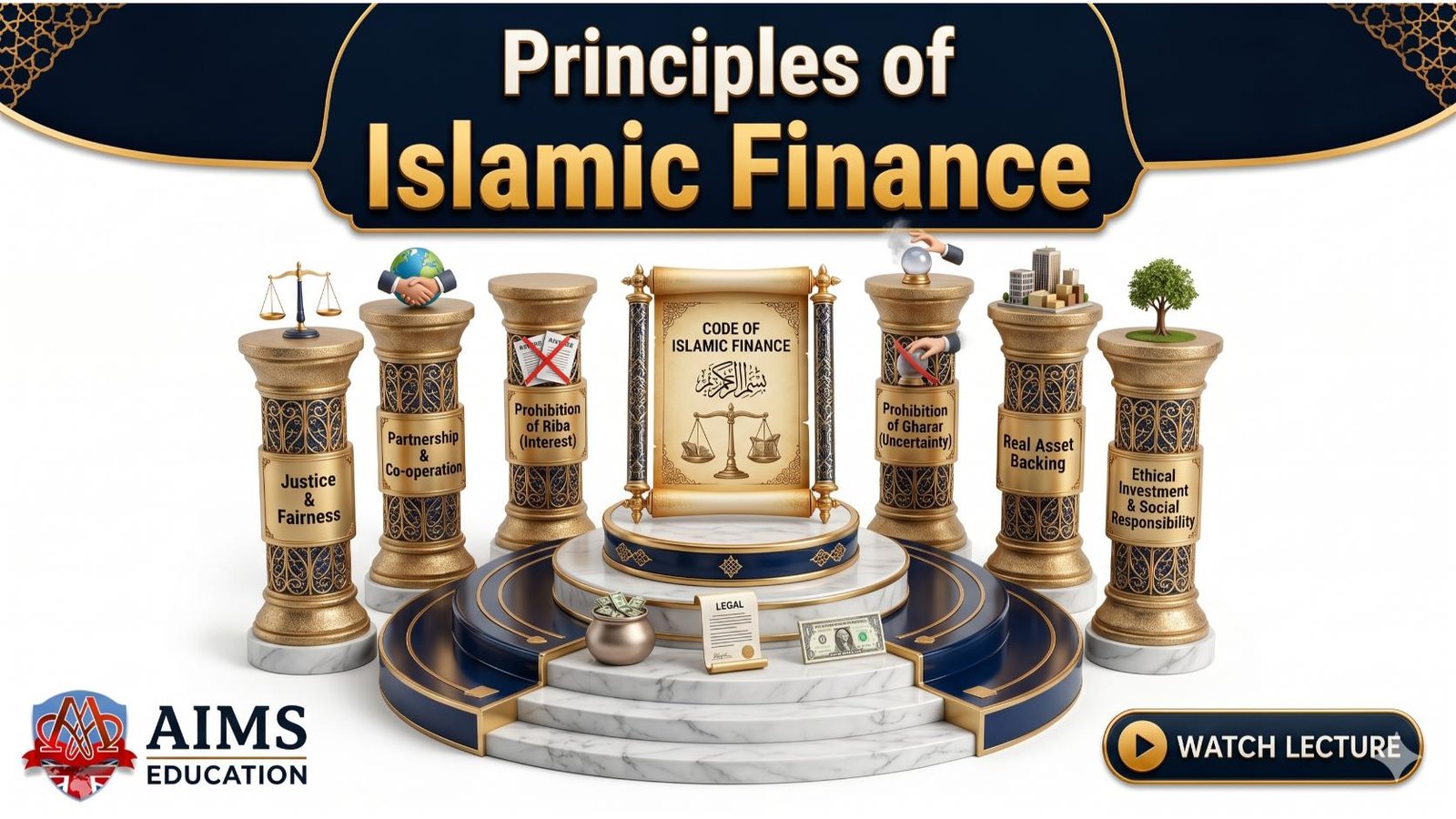
Islamic banking principles are the Shariah-based foundations that explain how banking can be conducted without riba, excessive uncertainty, gambling, or investment in prohibited activities. These Islamic finance principles connect financial return with real economic value, ethical conduct, risk-sharing, and social responsibility.
For people as what are the principles of Islamic finance?, the answer is not simply “banking without interest.” The principles of Islamic banking require lawful contracts, transparent terms, asset connection, shared commercial responsibility, and exclusion of activities that damage individual or public welfare.
In practical banking, the principles of Islamic finance shape products such as Musharakah, Mudarabah, Murabahah, Ijarah, Salam, Istisna, Sukuk, and Takaful. Students and professional who want structured study can build this foundation through a career-focused Islamic finance certification course that explains how Islamic financial contracts work in Islamic financial institutions.
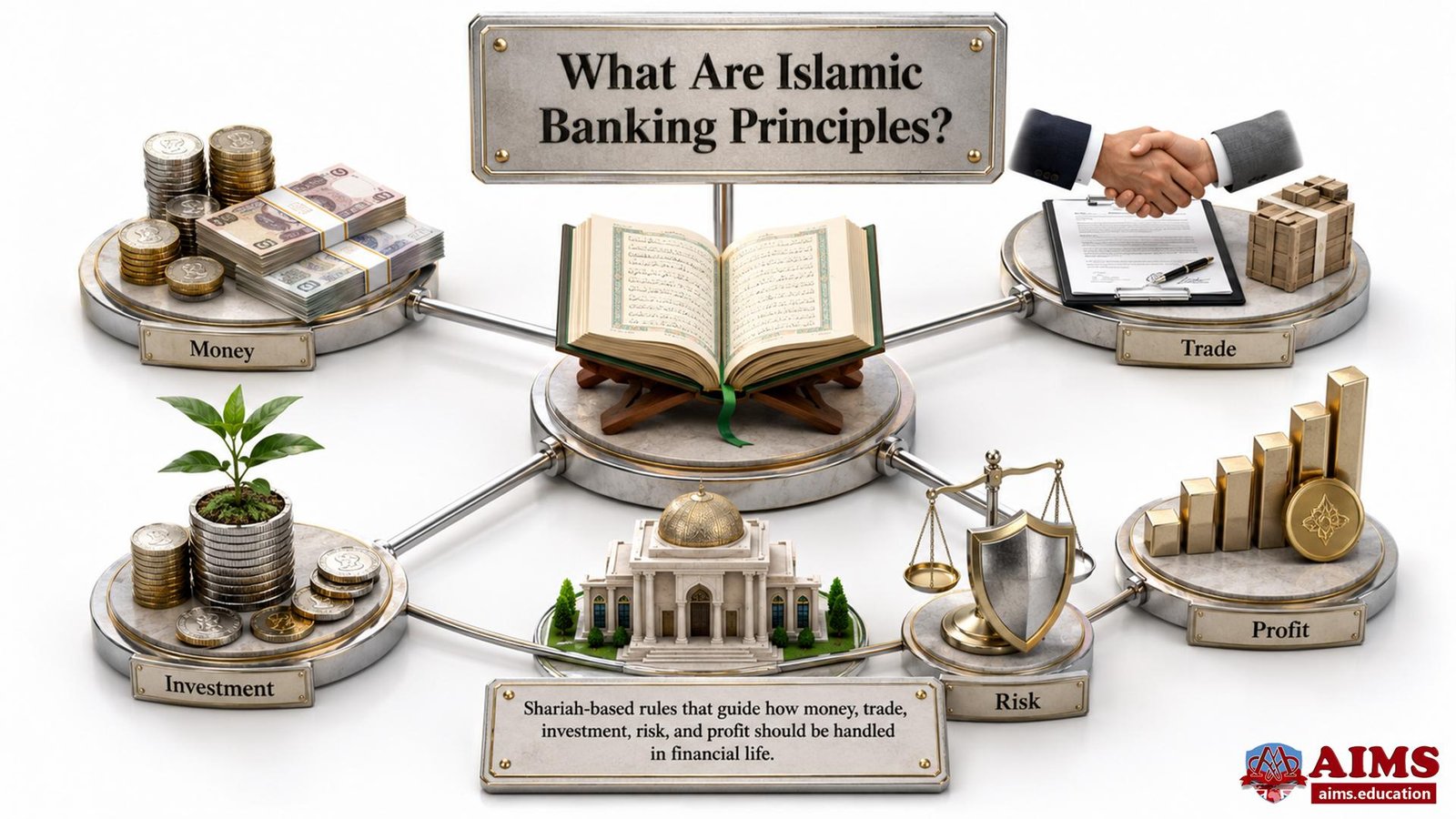
What Are Islamic Banking Principles?
Islamic banking principles are Shariah-based rules that guide how money, trade, investment, risk, and profit should be handled in financial life. They require finance to serve real economic activity, avoid unjust gain, and protect society from interest, excessive uncertainty, gambling, and harmful industries.
Shariah is often understood as a clear path for religious, ethical, legal, commercial, and social conduct. In banking, it does not mean that financial institutions cannot earn a return. It means that the return must arise from a lawful basis, such as ownership, trade, leasing, service, agency, or shared business performance.
A key distinction is between a charitable loan and commercial finance.
- If money is advanced only to help a borrower, the lender may recover the principal but may not demand an additional return.
- If capital is advanced for business, the financier may share actual profit, but must also accept the relevant commercial risk.
What Are the Main Principles of Islamic Finance?
The main principles of Islamic finance are the prohibition of riba, avoidance of gharar and maysir, profit and loss sharing, shared risk, ethical investment, asset-linked transactions, and social responsibility through Zakat. Together, they move finance from pure lending to fair trade, partnership, and accountability.
In simple terms, the question what are the main principles of Islamic finance? can be answered through the following foundations:
- Islamic finance prohibits riba because money should not generate a guaranteed return merely through the passage of time.
- Islamic finance avoids gharar because contract terms, asset details, price, delivery, and responsibilities must be clear.
- Islamic finance prohibits maysir because wealth should not be acquired through gambling, chance, or harmful speculation.
- Islamic finance encourages profit and loss sharing because commercial gain should be connected to real business performance.
- Islamic finance requires shared risk because return should not be separated from ownership, effort, or liability.
- Islamic finance supports ethical investment because capital should not promote industries that Shariah considers unlawful or harmful.
- Islamic finance emphasizes Zakat and social responsibility because wealth should circulate and support public welfare.
A contract becomes Shariah-compliant when its structure, documentation, ownership, risk transfer, and economic purpose comply with Shariah rules.
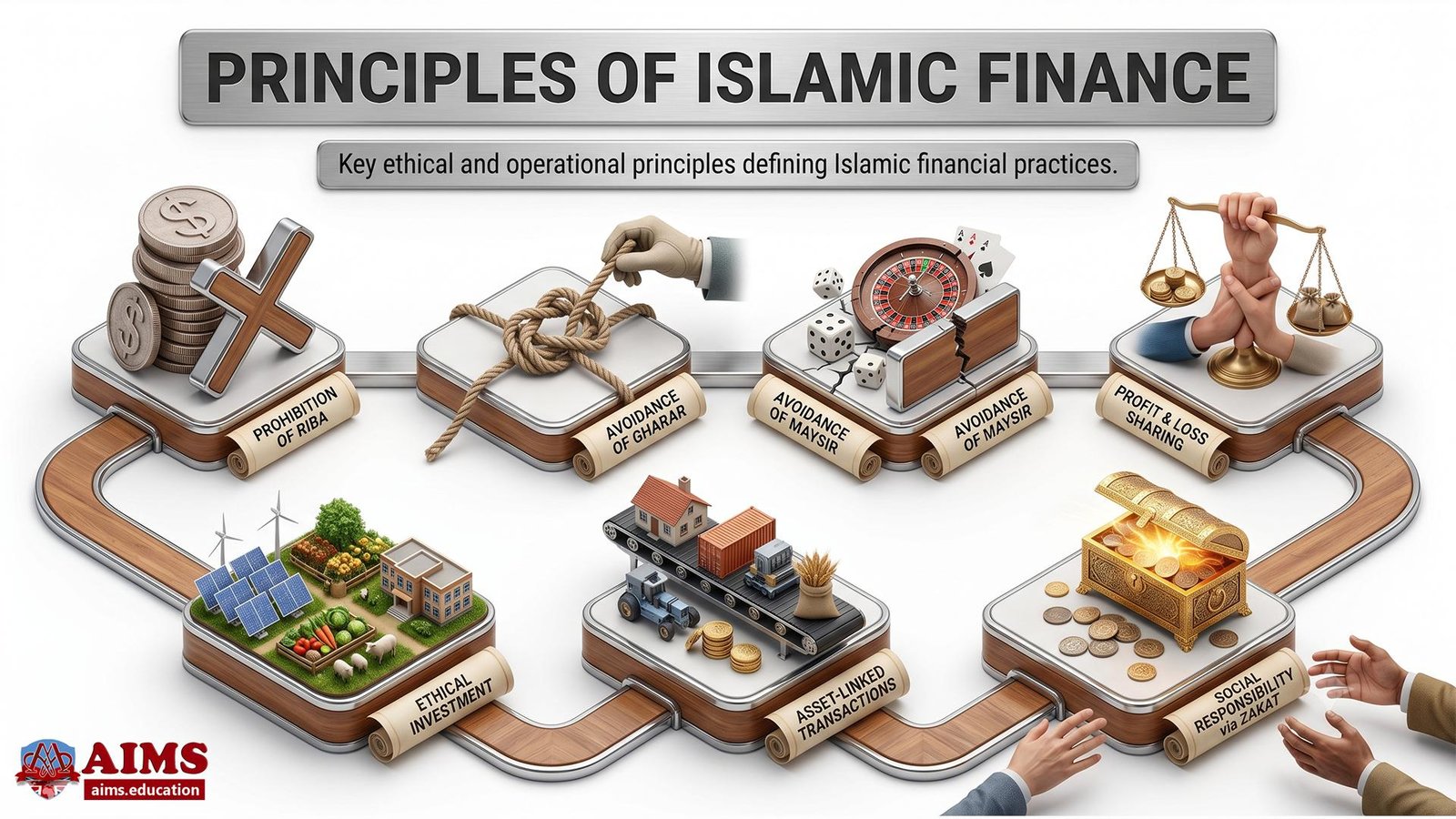
The Seven Principles of Islamic Banking and Finance
The seven principles of Islamic banking and finance that translate Shariah values into practical financial rules are:
- Profit and Loss Sharing
- Shared Risk
- Prohibition of Riba
- Avoidance of Gharar
- Prohibition of Maysir or Gambling
- Prohibtion of Investment in Unlawful Industries
- Paying Zakath to Fulfill Social Responsibility.
These Islamic banking principles explain how Islamic banks earn lawful profit, share business risk, screen investments, document transactions, and support social welfare while avoiding interest-based lending and speculative contracts that separate return from responsibility.
1. Profit and Loss Sharing
Profit and loss sharing means that parties involved in a business arrangement share results according to an agreed Shariah-compliant structure. Profit ratios may be agreed in advance, but a fixed guaranteed return on capital is not treated as a lawful substitute for business participation.
- In Musharakah, partners contribute capital and share profit according to an agreed ratio, while losses are normally borne according to capital contribution.
- In Mudarabah, one party provides capital and the other provides management expertise.
- If the venture loses money without negligence, the capital provider bears the financial loss and the manager loses the effort and expected reward.
For example:
- Hassan provides $40,000 for a trading venture, and Bilal manages the business under a Mudarabah arrangement.
- Both parties agree that Hassan will receive 60% of actual profit, and Bilal will receive 40% for his management work.
- If the venture earns $10,000 profit, Hassan receives $6,000 and Bilal receives $4,000.
- If the venture loses $5,000 without Bilal’s negligence, Hassan’s capital is reduced by $5,000 and Bilal does not receive a profit share.
This structure links reward to real business performance rather than a guaranteed interest charge.
2. Shared Risk
Shared risk means that financial gain should not be detached from commercial exposure. Islamic banking encourages parties to participate responsibly in the outcome of a transaction, whether through partnership, ownership, leasing, or sale-based structures.
This principle helps distinguish Islamic finance from conventional debt-based lending.
- In conventional lending, the lender may receive interest regardless of whether the borrower’s business succeeds or fails.
- In Islamic finance, a lawful return should normally arise from an asset, service, trade, or business risk that the financier has actually accepted.
A practical example is a Musharakah partnership structure for shared commercial ownership, where the bank and customer may jointly finance a business or asset. The bank is not merely a creditor demanding interest, but a participant whose return depends on the agreed contractual basis.
3. Prohibition of Riba
Riba refers to an unlawful excess or increase in lending or exchange transactions. In banking, it is commonly associated with interest charged on loans, where the lender earns a guaranteed return without sharing the borrower’s business risk or creating direct value through trade, ownership, or service.
The prohibition of riba protects borrowers from unjust burden and prevents capital from earning a return without responsibility. A detailed explanation of the concept is available in this guide to how riba operates in Islamic banking and finance.
For example, if a lender gives $10,000 and requires $11,000 after one year regardless of the borrower’s outcome, the additional $1,000 is not tied to a shared business result. Under Islamic finance principles, lawful gain should come from trade, rent, partnership, agency, or service, not from lending money at interest.
4. Avoidance of Gharar
Gharar means excessive uncertainty, ambiguity, or avoidable risk in a contract. Islamic finance does not prohibit every commercial uncertainty, because normal business risk is unavoidable. It prohibits uncertainty that makes the contract unfair, deceptive, incomplete, or open to serious dispute.
Gharar may arise when the asset is not clearly identified, the price is unknown, delivery is uncertain, responsibilities are vague, or one party withholds material information. Readers who want deeper contract-level examples can study this explanation of how gharar affects Islamic banking contracts.
For example, selling “one of my cars at a price to be decided later” creates avoidable uncertainty because the asset and price are unclear. A compliant sale should identify the car, price, payment schedule, delivery date, and responsibilities of each party.
5. Prohibition of Maysir and Gambling
Maysir refers to gambling or games of chance where wealth is gained through speculation rather than productive effort, ownership, trade, or shared responsibility. Islamic banking avoids transactions that resemble betting on uncertain outcomes without genuine economic purpose.
This principle is also relevant to insurance. Many jurists object to conventional insurance because it may contain gharar, maysir, and interest-based investment elements. The Islamic alternative is Takaful, where participants contribute to a mutual pool and help indemnify one another under transparent rules. This is explained further in the Takaful model for mutual risk-sharing.
6. Prohibition of Investment in Unlawful Industries
Islamic banking requires capital to serve lawful and beneficial economic activity. Investment in industries that are prohibited or harmful to society is excluded because finance is not treated as a morally neutral activity.
Common exclusions include:
- Islamic finance excludes alcohol-related businesses because they involve prohibited goods and social harm.
- Islamic finance excludes pork-related businesses because the underlying product is not permissible under Shariah.
- Islamic finance excludes pornography and prostitution because they conflict with Islamic moral and social principles.
- Islamic finance excludes gambling businesses because they generate wealth through chance rather than productive exchange.
- Islamic finance excludes recreational drugs and other harmful activities because they damage individual and public welfare.
Modern Shariah screening may also consider whether a company has excessive interest-based debt, significant impermissible income, or unclear business activities. The aim is not only to avoid prohibited products, but also to keep investment aligned with ethical economic purpose.
7. Paying Zakath to Fulfill Social Responsibility
Zakat is an obligatory form of wealth purification and redistribution in Islam. It reinforces the idea that wealth should not remain concentrated among a small group, but should circulate in a way that supports social balance, relief, and responsible economic life.
- In Islamic banking, institutions may help customers calculate, collect, or distribute Zakat where this is permitted by law, governance policy, and customer authorization.
- This role should be handled transparently, because Zakat is not merely a fee. It is a religious and social obligation connected to justice, compassion, and circulation of wealth.
How Islamic Banking Principles Shape Financial Products
Islamic banking principles shape products by requiring finance to be connected to trade, ownership, leasing, agency, or partnership. A bank may earn profit through a sale margin, rent, service fee, or agreed profit share, but not by charging interest on money itself.
This is why Islamic banks use different contract structures for different needs.
- Musharakah and Mudarabah are partnership-based.
- Murabahah is a cost-plus sale. Ijarah is leasing.
- Salam and Istisna support forward sale and manufacturing or construction finance.
- Sukuk may represent ownership or beneficial interest in assets, usufruct, or projects, depending on the structure.
Asset connection is especially important. Money itself is not treated as a commodity that earns return simply because it is lent. Instead, a financial transaction should be linked to a tangible asset, identifiable service, lawful trade, or genuine business activity.
For example:
- A business needs equipment worth $25,000 for production.
- An Islamic bank purchases the equipment from the supplier and takes ownership before selling it to the business for $28,000 on deferred payment terms.
- The asset, price, payment schedule, and delivery are clearly identified before the sale is completed.
- The bank’s $3,000 return is a disclosed sale margin, not an interest charge on a cash loan.
The practical impact is that lawful profit is connected to ownership and sale, while the documentation must show real asset transfer and clear contractual obligations.

Islamic Banking and Conventional Banking Compared
Islamic banking and conventional banking differ mainly in how they treat money, risk, ownership, and return. Conventional lending usually prices money through interest, while Islamic banking seeks income through Shariah-compliant trade, asset use, partnership, or service, with clearer limits on speculation and prohibited activities.
The difference is not only religious terminology. It is a difference in legal structure and economic logic. A useful product-level comparison is available in this guide to how Islamic banking differs from conventional banking in practice.
| ATTRIBUTE | ISLAMIC BANKING | CONVENTIONAL BANKING |
|---|---|---|
| Basis of Return | Return is earned through trade, ownership, leasing, partnership, agency, or service. | Return is commonly earned through interest charged on loans and credit facilities. |
| Treatment of Money | Money is treated mainly as a medium of exchange and cannot earn interest by itself. | Money may be lent at interest and priced according to time, risk, and market rates. |
| Risk Allocation | Risk should follow ownership, partnership, asset use, or contractual responsibility. | Credit risk is transferred mainly to the borrower through repayment and interest obligations. |
| Asset Connection | Transactions should be linked to identifiable assets, services, or real economic activity. | Loans may be advanced primarily as money contracts, even when no asset transfer occurs. |
| Investment Screen | Investment excludes prohibited sectors such as alcohol, gambling, pork, and pornography. | Investment restrictions depend on law, policy, risk appetite, or voluntary ethical screens. |
Governance and Shariah Compliance in Islamic Banking
Shariah governance ensures that Islamic finance principles are applied in documentation, approval, execution, and monitoring, not only in product names. A Shariah board or qualified adviser reviews structures, screens activities, and helps institutions align contracts with recognized standards and sound Islamic commercial law.
- Islamic finance is applied across different countries, legal systems, and regulatory environments, so governance is essential.
- A Shariah supervisory board normally reviews products, advises management, checks compliance, and helps prevent structures from becoming interest-based lending in another form.
International standard-setting bodies also support consistency. For example, institutions may refer to the official AAOIFI Shariah standards for Islamic finance institutions when developing products, governance frameworks, accounting practices, and Shariah compliance procedures.
Good governance also protects customers. A customer should be able to understand what is being purchased, leased, invested, or shared. The bank should document ownership, risk transfer, price, payment terms, delivery obligations, and any agency relationship clearly.
Common Mistakes That Weaken Islamic Banking Compliance
Common compliance mistakes occur when the form of an Islamic product looks correct but the substance does not reflect Shariah principles. The most serious weaknesses involve simulated interest, unclear ownership, vague contract terms, prohibited income, and poor documentation of risk transfer.
Several mistakes appear repeatedly in weak Islamic finance structures:
- A product becomes weak when the bank never genuinely owns, possesses, or assumes responsibility for the asset it sells or leases.
- A contract becomes weak when the customer is charged a return that functions like interest without trade, rent, service, or partnership substance.
- A transaction becomes weak when the price, subject matter, delivery, or responsibilities are vague enough to create gharar.
- An investment becomes weak when prohibited business income or excessive interest exposure is ignored during screening.
- A governance process becomes weak when Shariah review is treated as a one-time approval rather than ongoing supervision.
The strongest Islamic banking practices combine Shariah knowledge with legal precision, commercial realism, and transparent documentation. This is where the principles of Islamic banking become practical safeguards rather than abstract ideals.
Final Words
The principles of Islamic banking create a financial system that connects profit with responsibility, money with real activity, and contracts with ethical limits. When applied carefully, they offer a disciplined alternative to interest-based lending while supporting transparency, fairness, risk-sharing, and socially responsible investment.
Islamic finance is not simply conventional finance with religious labels. It is a structured approach to banking in which return must be earned through lawful means, uncertainty must be controlled, risk must be allocated fairly, and investment must remain connected to ethical purpose. These principles help students, professionals, and institutions understand why Shariah-compliant finance requires both technical contract knowledge and moral accountability.
Frequently Asked Questions
These FAQs answer the most common questions students and early professionals ask about Islamic banking principles. They clarify riba, gharar, maysir, risk-sharing, asset-backing, Zakat, and the practical difference between Islamic banking and conventional financial products in a concise, search-friendly format.
What Are the Core Principles of Islamic Banking?
Islamic banking principles prohibit riba, avoid gharar and maysir, require ethical investment, encourage risk-sharing, and connect finance to real assets, services, trade, or partnership. They also emphasize transparency, social responsibility, and the circulation of wealth through obligations such as Zakat.
What Are the Principles of Islamic Finance?
The principles of Islamic finance include the prohibition of interest, avoidance of excessive uncertainty, prohibition of gambling, profit and loss sharing, shared risk, asset-linked transactions, ethical investment, and social welfare. They require financial return to be linked with lawful economic activity.
What Are the Key Principles of Islamic Finance?
The key principles of Islamic finance are riba-free financing, transparent contracts, avoidance of speculation, ethical investment screening, asset connection, risk-sharing, and social responsibility. These principles guide Islamic banking products such as Musharakah, Mudarabah, Murabahah, Ijarah, Sukuk, and Takaful.
Why Is Riba Prohibited in Islamic Banking?
Riba is prohibited because it allows a lender to earn a guaranteed excess from money without sharing business risk or creating value through ownership, trade, service, or partnership. Islamic banking requires returns to arise from lawful commercial activity rather than interest on loans.
How Does Profit and Loss Sharing Work?
Profit and loss sharing works by agreeing profit ratios in advance and allocating losses according to the relevant Shariah contract. In Musharakah, partners usually bear losses according to capital contribution. In Mudarabah, the capital provider bears financial loss unless the manager is negligent or violates the agreement.
What Is Gharar in Islamic Finance?
Gharar is excessive uncertainty or ambiguity in a contract. It may appear when the asset, price, delivery date, quantity, or responsibilities are unclear. Islamic finance reduces gharar by requiring transparent terms, proper disclosure, and clear documentation before the transaction is completed.
What Is Maysir and Why Is It Prohibited?
Maysir means gambling or acquiring wealth through chance rather than productive effort or lawful exchange. It is prohibited because it creates unjust gain, encourages speculation, and separates wealth from real economic contribution. Islamic finance avoids transactions that resemble betting or games of chance.
Which Industries Are Prohibited in Islamic Investment?
Islamic investment generally excludes alcohol, pork, gambling, pornography, prostitution, recreational drugs, and other activities considered unlawful or harmful under Shariah. Screening may also examine excessive interest-based debt, impermissible income, and business activities that conflict with Islamic ethical principles.
What Role Does Zakat Play in Islamic Banking?
Zakat supports the redistribution and purification of wealth. Islamic banks may help customers calculate, collect, or distribute Zakat where law, governance policy, and customer authorization allow it. Its wider purpose is to promote social welfare and responsible circulation of resources.
Is Islamic Banking Only Interest-Free Banking?
No. Islamic banking is not only interest-free banking. It also requires clear contracts, asset connection, lawful investment, ethical purpose, risk-sharing, avoidance of gambling and excessive uncertainty, and Shariah governance. Removing interest is essential, but it is only one part of compliance.
About AIMS’ Institute of Islamic Banking and Finance
AIMS’ Institute of Islamic Banking and Finance has supported global learners since 2005 through internationally accredited, career-focused education in Islamic banking and finance. Its curriculum combines qualified faculty, industry-oriented teaching, practical skill development, 3D interactive learning content, and real-world case studies for professional readiness.
This educational content and AIMS’ study content and curriculum are collaboratively developed and rigorously peer-reviewed by an academic board of qualified industry practitioners to support job-ready qualifications. Explore professional Islamic banking and finance education aligned with industry practice.