
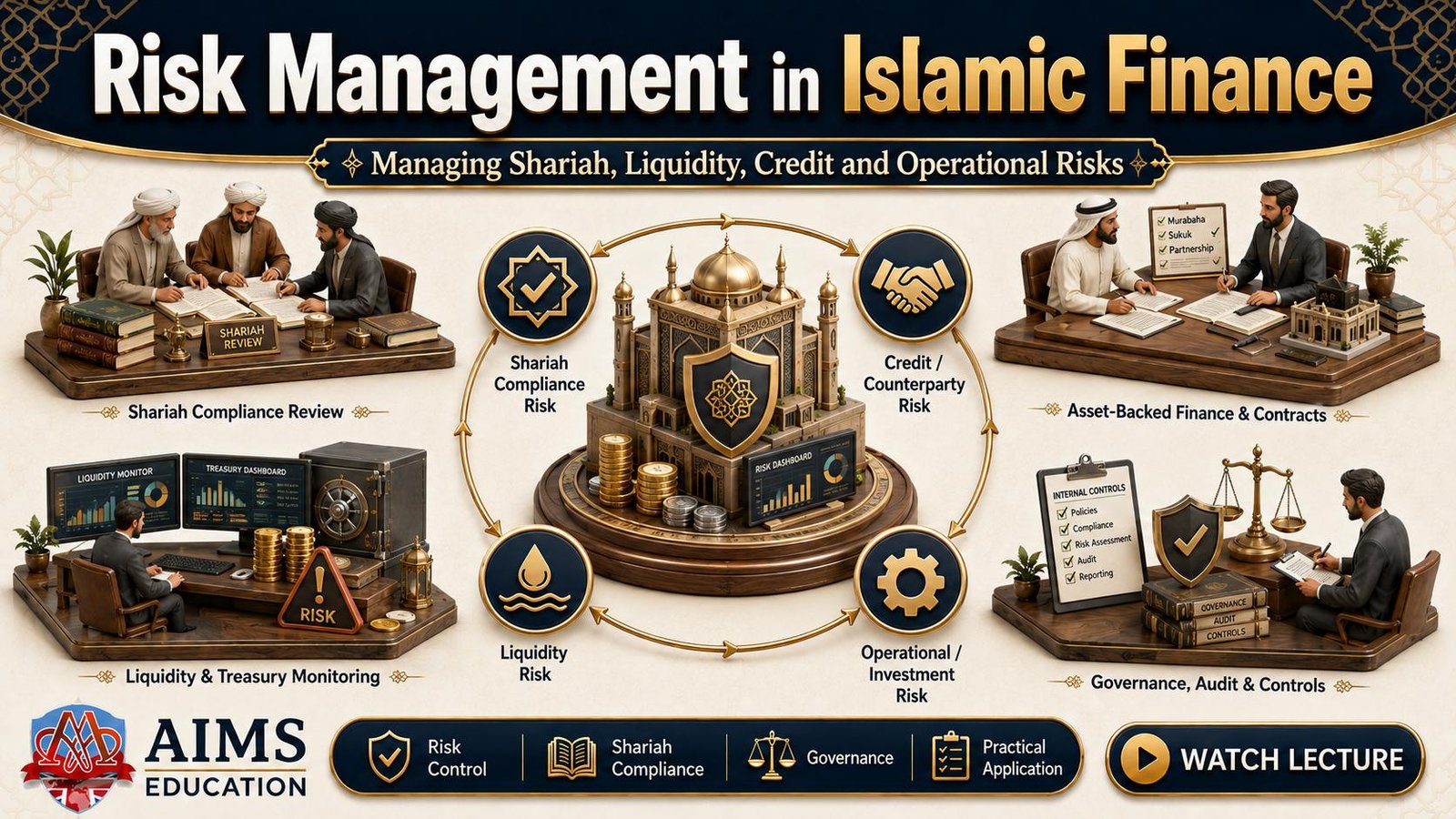
Risk management in Islamic finance is the disciplined process of identifying, measuring, monitoring, reporting, and controlling financial and Shariah related risks within a framework that avoids riba, excessive uncertainty, and unlawful activities. It is essential because Islamic banks face the same core financial risks as other banks, yet they also carry contract specific responsibilities linked to asset ownership, delivery, profit sharing, and Shariah compliance.
Risk management in Islamic banking is important because Islamic financial institutions do not simply lend money for interest. They use structures such as Murabahah, Ijarah, Salam, Istisna, Mudarabah, Musharakah, and Sukuk, and each structure creates its own pattern of exposure. A bank may face credit risk in Murabahah, asset risk in Ijarah, delivery risk in Salam, construction and specification risk in Istisna, and capital impairment risk in participatory contracts. For that reason, risk management in Islamic financial institutions must connect governance, contract design, documentation, monitoring, and ethical controls into one coherent system.
In practice, Islamic finance risk management combines prudential discipline with Shariah governance.
- The board sets risk appetite and approves limits.
- Senior management implements policies and reporting lines.
- Independent risk functions measure exposures.
- Shariah oversight checks that products, processes, and remedies remain compliant.
When these elements work together, risk management Islamic banking institutions apply becomes both commercially sound and ethically credible.
Risk Management in Islamic Banking and Finance: Definition & Importance
What Is Risk Management in Islamic Finance?
Risk management in Islamic finance is the process through which an institution identifies possible threats to capital, earnings, liquidity, operations, and reputation, then applies controls that remain consistent with Shariah rules and principles. The aim is not to eliminate risk completely, because finance always involves uncertainty. The aim is to understand risk correctly, price it fairly, allocate it lawfully, and manage it before it harms depositors, investors, shareholders, or counterparties.
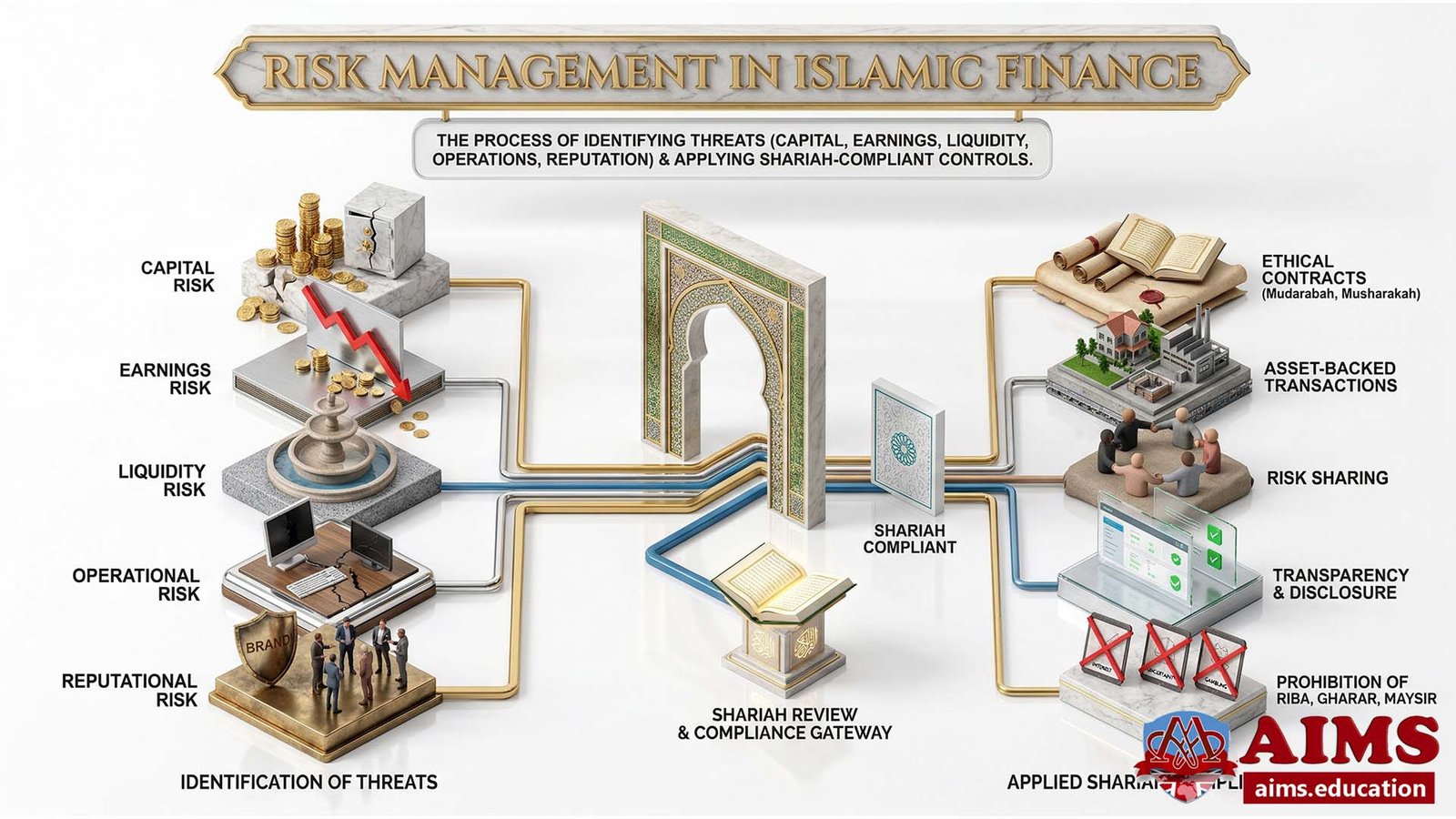
- This means an Islamic bank must ask more than whether a client can pay.
- It must also ask whether the contract is valid, whether ownership and possession rules are observed, whether delivery terms are workable, whether documentation is sequenced correctly, whether profit allocation is fair, and whether any remedy on default remains Shariah compliant.
That broader lens is what makes Islamic banking risk management distinct.
Islamic Finance Risk Management Principles
Several principles shape sound risk management in Islamic banking.
- The institution must maintain a comprehensive risk management and reporting process.
- The board of directors must approve objectives, policies, limits, and capital allocation.
- Senior management must separate risk oversight from risk taking and enforce clear accountability.
- Shariah compliance must be built into products, documentation, controls, and reporting.
- Each contract must be assessed according to its own legal and economic characteristics.
- Profit and loss sharing structures require strong valuation, monitoring, and exit discipline.
- Depositors on a profit and loss sharing basis need timely and meaningful disclosures.
Role of Shariah Board in Risk Oversight
Shariah oversight does not replace financial risk management, but it adds a vital protective layer.
- Shariah advisors or supervisory boards review structures, contracts, processes, and remedial actions to ensure that transactions remain valid from beginning to end.
- This reduces Shariah compliance risk in Islamic banking, protects depositor confidence, and prevents a transaction from becoming commercially successful but religiously defective.
For example, in a Murabahah arrangement, document sequencing matters. If the institution does not acquire the asset before selling it onward, the structure can become invalid. A transaction may appear profitable on paper, yet a Shariah breach can still damage reputation, earnings, and trust. This example shows how legal form, operational execution, and Shariah oversight must move together.
Types of Risk in Islamic Finance
The main types of risk in Islamic finance are credit risk, equity investment risk, market risk, liquidity risk, rate of return risk, and operational risk. In practical discussion, fiduciary and Shariah compliance concerns also deserve separate explanation because they directly affect trust, disclosure, and contract validity.
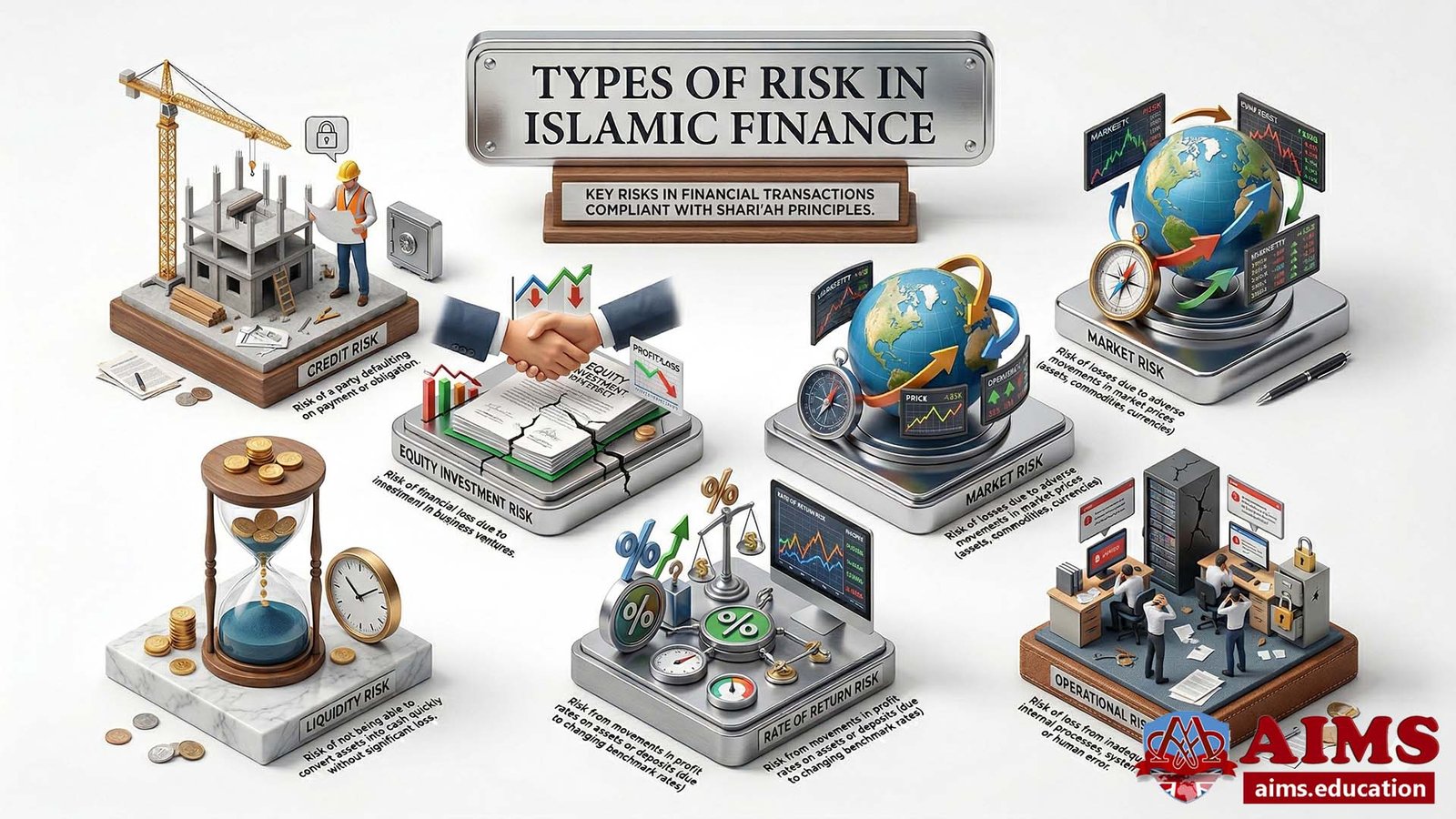
| RISK TYPE | WHAT IT MEANS | COMMON ISLAMIC CONTRACT EXAMPLES |
|---|---|---|
| Credit Risk | The counterparty may fail to meet payment or delivery obligations under agreed terms. | Murabahah, Ijarah, Diminishing Musharakah, Salam, Istisna, Mudarabah receivables. |
| Equity Investment Risk | The bank shares business risk and may face capital impairment in profit sharing ventures. | Mudarabah, Musharakah, Diminishing Musharakah. |
| Market Risk | Asset values may change because of market prices, residual values, or foreign exchange movements. | Salam commodities, Sukuk, leased assets, foreign currency receivables. |
| Liquidity Risk | The institution may struggle to meet obligations or fund asset growth without major loss or cost. | Current accounts, PLS deposits, tradable Sukuk portfolios. |
| Rate of Return Risk | Returns on assets may not match depositor expectations when market benchmarks move. | PLS investment accounts funded by assets with slower repricing. |
| Operational and Shariah Risk | Failures in people, systems, controls, documentation, or compliance can create financial and reputational harm. | All Islamic contracts and support processes. |
Credit Risk in Islamic Finance
Credit risk in Islamic finance is the possibility that a counterparty will not meet payment, delivery, or performance obligations. It appears in receivables and lease based structures such as Murabahah, Diminishing Musharakah, and Ijarah, and it also appears in working capital and project structures such as Salam and Istisna.
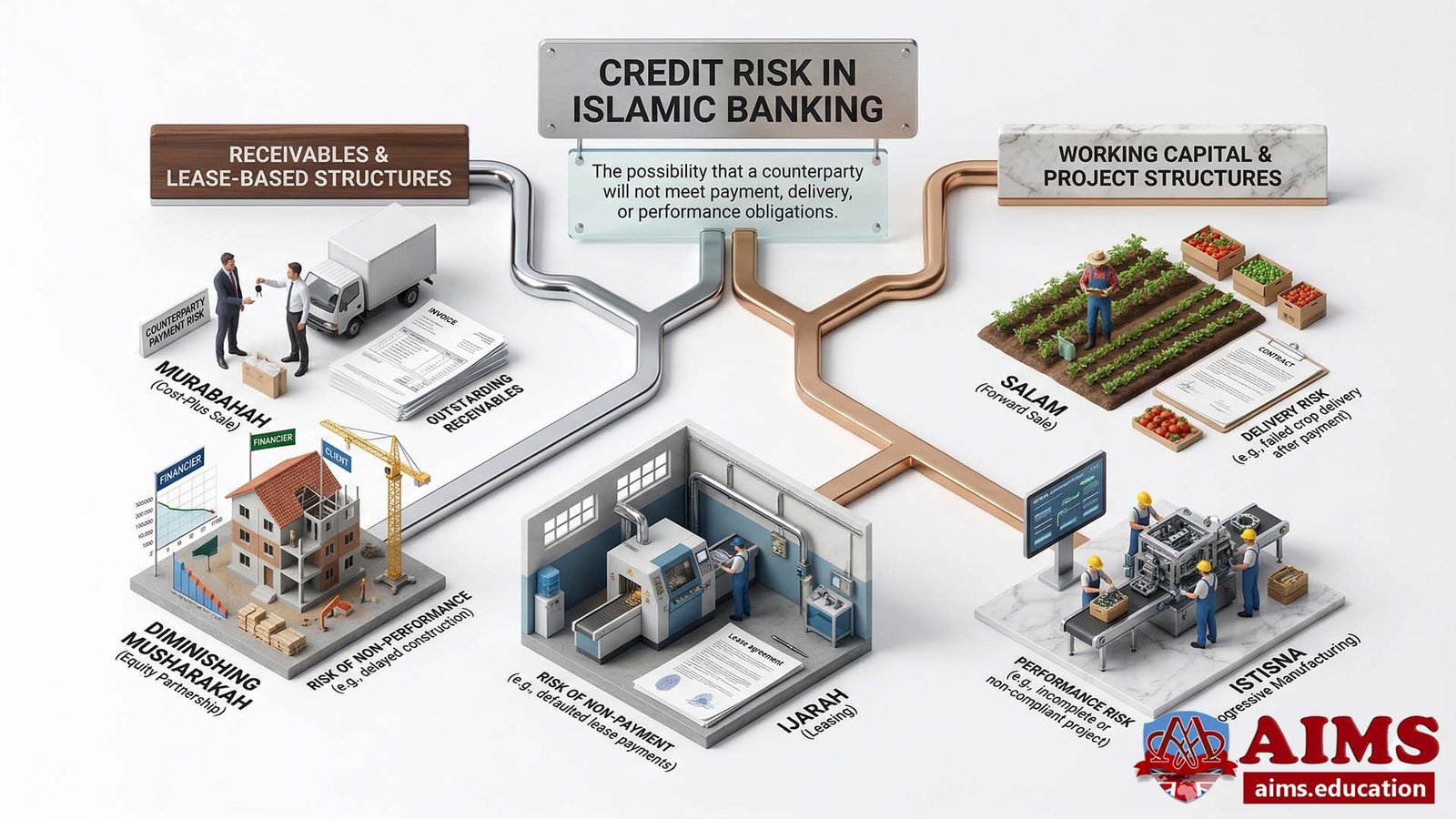
Risk management in Islamic finance treats credit risk carefully because exposure can change over the life of a contract. In Murabahah, for example, the institution initially faces market risk while holding the asset. Once the asset is sold on deferred payment terms, the exposure turns into credit risk. In Salam, the institution may pay in advance and then face delivery, quality, and settlement risk. In participatory structures, negligence or misconduct can transform an investment exposure into a debt claim.
Common mitigation tools include due diligence, risk based pricing, enforceable collateral, guarantees, clear governing law, early remedial action, and careful documentation on whether purchase orders are cancelable. Default penalties also need special care because the bank cannot take such penalties as income for itself. Where allowed, those amounts are directed to charity.
Example:
- An Islamic bank purchases industrial equipment for $80,000 under a Murabahah request.
- It sells the equipment to Ahmad Engineering for $92,000 on deferred installments.
- Before sale to the client, the bank bears asset holding risk.
- After sale, the main exposure becomes the client’s ability and willingness to pay.
- If the client faces distress, the bank may restructure timing without increasing the debt amount.
This example shows how exposure can move from asset risk to credit risk within one Shariah compliant structure.
Liquidity and Market Risks in Islamic Finance
Liquidity and market risk in Islamic finance deserve special attention because Islamic banks do not rely on conventional interest based liquidity tools in the same way as conventional banks.
- Liquidity risk in Islamic banks arises when an institution cannot meet withdrawals or fund assets on time without unacceptable loss.
- Market risk arises when tradable, marketable, or leaseable assets change in value because of prices, residual values, or foreign exchange movements.
On the liquidity side, Islamic banks manage two broad fund provider groups.
- Current account holders expect full repayment of principal on demand.
- Profit and loss sharing deposit holders accept investment uncertainty, yet they may still withdraw if returns disappoint, confidence weakens, or Shariah concerns emerge.
That makes maturity analysis, cash flow forecasting, stress testing, liquidity mismatch limits, and contingency planning central parts of Islamic banking risk management.
On the market side, exposures differ by contract. In Salam, the bank may hold a commodity position before sale. In Ijarah, the lessor faces residual value and impairment risk on the leased asset. In Sukuk, market prices can move because of changes in credit conditions, liquidity, and broader market sentiment.
Example:
- A bank enters a Salam contract with a farmer and pays $50,000 in advance for wheat to be delivered after harvest.
- Before the wheat is received and sold, market prices fall sharply.
- If a parallel Salam sale has already been arranged at a fixed price, the bank still faces delivery risk if the farmer fails to supply on time.
- The bank may then need to buy wheat in the spot market to honor the second contract.
This example shows how commodity price risk and delivery risk can combine in a single Islamic trade finance structure.
Operational and Fiduciary Risks in Islamic Finance Risk Management
- Operational risk in Islamic finance comes from failures in processes, people, systems, and controls. In Islamic finance risk management, this includes ordinary banking failures and contract specific failures, such as weak documentation, incorrect sequencing, poor recordkeeping, inadequate Shariah review, or inaccurate profit allocation.
- Fiduciary risk also matters because Islamic institutions manage funds on behalf of depositors and investment account holders who rely on fair treatment and accurate disclosures.
Strong controls therefore require independent risk units, reliable management information systems, proper checks and balances, periodic training, and clear reporting to senior management and the board. Finance administration should be separated from finance origination so that documentation and execution can be checked independently.
A simple example is an Ijarah file with missing evidence of insurance, maintenance responsibility, or asset handover. That may look like an administrative defect, but it can quickly become a legal dispute, a Shariah issue, and a reputational loss. This example shows how a small operational weakness can create several larger risks at once.
Shariah Compliance Risk in Islamic Banking
Shariah compliance risk in Islamic banking is the possibility that a transaction, process, income stream, or remedy violates Shariah rules and principles. It can arise from entering prohibited sectors, mixing contracts improperly, failing to transfer ownership correctly, ignoring possession rules, using defective documentation, or applying remedies that are not allowed.
This risk is often misunderstood. It is not limited to fatwa approval at product launch. It continues through execution, monitoring, amendment, settlement, default handling, and disclosure. A contract may be approved in principle, yet poor implementation can still create non compliance.
For instance, if a bank structures a Murabahah but never truly takes ownership before resale, the bank faces more than a technical error. It faces income purification questions, legal exposure, reputational harm, and loss of confidence among depositors. This example shows why Shariah compliance risk in Islamic banking is inseparable from governance and internal control.
Profit Rate Risk and Displaced Commercial Risk
Profit rate risk Islamic banking institutions face is not the same as conventional interest rate risk.
- In a conventional loan, interest terms are contractually fixed or benchmark linked in a direct way.
- In Islamic banking, returns depend on the performance and cash flow timing of underlying assets and investments. If market benchmark rates rise quickly, depositor expectations may rise before asset returns adjust. That creates rate of return pressure.
Displaced commercial risk is a further consequence. It appears when an Islamic bank feels pressure to offer depositors a return higher than what the underlying assets have actually generated, simply to remain competitive and prevent withdrawals. In that situation, the institution may sacrifice part or all of its own Mudarib share to support depositor returns.
Islamic finance risk management must therefore set clear board approved policies on when such smoothing is allowed, how it is measured, and how the interests of shareholders and investment account holders are balanced. Risk management Islamic banking institutions follow in this area requires careful cash flow analysis, gap analysis, stress testing, and clear disclosure.
Example:
- A bank’s unrestricted investment account pool earns 4.2 percent this quarter.
- Competing banks are distributing around 5.1 percent.
- The bank fears a wave of withdrawals from PLS deposit holders.
- Management proposes waiving part of the bank’s own Mudarib share so depositors receive 4.9 percent.
- The decision is reviewed under a preapproved framework to avoid arbitrary profit smoothing.
This example shows how displaced commercial risk arises from market competition rather than from a fixed interest obligation.
Shariah Governance and Islamic Risk Oversight
Shariah Board and Audit Functions
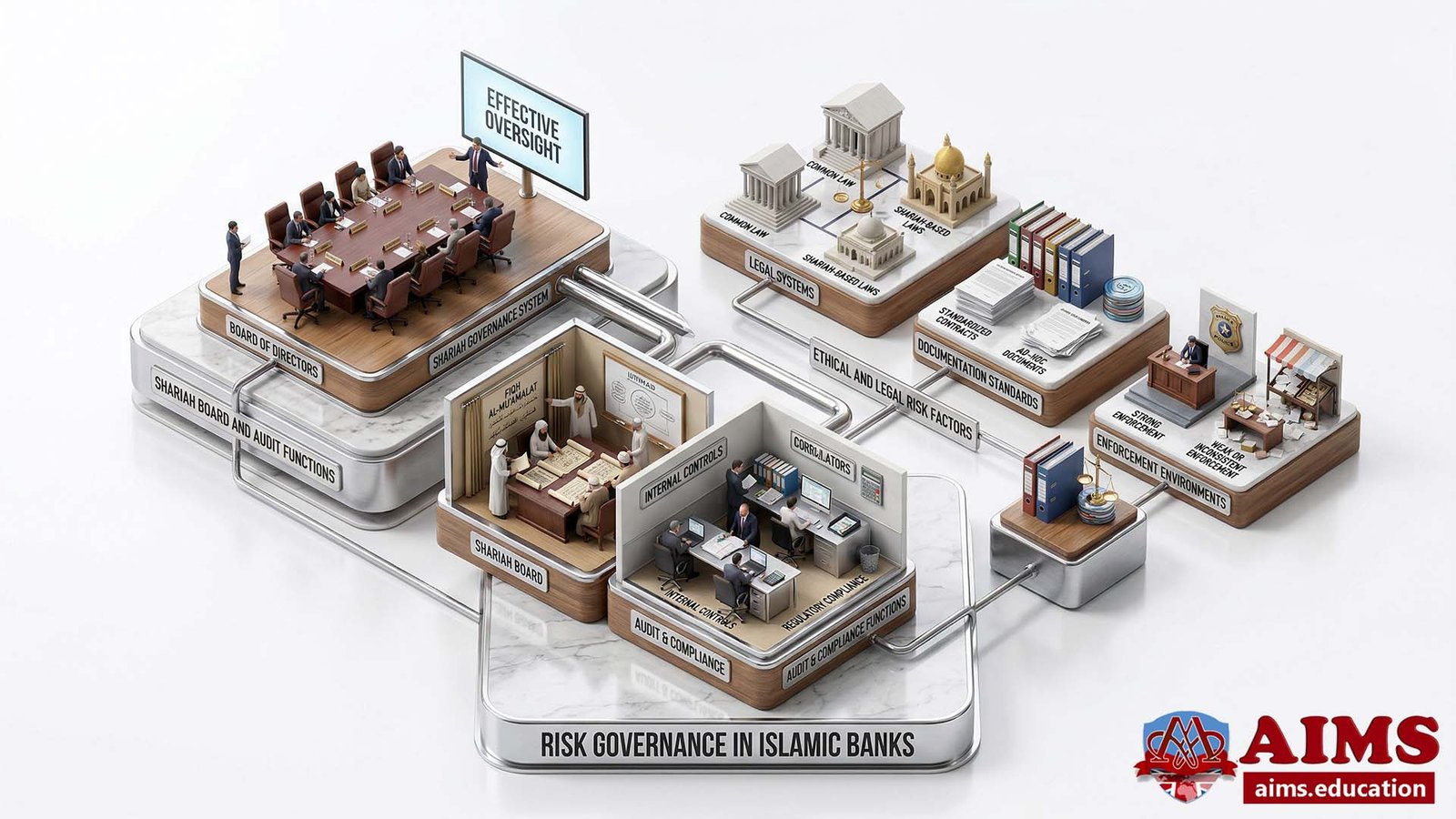
Effective oversight begins with the board of directors, but it also depends on a functioning Shariah governance system.
- The board approves risk objectives, strategies, policies, limits, and concentration thresholds.
- Senior management implements them.
- Independent risk management units monitor exposures and compliance.
- Shariah boards or advisors review products, amendments, and operational practices. Internal Shariah audit then checks whether approved structures are actually being followed in real transactions.
This layered design is one of the clearest marks of strong risk management in Islamic finance. Financial controls and Shariah controls should reinforce each other, not work in isolation. When they do, the institution can better protect asset quality, depositor expectations, and reputational standing.
Ethical and Legal Risk Factors
Islamic banks also operate within different legal systems, documentation standards, and enforcement environments. Ethical and legal risk factors therefore include contract enforceability, cross border legal differences, treatment of collateral, insolvency procedures, tax effects, and the challenge of keeping related agreements contractually independent while commercially coordinated.
These issues are especially important in structures that use multiple contracts or parallel arrangements.
- An Istisna transaction, for example, may require one contract with the customer and another with the manufacturer.
- If the supplier fails to meet specifications, the bank can still remain liable to the customer under its separate obligation.
- This example shows why Islamic banking risk management must connect legal drafting, technical review, and project monitoring.
Risk Management in Islamic Financial Institutions: Frameworks and Regulations
IFSB and AAOIFI Standards
Risk management in Islamic banking and finance is strengthened by international standard setting bodies.
- The Islamic Financial Services Board publishes prudential standards and guiding principles for banking, governance, capital adequacy, liquidity, and supervision. These include governance guidance for Shariah oversight and capital adequacy standards tailored to Islamic financial services.
- The Accounting and Auditing Organization for Islamic Financial Institutions issues accounting, auditing, ethics, governance, and Shariah standards, including Financial Accounting Standard No. 35 on risk reserves.
These frameworks translate broad Islamic principles into operational expectations. They help institutions structure governance, recognize exposures correctly, protect investment account holders, and report performance more consistently across jurisdictions.
Internal Risk Management Processes
Internal processes usually move through six connected stages: identification, measurement, mitigation, monitoring, reporting, and control. Those stages should not be treated as a checklist. They should function as a continuous cycle.
- The institution identifies risks in each product, counterparty, and process.
- It measures exposures using methods suited to the contract and business scale.
- It mitigates risk through collateral, diversification, documentation, due diligence, and Shariah controls.
- It monitors exposures through MIS, exception reporting, and independent review.
- It reports meaningful information to management, the board, and relevant supervisors.
- It controls risk through limits, escalation procedures, audit, and corrective action.
Risk management in Islamic banking is strongest when these processes are integrated across the institution rather than isolated by department.
Capital Adequacy and Risk Reserves
Capital adequacy in Islamic banking cannot ignore the relationship between shareholders’ funds and investment account holders’ funds. Islamic frameworks therefore pay close attention to the extent of risk sharing, the treatment of profit sharing investment accounts, and the impact of displaced commercial risk on capital assessment. Accounting guidance on risk reserves also matters because reserves can help absorb volatility and support fair treatment among stakeholders.
In practical terms, this means boards must understand not only headline profitability, but also how profits are allocated, what reserves exist, how losses are recognized, and whether the institution is building resilience in a transparent and Shariah consistent way.
Risk Mitigation Tools and Techniques in Islamic Finance
Takaful and Risk Sharing Mechanisms
Takaful (Islamic insurance) principles support risk sharing rather than conventional risk transfer. Takaful does not remove business risk entirely, but it can reduce the financial impact of asset damage, liability events, and operational disruption when structured properly. In Ijarah, for example, protection of the leased asset is important because the lessor retains asset related responsibilities.
Sukuk and Asset Backed Instruments
Sukuk and other asset backed structures can support liquidity planning, portfolio diversification, and investment management. They also help institutions place funds in tradable instruments that align more closely with Shariah requirements than conventional interest based securities. Used carefully, Sukuk can reduce liquidity pressure and broaden funding options, though they still carry market, credit, and compliance risks.
Diversification and Profit Sharing Structures
Diversification remains a core safeguard. Islamic banks should diversify by contract type, sector, geography, tenor, and currency where appropriate. They should also understand how profit sharing contracts behave differently from debt like receivables. A well designed Mudarabah profit-sharing contract or Musharakah arrangement can spread entrepreneurial risk more fairly, but only when valuation, governance, and exit conditions are properly defined.
Other useful supporting concepts include the Wakalah agency model in Islamic finance, which clarifies delegated authority, and the need to avoid Gharar (contract uncertainty in Islamic finance), which helps reduce ambiguity driven disputes. In trade structures, institutions must also understand Islamic trade finance instruments because delivery, documentation, and settlement risk often sit at the center of those products.
Comparing Islamic vs Conventional Risk Management
Risk Sharing vs. Risk Transfer Models
Conventional banking generally centers on risk transfer through debt contracts, interest pricing, and security enforcement. Islamic banking uses a wider mix of trade based, lease based, and profit sharing contracts. That does not mean Islamic banks face less risk. It means risk is allocated differently and must be understood through ownership, performance, and contractual substance.
Liquidity Support and Interest Rate Alternatives
Conventional banks often rely on deep money markets and standard lender of last resort tools built around interest based instruments. Islamic banks may have fewer immediately available options and must rely more heavily on Shariah compliant liquidity assets, structured interbank arrangements, sale and leaseback possibilities where permitted, and stronger contingency planning.
Ethical Constraints and Product Design
Islamic finance also imposes ethical constraints that shape risk management in Islamic finance from the start. Prohibitions on riba, unlawful business activity, and excessive contractual uncertainty affect product design, documentation, and risk remedies. Conventional systems may treat some of these issues as secondary commercial matters. Islamic systems treat them as core design constraints.
| POINT OF COMPARISON | ISLAMIC BANKING | CONVENTIONAL BANKING |
|---|---|---|
| Return Structure | Returns are tied to trade, leasing, or investment outcomes within Shariah limits. | Returns are commonly tied to interest based lending and benchmark repricing. |
| Risk Allocation | Risk is often shared through asset backed or profit sharing arrangements. | Risk is more often transferred through debt covenants, pricing, and collateral. |
| Compliance Layer | Transactions require ongoing Shariah compliance in structure and execution. | Transactions focus mainly on legal, regulatory, and commercial compliance. |
| Liquidity Tools | Liquidity support relies on Shariah compliant instruments and tailored arrangements. | Liquidity support commonly uses standard interest based money market tools. |
| Depositor Pressure | PLS expectations can create profit rate pressure and displaced commercial risk. | Deposit pricing usually follows contractual or market rate based mechanisms. |
Challenges and Best Practices in Islamic Banking Risk Management
Emerging Risks
Digital banking, fintech partnerships, cybersecurity threats, outsourced services, and fast moving payment platforms create new exposures for both Islamic and conventional institutions. In Islamic settings, these new channels also need Shariah review because product logic, customer journeys, and automated workflows can affect contract validity.
Capacity and Awareness
Staff training remains one of the most underestimated controls. Risk officers, product teams, Shariah reviewers, operations staff, legal teams, and frontline staff should understand how Islamic contracts work in real transactions, not only in theory. That is one reason many professionals pursue structured study such as an online MBA degree in Islamic Banking and Finance or advanced specialist training.
Innovative Solutions
Better stress testing, stronger data systems, high quality liquid Sukuk, improved Shariah compliant hedging tools, and more developed interbank markets can all strengthen resilience. Best practice also includes early warning systems, scenario analysis, technical review for complex assets, independent Shariah audit, and clear contingency plans. Risk management Islamic banking institutions need today should therefore be proactive, integrated, well documented, and continuously improved.
Frequently Asked Questions
What Is Risk Management in Islamic Banking?
Risk management in Islamic banking is the process of identifying, assessing, mitigating, monitoring, and reporting financial and Shariah related risks in a way that remains compliant with Islamic law and ethical finance principles.
What Are the Main Types of Risk in Islamic Banking?
The main categories are credit risk, equity investment risk, market risk, liquidity risk, rate of return risk, operational risk, and closely related Shariah compliance and fiduciary concerns.
What Is Shariah Compliance Risk in Islamic Banking?
It is the risk that a contract, transaction, process, or remedy breaches Shariah rules and principles. It can arise from invalid ownership transfer, weak documentation, prohibited business exposure, or incorrect execution of approved contracts.
What Is Displaced Commercial Risk?
Displaced commercial risk arises when an Islamic bank gives up part of its own profit share to keep depositor returns competitive and discourage withdrawals, even though underlying assets earned less than the market expects.
How Do Islamic Banks Manage Liquidity Risk?
They manage liquidity risk through maturity analysis, stress testing, liquidity mismatch limits, contingency planning, tradable Shariah compliant assets such as Sukuk, and carefully structured funding arrangements that avoid interest.
What Role Do Shariah Boards Play in Risk Management?
Shariah boards or advisors review product structures, amendments, and operational practices to ensure ongoing compliance. They help prevent non compliant income, reputational damage, and depositor mistrust, but they do not replace financial risk controls.
What Is the Difference Between Risk Management in Islamic Finance and Conventional Risk Management?
Risk management in Islamic finance includes the usual prudential concerns found in banking, but it also addresses Shariah validity, asset ownership, delivery obligations, profit sharing fairness, and ethical restrictions that shape product design from the start.
What Is Takaful in Islamic Finance?
Takaful is a cooperative risk sharing arrangement that serves as Islamic insurance. It helps reduce the financial effect of certain losses, but it does not remove investment and business risk from the institution.
What Is Profit Rate Risk in Islamic Banking?
Profit rate risk Islamic banking institutions face is the risk that returns generated by assets will not keep pace with depositor expectations when market benchmarks change, creating pressure on profitability and fund retention.
Conclusion
Risk management in Islamic banking is not a narrow compliance exercise. It is a full institutional discipline that joins governance, Shariah oversight, contract design, quantitative analysis, disclosure, and operational control. Islamic banks face credit, market, liquidity, operational, and investment risks like other institutions, yet they also carry distinct exposures linked to profit sharing, asset backing, and Shariah validity. When those realities are managed with clarity and discipline, Islamic finance risk management supports stability, fairness, and long term confidence.
About AIMS’ Institute of Islamic Banking and Finance
Since 2005, AIMS’ Institute of Islamic Banking and Finance has supported global learners through internationally accredited, career-focused Islamic finance education. Its qualified faculty combine Shariah governance, banking practice, real-world case studies, practical skill development, and 3D interactive learning content within an internationally standardized curriculum. This educational material, along with AIMS’ study content and curriculum, is collaboratively developed and rigorously peer-reviewed by an academic board of qualified industry practitioners, helping professionals build job-ready Islamic banking and finance qualifications. Explore career-focused Islamic finance programs at AIMS.