
Shariah Meaning
The word Shariah is an Arabic word شريعة, and it literally means “a way,” “a clear path,” or “a path to water.” It also carries the meaning of path leading to water. Since water preserves life, supports growth, and benefits everyone – in the same way, Sharia aims to guide human beings toward justice, discipline, mercy, responsibility, and moral order.
Shariah, also known as Islamic Law and Muslim Law, is the revealed path of Islam that guides belief, worship, ethics, family life, business, finance, and social conduct. These terms refer to the same foundational idea: Allah’s guidance for human life as known through the sources of Shariah, primarily the Qur’an and the Sunnah of Prophet Muhammad ﷺ, together with scholarly methods such as ijma and qiyas, which help apply that guidance to changing circumstances.
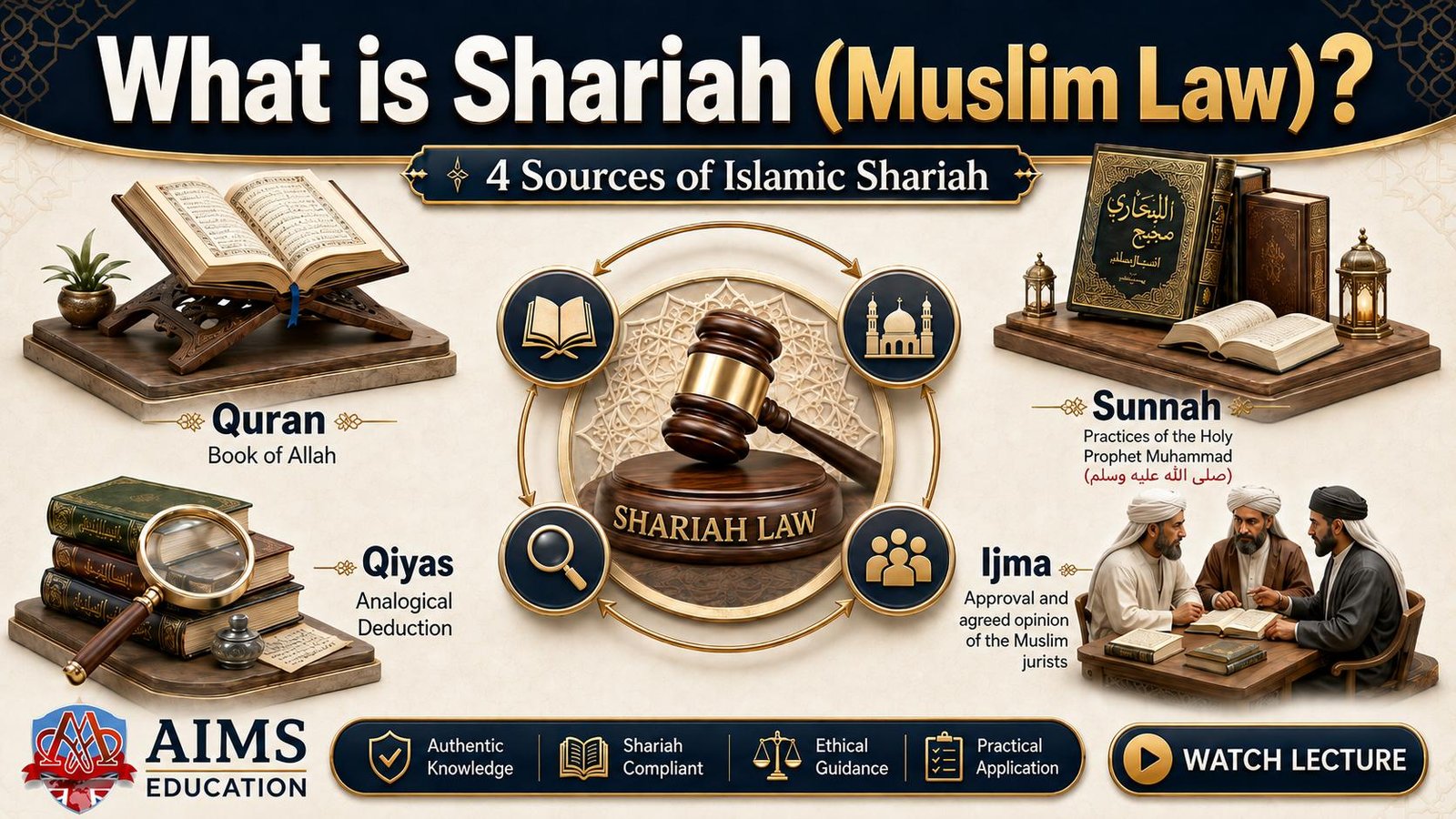
Shariah Definition and Scope
Shariah is defined as an Islam’s revealed framework of guidance for belief, worship, ethics, law, family life, business, finance, and society. It is wider than a legal code because it connects outward conduct with moral intention, social responsibility, and accountability before Allah in this life and the hereafter.
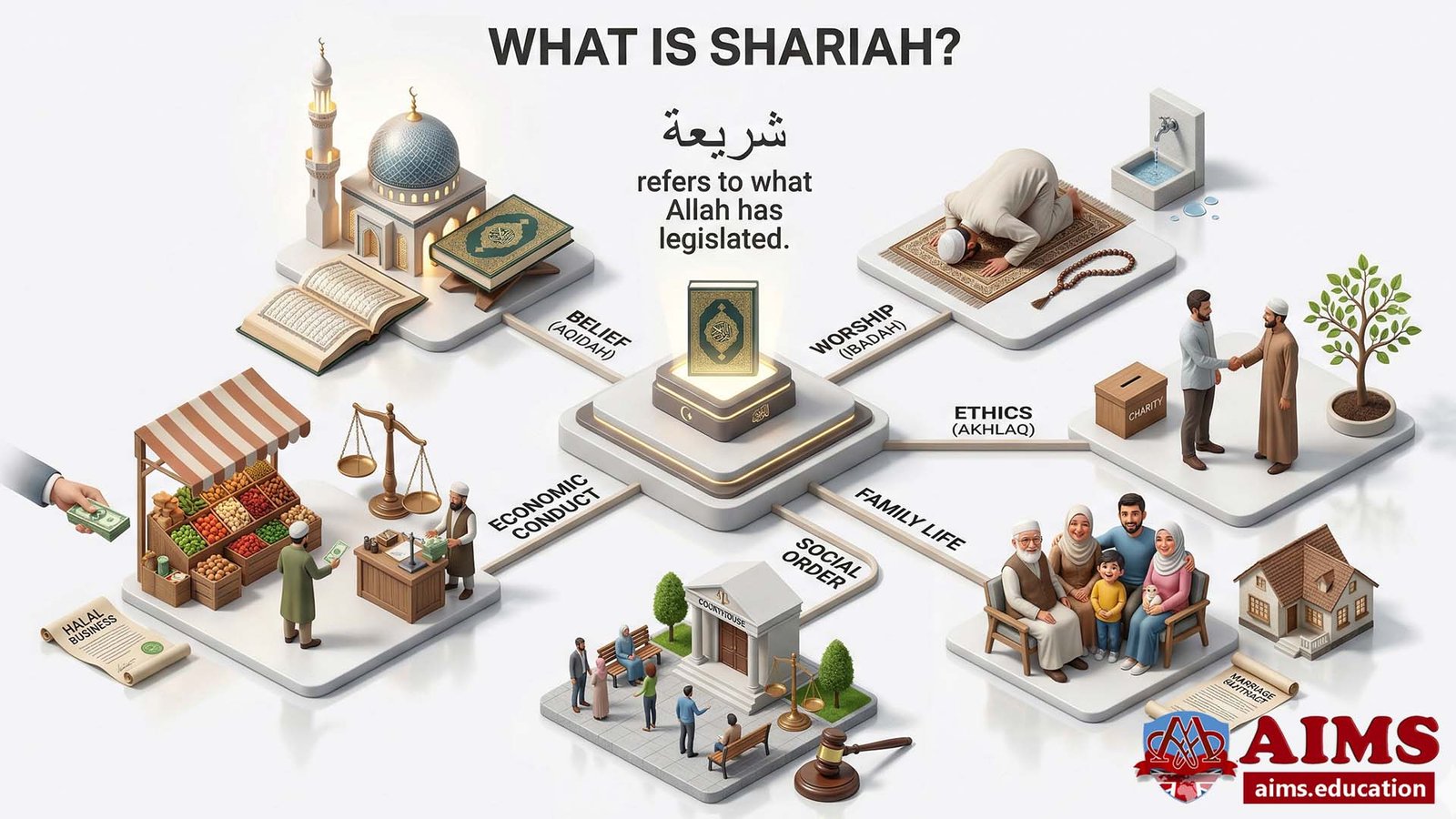
What is of Shariah (Islamic Law / Muslim Law) in Islam
In Islamic terminology, Shariah refers to what Allah has legislated for His servants. It includes commands, prohibitions, values, and principles that guide Muslims in personal and collective life. Shariah is a complete way of life, covering personal, familial, religious, social, moral, political, economic, and business matters.
“Today I have perfected your way of life (din) for you, and completed My favour upon you, and have chosen Islam as your way of life.” (Qur’an, 5: 3)
“We have only sent you are a mercy for all creation.” (Qur’an, 21:107)
Scope of Shariah in Personal, Social, and Economic Life
The scope of Shariah includes worship, belief, family relations, inheritance, contracts, trade, finance, public ethics, and social justice.
- It guides prayer and fasting, but it also guides how wealth is earned, how agreements are honored, how debts are managed, and how vulnerable members of society are protected.
- In economic life, Shariah requires lawful earning, honest trade, fair dealing, and avoidance of prohibited elements such as riba, deception, and injustice. This is why Islamic finance does not treat money as a commodity that earns guaranteed interest by itself. Instead, it connects finance with real assets, risk sharing, contractual clarity, and ethical responsibility.
For deeper study of Islamic finance principles, learners may explore the Islamic Banking and Finance Study Notes, which expand related concepts across Islamic economics, banking, contracts, and financial ethics.
A Simple Example of Shariah in Daily Life
Suppose Fatima sells office equipment to Hasan for $4,000, payable after three months. Shariah requires both parties to know the price, the goods, the delivery terms, and the payment date clearly. If Fatima hides a major defect, the transaction becomes ethically and legally problematic.
- Fatima must describe the equipment honestly because Shariah requires transparency in trade.
- Hasan must honor the agreed payment date because Shariah protects contractual obligations.
- Both parties must avoid uncertainty and deception because Islamic law links business activity with moral accountability.
This example shows how Shariah connects lawful commerce with fairness, trust, and responsibility.
Shariah, Fiqh, and Secular Law: Key Differences
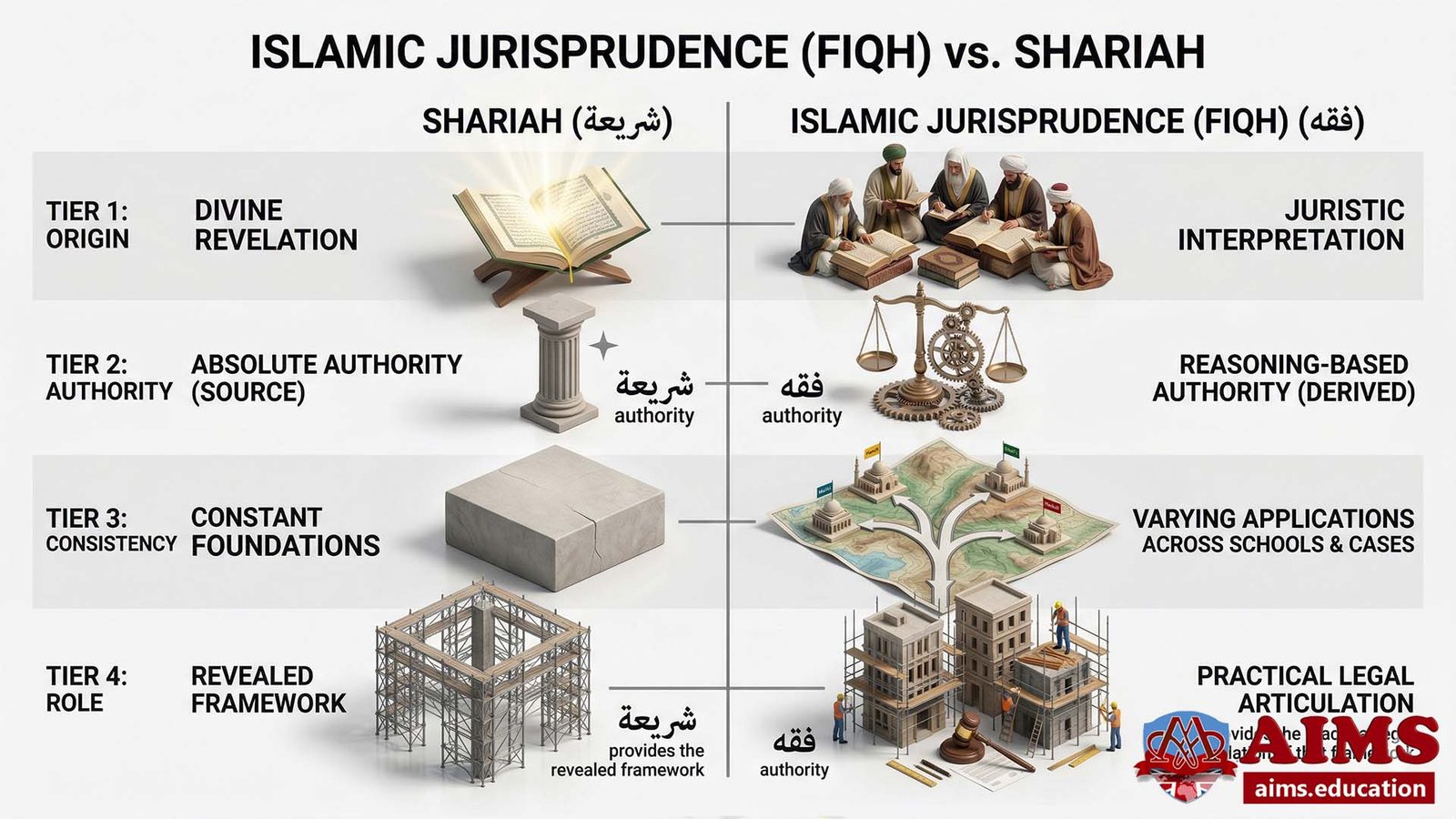
Shariah refers to divine guidance, fiqh refers to juristic understanding of that guidance, and secular law refers to rules enacted by human authorities. Confusing these three creates many misunderstandings, especially when people assume every legal opinion or state policy is identical to Shariah itself.
- Shariah is the revealed path.
- Fiqh is the human scholarly effort to understand and apply that path.
- Secular law is legislation created by states, courts, parliaments, or legal institutions.
These categories may interact, but they are not identical.
| ATTRIBUTE | SHARIAH | FIQH | SECULAR LAW |
|---|---|---|---|
| Source | Shariah is rooted in divine revelation through the Qur’an and Sunnah. | Fiqh is produced by qualified jurists interpreting Islamic sources. | Secular law is enacted by human legal and political institutions. |
| Nature | Shariah represents revealed guidance and moral purpose. | Fiqh represents human understanding, legal reasoning, and interpretation. | Secular law represents enforceable state rules within a jurisdiction. |
| Flexibility | Shariah contains fixed principles and broad objectives. | Fiqh may vary across scholars, schools, times, and contexts. | Secular law changes through legislation, regulation, and judicial decisions. |
| Purpose | Shariah seeks obedience to Allah, justice, mercy, and human welfare. | Fiqh explains how Shariah may be applied in real situations. | Secular law seeks public order according to state policy and legal philosophy. |
Muslim Law as a Translation and Its Limits
The phrase Muslim law is often used in English legal writing to describe rules derived from Islamic sources, especially in areas such as marriage, divorce, inheritance, gifts, and family matters. However, Muslim law can sound narrower than Shariah because Shariah includes worship, ethics, spirituality, finance, and personal conduct, not only court-enforced rules.
For example, a legal system may recognize rules related to inheritance or marriage, while a Muslim still follows Shariah guidance in prayer, charity, business ethics, diet, and personal behavior. Muslim law, therefore, can be a useful translation in legal contexts, but it should not reduce Shariah to only state legislation.
A practical example appears in gift and property matters. The rules of hiba show how Islamic legal concepts govern ownership transfer, intention, and delivery. For a focused explanation, see What is Hiba in Muslim Law (Islamic gift).
Sources of Shariah (Islamic Law): The Four Foundations
There are four sources of Shariah, and they are: the Qur’an, the Sunnah, Ijma, and Qiyas. The Qur’an and Sunnah are primary sources, while Ijma and Qiyas help qualified scholars extend guidance to issues that are not explicitly resolved in the primary texts.
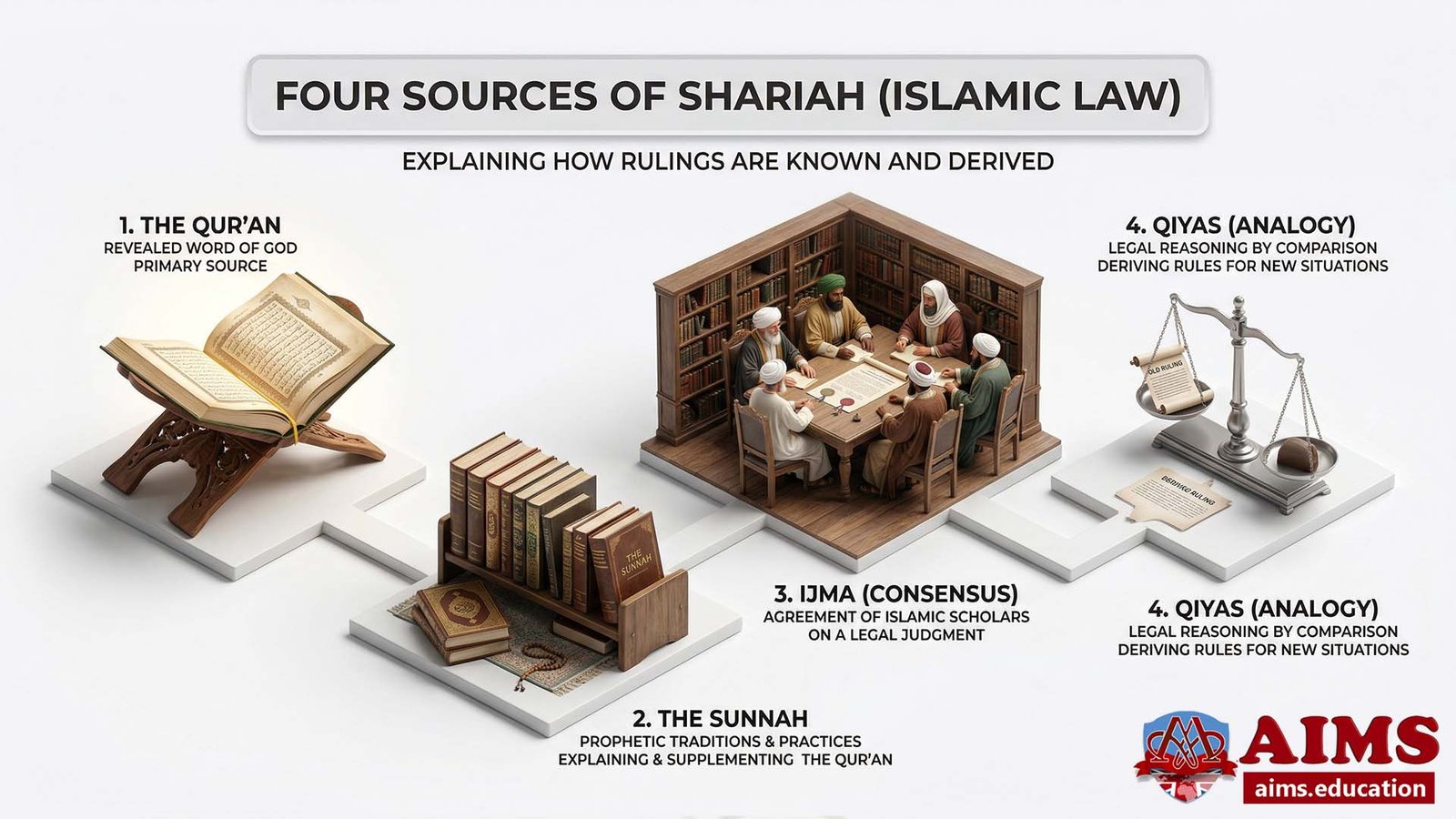
The sources of shariah explain how Islamic rulings are derived. They prevent legal reasoning from becoming arbitrary because every ruling must remain connected to revelation, Prophetic guidance, recognized scholarly method, and the objectives of justice and welfare.
1. The Qur’an as the Primary Source of Shariah
The Qur’an is the first and highest source of Islamic law. Muslims believe it is the direct word of Allah revealed to Prophet Muhammad ﷺ. Every other source must agree with the Qur’an and cannot override its essential principles.
The Qur’an provides foundational guidance on belief, worship, justice, contracts, inheritance, charity, trade, family life, and moral conduct. Some rulings are stated directly, while others are expressed through principles that require explanation through the Sunnah and juristic reasoning.
“When Allah and His Messenger have decreed a matter, it is not for any believing man or believing woman to have a choice in their affairs. And whosoever disobeys Allâh and His Messenger has gone astray into clear error.” (Qur’an, 33:36)
2. The Sunnah and Hadith as the Second Source
The Sunnah refers to the sayings, actions, approvals, and practical example of Prophet Muhammad ﷺ. It explains, clarifies, and applies the Qur’an. Without the Sunnah, many Qur’anic commands would remain general in wording but unclear in practical performance.
For example, the Qur’an commands prayer, but the Sunnah shows how prayer is performed. In financial matters, the Sunnah gives practical guidance on sales, debt, partnership, charity, market conduct, and prohibition of unfair transactions. This makes the Sunnah essential to the Islamic legal system meaning and method.
3. Ijma or Consensus in Shariah
Ijma means the consensus or agreed position of qualified Muslim scholars on a legal issue. It is used when a specific ruling is not stated directly in the Qur’an or Sunnah, but the scholarly community recognizes a valid ruling based on the sources.
Consensus protects the legal tradition from isolated or careless opinions. It also reflects the collective weight of scholarship. In practical terms, Ijma gives stability to Islamic jurisprudence where qualified scholars have reached settled agreement on important matters.
“If anything comes to you for decision, according to the book of Allah, if anything comes to you which is not in the book of Allah, then look to the Sunnah of the Prophet (صلى الله عليه وسلم), if anything comes to you which is not in the Sunnah of Prophet (صلى الله عليه وسلم), then look to what people unanimously agrees upon”.
4. Qiyas or Analogical Reasoning as a Source in Shariah
Qiyas means analogical reasoning. It applies an established ruling from the Qur’an, Sunnah, or Ijma to a new case because both cases share the same effective legal cause, known as the illah.
For example, if a new financial product contains the same harmful cause found in a prohibited transaction, scholars may extend the ruling through Qiyas. This allows Islamic law to address modern issues without abandoning its revealed foundation.
The Four Sources of Shariah in One View
| SOURCE | ROLE IN SHARIAH | PRACTICAL FUNCTION |
|---|---|---|
| Qur’an | The Qur’an provides the highest authority and core divine commands. | It establishes foundational duties, prohibitions, values, and principles. |
| Sunnah | The Sunnah explains and demonstrates Qur’anic guidance. | It shows how Islamic guidance is practiced in real life. |
| Ijma | Ijma records authoritative scholarly agreement on legal matters. | It gives stability where qualified scholars agree on a ruling. |
| Qiyas | Qiyas extends known rulings to new cases by analogy. | It helps scholars address new issues through shared legal causes. |
Islamic Jurisprudence (Fiqh) and Shariah
Fiqh is the human understanding and application of Shariah through juristic reasoning. Shariah is divine in origin, while fiqh is scholarly interpretation. This distinction explains why Islamic law has stable principles but also contains juristic diversity across schools and contexts.
Definition of Fiqh and Its Relationship to Shariah
Fiqh literally means understanding. In legal usage, it refers to the juristic understanding of practical Shariah rulings from detailed evidence. Fiqh deals with questions such as how a contract should be structured, how inheritance shares are calculated, or how a new financial practice should be evaluated.
The difference between Shariah and fiqh is essential. Shariah is the revealed path. Fiqh is the scholarly map drawn from that path. A map may differ in detail, but it must remain faithful to the path it represents.
Schools of Law and Source Interpretation
Islamic jurisprudence developed through recognized schools of law, often called madhahib. These schools use the same primary sources but may differ in how they weigh evidence, interpret texts, apply analogy, or evaluate public interest within the boundaries of Shariah.
This juristic diversity does not mean Shariah is confused. It means qualified scholars developed structured methods to apply revelation responsibly. Differences may appear in details of worship, family law, commercial contracts, and financial structuring, while the major principles remain rooted in the Qur’an and Sunnah.
The Role of Ijtihad in New Issues
Ijtihad is independent juristic reasoning by qualified scholars. It becomes important when new circumstances arise, such as digital assets, online marketplaces, biomedical issues, artificial intelligence, or complex financial instruments.
Consider a digital stock exchange. The Qur’an and Sunnah do not mention online trading platforms by name, but they do provide principles about ownership, sale, risk, uncertainty, deception, and lawful assets. Scholars study the new issue, identify its features, compare it with established rulings, and determine whether it fits within Shariah parameters.
- Scholars first examine whether the traded asset is lawful and genuinely owned.
- They then assess whether the transaction contains riba, excessive uncertainty, fraud, or prohibited speculation.
- They finally evaluate whether the structure serves legitimate exchange or creates harm and injustice.
This example shows how Islamic jurisprudence can address modern finance while remaining anchored in revelation.
Maqasid al-Shariah: Objectives of Islamic Law
Maqasid al-Shariah are the higher objectives of Islamic law, commonly summarized as the protection of religion, life, intellect, lineage or family, and property. These objectives explain why Shariah rules exist and how jurists evaluate benefit, harm, justice, and social welfare.
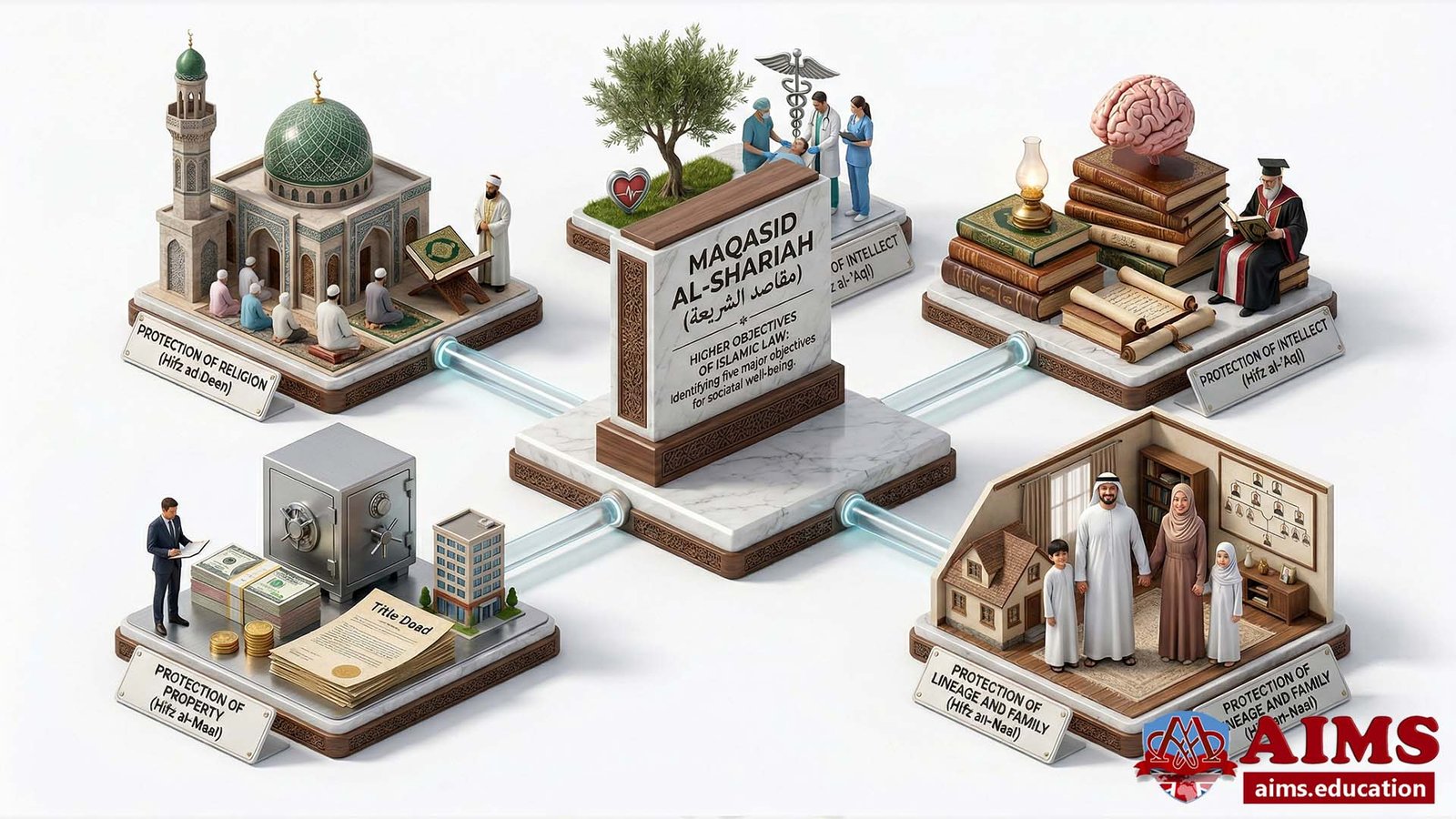
The phrase Maqasid al-Shariah means the objectives, aims, or purposes of Islamic Law (Shariah). These objectives help readers understand that Islamic law is not a collection of isolated commands. It is a coherent moral and legal system designed to protect human welfare and prevent harm.
The Five Core Objectives of Islamic Law
| OBJECTIVE | WHAT IT PROTECTS | EXAMPLE IN DAILY LIFE |
|---|---|---|
| Religion | It protects faith, worship, moral commitment, and spiritual responsibility. | A Muslim is given guidance for prayer, fasting, charity, and lawful conduct. |
| Life | It protects human life, safety, dignity, and public welfare. | Rules against violence and harm preserve human security. |
| Intellect | It protects sound judgment, learning, and moral responsibility. | Rules against intoxicants protect reason and decision-making. |
| Lineage and Family | It protects family structure, identity, rights, and responsibilities. | Marriage, inheritance, and custody rules protect family order. |
| Property | It protects ownership, contracts, wealth, and fair exchange. | Rules against theft, fraud, riba, and deception protect wealth. |
Role of Maqasid in Modern Lawmaking and Interpretation
Maqasid helps scholars and policymakers understand the wisdom behind legal rules. In modern Islamic finance, these objectives support fair contracts, real economic activity, risk sharing, protection of wealth, and avoidance of exploitation.
For example, a Shariah-compliant financing product should not merely copy the financial outcome of interest-based lending. It should respect ownership, risk, contract clarity, and fairness. The objective is not only technical compliance, but also ethical economic behavior.
Suppose an Islamic microfinance institution supports small traders through asset-based financing. It buys productive equipment for $1,000 and sells it to a trader at a known deferred price of $1,120. The trader understands the price, receives the asset, and uses it to generate lawful income.
- The contract protects property because ownership and price are clear.
- The transaction avoids riba because the financing is linked to a real asset sale.
- The arrangement supports livelihood because the trader gains productive capacity.
This example shows how Maqasid al-Shariah connects legal form with economic justice and human benefit.
Sharia in Modern Finance, Family Life, and Society
Shari’ah applies today through personal ethics, family law, commercial conduct, Islamic banking, charitable obligations, and social responsibility. Sharia is not confined to courts or criminal law. It also shapes daily choices, financial decisions, marriage contracts, inheritance planning, and professional conduct.
Shariah in Contemporary Muslim Societies
Muslim societies apply Shariah in different ways. In some countries, family law may formally incorporate Islamic rules. In others, Muslims follow Shariah personally while the state legal system remains secular or mixed. This variation is one reason Shariah law should not be confused with every policy of every Muslim-majority state.
In family matters, Shariah covers marriage, divorce, maintenance, inheritance, gifts, and guardianship. In social life, it encourages honesty, charity, mercy, respect for parents, protection of neighbors, and avoidance of oppression. In public life, it emphasizes justice, consultation, and responsibility.
Shariah-Compliant Finance and the Prohibition of Riba
Islamic finance is one of the clearest modern applications of Shariah. It requires financial activity to avoid riba, excessive uncertainty, deception, gambling-based gain, and prohibited industries. It also requires contracts to be transparent and connected to lawful assets or services.
Riba is especially important because interest-based lending often separates return from real trade, risk, or ownership. For a detailed explanation, see Riba in Islamic Banking and Finance.
A useful comparison can also be made between Islamic banking and conventional finance. Islamic banking links financing to Shariah-compliant contracts such as Murabaha, Ijarah, Musharakah, and Mudarabah, while conventional banking often relies on interest-bearing loans. For a detailed side-by-side explanation, see Difference between Islamic and Conventional Banking.
Academic Pathways in Islamic Banking and Finance
Students who want structured learning in Shariah, Islamic economics, and financial contracts may benefit from formal study. AIMS provides academic pathways in Islamic banking and finance, including the Internationally recognized diploma in Islamic Finance offered by AIMS and the MBA in Islamic Banking and Finance (AIMS).
These pathways help learners understand how classical Fiqh principles are applied to modern banking, product development, risk management, Shariah governance, and financial ethics.
Muslim Law and Common Misconceptions about Shariah
Many misconceptions about Shariah come from reducing it to punishments, politics, or cultural practice. Muslim law in its fuller sense includes worship, ethics, family life, trade, finance, charity, governance, and personal responsibility, while fiqh and local custom may differ across communities.
Misconception: Shariah Is Only a Criminal Code
One common misunderstanding is that Shariah is mainly about criminal punishment. This view is incomplete. Criminal law is only a small part of a much broader framework that includes worship, contracts, charity, family rights, business ethics, education, and social welfare.
A Muslim may engage Shariah every day by praying, earning halal income, avoiding fraud, respecting parents, giving charity, fulfilling contracts, and maintaining honesty in trade. These daily acts are far more representative of Shariah than sensational political claims.
Misconception: Shariah Is the Same as Culture or Politics
Another misconception is that every cultural practice in a Muslim society automatically represents Shariah. Culture may agree with Shariah, but it may also conflict with it. A harmful custom cannot become Islamic merely because a Muslim community practices it.
The same caution applies to politics. A government may claim to apply Shariah, but its policies still need to be evaluated through the Qur’an, Sunnah, juristic method, justice, and Maqasid al-Shariah. Shariah should not be judged only by political slogans or local customs.
Misconception: Shariah Is Rigid and Cannot Address Modern Life
Shariah contains fixed principles, but fiqh provides methods for applying those principles to new realities. Ijtihad, Ijma, and Qiyas allow scholars to evaluate new issues such as digital banking, online contracts, artificial intelligence, and global finance.
This is why the spelling Shari’ah may appear in academic books, Sharia may appear in journalism, and Shariah may appear in Islamic finance writing, while the underlying concept remains connected to the same revealed guidance.
| MISCONCEPTION | CLARIFICATION |
|---|---|
| Shariah is only punishment. | Shariah covers worship, ethics, family law, finance, charity, and social justice. |
| Shariah and fiqh are identical. | Shariah is divine guidance, while fiqh is human scholarly interpretation. |
| Every Muslim country applies Shariah the same way. | Application varies because legal systems, schools of law, and state structures differ. |
| Shariah cannot address modern finance. | Ijtihad and Qiyas allow scholars to evaluate new financial practices through Islamic principles. |
شريعة in Practice: A Simple Example of Deriving a Modern Ruling
شريعة is applied to modern questions by returning first to the Qur’an and Sunnah, then using Ijma, Qiyas, and qualified ijtihad where needed. This method allows scholars to address new realities without separating Islamic law from its revealed foundations.
Consider a fintech company that offers instant online financing for consumer electronics. The platform advertises “zero paperwork,” but it charges late penalties, bundles insurance without disclosure, and transfers no real ownership before collecting payments. A Shariah review would not only examine the label of the product. It would examine the structure.
- The scholars would identify the actual contract between the fintech company, the seller, and the customer.
- The scholars would check whether the asset is lawful, identified, owned, and deliverable.
- The scholars would examine whether the price, payment schedule, and penalties are transparent.
- The scholars would assess whether any riba, excessive uncertainty, deception, or unfair condition exists.
- The scholars would recommend changes if the structure conflicts with Shariah principles.
If the company restructures the product as a genuine asset sale with clear ownership, transparent pricing, and fair remedies for default, the transaction may move closer to Shariah compliance. This example shows how شريعة works as a disciplined method, not merely as a label.
For comparative legal reading, the Shariah Law Overview (U.S. Library of Congress) may also help readers understand how Islamic law is described in legal reference material.
Frequently Asked Questions about Shariah
These questions summarize the most important points about Shariah, Islamic law, Muslim law, sources, fiqh, and Maqasid al-Shariah. Each answer is written to clarify the concept directly and help readers distinguish divine guidance from juristic interpretation and state law.
What is Shariah law and how does it guide Muslim life?
Shariah law is the revealed guidance of Islam covering belief, worship, ethics, family life, trade, finance, and social conduct. It guides Muslims by defining lawful and unlawful conduct, encouraging justice and mercy, and connecting daily actions with accountability before Allah.
What are the four primary sources of Shariah?
The four sources of Shariah are the Qur’an, the Sunnah, Ijma, and Qiyas. The Qur’an and Sunnah are the primary revealed sources, while Ijma and Qiyas support juristic application when a new issue is not directly resolved in the primary texts.
How do Ijma and Qiyas function in deriving Shariah rulings?
Ijma functions through the agreement of qualified scholars on a legal matter, while Qiyas applies an established ruling to a new case because both share the same effective legal cause. Together, they help Islamic law address new circumstances with discipline and continuity.
How is Shariah different from Islamic jurisprudence or secular law?
Shariah is divine guidance, Islamic jurisprudence or fiqh is human scholarly understanding of that guidance, and secular law is legislation produced by human institutions. Fiqh may vary between scholars and schools, while Shariah remains the revealed foundation that jurists seek to understand.
What are Maqasid al-Shariah?
Maqasid al-Shariah are the objectives of Islamic law. They are commonly summarized as the protection of religion, life, intellect, lineage or family, and property. These objectives help explain why Shariah rules exist and how they protect human welfare.
Are Islamic law and Muslim law the same as Shariah?
Islamic law is usually used as a broad English translation of Shariah. Muslim law is also used, especially in legal contexts, but it can sound narrower because it often refers to personal law areas such as marriage, inheritance, gifts, and family rights.
Why is the Qur’an considered the primary source of Shariah?
The Qur’an is considered the primary source of Shariah because Muslims believe it is the direct word of Allah. The Sunnah explains and applies Qur’anic guidance, while Ijma and Qiyas must remain consistent with the Qur’an and cannot contradict it.
Is Shariah the same in every country?
Shariah as divine guidance is rooted in the same core sources, but its legal application differs across countries, schools of law, courts, and political systems. Differences in application often reflect fiqh interpretation, state legislation, legal institutions, and local context.
Conclusion: Why Shariah Still Matters in Islamic Banking and Finance
Shariah remains central to Islamic banking and finance because it connects financial activity with justice, transparency, lawful ownership, ethical risk, and social responsibility. It gives Islamic finance a moral foundation that goes beyond profit and asks whether wealth is earned, structured, and used lawfully.
For students and professionals, understanding Shariah is the foundation for studying Islamic economics, Islamic banking, Shariah governance, contract law, and modern financial product development. The key is to understand its sources, its objectives, and the difference between revelation, juristic interpretation, and state enforcement.
Readers who want to continue exploring Islamic banking, contracts, and Shariah-compliant finance can visit the Islamic Finance Blog for related educational resources.
About AIMS’ Institute of Islamic Banking and Finance
AIMS’ Institute of Islamic Banking and Finance has supported global Islamic banking and finance education since 2005 through internationally accredited, career-focused learning. Its standardized curriculum is developed with qualified faculty, industry-oriented teaching, practical skill development, 3D interactive learning content, and real-world case studies. AIMS’ published study materials, study content, and curriculum are collaboratively developed and rigorously peer-reviewed by an academic board of qualified industry practitioners. These standards help professionals build job-ready qualifications in Islamic banking and finance. Explore AAOIFI compliant and career oriented Islamic finance programs at AIMS.