
History of Islamic Banking
The history of Islamic banking traces how Islamic rules on trade, fairness, risk-sharing, and the prohibition of riba developed from early Muslim commercial practice into a modern financial industry. Its intellectual roots go back to the Quran, Sunnah, and classical Islamic commercial law, while its modern institutional form began in the mid-twentieth century and expanded strongly after the 1970s.
In simple terms, Islamic banking did not begin as a new invention, but as the modern organization of long-established Shariah principles into banks, financial products, regulatory systems, and international Islamic finance institutions.
- Islamic finance was never simply a rejection of interest. It was an effort to build financial relationships around lawful trade, shared risk, asset backing, fairness in contracts, and responsibility toward society. That is why the origins of Islamic finance cannot be reduced to one bank or one country.
- The deeper story begins with early Muslim markets, continues through centuries of commercial practice, and then takes a decisive institutional turn with experimental banks, development institutions, national reforms, and global standard setting.
To understand the first Islamic bank in the world, it is important to see how early Islamic trade ethics gradually developed into modern institutions, including Islamic banks, investment funds, sukuk markets, regulators, and educational bodies.
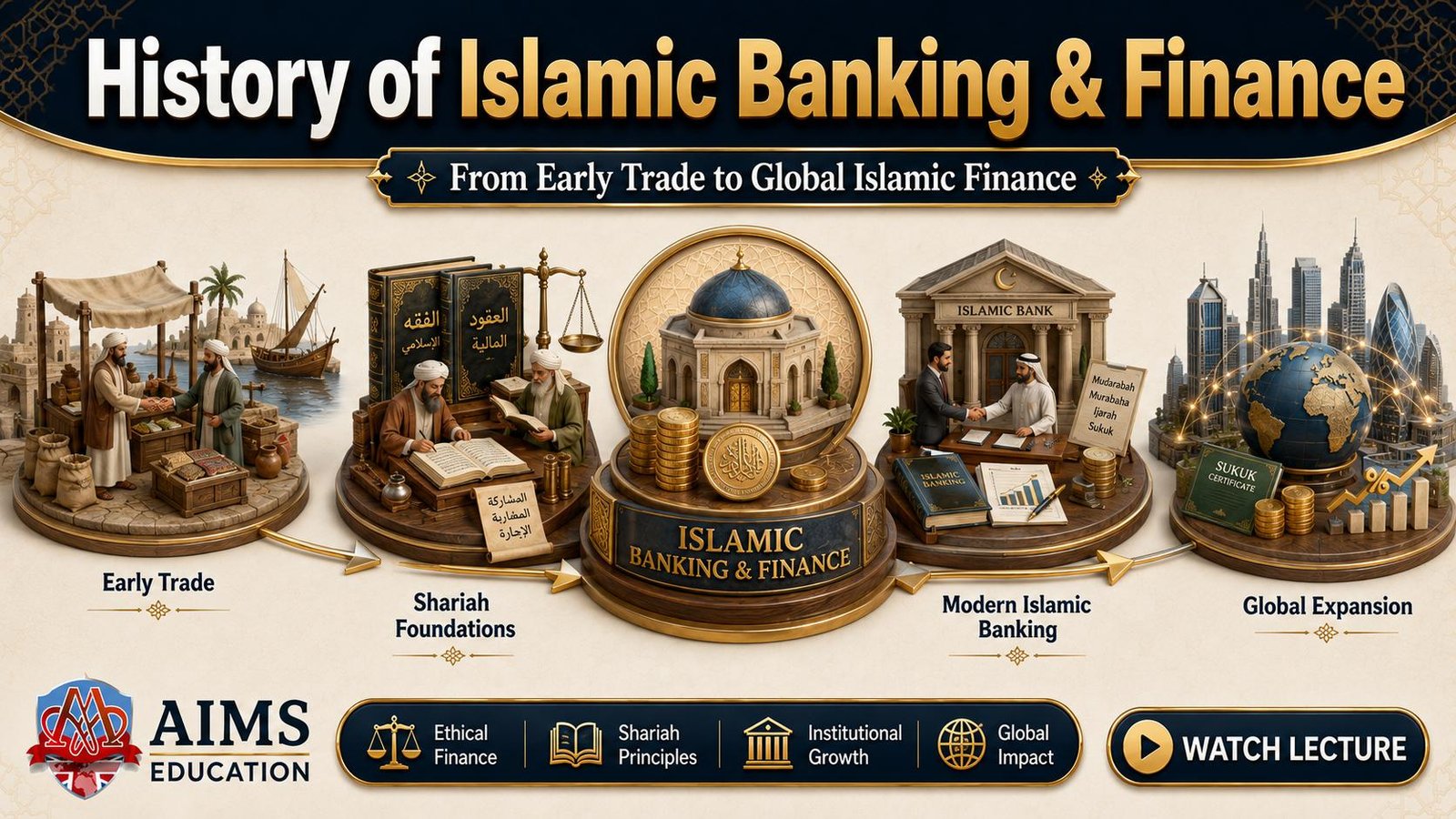
Importance of Islamic Banking History
Islamic finance is a system of financial dealings structured to comply with Shariah. In practical terms, it avoids riba, restricts excessive uncertainty and unethical speculation, links finance to real assets or productive activity, and encourages lawful profit through trade, partnership, leasing, and investment.
- Islamic finance did not emerge to eliminate profit. It emerged to distinguish legitimate profit from income generated through prohibited contractual forms.
- This is why trade, leasing, partnership, and investment became central to Islamic financial development, while interest based lending remained the major line of difference.
Anyone exploring the Definition of Islamic banking and finance should understand that the system seeks more than technical legal compliance. It also aims to preserve justice, transparency, and social responsibility in economic life. This ethical dimension helps explain why the historical development of Islamic finance involved scholars, merchants, governments, regulators, and later universities and professional institutes.
History of Islamic Banking from Early Muslim Commercial Life
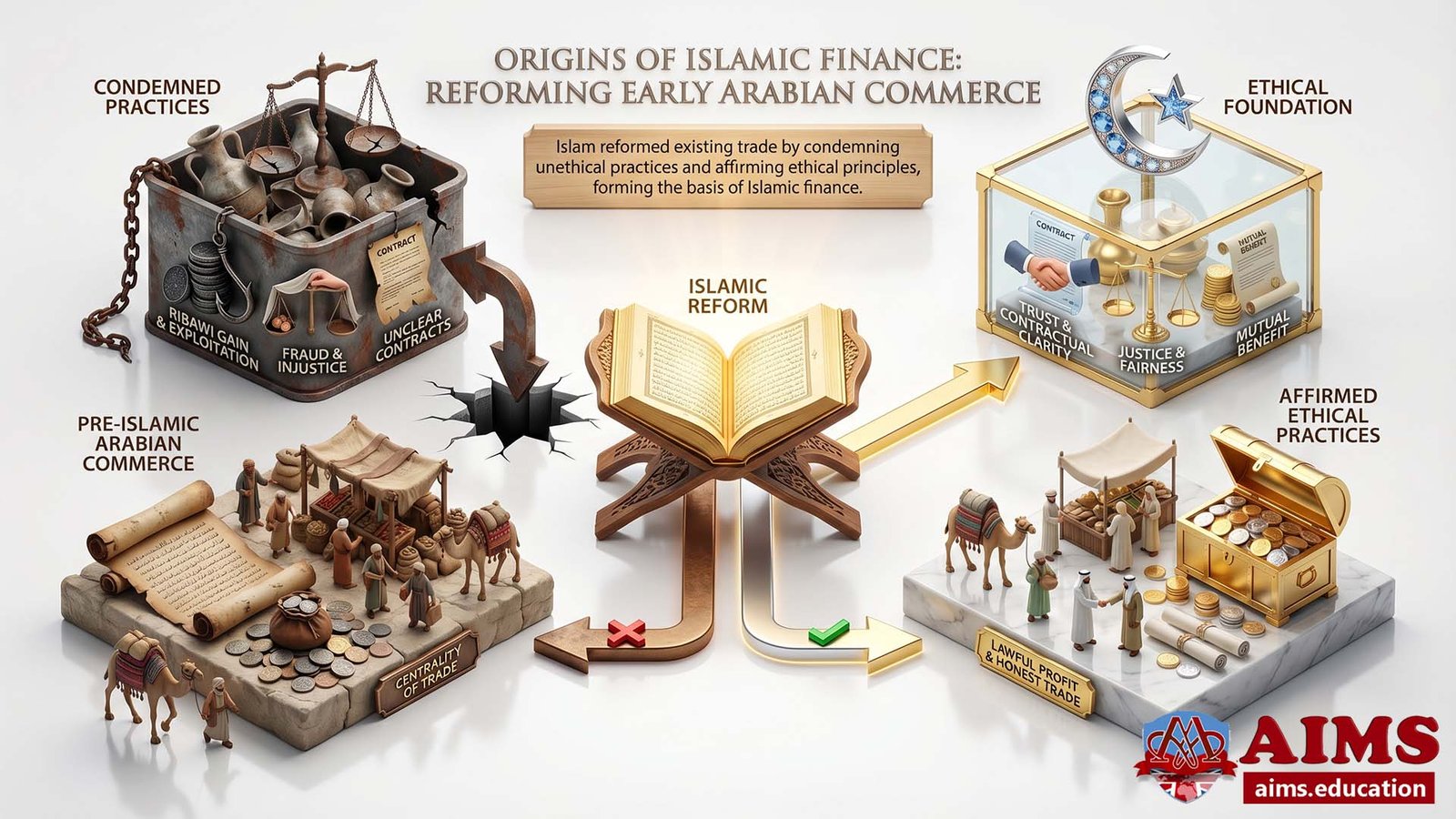
The earliest foundations of Islamic finance appeared in the commercial life of the Muslim community itself. Trade was central to Arabian society, and Islam did not reject commerce. It reformed it. Fraud, injustice, exploitation, and ribawi gain were condemned, while honest trade, lawful profit, trust, and contractual clarity were affirmed.
In the early years, several principles shaped later Islamic finance.
- Wealth was treated as a trust from Allah, contracts had moral significance, and markets were expected to function with fairness and accountability.
- Public finance also developed through institutions such as Bayt al-Mal, while charitable endowments and welfare obligations reinforced the idea that finance must serve society, not only private accumulation.
These early practices did not create modern banks, but they created the legal and moral grammar that later Islamic banking would rely on. This is one reason the history of Islamic banking should never be told as if it began only in the 1960s. The institutional story is modern, but the normative framework is much older.
Early Islamic Financial Practices and Commercial Ethics
Several pre modern practices help explain later developments in the Islamic finance history of the modern era.
- Profit sharing arrangements such as mudarabah allowed capital owners and entrepreneurs to cooperate without interest based lending.
- Partnership structures created a basis for shared risk and shared reward.
- Trust based transfer systems, often discussed through hawala, showed that value could move across distance without modern banking infrastructure.
- Market supervision and legal rules discouraged deception, uncertainty, and unjust enrichment.
One practical example makes this easier to see. A merchant in one city could provide capital to a traveling trader under a profit sharing arrangement. The trader would use skill and labor, the financier would provide capital, and both would share the outcome according to an agreed ratio. This example shows how Islamic commercial law allowed financing to occur without a fixed interest charge.
These arrangements were not identical to modern banking, but they gave later scholars workable precedents when they began searching for alternatives to conventional finance.
History of Islamic Banking Before Modern Institutions
The nineteenth and early twentieth centuries created the background against which modern Islamic finance would later emerge.
- Western commercial banks spread across the Middle East, South Asia, and Southeast Asia, often in colonial or semi colonial settings.
- Conventional banking methods, especially interest based instruments, became dominant in practice even where Muslim populations objected to riba in principle.
This period is crucial in the Islamic banking history narrative because it shows the problem reformers were trying to solve. Muslim owned banks did appear in the early twentieth century, but most adopted the same operational logic as conventional institutions. In other words, the demand for banking existed, yet a widely accepted Shariah compliant banking model had not fully taken shape.
By the 1950s, economists and jurists began exploring whether classical Islamic contracts could be adapted for modern finance. That search marked the true bridge between inherited legal theory and institutional experimentation.
From Classical Contracts to Modern Experimentation
Early reformers did not begin with a blank page. They turned to contracts already known in Islamic jurisprudence, especially mudarabah, musharakah, murabaha, ijara, and later istisna. The central question was simple but difficult: could these contracts support deposit taking, financing, liquidity management, and commercial expansion at scale?
Islamic finance did not grow only through market demand. It also grew through juristic interpretation, institutional design, and debate over how far traditional contracts could be extended into modern banking practice.
First Islamic Bank in the World: When Did Islamic Banking Start?
Modern Islamic banking began experimentally in the late 1950s and early 1960s, and first Islamic bank in the world started commercial banking in 1975. That answer resolves a common confusion. There is a difference between the first practical experiments and the first full scale commercial Islamic bank.
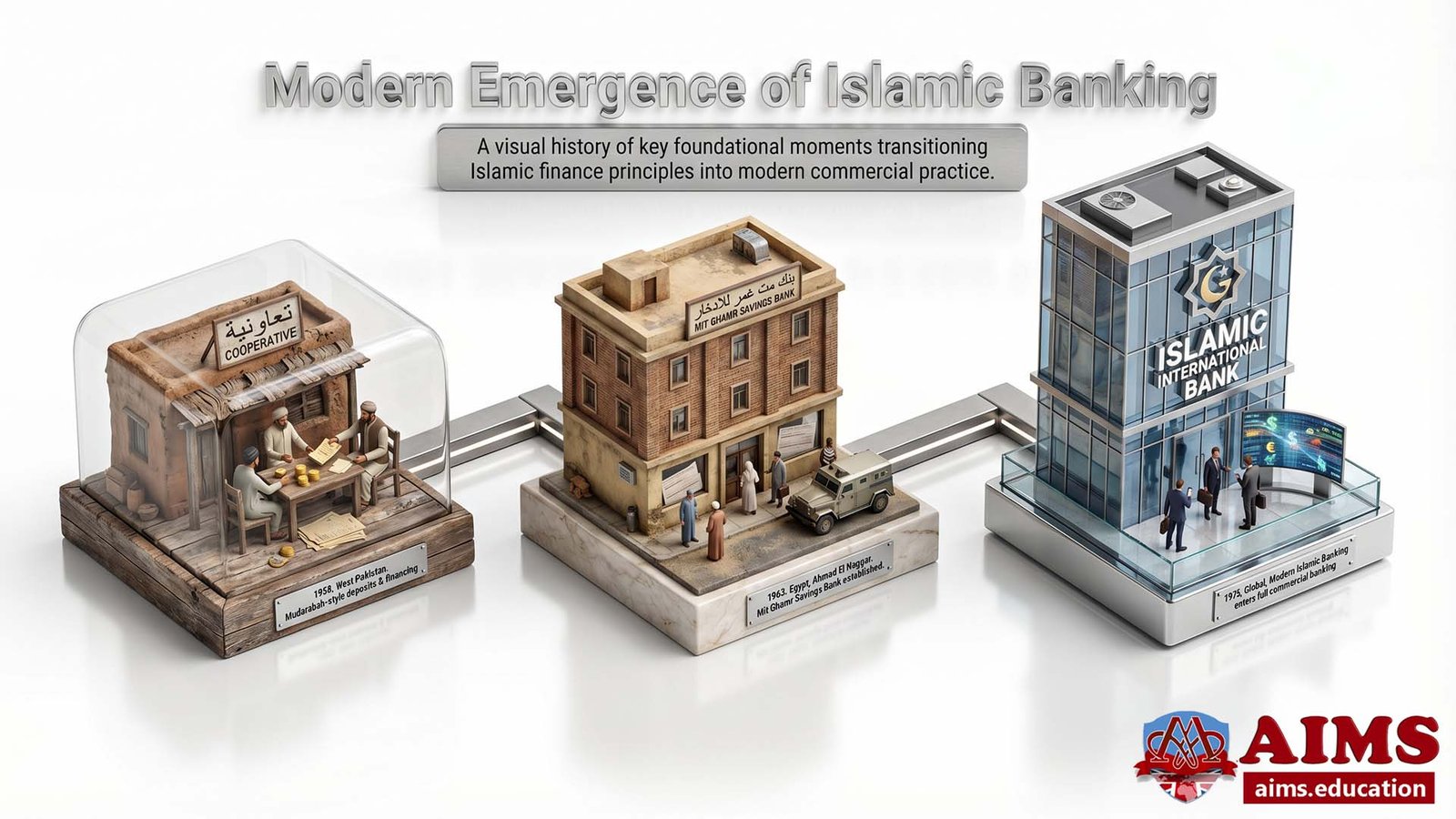
- In 1958, a small cooperative experiment in West Pakistan used a mudarabah style basis for deposits and financing. It was limited in scope, but historically important because it showed that the search for institutional alternatives had already begun.
- The most widely cited breakthrough came in 1963, when Ahmad El Naggar established the Mit Ghamr Savings Bank in Egypt. Mit Ghamr attracted thousands of depositors and financed local productive activity, especially agriculture. It is best understood as the pioneering modern experiment in Islamic banking.
- Yet many scholars and educators make a useful distinction here. Mit Ghamr was a landmark pilot, while Dubai Islamic Bank, founded in 1975, is generally described as the first Islamic bank in the world offering a broader range of banking services. That is why both dates are important in the history of Islamic banking.
First Islamic Bank in the World and the Mit Ghamr Model
Mit Ghamr deserves attention because it did more than avoid interest. It attempted to operationalize cooperation, profit sharing, and socially useful financing in a real banking environment.
- Depositors did not receive conventional interest.
- Funds were directed toward productive local activities.
- The model aligned savings with investment rather than fixed debt return.
A simple example helps. Suppose a savings institution gathered funds from local depositors and then financed irrigation equipment, seed supply, or workshop tools for small producers. Returns would depend on the performance of those financed activities rather than on a predetermined interest formula. This example shows how the early model tried to connect finance with real economic output.
Mit Ghamr did not by itself create a global industry, but it proved that Islamic banking was not merely theoretical.
Islamic Banking History in the 1970s and 1980s
The 1970s were the turning point in Islamic banking history. Three developments made expansion possible.
- First, Muslim governments supported institution building.
- Second, oil price rises increased liquidity in Gulf economies.
- Third, scholars developed workable structures for modern banking operations.
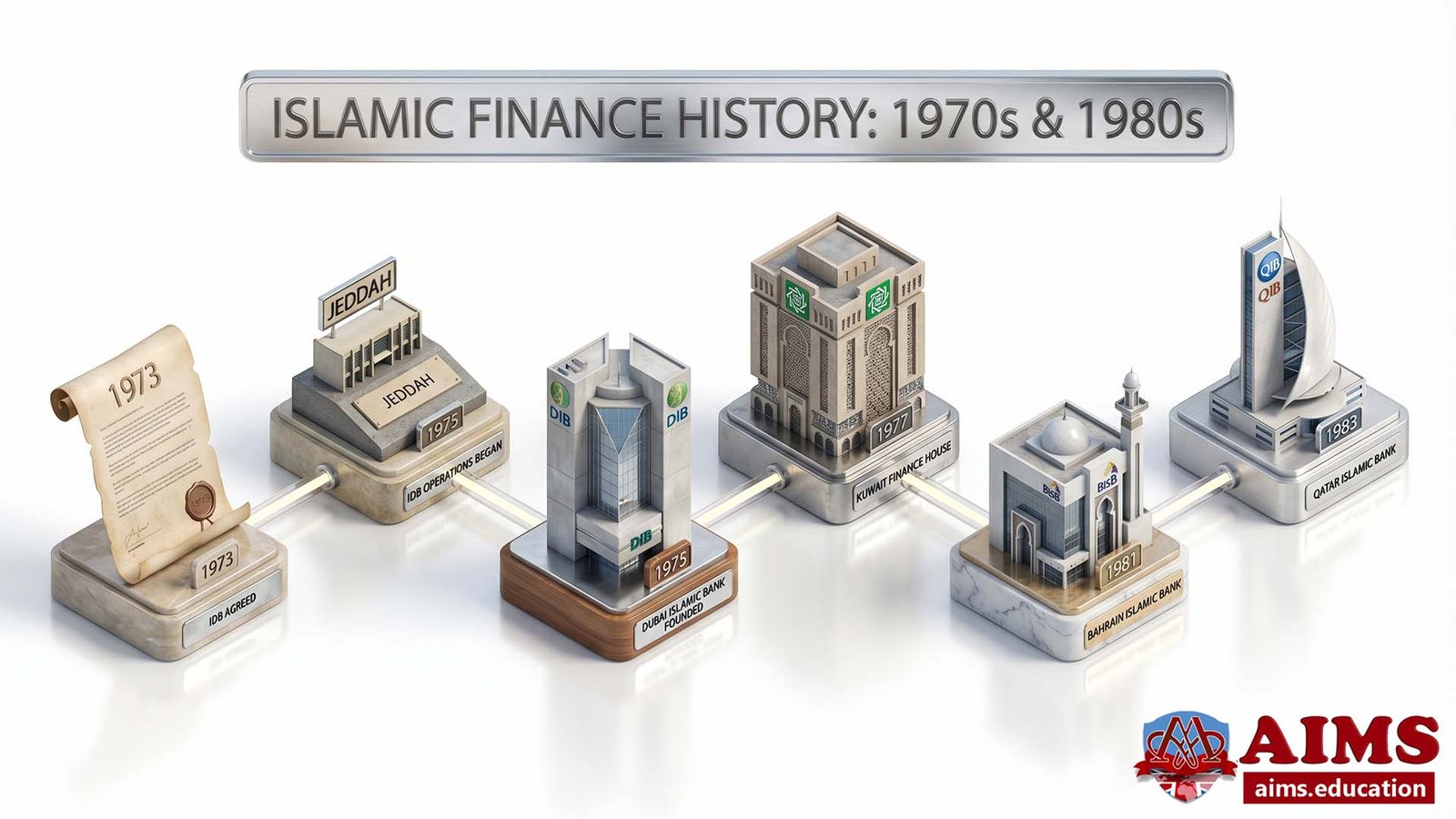
The Islamic Development Bank was agreed in 1973 and began operations in Jeddah in 1975. Its role was not the same as a retail commercial bank. It functioned primarily as a development institution, but it also became a major promoter of Islamic finance through research, conferences, technical guidance, and support for member countries.
At the same time, commercial institutions spread quickly. Dubai Islamic Bank was founded in 1975, Kuwait Finance House in 1977, Bahrain Islamic Bank in 1981, and Qatar Islamic Bank in 1983. Faisal Islamic Banks also expanded the model in Egypt and Sudan. This period established the first recognisable Islamic banking network across multiple markets.
Key Milestones in Islamic Finance
- 1958, early cooperative experiment in West Pakistan.
- 1963, Mit Ghamr Savings Bank in Egypt.
- 1973, agreement to establish the Islamic Development Bank.
- 1975, Islamic Development Bank operations begin and Dubai Islamic Bank is founded.
- 1977 onward, Kuwait Finance House and Faisal Islamic Banks expand the sector.
- 1980s, product diversification accelerates and Malaysia develops a strong regulatory model.
- 1991, AAOIFI is established to issue standards.
- 1990s and early 2000s, sukuk and Islamic money markets deepen liquidity management.
This sequence is essential for anyone searching an Islamic banking timeline, because it shows that the industry did not appear all at once. It moved from local experimentation to development banking, then to commercial expansion, then to standardization and market deepening.
How Products Evolved in the History of Islamic Banking and Finance
One of the most important stages in the history of Islamic banking and finance was the shift from a heavy theoretical reliance on partnership toward a more diversified set of instruments.
- Early reformers often emphasized mudarabah and musharakah because they reflected risk sharing most clearly.
- In practice, however, banks faced monitoring problems, information asymmetry, and the possibility of hidden profits or losses.
That led many institutions to expand the use of murabaha, which offered more predictable risk and clearer payment schedules. Later, ijara became important for equipment and property finance, while istisna was used for staged project financing. Over time, Islamic finance moved from a narrow identity around profit sharing alone to a broader architecture of trade, leasing, manufacturing finance, investment screening, and securities.
This is also why gharar in islamic banking is important historically. As products became more sophisticated, scholars had to assess not only interest prohibition but also uncertainty, asset ownership, delivery obligations, contractual sequencing, and risk allocation.
Leasing became especially significant in long term finance. Readers who want a clearer operational picture can explore why ijarah financing is an important instrument in Islamic banking practice.
Example of Product Diversification
Consider a manufacturing firm that needs machinery worth $500,000.
- Under a murabaha structure, the bank buys the machinery first and sells it to the client at an agreed marked up price payable over time.
- Under an ijara structure, the bank acquires the machinery and leases it to the client for periodic rentals.
- Under an istisna arrangement, financing can be released in stages while an asset is being constructed or manufactured.
This example shows how Islamic finance moved beyond abstract theory into practical contract engineering suited to different business needs.
The Pioneering Malaysian Market and the Growth of Sukuk
Malaysia occupies a central place in the Islamic finance history of regulation, liquidity management, and market innovation. Bank Islam Malaysia Berhad was established under the Islamic Banking Act of 1983, and the country later allowed conventional banks to offer Islamic products through dedicated windows and counters.
Malaysia also addressed one of Islamic banking’s hardest technical problems, liquidity management. Since Islamic banks could not simply rely on conventional treasury bills, regulators supported alternative instruments such as Government Investment Certificates, Islamic interbank arrangements, and later broader securities market development.
This set the stage for sukuk growth. Sukuk are often described too casually as Islamic bonds, but that can be misleading. While they may serve some similar funding purposes, they are structured around ownership interests, usufruct, assets, or defined contractual rights rather than a simple interest bearing debt promise. That distinction must be stated clearly because it is one of the most common misunderstandings in the field.
History of Islamic Banking and Finance Across Regions
The industry did not develop in one uniform pattern. The history of Islamic banking and finance differs by region, legal culture, political environment, and regulatory choice.
In the Gulf, Islamic banking expanded with strong demand, oil wealth, and the rise of dedicated Islamic institutions. In Malaysia, it grew through careful central bank support, regulatory design, and market infrastructure. In Pakistan, repeated attempts at Islamization produced a more uneven and politically contested path. In Sudan and Iran, broader system level Islamization created a different historical experience from countries that allowed Islamic and conventional banking to coexist side by side.
These regional differences matter because Islamic finance is not identical everywhere. Contract preferences, legal opinions, disclosure rules, and product acceptance can vary. Anyone studying the Islamic banking history of one country should avoid assuming that the same pathway applies universally.
Islamic Finance vs Conventional Banking in Historical Context
| ATTRIBUTE | ISLAMIC FINANCE | CONVENTIONAL BANKING |
|---|---|---|
| Core return logic | Return is structured through trade, lease, partnership, or investment linked to lawful contracts. | Return is commonly generated through interest based lending and borrowing. |
| View of money | Money is a medium of exchange and must be tied to real economic activity for profit generation. | Money can itself be priced through interest as part of standard credit intermediation. |
| Risk structure | Shared risk and asset linkage are emphasised, though products vary in practice. | Risk is often transferred contractually through fixed debt obligations. |
| Ethical screening | Activities must avoid prohibited sectors and invalid contractual elements. | Sector screening is not inherently required unless imposed by separate policy. |
| Historical objective | To create finance consistent with Shariah, justice, and lawful profit. | To expand credit, savings, and investment through secular banking models. |
This contrast also helps answer why many readers ask why islamic banking is better than conventional. The stronger answer is not a slogan. It is that Islamic banking was historically built to align finance with ethical limits, real assets, and a more accountable model of gain.
To understand the broader foundations behind that difference, it also helps to study the principles of islamic economic system that shaped financial thought long before the rise of modern Islamic banks.
AAOIFI, Standardization, and the Future Direction of Islamic Finance
As the industry expanded across countries, standardization became essential. Without common accounting, governance, and Shariah standards, Islamic finance risked fragmentation and weak comparability. That is why AAOIFI became such a major milestone.
AAOIFI helped strengthen Islamic finance by issuing accounting, auditing, governance, ethical, and Shariah standards that improved consistency and credibility. Readers can explore the institutional source directly through AAOIFI’s official Islamic finance standards.
Standardization did not eliminate all differences, and it should not be expected to do so. Islamic finance still reflects regional practice, scholarly diversity, and evolving regulatory priorities. Even so, the move toward standards has helped the industry gain greater international confidence.
The future path is likely to involve more than simple growth in bank numbers. It will depend on product authenticity, stronger governance, better disclosure, digital infrastructure, and the continued ability of Islamic finance to show that it offers not only legal form, but genuine economic substance.
Frequently Asked Questions
What is Islamic finance?
Islamic finance is a Shariah compliant system of finance that avoids riba, restricts excessive uncertainty, and uses lawful contracts such as trade, leasing, partnership, and investment.
What was the first Islamic bank?
Mit Ghamr Savings Bank in Egypt, established in 1963, is widely recognised as the first modern Islamic banking experiment, while Dubai Islamic Bank, founded in 1975, is generally regarded as the first full commercial Islamic bank.
When did Islamic banking start?
Islamic banking started institutionally in the late 1950s and early 1960s, with a major breakthrough in 1963, then expanded commercially from 1975 onward.
What are the main principles of Islamic finance?
The main principles are the prohibition of riba, avoidance of excessive gharar, lawful profit through valid contracts, asset linkage, ethical screening, and fairness in risk and reward.
How does Islamic finance differ from conventional banking?
Islamic finance structures return through trade, lease, and partnership rather than interest based lending, and it applies ethical and contractual constraints that conventional banking does not require by default.
What is riba in Islamic finance?
Riba refers to prohibited increase in specified financial dealings, especially unjust gain linked to lending and debt, and its prohibition is one of the main reasons Islamic banking developed alternative financial contracts.
Are sukuk just conventional bonds with Islamic names?
No. Sukuk may serve a similar funding purpose, but they are structured around assets, usufruct, ownership interests, or defined contractual rights rather than a simple interest bearing debt promise.
Why is Malaysia important in Islamic banking history?
Malaysia became one of the most important markets because it combined regulation, institutional support, liquidity management tools, and product innovation in a way that helped Islamic finance scale.
What role did education play in modern Islamic finance development?
Education helped transform Islamic finance from a specialist niche into a professional discipline by training bankers, researchers, regulators, and scholars in both Shariah and modern financial practice.
Conclusion
The history of Islamic banking is not a narrow story about replacing one contract with another. It is the record of a long effort to build finance on lawful trade, justice, and economic substance. The modern industry grew through experimentation, institutional support, product engineering, regional adaptation, and standard setting. That is why the history of Islamic banking and finance remains essential for understanding both the achievements of the field and the questions it still must answer.
About AIMS’ Institute of Islamic Banking and Finance
Since 2005, AIMS’ Institute of Islamic Banking and Finance has delivered internationally accredited Islamic finance education to learners worldwide through standardized, career-focused curricula, qualified faculty, and industry-oriented teaching. AIMS’ published learning content, study materials, and curriculum are collaboratively developed and rigorously peer-reviewed by an academic board of qualified industry practitioners. Through practical skill development, 3D interactive learning, and real-world case studies, AIMS supports job-ready qualifications for Islamic banking and finance professionals. Explore AAOIFI compliant Islamic finance education for professionals.