
Wakala Meaning
Wakala (وكالة) means agency or representation, and Wakala meaning refers to a Shariah-compliant Agency Contract where an agent acts on behalf of a principal for an agreed purpose. It is also written as wakalah, and is one of the most practical contracts in Islamic finance because it allows one party to appoint another to act on its behalf in a lawful and clearly defined matter.
- In modern markets, this structure helps individuals, businesses, and Islamic financial institutions complete transactions where time, distance, expertise, scale, or operational complexity make direct action difficult.
- The result is a Shariah-compliant agency relationship built on trust, authority, and clearly limited responsibility.
The wakala contract is especially important in Islamic banking, trade finance, investment management, and takaful operations.
The wakala (agency contract) explains how a principal delegates authority, how an agent must act within instructions, how fees are earned, and when the agent becomes liable. It also clarifies a point many students confuse: the agent in a wakalah contract is not a profit-sharing partner by default. The agent is usually paid for services, while the underlying profit or loss belongs to the principal unless negligence, misconduct, or breach changes the legal position.
Understanding wakala also help you distinguish it from related contracts such as Mudarabah profit-sharing partnership contract, Musharakah joint venture contract, Kafalah (guarantee) contract in Islamic finance, and Wadiah deposit (custodial safekeeping) concept. In simple terms, wakala is an agency contract, not a partnership, not a guarantee, and not a safekeeping arrangement.

Wakalah in Islamic Banking
Wakalah in Islamic banking means a contract of agency in which a Islamic bank authorizes an agent to perform a specific lawful act on the
bank’s behalf. In classical Islamic legal writing, the principal is often called the muwakkil, and the agent is called the wakeel or wakil. The authority given may be narrow and highly specific, or wider and more general, but it must remain within lawful and understood boundaries.

The core idea is straightforward. A person may be capable of owning an asset or entering a transaction, but may not have the time, location access, technical knowledge, or commercial network to handle it personally. In that case, the person may appoint an agent. This is why wakala appears in ordinary life as well as in sophisticated Islamic finance structures.
Parties in a Wakalah Contract and Their Responsibilities
A valid wakala contract involves two primary parties and a defined subject matter.
- The principal delegates authority.
- The agent accepts that authority and acts within it.
- The delegated act must be known, lawful, and capable of being performed through agency.
This means agency can apply to many financial and commercial matters, including sale, purchase, fund management, collection, delivery, and procedural tasks. It does not apply to every human act. Purely personal religious duties such as salah and fasting are not matters that can be transferred through wakala.
How the Wakala Contract Works
The wakala contract works by transferring authority, not ownership. The principal remains the owner of the relevant right, asset, or commercial interest, while the agent acts as a representative within the scope of delegation.
This is how it works:
- The principal appoints an agent for a specific or general lawful task.
- The scope, limits, and conditions of authority are defined.
- The agent performs the task in line with those instructions and accepted market practice.
- The legal effects of the agent’s authorized act attach to the principal.
- The agent receives an agreed fee, a customary fee, or no fee, depending on the contract.

This structure is one reason Principles of Islamic banking and finance place strong emphasis on contractual clarity.
- If the authority is restricted, the agent must stay inside those limits.
- If the authority is wider, the agent must still protect the principal’s interests and follow sound commercial custom.
Agent’s Fee, Status, and Liability
The agent in a wakalah contract may work with or without remuneration. Paid wakala is permissible, and the fee may be fixed as a lump sum, a periodic fee, or another clearly determined method. In Islamic finance, a fee may also be linked to a known benchmark or measurable output where the method is clearly disclosed in advance.
- The agent is treated as a trustee. That means the agent does not automatically guarantee outcomes.
- If an asset is damaged or an investment underperforms without negligence, misconduct, or breach, the agent is not automatically liable.
- Liability arises when the agent acts outside the contract, acts negligently, commits misconduct, or causes loss through an avoidable breach.
Conditions and Shariah Basis of Wakala
A valid wakala structure depends on legal capacity, lawful purpose, clarity, and delegable subject matter. These conditions protect both parties and reduce gharar, avoidable uncertainty, in the relationship.
Essential Conditions of Wakala
- The principal must have legal capacity and the right to deal in the relevant asset or matter.
- The agent must be legally competent to perform the assigned task.
- The delegated matter must be known well enough to avoid serious dispute.
- The act must be lawful under Shariah.
- The matter must be one that can validly be performed through agency.
These conditions explain why wakala is widely accepted in trade, banking, and investment, but not in acts that are strictly personal and non-delegable.
AAOIFI Guidance on Agency
Contemporary Islamic finance relies heavily on standard-guidance to ensure that contracts remain faithful to Shariah while also working in modern institutions. A useful summary appears in the AAOIFI discussion of agency:
“Wakala/Agency is the act of one party delegating the other to act on its behalf in what can be a subject matter of delegation and it is, thus, permissible.”
Wakala/Agency can be used in fund management, procurement, trade documentation, and investment operations, while remaining subject to limits.
Types of Wakalah
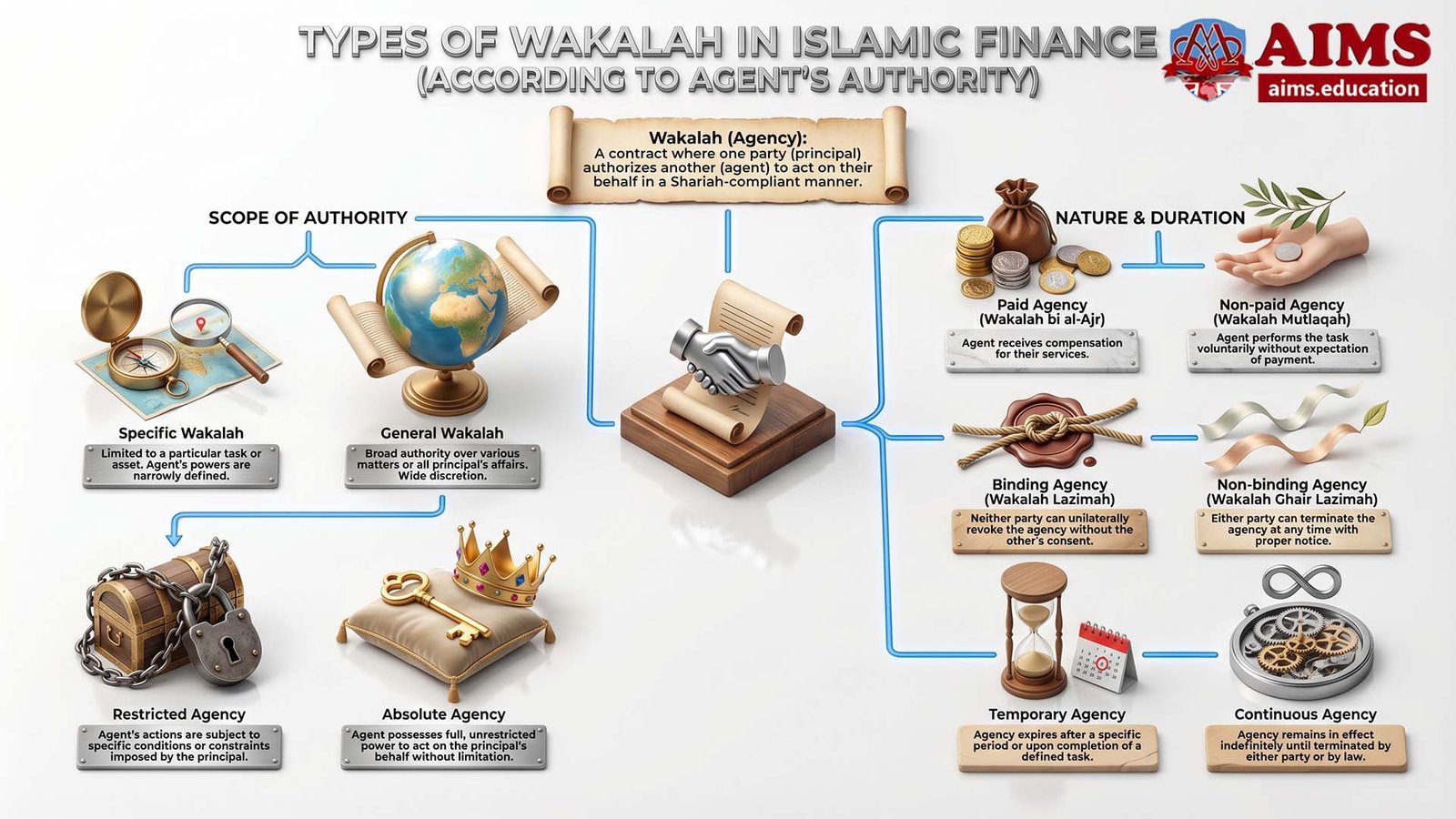
Wakala (agency contract) can be classified from several different perspectives, depending on the terms agreed upon by the principal and the agent (Wakeel). The primary classifications include:
- By Scope of Authority: Restricted Agency (Wakala Muqayyada) vs. Absolute/Unrestricted Agency (Wakala Mutlaqa).
- By Specificity of Task: Specific Wakala (for a defined task) vs. General Wakala (for broader management).
- By Remuneration: Paid Agency (Wakala bil Ujra) vs. Non-paid (Voluntary) Agency.
- By Duration: Temporary Agency (ends at a specific time) vs. Continuous Agency.
- By Legal Nature: Binding Agency (cannot be revoked unilaterally once initiated) vs. Non-binding Agency.
Specific Wakala and General Wakala
- Specific wakalah is limited to a known transaction, while general wakalah gives broader authority across a wider area of action. A specific appointment might authorize an agent to buy one identified property, collect one debt, or complete one documented transaction.
- General wakala gives wider discretion, though it still remains controlled by the principal’s interests and accepted market custom.
Example:
- Ahmad tells Bilal to purchase a specific machine from a named supplier for up to $15,000. This is specific wakalah.
- Ahmad tells Bilal to source suitable office equipment for a new branch within normal market standards. This is general wakalah.
This example shows how the scope of authority changes the agent’s freedom to act.
Restricted Wakala and Unrestricted Wakala
- Restricted wakala imposes explicit conditions such as price, quality, delivery method, time limit, payment method, or location.
- Unrestricted wakala Absolute agency removes many of those express limitations, but it does not create unlimited freedom.
Even under broader authority, the agent must still act within prevailing custom, fair market practice, and the principal’s interests.
That point is central in Islamic finance. An unrestricted agent is not free to behave recklessly. A broader mandate still does not justify selling below market value, buying above fair value, or entering unusual structures without authority where the principal would reasonably object.
Paid and Non-paid Wakala
- Paid wakala is common in modern finance because banks, operators, fund managers, and service institutions perform wakala functions professionally.
- Non-paid wakala also exists, especially in private or informal settings, but commercial finance usually depends on a clearly disclosed fee arrangement.
This is where you should distinguish wakala from profit-sharing contracts. In wakala, the fee compensates the service. It does not automatically entitle the agent to a share of business profit in the same way as a mudarib under Mudarabah.
Binding and Non-binding Agency
As a general rule, wakala is non-binding, meaning either party may revoke it. However, paid agency, third-party rights, or operational circumstances may make parts of the relationship effectively binding for a period. That is especially relevant in structured finance, institutional fund management, and operational mandates that cannot be stopped suddenly without causing harm.
Wakala in Islamic Banking and Finance
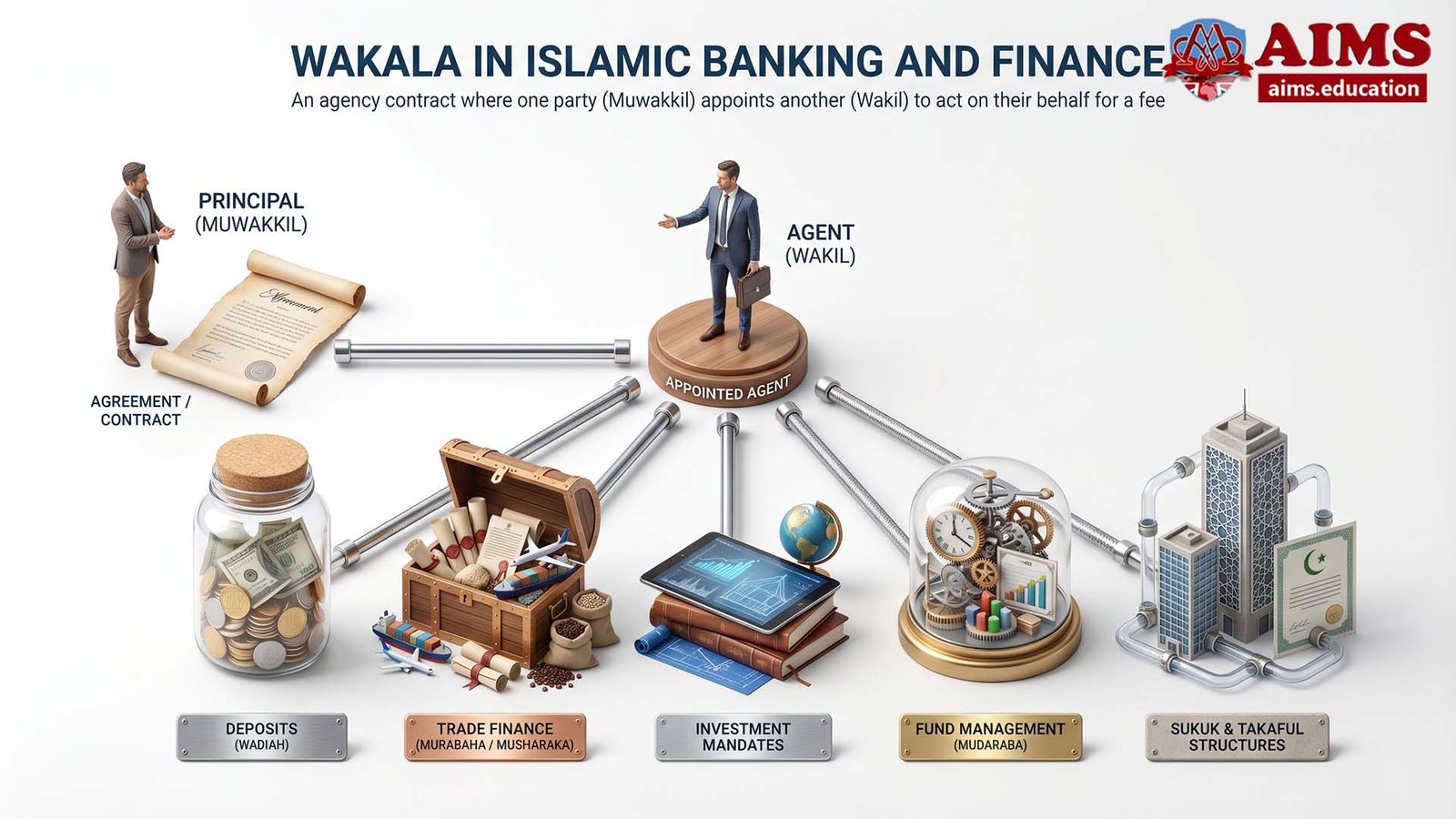
Wakala has become a practical building block in modern Islamic finance because it allows the bank or institution to act for the client without turning the relationship into an interest-based loan. Wakala in Islamic banking is used in deposits, trade finance, investment mandates, fund management, and some sukuk and takaful structures. For a wider background on contract design, see Islamic financial instruments and products overview.
What Is a Wakala Deposit?
A wakala deposit is a structure in which a customer appoints an Islamic bank as agent to invest funds in Shariah-compliant activities. The bank acts as wakeel, follows the agreed mandate, and earns a disclosed fee. The profit outcome depends on the actual performance of the underlying investment activity, not on a guaranteed interest return.
Wakala deposit or Agency deposit does not work like a fixed conventional term deposit, because:
- The contract is agency-based.
- The bank is appointed to invest, manage, or place the funds according to Shariah-approved instructions.
- Returns may be projected, expected, or targeted, but they are not simply interest promised on cash for time.
Wakala Deposit Works in Practice – An Example
Suppose: A customer places $50,000 with an Islamic bank under a wakala (agency) deposit.
- The bank is appointed as agent to invest that amount in Shariah-compliant assets or transactions.
- The contract sets the investment scope, duration, and the bank’s agency fee.
- If the investment performs well, the resulting return belongs to the principal after deducting the agreed fee.
- If a loss occurs without negligence, the principal bears the commercial result, while the bank remains entitled only to the contractually valid fee structure.
This example shows how the structure is based on representation and execution, not on lending money for interest.
Wakala in Fund Management and Investment Agency
Investment funds often use wakala because subscribers appoint a manager to act on their behalf. The fee may be fixed, periodic, or linked to a disclosed basis such as net asset value if structured properly and disclosed clearly before launch. This is one reason disclosure documents matter so much in Islamic finance. The authority, fee method, and investment scope must be known in advance.
Wakala in Trade Finance
A clear modern application appears in documentary trade transactions such as letters of credit. In an Islamic structure, the client appoints the bank as agent to handle documents and payment execution. The client places funds, the bank acts within the mandate, and the bank charges fees for agency services rather than interest for a short-term loan. This is a strong example of how classical wakala principles continue to operate in modern banking.
Wakala vs Other Islamic Financial Contracts
Wakala vs Mudarabah
| FEATURE | WAKALA | MUDARABAH |
|---|---|---|
| Legal Role | The agent acts on behalf of the principal. | The mudarib manages capital as an investment entrepreneur. |
| Compensation | The agent usually earns a fixed or clearly determined fee. | The mudarib earns an agreed share of actual profit. |
| Profit Ownership | Profit belongs to the principal after valid fees and terms. | Profit is shared between capital provider and mudarib. |
| Loss Position | Commercial loss belongs to the principal unless the agent was negligent or in breach. | Financial loss falls on capital, while the mudarib loses effort unless negligent. |
| Nature of Relationship | The relationship is agency based. | The relationship is investment partnership based. |
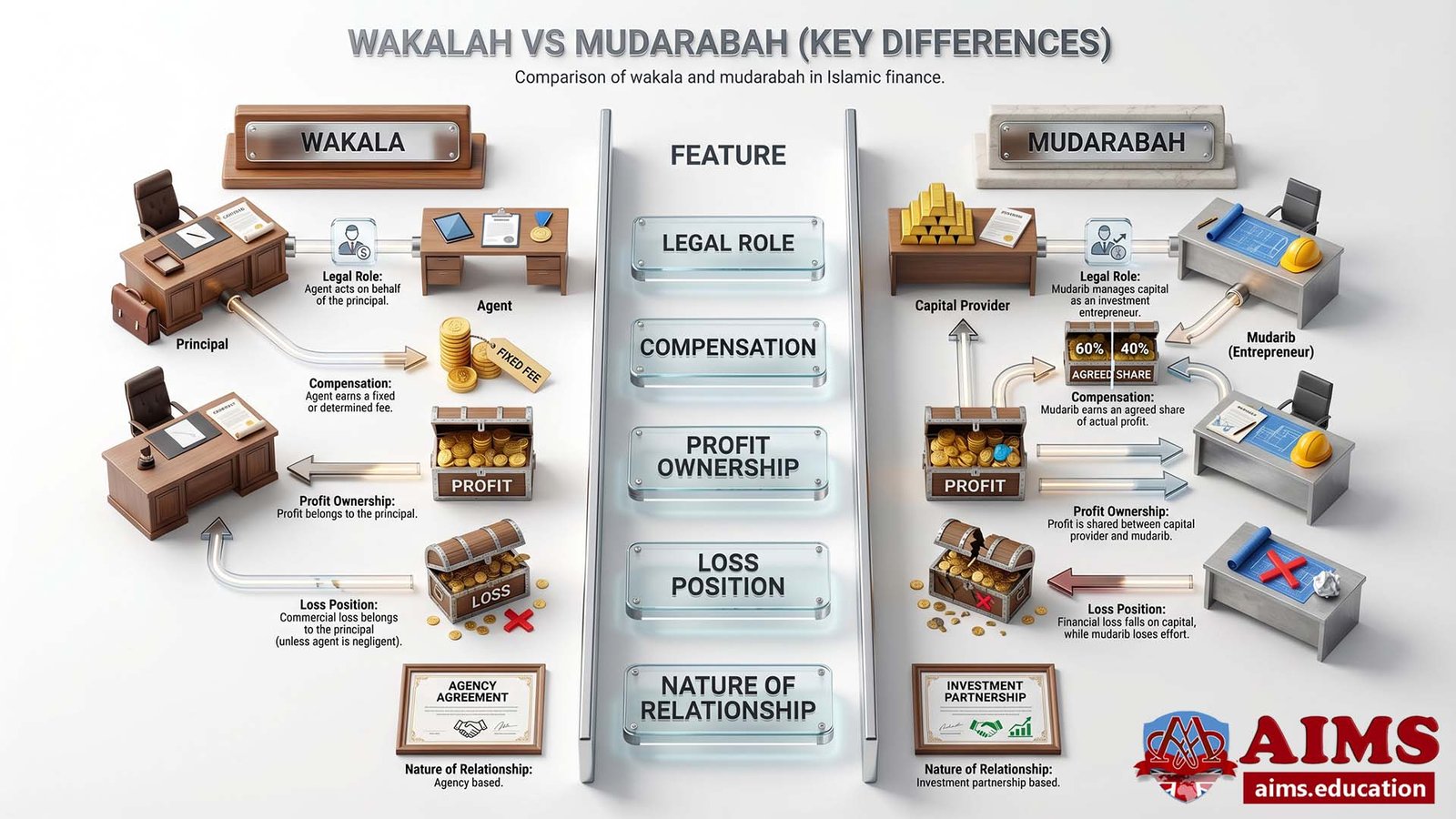
This is why wakalah vs mudarabah is not a minor technical distinction. It changes remuneration, authority, profit distribution, and legal characterization. To learn more, you should also review Mudarabah profit-sharing partnership contract and Musharakah joint venture contract.
Wakala vs Musharakah
Wakala is agency, whereas Musharakah is joint ownership and shared participation.
- In Musharakah, the parties invest and participate as partners.
- In wakala, one party mainly executes instructions on behalf of the other.
That difference affects risk sharing, managerial authority, and entitlement to returns.
Wakalah Example and Business Applications
In daily commerce, lawyers, brokers, procurement agents, managers, and directors may all function through agency principles when they act within delegated authority.
A Simple Wakalah Example in Trade
- Fatimah owns a retail business but cannot travel to purchase inventory.
- She appoints Yusuf as her agent under a wakalah contract to purchase 500 units of halal-certified goods.
- She limits the purchase price to $8 per unit and requires delivery within ten days.
- Yusuf follows the mandate and buys at $7.60 per unit.
- The purchase binds Fatimah because the agent acted within authority and in her interest.
This example shows how agency makes commerce easier while preserving legal accountability.
Another Wakalah Example in Banking
Suppose: A customer opens a wakala (agency) deposit with an Islamic bank:
- The bank acts as wakeel to invest funds in Shariah-compliant opportunities.
- The agreement discloses the investment mandate and the bank’s fee.
- The customer remains the principal and ultimate economic owner of the funds.
- The bank is liable only if it breaches the mandate or acts negligently.
This wakalah example shows why the contract is so useful in modern Islamic banking.
Wakalah Takaful Model and Insurance Application
The wakalah takaful model is another important modern use of agency.
- In this model, the takaful operator acts as agent for participants and manages underwriting, administration, claims handling, and related operational tasks in return for a wakala fee.
- The operator is not simply taking premiums as its own income in the way a conventional insurer would. The operator is managing a Shariah-compliant cooperative risk-sharing arrangement.
In wakalah takaful model, the fee belongs to the operator for services rendered, while the participants’ risk fund remains legally and conceptually distinct. In practice, some structures may also involve hybrid features, but the agency basis remains central to understanding how the operator is compensated.
Benefits, Risks, and Common Misunderstandings
Key Benefits of Wakala
- It allows specialization, so experts can act for those who lack time or technical skill.
- It supports large-scale commercial operations across distance and multiple markets.
- It creates a lawful framework for service fees in banking, trade, and investment.
- It makes modern Islamic finance operationally possible in many institutional settings.
Main Risks and Legal Limits of Wakala
- The agent must not exceed delegated authority.
- The agent must avoid self-dealing where conflict of interest is present.
- The agent must not combine agency with an impermissible guarantee in a way that changes the transaction into riba-based logic.
- The principal must define scope and fee clearly enough to prevent dispute.
Common Misunderstandings
- The first common misunderstanding is that the agent automatically shares business profit. That is not the default rule in wakala. The agent usually earns a fee for service. Profit-sharing belongs to different contract logic.
- The second common misunderstanding is that wakala guarantees return. It does not. A wakala (agency) deposit may target returns, but commercial outcomes still depend on actual investment performance unless a separate lawful feature changes the position.
- The third common misunderstanding is that a wakalah contract gives the agent unlimited power. It does not. Even wider authority remains constrained by Shariah, contract terms, custom, and the principal’s interests.
Frequently Asked Questions
What Is Wakala in Islamic Finance?
Wakala is an Islamic agency contract in which one party appoints another to carry out a lawful and defined task on its behalf.
What Is the Difference Between Wakala and Wakalah?
There is no substantive difference in meaning. Wakala and wakalah are variant transliterations used for the same agency concept.
What Is a Wakala Contract Used For?
A wakala contract is used in trade, banking, investment management, fund administration, document handling, debt collection, and takaful operations.
Can a Wakala Contract Be Revoked?
Yes. As a general rule, wakala is non-binding and may be revoked, although paid agency, third-party rights, or practical circumstances may limit immediate termination.
Who Bears the Risk in a Wakala Arrangement?
The principal bears the commercial result of the authorized transaction, while the agent is liable only for negligence, misconduct, or breach of mandate.
How Is Wakala Different from Mudarabah?
In wakala, the agent usually earns a fee. In Mudarabah, the manager earns a share of actual profit. The legal structure and return logic are different.
What Is a Wakala Deposit?
A wakala deposit is an arrangement where a customer appoints an Islamic bank as agent to invest funds in Shariah-compliant activities for an agreed fee structure.
What Is the Role of Wakala in Takaful?
In the wakalah takaful model, the operator manages the takaful fund and operations as agent for participants in return for a disclosed wakala fee.
Can the Agent Appoint Another Agent?
Not automatically. A sub-agent generally requires the principal’s permission, especially where the original authority was limited or personal in nature.
When Does a Wakalah Contract End?
A wakalah contract may end by completion of task, revocation, resignation, loss of legal capacity, expiry of agreed term, or destruction of the subject matter.
Conclusion
Wakala remains one of the clearest and most useful contracts in Islamic finance because it translates a simple agency idea into a strong legal and Shariah-compliant framework for modern commerce. Once you understands authority, fee, liability, and limits, the wider applications become much easier to grasp. That is why wakala continues to play a central role in Islamic banking, investment activity, trade execution, and takaful operations.
About AIMS’ Institute of Islamic Banking and Finance
Since 2005, AIMS’ Institute of Islamic Banking and Finance has delivered internationally accredited Islamic finance education to learners worldwide through standardized, career focused curriculum, qualified faculty, practical case studies, and 3D interactive learning content. AIMS study content and curriculum are collaboratively developed and rigorously peer reviewed by an academic board of qualified industry practitioners, helping professionals build applied, job ready expertise for Islamic banking, finance, and Shariah compliant markets. Explore career oriented Islamic banking and finance education.