
Ijarah Meaning
Ijarah (إجارة) comes from the Arabic root “Ajr” (أجر), meaning compensation, wage, or rent. In Islamic jurisprudence, Ijarah refers to the transfer of usufruct, meaning the right to use an asset or service, for an agreed consideration and an agreed period. The lessor retains ownership of the asset, while the lessee receives the right to use it according to the contract terms.
Ijarah is one of the most important contracts in Islamic banking and finance because it allows the lawful use of an asset without turning the transaction into an interest based loan. Ijarah in Islamic banking is a lease arrangement in which, an Islamic bank gives customer the right to use a valuable asset for an agreed period and agreed rent, while ownership remains with the Islamic bank. The Ijarah contract is central to Islamic banking, equipment leasing, vehicle finance, and lease to own structures.
In Islamic banking, the arrangement is not merely a change of label from interest to rent.
- The lessor must own the asset, bear ownership risk, and charge rent only after delivery of the asset.
- The lessee pays for use, not for borrowed money.
This is why Ijara remains one of the clearest ways to understand how Islamic finance separates trade and usufruct from riba.
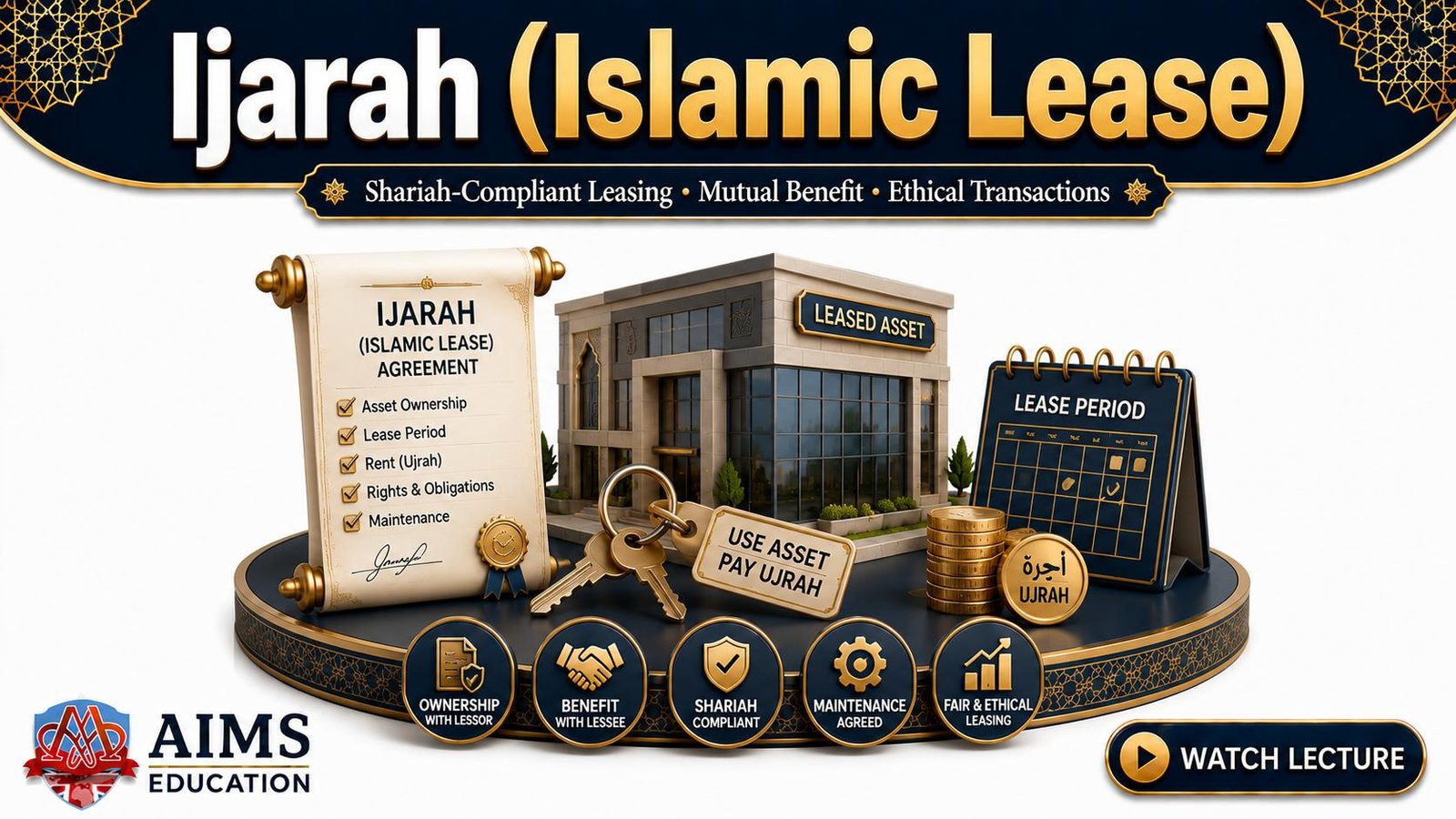
Ijarah in Islamic Banking and Finance
The concept of Ijarah in Islamic banking and finance is simple: ownership of the asset stays with the bank as lessor, while the customer as lessee receives the right to benefit from it.
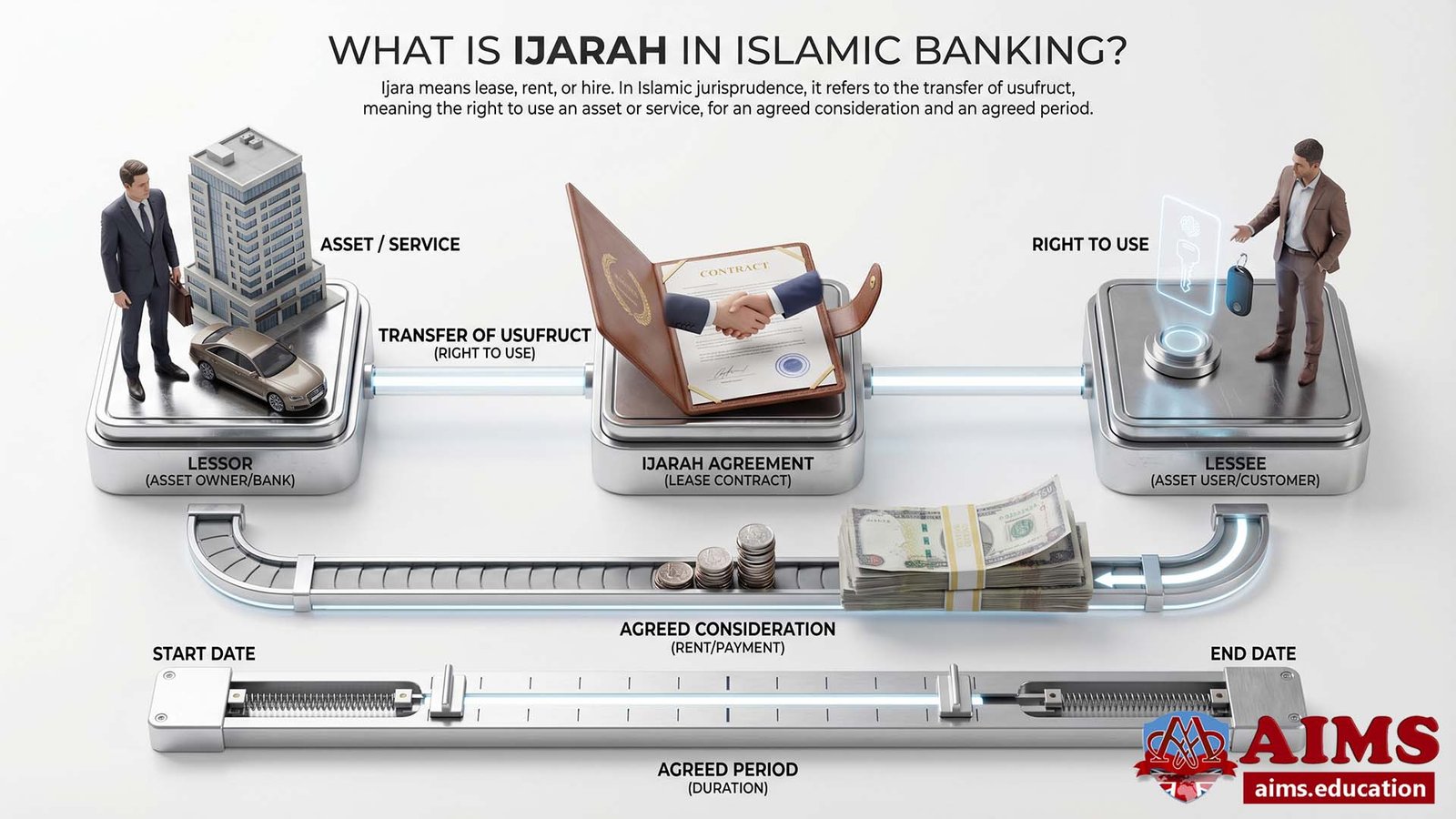
Classically, Ijarah appears in two broad forms.
- The first is hiring services, such as employing a worker.
- The second is leasing an identified asset, such as a car, house, machine, or equipment.
In Islamic banking, the second form is the one most commonly used, because it allows the bank to finance access to a real asset rather than lend cash on interest.
That is also why Ijara should not be confused with a loan. Cash itself cannot be leased, because it is consumed in use and ownership transfers by spending. A lawful Ijara contract therefore requires a non consumable, identifiable, and usable asset. This distinction protects the structure from becoming disguised interest.
How an Ijarah Contract Works in Islaimic Banking
An Ijarah contract is valid when it transfers use, not ownership, of a lawful asset for a known rent and a known period. The lessor remains owner throughout the lease term. Because ownership remains with the lessor, ownership related liabilities also remain with the lessor.
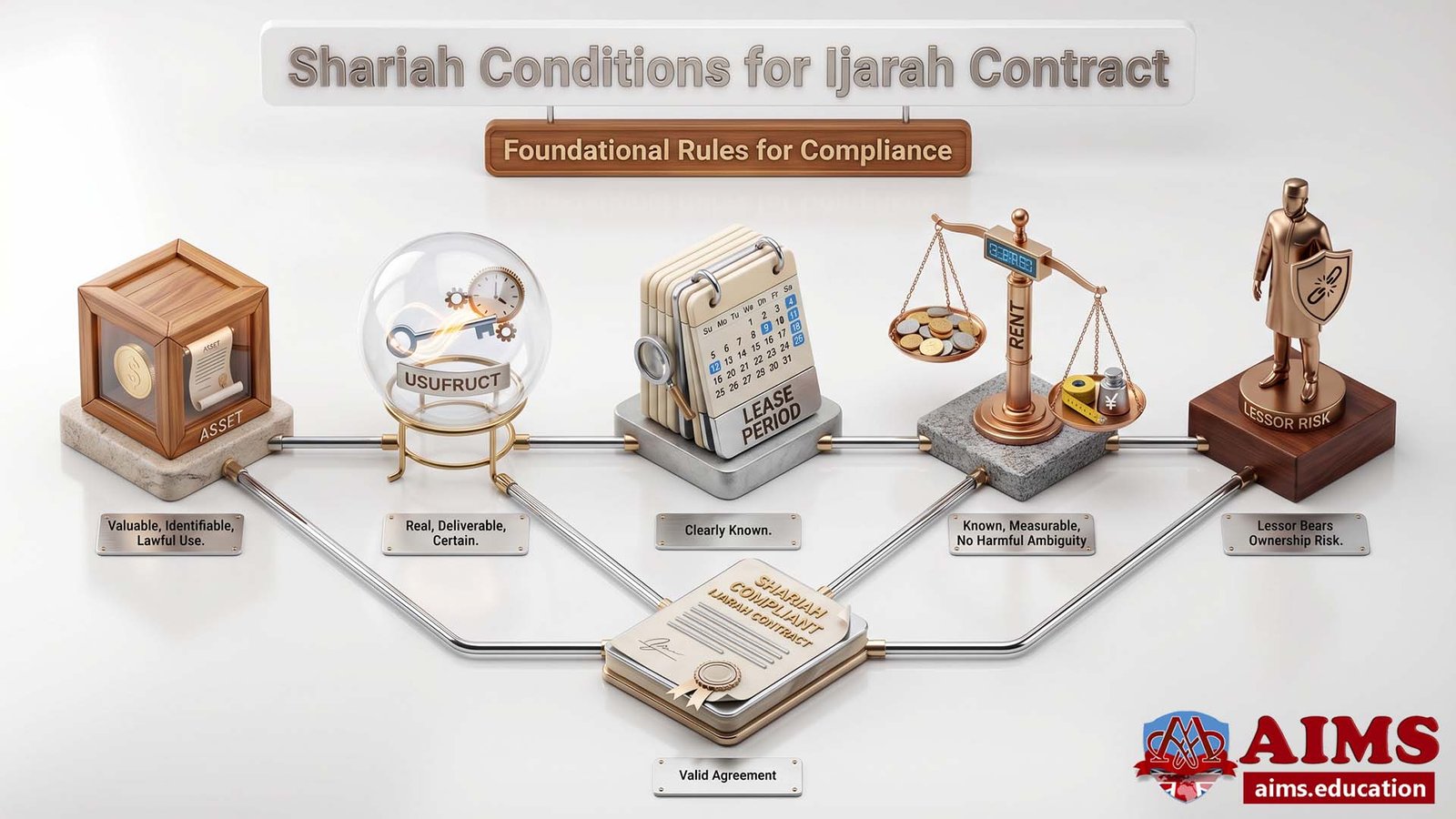
The structure rests on several foundational rules:
- The asset must be valuable, identifiable, and capable of lawful use.
- The usufruct must be real and deliverable, not imaginary or uncertain.
- The lease period must be clearly known at the time of agreement.
- The rent must be known, measurable, and free from harmful ambiguity.
- The lessor must bear ownership risk, including major ownership related loss not caused by the lessee’s negligence.
These rules matter because the Ijarah contract is not just a pricing arrangement. It is a legal framework that assigns rights and responsibilities in a distinct way. If the lessor keeps ownership in name only but shifts all real ownership burdens to the lessee, the structure begins to resemble an impermissible conventional finance lease rather than a true Islamic lease.
Shariah Conditions for a Valid Ijarah Contract
The main Shariah conditions are grouped under the asset, the rent, the period, and the responsibilities of the parties.
Asset Conditions
The leased asset must be a non consumable item whose use does not destroy its corpus.
- A car, house, office, generator, or machine can be leased.
- Money, wheat, fuel, or food cannot be leased in this sense because they are consumed in use.
The asset must also be identified with sufficient precision, such as make, model, location, quantity, or technical specification.
Ijarah Rent Conditions
Rent must be agreed at the outset:
- It may be fixed as one amount for the whole term or divided across phases.
- It may also be benchmarked in long leases, but the formula, review periods, and limits must be clearly stated.
What is not allowed is a unilateral increase by the lessor after the Ijarah contract has already been concluded.
Delivery and Use Conditions
Rent becomes due only when the asset is delivered and the lessee can benefit from it.
- If the asset becomes unusable without the lessee’s negligence, rent for that unusable period cannot be claimed.
- If the agreement limits use to a certain purpose, the lessee must stay within that purpose.
Responsibility Conditions
- The lessor bears ownership related costs, such as major ownership risk, registration linked to ownership, and insurance or Takaful as owner.
- The lessee bears use related costs, such as routine operation, normal wear in use, and damage caused by misuse or negligence.
This allocation is one of the clearest markers of a genuine Ijarah contract.
Types of Ijarah Contracts
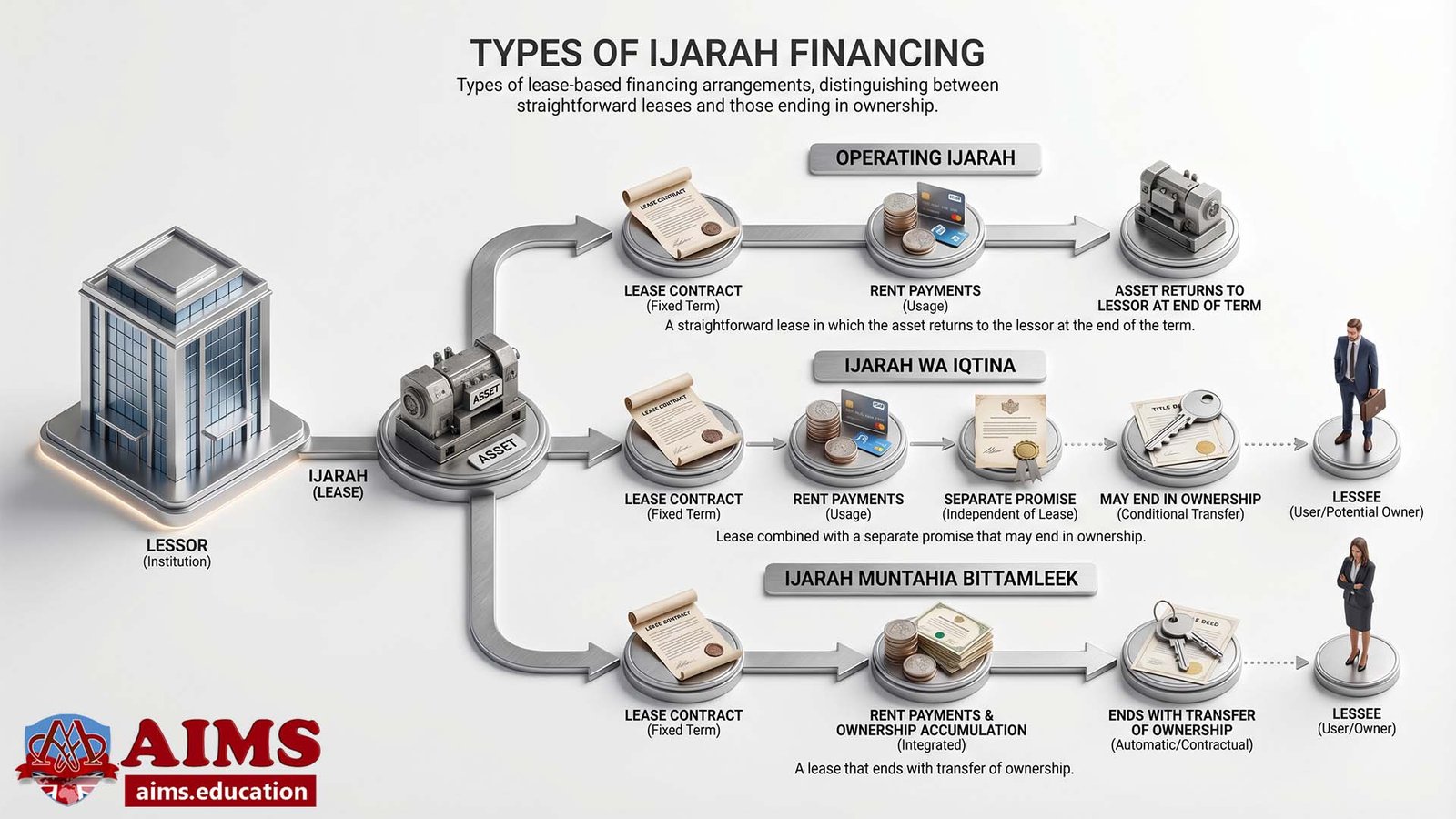
There are three different types of Ijarah, and they are: Operating Ijarah, Ijarah wa Iqtina, and Ijarah Muntahia Bittamleek. Some less common variants are also used in discussion or practice.
Operating Ijarah
Operating Ijarah is a straightforward lease in which the asset returns to the lessor at the end of the term. The lessee enjoys use for a defined period, pays rent, and does not automatically become owner. This is the cleanest form of Ijarah because the lease remains a lease from start to finish.
- A company may lease office equipment for three years under Ijarah financing.
- After the lease ends, the machines return to the bank or leasing company unless a new and separate arrangement is made.
This form is useful where access matters more than ownership.
Ijarah Wa Iqtina
Ijarah wa Iqtina is a lease combined with a separate promise that may end in ownership. Usually, the lessor gives a unilateral promise to sell or gift the asset at the end of the lease, subject to fulfillment of agreed conditions such as payment of all rentals.
- This structure is widely used because it gives flexibility.
- The lessee benefits from the asset during the lease and may later become owner.
- The key Shariah point is that the promise to transfer ownership must remain separate from the lease itself.
- The lease should not make sale or gift a built in bilateral condition from the outset.
In practical terms, Ijarah financing under Ijarah wa Iqtina is common in car and equipment finance because many customers want use today and ownership later. The promise is separate, the lease remains valid as a lease, and the final transfer occurs through a distinct legal step.
Ijarah Muntahia Bittamleek
Ijarah Muntahia Bittamleek is a lease that ends with transfer of ownership. The transfer may occur through gift, token consideration, sale at a specified price, sale for the remaining amount, or gradual transfer of ownership over time.
This form requires special care.
- If the lease agreement itself ties sale and lease together in a way that removes the lessor’s ownership responsibilities, the structure becomes problematic.
- A Shariah compliant model keeps the lease genuine during the lease term and handles ownership transfer through a separate mechanism disclosed in a lawful way.
For that reason, Ijarah financing that promises eventual ownership must still preserve a real difference between rent for usufruct and price for transfer of title. If not, the structure turns into a disguised credit sale or impermissible hybrid.
Other Variations in Practice
Some scholars also mention two other forms of Ijarah: Ijarah Thumma Al Bai and Ijarah Thumma Al Iqtiradh. In practice, the importance is not the label alone but whether the structure preserves the essential Shariah rules of lease, ownership risk, separate contracts where needed, and lawful transfer of title.
How Ijarah Financing Works Step by Step
Step by Step Ijarah Leasing Process
Ijarah financing works by linking finance to a real asset and keeping ownership with the lessor during the lease term. A typical process follows these steps:
- The customer identifies the asset needed, such as a car, machine, or property fit out.
- The bank or lessor assesses the request and approves the facility.
- The bank purchases the asset and takes ownership.
- The bank leases the asset to the customer under an agreed rent and term.
- The customer uses the asset and pays rent according to schedule.
- At the end, the asset is either returned, sold under a separate agreement, or transferred under a separate promise based structure.
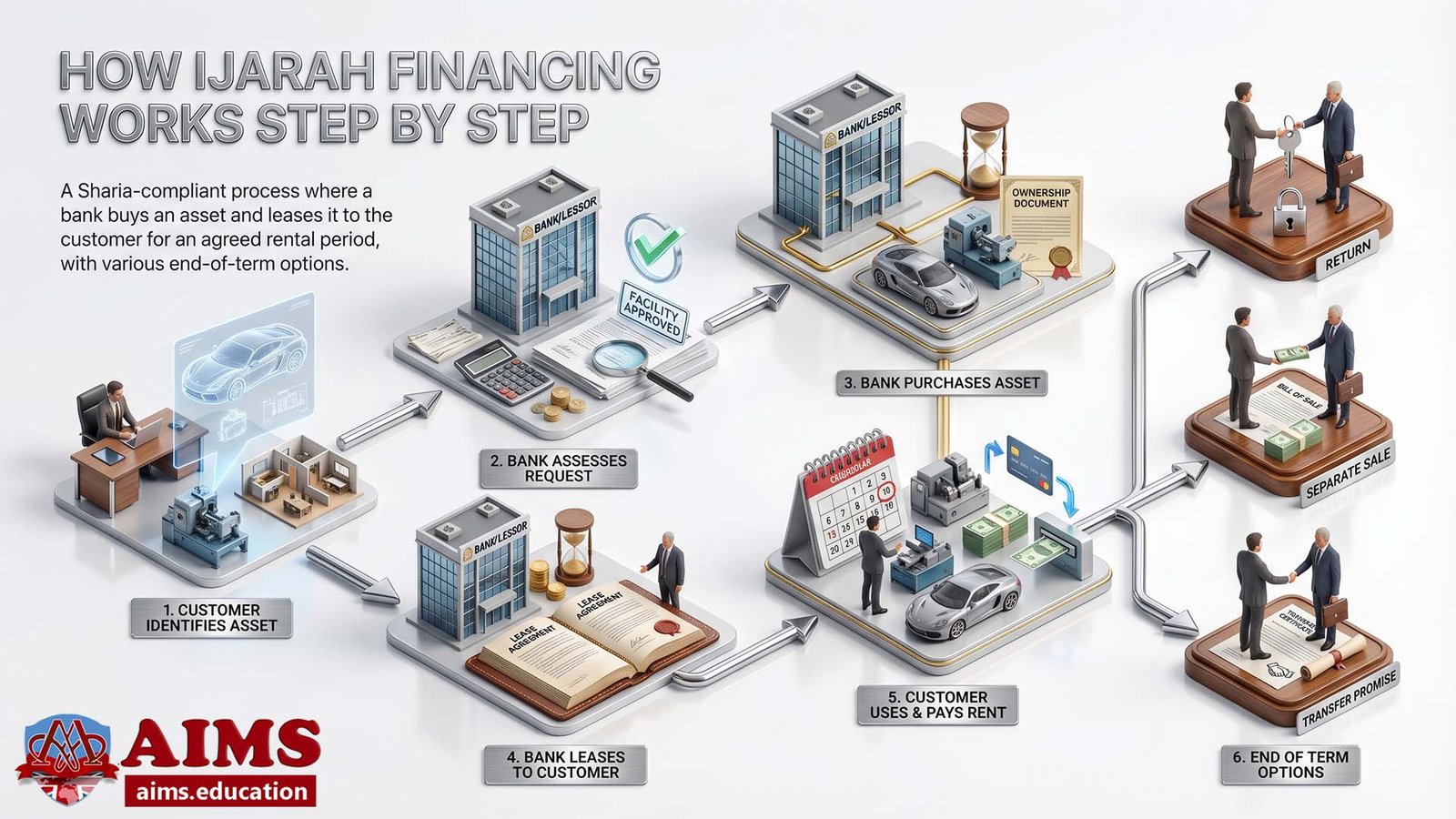
This process shows why the lessor cannot charge rent from the date it pays the vendor if the asset has not yet been delivered to the lessee. Delivery matters because rent is consideration for use, not consideration for capital advanced.
Practical Ijara Example: Car Financing
A simple example makes the Ijarah structure easier to understand.
- Ahmad wants a car worth $18,000 but does not want an interest based loan.
- An Islamic bank agrees to purchase the car and then lease it to Ahmad for 36 months.
- The monthly rent is fixed at $450.
- Ahmad takes delivery of the car and starts using it.
- He pays 36 monthly rentals of $450, which equals $16,200 over the lease term.
- At the end, the bank may take back the car, or under a separate Ijarah wa Iqtina promise, transfer ownership for a token amount or agreed sale price.
This example shows how the customer gains lawful use of the vehicle without borrowing cash on interest, while the bank earns rent from a real asset it owns.
For readers who want to understand the Islamic banking system, Ijarah offers an excellent starting point because it shows how Shariah principles shape real financial products. It also sits alongside other well-know Islamic financial instruments that serve different business and consumer needs.
Ijarah vs Other Financing Modes
Ijarah vs Conventional Leasing
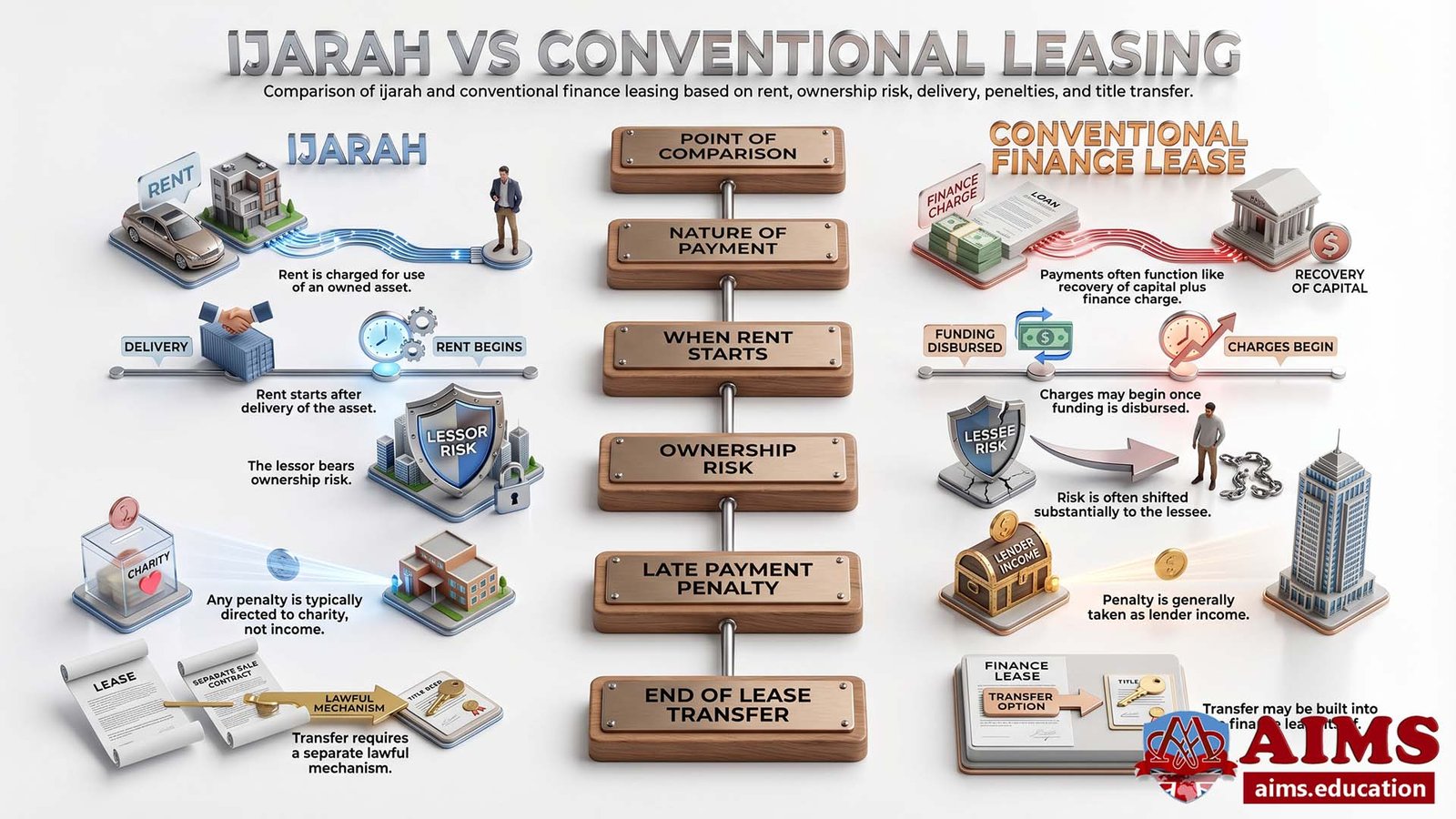
Ijarah differs from conventional leasing because rent in Ijarah is payment for lawful usufruct under real ownership risk, not a disguised interest charge. Conventional finance leases often shift nearly all risks and rewards to the customer from the beginning. In Shariah compliant Ijarah, the lessor must still bear ownership risk and cannot build the transfer of ownership into the lease in an impermissible way.
| POINT OF COMPARISON | IJARAH | CONVENTIONAL FINANCE LEASE |
|---|---|---|
| Nature of payment | Rent is charged for use of an owned asset. | Payments often function like recovery of capital plus finance charge. |
| When rent starts | Rent starts after delivery of the asset. | Charges may begin once funding is disbursed. |
| Ownership risk | The lessor bears ownership risk. | Risk is often shifted substantially to the lessee. |
| Late payment penalty | Any penalty is typically directed to charity, not income. | Penalty is generally taken as lender income. |
| End of lease transfer | Transfer requires a separate lawful mechanism. | Transfer may be built into the finance lease itself. |
Difference Between Ijarah and Murabaha
The difference between Ijarah and Murabaha is that Ijarah leases use, while Murabaha sells ownership.
- In Murabaha, the bank buys an asset and sells it to the customer at a disclosed markup.
- In Ijarah, the bank retains ownership and leases the asset for rent.
This is why the difference between Ijarah and Murabaha matters in practice.
- A business that wants immediate ownership of machinery may prefer Murabaha.
- A business that wants use first, cash flow flexibility, and possibly later transfer may prefer Ijarah.
Readers comparing both structures should also explore time value of money in Islam, because Islamic finance does not reject pricing, profit, or deferred payment. It rejects riba and requires lawful contractual forms.
Ijarah vs Diminishing Musharaka
Ijarah and Diminishing Musharaka differ because one is a lease contract and the other is a co ownership partnership that gradually shifts shares. In Diminishing Musharaka, the customer and financier jointly own the asset, and the customer gradually buys out the financier’s share while also paying rent for the financier’s remaining share.
This distinction is especially important in home finance. Those exploring an Islamic or Halal mortgage (diminishing Musharaka) should not assume it is the same as Ijarah, even though both may involve rent and gradual acquisition.
| FEATURE | IJARAH | MURABAHA | DIMINISHING MUSHARAKA |
|---|---|---|---|
| Main legal form | Lease of usufruct. | Sale with disclosed markup. | Partnership with gradual buyout. |
| Ownership during term | Stays with lessor. | Transfers to buyer after sale. | Shared ownership changes over time. |
| Customer payment | Rent for use. | Installments of sale price. | Rent plus purchase of ownership units. |
| Best suited for | Vehicles, equipment, operating assets. | Inventory and direct asset purchase. | Home finance and partnership based acquisition. |
Real World Applications of Ijarah in Ilsamic Banking
Where Ijarah Financing Is Commonly Used
Ijarah financing is commonly used for assets that are durable, identifiable, and economically useful over time. Common examples include:
- Cars and commercial vehicles.
- Industrial machinery and factory equipment.
- Medical equipment and office systems.
- Commercial property and some real estate use cases.
- Sale and lease back arrangements, provided sale and lease remain separate contracts.
Because the contract is asset based, it also raises important operational questions such as insurance, asset damage, late payment treatment, and customer risk assessment. That is why serious practice in risk management in Islamic banking and finance is closely connected to strong Ijarah documentation and monitoring.
Common Misunderstandings About Ijarah
Several misunderstandings appear frequently.
- Ijarah is not a loan. It is a lease of usufruct, not lending money for interest.
- Ijarah does not automatically transfer ownership. Ownership transfer requires a separate valid mechanism.
- Not every asset can be leased. Consumables and unlawful assets are excluded.
- Rent cannot be changed unilaterally. Any variation must be pre defined or mutually agreed.
- The lessor cannot escape ownership burdens. If the lessor shifts all ownership risk away, the structure loses its Shariah character.
Students and professionals who want structured mastery of these issues often deepen their understanding through a CIB Islamic banking certification course or a Masters degree in Islamic banking and finance, where lease based contracts are studied alongside broader Islamic commercial law.
Frequently Asked Questions
What is Ijarah in Islamic banking?
Ijarah is a Shariah compliant lease in which the owner gives another party the right to use a tangible asset for an agreed period and rent, while ownership remains with the owner.
How does Ijarah financing work in practice?
The customer identifies an asset, the bank purchases it, and the bank then leases it to the customer. The customer pays rent for use of the asset. At the end, the asset may be returned or transferred through a separate lawful arrangement.
Which assets can be leased under an Ijarah contract?
Assets must be durable, identifiable, valuable, and lawful to use. Cars, machinery, buildings, and equipment can be leased. Money, wheat, fuel, and other consumables cannot be leased because their use destroys their corpus.
Who owns the asset during Ijara?
During Ijara, the lessor remains owner. The lessee only gains usufruct, meaning the right to use the asset according to the lease terms.
When does rent become payable in Ijarah?
Rent becomes payable after the asset is delivered to the lessee and the usufruct is available. Rent cannot be charged merely because the lessor paid the supplier.
Can rent change during the lease term?
Yes, but only if the method of variation is agreed in advance, such as clearly defined phases or a benchmark with stated limits. The lessor cannot change rent unilaterally after the contract is concluded.
What is Ijarah wa Iqtina?
Ijarah wa Iqtina is a lease with a separate promise that may end in transfer of ownership, often by sale or gift after all agreed rentals are paid. The promise must be separate and unilateral to preserve Shariah compliance.
What is Ijarah Muntahia Bittamleek?
It is a lease that ends with transfer of ownership to the lessee. The transfer may occur through gift, token consideration, specified sale price, remaining amount, or gradual transfer, but the lease itself must remain genuinely distinct during its term.
How is Ijarah different from conventional leasing?
Ijarah requires real ownership by the lessor, real ownership risk, rent after delivery, and a Shariah compliant treatment of penalties and end of lease transfer. Conventional finance leasing often collapses these distinctions.
How is Ijarah different from Murabaha?
Ijarah leases an asset’s use, while Murabaha sells the asset itself at a disclosed markup. In Ijarah, ownership stays with the lessor during the lease. In Murabaha, ownership transfers to the buyer after the sale.
Conclusion
Ijarah is a disciplined asset based contract that turns lawful use into the basis of finance. Its strength lies in its clarity. The asset must be real, ownership must be genuine, rent must be known, and risk must follow ownership. Once these rules are respected, Ijarah becomes one of the most practical and ethically coherent tools in Islamic banking and finance.
About AIMS’ Institute of Islamic Banking and Finance
Since 2005, AIMS’ Institute of Islamic Banking and Finance has delivered internationally accredited Islamic finance education to learners worldwide through internationally standardized curricula, qualified faculty, and industry-oriented teaching. This article, together with AIMS’ study content and curriculum, is collaboratively developed and rigorously peer-reviewed by an academic board of qualified industry practitioners. With 3D interactive learning content, practical skill development, and real-world case studies, AIMS helps professionals build job-ready expertise. Explore career-focused Islamic finance programs for banking and finance professionals.