
What is a Project Life Cycle?
The project life cycle is the overall framework that connects a project’s beginning, its logically related phases, the work performed within those phases, and its closure. It helps the project team understand how work will progress, when decisions should be made, what must be delivered, and how the project will remain aligned with its intended objectives.
A project may be simple or complex, short or long, predictive or adaptive. The basic idea still applies. The project moves through a structured life span, while the management practices used inside that life span are tailored to the nature of the work. This is why a sound understanding of the life cycle is central to understanding how project management works in practice.
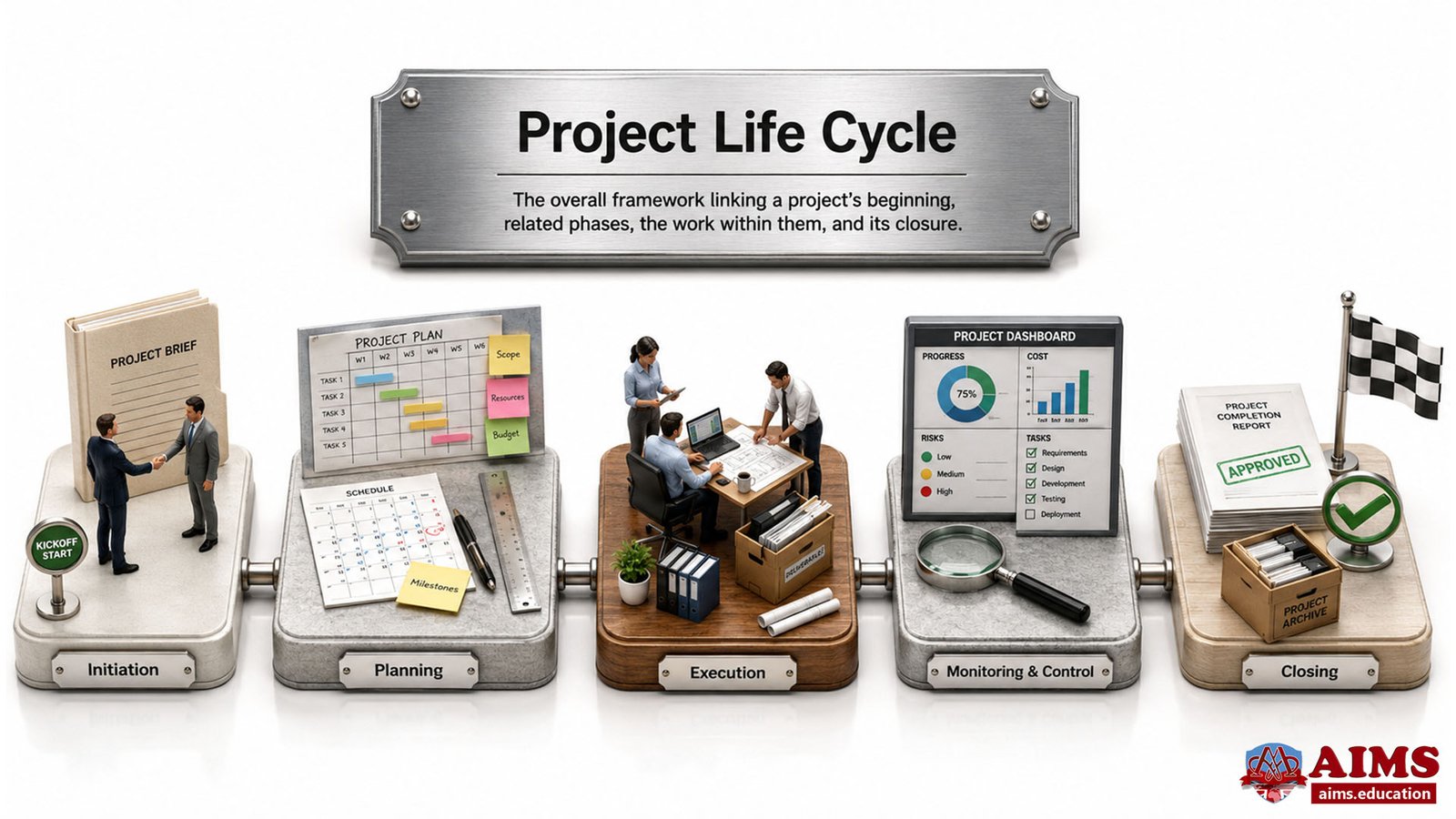
The source framework examines the project life cycle through five connected factors:
- Project phases organize logically related activities around deliverables or outcomes.
- Development approaches determine how the product, service, or result is created and evolved.
- Selection considerations help the team choose a suitable predictive, adaptive, or hybrid approach.
- Delivery cadence determines whether value is delivered once, several times, periodically, or continuously.
- Project Management Focus Areas describe fundamental management actions that occur across the project.
Project Life Cycle Phases and Phase Gates
A project phase is a collection of logically related project activities that culminates in one or more deliverables or outcomes. Projects can be decomposed into multiple phases, but the names and number of those phases are not universal. They should reflect the work, governance needs, deliverables, risks, and development approach of the specific project.
The project life cycle phases may be sequential, transitional, or overlapping. A large project may even combine these patterns. For this reason, it is more accurate to think of project lifecycle stages as context-dependent parts of a broader framework rather than a mandatory list that applies identically to every project.
If you want to explore the familiar stage-based view separately, AIMS also explains how project management phases are commonly structured. The important distinction is that practical phase names should follow the project’s actual work rather than be imposed simply because a generic model uses them.
What Defines a Project Phase?
A project phase is defined by the work it contains, the deliverables or outcomes it is expected to produce, and the criteria used to enter or complete it. Useful phase attributes may include:
- The phase name and sequence identify where the work sits within the wider life cycle.
- The expected duration indicates how long the phase is planned to remain active.
- Resource requirements show the people, budget, materials, or capabilities needed.
- Entrance criteria establish what must be true before the phase begins.
- Exit criteria establish what must be achieved before the phase can be completed.
How Phase Gates Control Progress
A phase gate is a formal or informal decision point used to determine whether a project should proceed, change direction, remain in the current phase, pause, repeat work, or stop. Gates are commonly placed at the end of phases, although a pre-phase gate can also be used before new work begins.
A gate review may examine acceptance criteria, contractual obligations, performance targets, resource availability, project viability, current risks, and continued alignment with organizational objectives. This gives management a structured point at which to compare actual progress with expectations before committing additional resources.
Example of Project Life Cycle Phases
Consider Orion Properties, which is delivering a smart office facility. Its project-specific life cycle could be organized as follows:
- Concept and authorization: The sponsor confirms the business need, desired outcomes, funding boundaries, and initial stakeholders.
- Design: Architects and technical teams develop the building design, technology requirements, and approval packages.
- Build and integration: Construction proceeds while digital systems are configured and tested.
- Transition and closure: The completed facility is accepted, handed to operations, outstanding obligations are closed, and the project is formally completed.
The practical impact is that each phase has a purpose, a deliverable, and a decision point rather than merely a label.
How Cost, Risk, and Stakeholder Influence Change Across the Project Lifecycle
Project conditions change as work progresses, so the management emphasis at the beginning of a project is rarely identical to the emphasis near closure. Three variables are especially useful for understanding this movement.
- Cost and staffing: In many predictive projects, cost and staffing begin at relatively low levels, rise as project work accelerates, and then fall as the project or phase approaches completion.
- Risk and uncertainty: These are usually highest early in the project because fewer decisions have been resolved and fewer deliverables have been accepted. They tend to reduce as knowledge and commitment increase.
- Stakeholder influence on change: In some projects, stakeholders can influence scope more easily and less expensively early in the life cycle. In adaptive environments, active stakeholder feedback may continue throughout delivery so that risks, needs, and value can be reassessed frequently.
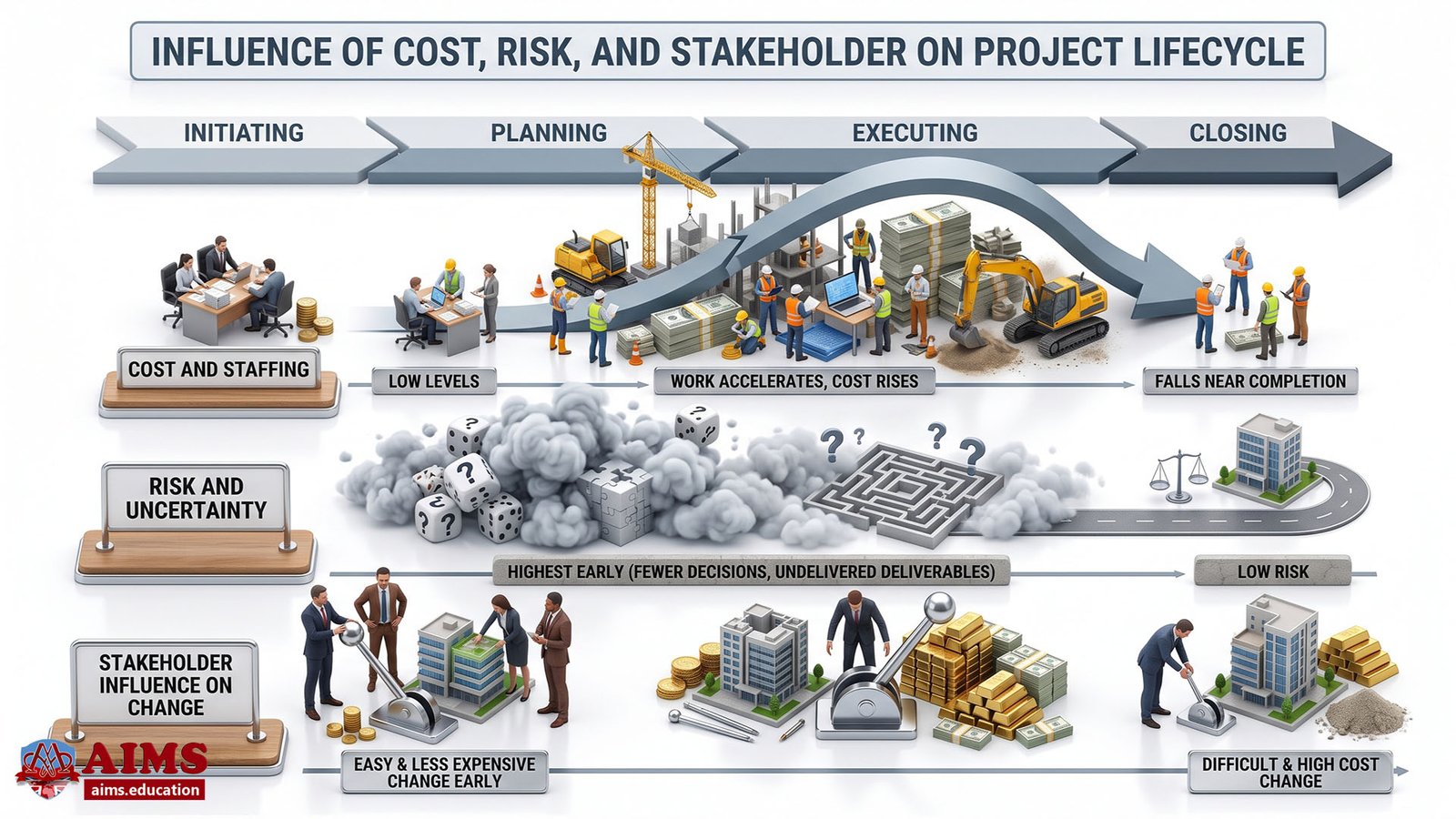
These relationships are not mechanical rules. They are management patterns. They help explain why early decisions deserve careful attention and why the chosen life cycle must match the project’s uncertainty and feedback needs.
Predictive, Adaptive, and Hybrid Project Life Cycles
A development approach is the means used to create and evolve the product, service, or result during the project life cycle. It is not the same thing as a development phase. The approach describes how the work is developed and managed, while a phase is a defined part of the project’s life span.
Three commonly used development approaches are predictive, adaptive, and hybrid. They can be viewed as a spectrum rather than as rigid boxes. A project manager and team select or tailor the approach after considering requirements, scope stability, timing, organizational culture, stakeholder involvement, risk, technology, complexity, and delivery needs. A broader discussion of project management methodologies and ways of working can help place these approaches in context.
The three major approaches are:
- A predictive approach emphasizes early definition, planning, baselines, and controlled change.
- An adaptive approach emphasizes iterative learning, stakeholder feedback, evolving requirements, and frequent replanning.
- A hybrid approach intentionally combines predictive and adaptive elements to suit different parts of the same project.
Predictive Project Life Cycle
A predictive project life cycle is most suitable when scope and requirements can be stabilized relatively early and substantial planning can be completed before execution. It may also be called plan-driven, traditional, or waterfall-oriented.
In a predictive environment, the team can often define scope, schedule, cost, resource needs, quality requirements, and major risks early in the project. This supports baselines, formal change control, and planned reevaluation between phases. Predictive work is particularly useful when changes are expensive, regulatory oversight is significant, or the cost of repeated iteration is greater than its expected value.
Predictive does not always mean one final delivery. A project can remain predictive while using planned incremental delivery, provided the overall scope is well understood and the increments form part of the structured plan.
Adaptive Project Life Cycle
An adaptive project life cycle is suitable when requirements or the technical solution are uncertain, volatile, or expected to evolve through feedback. Adaptive approaches are often associated with agile or change-driven ways of working.
Instead of attempting to define every detail at the start, the team establishes a clear vision and progressively elaborates the requirements. Work may be iterative, incremental, or both. Iteration refines a solution through repeated cycles, while incremental delivery produces usable portions that build toward the complete result.
Some adaptive methods use short timeboxes and frequent demonstrations. Others use flow-based scheduling to improve throughput and limit work in process. For readers studying adaptive delivery more deeply, AIMS provides a separate explanation of how agile project management responds to changing requirements.
Hybrid Project Life Cycle
A hybrid project life cycle combines predictive and adaptive elements so that different parts of the project can be managed according to their actual level of certainty, risk, and change. This is useful when one deliverable is stable while another requires experimentation, or when different phases need different ways of working.
A smart-building project illustrates the logic. The physical structure may follow a predictive sequence because changes during construction can be costly. The building’s software, interfaces, and digital services may be developed adaptively because user feedback can improve the solution. The project remains one project, but its components are managed differently.
Hybrid patterns can include adaptive development followed by predictive rollout, predictive and adaptive streams operating simultaneously, a mainly predictive project with a small adaptive component, or a mainly adaptive project with a predictive component. AIMS compares these choices further in its discussion of Agile vs Waterfall vs Hybrid project management approaches.
| ATTRIBUTE | PREDICTIVE | ADAPTIVE | HYBRID |
|---|---|---|---|
| Planning | More planning is completed up front, with later refinement when needed. | High-level planning begins early, followed by frequent planning and replanning. | Planning depth varies by component, phase, or workstream. |
| Requirements | Requirements are relatively clear and stable early. | Requirements are expected to evolve through learning and feedback. | Some requirements are stable while others remain uncertain. |
| Change | Change is controlled against an established plan or baseline. | Change is expected and incorporated through repeated review. | Change practices differ according to the nature of each component. |
| Delivery | Delivery may be single or planned in increments. | Delivery is commonly incremental, periodic, or continuous. | Different delivery cadences may coexist within the project. |
| Best fit | Stable scope, expensive change, substantial regulation, or high need for early certainty. | High uncertainty, evolving scope, strong feedback needs, or early value delivery. | Mixed uncertainty, modular deliverables, or components requiring different management approaches. |
How to Choose the Right Project Life Cycle Approach
The right life cycle approach is the one that best fits the deliverable, the project environment, and the organization rather than the approach that happens to be most fashionable. Selection should be treated as a management decision based on evidence and context.
1. Evaluate the Deliverable
- High innovation or uncertain technology can favor an adaptive approach because learning is expected during development.
- Clear requirements and stable scope can favor a predictive approach because reliable early planning is possible.
- Expensive or difficult change can favor predictive control because late iteration may destroy value.
- Frequent user feedback can favor adaptive delivery because each review can improve the evolving solution.
- Rigorous safety or regulatory requirements can increase the need for structured planning, documentation, and formal gates.
2. Evaluate the Project
- Projects that depend on frequent stakeholder participation may gain more value from adaptive practices.
- Projects that benefit from early partial delivery may use iterative, incremental, or adaptive techniques.
- Large or complex projects with changing requirements may need a more flexible or hybrid structure.
- Team skills matter because adaptive work places significant emphasis on collaboration, communication, and problem solving.
- Dependencies on other teams, departments, suppliers, or projects may influence how work can be sequenced and delivered.
3. Evaluate the Organization
- A strongly hierarchical structure may fit predictive governance more naturally when authority and reporting lines are fixed.
- A network-oriented or innovation-focused culture may be more comfortable with adaptive or hybrid arrangements.
- Policies, reporting structures, established practices, and organizational capability must support the chosen way of working.
- Team size and location can affect the practicality of frequent collaboration, iteration, and feedback.
Selection also involves trade-offs among scope, schedule, cost, and other constraints. A related explanation of project management constraints and the project triangle helps clarify why a team may keep some constraints relatively fixed while allowing others to vary.
Delivery Cadence Across the Project Life Cycle
Delivery cadence describes how often a project produces deliverables or value during its life cycle. The selected cadence should fit the development approach, the nature of the deliverable, stakeholder needs, and the economics of releasing work.
- Single delivery: The project produces its main outcome near the end of the life cycle.
- Multiple deliveries: Separate components or elaborations are delivered at different times, either sequentially or in parallel.
- Periodic deliveries: Deliverables are released on a regular schedule, such as every few weeks or every month.
- Continuous delivery: Tested and validated increments are kept ready for frequent production release through an ongoing flow of prioritization, development, testing, and deployment.
Delivery cadence is therefore not merely a scheduling preference. It affects how quickly stakeholders receive value, how often feedback becomes available, and how the project team structures its development and control activities.
Project Life Cycle vs Project Management Focus Areas
The project life cycle and the five Project Management Focus Areas are related, but they are not the same concept. A life cycle describes the project’s phases and progression from start to closure. The Focus Areas describe fundamental management actions that can occur throughout the project and within individual phases. This distinction is essential when comparing project life cycle vs project management process groups, the older terminology many readers still encounter.
Focus Areas are not project phases.
The five Focus Areas are Initiating, Planning, Executing, Monitoring and Controlling, and Closing. They may appear sequential when taught, but in practice they can overlap, repeat, and interact. This is especially clear in adaptive work, where planning, execution, monitoring, and adjustment may recur within each short iteration.
Initiating Focus Area
Initiating defines and authorizes a new project or a new phase while aligning purpose, stakeholders, initial scope, and strategic intent. Typical outputs can include a project charter and stakeholder information. Effective project initiation management and early stakeholder alignment create a shared understanding of why the project exists and what success should mean.
Planning Focus Area
Planning defines and refines objectives and develops the course of action for completing the project or phase. Planning may be extensive early in a predictive environment or repeated frequently in an adaptive environment. Progressive elaboration means the plan continues to develop as information becomes clearer.
Executing Focus Area
Executing performs the work according to the currently agreed course of action. It includes coordinating resources, engaging stakeholders, and producing project outputs. The chosen predictive, adaptive, or hybrid approach often becomes especially visible during execution.
Monitoring and Controlling Focus Area
Monitoring and Controlling tracks, measures, reviews, and regulates project performance while identifying and responding to needed changes. It operates alongside other Focus Areas rather than as an isolated step. The team compares actual performance with expectations, analyzes variance, evaluates alternatives, and agrees corrective action when necessary.
Closing Focus Area
Closing formally completes or terminates a project, phase, or contract and supports an orderly transition to operations. The team verifies completion, confirms outputs and outcomes, settles remaining obligations, and determines whether the intended value and stakeholder expectations have been addressed.
| CONCEPT | WHAT IT DESCRIBES | KEY DISTINCTION |
|---|---|---|
| Project life cycle | The project’s progression through phases from start to closure. | Its phases can vary according to the project and development approach. |
| Project Management Focus Areas | Initiating, Planning, Executing, Monitoring and Controlling, and Closing actions. | They can overlap and recur within multiple life cycle phases. |
| Product life cycle | The broader life of a product from its creation and use through later evolution and eventual retirement. | It can extend beyond the project that created or changed the product. |
Project Life Cycle vs Product Life Cycle
A project life cycle ends when the temporary project is closed, while a product life cycle can continue after the project has finished. The two can interact, but they are independent concepts.
For example, a project may create and launch a new mobile banking application. The project life cycle covers the temporary initiative used to define, develop, test, release, and close that project. The product itself may continue operating for years, receive updates through later projects, mature in the market, and eventually be replaced or retired.
This distinction prevents a common planning error. Project managers must define the boundaries of the project even when the product, service, or business capability created by the project will continue far beyond closure.
Worked Project Life Cycle Examples: One Practical Scenario
A useful project life cycle example shows both the project-specific phases and the Focus Areas operating inside them. Consider Nova Health Services, which is implementing a new appointment-booking platform.
- Concept and authorization: The sponsor defines the business problem, expected outcomes, initial budget, and key stakeholders. Initiating actions are dominant, but early planning also begins.
- Solution design: The team clarifies requirements, selects technology, assesses risks, and prepares a delivery roadmap. Because user-interface requirements are uncertain, the software stream is planned adaptively.
- Development and infrastructure: The software team develops features in iterations while the hosting and security infrastructure follows more predictive controls. Executing, planning, and Monitoring and Controlling overlap throughout this phase.
- Pilot delivery: A usable version is released to one clinic. Feedback is collected, defects are corrected, and priorities are adjusted before wider deployment.
- Rollout and closure: The system is deployed across locations, acceptance is confirmed, operational responsibility is transferred, contracts are settled, and the project is formally closed.
This example shows why a hybrid life cycle can be more useful than forcing every workstream into exactly the same method.
Importance of Project Management Life Cycle
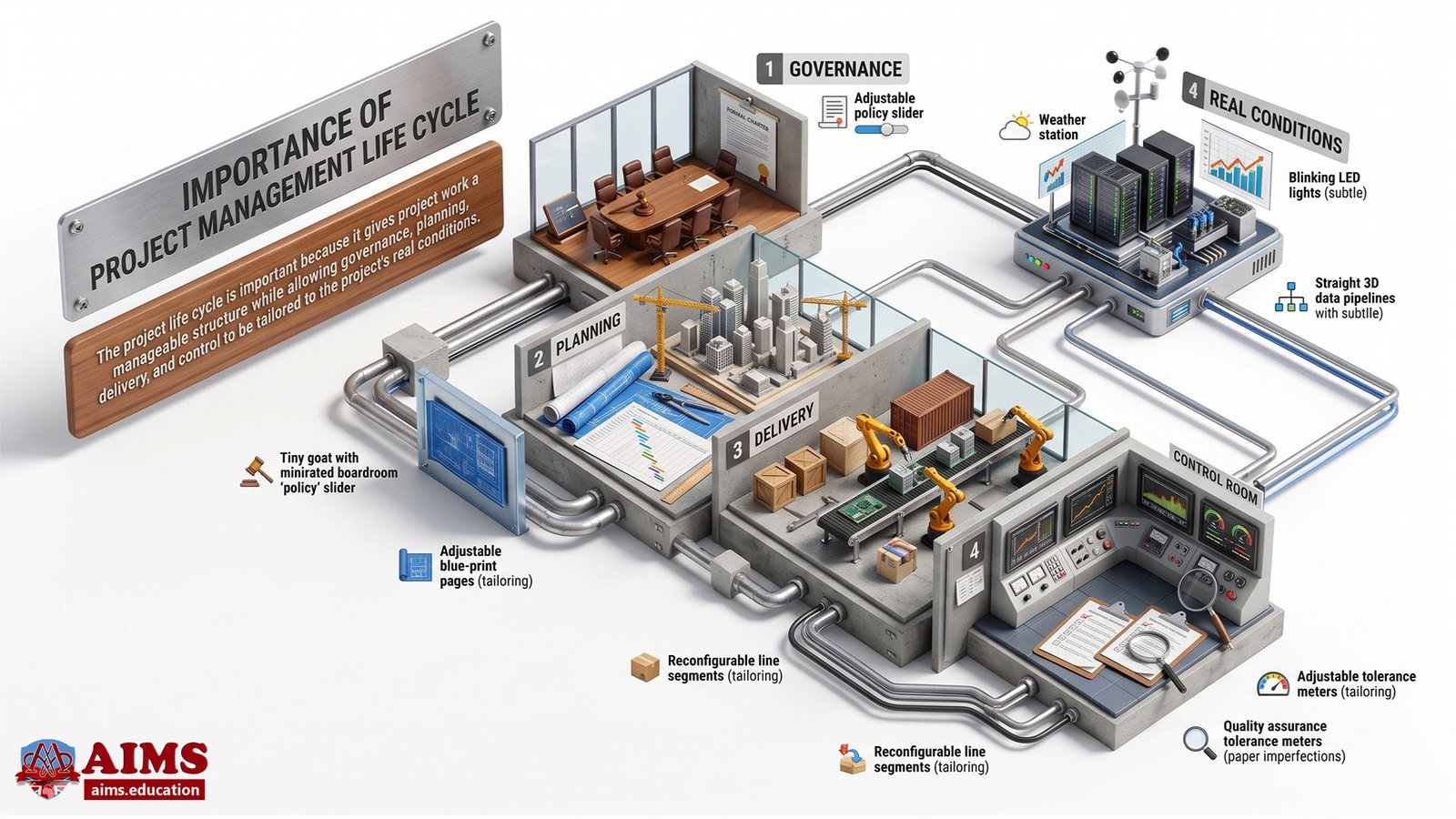
The project life cycle is important because it gives project work a manageable structure while allowing governance, planning, delivery, and control to be tailored to the project’s real conditions. It makes the progression of work visible and supports better decisions about when to commit, review, adapt, deliver, or stop.
- It clarifies how the project will move from authorization to formal completion.
- It gives phases meaningful entry criteria, exit criteria, deliverables, and decision points.
- It helps teams choose a development approach that fits uncertainty rather than applying one method automatically.
- It connects delivery timing with stakeholder value and feedback.
- It allows management actions to be repeated or overlapped where the project requires them.
- It provides a framework for governance while preserving enough flexibility to tailor the work.
Professionals who want to develop this decision-making discipline in a structured qualification can explore AIMS’ globally recognized project management diploma for professionals and its Certified Project Manager (CPM) certification program.
Common Project Life Cycle Misunderstandings
The most common misunderstanding is assuming that every project life cycle must consist of the same five named phases. That interpretation confuses the life cycle with management actions that may occur throughout the life cycle.
- Misunderstanding 1: Initiating, Planning, Executing, Monitoring and Controlling, and Closing are not automatically five universal project phases. They are Focus Areas that can interact within phases.
- Misunderstanding 2: Predictive does not necessarily mean one final delivery. A predictive project can use planned incremental deliveries.
- Misunderstanding 3: Adaptive does not mean planning is absent. Adaptive projects plan repeatedly as new information becomes available.
- Misunderstanding 4: Hybrid does not mean randomly mixing methods. A hybrid approach should deliberately assign different practices to different levels of certainty and need.
- Misunderstanding 5: A project life cycle is not the same as a product life cycle. The product may continue long after the project has closed.
The practical lesson is to tailor deliberately. Lifecycle design should support value, control, learning, and delivery rather than forcing the project into terminology that does not match the work.
Final Words
The project life cycle is best understood as a flexible management framework from project start to closure, not as one compulsory sequence of five universal phases. Effective project managers define suitable phases, use decision gates where needed, choose predictive, adaptive, or hybrid development approaches, establish an appropriate delivery cadence, and apply the five Focus Areas throughout the work.
That perspective turns the life cycle from a textbook diagram into a practical decision system. For broader professional context, the PMI provides internationally recognized project management guidance.
Frequently Asked Questions
What is a project life cycle?
A project life cycle is the series of activities and phases through which a project moves from its start to its closure. It provides the foundational framework for structuring project work, decisions, delivery, and completion.
What are the phases of the project life cycle?
Project life cycle phases are logically related groups of activities that produce deliverables or outcomes. Their names and number can vary, and phases may be sequential, transitional, overlapping, or combined according to the project.
What are the five phases in project management life cycle?
Initiating, Planning, Executing, Monitoring and Controlling, and Closing are commonly presented as five management areas, but they should not automatically be treated as five universal project life cycle phases. These actions can overlap and recur within different phases.
Why is the project life cycle important?
It gives a project a manageable structure from authorization to closure. It also supports governance, phase decisions, selection of a suitable development approach, delivery planning, stakeholder alignment, and control of progress.
What is an example of a project life cycle?
A smart-office project might use concept and authorization, design, build and integration, and transition and closure as its project-specific phases. Management actions such as planning and monitoring can occur in more than one of those phases.
What is the difference between a project life cycle and a product life cycle?
The project life cycle covers a temporary project from start to closure. A product life cycle can continue after the project ends because the product may remain in use, evolve, receive upgrades, and eventually be retired.
What is the difference between a project life cycle and project management process groups?
The project life cycle describes project phases and progression. The management groupings describe actions such as initiating, planning, executing, monitoring and controlling, and closing that can operate across multiple phases rather than defining the phases themselves.
What is the difference between predictive and adaptive project life cycles?
Predictive approaches work best when scope and requirements can be stabilized early and substantial planning is possible up front. Adaptive approaches are more suitable when uncertainty is high and requirements need to evolve through frequent feedback and repeated planning.
What is a hybrid project life cycle?
A hybrid project life cycle deliberately combines predictive and adaptive practices. It is useful when different deliverables, phases, or workstreams have different levels of uncertainty, change, regulation, or feedback needs.
How do you choose the right project life cycle for a project?
Evaluate the deliverable, requirements certainty, scope stability, cost of change, risks, regulatory needs, stakeholder involvement, schedule, team capability, organizational culture, and delivery options. The selected approach should fit the project rather than follow a default method.
Is the project life cycle the same as the project management life cycle?
The terms are often used in related ways, but the more precise idea is the project life cycle: the project’s progression from start to closure. Management activities operate throughout that life cycle and should not be confused with a fixed set of project phases.
Do all projects follow the same life cycle phases?
No. Organizations may standardize certain life cycles, but project teams can tailor phase names, number, duration, entry criteria, exit criteria, development approach, and delivery pattern to fit the project’s objectives and context.
Project Management Education at AIMS
Since 2005, AIMS’ Project Management Academy has supported a global community of learners through internationally accredited, career-focused education built around standardized curricula, qualified faculty, practical skill development, 3D interactive learning content, and real-world case-based qualifications. AIMS study content and curricula are collaboratively developed and rigorously peer-reviewed by an academic board of qualified industry practitioners. Understanding project life cycles strengthens professional judgment in planning and delivery. Explore globally accredited institute of project management.