
What Is Effective Project Management?
Effective project management is the disciplined coordination of objectives, people, scope, time, cost, quality, risk, and stakeholder expectations so a project delivers its intended value. It combines clear planning with capable execution, continuous monitoring, timely decisions, and adaptation when conditions change. In practice, success means more than finishing on time; it means achieving agreed outcomes responsibly and predictably.
For project managers, efficient project management requires more than preparing a schedule and assigning tasks. You must understand:
- what the project is expected to achieve,
- organize the work around realistic priorities,
- communicate with stakeholders,
- manage uncertainty,
- monitor performance, and
- make informed adjustments throughout the project.
A project can follow its schedule closely and still fail if it delivers the wrong outcome, exceeds acceptable costs, produces poor-quality work, or does not satisfy essential stakeholder requirements.
For this reason, managing projects effectively requires attention to several interconnected areas:
- The project objectives must be clearly defined and understood.
- The scope and requirements must establish what the project will and will not deliver.
- The project team must have suitable responsibilities, resources, and capabilities.
- The schedule and budget must be realistic enough to support delivery.
- Stakeholder expectations must be identified and actively managed.
- Risks and emerging problems must be identified before they seriously affect performance.
- Deliverables must satisfy agreed quality and acceptance requirements.
- Project performance must be monitored so corrective action can be taken when necessary.
These ideas complement established principles that guide professional project management decisions. Current professional standards also emphasize that project practices should be tailored to the project context rather than applied mechanically. For additional professional guidance, project managers may consult PMI’s PMBOK Guide and Standard for Project Management.
How to Manage a Project Effectively
To manage a project effectively, define the required outcome first, develop a realistic plan, organize people and resources, maintain stakeholder communication, monitor progress and risks, and adjust the project when evidence shows that change is necessary.
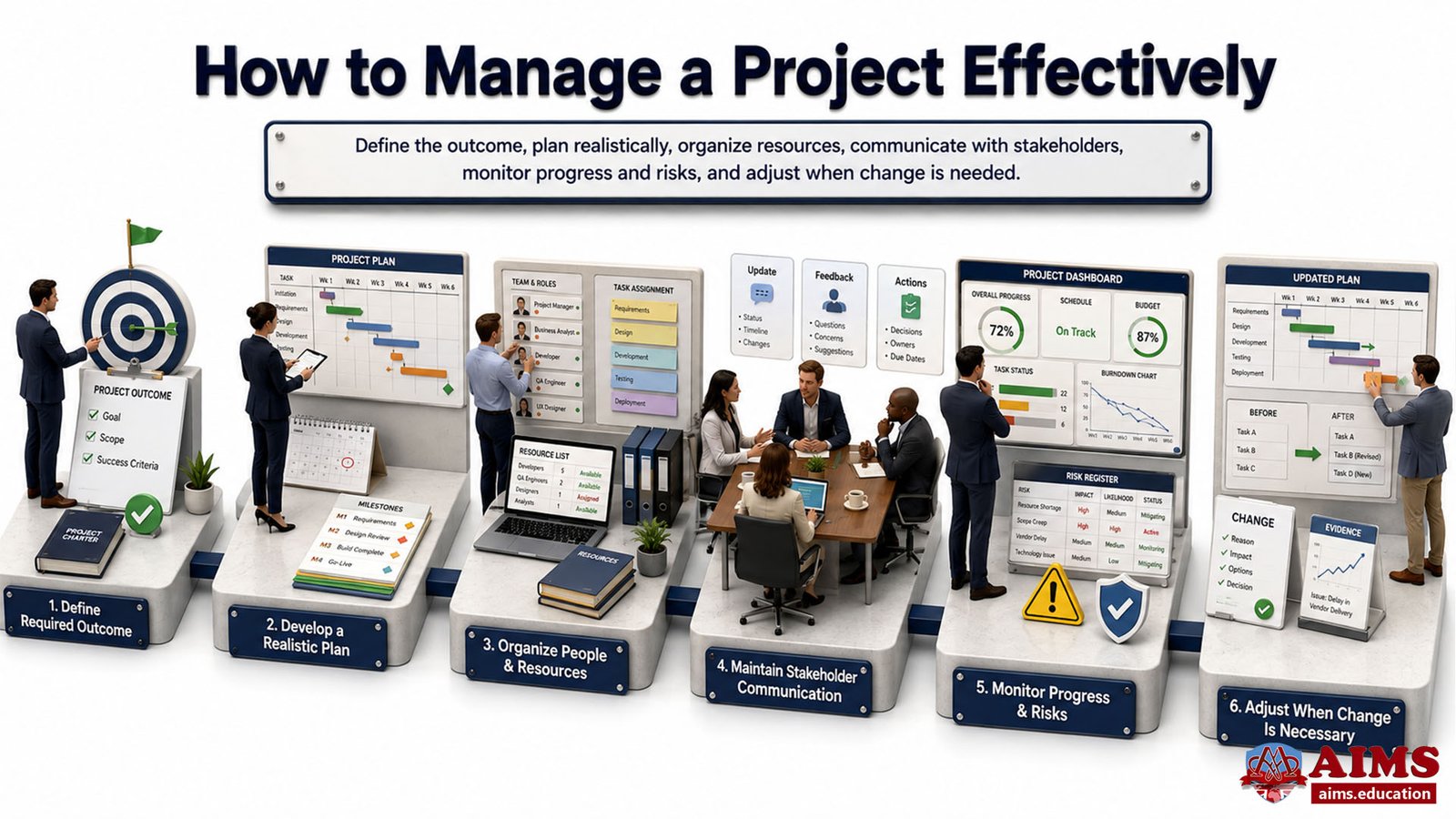
Your project plan should reflect both organizational requirements and stakeholder expectations. However, planning is not enough by itself. A project manager must continually compare actual performance with the plan and decide whether the project remains achievable.
For example, if a milestone is approaching but a critical supplier has delayed an important component, simply continuing with the original schedule does not demonstrate effective management. The manager must assess the impact, examine alternatives, communicate with affected stakeholders, and implement an appropriate response.
This ability to combine planning with judgment is one of the main differences between administrating tasks and actually managing a project successfully.

7 Key Rules for Effective Project Management
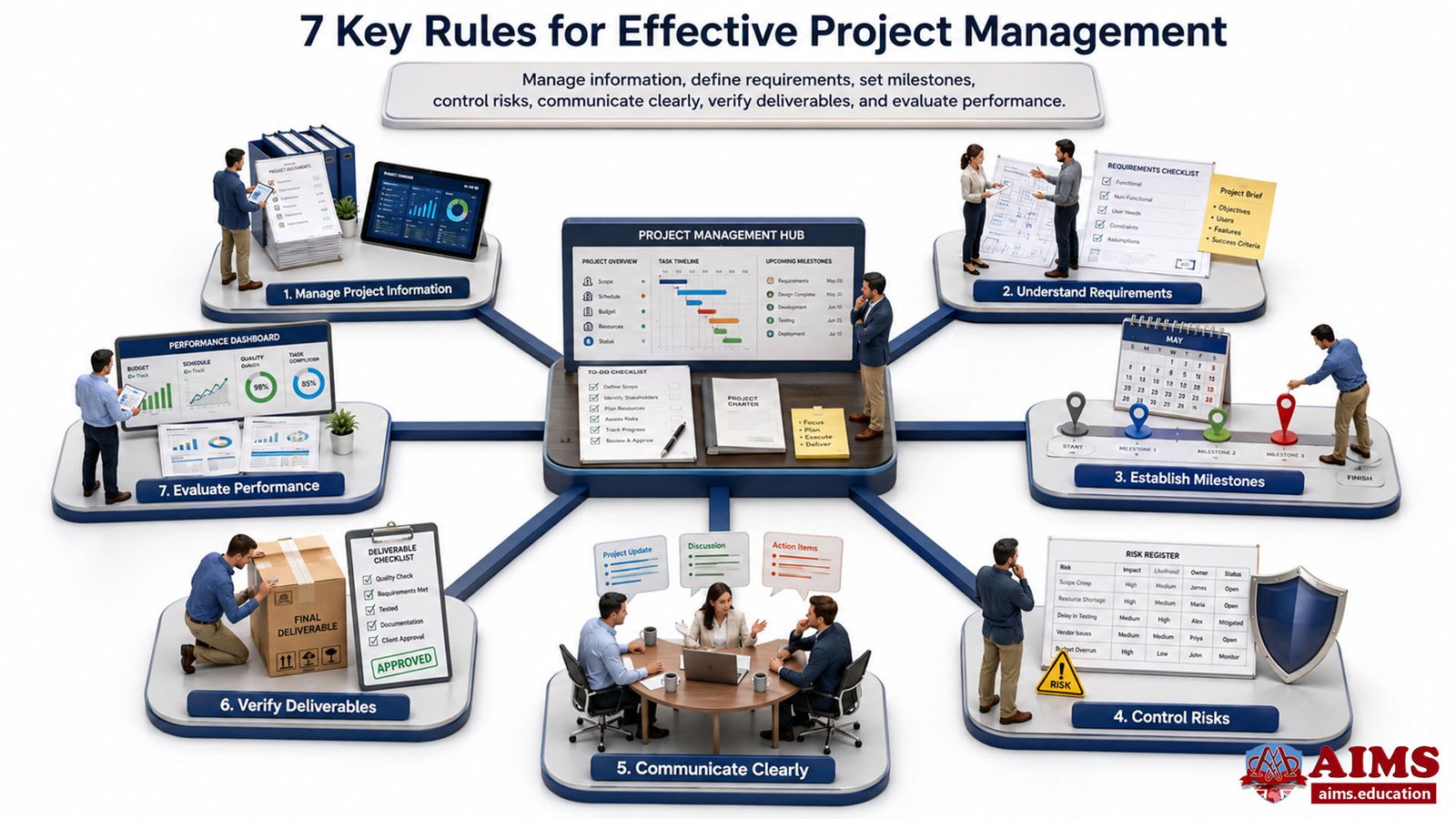
The seven practical rules of effective project management are to manage essential project information, understand requirements, establish milestones, control risks, communicate clearly, verify deliverables, and evaluate project performance.
These are practical management rules rather than a replacement for a formal project management standard. Together, however, they provide a useful framework for understanding effective project management strategies in day-to-day project work.
- Manage important project details systematically. Maintain clear information about objectives, scope, responsibilities, schedules, costs, dependencies, decisions, issues, and changes. The objective is not to document everything unnecessarily, but to ensure that information required for decisions remains visible and controlled.
- Identify project and team requirements. Clarify what stakeholders need, what the project must deliver, and what capabilities the team requires. Requirements should be sufficiently clear that the project team can plan, implement, and eventually verify the resulting deliverables.
- Define meaningful project milestones. Milestones create management checkpoints. They allow the project manager and stakeholders to assess whether significant stages, approvals, deliverables, or decisions have been completed as expected.
- Manage project risks continuously. Identify uncertainty early, assess its possible effect, assign responsibility where appropriate, plan responses, and monitor whether risk conditions change. A deeper understanding of practical project risk management processes helps managers respond before manageable uncertainty becomes a major project issue.
- Maintain clear communication. Important information should reach the appropriate people at the appropriate time. Professional communication management in project environments reduces assumptions, improves coordination, and supports timely decision-making.
- Test and verify deliverables. Deliverables should be reviewed against agreed requirements and acceptance criteria rather than accepted simply because a task has been marked complete.
- Evaluate project performance. Compare results with objectives, learn from problems and successes, document relevant lessons, and use those insights to improve future decisions.
| KEY ELEMENT | PURPOSE | PRACTICAL EXAMPLE |
|---|---|---|
| Clear objectives | Define the result the project is expected to achieve. | Complete an online customer portal that supports specified services before the approved launch date. |
| Planning | Organize the work, resources, responsibilities, schedule, and budget. | Break development into design, development, testing, training, and deployment activities. |
| Stakeholder engagement | Align expectations and support informed decisions. | Review major requirements with the sponsor and operational users before development begins. |
| Risk management | Reduce the effect of uncertainty on project objectives. | Prepare an alternative supplier before a critical component becomes unavailable. |
| Monitoring and control | Compare actual performance with expectations and take corrective action. | Review schedule progress weekly and address a growing delay before it affects the launch date. |
| Quality verification | Confirm that deliverables satisfy agreed requirements. | Test the completed portal against approved functional and security acceptance criteria. |
| Evaluation | Capture lessons and determine whether project objectives were achieved. | Review final results, unresolved issues, stakeholder feedback, and lessons after deployment. |
Important Factors for Effective Project Management
Several factors determine whether good plans translate into good project outcomes. The most important include a sound business case, capable people, practical planning, realistic objectives, stakeholder support, and disciplined communication.
Effective Project Management Skills
Effective project management skills combine leadership, communication, planning, decision-making, problem-solving, stakeholder management, risk awareness, and the ability to coordinate people and resources toward a defined outcome.
A project manager does not need to perform every technical activity personally. Instead, the manager must understand what expertise the project requires, establish suitable responsibilities, facilitate decisions, and create an environment in which specialists can perform effectively.
Professionals who want to examine these capabilities in greater detail can review the essential skills required for professional project managers.
Build a Strong Business Case
A business case explains why the project should be undertaken and why organizational resources should be committed to it. It should establish the problem or opportunity, expected benefits, major costs, important risks, assumptions, and strategic relevance.
The business case does not need to prove that success is guaranteed. Instead, it should demonstrate that the project has sufficient justification for decision-makers to authorize further investment.
Define Project Success Clearly
Project success should be defined before major work begins. If stakeholders disagree about what a successful outcome looks like, the team may complete substantial work and still face dissatisfaction at the end.
Success criteria may include:
- The agreed scope and essential requirements are delivered.
- Important milestones are achieved within acceptable schedule tolerances.
- Costs remain within the approved budget or agreed control limits.
- Deliverables meet the required quality and acceptance standards.
- Critical risks remain controlled at an acceptable level.
- Stakeholder expectations are appropriately managed.
- The project creates the intended organizational or customer value.
Therefore, what makes project management effective is not one isolated technique. Effectiveness comes from balancing multiple project objectives while continuing to focus on the value the project is intended to create.
Effective Project Planning
Effective project planning converts the project objective into an organized and realistic approach for completing the required work.
Once sufficient authorization and support exist, the manager should determine what work is required, establish dependencies, estimate resources, assign responsibilities, sequence activities, and define how progress will be measured.
A practical project plan usually addresses:
- Project objectives and expected outcomes.
- Scope, requirements, and major deliverables.
- Activities, milestones, and dependencies.
- Roles, responsibilities, and required resources.
- Schedule expectations and important deadlines.
- Budget and cost assumptions.
- Quality and acceptance expectations.
- Stakeholders and communication needs.
- Risks, assumptions, and possible responses.
- Monitoring, reporting, and change-control arrangements.
Project management software can support scheduling, collaboration, reporting, and visibility, particularly when projects contain many activities or dependencies. However, software does not replace sound management judgment. A sophisticated tool cannot compensate for unclear objectives or unrealistic assumptions.
Being an Effective Project Manager
An effective project manager provides direction, enables the team to perform, makes timely decisions, communicates clearly, and responds constructively when the project does not proceed exactly as planned.
Keep the Team Motivated
Projects often experience difficult periods. Delays, changing priorities, technical problems, or resource constraints can reduce team confidence. The manager should acknowledge problems realistically while keeping the team focused on achievable next steps.
Recognizing genuine progress and celebrating meaningful achievements can reinforce motivation, but encouragement should never replace honest performance management.
Set Realistic and Meaningful Goals
Goals should be challenging enough to create progress but realistic enough to support credible planning. Setting targets that cannot reasonably be achieved may create pressure without improving performance.
Professional development can also strengthen a manager’s ability to plan and lead complex work. Depending on career level, learners may explore a Certified Project Manager (CPM) training, broader career-focused project management certification course, or an online project management diploma program.
Communicate Instead of Assuming
One of the most damaging management habits is assuming that other people already understand an unstated requirement, priority, deadline, or decision.
A project manager should clarify important information and confirm understanding when the consequences of confusion are significant. This is especially important where responsibilities overlap or several stakeholders influence the same deliverable.
5 Steps for Effective Project Management
A practical five-step approach to effective project management is to define the goal, plan the work, establish requirements, align stakeholders, and manage estimates and quality throughout delivery.
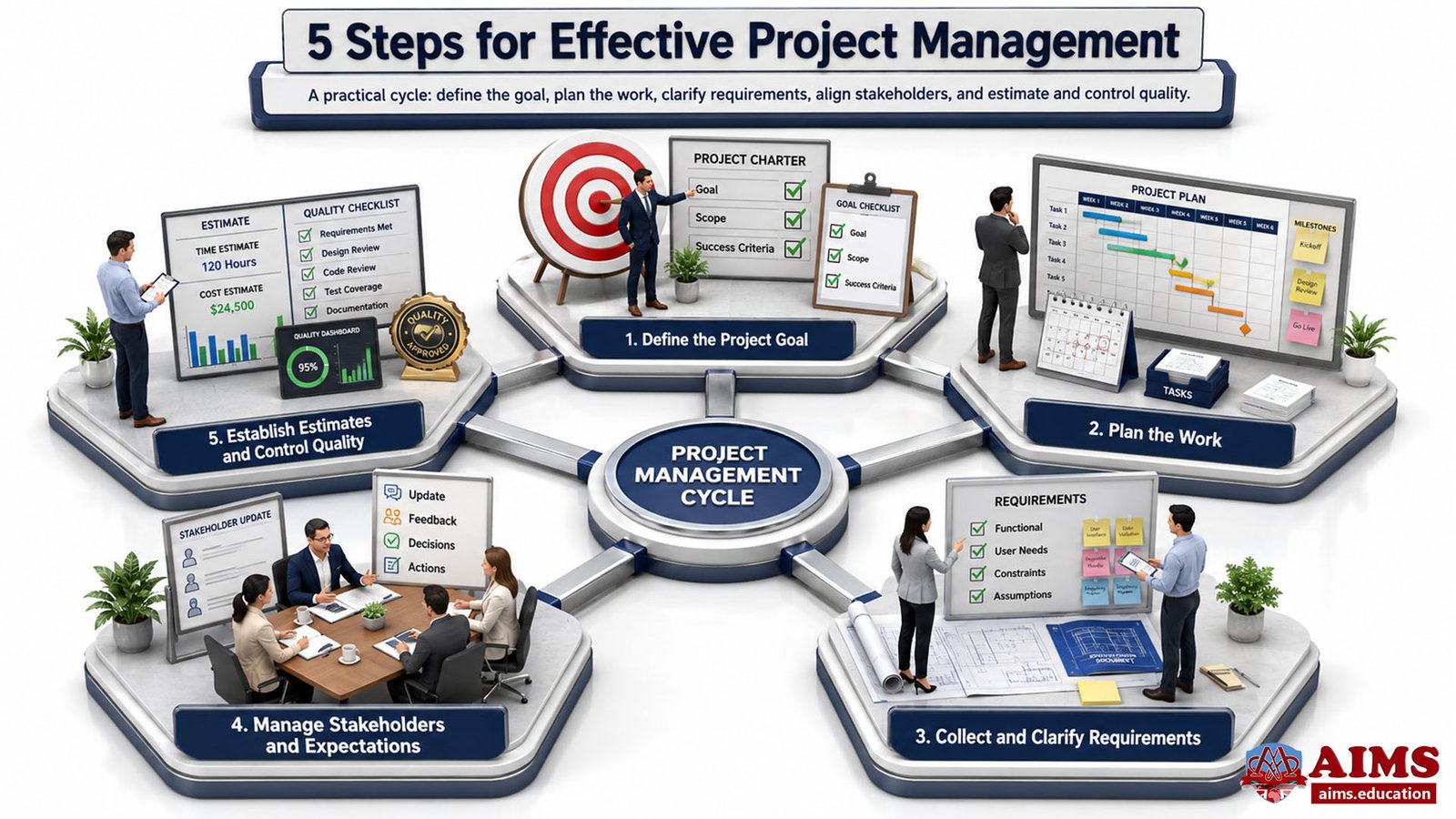
These steps preserve a simple management sequence while allowing the level of detail and control to be adapted to the complexity of the project.
Step 1: Define the Project Goal
The project goal explains what the project is intended to accomplish. Without a clear goal, the team may remain busy while moving in different directions.
A useful goal should help the project manager understand:
- What result must be achieved.
- Why that result matters.
- Who will benefit from the outcome.
- What important constraints must be respected.
- How stakeholders will recognize successful completion.
Clear goals also help the manager prioritize work and distinguish essential requirements from activities that add little value.
Step 2: Plan the Work
Planning translates the project goal into manageable work. The manager identifies major deliverables, breaks the work into appropriate activities, determines dependencies, assigns responsibilities, and estimates the resources and time required.
Planning should provide direction without pretending that the future can be predicted perfectly. As new information emerges, the project manager may need to refine the plan while protecting the agreed objectives and appropriately managing changes.
Step 3: Collect and Clarify Requirements
Project requirements describe the conditions, capabilities, characteristics, or outcomes that the project or its deliverables must satisfy.
The manager and project team should understand who will use or benefit from the deliverable, what those stakeholders need, and which requirements are essential for acceptance.
Requirements should be discussed, validated, prioritized where necessary, and kept sufficiently clear that the team can design, build, test, or deliver against them.
Step 4: Manage Stakeholders and Expectations
Projects may involve sponsors, customers, users, team members, suppliers, regulators, managers, and other interested parties. These groups may have different levels of influence and different expectations.
Effective stakeholder management throughout the project life cycle helps the manager identify those expectations, understand areas of potential disagreement, and involve the right people in appropriate decisions.
The objective is not to make every stakeholder agree with every decision. The objective is to ensure that relevant expectations, influence, concerns, and information needs are understood and managed appropriately.
Step 5: Establish Estimates and Control Quality
Project estimates help managers plan the likely effort, duration, cost, and resources required for the work. Estimates should use suitable information such as previous project experience, available data, expert judgment, known constraints, and the level of uncertainty surrounding the work.
Quality control then helps determine whether the project outputs satisfy the agreed requirements and acceptance criteria.
For this reason, estimating and quality management should not be treated as one-time activities. Estimates may require refinement as better information becomes available, while quality should be considered throughout delivery rather than inspected only at the end.
Example of Effective Project Management in Practice
Consider a company called Northstar Services that plans to launch a customer self-service portal within five months.
- Goal definition: The project manager defines the required business outcome as reducing routine customer-service requests by enabling customers to complete selected transactions online.
- Planning: The team divides the work into requirements analysis, interface design, development, testing, staff training, and deployment. Responsibilities and major milestones are assigned.
- Execution: Designers and developers create the portal while the project manager coordinates dependencies, resources, decisions, and stakeholder communication.
- Monitoring: During a progress review, testing activities are found to be two weeks behind schedule. The manager examines the cause instead of merely reporting the delay.
- Risk response: The team identifies limited testing resources as the main risk. Additional testing support is assigned and lower-priority functionality is rescheduled through the agreed change process.
- Completion: The portal is tested against its acceptance criteria, approved by the relevant stakeholders, deployed, and reviewed against the original project objectives.
By connecting objectives, planning, monitoring, decisions, and risk responses, the manager protects project value rather than simply following the original schedule.
Effective vs Ineffective Project Management
Effective project management creates visibility, alignment, and controlled decision-making, while ineffective project management allows unclear goals, unmanaged risks, weak communication, and unrealistic expectations to accumulate.
| AREA | EFFECTIVE PROJECT MANAGEMENT | INEFFECTIVE PROJECT MANAGEMENT |
|---|---|---|
| Goals | Objectives and expected outcomes are clearly defined. | The team works without a shared understanding of success. |
| Scope | Requirements and boundaries are understood and changes are controlled. | Unplanned work is added without assessing its effect. |
| Planning | Plans reflect realistic activities, resources, dependencies, and constraints. | Schedules and budgets are based mainly on optimism or unsupported assumptions. |
| Communication | Relevant information reaches the appropriate stakeholders when needed. | Important decisions, problems, and expectations remain unclear. |
| Risk | Uncertainty is identified, assessed, monitored, and addressed. | Risks receive attention only after they become serious issues. |
| Monitoring | Actual performance is compared with expectations and corrective action is taken. | Problems continue because progress is reported without meaningful analysis. |
| Stakeholders | Expectations and decision roles are actively managed. | Stakeholders are engaged only when approval or intervention becomes urgent. |
| Outcomes | Success considers objectives, value, quality, resources, risks, and stakeholder expectations. | Success is judged mainly by whether activities were completed. |
What Makes Project Management Successful?
Successful project management depends on maintaining alignment between the intended outcome, the work being performed, the resources available, stakeholder expectations, emerging risks, and actual project performance.
This explains why no single technique guarantees project success. A detailed schedule is valuable, but it cannot compensate for the wrong requirements. Strong leadership helps, but it cannot remove the need for realistic cost and resource decisions.
The most useful effective project management practices therefore work together as a system:
- Define success before starting major work.
- Keep project priorities visible to the team.
- Assign clear responsibilities and decision authority.
- Base plans and estimates on credible information.
- Engage stakeholders according to their influence and information needs.
- Identify and address risks before their effects become difficult to control.
- Review performance regularly rather than waiting for major failures.
- Control changes according to their effect on project objectives.
- Verify quality against agreed requirements.
- Capture lessons that can improve future project performance.
Common Causes of Ineffective Project Management
Project management becomes ineffective when managers lose visibility of objectives, assumptions, responsibilities, risks, stakeholder expectations, or actual performance.
Common problems include:
- Starting work before project objectives and requirements are sufficiently clear.
- Creating unrealistic schedules or budgets to satisfy expectations rather than evidence.
- Allowing uncontrolled changes to expand the project scope.
- Assuming that stakeholders or team members understand information that has not been clearly communicated.
- Ignoring early warning signs because a formal milestone has not yet been missed.
- Failing to assign ownership for significant risks, issues, or decisions.
- Measuring activity instead of meaningful project progress.
- Waiting until the end of the project to evaluate quality.
- Treating the original plan as fixed even when new evidence shows that adjustment is necessary.
The underlying lesson is simple: effective control is not about preventing every change or problem. It is about identifying relevant information early enough to make better decisions.
Final Words on Managing Projects Effectively
Effective project management requires a strong foundation of clear objectives, practical planning, capable people, stakeholder engagement, risk awareness, disciplined communication, quality management, and continuous monitoring.
The seven rules and five-step process explained above provide a practical starting point, but successful managers also exercise judgment. They know when to follow the plan, when to investigate a deviation, and when changing the approach is necessary to protect the project’s intended outcome.
Ultimately, how to manage projects effectively is not answered by one template or technique. It depends on connecting project objectives with informed decisions throughout the entire course of the work.
Frequently Asked Questions
What is effective project management?
Effective project management is the coordinated planning, organization, leadership, monitoring, and control of project work so that agreed objectives and intended value are achieved while appropriately managing scope, time, cost, quality, resources, risks, and stakeholder expectations.
What are the key principles of effective project management?
Key principles include maintaining clear objectives, focusing on project value, defining responsibilities, planning realistically, communicating with stakeholders, managing risks, protecting quality, monitoring performance, making evidence-based decisions, and adapting project practices to the circumstances of the work.
What makes project management successful?
Project management becomes successful when objectives, requirements, people, resources, stakeholder expectations, risks, and project decisions remain aligned throughout delivery. Success should consider the value and quality of the outcome as well as schedule and cost performance.
What are the best practices for effective project management?
Useful practices include defining measurable objectives, clarifying requirements, creating a realistic plan, assigning responsibilities, establishing milestones, engaging stakeholders, reviewing risks, monitoring actual performance, controlling significant changes, testing deliverables, and capturing lessons after completion.
What are the most effective project management strategies?
The most effective strategies combine outcome-focused planning, clear prioritization, active stakeholder engagement, risk-based decision-making, regular performance reviews, appropriate change control, quality verification, and adaptation when new information affects the project’s assumptions or constraints.
What skills are required for effective project management?
Important project management skills include leadership, communication, planning, organization, decision-making, negotiation, stakeholder management, risk awareness, problem-solving, resource coordination, conflict management, and the ability to interpret project information before taking action.
Why is communication important in effective project management?
Communication keeps team members and stakeholders aligned on objectives, responsibilities, decisions, progress, risks, issues, and changes. Clear communication reduces harmful assumptions and allows problems to be identified and addressed before they significantly affect project performance.
How does risk management improve project success?
Risk management helps the team identify uncertain events or conditions before their effects become difficult to control. By assessing exposure, planning appropriate responses, assigning responsibility, and monitoring changes, managers can make earlier and more informed decisions.
How do you keep a project on time and within budget?
Start with realistic scope, estimates, resources, and dependencies. Then monitor actual schedule and cost performance, review emerging risks, manage changes carefully, address deviations early, and escalate decisions when corrective action requires additional authority or resources.
What are the common causes of ineffective project management?
Common causes include unclear objectives, weak requirements, unrealistic planning, poor communication, uncontrolled scope changes, inadequate stakeholder involvement, ignored risks, unclear responsibilities, insufficient monitoring, weak quality controls, and failure to respond when actual conditions differ from the original assumptions.
Develop Professional Project Management Competence with AIMS
Since 2005, AIMS’ Project Management Academy has supported international learners through accredited, internationally standardized, and career-focused project management education. Its curriculum combines qualified faculty expertise, industry-oriented teaching, practical skill development, 3D interactive learning content, and real-world case studies. AIMS educational content, study materials, and curricula are collaboratively developed and rigorously peer-reviewed by an academic board of qualified industry practitioners. Effective project management strengthens the professional competence required to lead projects responsibly. Explore AIMS’ Institute for practical and career-focused project management qualifications.