
What Are Project Management Skills?
Project management skills are the competencies that enable a project manager to organize work, guide people, make decisions, manage constraints, respond to uncertainty, and deliver agreed project outcomes. They include both learned technical capabilities and interpersonal abilities developed through education, practice, feedback, and experience.
These project manager skills apply across predictive, agile, and hybrid environments. The exact mix varies by project, but the purpose remains consistent: turn objectives into coordinated action while managing people, uncertainty, time, cost, quality, and stakeholder expectations. Understanding how project manager responsibilities connect with successful delivery also helps explain why such a broad skill set is required.
A useful way to think about project management skills and competencies is to consider three dimensions.
- Project managers need practical methods for getting work done,
- Interpersonal capabilities for working with people, and
- Sufficient business awareness to understand why the project matters to the organization.
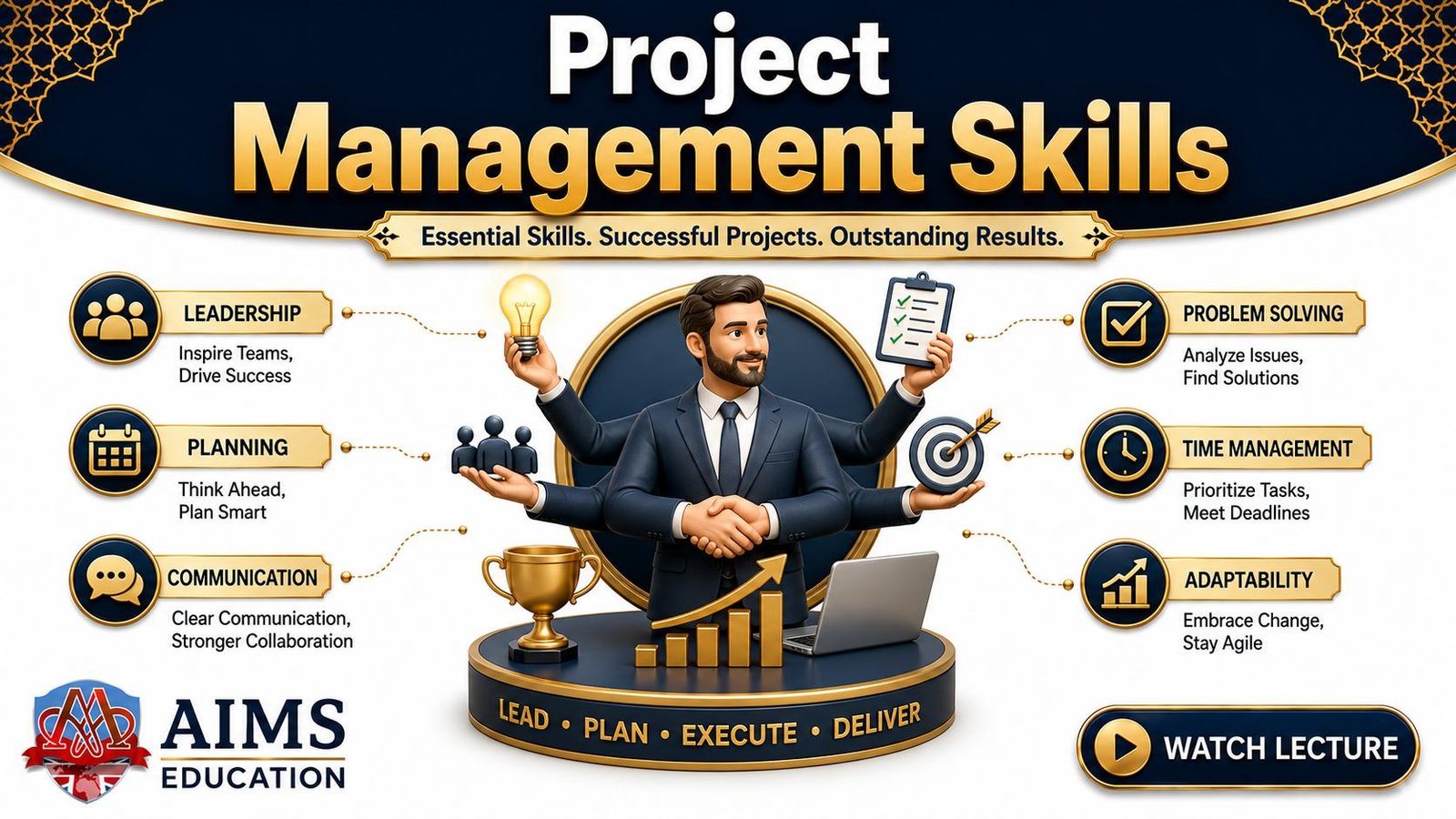
Most Important Project Management Skills at a Glance
| SKILL | CATEGORY | WHY IT MATTERS | PROJECT EXAMPLE |
|---|---|---|---|
| Planning | Technical | Converts objectives into organized work, milestones, responsibilities, and delivery actions. | Building a realistic plan for a 12-week product launch. |
| Communication | Power skill | Keeps team members and stakeholders informed, aligned, and able to make decisions. | Explaining a schedule delay and its implications to the sponsor. |
| Leadership | Power skill | Provides direction, builds commitment, and helps teams perform effectively. | Guiding a cross-functional team through a difficult delivery period. |
| Risk Management | Technical | Identifies uncertainty before it becomes an unmanaged problem. | Preparing a response for a possible supplier delay. |
| Stakeholder Management | Power and business skill | Builds support and manages differing expectations, interests, and influence. | Resolving conflicting priorities between operations and finance. |
| Scheduling and Time Management | Technical | Helps teams sequence work and protect important deadlines. | Resequencing non-dependent tasks after a delayed activity. |
| Budgeting | Technical and business skill | Supports responsible allocation and control of project expenditure. | Reviewing forecast costs after a change request. |
| Problem-Solving | Power and analytical skill | Enables teams to identify causes and select workable solutions. | Finding an alternative integration approach after a technical failure. |
| Technical and Tool Literacy | Technical | Allows the manager to understand delivery information and use appropriate project tools. | Interpreting a dashboard and updating dependencies in scheduling software. |
| Strategic Thinking | Business skill | Connects project decisions with organizational objectives and expected value. | Prioritizing a feature because it supports the organization’s strategic objective. |
Why Are Project Management Skills Important?
Project management skills are important because projects require coordinated decisions about people, work, resources, uncertainty, stakeholders, and competing constraints. A project manager may have an excellent schedule, but the project can still struggle if expectations are unclear, risks are ignored, conflicts remain unresolved, or decisions are delayed.
Project management is not simply about overseeing tasks. It involves leading a project from initiation to completion while maintaining sight of both the overall objective and the details required to achieve it.
Strong skills help a project manager to:
- Translate objectives into realistic plans and coordinated activities.
- Communicate priorities, decisions, changes, and expectations clearly.
- Allocate time, money, people, and other resources responsibly.
- Identify risks and prepare appropriate responses before problems escalate.
- Lead teams through uncertainty, disagreement, and changing requirements.
- Balance project delivery with stakeholder expectations and organizational value.
For this reason, the skills needed for project management extend far beyond scheduling tools and administrative techniques.
Difference Between Hard and Soft Project Management Skills
Hard project management skills concern methods, processes, analysis, tools, and technical delivery, while soft project management skills concern communication, leadership, collaboration, influence, behavior, and relationships. Successful project managers normally need both because technical knowledge helps structure the work, while interpersonal capability helps people perform that work effectively.
| AREA | HARD OR TECHNICAL SKILLS | SOFT OR POWER SKILLS |
|---|---|---|
| Primary Focus | Planning, analysis, controls, methods, tools, and project processes. | People, relationships, communication, behavior, influence, and leadership. |
| Examples | Scheduling, budgeting, scope, risk, quality, procurement, reporting, and software. | Communication, leadership, negotiation, collaboration, adaptability, empathy, and conflict resolution. |
| How They Develop | Education, training, methodology practice, tool use, and project experience. | Experience, coaching, reflection, feedback, observation, and deliberate interpersonal practice. |
| Project Contribution | Creates discipline, predictability, analysis, and control. | Creates alignment, trust, motivation, cooperation, and stakeholder support. |
The terminology is not identical across every professional framework. What are traditionally called project management soft skills are increasingly described as power skills, while technical project management skills include the methods and practices used to organize and deliver project work.
What Is the Project Management Skills Gap?
A project management skills gap is the difference between the capabilities required for effective project delivery and the capabilities currently available in an individual or team. The gap can develop as methods, technologies, organizational expectations, project complexity, or professional responsibilities change.
Closing the gap involves more than gaining theoretical knowledge. Project managers need to identify weaknesses, select appropriate development activities, apply new skills in practice, and evaluate whether performance has actually improved.
A simple skills matrix can support this process by mapping required competencies against current capability. It can then guide training, mentoring, role allocation, recruitment, and professional development priorities.
30 Key Project Management Skills
The most effective project managers develop a balanced portfolio of technical, interpersonal, analytical, and business skills rather than depending on one area of expertise. The following 30 skills preserve that balanced perspective.
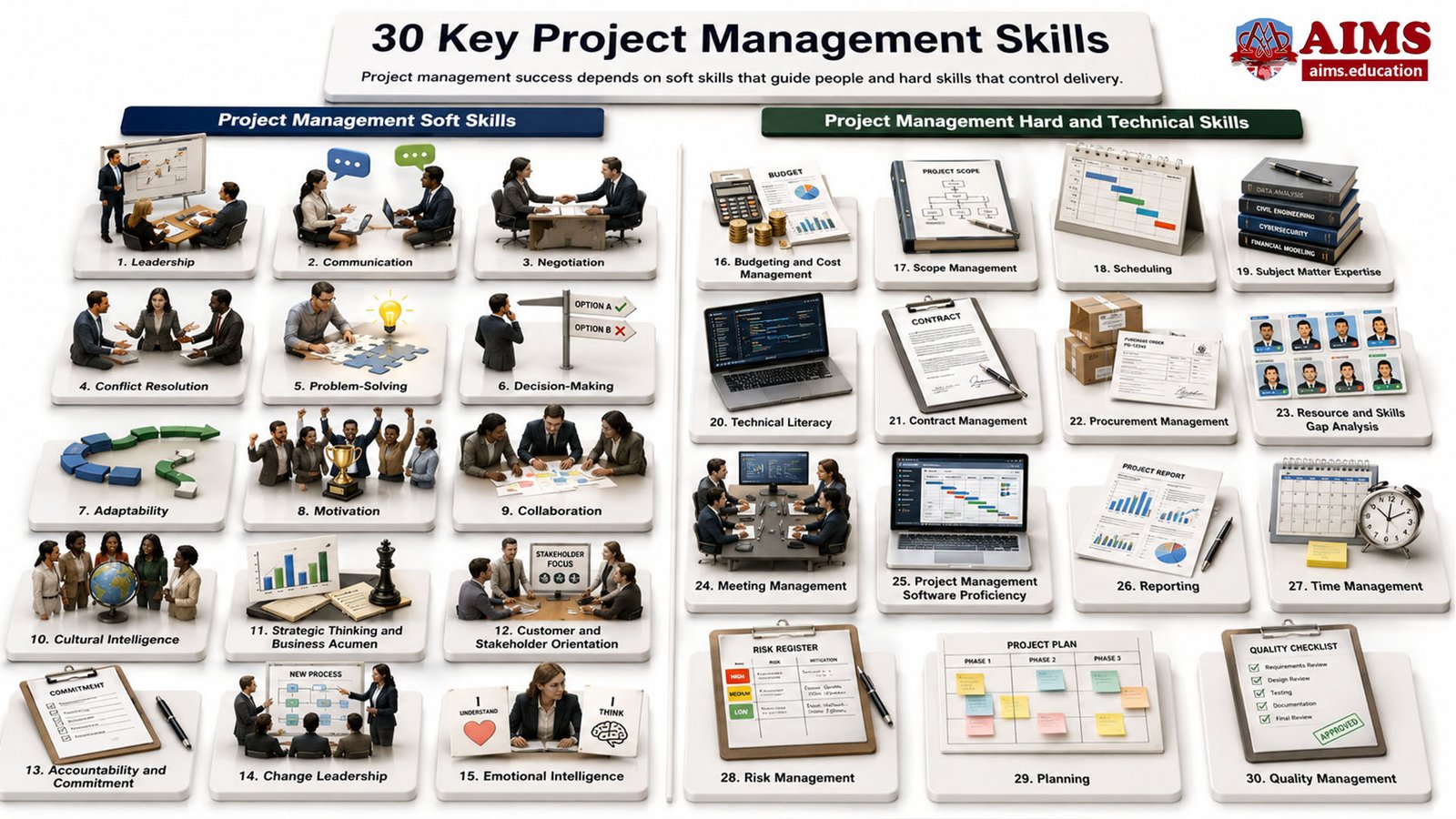
Project Management Soft Skills and Power Skills
Project management soft skills, often referred to as power skills, enable a project manager to lead people, communicate effectively, build relationships, influence decisions, and respond constructively to difficult situations.
1. Leadership
Leadership is needed not only to manage a team but also to provide direction and meaning. A project manager must listen, coach, clarify priorities, encourage accountability, and help people understand how their work contributes to the project objective.
Strong leadership skills in project management become especially important when the team faces uncertainty or pressure. In practice, leadership means creating conditions in which people understand what needs to be done and are prepared to take responsibility for doing it.
2. Communication
Communication involves understanding and being understood. Project managers communicate with team members, clients, sponsors, suppliers, executives, and other stakeholders, often adapting the message for audiences with very different interests and levels of technical knowledge.
Effective communication skills in project management include listening, questioning, presenting, writing, facilitating, and confirming understanding. Project managers also need a structured approach to planning and managing project communications rather than relying only on informal updates.
3. Negotiation
Project managers negotiate budgets, resources, deadlines, scope priorities, supplier arrangements, responsibilities, and competing stakeholder expectations. Good negotiation is not simply about winning an argument. It seeks an agreement that protects important project objectives while recognizing legitimate interests on both sides.
For example, if two departments need the same specialist during the same week, the project manager may negotiate priorities, alternative dates, or partial allocation rather than allowing the resource conflict to delay both teams.
4. Conflict Resolution
Conflict is a normal part of project work because people may disagree about priorities, responsibilities, methods, resources, or decisions. A skilled project manager identifies the source of disagreement, creates space for constructive discussion, and works toward a solution that protects both working relationships and project objectives.
Effective conflict resolution requires listening to each perspective rather than treating every disagreement as a personality problem.
5. Problem-Solving
Projects regularly encounter unexpected obstacles. Problem-solving enables the project manager to define the problem accurately, investigate its causes, consider alternatives, assess consequences, and implement a practical response.
Strong problem solvers distinguish symptoms from causes. A recurring missed deadline, for example, may appear to be a productivity problem when the real cause is unclear requirements or an unresolved dependency.
6. Decision-Making
Project managers make decisions about priorities, risks, resources, changes, trade-offs, escalations, suppliers, and delivery approaches. Effective decision-making combines timely action with appropriate evidence and professional judgment.
Not every decision requires lengthy analysis. The skill is knowing when more information is necessary and when delaying the decision would create greater risk than acting on the information already available.
7. Adaptability
Adaptability is the ability to adjust plans, behaviors, and approaches when conditions change. Changes in scope, technology, stakeholders, resources, regulation, or market conditions may make the original approach unsuitable.
An adaptable project manager does not abandon discipline. Instead, the manager evaluates what has changed, determines what needs adjustment, and protects the project’s most important objectives while responding realistically to the new situation.
8. Motivation
A project manager is responsible not only for coordinating tasks but also for helping the team maintain energy and commitment. Clear goals, constructive feedback, recognition, autonomy, and meaningful work can all contribute to motivation.
Motivation is particularly important during demanding project periods. A manager who understands individual and team needs can support performance without relying solely on deadlines or authority.
9. Collaboration
Collaboration enables people with different expertise and responsibilities to work toward a shared project objective. Project managers create collaboration by clarifying roles, facilitating information exchange, removing unnecessary barriers, and encouraging joint problem-solving.
This skill is especially important in cross-functional projects where no single department controls every resource or decision required for delivery.
10. Cultural Intelligence
Cultural intelligence is the ability to recognize, understand, and adapt appropriately to cultural differences. It is particularly valuable for international projects, virtual teams, and organizations whose stakeholders work across different countries and professional cultures.
A culturally intelligent project manager avoids assuming that one communication, decision-making, or leadership style will work equally well for everyone.
11. Strategic Thinking and Business Acumen
Strategic thinking enables a project manager to look beyond individual tasks and understand how the project contributes to broader organizational objectives. Business acumen strengthens this skill by helping the manager consider value, customers, finances, industry conditions, priorities, and organizational strategy.
For example, two project options may both be technically feasible, but one may create greater customer value or align more closely with a strategic priority. Strong project managers understand that successful delivery should support a meaningful organizational outcome.
12. Customer and Stakeholder Orientation
Project managers often act as a bridge between delivery teams and people who expect value from the project. Customer and stakeholder orientation means listening carefully, understanding expectations, communicating constraints, and focusing attention on the outcomes stakeholders actually need.
This does not mean agreeing to every request. Effective managers use stakeholder engagement and management techniques to understand influence, expectations, concerns, and appropriate communication strategies.
13. Accountability and Commitment
Commitment reflects a project manager’s determination to see responsibilities through, while accountability means accepting ownership for decisions and agreed actions. Together, they build credibility with both the team and stakeholders.
An accountable project manager does not hide difficult information. If a milestone is likely to be missed, the manager reports the situation, explains the impact, recommends action, and follows through on the agreed response.
14. Change Leadership
Projects frequently create or experience change. Change leadership is the ability to help people understand why change is necessary, what it means for them, and how they can move from the current situation toward the desired outcome.
It complements formal change control. Change control manages proposed changes to project baselines and deliverables, while change leadership focuses more directly on people, adoption, communication, and transition.
15. Emotional Intelligence
Emotional intelligence helps project managers recognize emotions in themselves and others and respond appropriately. It includes self-awareness, self-management, empathy, and relationship awareness.
This capability supports leadership, negotiation, conflict resolution, motivation, and stakeholder communication. For example, recognizing that resistance to a new process is driven by uncertainty rather than opposition may lead to a more constructive response.
Project Management Hard and Technical Skills
Project management hard skills include the methods, analytical capabilities, tools, processes, and domain knowledge used to plan, monitor, control, and deliver project work.
16. Budgeting and Cost Management
Budgeting involves estimating costs, establishing an approved financial baseline, tracking expenditure, forecasting future costs, and responding when financial performance differs from expectations.
A project manager with sound cost-management skills can identify emerging financial problems early and make informed recommendations rather than discovering a budget overrun near project completion.
17. Scope Management
Scope management is the ability to define what the project will deliver, clarify boundaries, organize the required work, validate outputs, and control proposed changes.
Without clear scope, teams may perform unnecessary work or stakeholders may develop different expectations about what completion means. Effective scope management therefore protects time, cost, quality, and stakeholder alignment.
18. Scheduling
Scheduling converts planned work into a time-based sequence by considering activities, durations, milestones, dependencies, constraints, and available resources. A useful schedule helps the project manager understand not merely when work should happen, but how delays in one activity may affect other work.
Scheduling becomes particularly valuable when teams need to evaluate alternatives after a dependency changes or a critical activity is delayed.
19. Subject Matter Expertise
Subject matter expertise is knowledge of the industry, product, service, technology, or professional field in which the project operates. A project manager does not necessarily need to be the team’s deepest technical specialist, but sufficient domain understanding improves questioning, planning, risk awareness, and communication.
The required depth varies. An engineering, construction, banking, healthcare, or software project may each demand different levels of specialized knowledge.
20. Technical Literacy
Technical literacy means understanding enough of the project’s technical environment to coordinate work intelligently and communicate with specialists. It differs from personally performing every technical task.
For example, an IT project manager may not write production code but should understand core system dependencies, testing requirements, technical risks, and the implications of major architectural decisions.
21. Contract Management
Contract management involves understanding contractual obligations, deliverables, responsibilities, timelines, payment conditions, changes, and performance requirements. It becomes especially important when external suppliers or contractors contribute to the project.
A project manager should know which commitments are contractual and when an issue requires involvement from procurement, commercial, or legal specialists.
22. Procurement Management
Procurement management covers the planning and coordination of goods or services obtained from outside the project organization. It may include defining requirements, supporting supplier selection, negotiating commercial arrangements, monitoring supplier performance, and managing procurement risks.
Strong procurement skills help ensure that external resources arrive when required and meet the project’s technical, commercial, and quality expectations.
23. Resource and Skills Gap Analysis
A skills gap analysis helps identify differences between the capabilities a project needs and those currently available in the team. This supports resource planning, training decisions, recruitment, mentoring, and assignment of critical responsibilities.
The analysis should be practical. Instead of asking whether someone broadly “knows risk management,” a manager can assess whether the individual can identify risks, evaluate exposure, develop responses, maintain a risk register, and escalate issues appropriately.
24. Meeting Management
Meeting management involves setting a clear purpose, inviting the right participants, preparing relevant information, keeping discussion focused, recording decisions, and assigning actions with accountable owners.
A meeting should produce something useful. If the same information can be communicated effectively without a meeting, the project manager should consider whether the meeting is necessary.
25. Project Management Software Proficiency
Modern project managers often use software for schedules, task coordination, documentation, dashboards, resources, risks, communication, reporting, and collaboration. Tool proficiency improves efficiency when it supports a sound management process.
The correct tool depends on project needs rather than popularity alone. When selecting technology, managers should consider features, team size, integration, reporting, workflow, ease of use, and governance. A structured approach to comparing project management software for different team needs can support this decision.
26. Reporting
Reporting is the ability to present accurate, relevant, and timely project information to the people who need it. Good reporting explains not only what has happened but also what the information means and whether management action is required.
Project reports may cover progress, milestones, costs, risks, issues, changes, dependencies, quality, decisions, and forecasts. The level of detail should match the needs of the audience.
27. Time Management
Project managers handle competing responsibilities, requests, meetings, decisions, and interruptions. Effective time management skills for project managers involve prioritizing high-impact work, distinguishing urgency from importance, protecting concentration time, delegating appropriately, and addressing blockers early.
This personal capability complements formal scheduling. Managers who want deeper technical understanding can also study practical approaches to managing project time.
28. Risk Management
Risk management involves identifying uncertainty, assessing its potential effect on objectives, deciding how to respond, assigning responsibility, and monitoring whether risk exposure changes over time.
Strong risk management skills are proactive. Instead of waiting for an uncertain event to become a problem, the project manager prepares responses in advance. More detailed project risk identification, analysis, and response practices help turn this principle into a repeatable management process.
29. Planning
Planning organizes objectives into coordinated work. Strong project planning skills help managers define activities, responsibilities, sequencing, resources, assumptions, milestones, controls, and expected outcomes before execution becomes difficult to change.
A project plan should not be treated as a static document. When material changes occur, the manager evaluates their effect and updates the relevant plans through appropriate control processes.
30. Quality Management
Quality management ensures that project processes and deliverables satisfy defined requirements and are fit for their intended purpose. It involves establishing appropriate quality expectations, planning how they will be achieved, reviewing performance, verifying outputs, and correcting unacceptable results.
Strong quality management reduces avoidable rework and helps ensure that completing a project on time does not come at the expense of an unacceptable deliverable.
Project Management Skills Example: Launching a Customer Portal
A single project normally requires several project management skills to operate together rather than one skill being used in isolation. Consider a fictional project manager, Aisha, who is responsible for launching a customer portal within 12 weeks with an approved budget of £120,000.
- Planning: Aisha divides the project into requirements, design, development, integration, testing, training, and launch activities.
- Communication: She establishes weekly team updates and a concise sponsor report covering progress, risks, decisions, and upcoming milestones.
- Risk management: The team identifies a possible delay in a third-party integration and prepares a fallback approach.
- Stakeholder management: Aisha works with customer service, IT, marketing, and compliance to reconcile different requirements.
- Scheduling and time management: When the integration is delayed, she resequences independent testing activities rather than allowing the entire team to wait.
- Problem-solving: The team evaluates alternative technical approaches and selects the option that provides acceptable functionality without exceeding the approved risk tolerance.
- Quality management: Aisha confirms acceptance criteria before user testing and ensures critical defects are resolved before launch.
Together, these skills help Aisha protect delivery commitments while maintaining stakeholder confidence and measurable project value.
Which Project Management Skills Should Beginners Develop First?
Beginners should first develop communication, planning, time management, problem-solving, basic risk management, stakeholder awareness, and project-tool literacy. These capabilities provide a practical foundation because they appear in almost every project regardless of industry or methodology.
The most useful starting priorities are:
- Communication: Learn to provide clear updates, listen actively, ask useful questions, and confirm decisions.
- Planning: Practice breaking an objective into activities, milestones, dependencies, and responsibilities.
- Time management: Learn how to prioritize work and understand the relationship between personal productivity and the project schedule.
- Risk awareness: Develop the habit of asking what might affect the project and what can be done before it happens.
- Problem-solving: Practice defining causes before selecting solutions.
- Stakeholder awareness: Identify who is affected by the project and what information or decisions they require.
- Tool literacy: Learn to use basic scheduling, task-management, documentation, and reporting tools effectively.
Beginners do not need to master every advanced technique immediately. A stronger approach is to develop reliable fundamentals and gradually deepen specialist knowledge as project responsibilities increase.
How to Improve Project Management Skills
To improve project management skills, assess your current capability, identify priority gaps, learn the relevant concepts, apply them on real work, request feedback, and repeatedly evaluate your performance. Skill improvement is most effective when formal learning and practical application reinforce each other.
For professionals researching how to improve project management skills, the following process provides a practical starting point:
- Assess your current skill set. Compare your responsibilities with your current ability in areas such as planning, communication, leadership, risk, cost, scheduling, stakeholders, and tools.
- Prioritize the gaps that affect performance. Do not attempt to improve everything at once. Focus first on skills that influence your current or next role.
- Study the underlying method. Learn why the technique works rather than memorizing templates or terminology.
- Apply the skill on a real project. Practice risk analysis, stakeholder mapping, scheduling, facilitation, reporting, or another target capability in an authentic situation.
- Request evidence-based feedback. Ask colleagues, supervisors, mentors, or team members what improved and what still causes difficulty.
- Review results and repeat. Professional competence develops through repeated learning, application, feedback, and refinement.
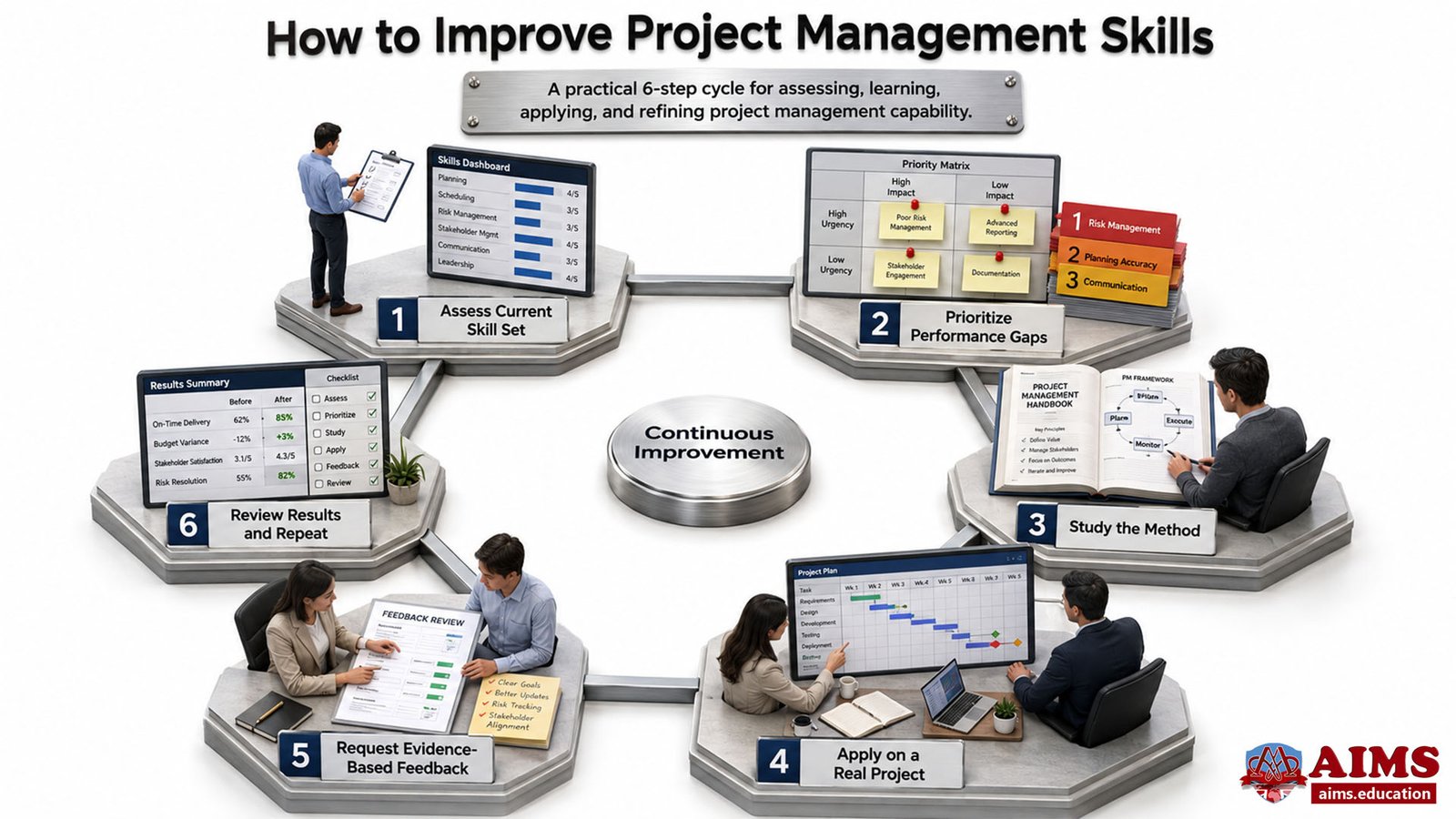
A simple development record can help you track the capability being developed, the practical action taken, the feedback received, and the next improvement target.
How AI Is Changing Project Management Skills
AI is expanding the project manager’s skill set, but it does not remove the need for core project management judgment, leadership, communication, planning, risk management, or stakeholder management. Instead, project managers increasingly need enough AI literacy to use automated assistance productively while understanding its limitations.
Modern project managers should progressively develop capabilities such as:
- AI literacy: Understand what AI tools can and cannot reasonably support in project work.
- Data literacy: Recognize the importance of data quality, context, and interpretation when using AI-supported analysis.
- Effective prompting: Give sufficiently clear instructions, context, constraints, and desired outputs when working with generative AI tools.
- Verification: Review AI-generated schedules, summaries, risk suggestions, reports, and recommendations rather than accepting them automatically.
- Governance awareness: Consider confidentiality, security, accountability, intellectual property, bias, organizational policy, and appropriate human oversight.
- Human judgment: Retain responsibility for decisions where context, ethics, stakeholder impact, uncertainty, or professional accountability matters.
The practical lesson is straightforward. AI capability should complement sound project-management practice, not become a substitute for it.
How Formal Education Can Strengthen Project Management Skills
Formal project management education can strengthen skills by combining structured theory with methods, frameworks, practical exercises, case analysis, and progressive professional development. It is particularly useful when a manager needs to close multiple skill gaps rather than learn one isolated technique.
Professionals building their foundations must consider CPME project management course for applied skill development to improve understanding of core methods and professional practice.
Those who already have project experience may benefit from career-oriented diploma in project management for working professional, where planning, risk, cost, quality, leadership, and other project disciplines can be studied as an integrated management system rather than as disconnected techniques.
At higher levels, postgraduate business education can strengthen strategic and managerial capability, while doctoral study is more appropriate for experienced professionals who intend to investigate complex project-management problems through advanced research.
Education is most valuable when learners actively apply what they study. Qualifications alone do not replace practical experience, reflection, feedback, or continued professional development.
Final Words on Developing Project Management Skills
Effective project management depends on a balanced combination of technical discipline and human capability. Planning, scheduling, budgeting, risk management, quality, and software skills help structure delivery, while communication, leadership, adaptability, collaboration, negotiation, and emotional intelligence help people work effectively within that structure.
The strongest development strategy is therefore not to collect isolated skills. Assess where your project responsibilities require greater competence, improve those areas deliberately, apply them to real situations, and continue adjusting your skill set as projects, technology, and organizational expectations evolve.
Frequently Asked Questions
What are project management skills?
Project management skills are the technical, interpersonal, analytical, and business capabilities used to plan projects, coordinate teams, manage resources and risks, communicate with stakeholders, solve problems, and deliver agreed outcomes.
What are the most important project management skills?
The most important skills include planning, communication, leadership, risk management, stakeholder management, time management, problem-solving, decision-making, budgeting, adaptability, and strategic thinking. The required emphasis varies according to the project, industry, team, and management approach.
What skills does a project manager need?
A project manager needs both technical and interpersonal skills. Technical capabilities include planning, scheduling, budgeting, risk, scope, quality, reporting, and tool proficiency, while interpersonal capabilities include leadership, communication, negotiation, collaboration, adaptability, and conflict resolution.
What is the difference between hard and soft project management skills?
Hard skills relate mainly to project methods, analysis, tools, processes, and controls, such as scheduling, budgeting, risk analysis, and quality management. Soft or power skills relate mainly to people and relationships, including communication, leadership, negotiation, empathy, collaboration, and conflict resolution.
What technical skills should a project manager have?
Important technical skills include planning, scheduling, scope management, budgeting, risk management, quality management, reporting, procurement, contract awareness, resource planning, and appropriate use of project-management software. The exact technical requirements depend on the type and complexity of the project.
Why are communication and leadership important in project management?
Communication keeps people informed and aligned, while leadership provides direction, supports accountability, and helps teams work through uncertainty. Together, these capabilities enable the project manager to coordinate people rather than merely administer project tasks.
How can you improve your project management skills?
Begin by assessing your current capabilities and identifying high-priority gaps. Study the relevant concepts, apply them in real project situations, request feedback, review your performance, and repeat the development process through formal learning, mentoring, practice, and professional experience.
What project management skills should beginners develop first?
Beginners should prioritize communication, basic planning, time management, problem-solving, risk awareness, stakeholder awareness, and project-tool literacy. These skills provide a practical foundation that can later support more advanced responsibilities such as budgeting, procurement, quality, and strategic decision-making.
Do project managers need technical skills?
Yes. Project managers need enough technical project-management capability to plan, monitor, analyze, and control project work. However, they do not always need to be the most technically specialized person on the team. The required depth of domain expertise depends on the project and industry.
What project management skills should you put on a resume?
Choose project management skills for resume sections according to the role you are targeting. Rather than listing generic terms alone, connect skills such as planning, risk management, stakeholder management, budgeting, leadership, and scheduling with evidence of how you applied them and the results achieved.
How is AI changing the skills required for project managers?
AI is increasing the value of AI literacy, data awareness, effective prompting, output verification, governance awareness, and responsible human judgment. These emerging capabilities complement rather than replace established skills such as communication, leadership, planning, risk management, and decision-making.
Develop Professional Project Management Skills with AIMS
AIMS’ Project Management Academy has delivered professional project management education since 2005, supporting a global learner community through internationally accredited, career-focused qualifications. Its internationally standardized curriculum is taught by qualified faculty and emphasizes industry-oriented learning, practical skill development, 3D interactive learning content, and real-world case studies. Educational articles, study content, and curriculum are collaboratively developed and rigorously peer-reviewed by an academic board of qualified industry practitioners. Developing these skills strengthens practical project leadership and delivery competence. Explore AIMS’ globally recognized and accredited instutute for professional project management qualifications.