
What Is Inflation in Islamic Economics?
Inflation in Islamic economy is a continuing increase in the general prices of goods and services, resulting in a decline in the purchasing power of money. The study of inflation in Islamic economics combines economic analysis with ethical, contractual, and public-policy considerations. Islam does not classify every price increase as unlawful, nor does it treat inflation itself as a prohibited transaction. Instead, an Islamic perspective on inflation examines:
- Why prices are rising,
- Who is being harmed,
- Whether injustice or prohibited conduct is involved, and
- Which lawful measures can restore monetary discipline, adequate production, fair exchange, and social balance.
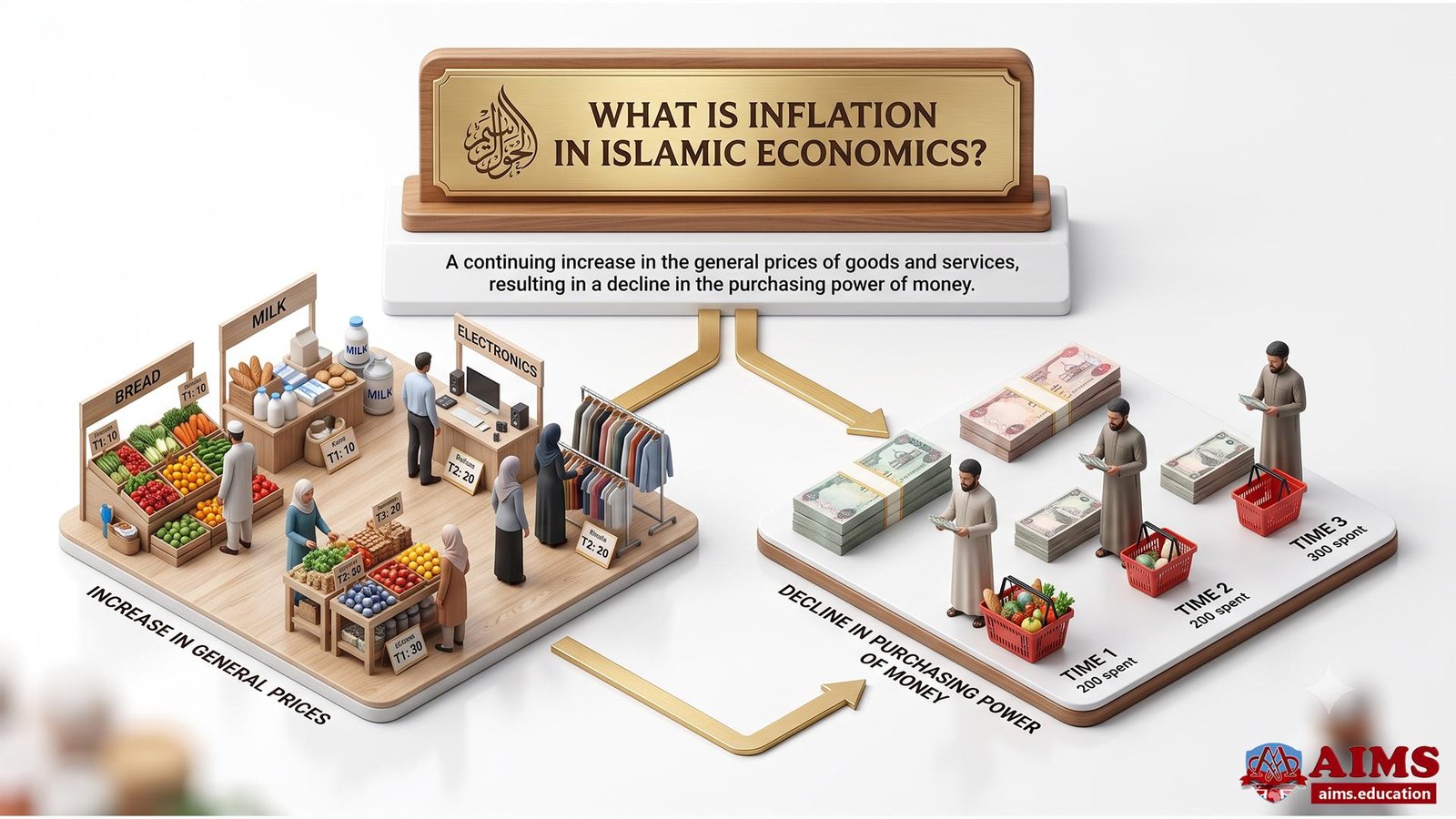
Inflation should be understood as a broad and persistent economic condition. A temporary increase in the price of one product does not necessarily represent inflation. For example, the price of dates may rise after a poor harvest while the prices of most other goods remain stable. This is a relative price change rather than general inflation.
Three features normally distinguish inflation from an isolated price increase:
- Prices rise across a broad range of goods and services. The change is not limited to one product or one local market.
- The increase continues over time. A brief seasonal shortage may raise prices temporarily without creating persistent inflation.
- Money loses purchasing power. Households require more currency to purchase substantially the same basket of goods and services.
The Islamic analysis adds another question: does the inflationary process involve injustice, monetary irresponsibility, hoarding, deception, excessive credit expansion, monopoly power, or preventable harm to the public?
Inflation and the Value of Money in Islam
Money serves as a medium of exchange, a unit of account, and a means of settling financial obligations. Serious instability in its value can therefore affect wages, savings, deferred payments, business accounts, zakat calculations, financing contracts, and the distribution of wealth.
The nominal amount of money may remain unchanged while its real value declines. If a worker earns 2,000 currency units each month and prices rise by 20 percent while the salary remains fixed, the worker still receives 2,000 units but can purchase considerably less.
This distinction between nominal value and real purchasing power is central to understanding inflation and the value of money in Islam. It also explains why inflation creates difficult Shariah questions in relation to debts, deferred obligations, and exceptional currency depreciation.

Types of Inflation in Islamic Economics
The two principal types of inflation are demand-pull inflation and cost-push inflation. Although modern economies may experience imported, monetary, structural, or expectation-driven inflation, these additional descriptions generally explain how demand or production costs are being affected.
- Demand-pull inflation
- Cost-push inflation
Demand-Pull Inflation
Demand-pull inflation occurs when total demand for goods and services grows faster than the economy’s ability to supply them. Buyers compete for limited goods, enabling sellers to charge higher prices.
Demand may rise because of:
- Population growth that increases the need for food, housing, transport, and public services.
- Higher government expenditure that introduces additional purchasing power into the economy.
- Rapid private investment that raises demand for machinery, labour, land, and raw materials.
- Increasing household income and consumption without a corresponding increase in production.
- Excessive monetary expansion that allows demand to grow beyond available output.
Example of Demand-Pull Inflation in an Islamic Economy
Suppose Noor City launches a major housing programme while private construction is also expanding.
- Government agencies and private developers begin purchasing cement, steel, machinery, and labour at the same time.
- Local suppliers cannot immediately increase their production capacity.
- Construction companies offer higher prices to secure limited materials and skilled workers.
- Production costs and property prices rise throughout the construction sector.
- The increase spreads to rents, transport, storage, and other related services.
Coordinating expenditure with productive capacity would reduce shortages while preserving necessary investment and employment.
Cost-Push Inflation
Cost-push inflation occurs when the cost of producing goods and services rises and businesses pass part or all of that increase to consumers.
Production costs may increase because of:
- Higher wages that are not accompanied by productivity growth.
- Rising prices of imported fuel, machinery, components, or raw materials.
- Currency depreciation that makes imports more expensive.
- New taxes, duties, transport charges, or regulatory costs.
- Natural disasters, conflict, or supply-chain disruption.
- Market manipulation that artificially raises the price of essential inputs.
Example of Cost-Push Inflation in Food Production
Amanah Foods produces bread for several cities but depends on imported fuel and packaging materials.
- The domestic currency loses value against the currency used to purchase imports.
- Fuel, transport, packaging, and maintenance costs increase.
- The bakery’s cost per loaf rises even though customer demand has not changed.
- The company increases its selling price to remain financially viable.
- Other food producers facing similar costs also raise their prices.
Supply support and currency stability can limit the spread of higher input costs into essential consumer prices.
Causes of Inflation in Islamic Economics
The main causes of inflation in Islamic economics include excessive demand, disproportionate monetary expansion, deficit financing, production shortages, market concentration, hoarding, speculative conduct, rising costs, and inflationary expectations. Islamic analysis also investigates whether these pressures have been intensified by prohibited or socially harmful behaviour.
| CAUSE OF INFLATION | HOW IT RAISES PRICES | ISLAMIC POLICY RESPONSE |
|---|---|---|
| Excessive money creation | Purchasing power expands faster than real production. | Apply monetary discipline, liquidity controls, and financing linked more closely to productive activity. |
| Government deficit financing | Newly created money or excessive bank financing increases aggregate demand. | Control non-essential expenditure, improve revenue collection, and align public spending with productive capacity. |
| Supply shortages | Limited goods are pursued by a larger volume of spending. | Increase production, remove bottlenecks, release lawful reserves, and permit necessary imports. |
| Hoarding and artificial scarcity | Traders withhold essential goods to sell later at higher prices. | Enforce anti-hoarding rules, market supervision, stock disclosure, and proportionate penalties. |
| Monopoly and cartel pricing | Dominant firms restrict supply or impose prices without effective competition. | Prevent collusion, protect fair market access, and intervene when market power produces public harm. |
| Extravagant consumption | Artificial or luxury demand diverts resources from necessities and productive investment. | Encourage moderation, responsible advertising, saving, investment, and priority production. |
| Rising production costs | Businesses increase prices to recover higher labour, material, energy, or financing costs. | Improve productivity, reduce avoidable costs, support essential supply, and examine unfair contractual burdens. |
| Inflationary expectations | Consumers buy early and businesses raise prices in anticipation of future increases. | Provide credible policy, transparent information, stable supply, and firm action against manipulation. |
Excessive Money Supply and Credit Expansion
Inflationary pressure can develop when the volume of money and financing grows substantially faster than the supply of real goods and services. More money then competes for an insufficient quantity of output.
Commercial financing can support legitimate production, trade, and employment. The problem arises when monetary expansion becomes disconnected from genuine economic activity or is concentrated in speculative purchases, non-productive assets, and consumption that cannot be matched by supply.
An Islamic system does not eliminate the need for money creation or financial intermediation. It requires those functions to be governed by monetary discipline, transparency, risk awareness, and the public interest.
Government Spending and Deficit Financing
Public expenditure becomes inflationary when it raises demand without creating sufficient productive capacity or when persistent deficits are financed through excessive monetary expansion.
Government spending on infrastructure, health, education, and productive development may expand supply over time. However, poorly sequenced expenditure can increase current demand before the new productive capacity becomes available.
Effective Shariah-guided fiscal policy therefore distinguishes necessary public investment from wasteful expenditure and evaluates both the amount and timing of government spending.
Higher Private Consumption
Rapid growth in private consumption can increase prices when household spending rises faster than the production of consumer goods.
Islam does not condemn lawful consumption. It rejects extravagance, waste, harmful display, and consumption that ignores the rights of dependants, creditors, neighbours, or society. you can examine the wider Islamic principles of responsible consumption to understand how moderation directs resources towards genuine needs and productive purposes.
Monopoly, Cartels, and Market Power
Monopoly contributes to inflation when dominant sellers restrict supply, prevent competition, or impose unjustified prices. A firm’s large size alone is not necessarily prohibited, but using market control to exploit consumers conflicts with justice and fair dealing.
Market authorities should distinguish between a price increase caused by genuine cost changes and one produced by collusion, artificial scarcity, or abuse of dominance. This distinction prevents arbitrary interference while protecting the public from commercial oppression.
Hoarding and Speculative Conduct
Hoarding becomes economically harmful when essential goods are deliberately withheld from the market to create scarcity and obtain excessive profit.
“He who hoards is a sinner.” Sahih Muslim 1605a.
This prohibition concerns conduct that harms the public, particularly when necessities are withheld during scarcity. It should not be confused with ordinary inventory management, seasonal storage, or maintaining reasonable commercial reserves.
Speculation may also intensify inflation when participants purchase goods merely because they expect higher future prices. Their additional demand pushes prices upward, encourages further hoarding, and may detach market prices from actual consumption needs.
Wage and Price Pressures
A wage-price spiral develops when prices and wages repeatedly increase in response to one another. Workers seek higher wages because living costs have risen, while businesses raise prices because their labour costs have increased.
Islamic economics requires a just wage and humane treatment of workers. It does not support suppressing wages merely to reduce inflation. The stronger response is to combine fair compensation with productivity, cooperative labour relations, efficient production, and protection against exploitative pricing.
Interest-Based Financing and Inflation
The relationship between inflation and riba in Islam is important but must not be oversimplified. Interest-bearing debt may increase business costs, encourage highly leveraged financial expansion, and distribute risk unfairly. These channels can contribute to inflation in particular circumstances.
However, riba is not the sole cause of inflation. Inflation also occurs through supply shocks, fiscal deficits, currency depreciation, natural disasters, excessive demand, market concentration, and expectations. Conversely, eliminating interest does not automatically guarantee stable prices.
The Islamic prohibition of riba has a broader contractual and moral basis. A detailed examination of how riba affects Islamic banking and finance helps distinguish the Shariah ruling from the separate economic question of inflation transmission.
Effects of Inflation on an Islamic Economy
The main effects of inflation on an Islamic economy are declining purchasing power, unequal redistribution of wealth, uncertainty in contracts, pressure on fixed-income households, weaker savings, distorted investment, and possible disruption of production and trade.
Loss of Purchasing Power
When prices rise faster than income, households can purchase fewer necessities. The burden is especially severe for pensioners, salaried workers, students, unemployed people, and families whose incomes cannot adjust quickly.
Economic Injustice and Unequal Distribution
Inflation does not affect everyone equally. Owners of scarce assets may benefit from rising prices, while people holding cash or receiving fixed incomes lose real purchasing power. Borrowers may gain when debts are repaid in depreciated money, while creditors bear a real loss.
This distributional imbalance makes inflation and economic justice in Islam inseparable concerns. Price stability is not pursued merely to improve statistical performance. It protects livelihoods, contractual fairness, social confidence, and the real value of lawful earnings.
“So that wealth may not merely circulate among your rich.” Qur’an 59:7.
Lower Real Savings
If savings lose value rapidly, households may reduce cash holdings or move funds into land, commodities, foreign currency, and other assets. This behaviour may protect individuals but can increase asset-price pressure and reduce funds available for balanced productive investment.
Uncertainty in Investment and Business Planning
Businesses find it difficult to estimate future costs, selling prices, wages, and returns during unstable inflation. Long-term projects may be delayed because entrepreneurs cannot reliably calculate whether expected revenue will cover future expenditure.
Pressure on Production and Employment
Mild demand growth may initially encourage production and employment when unused capacity exists. Persistent or unpredictable inflation, however, raises input costs, reduces real demand, creates inventory problems, and may eventually discourage investment.
Reduced Export Competitiveness
If domestic production costs rise faster than those of trading partners, locally produced goods may become less competitive internationally. Currency depreciation may temporarily support exports, but expensive imported inputs can offset that advantage.
Example of Inflation’s Distributional Effect
Maryam lends Hassan 100,000 units as an interest-free loan for two years.
- At the time of the loan, 100,000 units can purchase a specified quantity of essential goods.
- During the two years, the general price level rises substantially.
- Hassan repays the nominal amount of 100,000 units.
- Maryam receives the agreed number of currency units but substantially less purchasing power.
- The parties now face a juristic question concerning contractual certainty, riba, fairness, and exceptional depreciation.
Clear Shariah guidance is essential because neither automatic indexation nor ignoring exceptional loss is always an adequate answer.
Islamic View on Inflation and Price Stability
The Islamic view on inflation evaluates price instability through the objectives of justice, lawful exchange, protection of wealth, fulfilment of contracts, moderation, and prevention of public harm.
The market has an important role within the wider structure of the Islamic economic system. Consumers, producers, investors, and workers may make independent economic decisions, but their freedom is subject to Shariah duties and prohibitions.
The principal foundations include:
- Justice: Economic policy should not transfer avoidable losses to vulnerable households or permit exploitation by powerful market participants.
- Lawful earning: Profit is legitimate when earned through permissible trade, productive effort, investment, service, or risk-bearing.
- Contractual fulfilment: Parties should honour valid obligations and avoid ambiguity, deception, and unlawful additions to debts.
- Moderation: Consumption and public expenditure should avoid waste, extravagance, and artificial demand.
- Protection of wealth: Monetary and fiscal institutions should protect the reliability of money, savings, property, and financial rights.
- Public responsibility: The state may intervene where fraud, hoarding, monopoly, manipulation, or an emergency threatens society.
- Moral accountability: Economic decisions are not assessed only by profit but also by their effect on people and accountability before Allah.
“Woe to those who give less, who take full measure but give less when they measure or weigh.” Qur’an 83:1-3.
This guidance establishes a market ethic based on honest measurement, transparent pricing, fair dealing, and the rejection of commercial practices that transfer hidden losses to others.
How Does Islamic Economics Control Inflation?
Islamic solutions to inflation combine preventive market principles with monetary restraint, responsible public finance, increased production, fair distribution, business regulation, and proportionate state intervention. No single instrument can control every form of inflation because demand, cost, monetary, structural, and external pressures require different responses.
Built-In Stabilizers in an Islamic Economy
Built-in stabilizers are permanent principles and institutions that reduce the likelihood that inflationary imbalances will become severe.
Prohibition of Riba and Harmful Speculation
The prohibition of riba encourages financing structures based on lawful sale, leasing, partnership, investment, and risk-sharing rather than a guaranteed return on a monetary loan. When properly governed, these structures can connect finance more closely with assets, trade, services, and productive activity.
Profit-and-loss sharing arrangements such as mudarabah may support productive investment without imposing a fixed interest obligation on the entrepreneur. This does not make such arrangements risk-free or automatically non-inflationary. Strong governance, asset quality, disclosure, and monetary discipline remain necessary.
Moderation in Consumption
Islamic teachings discourage extravagance and waste. Moderation reduces artificial demand and helps channel income towards genuine needs, savings, family responsibilities, charity, and productive investment.
This principle does not require economic stagnation or the rejection of lawful comfort. It requires proportion, responsibility, and an awareness that consumption choices affect resource allocation throughout society.
Fair Labour Relations
A just wage protects workers from exploitation and helps maintain social stability. Employers should compensate labour fairly, while workers should perform their duties honestly and productively.
A fair wage policy should be combined with skill development and productivity. Raising wages without improving output may increase production costs, but holding wages below subsistence levels creates injustice and weakens effective participation in the economy.
Eradication of Business Malpractices
Islamic commercial law prohibits fraud, deception, artificial scarcity, collusion, and harmful hoarding. Enforcing these rules prevents businesses from manufacturing inflationary pressure merely to obtain excessive gains.
Increasing the Supply of Goods
Inflation cannot be controlled sustainably by suppressing demand alone. Production must also increase, particularly for food, housing, energy, transport, healthcare, and other necessities.
An Islamic economy should therefore:
- Bring idle land, capital, and productive resources into lawful use.
- Encourage entrepreneurship and useful work.
- Direct investment towards sectors where shortages are most damaging.
- Improve technology, skills, infrastructure, and supply-chain efficiency.
- Reduce barriers that unnecessarily restrict lawful production and trade.
- Protect producers from predatory conduct while preventing exploitation of consumers.
Example of a Built-In Anti-Inflation Framework
Rahmah Province faces repeated increases in the price of basic food.
- Authorities identify that limited storage, transport losses, and cartel behaviour are restricting supply.
- Investment partnerships finance warehouses, cold storage, and local food processing.
- Market regulators prohibit collusion and require accurate stock information from major distributors.
- Consumer education discourages panic buying and waste.
- Targeted assistance protects low-income households without creating uncontrolled general demand.
The combined response increases supply, protects households, and corrects misconduct without replacing the market with arbitrary control.
Islamic Monetary Policy and Inflation
Islamic monetary policy and inflation control require the central monetary authority to manage liquidity and financing without relying on interest-based instruments.
Possible instruments include:
- Higher reserve requirements: The central authority may require banks to hold a larger share of deposits in reserve, reducing their immediate capacity to expand financing.
- Liquidity ratios: Banks may be required to retain additional liquid assets during periods of excessive monetary growth.
- Reduced refinancing support: Central-bank funding facilities can be tightened when financial institutions are expanding credit too rapidly.
- Selective financing controls: Regulators may restrict financing for speculative or non-essential activities while preserving support for productive and socially necessary sectors.
- Shariah-compliant market operations: The monetary authority may buy or sell eligible asset-backed or investment instruments to influence system liquidity.
- Prudential limits: Loan-to-value, down-payment, exposure, and concentration limits can reduce excessive asset and consumer financing.
- Moral persuasion and supervisory direction: Regulators may require banks to align financing growth with national stability and public welfare.
Let us discuss adjusting the proportion of qard hasan financing and the profit-sharing terms used in new mudarabah arrangements. Any such policy must respect existing contracts. A regulator may influence future financing conditions, but it should not arbitrarily rewrite an agreed profit-sharing ratio after a valid contract has begun.
Fiscal Measures to Control Inflation
Fiscal measures control inflation by reducing excessive demand, improving the quality of public expenditure, and supporting an increase in productive capacity.
Relevant measures include:
- Reducing non-essential government expenditure during periods of excessive demand.
- Avoiding persistent deficits financed through uncontrolled monetary expansion.
- Increasing lawful and equitable public revenue where genuinely necessary.
- Prioritising infrastructure and productive investment that removes supply constraints.
- Improving procurement to prevent waste, corruption, and inflated public-sector prices.
- Managing public debt through permissible and transparent instruments.
- Coordinating fiscal support so that assistance protects vulnerable groups without producing broad uncontrolled demand.
A surplus budget may reduce demand in an overheated economy, but it is not automatically appropriate in every inflationary situation. Cost-push inflation caused by energy shortages, for example, may require targeted investment rather than general fiscal contraction.
Zakat Policy and Inflation
Zakat promotes lawful wealth circulation and protects eligible recipients, but it should not be treated merely as a tool for reducing aggregate demand.
Zakat transfers resources to people who often have urgent consumption needs. This may increase demand for food, clothing, housing, and healthcare. That increase is not a defect in zakat. It reflects the fulfilment of legitimate rights and the movement of wealth towards people with unmet needs.
Inflationary pressure can be limited by ensuring that:
- Zakat is collected and distributed according to Shariah requirements.
- Eligible recipients receive assistance efficiently and without unjustified delay.
- Support programmes improve employability, productive capacity, and sustainable livelihoods where appropriate.
- Cash assistance is coordinated with the availability of essential goods.
- Policymakers increase the supply of necessities rather than attempting to suppress the valid needs of poorer households.
Any proposal involving zakat certificates, delayed distribution, investment of zakat funds, or changes in allocation requires qualified Shariah review. The rights of eligible recipients cannot be suspended simply because their consumption may increase market demand.
Supply-Side and Emergency Measures
The state may take direct action when severe shortages, manipulation, war, disaster, or market failure threatens essential welfare.
Possible measures include:
- Buffer stocks: Public reserves of essential goods may be released during genuine shortages.
- Temporary rationing: Fair distribution may be required when necessities are insufficient for unrestricted market allocation.
- Emergency imports: Essential goods may be imported to increase supply and relieve hardship.
- Anti-hoarding enforcement: Authorities may investigate concealed stocks and compel lawful release where harmful hoarding is proven.
- Temporary price regulation: Controls may be justified where traders are exploiting scarcity or manipulating markets.
- Support for production: Financing, infrastructure, logistics, and essential inputs may be directed towards sectors facing critical shortages.
These powers should be exercised through law, evidence, due process, proportionality, and compensation where Shariah and public justice require it. Emergency authority should not become a licence for arbitrary confiscation or permanent disruption of lawful trade.
Islamic and Conventional Approaches to Inflation
The Islamic vs conventional approaches to inflation share several economic tools, but the Islamic approach adds Shariah rules, ethical responsibility, distributional justice, and accountability for how monetary stability is achieved.
| AREA | CONVENTIONAL APPROACH | ISLAMIC APPROACH |
|---|---|---|
| Primary objective | Maintain price stability, employment, output, and financial-system stability. | Maintain stability while protecting justice, wealth, lawful exchange, contracts, and public welfare. |
| Diagnosis | Examines demand, supply, expectations, money, fiscal policy, productivity, and external shocks. | Examines the same economic forces and whether prohibited or unjust conduct intensified them. |
| Monetary instruments | Commonly uses interest rates, reserves, open-market operations, and credit regulation. | Uses reserves, liquidity management, prudential controls, and Shariah-compliant market instruments without riba. |
| Financial structure | Permits interest-bearing debt and a wide range of derivative and speculative transactions. | Prohibits riba, excessive contractual uncertainty, gambling, fraud, and harmful speculation. |
| Consumption | Generally treats lawful consumer preference as an individual economic choice. | Adds duties of moderation, avoidance of waste, and responsibility towards others. |
| Market intervention | Intervenes to address market failure, monopoly, emergencies, or policy objectives. | Allows proportionate intervention against injustice, manipulation, hoarding, and serious public harm. |
| Distribution | May address distribution through taxation, subsidies, welfare, and income policies. | Adds zakat, obligatory rights, charity, inheritance rules, and ethical duties of wealth circulation. |
| Policy constraint | Policy is constrained by law, institutions, economic evidence, and political objectives. | Policy is additionally constrained by Shariah, contractual justice, and the prohibition of unlawful means. |
Islamic economics should not reject a policy merely because conventional institutions also use it. Reserve requirements, competition law, buffer stocks, fiscal restraint, productivity improvement, and transparent statistics may all be permissible when their structure and implementation comply with Shariah.
The distinctive question is not only whether a policy reduces inflation. It is also whether the policy uses lawful means, allocates burdens fairly, protects valid contracts, and avoids creating a greater injustice than the one it is intended to remove.
Inflation, Debt Repayment, and Currency Depreciation under Shariah
Inflation does not automatically permit a creditor to add compensation to every monetary debt. The Shariah treatment depends on the original contract, the currency used, the severity of depreciation, whether adjustment was agreed in advance, and whether settlement occurs through mutual agreement, arbitration, or judicial determination.
Can Loan Repayment Be Adjusted for Inflation in Islam?
For ordinary or low inflation, the established starting rule is that a debt denominated in a particular currency is repaid in the same currency and nominal amount. Automatically adding a percentage because the consumer price index has increased may convert a benevolent or commercial debt into an uncertain or prohibited increase.
Pre-agreed indexation of a monetary loan to inflation, gold, another currency, or a price index raises serious concerns involving riba, uncertainty, and the alteration of a fixed debt.
Exceptional hyperinflation is treated differently. Where severe depreciation occurs after the debt has arisen, qualified juristic guidance may allow the parties to reach a settlement based on value or to distribute the loss through reconciliation. Judicial or arbitral resolution may also be used, but the adjustment should not have been stipulated in advance as an automatic return on the loan.
This distinction is explained in the International Islamic Fiqh Academy resolution on monetary inflation and currency rate fluctuation.
| ARRANGEMENT | GENERAL SHARIAH TREATMENT | REASON |
|---|---|---|
| Repayment of the same nominal currency amount during ordinary inflation | Generally required. | A fixed monetary debt is ordinarily settled with its equivalent amount in the same currency. |
| Automatic increase linked to the consumer price index from the beginning | Generally impermissible for a monetary loan. | The final debt becomes uncertain and may require an increase over the amount advanced. |
| Loan stated in one currency but automatically repayable by the value of gold | Generally impermissible when used as prior indexation. | The borrower may become liable for an amount different from the currency debt actually received. |
| Original obligation genuinely denominated in a more stable currency | Potentially permissible when properly structured. | The debt is created in that currency rather than converted into it retrospectively. |
| Payment in another currency agreed on the settlement date | Potentially permissible at the prevailing exchange rate with immediate completion. | The parties make a spot currency settlement rather than a pre-agreed indexed increase. |
| Post-contract settlement after exceptional hyperinflation | May be resolved by mutual reconciliation, arbitration, or a court. | Exceptional loss is assessed after it occurs rather than guaranteed to the creditor in advance. |
| Inflation adjustment in rent or salary for future periods | May be permissible under properly defined contractual conditions. | Rent and salary are compensations for future use or work, not monetary loans requiring identical repayment. |
Example of a Long-Term Qard Hasan during Hyperinflation
Fatimah lends 500,000 units to Bilal as qard hasan, repayable after three years.
- The contract requires Bilal to repay 500,000 units and contains no inflation-indexation clause.
- An unforeseen monetary crisis then causes exceptional depreciation of the currency.
- Fatimah cannot independently impose a predetermined inflation return on the loan.
- Fatimah and Bilal may seek qualified Shariah advice and negotiate a fair post-event settlement.
- If they cannot agree, arbitration or judicial determination may evaluate the exceptional circumstances.
Post-event reconciliation addresses extraordinary loss without converting every interest-free loan into an inflation-linked investment.
Why Debt Adjustment Requires Special Caution
A loan transfers ownership of money to the borrower while creating an obligation to return its equivalent. Any contractual benefit imposed for the lender because of the loan may raise a riba concern.
At the same time, exceptional currency collapse can impose a severe and unintended loss on the creditor. For this reason, scholars distinguish between:
- Normal changes in purchasing power that form part of ordinary monetary risk.
- Low or moderate inflation that does not alter the standard nominal repayment rule.
- Exceptional or hyperinflationary depreciation that may justify post-event reconciliation or adjudication.
The classification of a real case should not be made solely through a convenient percentage selected by one party. It requires evidence, recognised standards, contractual analysis, and qualified juristic judgement.
Price Controls, Market Freedom, and State Intervention
Islamic law recognises market pricing under normal conditions but permits intervention when manipulation, injustice, or emergency conditions prevent a fair market outcome.
Prices rose during the lifetime of the Prophet Muhammad, peace be upon him. When people requested official price fixing, he declined to impose it because he feared committing injustice in people’s wealth.
“Indeed Allah is the One Who fixes prices, withholds, gives abundantly, and provides.” Jami’ al-Tirmidhi 1314.
This hadith demonstrates that a naturally occurring price increase is not automatically evidence of wrongdoing. Supply, demand, weather, production, and other genuine conditions may cause prices to change.
It does not establish an absolute ban on every form of price regulation. When merchants create artificial scarcity, collude, deceive buyers, or exploit an emergency, state intervention may restore justice rather than override a functioning market.
When Price Control May Be Justified
Temporary regulation may be justified when:
- Essential goods are being withheld to create artificial scarcity.
- A cartel is coordinating prices or dividing the market.
- Consumers cannot obtain necessities because of war, famine, disaster, or severe disruption.
- Sellers are exploiting privileged access to public resources or emergency supplies.
- Normal competition has collapsed and unrestricted pricing would create serious public harm.
Price ceilings imposed below the genuine cost of production can produce shortages and black markets. Effective regulation must therefore examine costs, ensure reasonable profit, increase supply, enforce competition, and remain limited to the period of necessity.
Did Inflation Exist during Early Islamic History?
Price increases, scarcity, currency changes, and fluctuations in purchasing power existed during early Islamic history, although the modern statistical concept of inflation developed much later.
Early Muslim societies experienced harvest failures, trade disruption, changes in the supply of gold and silver, debasement of coinage, and local shortages. Jurists therefore discussed fair prices, currency value, debt repayment, market supervision, and public intervention.
Modern inflation differs because contemporary economies use national paper currencies, central banking, large-scale credit creation, price indices, and complex international supply chains. Classical principles remain relevant, but their application requires economic evidence and contemporary ijtihad.
Professional Relevance for Islamic Banking and Finance
Inflation affects Islamic banks, regulators, investors, depositors, accountants, businesses, and Shariah boards because it changes real returns, asset values, financing behaviour, and the fairness of deferred obligations.
Islamic Banks
Islamic banks must assess how inflation affects asset prices, customer affordability, lease rentals, trade-finance costs, partnership returns, liquidity, and the real value of investment accounts.
They should not imitate interest-based indexation through artificial contractual devices. Product design must connect any price, rent, or profit adjustment to a valid underlying contract rather than to a guaranteed return on money.
Central Banks and Regulators
Regulators require Shariah-compliant liquidity instruments, reliable price data, prudent financing limits, and coordination with fiscal and supply-side authorities. Monetary restriction alone cannot resolve inflation caused by food shortages, imported energy costs, or damaged infrastructure.
Shariah Boards
Shariah boards must distinguish between a loan, sale price, lease rental, salary, investment return, and post-event settlement. The permissibility of an adjustment can change according to the legal nature of the obligation.
Accounting and Financial Reporting
Inflation can make historical financial figures less informative. Islamic financial institutions should disclose material inflation risks, explain valuation assumptions, and protect the interests of investment account holders, shareholders, and other stakeholders.
Students and Finance Professionals
Understanding inflation requires knowledge of economics, monetary policy, Islamic commercial jurisprudence, contract design, and social welfare. Learners seeking structured development can explore career-focused Islamic finance qualifications or undertake advanced diploma study in Islamic banking and finance.
Common Misconceptions about Inflation in Islam
Several popular claims about inflation according to Islam confuse economic diagnosis with Shariah rulings.
- Misconception: Inflation is automatically haram. Inflation is an economic condition. Particular causes or responses may be prohibited, such as riba, fraud, harmful hoarding, or unjust monetary conduct.
- Misconception: Every price increase is inflation. A single product can become more expensive because of seasonality, quality, taxation, scarcity, or changing preferences.
- Misconception: Riba is the only cause of inflation. Riba-related financing may contribute to particular inflationary processes, but supply shocks, deficits, currency depreciation, and market concentration also matter.
- Misconception: Islamic banking automatically eliminates inflation. Islamic banks operate within wider monetary, fiscal, political, and international systems and cannot independently remove every inflationary pressure.
- Misconception: Every debt should be adjusted for purchasing-power loss. Automatic indexation can create riba and uncertainty. Exceptional depreciation requires specialised juristic treatment.
- Misconception: Returning to gold would automatically solve inflation. Commodity money can also experience changes in supply, demand, value, storage cost, and economic availability.
- Misconception: Zakat causes inflation and should be delayed. Zakat fulfils established rights. Policymakers should increase essential supply and administer distribution effectively rather than deny eligible recipients.
- Misconception: Islam never permits price controls. Natural market prices should not be arbitrarily fixed, but intervention may be justified against manipulation, monopoly, or serious public harm.
Final Words on Inflation in the Islamic Economy
Inflation under the Islamic economic system is addressed through a combination of sound economic management and Shariah-based responsibility. Monetary discipline, balanced public expenditure, productive investment, fair competition, responsible consumption, lawful finance, just wages, wealth circulation, and protection from market abuse work together to support stability.
Islam does not promise an economy in which prices never change. It provides principles for distinguishing natural market movement from injustice and preventable disorder. It also requires policymakers to choose remedies that control inflation without violating contracts, suppressing valid rights, or shifting the entire burden to weaker members of society.
The strongest response is therefore neither purely monetary nor purely moral. It is an integrated system in which institutions, markets, households, businesses, and public authorities pursue price stability in Islamic economics through lawful means, reliable evidence, productive capacity, and economic justice.
Frequently Asked Questions
What is inflation in Islamic economics?
Inflation is a sustained increase in the general price level that reduces money’s purchasing power. Islamic economics examines its monetary and productive causes together with its effects on justice, contracts, wealth distribution, and public welfare.
What does Islam say about inflation?
Islam does not classify inflation itself as a prohibited transaction. It prohibits causes and practices involving riba, fraud, harmful hoarding, monopoly abuse, injustice, and irresponsible conduct, while supporting lawful measures that restore supply, stability, and fairness.
Is inflation prohibited in Islam?
No. Inflation is an economic condition rather than a contract or transaction that can automatically be labelled halal or haram. Specific conduct contributing to inflation may be prohibited, and unjust policy responses may also violate Shariah principles.
What causes inflation according to Islamic economics?
Important causes include excessive money creation, deficit financing, demand exceeding supply, rising production costs, currency depreciation, shortages, hoarding, monopoly pricing, speculative demand, extravagant consumption, and inflationary expectations.
How does Islamic economics control inflation?
Islamic economics combines monetary restraint, responsible fiscal policy, increased production, fair competition, prohibition of harmful market practices, moderation in consumption, targeted social protection, and proportionate state intervention during emergencies.
What is the relationship between inflation and riba?
Interest-bearing debt can increase costs and encourage leveraged financial expansion, which may contribute to inflation. However, riba is not the sole cause of inflation, and eliminating interest does not automatically guarantee price stability.
Can a loan repayment be adjusted for inflation in Islam?
Ordinary monetary debts are generally repaid in the same currency and nominal amount. Automatic inflation indexation is generally impermissible. Exceptional hyperinflation may permit a post-event settlement through mutual consent, arbitration, or judicial determination.
How does inflation affect debts and purchasing power under Shariah?
Inflation reduces the real value of money. A debtor may repay the agreed nominal amount while the creditor receives less purchasing power. This creates a difficult balance between contractual certainty, avoidance of riba, and fairness during exceptional depreciation.
What roles do hoarding and monopoly play in inflation?
Hoarding can create artificial scarcity by withholding essential goods, while monopoly power can restrict supply and impose excessive prices. Both practices may intensify inflation and justify market supervision or proportionate intervention.
How can zakat and wealth circulation help reduce economic hardship?
Zakat transfers resources to eligible recipients and reduces severe deprivation. It does not directly guarantee lower inflation, but effective distribution, productive support, and an adequate supply of necessities can protect households without creating avoidable price pressure.
How does the Islamic approach to inflation differ from conventional economics?
Both approaches examine demand, supply, money, fiscal policy, and expectations. Islamic economics additionally requires Shariah-compliant instruments, prohibition of riba and harmful speculation, responsible consumption, contractual justice, zakat, and protection of public welfare.
Did inflation exist during early Islamic history?
Early Muslim societies experienced rising prices, scarcity, currency changes, and loss of purchasing power. Modern inflation measurement developed later, but classical discussions of pricing, hoarding, currency value, debt, and state intervention remain relevant.
Study Islamic Economic Policy with AIMS
Since 2005, AIMS’ Institute of Islamic Banking and Finance has delivered internationally accredited, career-focused education to learners worldwide. Its internationally standardised curriculum is taught by qualified faculty through practical instruction, 3D interactive learning content, and real-world case-study-based qualifications. Educational resources, study content, and curricula are collaboratively developed and rigorously peer-reviewed by an academic board of qualified industry practitioners. Understanding inflation strengthens professional competence in monetary policy, Islamic contracts, banking, and socioeconomic welfare. Explore AIMS’ practical and flexible Islamic finance programmes.