
Islamic principles of consumption are Shariah-guided rules for using goods, services, income, and wealth in a lawful, wholesome, balanced, and socially responsible manner. They require halal and tayyib choices, moderation, avoidance of israf and tabdhir, fulfilment of legitimate needs, and responsible provision for family, charity, and wider social welfare.
In consumption in Islamic economics, the consumer does not seek satisfaction without moral limits. Choices are evaluated by their permissibility, purpose, health effects, affordability, impact on others, and contribution to falah, meaning well-being in this life and the Hereafter. The Islamic framework allows lawful enjoyment while restraining harm, waste, greed, and neglect of social obligations.
- Lawfulness through halal consumption
- Wholesomeness through tayyib choices
- Moderation and balanced expenditure
- Benefit and purposeful use of resources
- Morality and social responsibility
- Integrated individual and social welfare
- Trust and responsible stewardship
- Gratitude through responsible use of blessings
What Is Consumption in Islamic Economics?
Consumption in Islamic economics means using goods and services to satisfy legitimate human needs within the ethical and legal boundaries of Shariah. It includes food and drink, but also housing, clothing, education, healthcare, transport, technology, recreation, and other resources used in daily life.
Consumption normally follows production and distribution within an economic system. However, the Islamic approach does not treat the consumer as an individual whose only objective is to maximise personal satisfaction. The consumer remains accountable for what is purchased, how it was acquired, how much is used, and what consequences the decision creates.
The wider Islamic economic system and its ethical objectives therefore connects consumer choice with justice, human welfare, responsible ownership, and circulation of wealth.
Islamic consumer behaviour is shaped by several questions:
- Is the product or service halal?
- Is it wholesome, safe, and beneficial?
- Does it satisfy a legitimate need or merely encourage uncontrolled desire?
- Is the amount proportionate to the consumer’s income and circumstances?
- Will the purchase harm the individual, family, society, or environment?
- Have financial and social obligations been fulfilled first?
Consumption is therefore both an economic activity and an ethical responsibility. Proper consumption supports physical well-being, family stability, spiritual discipline, and social cooperation.
Qur’anic and Prophetic Foundations of Islamic Consumption
The Qur’an and Sunnah establish the foundations of lawful, moderate, purposeful, and socially responsible consumption. They permit beneficial enjoyment while warning against unlawful products, greed, extravagance, waste, miserliness, and neglect of people in need.
Lawful and Wholesome Consumption
“Eat of that which Allah hath bestowed on you as food lawful and good, and keep your duty to Allah in whom ye are believers”.
Reference: Surah Al-Maidah, Verse 88
This verse brings halal and tayyib together. Consumption must comply with Islamic law, but it should also involve what is good, wholesome, safe, and suitable for human well-being.
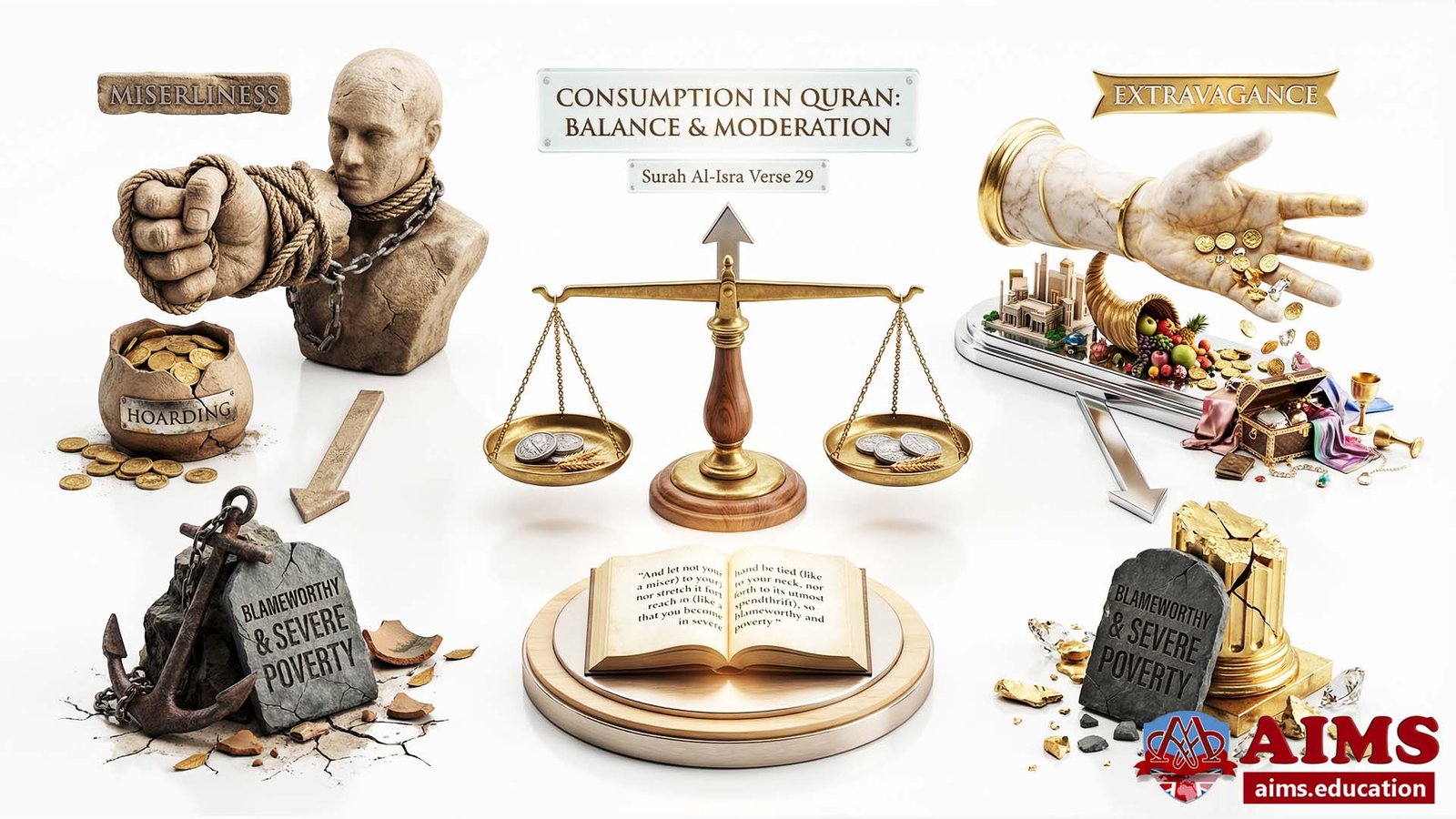
Moderation in Spending
“And those, who, when they spend, are neither extravagant nor niggardly, but hold a medium (way) between those (extremes)”.
Reference: Surah Al-Furqan, Verse 67
This principle rejects both uncontrolled expenditure and excessive withholding. A responsible consumer spends according to legitimate needs, available means, family responsibilities, and social obligations.
Avoidance of Waste
“Spend not wastefully (your wealth) in the manner of a spendthrift”.
Reference: Surah Al-Isra, Verse 26
Waste can occur when too much is purchased, when usable resources are discarded, or when wealth is directed towards something with no legitimate benefit.
Concern for People in Need
“And they give food, despite their love for it, to Miskin (poor), the orphan, and the captive. (Saying): ‘We feed you seeking Allah’s countenance only. We wish for no reward, nor thanks from you”.
Reference: Surah Al-Insan, Verses 8–9
Islamic consumption is not completely individualistic. A Muslim’s spending decisions should leave room for dependants, relatives, vulnerable people, and wider community needs.
Prophetic Guidance on Greed and Charity
“If Adam’s son had a valley full of gold, he would like to have two valleys, for nothing fills his mouth except dust (of the grave)”.
Reference: Narrated by Ibn Abbas, Sahih al-Bukhari, Book of Ar-Riqaq, Hadith 6437
The narration warns that material desire can continue expanding even after genuine needs have been satisfied. Without discipline, additional income may create additional wants rather than contentment.
“The best charity is to spend (in charity) while you are healthy, aspiring, hoping to survive, and fearing poverty, and not delaying until death comes to you”.
Reference: Narrated by Abu Hurairah, Sunan Abi Dawud, Book of Wills, Hadith 2865
Charitable allocation should therefore be part of responsible financial behaviour, not merely an afterthought when wealth is no longer personally useful.

Eight Key Islamic Principles of Consumption
The eight key principles govern the legality, quality, quantity, purpose, and social consequences of consumption. Together, they transform consumer choice from unrestricted preference satisfaction into morally accountable economic behaviour.
| PRINCIPLE | MEANING | BEHAVIOUR TO AVOID | MODERN APPLICATION |
|---|---|---|---|
| Lawfulness | Consumption must involve halal goods, services, income, and transactions. | Purchasing prohibited products or supporting unlawful activities. | Checking ingredients, business activities, contracts, and sources of income. |
| Wholesomeness | A permissible choice should also be clean, safe, suitable, and beneficial. | Choosing harmful or unsafe products merely because they are technically permissible. | Considering health, quality, safety, and responsible production. |
| Moderation | Spending should remain between extravagance and excessive withholding. | Lifestyle inflation, uncontrolled shopping, or unreasonable miserliness. | Using budgets, purchase limits, and proportionate lifestyle choices. |
| Benefit | Resources should produce a legitimate personal, family, or social benefit. | Spending on harmful, useless, or purposeless products and activities. | Prioritising education, health, family welfare, productivity, and useful recreation. |
| Morality | Consumer choices should reflect dignity, honesty, justice, and good character. | Supporting exploitation, deception, indecency, gambling, or degrading content. | Evaluating how products are promoted, produced, financed, and used. |
| Integrated Welfare | Consumption should support material welfare, spiritual growth, and social well-being. | Pursuing personal pleasure while causing financial, moral, or social harm. | Balancing household needs, savings, lawful enjoyment, and community support. |
| Amanah | Wealth is a trust that must be managed responsibly and accountably. | Careless spending, destruction of resources, and neglect of dependants. | Using financial plans, maintaining assets, and avoiding irresponsible debt. |
| Shukr | Gratitude is demonstrated through lawful, beneficial, and generous use of blessings. | Arrogance, constant dissatisfaction, hoarding, and wasteful display. | Supporting family, worship, charity, education, and beneficial projects. |
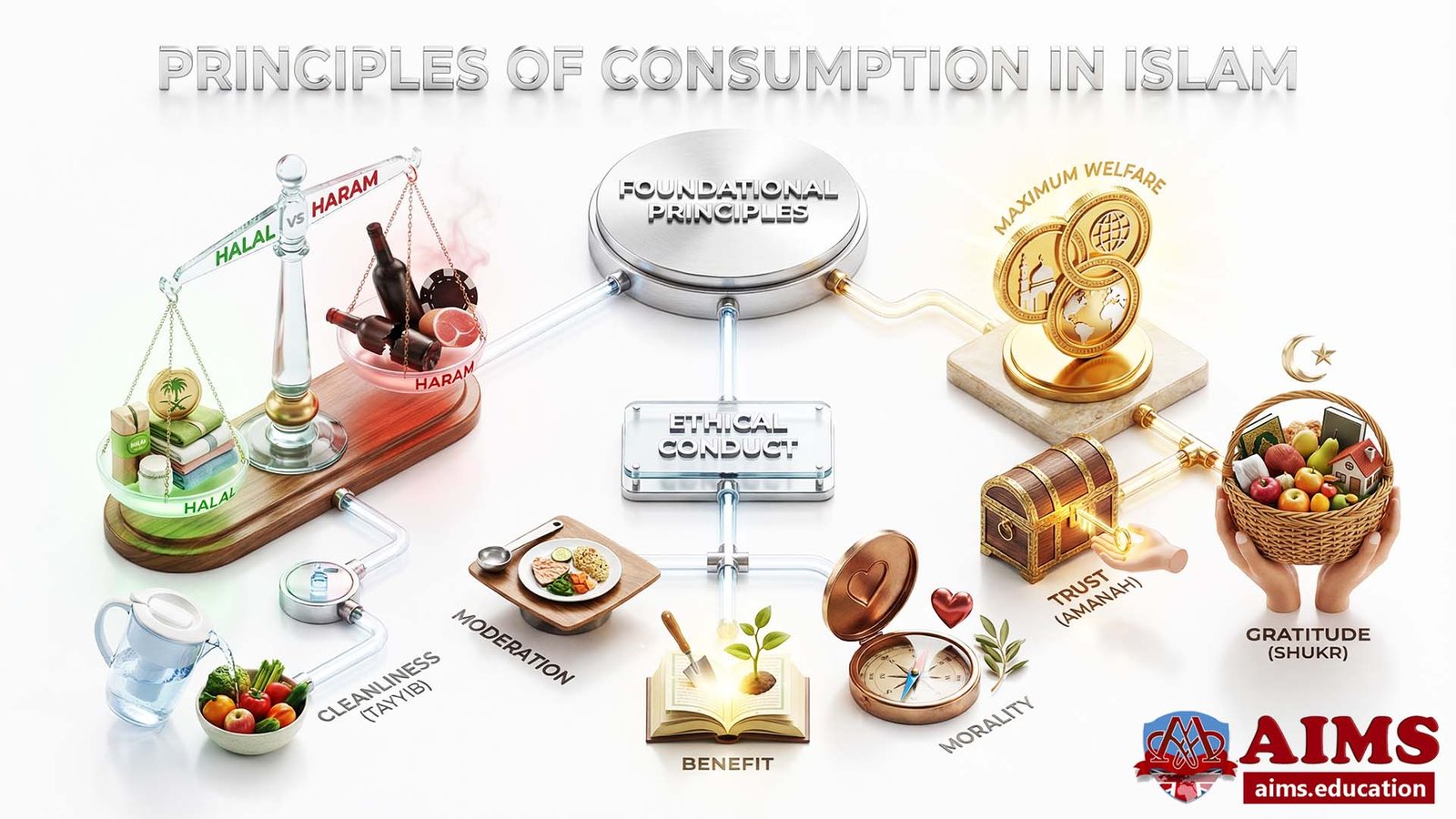
1. Principle of Lawfulness: Halal and Haram
The principle of lawfulness requires Muslims to consume only what Shariah permits. A lawful decision involves more than the physical product. The source of income, method of purchase, contractual arrangement, intended use, and business activity connected with the transaction may also require consideration.
The sources and objectives of Shariah law provide the legal and ethical foundations used to evaluate such decisions.
- A Muslim should avoid clearly prohibited products such as intoxicants, pork, gambling services, and other unlawful goods.
- The money used for consumption should come from a lawful source.
- The transaction should not involve fraud, coercion, deception, or another prohibited practice.
- A lawful product should not be purchased for an unlawful purpose.
Example of Lawful Consumer Choice
- Bilal wants to invest in a food business.
- He checks whether its products, ingredients, financing, and principal activities comply with Shariah.
- He also examines whether its advertising and sales practices are honest.
- He proceeds only after determining that both the product and business activity are permissible.
Lawfulness protects the consumer from separating a permissible product from an impermissible transaction or purpose.
2. Principle of Wholesomeness: Halal and Tayyib
Halal describes what is legally permissible, while tayyib describes what is wholesome, clean, safe, beneficial, and suitable. The concepts are closely related but not identical.
Halal and tayyib consumption requires consumers to consider quality and consequences in addition to formal permissibility. A product may contain permissible ingredients but still be unsuitable because it is contaminated, dangerously prepared, misleadingly labelled, or harmful when used irresponsibly.
- Halal asks whether the product or activity is permitted.
- Tayyib asks whether it is good, safe, wholesome, and appropriate.
- The suitability of a product may depend on the consumer’s health, circumstances, quantity, and method of use.
- A tayyib choice should not create avoidable harm for the consumer or other people.
Example of Halal and Tayyib Consumption
- Maryam finds two halal-certified food products.
- One contains excessive ingredients that conflict with her medical requirements.
- The other is safe, nutritious, and appropriate for her health.
- She chooses the second because it satisfies both permissibility and wholesomeness.
Tayyib encourages the consumer to move beyond minimum legality towards responsible and beneficial choice.
3. Principle of Moderation
Moderation means spending neither extravagantly nor miserly, but in proportion to legitimate needs, available resources, and personal responsibilities. It does not require poverty, deprivation, or rejection of lawful comfort.
Moderation in Islamic consumption is closely associated with iqtisad, meaning balanced and measured conduct. The Islamic concept of moderation in spending helps households balance present needs, future security, lawful enjoyment, and social responsibility.
- Expenditure should remain proportionate to income and financial capacity.
- Essential obligations should receive priority over status-driven purchases.
- Saving is permissible when it serves a legitimate purpose and does not become harmful hoarding.
- Generosity should not be exercised so recklessly that dependants are left without support.
Example of Moderation in Household Spending
- Omar can afford a reliable family vehicle without borrowing excessively.
- He considers a much more expensive model primarily for social status.
- He chooses the reliable vehicle and uses part of the difference for savings, education, and charity.
- He still enjoys a lawful and comfortable purchase without allowing display to control the decision.
Moderation creates financial stability without turning responsible consumption into unnecessary self-denial.
What Is the Difference Between Israf and Tabdhir?
A useful practical distinction is that israf means exceeding proper limits, while tabdhir means wasting or misdirecting resources in an unproductive or wrongful manner. The concepts overlap, but they examine different weaknesses in consumer behaviour.
- Israf and tabdhir in Islam both violate responsible use of wealth.
- Israf focuses on excess, such as buying or consuming more than is reasonably needed.
- Tabdhir focuses on waste or misallocation, such as discarding usable resources or spending on a harmful purpose.
- A purchase may involve both when an excessive quantity is obtained and much of it is later discarded.
Example of Israf and Tabdhir
- An organisation expects 100 guests at an event but orders food for 180 to create an impression of abundance.
- The excessive order represents israf because it goes beyond a reasonable requirement.
- Discarding the untouched food represents tabdhir because valuable resources are wasted.
- Better planning, realistic quantities, and safe redistribution would reduce both problems.
The distinction shows that ethical consumption concerns both how much is used and how effectively resources are allocated.
4. Principle of Benefit
The principle of benefit requires consumption to serve a lawful and meaningful purpose for the individual, family, or society. Wealth should support physical health, education, productive work, family welfare, spiritual development, and beneficial recreation.
- A purchase should provide a recognisable benefit without causing greater harm.
- Immediate pleasure should be considered alongside long-term consequences.
- Consumers should distinguish genuine usefulness from advertising-created urgency.
- Benefits to one person should not depend on injustice or serious harm to another.
Example of Purposeful Consumption
- Fatimah considers replacing a functional laptop simply because a new model has been released.
- She reviews whether the current device still meets her professional requirements.
- She delays the purchase and allocates the money to a training course that improves her skills.
- She plans to replace the laptop when a genuine functional need arises.
Purposeful consumption directs resources towards real improvement rather than temporary excitement created by novelty.
5. Principle of Morality and Social Responsibility
Consumption should reflect honesty, dignity, justice, compassion, and concern for the consequences of economic activity. A Muslim consumer considers not only personal enjoyment but also whether the purchase supports exploitation, deception, harm, or socially destructive behaviour.
Ethical spending in Islam may therefore involve examining:
- Whether advertising makes truthful and transparent claims.
- Whether workers, customers, and suppliers are treated fairly.
- Whether the product encourages addiction, indecency, violence, or harmful behaviour.
- Whether the purchase creates avoidable environmental or community damage.
- Whether a less harmful and reasonably accessible alternative is available.
Example of Ethical Product Selection
- Hassan compares two suppliers offering similar products at comparable prices.
- One supplier uses misleading marketing and has repeatedly failed to honour customer guarantees.
- The other provides transparent information and responsible after-sales service.
- Hassan selects the second supplier because ethical conduct forms part of the product’s total value.
Moral consumer choice communicates that commercial success should not depend on dishonesty, exploitation, or preventable harm.
6. Principle of Maximum Welfare
Maximum welfare in Islamic consumption means balancing material benefit, spiritual well-being, family security, and social welfare. It is not simply the greatest possible quantity of goods or the highest level of immediate personal satisfaction.
The Islamic concepts of maslahah and falah broaden the meaning of welfare:
- Maslahah concerns genuine benefit and the prevention of harm.
- Falah concerns comprehensive success and well-being in this life and the Hereafter.
- Personal consumption should not undermine family duties or community welfare.
- Spiritual accountability gives long-term moral consequences importance in present decisions.
Example of Integrated Welfare
- Ayesha receives an increase in salary.
- She improves her family’s housing and healthcare arrangements.
- She strengthens emergency savings and supports the education of a relative.
- She also increases regular charitable giving rather than directing the entire increase towards luxury consumption.
The decision improves personal welfare while extending the benefit of additional income to family and society.
7. Principle of Trust: Amanah
Amanah means that wealth, income, abilities, and material resources are trusts that must be managed responsibly. Ownership gives a person recognised rights, but it does not remove moral accountability for misuse, neglect, or harm.
Understanding Amanah as a principle of responsible stewardship helps explain why financial discipline is a religious and ethical responsibility.
- Dependants should receive proper maintenance and support.
- Assets should be protected from careless damage or unnecessary destruction.
- Debt should not be taken for consumption without considering the ability to repay.
- Natural and shared resources should not be used as though their supply and social effects are irrelevant.
Example of Amanah in Personal Finance
- Yusuf receives a yearly employment bonus.
- Before spending it, he reviews outstanding obligations, family needs, and emergency savings.
- He uses part of the bonus for a lawful family holiday and allocates the remainder responsibly.
- His approach recognises enjoyment while preserving accountability and financial resilience.
Amanah transforms financial planning from a purely personal preference into responsible stewardship of resources.
8. Principle of Gratitude: Shukr
Shukr means recognising blessings and using them in ways that are lawful, beneficial, and pleasing to Allah. Gratitude is not expressed only verbally. It becomes visible in responsible spending, contentment, generosity, and avoidance of destructive waste.
- A grateful consumer values existing possessions rather than constantly comparing lifestyles.
- Resources are maintained, shared, and used productively.
- Additional wealth creates opportunities for worship, family support, charity, and social benefit.
- Gratitude restrains arrogance and dissatisfaction without prohibiting lawful improvement.
Example of Gratitude Through Spending
- Samira’s business performs better than expected.
- She rewards employees fairly and improves her family’s financial security.
- She contributes to a clean-water project and funds educational resources for disadvantaged learners.
- Her spending demonstrates gratitude by extending the benefit of prosperity to other people.
Gratitude gives wealth a constructive purpose and reduces the pressure to prove success through wasteful display.

Needs, Wants and Maqasid al-Shariah in Consumption
Maqasid al-Shariah guides consumption by prioritising choices that protect essential human interests, remove genuine hardship, and improve life without encouraging excess. This framework helps distinguish important needs from preferences that can be delayed, reduced, or abandoned.
Needs versus wants in Islamic economics is not a rigid distinction between everything necessary and everything enjoyable. Islam recognises different levels of human need and permits comfort, beauty, and lawful pleasure. The central question is whether the choice remains lawful, proportionate, beneficial, and consistent with higher responsibilities.
Daruriyyat, Hajiyyat and Tahsiniyyat
Daruriyyat, hajiyyat and tahsiniyyat classify needs according to their importance for human welfare.
- Daruriyyat: Essential necessities required to protect religion, life, intellect, family or lineage, and wealth. Examples include basic food, safe housing, essential healthcare, education, and protection of property.
- Hajiyyat: Complementary needs that remove hardship and make life reasonably manageable. Examples may include suitable transport, work equipment, household appliances, and communication tools.
- Tahsiniyyat: Refinements, comforts, and aesthetic improvements that enhance life without being essential. Examples may include premium decoration, higher-quality furnishings, leisure travel, and luxury features.
The classification depends partly on context. A vehicle may be tahsiniyyat for someone with excellent public transport, hajiyyat for a commuter, or close to daruriyyat for a person whose health or employment requires it.
How Maqasid al-Shariah Guides Consumer Behaviour
Maqasid al-Shariah in consumption evaluates whether a choice protects human welfare or creates avoidable harm. A consumer may consider how a purchase affects:
- Religion: Does it support or obstruct religious obligations and moral conduct?
- Life: Is it safe, healthy, and protective of human well-being?
- Intellect: Does it strengthen education and sound judgement, or encourage addiction and impairment?
- Family and future generations: Does it support stable family life and responsible care?
- Wealth: Does it preserve resources, prevent exploitation, and avoid destructive financial behaviour?
Six Questions for Evaluating a Purchase
- Is it halal? Check the product, transaction, source of funds, and intended use.
- Is it tayyib? Consider safety, quality, suitability, and harmful consequences.
- Which level of need does it serve? Identify whether it is essential, complementary, or a refinement.
- Have prior obligations been fulfilled? Review family maintenance, debts, zakat, and other responsibilities.
- Is the amount proportionate? Compare the cost and quantity with income, need, and available alternatives.
- Will it create waste or harm? Consider disposal, duplication, environmental effects, and social consequences.
This framework does not automatically make every non-essential purchase wrong. It helps the consumer reach a reasoned and accountable decision.
Is Luxury Prohibited in Islam?
Islam does not prohibit lawful luxury or material enjoyment merely because it exceeds basic survival needs. A luxury purchase becomes problematic when it involves a prohibited product, neglected obligations, arrogance, serious financial irresponsibility, harmful competition, israf, or tabdhir.
A premium purchase may remain permissible when:
- The product and transaction are halal.
- The buyer can genuinely afford it without harming dependants or creditors.
- Religious and financial obligations have been fulfilled.
- The purchase provides a recognised benefit or lawful enjoyment.
- The quantity and frequency remain proportionate.
- The decision does not involve wasteful display, exploitation, or preventable harm.
Therefore, the moral status of luxury depends on affordability, intention, use, consequences, and surrounding responsibilities, not on price alone.
Islamic Versus Conventional Consumption Theory
Standard conventional consumer theory generally explains how individuals maximise utility within income and price constraints, while Islamic consumption theory adds Shariah, moral accountability, social welfare, and falah to the decision.
This comparison refers mainly to the standard neoclassical model. Conventional economics contains several schools of thought, and many modern approaches also examine ethics, sustainability, psychology, and social consequences.
Within Islamic microeconomic theory and consumer choice, preferences are recognised but do not possess unlimited moral authority. Islamic economic scholarship seeks to integrate values and concepts into economic analysis, as reflected in the Islamic Development Bank Institute’s research on the foundations of Islamic economics.
| AREA | STANDARD CONVENTIONAL MODEL | ISLAMIC CONSUMPTION THEORY |
|---|---|---|
| Primary Objective | Maximise utility or preference satisfaction within a budget. | Pursue maslahah and falah within Shariah and financial constraints. |
| Choice Boundaries | Preferences are generally accepted if purchases are legally available and affordable. | Preferences remain subject to halal, tayyib, morality, moderation, and accountability. |
| Needs and Wants | Consumer preferences determine value within the model. | Needs are prioritised through daruriyyat, hajiyyat, and tahsiniyyat. |
| Social Effects | External effects may require separate policy or welfare analysis. | Social consequences and obligations form part of the consumer’s moral decision. |
| Time Horizon | The model may compare present and future material satisfaction. | The decision includes worldly consequences and accountability in the Hereafter. |
| View of Wealth | Wealth expands purchasing power and consumption possibilities. | Wealth is both a lawful benefit and an Amanah carrying rights and responsibilities. |
Islamic versus conventional consumption theory differs most clearly in its treatment of moral limits. Islamic economics does not reject rational choice or personal satisfaction. It places them within a wider framework of responsibility, justice, and comprehensive welfare.
How Zakat and Charity Influence Consumption Behaviour
Zakat and voluntary charity influence consumption by assigning part of wealth to social obligations and encouraging circulation rather than complete concentration around personal wants.
Zakat and wealth circulation remind consumers that disposable income cannot always be treated as an entirely private resource. Eligible wealth may carry zakat obligations, while sadaqah and other forms of giving develop generosity and social concern.
The relationship between zakat, public welfare, and Islamic fiscal policy also shows how Islamic economics connects private financial conduct with broader social stability.
- Zakat reduces the tendency to hoard qualifying wealth without social contribution.
- Charity encourages households to include others within their financial planning.
- Support for relatives, neighbours, and vulnerable people strengthens social cooperation.
- Giving can restrain greed and reduce the belief that well-being depends only on personal accumulation.
- Wealth circulation can support consumption, education, health, and productive activity among people in need.
Charity does not remove the responsibility to support oneself and one’s dependants. Islamic balance requires both responsible household provision and concern for society.
Applying Islamic Consumption Principles in Modern Life
Modern application requires consumers to evaluate everyday decisions through lawfulness, wholesomeness, need, affordability, purpose, and social impact. The principles remain relevant to supermarkets, online shopping, subscriptions, household budgeting, travel, events, digital services, and environmental responsibility.
Food Purchasing and Waste
- Plan meals before shopping and review food already available at home.
- Purchase realistic quantities rather than responding automatically to promotions.
- Store food safely and use items before their expiry dates.
- Share suitable surplus food instead of allowing it to be discarded.
Household Budgeting
- Prioritise basic needs, dependants, debts, and religious obligations.
- Maintain reasonable savings for emergencies and predictable future costs.
- Set a proportionate allowance for lawful comforts and recreation.
- Review recurring subscriptions and purchases that no longer provide a benefit.
Online Shopping and Digital Marketing
- Delay non-essential purchases to reduce impulsive decisions.
- Compare actual need and product quality rather than relying on urgency messages.
- Examine instalment arrangements, fees, and contractual terms before purchasing.
- Avoid shopping primarily to imitate influencers or display social status.
Environmentally Responsible Consumption
- Maintain and repair usable goods where reasonably practical.
- Reduce unnecessary packaging and single-use products.
- Choose durable products when their additional cost is justified by longer use.
- Dispose of electronic, chemical, and hazardous waste responsibly.
Practical Household Example
A household with a monthly income of £3,000 might apply Islamic consumption principles through the following illustrative process:
- It allocates £1,700 for housing, food, utilities, transport, and other essential needs.
- It sets aside £350 for debts and existing financial obligations.
- It saves £300 for emergencies and future family requirements.
- It allocates £350 for permissible comforts, recreation, and flexible household spending.
- It assigns £200 to zakat where applicable, voluntary charity, and support for relatives.
- It retains £100 as a buffer rather than automatically spending the full income.
The figures are illustrative rather than a fixed Islamic formula. Actual allocation depends on income, family size, location, debts, and personal obligations.
The result is disciplined spending that serves the household without neglecting resilience, lawful enjoyment, or social responsibility.
Common Misunderstandings About Islamic Consumption
Islamic consumption is neither unrestricted consumerism nor compulsory asceticism. It permits lawful enjoyment while requiring consumers to remain within ethical, financial, and social boundaries.
Islam Requires Muslims to Avoid Material Enjoyment
This is incorrect. Islam permits good food, suitable clothing, comfortable housing, recreation, and other lawful benefits. The restrictions concern prohibited products, harmful conduct, excess, waste, arrogance, and neglect of obligations.
Every Expensive Purchase Is Israf
Price alone does not determine israf. Affordability, quantity, purpose, local circumstances, consequences, and existing responsibilities must also be considered. An expensive professional tool may provide greater benefit than several cheaper but unreliable alternatives.
Anything Halal Is Automatically a Good Choice
Formal permissibility is essential, but the consumer should also consider tayyib, health, safety, purpose, quantity, and consequences. A permissible product can still be consumed irresponsibly.
Moderation Requires Everyone to Spend the Same Amount
Moderation is contextual rather than a universal monetary limit. An amount that is proportionate for one household may be irresponsible for another because incomes, obligations, needs, and social circumstances differ.
Charity Should Replace Personal and Family Needs
Charity is important, but a person must also fulfil legitimate responsibilities towards dependants, creditors, health, and basic security. Responsible generosity avoids both selfishness and reckless giving.
Professional Relevance for Islamic Economics and Finance
Islamic consumption principles help professionals understand how Shariah values influence households, markets, product design, marketing, public policy, and the halal economy.
The framework is relevant to:
- Islamic economists analysing consumer choice and welfare.
- Islamic financial institutions designing responsible products.
- Halal-industry professionals evaluating quality, safety, and consumer expectations.
- Marketing professionals developing ethical and transparent campaigns.
- Policymakers addressing food waste, household debt, poverty, and sustainability.
- Researchers studying Muslim consumer behaviour and value-based decision-making.
Learners can develop these foundations through a job-oriented and recognized Islamic finance course or pursue broader strategic expertise through an MBA in Islamic banking and finance. Professionals seeking top-tier postions in Islamic finance industry, must consider a research based flexible PhD in Islamic finance.
Final Words
Islamic principles of consumption provide a balanced framework for using wealth without rejecting lawful enjoyment. They require consumers to distinguish halal from haram, combine permissibility with tayyib quality, avoid israf and tabdhir, prioritise legitimate needs, and consider the effects of spending on family and society.
Consumption becomes more than the pursuit of personal satisfaction. It becomes an accountable process directed towards maslahah, falah, gratitude, responsible stewardship, and social welfare. In modern life, these principles can guide household budgets, food purchasing, online shopping, luxury decisions, charitable allocation, and environmentally responsible use of resources.
Frequently Asked Questions
What are the basic principles of consumption in Islam?
The basic principles are lawfulness, wholesomeness, moderation, benefit, morality, integrated welfare, Amanah, and gratitude. Together, they require consumers to choose halal and tayyib products, avoid waste and excess, fulfil legitimate needs, support dependants, and consider the social consequences of spending.
How does Islamic economics define consumption?
Islamic economics defines consumption as the use of goods and services to satisfy legitimate needs within Shariah boundaries. The consumer seeks benefit and lawful satisfaction while considering morality, affordability, health, family duties, social welfare, and accountability before Allah.
What is the difference between halal and tayyib consumption?
Halal refers to what Islamic law permits. Tayyib refers to what is wholesome, clean, safe, beneficial, and suitable. A product may be halal in its ingredients but unsuitable for a particular consumer because of contamination, harmful use, poor quality, or health considerations.
What is the difference between israf and tabdhir?
Israf generally means exceeding reasonable limits through excessive consumption. Tabdhir generally means wasting or misdirecting resources in an unproductive or wrongful way. Ordering far more food than needed is israf, while discarding the untouched surplus may also constitute tabdhir.
Why is moderation important in Islamic consumption?
Moderation protects consumers from extravagance, waste, uncontrolled debt, and harmful miserliness. It helps households balance essential needs, lawful comforts, savings, family responsibilities, and charity according to their actual income and circumstances.
How does Islam distinguish between needs and wants?
Islam evaluates needs and wants according to their importance, benefit, context, and consequences. Essential needs receive priority, while comforts and refinements remain permissible when they are affordable, lawful, proportionate, and do not cause neglected obligations, waste, or harm.
What are daruriyyat, hajiyyat and tahsiniyyat?
Daruriyyat are essential necessities required to protect fundamental human interests. Hajiyyat are complementary needs that remove hardship and make life manageable. Tahsiniyyat are refinements and comforts that improve life but are not essential. Their application may change according to personal circumstances.
How does Islamic consumption differ from conventional consumption theory?
Standard conventional theory generally focuses on maximising utility within income and price constraints. Islamic theory recognises personal satisfaction but subjects consumer preferences to Shariah, moral accountability, social welfare, moderation, and the wider objective of falah.
How does Maqasid al-Shariah guide consumer behaviour?
Maqasid al-Shariah guides consumers towards choices that protect religion, life, intellect, family, and wealth. It helps determine whether a purchase satisfies an essential need, removes genuine hardship, improves life responsibly, or creates avoidable harm and waste.
What is the Islamic perspective on luxury and material enjoyment?
Islam permits lawful comfort, beauty, recreation, and luxury. A luxury becomes problematic when it is unaffordable, prohibited, wasteful, arrogant, harmful, or purchased while debts, dependants, zakat, and other obligations remain neglected. Price alone does not determine whether a purchase is excessive.
How do zakat and charity influence consumption behaviour?
Zakat and charity encourage consumers to recognise social claims on wealth. They restrain excessive concentration around personal wants, promote generosity, support vulnerable people, and encourage wealth circulation. These obligations should be balanced with responsible provision for oneself and one’s dependants.
How can Islamic consumption principles be applied in modern life?
They can be applied through household budgeting, halal and quality checks, realistic food purchasing, responsible use of instalments, reduced impulse shopping, maintenance of usable goods, charitable allocation, and evaluation of a product’s health, social, financial, and environmental consequences.
Study Islamic Economics and Finance with AIMS
Since 2005, AIMS’ Institute of Islamic Banking and Finance has delivered internationally accredited, career-focused education to learners worldwide. Its internationally standardised curriculum is taught by qualified faculty through industry-oriented instruction, practical skill development, 3D interactive learning content, and real-world case studies. AIMS’ educational content, study materials, and curriculum are collaboratively developed and rigorously peer-reviewed by an academic board of qualified industry practitioners. Understanding ethical consumption strengthens professional judgement in Islamic economics and finance. Explore AIMS’ accredited institute for practical Islamic finance learning.