
What Are Project Management Methodologies?
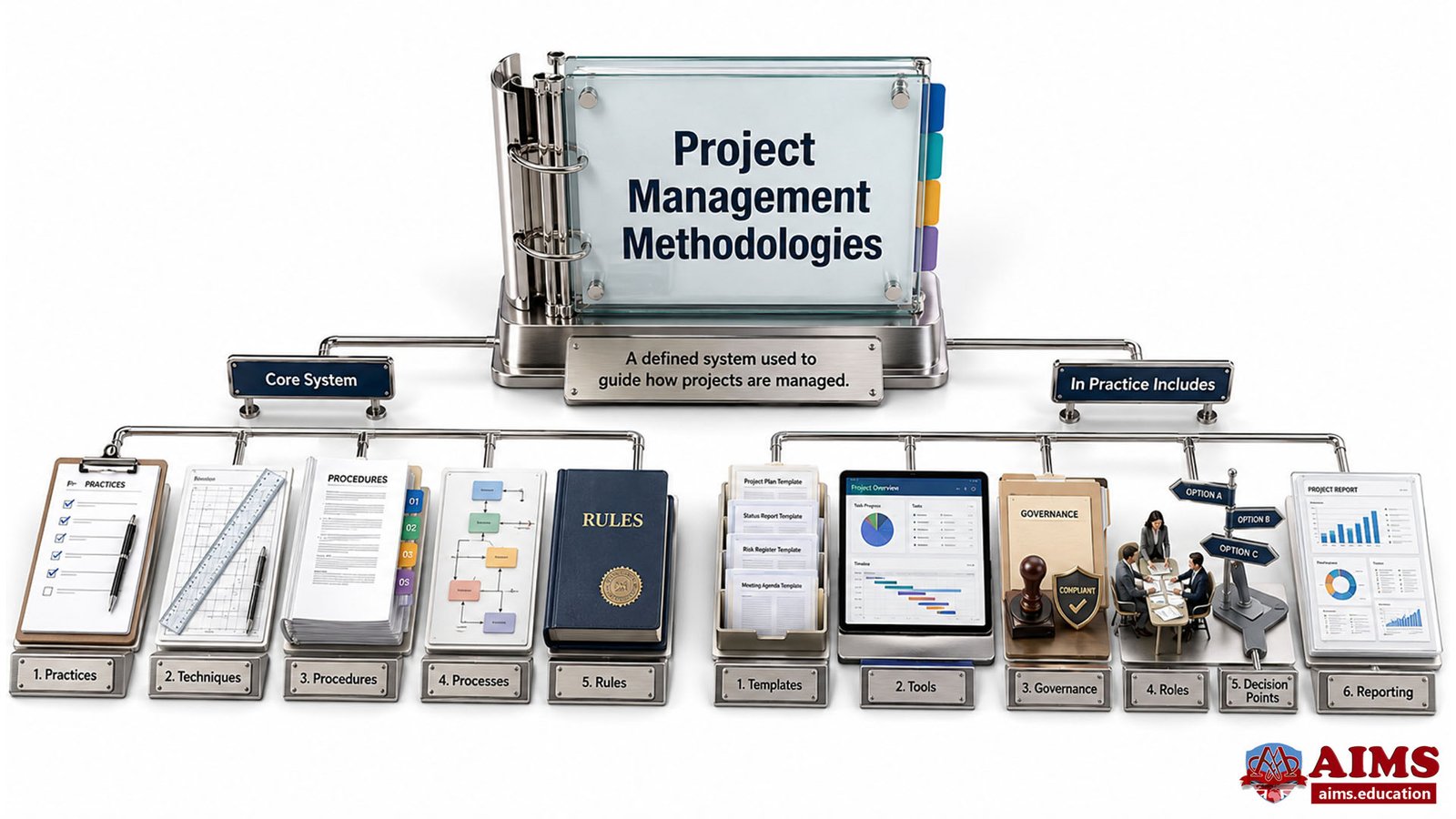
A project management methodology is a defined system of practices, techniques, procedures, processes, and rules used to guide how projects are managed. In practice, it may also include templates, tools, governance requirements, roles, decision points, and reporting expectations.
- A good methodology gives the team a repeatable way to manage work without assuming that every project should be handled identically.
PMI’s
guidance on tailoring a project management methodology emphasizes adapting methods to project size, complexity, organizational context, and industry. - Terms such as project management methods, project management frameworks, and
project management models are often used interchangeably, but they are not always technically identical. Agile, Waterfall, PRINCE2, Scrum, Kanban, Lean, and hybrid approaches organize project work differently, so the best choice should fit the project rather than follow a trend.
Methodology vs Framework vs Approach
A methodology usually provides a more defined system for managing work, while a framework provides an adaptable structure, and an approach describes the broader delivery orientation. The terms overlap in common usage, but distinguishing them improves professional accuracy.
- Methodology: A documented system of processes, practices, techniques, tools, and rules.
- Framework: A structured set of concepts, roles, practices, or components that teams can adapt.
- Approach: A broader delivery orientation, such as predictive, adaptive, or hybrid.
- Method: A defined way of performing project work, which may sit within a broader methodology.
For this reason, not every popular project management term is technically a methodology. Agile is better understood as an adaptive approach grounded in values and principles. Scrum is a lightweight framework. PRINCE2 is a structured project management method. Waterfall is commonly described as a predictive or linear lifecycle approach.
Is the PMBOK Guide a Project Management Methodology?
No. The PMBOK Guide is not itself a prescriptive project management methodology. It provides professional guidance and a body of knowledge that organizations and practitioners can use when developing or tailoring their own methods. Treating PMBOK guidance as a rigid one-size-fits-all methodology misunderstands the purpose of tailoring.
Main Types of Project Management Methodologies and Approaches
The main types can be grouped into predictive, adaptive, governance-oriented, flow-based, Lean, and hybrid approaches. These categories help explain the types of project management methodologies readers encounter in practice, although organizations often combine elements from more than one group.
- Predictive or linear: Work is planned substantially in advance and progresses through defined phases, as in Waterfall.
- Adaptive or Agile: Work is delivered iteratively or incrementally and adjusted through feedback.
- Governance-oriented: Business justification, roles, control, and staged decisions are central, as in PRINCE2.
- Flow-based: Work is visualized and managed continuously, with attention to work in progress, as in Kanban.
- Lean: The focus is customer value, waste reduction, smoother flow, and continuous improvement.
- Hybrid: Predictive and adaptive practices are deliberately combined within the same project.
Project Management Methodologies Comparison
A useful project management methodologies comparison asks how each choice handles uncertainty, change, governance, workflow, and delivery. The following table compares the most common project management methodologies and related approaches.
| METHOD / APPROACH | HOW IT WORKS | BEST FOR | ADVANTAGES | LIMITATIONS |
|---|---|---|---|---|
| Waterfall | Work moves through planned, largely sequential phases. | Stable requirements, physical delivery, approval-heavy work. | Clear sequencing, documentation, milestones, and accountability. | Late changes can be costly and feedback may arrive late. |
| Agile | Planning and delivery adapt through short feedback cycles. | Evolving requirements, digital products, uncertain solution paths. | Adaptability, early feedback, learning, and customer focus. | Needs active collaboration and disciplined prioritization. |
| PRINCE2 | Uses principles, practices, processes, roles, and stage-based control. | Projects needing clear governance and accountability. | Strong governance, defined roles, business justification, and tailoring. | Can create overhead if applied mechanically. |
| Scrum | A Scrum Team works in fixed-length Sprints using defined accountabilities, events, and artifacts. | Complex product work requiring frequent inspection and adaptation. | Fast feedback, transparency, focus, and regular increments. | Needs disciplined product ownership and coordination at scale. |
| Kanban | Visualizes workflow, limits work in progress, and manages flow continuously. | Service work, support, maintenance, and continuous delivery. | Visibility, smoother flow, flexible prioritization, bottleneck detection. | Weak flow policies can reduce its effectiveness. |
| Lean | Improves value by reducing waste, unevenness, delays, and unnecessary activity. | Process improvement and operational efficiency. | Efficiency, continuous improvement, and quality focus. | Requires sustained cultural discipline. |
| Hybrid | Combines predictive control with adaptive delivery where each fits best. | Projects needing both governance and flexibility. | Balances control, compliance, adaptability, and learning. | Can become confusing without clear boundaries and roles. |
Predictive vs Adaptive vs Hybrid Project Management
Predictive approaches emphasize upfront planning, adaptive approaches emphasize learning and adjustment, and hybrid project management combines both. This distinction is often more useful than debating labels because it focuses on how the project responds to uncertainty and change.
| FACTOR | PREDICTIVE | ADAPTIVE / AGILE | HYBRID |
|---|---|---|---|
| Planning | Detailed planning occurs early. | Planning is progressive and repeated. | High-level planning is combined with iterative detail. |
| Requirements | Best when requirements are relatively stable. | Best when requirements are expected to evolve. | Useful when some requirements are fixed and others uncertain. |
| Delivery | Major outputs may arrive later in the lifecycle. | Value is delivered incrementally and reviewed frequently. | Different deliverables may use different delivery cadences. |
| Change | Change is controlled against an established baseline. | Change is expected and incorporated through prioritization. | Change is flexible within defined governance boundaries. |
Top Common Project Management Frameworks
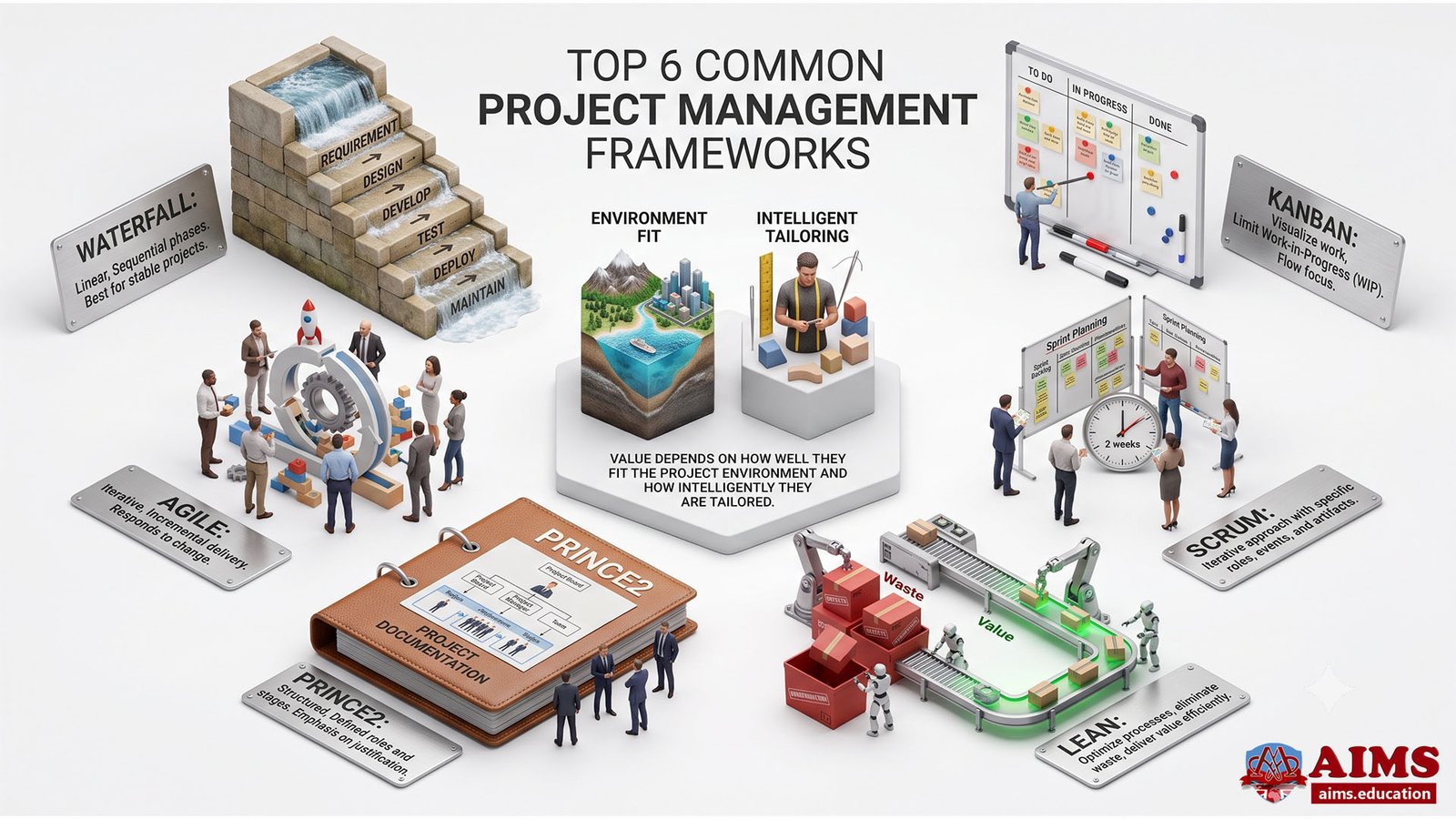
The most commonly discussed project management frameworks and methodologies are Waterfall, Agile, PRINCE2, Kanban, Scrum, and Lean. Their value depends on how well they fit the project environment and how intelligently they are tailored.
1. Waterfall Project Management
Waterfall project management is a predictive, linear approach in which major phases are planned in sequence and later work depends heavily on earlier work being completed and approved. It suits projects where requirements can be defined with reasonable confidence and late changes are expensive.
There is no single universal list of Waterfall phase names. A typical sequence may include requirements, design, implementation, testing, deployment, and maintenance. The defining feature is planned progression from one major phase to the next. For more detail, you can see this guide to linear project management and its practical tools.
Advantages of Waterfall Project Management
- Clear structure: Defined phases, milestones, approvals, and responsibilities make progress easier to control.
- Strong documentation: Requirements, designs, plans, and approvals can be documented before later work begins.
Limitations of Waterfall Project Management
- Lower responsiveness to late change: New requirements can cause expensive rework after design or implementation.
- Delayed validation: Users may not see a complete solution until substantial work has already been performed.
Waterfall Project Management Methodology Example
Northgate Developments is building a warehouse using approved architectural and engineering requirements.
- The team confirms requirements, permits, budget, and technical specifications before construction.
- Design is approved, then construction proceeds according to the planned sequence.
- Inspection and testing verify the completed facility before handover.
The sequential structure reduces ambiguity when major design changes would be expensive after construction has started.
2. Agile Project Management
Agile project management is an adaptive approach that delivers value in small increments, gathers frequent feedback, and adjusts plans as learning occurs. It is useful when requirements are uncertain, customer needs may change, or the solution must evolve through experimentation.
Agile is not one fixed methodology. It is a broader way of working that can be supported through frameworks and practices such as Scrum, Kanban, iterative planning, and incremental delivery. Readers can explore how Agile project management works in practice.
Advantages of Agile Project Management
- Adaptability: Teams can revise priorities as requirements, risks, and customer needs change.
- Frequent feedback: Stakeholders can review useful increments before final delivery.
Limitations of Agile Project Management
- Lower long-range predictability: Detailed scope, cost, and schedule forecasts may change as learning occurs.
- High collaboration needs: Agile works best when stakeholders provide timely feedback and decisions.
Agile Project Management Example
BrightPath Systems is developing a student-support application whose requirements are still evolving.
- The team prioritizes a small set of high-value features and develops an increment.
- Students and staff review the working features and provide feedback.
- The team updates priorities and repeats the cycle based on evidence and user needs.
Agile reduces the risk of building the wrong solution by using frequent delivery and feedback to guide development.
3. PRINCE2 Project Management Method
PRINCE2 is a structured project management method built around continued business justification, defined roles, management by stages, controlled decision-making, and tailoring. The PRINCE2 methodology is particularly useful where governance, accountability, and clear management control are important.
A key strength of PRINCE2 is that it separates project direction, management, and delivery responsibilities while requiring the business case to remain justified. It should be tailored so that documentation and control reflect project size, complexity, risk, and organizational needs.
Advantages of PRINCE2
- Clear governance: Roles, responsibilities, decision authority, and escalation routes are defined.
- Stage-based control: Management can review progress and authorize continued work at meaningful points.
Limitations of PRINCE2
- Potential overhead: Teams can create unnecessary administration if they fail to tailor the method.
- Requires role discipline: Benefits decline when governance responsibilities and decision rights remain unclear.
PRINCE2 Project Management Example
MetroServe is implementing a citizen-service platform with formal governance and funding controls.
- The project begins with a justified business case and defined responsibilities.
- Work is divided into controlled stages with agreed tolerances.
- Decision-makers review progress and business justification before authorizing the next stage.
PRINCE2 supports accountability by connecting delivery progress with governance decisions and continued business justification.
4. Kanban Project Management
Kanban project management is a flow-based method for visualizing work, limiting work in progress, and improving how tasks move through a process. Unlike Scrum, Kanban does not require fixed Sprints and commonly supports continuous flow.
A Kanban board uses columns to represent workflow stages and cards to represent work items. Visualization alone is not enough. Teams also manage work-in-progress limits so unfinished tasks do not accumulate faster than the system can complete them.
Advantages of Kanban
- Improved visibility: Teams can see work status, queues, blockers, and bottlenecks.
- Flow control: Work-in-progress limits encourage finishing work before starting too much new work.
Limitations of Kanban
- Requires disciplined policies: A board without clear flow rules may become only a task list.
- Less time-boxing: Teams needing fixed planning and review cycles may require additional practices.
Kanban Project Management Example
Vertex Services manages a continuous queue of IT support requests.
- Requests enter a visible backlog and are prioritized according to service rules.
- The team limits how many items can be in progress and pulls new work only when capacity is available.
- Blocked items and cycle times are reviewed to identify bottlenecks.
Kanban improves service flow by making workload visible and preventing excessive unfinished work from accumulating.
5. Scrum Project Management Framework
Scrum project management is commonly searched as a methodology, but Scrum is more accurately a lightweight Agile framework built around fixed-length Sprints, defined accountabilities, events, and artifacts. Sprints are one month or less and provide a regular cycle for creating value, inspection, and adaptation.
Scrum includes the Product Owner, Scrum Master, and Developers, together with events such as Sprint Planning, the Daily Scrum, Sprint Review, and Sprint Retrospective. A fuller explanation is available in this guide to Scrum and Sprint-based project management.
Advantages of Scrum
- Frequent inspection and adaptation: Teams review progress and stakeholder feedback regularly.
- Focused increments: Each Sprint gives the team a short-term goal and a regular opportunity to deliver value.
Limitations of Scrum
- Requires disciplined product ownership: Weak prioritization can create confusion even when Scrum events occur.
- Scaling requires coordination: Large initiatives need additional mechanisms for dependencies, governance, and integration.
Scrum Project Management Example
NovaReach is building a campaign analytics dashboard.
- The Product Owner orders the Product Backlog and the team selects work for a two-week Sprint.
- The Scrum Team develops and tests the selected features during the Sprint.
- Stakeholders review the Increment, and feedback informs the next cycle.
Scrum creates a regular rhythm for delivering increments, learning from stakeholders, and improving team performance.
6. Lean Project Management
Lean project management applies Lean thinking to maximize customer value while reducing waste, unevenness, delays, and unnecessary burden. It is useful when a project or process contains avoidable waiting, defects, rework, handoffs, or activities that consume resources without creating value.
Traditional Lean terminology highlights three related concerns:
- Muda: Waste or activity that does not add necessary value.
- Mura: Unevenness or variation that disrupts smooth flow.
- Muri: Overburden placed on people, equipment, or processes.
Advantages of Lean Project Management
- Efficiency: Teams focus effort on work that contributes to customer value.
- Continuous improvement: Processes are repeatedly examined for delays, defects, bottlenecks, and waste.
Limitations of Lean Project Management
- Requires cultural commitment: Sustainable improvement depends on leadership and employee involvement.
- Can be misapplied: Treating Lean only as cost reduction can damage quality and long-term value.
Lean Project Management Example
Oakline Logistics wants to shorten its order-fulfilment process.
- The team maps the process from order receipt to dispatch and identifies delays and rework.
- Low-value steps are removed and the workflow is redesigned.
- Performance is measured and the process is refined continuously.
Lean improves performance when waste reduction is tied to customer value rather than simple cost cutting.
What Is Hybrid Project Management?
Hybrid project management deliberately combines predictive and adaptive practices so different parts of a project can be managed according to their uncertainty, constraints, and governance needs. It should define where predictive control applies and where iterative learning is permitted.
For example, a bank may manage regulatory approvals, budget authorization, procurement, and major milestones predictively while developing customer-facing software iteratively. See this explanation of an Agile and Waterfall hybrid project approach for a closer look at combining the two.
Hybrid Project Management Example
Finora Bank is replacing its online account-opening platform under a fixed compliance deadline.
- Management defines regulatory milestones, budget controls, and approval gates.
- The software team develops customer features through short Agile iterations.
- Compliance specialists verify releases while overall cost, risk, and deadline performance remain under predictive governance.
The hybrid approach protects mandatory controls while allowing uncertain digital features to improve through iterative learning.
How to Choose a Project Management Methodology
The right methodology is the one that fits the project’s uncertainty, requirements, risk, governance, delivery environment, organizational culture, and team capability. If you are deciding how to choose a project management methodology, compare different project management methodologies against project characteristics rather than personal preference.
Important project management methodology selection factors include:
- Requirement stability: Stable requirements support predictive planning, while evolving requirements favor adaptive practices.
- Technical uncertainty: When the best solution is unclear, short experiments and iterative learning become more valuable.
- Risk and compliance: Regulated work may require formal approvals, documentation, traceability, and governance.
- Stakeholder availability: Agile and iterative approaches depend on timely feedback and decisions.
- Cost of change: Physical or hardware changes may become expensive later, making early definition more important.
- Team and organizational capability: A methodology only works when roles, practices, culture, and decision rules support it.
Selection should also reflect the project management principles that guide professional decisions. A method is useful only when it helps the team make better decisions and deliver outcomes rather than creating process for its own sake.
Project Management Methods – Selection Guide
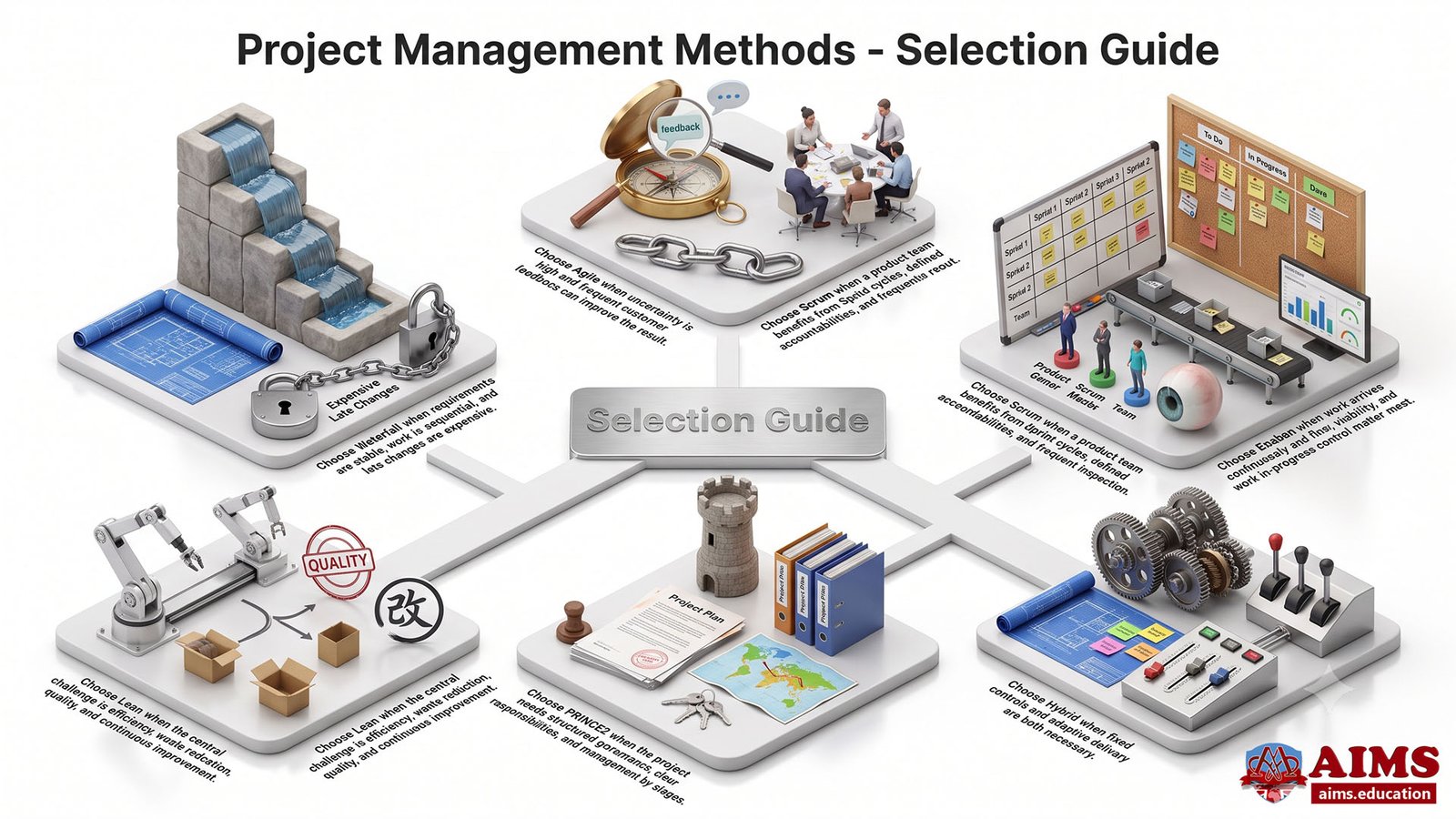
- Choose Waterfall when requirements are stable, work is sequential, and late changes are expensive.
- Choose Agile when uncertainty is high and frequent customer feedback can improve the result.
- Choose Scrum when a product team benefits from Sprint cycles, defined accountabilities, and frequent inspection.
- Choose Kanban when work arrives continuously and flow, visibility, and work-in-progress control matter most.
- Choose Lean when the central challenge is efficiency, waste reduction, quality, and continuous improvement.
- Choose PRINCE2 when the project needs structured governance, clear responsibilities, and management by stages.
- Choose Hybrid when fixed controls and adaptive delivery are both necessary.
Agile vs Waterfall: What Is the Main Difference?
Agile vs Waterfall is primarily a difference in how planning, delivery, and change are handled: Waterfall plans major phases predictively, while Agile adapts through frequent feedback and incremental delivery. Neither is universally superior.
Waterfall works well when the team can define what must be delivered and when changes are costly. Agile works better when uncertainty is high and teams can learn from users as work progresses. Hybrid delivery can combine both where governance must remain predictable but parts of the solution are still evolving.
Common Mistakes When Applying Project Management Methodologies
The most common mistake is treating a methodology as a rigid recipe instead of a system that must fit the project. Other problems arise when teams copy fashionable practices without understanding their purpose or add process that does not improve decisions.
- Choosing by popularity: A method should solve the project’s management problem, not simply follow a trend.
- Using one method for every project: Size, uncertainty, risk, and delivery context vary too much for one universal setup.
- Confusing Agile with no planning: Agile changes how planning occurs; it does not remove disciplined planning or accountability.
- Failing to tailor: Even a strong method can become bureaucratic or ineffective when applied mechanically.
- Mixing methods without rules: Hybrid delivery needs explicit boundaries, roles, decision rights, and interfaces.
Project Management Methodology Examples at a Glance
Project management methodology examples are easiest to understand when each approach is matched to a realistic project condition.
- Waterfall: Warehouse construction with approved drawings, permits, and a fixed physical sequence.
- Agile: A digital application refined through repeated user feedback.
- PRINCE2: A public or enterprise initiative requiring formal roles, stage decisions, and business justification.
- Kanban: An IT service team managing a continuous flow of support requests.
- Scrum: A product team delivering tested dashboard features in short Sprints.
- Lean: An operations project removing waiting, defects, and unnecessary steps from order fulfilment.
- Hybrid: A regulated technology project combining fixed compliance gates with iterative software delivery.
Expand Your Expertise in Multiple Project Management Methodologies
Understanding terminology is only the first step. Project managers also need to know how to select, tailor, and apply methods under real constraints. Professionals who want structured development can explore career-focused online project management certification course or a accredite online MBA in project management program covering broader planning, control, leadership, and delivery capability.
The goal is not to memorize labels. It is to understand why a practice exists, what problem it solves, and when a different approach would produce a better result.
Final Words
There is no single best project management methodology for every project. Waterfall provides predictability, Agile supports adaptation, Scrum structures iterative product work, Kanban manages flow, Lean improves value and efficiency, PRINCE2 strengthens governance, and hybrid delivery combines control with flexibility.
Effective project managers select and tailor methods according to the work in front of them. That ability supports an approach to successful project management, because project discipline comes from fit-for-purpose decisions rather than rigid adherence to labels.
Frequently Asked Questions
What is a project management methodology?
A project management methodology is a defined system of practices, processes, techniques, tools, and rules that guides how projects are planned, executed, monitored, controlled, and delivered.
What are the main types of project management methodologies?
Common categories include predictive, adaptive or Agile, governance-oriented, flow-based, Lean, and hybrid approaches.
What are the most commonly used project management methodologies?
Frequently discussed choices include Waterfall, Agile, PRINCE2, Scrum, Kanban, and Lean. Hybrid project management is also important where teams need both predictive control and adaptive delivery.
How do you choose the right project management methodology?
Choose according to requirement stability, uncertainty, complexity, cost of change, governance needs, risk, stakeholder availability, organizational culture, and team capability.
What is the difference between a project management methodology and framework?
A methodology generally provides a more defined system of processes and practices, while a framework provides a structure that can be adapted. In everyday use, the terms often overlap.
What is the difference between Agile and Waterfall project management?
Waterfall is predictive and plans major phases in sequence, while Agile is adaptive and uses frequent feedback and incremental delivery. Waterfall fits stable requirements; Agile fits greater uncertainty and change.
What is hybrid project management methodology?
Hybrid project management deliberately combines predictive and adaptive practices. For example, a project may use fixed governance gates while an Agile team develops uncertain product features iteratively.
Is Scrum a project management methodology or framework?
Scrum is more accurately described as a lightweight framework. It defines accountabilities, events, artifacts, and rules that help teams inspect and adapt while addressing complex work.
Is the PMBOK Guide a project management methodology?
No. The PMBOK Guide is a professional body-of-knowledge guide rather than a prescriptive end-to-end methodology. Organizations can use its guidance when developing and tailoring their own methods.
Can different project management methodologies be combined?
Yes. Hybrid delivery can combine predictive governance with Agile, Scrum, Kanban, or other adaptive practices when responsibilities, decision rules, and interfaces are clearly defined.
Which project management methodology is best for different types of projects?
Waterfall suits stable sequential work; Agile and Scrum suit evolving product development; Kanban suits continuous workflow; Lean suits efficiency improvement; PRINCE2 suits governance-heavy environments; and hybrid suits projects needing both control and adaptability.
What are the advantages and disadvantages of different project management methodologies?
Methodologies can improve consistency, governance, clarity, and decision-making, but an unsuitable or poorly tailored method can create rigidity, overhead, weak collaboration, or unnecessary process.
Project Management Education at AIMS
Since 2005, AIMS’ Project Management Academy has supported a global learner community through internationally accredited, career-focused project management education. Its internationally standardized curriculum combines qualified faculty, industry-oriented teaching, practical skill development, 3D interactive learning content, and real-world case studies. AIMS study content and curriculum are collaboratively developed and rigorously peer-reviewed by an academic board of qualified industry practitioners. Understanding methodology selection strengthens professional judgment across planning, governance, delivery, and change. Explore career-focused project management qualifications at AIMS.