
Program Manager vs Project Manager
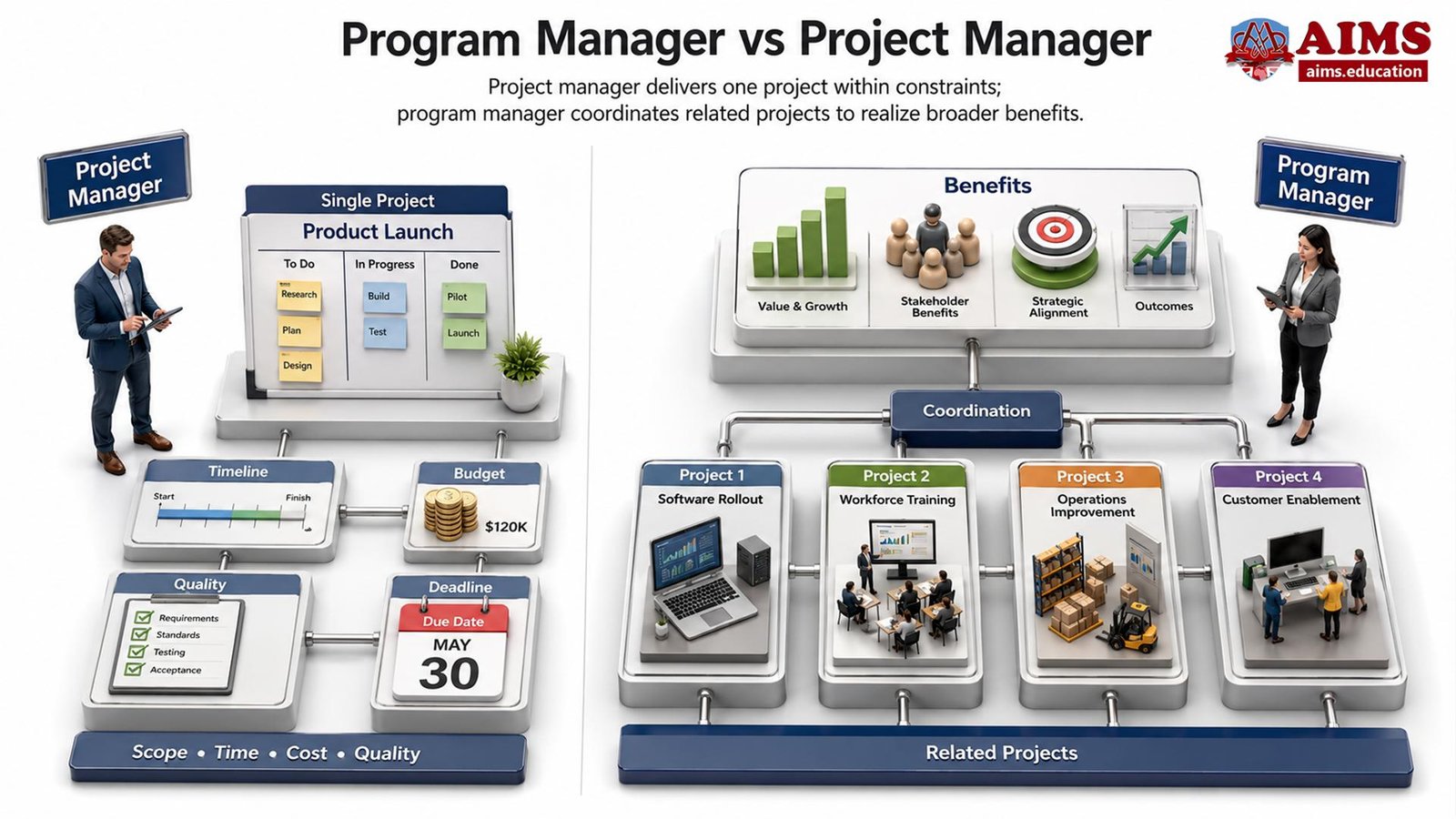
A project manager delivers a defined project, while a program manager coordinates related projects and activities to achieve broader strategic benefits. This is the simplest way to understand Project Management vs Program Management, but the practical distinction becomes clearer when we compare deliverables, outcomes, timelines, budgets, risks, stakeholders, and decision authority.
The Difference Between Project Manager and Program Manager is not only about job seniority. It is mainly about scope, value, governance, benefits, and how work is coordinated across an organization.
This Difference Between Project Manager and Program Manager also affects daily work:
- The project manager asks, “Are we delivering the agreed scope on time, within budget, and at the required quality?”
- The program manager asks, “Are all related initiatives still aligned with the strategy, and are they producing the intended benefits?”
In simple words:
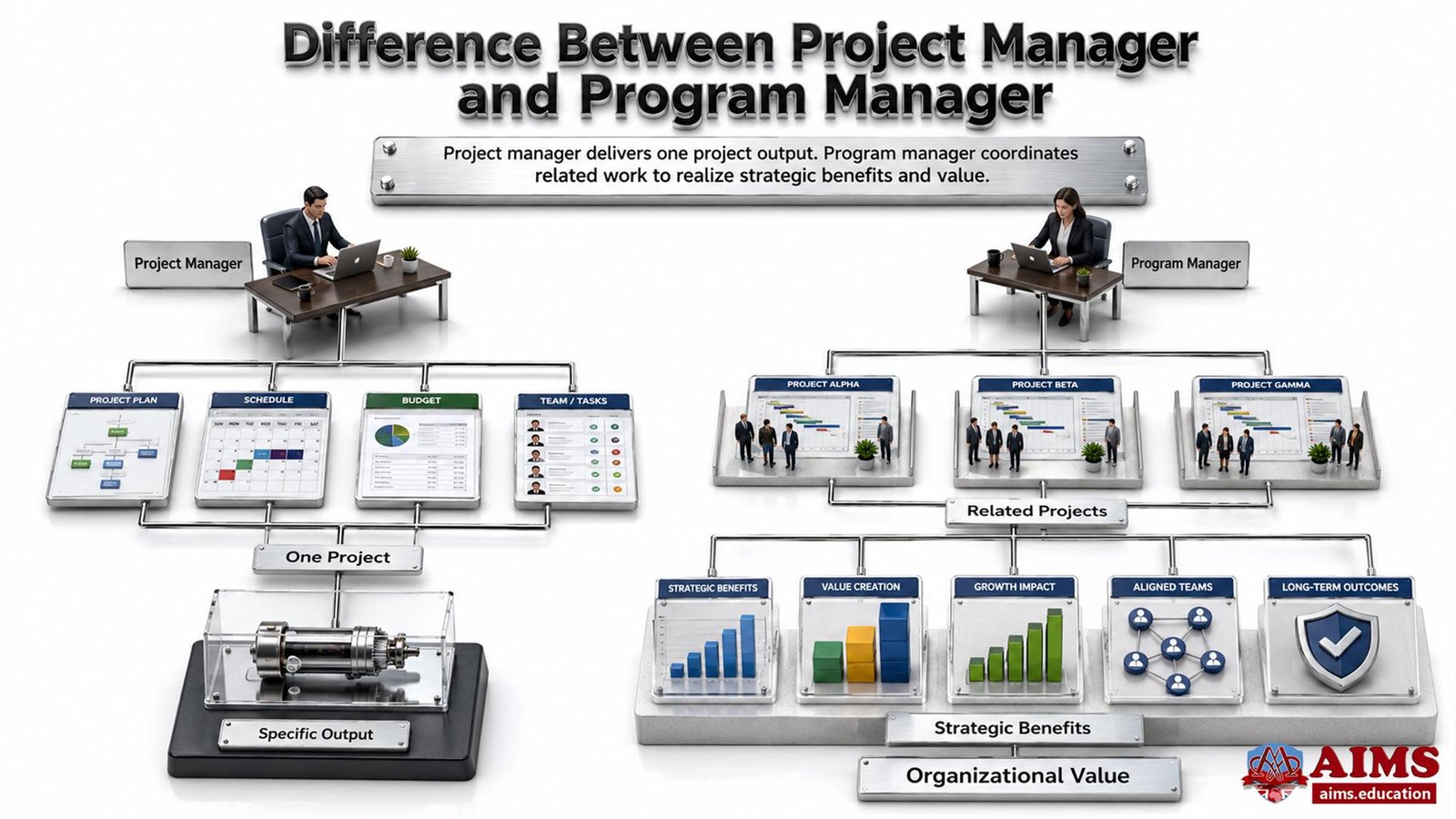
- Project manager is accountable for delivering a specific project output, while,
- Program manager is accountable for coordinating related work so that strategic benefits, organizational value, and sustained outcomes are realized.
Understanding Program Manager vs Project Manager is essential for anyone studying modern project leadership, organizational strategy, or professional delivery roles.
Key Differences Between Project Manager and Program Manager
| COMPARISON AREA | PROJECT MANAGER | PROGRAM MANAGER |
|---|---|---|
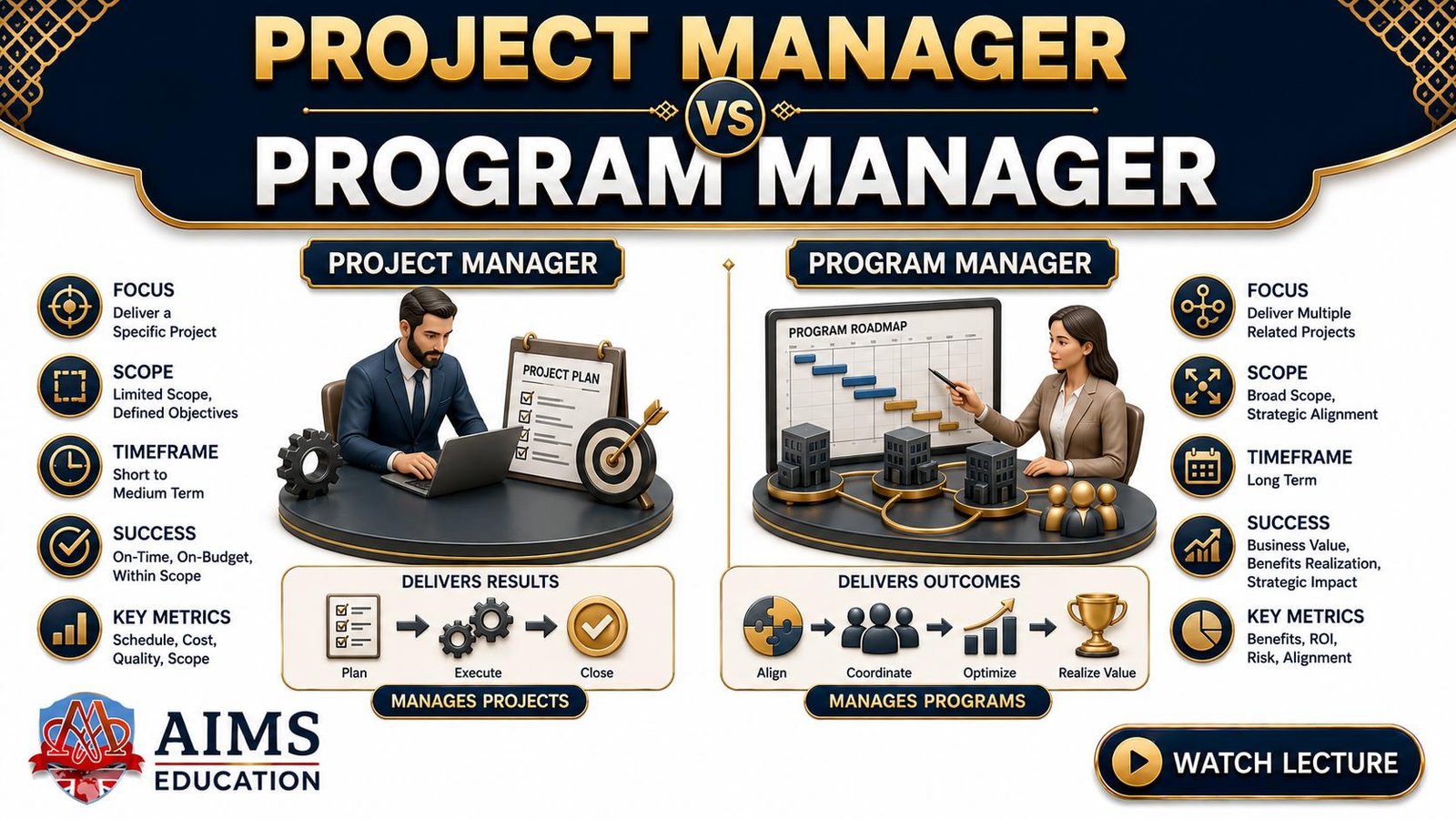
| Core Focus | A project manager focuses on delivering one defined project with agreed scope, schedule, cost, quality, and resources. | A program manager focuses on coordinating related projects and activities to achieve strategic benefits and organizational value. |
| Scope of Work | The scope is limited to a single project and its specific deliverables. | The scope covers multiple related projects, subsidiary programs, and supporting program activities. |
| Main Objective | The objective is to complete the project successfully according to approved requirements and constraints. | The objective is to ensure that related initiatives collectively deliver benefits that support organizational strategy. |
| Time Frame | A project usually has a clear start date, end date, and defined completion point. | A program usually runs over a longer period and may evolve across phases until benefits are realized and sustained. |
| Deliverables vs Outcomes | The project manager is responsible for project deliverables, such as a system, facility, service, report, or completed implementation. | The program manager is responsible for program outcomes, such as improved capability, business change, public value, or strategic performance. |
| Planning and Execution | The project manager develops the project plan and manages day-to-day execution within the project team. | The program manager integrates component plans, monitors the program roadmap, and adjusts strategy when component outcomes change. |
| Budget Responsibility | The project manager controls the budget assigned to one project and manages costs within that boundary. | The program manager manages or coordinates the wider program budget and allocates resources across related projects. |
| Risk Management | The project manager manages risks that affect the project’s scope, schedule, cost, quality, and delivery performance. | The program manager manages cross-project risks, strategic risks, dependency risks, operational risks, and risks to benefits realization. |
| Stakeholder Communication | The project manager communicates detailed project updates to team members, clients, sponsors, and project stakeholders. | The program manager communicates strategic progress to executives, sponsors, governance bodies, operational leaders, and multiple project teams. |
| Team Structure | The project manager usually leads a smaller project-specific team responsible for completing assigned work packages. | The program manager usually oversees several project managers, cross-functional teams, vendors, and operational stakeholders. |
| Dependency Management | The project manager manages dependencies within the project and escalates issues that affect delivery. | The program manager manages dependencies between projects and ensures that delays or changes in one component do not damage the wider program. |
| Governance and Control | Project governance controls approvals, changes, reporting, and delivery decisions within the project boundary. | Program governance controls strategic alignment, component coordination, benefits tracking, stakeholder engagement, and value delivery. |
| Success Measurement | Success is measured by whether the project is delivered on time, within budget, within scope, and to the required quality. | Success is measured by whether the program delivers intended benefits, strategic outcomes, operational adoption, and long-term value. |
Program Management vs Project Management
Project vs Program
What is a Project?
A project is a temporary effort undertaken to create a unique product, service, or result. It has a defined purpose, a planned beginning and end, and measurable deliverables. In the project vs program distinction, the project is the unit of focused execution.
Example
Launching a new customer portal may be a project.
What is a Program
A program is a group of related projects, subsidiary programs, and program activities managed in a coordinated way to obtain benefits not available from managing each component separately. A program may last longer than a project, may evolve over time, and may deliver benefits incrementally or at completion.
Example
A full digital transformation program may include the customer portal, CRM migration, staff training, data governance, process redesign, cybersecurity improvements, and customer communication.
Program Manager vs Project Manager compares two connected but different leadership roles.
- A project manager focuses on completing a specific project within agreed constraints, while,
- A program manager coordinates multiple related projects, subsidiary programs, and supporting activities to realize benefits that would not be achieved by managing them separately.
What is the Difference between Project Management and Program Management
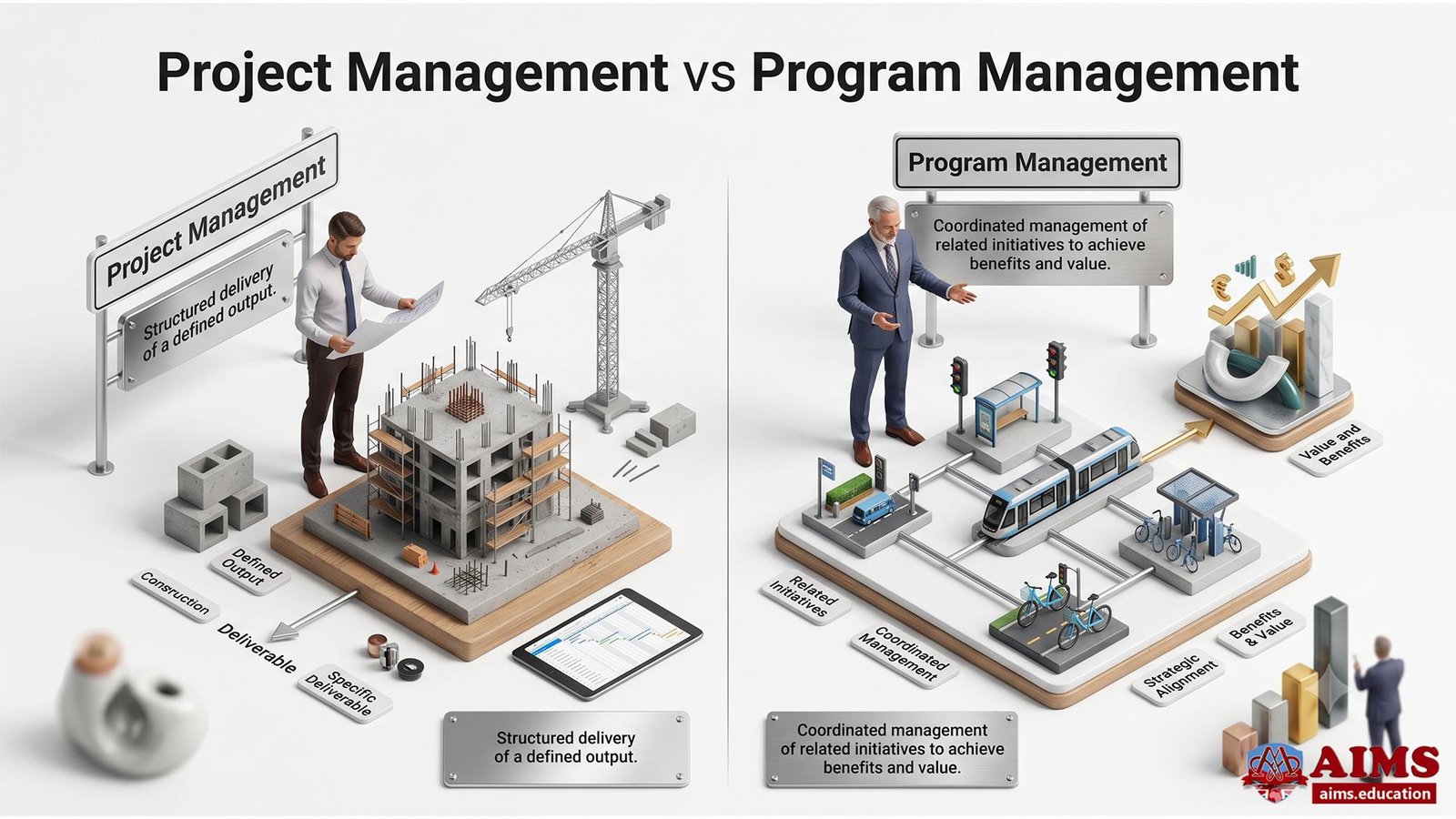
Project management is the structured delivery of a defined output, while program management is the coordinated management of related initiatives to achieve benefits and value. The difference is important because projects create deliverables, whereas programs integrate deliverables into broader organizational outcomes and sustained change.
| COMPARISON AREA | PROJECT MANAGEMENT | PROGRAM MANAGEMENT |
|---|---|---|
| Management Focus | Project management focuses on delivering a unique product, service, or result within approved constraints. | Program management focuses on coordinating related initiatives to deliver benefits, outcomes, and strategic value. |
| Unit of Work | The main unit of work is a single project with defined deliverables. | The main unit of work is a program made up of related projects, subsidiary programs, and supporting activities. |
| Purpose | The purpose is to complete the agreed work efficiently and effectively. | The purpose is to realize benefits that individual projects could not deliver as effectively on their own. |
| Lifecycle | The lifecycle usually moves from initiation to planning, execution, monitoring, control, and closure. | The lifecycle may evolve through program definition, delivery, benefits realization, transition, and closure. |
| Governance | Governance controls project approvals, changes, risks, reporting, and delivery decisions. | Governance controls strategic alignment, component coordination, benefits tracking, stakeholder engagement, and value delivery. |
| Dependencies | Dependencies are mainly managed within the project or with a limited number of external parties. | Dependencies are managed across several projects, operational teams, sponsors, resources, and strategic priorities. |
| Success Criteria | Success is measured by delivery against scope, time, cost, quality, risk, and stakeholder acceptance. | Success is measured by benefits realization, strategic outcomes, operational adoption, sustained value, and organizational impact. |
| Best Used When | Project management is best used when the work has a clear output, defined boundary, and fixed completion point. | Program management is best used when related initiatives must be coordinated to achieve change, capability improvement, or long-term value. |
Project Management vs Program Management is best understood as delivery control versus benefits coordination.
- Project management controls the work required to create a specific output.
- Program management integrates related projects, manages dependencies, guides governance, supports change, and ensures that outcomes contribute to organizational objectives.
Organizations often fail when they treat coordinated transformation as a bundle of independent projects. When initiatives share risks, resources, stakeholders, technologies, or strategic outcomes, program management provides the structure needed to manage interdependencies and value delivery.
If you need a basic grounding before comparing the two roles may use a foundational explanation of project management basics and the guiding project management principles.
Why Program Management Centers on Coordinated Strategic Outcomes?
- Program management is the application of knowledge, skills, and principles to a program to achieve program objectives and obtain benefits and control not available by managing program components separately.
- It aligns projects, subsidiary programs, resources, stakeholders, governance, risks, benefits, and operational transition.
Program managers work across performance domains such as strategic alignment, benefits management, stakeholder engagement, governance framework, collaboration, and life cycle management. Their work requires a holistic view because the best way to deliver benefits may be unclear at the beginning and may need to adapt as component outcomes emerge.
- The real value of Project Management vs Program Management lies in recognizing when coordinated benefits matter more than isolated delivery.
- A project may create a new system, while a program ensures that the system, training, process redesign, user adoption, governance, and business benefits move together.
Project Manager vs Program Manager: Comparison of Roles and Responsibilities
Project manager vs program manager roles differ in accountability, decision rights, communication level, and leadership depth.
- Project managers lead delivery teams toward defined outputs, while
- Program managers guide multiple component teams, resolve cross-project dependencies, manage strategic alignment, and ensure that benefits are delivered and sustained.
Project vs Program Manager Roles in Planning, Execution, and Oversight
Project vs program manager roles can be compared across three practical areas: planning, execution, and oversight. The project manager builds and controls the project plan. The program manager integrates component plans, manages dependencies, coordinates shared resources, and ensures that the program roadmap remains aligned with the business case.
- A project manager defines project scope, schedules tasks, estimates resources, controls cost, manages quality, and leads the team responsible for producing agreed deliverables.
- A program manager defines the program structure, coordinates multiple project managers, guides benefits planning, manages interdependencies, and adapts the program when strategy or component outcomes change.
- A project manager escalates issues that affect project constraints, while a program manager resolves conflicts that affect several projects, operational readiness, sponsors, beneficiaries, or strategic value.
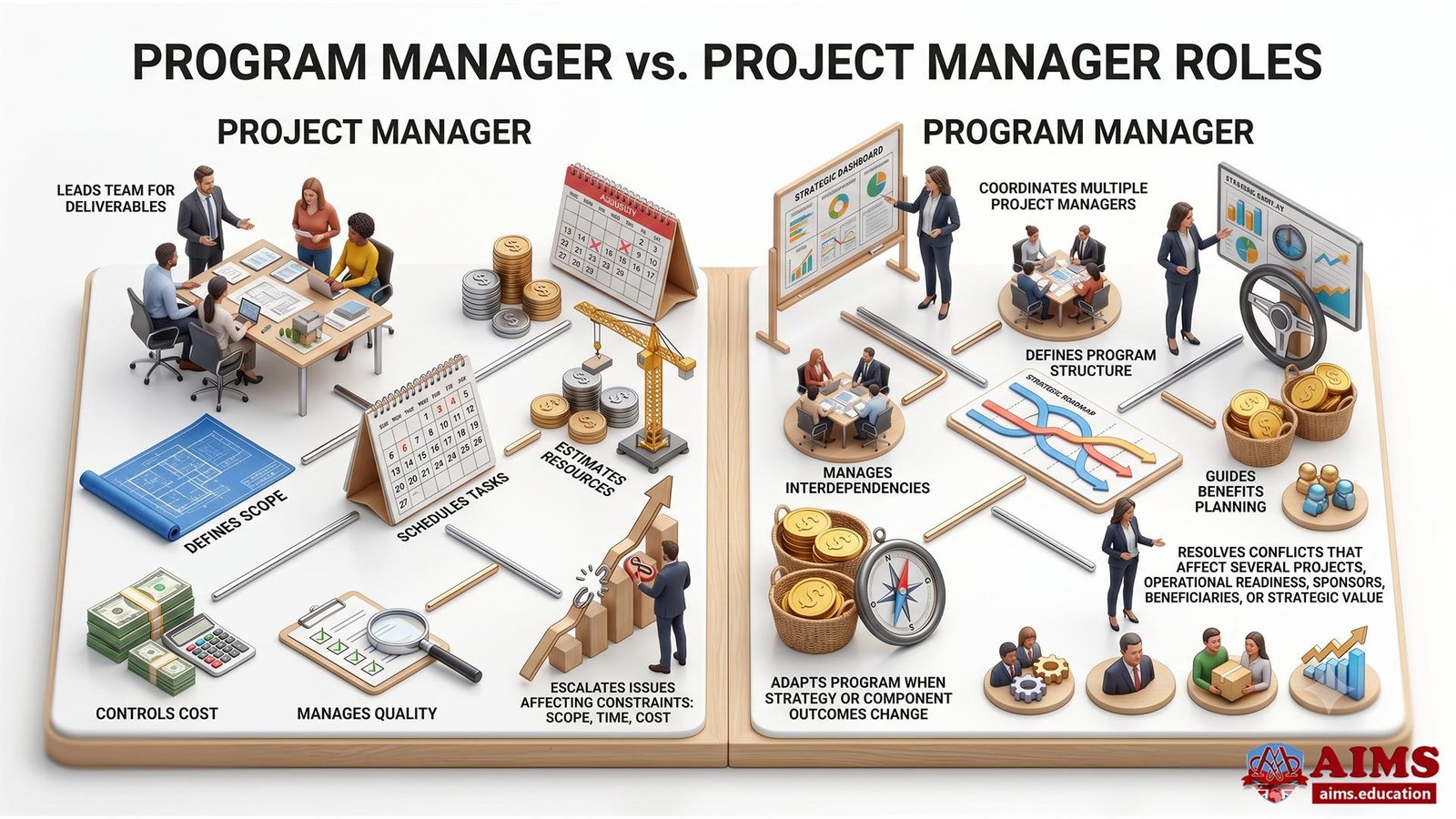
This is why the Difference Between Project Manager and Program Manager cannot be reduced to job title hierarchy. The roles operate at different layers of organizational delivery.
Decision Rights, Reporting Lines, and Stakeholder Communication
A project manager usually reports detailed progress on scope, schedule, cost, risk, quality, issues, and deliverables. Communication is close to the team and project stakeholders. The role requires strong day-to-day coordination, practical problem-solving, and disciplined control of approved work.
A program manager communicates at a more strategic level. The role often involves sponsors, steering committees, portfolio managers, operational managers, vendors, regulators, and multiple project managers. Program communication must explain not only what is being delivered, but why the work still matters and how it contributes to benefits.
Skills, Competencies, and Leadership Depth
Project managers need leadership, team building, motivation, communication, influencing, decision-making, cultural awareness, negotiation, trust building, conflict management, and coaching. They must also understand project constraints such as scope, time, cost, quality, resources, and risk.
Program managers need those abilities plus deeper business acumen, systems thinking, integration skills, governance awareness, strategic communication, benefits management, analytical judgment, stakeholder engagement, change management, and the ability to navigate volatility, uncertainty, complexity, and ambiguity.
In practical terms, a strong project manager can deliver difficult work. A strong program manager can connect difficult work to organizational value while ensuring that related initiatives do not undermine each other.
How Project Managers and Program Managers Work Together in Practice
Project managers and program managers work best when their responsibilities are distinct but connected.
- The project manager protects the delivery integrity of a component project.
- The program manager protects the strategic integrity of the whole program.
Example
Consider a bank implementing a new online service.
- The project manager for cybersecurity ensures that security testing, access controls, and compliance deliverables are completed.
- The program manager ensures that cybersecurity, customer onboarding, staff training, legal review, platform launch, and communication plans are synchronized so the bank gains a secure and usable service.
Project vs Program Manager – Real World Examples
The below project vs program manager example shows how the distinction works outside theory.
- Project manager may deliver one CRM migration, construction package, or training rollout, while
- Program manager coordinates several related initiatives so the organization achieves transformation, capability improvement, service expansion, or measurable public value.
A Digital Transformation Program Made Up of Linked Projects – Examples
A digital transformation program may aim to improve customer experience, reduce manual processing, strengthen data governance, and modernize internal operations. It is not one project because the desired benefit depends on several coordinated outcomes.
CRM Migration as a Project Inside a Broader Transformation Effort – An Example
- The CRM project manager plans the migration from an old customer database to a new cloud-based CRM platform.
- The team cleans data, configures workflows, tests integrations, and trains selected users before launch.
- The project is successful when the CRM system goes live, works correctly, and meets agreed acceptance criteria.
The project produces a deliverable, but the program determines whether that deliverable contributes to customer service improvement.
Staff Training and Adoption as Change Work Inside the Program – An Example
- The program manager identifies that staff adoption is necessary for benefits realization.
- A training project is created to prepare 600 employees across customer service, sales, and operations.
- Adoption metrics are monitored after launch because the CRM system has little value if teams continue using spreadsheets.
This shows why program-level change work is essential when multiple related initiatives move together.
Website Relaunch as a Separate Project Contributing to the Same Outcome – An Exampe
- A separate website relaunch project redesigns customer self-service pages and inquiry forms.
- The website team coordinates with the CRM team so online inquiries flow into the correct customer records.
- The program manager monitors whether the combined outcome reduces response time from three days to one day.
The practical impact is clear: individual projects deliver outputs, while the program turns connected outputs into measurable business improvement.
A Construction Expansion Program and Its Component Projects – An Example
A construction company building a new shopping mall may treat the full development as a program. Component projects may include structural construction, interior fit-out, parking facilities, utility connections, tenant coordination, safety approvals, marketing launch, and finance control.
- Each component project needs its own project manager, schedule, budget, risks, suppliers, and deliverables.
- The program manager coordinates dependencies, such as ensuring that utilities are ready before tenant fit-out begins and that marketing dates align with construction completion.
A Public Service Program and Its Component Projects – An Example
- A government children’s services program may include prenatal care, newborn immunization, early childhood developmental testing, parent awareness campaigns, data reporting, and community outreach.
- Each component may be a project, but the public value comes from the combined improvement in child health and early intervention.
This example is useful because not all programs are commercial. Programs may deliver social value, public benefit, compliance improvement, safety, security, sustainability, or reputation protection.
When Several Projects Do Not Qualify as One Program – An Example
Several projects do not automatically form a program. If projects only share a department, technology, sponsor, or funding source but do not pursue complementary benefits, they may be better managed as a portfolio.
For example, a company may run a website redesign, warehouse upgrade, office move, and recruitment campaign in the same year. If these projects do not depend on each other and do not contribute to one coordinated outcome, they are not necessarily a program. They may simply be a collection of projects competing for resources.
Project Manager vs Program Manager Across Scope, Risk, and Governance
Project Manager vs Program Manager differences become most visible across scope, risk, governance, budgets, dependencies, change control, and success measurement.
- Project manager controls delivery within approved boundaries, while
- Program manager balances components, adapts plans, coordinates resources, and protects strategic value across changing conditions.
Project Deliverables vs Program Outcomes
Project deliverables vs program outcomes is one of the clearest distinctions.
- Project deliverables are tangible or verifiable outputs, such as a software module, training course, bridge section, policy document, or completed facility.
- Program outcomes are broader results, such as faster service, improved compliance, stronger capability, or increased public value.
Project deliverables vs program outcomes also changes how success is judged. A project may be successful because it delivers the agreed system on time. The program may still fail if users do not adopt the system, operational teams are not prepared, or the expected business benefit does not appear.
Strategic vs Tactical Management in Day-to-Day Decision-Making
Project managers make many tactical decisions. They decide how to sequence tasks, assign team members, manage project issues, control scope changes, communicate status, and protect the delivery baseline.
Program managers make more strategic and integrative decisions. They decide whether component priorities should change, whether resources should move between projects, whether a delayed project threatens benefits, and whether new projects should be initiated because earlier outcomes reveal new needs.
Program Governance and Benefits Realization
Program governance provides the structure for decision-making, escalation, approvals, benefit tracking, stakeholder alignment, and component coordination. It helps sponsors and program leaders decide whether the program remains aligned with organizational strategy.
Benefits realization is central to program management because the program is created to deliver value beyond individual outputs. Benefits may be delivered incrementally, such as process improvements released in stages, or all at once, such as the full approval and launch of a regulated product.
Budget Ownership, Dependency Management, and Change Control
A project manager controls the budget allocated to one project. A program manager manages a wider resource picture, balancing funding, people, technology, procurement, and timing across components. This may require shifting resources when one project becomes more critical to program benefits than another.
Dependency management is also wider at program level. One project delay may affect training, operations, stakeholder confidence, regulatory approval, or the timing of benefits. This is why organizations need why change control in project management matters when multiple related initiatives move together.
How Success Is Measured at Project Level Versus Program Level
Project success is usually measured by delivery performance: scope, time, cost, quality, risk control, stakeholder acceptance, and deliverable completion. These measures matter because the project manager is accountable for producing the agreed output under approved constraints.
Program success is measured by benefits and value: strategic alignment, business improvement, operational adoption, stakeholder satisfaction, sustained capability, risk reduction, and benefit realization. This makes Project Management vs Program Management a difference in both management method and success logic.
Where Project Portfolio Management and PMO Support Fit
Project portfolio management and PMO support explain where projects and programs fit inside wider organizational delivery. Portfolios select and prioritize investments, programs coordinate related benefits, projects deliver outputs, and PMOs support governance, standards, reporting, methods, resources, and delivery discipline.
Project Portfolio Management Context
A portfolio is a collection of projects, programs, subsidiary portfolios, and operations managed as a group to achieve strategic objectives. Portfolio management helps decide which initiatives deserve funding, which should be paused, and which best support organizational priorities.
A program sits within this wider value delivery system when related components must be coordinated to achieve benefits. Readers who need this layer can understand the project portfolio manager role and responsibilities.
PMO Support for Projects and Programs
A project management office, often called a PMO, supports delivery by providing methods, templates, reporting routines, governance support, standards, coaching, and shared resource coordination. A PMO does not replace the project manager or program manager, but it strengthens the environment in which they work.
In a program, PMO support may be especially valuable because multiple project teams need consistent reporting, shared controls, coordinated risk visibility, and governance discipline. For a deeper view, see how a PMO supports governance, standards, and shared resources.
Governance Differences Between Project, Program, and Portfolio Layers
Project governance controls delivery. Program governance controls coordinated benefit realization. Portfolio governance controls strategic selection, prioritization, investment balance, and organizational value.
These layers should not be confused. A project may be well-managed but strategically unimportant. A program may be strategically important but poorly coordinated. A portfolio may include several programs and projects, but it does not manage every project task. For international terminology, organizations may also consult the ISO framework for project, programme, and portfolio management concepts.
Why Portfolio Manager Is Not the Same as Program Manager
A portfolio manager decides whether the organization is investing in the right mix of work. A program manager ensures that related work is coordinated to deliver intended benefits. The portfolio manager asks, “Are we doing the right initiatives?” The program manager asks, “Are these related initiatives producing the intended value together?”
This distinction prevents a common misunderstanding. A program manager is not simply a portfolio manager with fewer projects, and a portfolio manager is not simply a senior program manager. Their decision logic is different.
When to Use Each Approach and What Their Limits Are
Use a project approach when the work has a defined output and endpoint, and use a program approach when related initiatives must be coordinated to deliver benefits. The right choice depends on interdependencies, strategic value, operational change, stakeholder complexity, and whether benefits require integration across components.
Use a Project Manager When the Work Has a Defined Output and Endpoint
An organization should use a project manager when the goal is clear, the deliverable is identifiable, constraints can be planned, and success can be judged by completion against agreed criteria. This applies to work such as developing a training module, installing equipment, launching a website, or delivering a defined construction package.
The project approach works well when the team needs discipline, scheduling, task ownership, budget control, risk management, and stakeholder reporting within a bounded piece of work.
Use a Program Manager When the Goal Is Coordinated Change Across Initiatives
An organization should use a program manager when several related projects and activities must be integrated to achieve benefits. This applies to transformation, public service improvement, enterprise technology change, product development, infrastructure modernization, and capability-building initiatives.
The program approach works well when outcomes are connected, dependencies are complex, stakeholders are broad, benefits must be tracked, and operational adoption is essential. In these conditions, program manager vs project manager roles must be clearly separated to avoid confusion and duplicated authority.
Typical Limitations, Objections, and Trade-Offs
Project management can become too narrow when managers focus only on deliverables and ignore whether the work creates value. Program management can become too heavy when organizations create unnecessary governance for unrelated projects. The right structure should match the nature of the work, not the prestige of the title.
A practical test is simple: if separate projects can be managed independently without losing benefits, a program may not be necessary. If benefits depend on coordination, sequencing, shared resources, change adoption, and integrated governance, program management is likely needed.
Why a Program Manager Is Not Just an Advanced Project Manager
A program manager often has project management experience, but the role is not merely a promotion from project management. It requires a different viewpoint. The project manager optimizes delivery within constraints. The program manager optimizes benefits across components and adapts the program when strategy, risks, stakeholders, or outcomes change.
Professionals who want structured progression can consider an advanced diploma for mastering project, program, and portfolio practice or the Accredited MBA in Project and Program management leadership, depending on their academic goals and career stage.
FAQ on Program Manager vs Project Manager
These answers clarify common doubts about Program Manager vs Project Manager, Project Management vs Program Management, and related roles. They address definitions, fixed timelines, benefits, stakeholders, portfolios, PMO support, examples, and the mistaken belief that a program is only a larger version of a project.
What Is Program Manager?
A program manager is the authorized leader responsible for coordinating related projects, subsidiary programs, and program activities to achieve strategic benefits. The role focuses on alignment, governance, dependencies, stakeholder engagement, benefits realization, change, and value delivery across the whole program.
What Is Project Manager?
A project manager is the person assigned to lead the team responsible for achieving project objectives. The role focuses on planning, organizing, executing, monitoring, controlling, and closing a defined project so agreed deliverables are completed within scope, time, cost, quality, risk, and resource constraints.
What Is the Main Difference Between Program Manager and Project Manager?
The main difference is accountability. A project manager is accountable for delivering a specific project output, while a program manager is accountable for coordinating related initiatives so the organization realizes broader benefits, sustained outcomes, and strategic value.
Program Manager vs Project Manager: Which One Focuses on Outcomes and Which One Focuses on Deliverables?
The project manager focuses mainly on deliverables, such as a system, facility, report, service, or completed implementation. The program manager focuses mainly on outcomes and benefits, such as improved capability, organizational change, customer value, risk reduction, or strategic performance.
Project Management vs Program Management: Which One Has a Fixed Start and End Date?
Project management usually has a clearer start and end date because a project is temporary and deliverable-focused. Program management may last longer, evolve across phases, and continue until coordinated benefits are realized, sustained, or formally closed by governance decision.
Program Manager vs Project Manager: Who Manages Multiple Related Projects?
The program manager manages multiple related projects at the coordination and benefits level. Individual project managers still manage their own projects. The program manager integrates schedules, dependencies, risks, resources, communications, and outcomes across the program structure.
Can a Project Exist Without a Program?
Yes, a project can exist without a program. Many projects are standalone efforts with their own objectives, budget, stakeholders, and deliverables. A program is only needed when related projects and activities must be coordinated to achieve benefits that separate management would not deliver.
Is a Program Just a Larger Project?
No, a program is not just a larger project. Size may increase complexity, but the defining feature of a program is the relationship between its components and the need to coordinate them for shared benefits, strategic alignment, and sustained value.
When Should an Organization Use a Program Manager Instead of a Project Manager?
An organization should use a program manager when several related initiatives share outcomes, dependencies, risks, stakeholders, resources, or benefits. A project manager is enough when the work is a single bounded effort with a clear deliverable and limited cross-project dependency.
Does Programme Manager vs Project Manager Mean Anything Different in Global Usage?
Programme Manager vs Project Manager usually reflects spelling and regional usage. “Programme” is common in UK and Commonwealth English, while “program” is common in US English. The management distinction remains focused on coordinated benefits versus defined project delivery.
How Is a Project Portfolio Manager Different from a Program Manager?
A project portfolio manager focuses on selecting, prioritizing, balancing, and governing a mix of projects, programs, and operations to achieve strategic objectives. A program manager focuses on coordinating related initiatives within one program so the intended benefits are delivered.
What Are Examples of a Project and a Program?
A CRM migration, website relaunch, or warehouse installation can be a project. A digital transformation, shopping mall development, or public health improvement initiative can be a program when multiple related projects and activities must be coordinated to deliver shared benefits.
About AIMS’ Project Management Academy
AIMS’ Project Management Academy has supported professional project management education since 2005 through internationally accredited, globally accessible, and career-focused learning. Its curriculum is internationally standardized, taught by qualified faculty, and strengthened through industry-oriented teaching, practical skill development, 3D interactive learning content, and real-world case studies.
This content, along with AIMS’ study content and curriculum, is collaboratively developed and rigorously peer-reviewed by an academic board of qualified industry practitioners. These academic controls help support job-ready qualifications for professionals in project, program, and project portfolio management. Explore career-focused project management programs for professional growth.