
What Is a Program Manager?
A program manager is a senior professional who coordinates related projects to achieve shared strategic benefits and long-term organizational outcomes.
- A strong program manager definition always connects the role with strategy, governance, integration, and benefits realization.
- The role of program manager is broader than managing one project, one schedule, one budget, or one delivery team.
Example
- A project manager may deliver a website, training platform, or compliance module.
- A program manager connects those projects when they jointly support a larger goal, such as digital transformation, market expansion, or institution-wide process improvement.
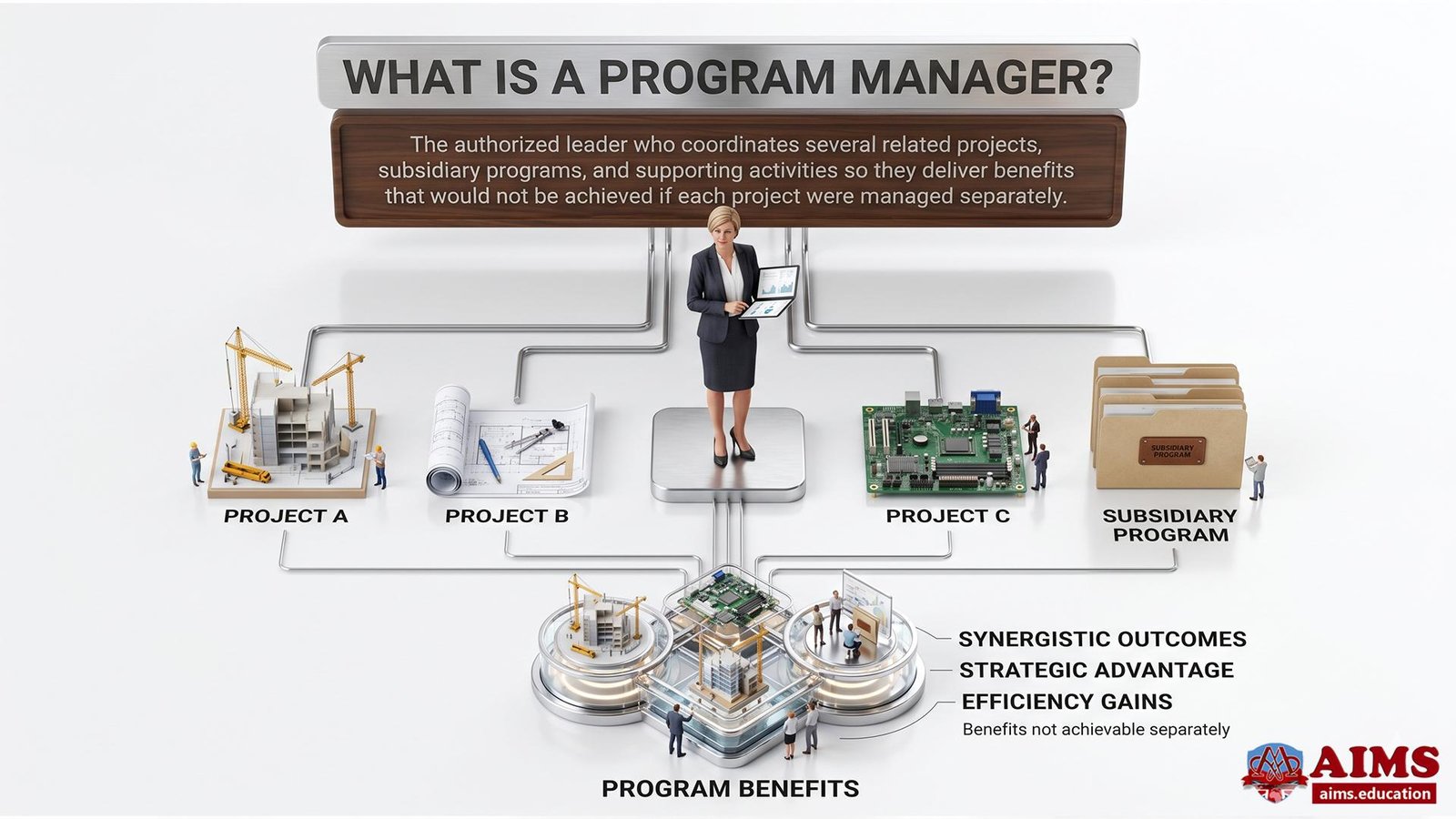
Role of Program Manager
The program manager works across project managers, operational teams, finance, procurement, compliance, customers, vendors, and internal stakeholders. The role of program manager also includes: Report to a sponsor, steering committee, senior executive, or portfolio governance body.
Before exploring the roles and responsibilities of a program manager, let us understand what is program, and how it is different from the project and portfolio.

What is a Program
A program is a coordinated set of related projects, subsidiary programs, and program activities managed together to obtain benefits not available from managing them independently.
In programs: The projects are not grouped because they are merely similar or large. They are grouped because their outcomes are connected.
Example
A company may run ten unrelated construction projects in different cities, but that does not automatically create a program. If those projects collectively create a new national logistics capability, such as warehouses, fleet technology, supplier onboarding, and route optimization, they may form a true program.
A program is not just a collection of projects; it is a benefits-led structure for delivering strategic change through coordinated work.
Project vs Program vs Portfolio
The program, project, and portfolio relationship explains how organizations convert strategy into results.
- Portfolios choose and prioritize investments, programs coordinate related change initiatives, and projects deliver defined outputs.
- A program manager sits between executive direction and project execution, translating strategic intent into coordinated delivery and measurable value.
Here is the quick relationship between the role of a program manager with project, and portfolio manager:
- Portfolio management decides which investments deserve resources.
- Program management coordinates related initiatives so the selected benefits are realized.
- Project management delivers the individual outputs required by the program or portfolio.
This is why how program management connects with portfolio decision-making is central to strategic execution. For a project-level contrast, you can review what project managers handle in day-to-day delivery. Project managers focus on specific deliverables, while the program manager protects the broader business outcome.
| TERM | CORE MEANING | MAIN SUCCESS MEASURE |
|---|---|---|
| Project | A temporary effort creates a specific product, service, or result. | The output is delivered within agreed scope, time, cost, quality, and risk constraints. |
| Program | Related projects and activities are coordinated to achieve benefits that depend on integration. | The combined outcomes create strategic value and measurable benefits. |
| Portfolio | Projects, programs, operations, and investments are grouped to achieve strategic priorities. | Resources are allocated to maximize value, balance risk, and support organizational strategy. |
Project vs Program vs Portfolio – An Example
- A healthcare group may approve a patient experience portfolio.
- Inside it, a digital care program may include appointment booking, electronic records, remote consultation, staff training, and data privacy projects.
- Each project has deliverables, but the program manager ensures they create one improved patient experience.
Program Manager Responsibilities: What Does a Program Manager Do
Program manager responsibilities include aligning strategy, coordinating related projects, managing dependencies, engaging stakeholders, governing risks, balancing resources, tracking benefits, and ensuring that program outcomes transition successfully into operations.
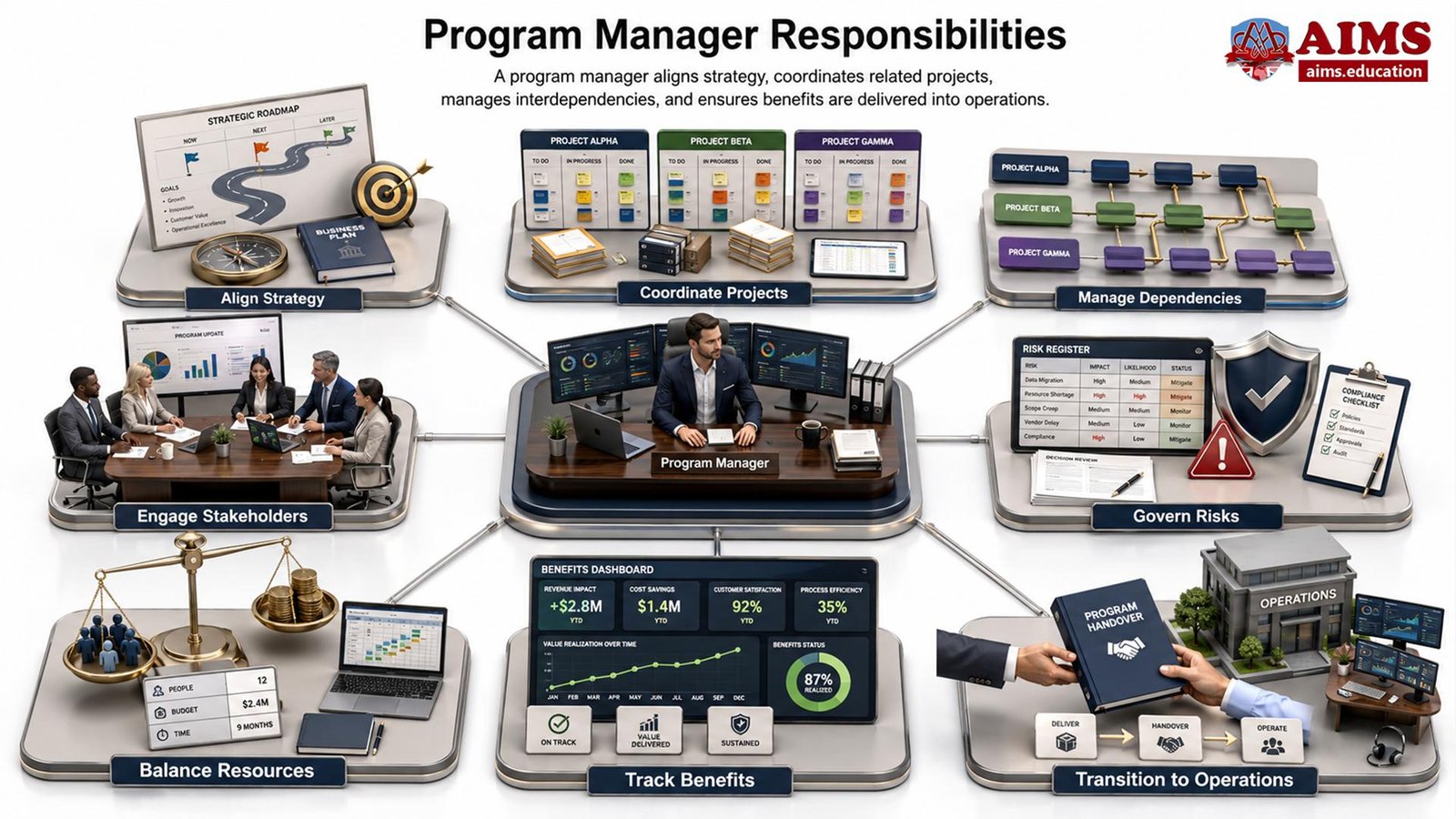
What Does a Program Manager Do Across Planning, Coordination, and Control
Core program manager responsibilities begin with understanding why the program exists. The program manager clarifies the business case, defines expected benefits, structures component projects, supports project manager selection, and builds a roadmap that shows how outcomes will connect over time.
- The program manager aligns component projects with the organization’s strategic objectives and approved business case.
- The program manager coordinates schedules, resources, risks, procurement needs, and communication across related initiatives.
- The program manager manages interdependencies so that the output of one project supports the timing and quality needs of another.
- The program manager reports integrated progress to sponsors, governance bodies, and stakeholders.
- The program manager supports transition to operations so that program benefits continue after delivery activity ends.
Program Manager Responsibilities in Stakeholder Management, Risk Management, and Resource Alignment
Role of Program Manager in Stakeholder Management
Programs involve stakeholders with different priorities. Sponsors may want fast benefits, finance teams may want cost control, operations teams may worry about disruption, and users may resist new processes. A program manager translates these concerns into realistic decisions that protect delivery and benefit realization.
Role of Program Manager in Risk Management
Risk management is also broader at program level. A project risk may affect one deliverable, while a program risk may affect several projects, the business case, regulatory approval, reputation, or operational adoption. This is why the program manager must take a systemic view.
How Success Is Measured Beyond Time and Budget
A project can be successful when it delivers the agreed output within accepted constraints. A program must also show that coordinated outputs created the benefits promised in the business case, such as capability improvement, revenue growth, service quality, compliance, resilience, cost efficiency, or stakeholder satisfaction.
A useful way to remember what is a program manager is to ask who owns the connection between project outputs and business benefits. In many organizations, that connection belongs to the program manager, supported by the sponsor, PMO, operations teams, and governance bodies.
Roles and Respoinsibilities of Program Manager in Practice
The program manager works in technology, healthcare, government, education, infrastructure, finance, and business transformation. Organizations need a program manager when several related initiatives must be coordinated to create a shared benefit, especially when dependencies, stakeholders, risks, and governance decisions cross project boundaries.
Role of Program Manager Across Sectors
- In technology, a technical program manager may coordinate cloud migration, cybersecurity, system integration, vendor transition, and staff enablement.
- In healthcare, a program manager may integrate digital records, patient access, compliance training, and clinical workflow change.
- In government, a programme manager may coordinate infrastructure, community outreach, regulation, and service delivery.
- In education, a program manager may lead online learning modernization across curriculum design, platform implementation, faculty training, assessment redesign, student support, and quality assurance.
These examples show why the role of program manager is not limited to software. They exist wherever related change initiatives must work together to create value.
Program Manager Roles and Responsibilities in Real-World – An Example
Consider Meridian College, an imaginary institution that wants to improve online student success. The sponsor approves a two-year digital transformation program with a budget of £1.8 million and four component projects.
- The platform project selects and implements a learning management system within nine months.
- The curriculum project redesigns thirty courses for online delivery using interactive content and assessment rubrics.
- The student support project creates live chat, advising workflows, and early-risk alerts.
- The analytics project builds dashboards to measure engagement, completion, satisfaction, and retention.
The program manager coordinates the dependencies. The platform must be ready before course migration, faculty training must occur before launch, data privacy approval must precede analytics use, and student support must be operational before intake. Separate outputs become one measurable institutional capability.
Common Types of Program Manager Roles
- Common titles include strategic program manager, technical program manager, transformation program manager, PMO manager, operations program manager, and change program manager.
- A technical program manager usually works where technology architecture, engineering dependencies, system integration, security, or product platforms are central to success.
When Organizations Need a Program Manager
An organization needs a program manager when several initiatives are related through outcomes, dependencies, resources, risks, stakeholders, or benefits. If a single project can be delivered independently with clear scope and limited cross-functional impact, a project manager may be enough.
A formal program layer becomes valuable when executive decisions, resource conflicts, operational transition, benefit tracking, or stakeholder alignment exceed the capacity of individual project teams. Without that layer, organizations often experience duplication, inconsistent priorities, delayed benefits, and weak accountability.
Limits, Trade-Offs, and Common Misconceptions
Program management adds value when coordination produces benefits. It can also add bureaucracy if applied to unrelated projects or small efforts that do not need a program structure.
Essential Skills and Qualifications for the Role of Program Manager
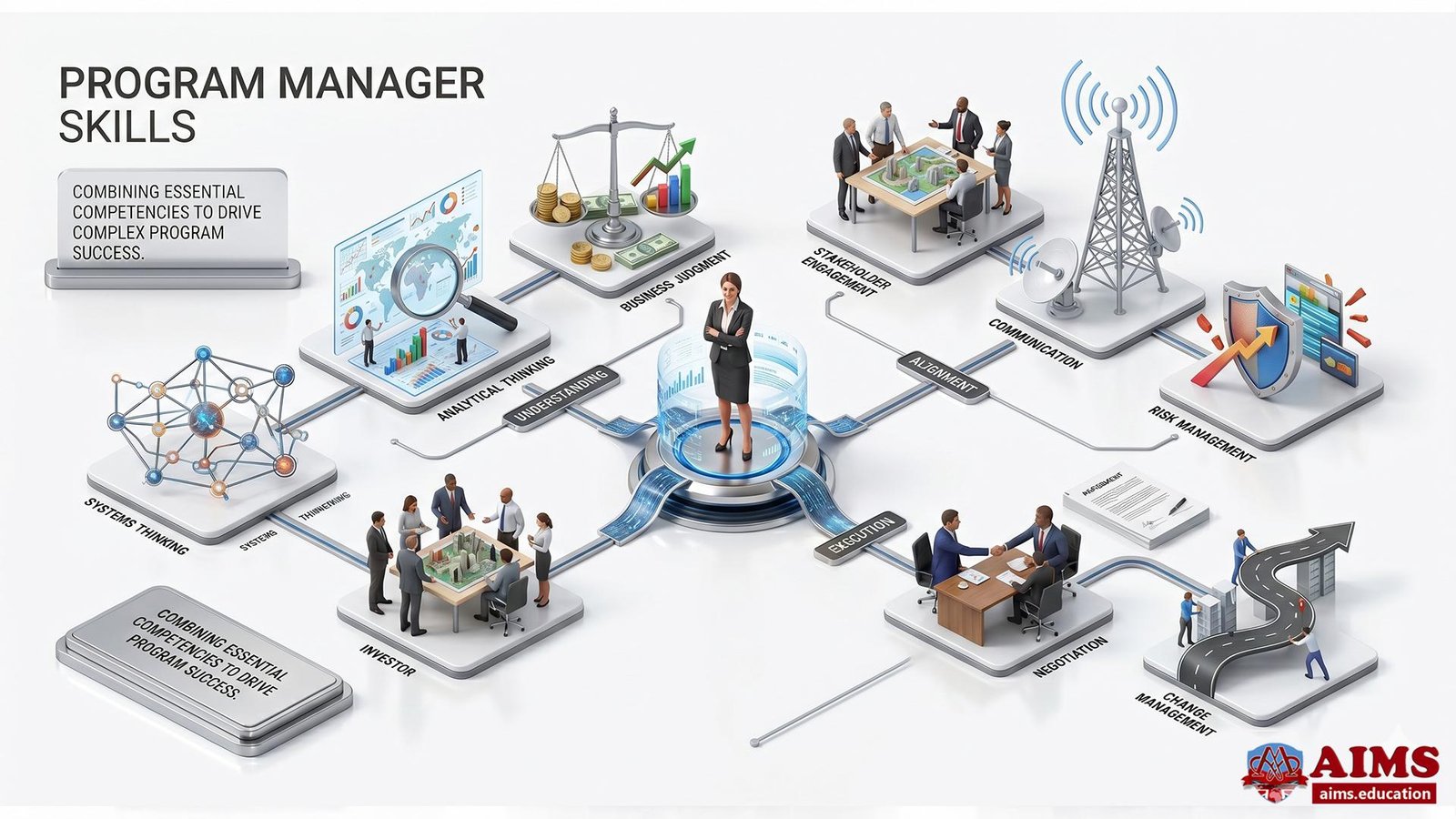
Program manager skills and qualifications combine leadership, business judgment, communication, negotiation, stakeholder engagement, change management, analytical thinking, risk management, systems thinking, and strong knowledge of project, program, and portfolio practices. Relevant education, certifications, and progressive experience help professionals move from delivery management toward strategic coordination.
Role of Program Manager: What Employers Demand
Employers look for people who can operate across uncertainty. Role of program manager includes understanding the budgets, risks, dependencies, benefits, governance, operations, and stakeholder politics. Technical knowledge helps in specialized sectors, but the defining capability is integrated judgment.
- Leadership skills help the program manager guide several teams without controlling every task directly.
- Communication and negotiation skills help the program manager align sponsors, project managers, vendors, regulators, and users.
- Analytical skills help the program manager interpret progress, risks, benefits, and trade-offs across components.
- Systems thinking helps the program manager understand how a change in one project affects the wider program.
- Change management skills help the program manager support adoption, transition, and long-term benefit sustainability.
Professionals building this capability can strengthen essential project management skills that feed into program management before moving into complex program work.
How to Become a Program Manager
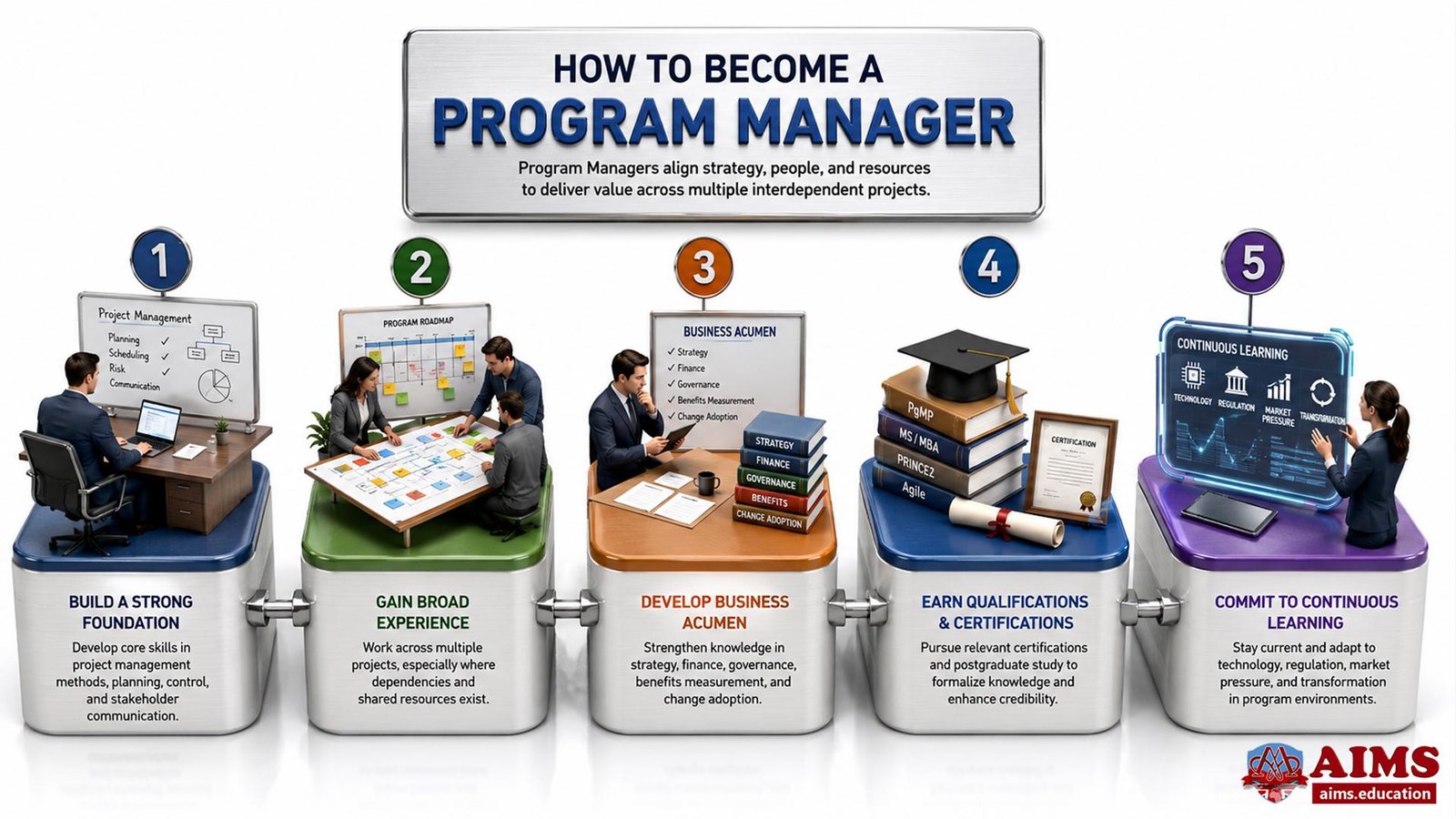
The phrase how to become a program manager usually points to a gradual career path. Most professionals begin in project management, operations, engineering, consulting, business analysis, product delivery, or functional leadership. They then build experience managing larger initiatives, senior stakeholders, resources, governance, and organizational change.
- A professional should first build a strong foundation in project management methods, planning, control, and stakeholder communication.
- The next step is to gain experience across multiple projects, especially where dependencies and shared resources exist.
- The professional should then develop business acumen in strategy, finance, governance, benefits measurement, and change adoption.
- Relevant qualifications, certifications, and postgraduate study can help formalize knowledge and improve career credibility.
- Continuous learning is necessary because program environments change through technology, regulation, market pressure, and transformation.
A learner seeking structured preparation may explore a career focused project management diploma for aspiring program managers or a professional project management certification for managing complex projects, depending on career stage and learning goals.
Education, Certifications, and Experience Pathways
Many program managers hold degrees in business, engineering, information systems, management, public administration, or a sector-specific field. Professional pathways may include project coordinator to project manager, senior project manager to program manager, technical specialist to technical program manager, or operations leader to transformation program manager.
Program Manager Job Description
A program manager coordinates related projects and strategic activities to achieve shared business objectives and long-term benefits. The main responsibilities usually include:
- Defining program goals, scope, priorities, and expected benefits.
- Coordinating multiple projects and ensuring they remain strategically aligned.
- Managing dependencies, risks, resources, budgets, and schedules across projects.
- Supporting and guiding project managers within the program.
- Communicating progress, risks, and performance to senior stakeholders.
- Resolving conflicts and issues that affect more than one project.
- Monitoring whether the program is delivering its intended outcomes and benefits.
- Managing organizational change associated with the program.
- Establishing governance, reporting standards, and decision-making processes.
- Ensuring that completed projects collectively support the organization’s strategy.
Example-1: Program Manager in a Digital Transformation Program
A digital transformation program manager may oversee several connected technology projects designed to modernize an organization.
- Coordinate projects involving cloud systems, cybersecurity, data management, and employee training.
- Align each project with the organization’s digital transformation strategy.
- Manage dependencies between technology implementation and staff readiness.
- Report overall progress, risks, costs, and expected benefits to senior management.
- Ensure the combined projects improve efficiency, customer experience, and business performance.
Example-2: Program Manager in a Product Development Program
A product development program manager may coordinate multiple projects required to launch a new product successfully.
- Oversee projects related to product design, manufacturing, marketing, testing, and distribution.
- Ensure all project teams work toward the same product launch objectives.
- Manage shared resources, deadlines, risks, and cross-functional dependencies.
- Resolve issues that could delay development or market release.
- Confirm that the complete program delivers the expected commercial and customer benefits.
Program Manager vs Project Manager and Other Related Roles
Program manager vs project manager is mainly a difference of scope, authority, timeframe, and success measure. A project manager controls a defined temporary effort, while a program manager coordinates several related efforts so they jointly deliver strategic benefits. Related roles, including product and portfolio managers, have different decision responsibilities.
Program Manager vs Project Manager: Scope, Timeframe, Outcomes, and Authority
The most common mistake is treating a program manager as simply a senior project manager. Seniority may be part of the picture, but it is not the definition. The real difference is that the program manager coordinates related work whose combined value is greater than separate project outputs.
The program manager vs project manager distinction also affects daily decisions. A project manager asks whether the project is on schedule. A program manager asks whether the sequence of projects still produces the intended benefits, whether resources are optimized across components, and whether the program remains aligned with strategy.
| ATTRIBUTE | PROGRAM MANAGER | PROJECT MANAGER |
|---|---|---|
| Scope | The role coordinates multiple related projects, subsidiary programs, and supporting activities. | The role manages one defined project with specific deliverables. |
| Timeframe | The work often spans a longer, iterative, and change-oriented lifecycle. | The work usually follows a defined project lifecycle with clearer boundaries. |
| Success Measure | Success is measured by benefits, strategic alignment, adoption, and sustained value. | Success is measured by delivery of approved scope within constraints. |
| Primary Focus | The focus is integration, dependencies, governance, stakeholder alignment, and benefits. | The focus is planning, execution, control, team coordination, and output delivery. |
For a deeper contrast, see how the program manager role differs from project management. Readers new to delivery terminology may also review the foundational meaning of project management and project objectives.
Program Manager vs Product Manager vs Portfolio Manager
A product manager owns the direction, value proposition, features, and lifecycle of a product or service. A portfolio manager prioritizes investments across projects, programs, and operations. A program manager coordinates related initiatives so a selected strategic change produces benefits.
These roles overlap in communication and decision-making, but they should not be confused. A product manager may define what customers need. A portfolio manager may decide whether the organization should invest. A program manager turns related approved initiatives into coordinated value delivery.
Is a Program Manager More Senior Than a Project Manager?
A program manager is often more senior in responsibility because the role deals with strategy, governance, multiple project teams, complex stakeholders, and benefits realization. However, seniority depends on the organization. The safer answer is that program management is broader, not automatically superior.
FAQ About Program Manager
What Is a Program Manager in Simple Terms?
A program manager leads several related projects so they work together toward a larger organizational benefit. The role coordinates project managers, stakeholders, dependencies, risks, resources, governance, and benefit delivery rather than managing every individual task personally.
What Is the Best Program Manager Definition for Beginners?
The best program manager definition for beginners is that the role connects strategy with delivery by coordinating related projects and activities. The program manager makes sure that separate outputs combine into measurable benefits, such as improved capability, service quality, compliance, growth, or change.
Is a Programme Manager the Same as a Program Manager?
Yes. In most professional contexts, a programme manager and a program manager are the same role. Programme manager is common in UK and Commonwealth usage, while program manager is common in US and global technology usage.
What Does a Program Manager Do Each Day?
A program manager reviews progress across component projects, resolves dependencies, prepares governance updates, engages stakeholders, manages risks, aligns resources, supports project managers, and checks whether the program remains on track to deliver planned benefits.
What Are the Main Program Manager Responsibilities?
The main program manager responsibilities include strategic alignment, benefits planning, governance support, stakeholder engagement, dependency management, resource coordination, risk oversight, communication, performance reporting, and transition to operations. The role is accountable for integrated outcomes, not only project outputs.
How Is a Program Manager Different From a Project Manager?
A project manager delivers one defined project, while a program manager coordinates several related projects and activities to achieve broader benefits. The project manager focuses on project constraints. The program manager focuses on integration, governance, dependencies, strategic alignment, and benefits.
Can a Program Manager Manage One Project?
A program manager may sometimes manage one project in a small organization, but that is not the ideal use of the role. If there is only one independent project with no major cross-project dependencies, a project manager is usually sufficient.
Is a Program Manager Higher Than a Project Manager?
A program manager often has broader authority because the role coordinates several projects, senior stakeholders, and strategic benefits. However, “higher” depends on the organization. It is more accurate to say that program management is broader in scope.
What Skills Does a Program Manager Need?
A program manager needs leadership, communication, negotiation, business acumen, stakeholder engagement, analytical thinking, governance awareness, risk management, systems thinking, change management, and the ability to coordinate teams without micromanaging them.
How Does Program Management Work Step by Step?
Program management usually starts with strategic need and program authorization. The program manager then defines benefits, structures component projects, establishes governance, coordinates delivery, manages risks and dependencies, supports transition, and confirms whether benefits are realized and sustained.
What Is Benefits Realization in Program Management?
Benefits realization in program management is the process of planning, measuring, delivering, and sustaining the value expected from a program. It ensures that project outputs lead to real improvements, such as higher efficiency, better service, revenue growth, or risk reduction.
What is the difference between Programme Manager and Program Manager
The term programme manager is common in the United Kingdom, Europe, and Commonwealth contexts, while program manager is more common in the United States and international technology environments. In professional practice, programme manager and program manager usually refer to the same strategic coordination role.
About AIMS’ Project Management Academy
AIMS’ Project Management Academy has delivered project management education since 2005 through internationally accredited, globally accessible, and career-focused programs supported by qualified faculty, standardized curriculum, practical skill development, 3D interactive learning content, and real-world case studies for professionals in project, program, and project portfolio management.
This article and AIMS’ study content & curriculum are collaboratively developed and rigorously peer-reviewed by an academic board of qualified industry practitioners. This approach supports job-ready learning outcomes for professionals seeking structured advancement. Explore AIMS’ career-focused project management programs for strategic leadership roles.