
What Is Project Portfolio Management (PPM)?
Project Portfolio Management (PPM) is the centralized management of a collection of projects, programs, subsidiary portfolios, and operations to achieve strategic objectives. It connects strategy with execution by evaluating, selecting, prioritizing, funding, monitoring, balancing, and sometimes terminating portfolio components according to value, risk, capacity, and organizational direction.
Project Portfolio Management Process, PPM Tools, and Strategic Value
- Project Portfolio Management is the discipline of selecting, prioritizing, balancing, governing, and reviewing projects, programs, subsidiary portfolios, and related operations so they collectively support strategic objectives.
- It helps organizations move beyond doing projects well toward choosing the right work, funding it wisely, and adjusting decisions when strategy, risk, capacity, or value changes.
- Modern organizations rarely fail because they lack project ideas. They fail because they approve too many initiatives, fund the wrong mix of work, overload scarce resources, and measure success only at the project level.
- That is why Project Portfolio Management Tools, also known as PPM Tools, a disciplined project portfolio management process, and clear portfolio management in project management practices are now central to strategy execution.
- At its best, portfolio thinking asks a senior-level question: are these initiatives still the best use of the organization’s money, people, time, and attention?
- A project may be well managed and still be the wrong investment. Portfolio management gives leaders the visibility and governance needed to stop, delay, reshape, or accelerate work before resources are wasted.
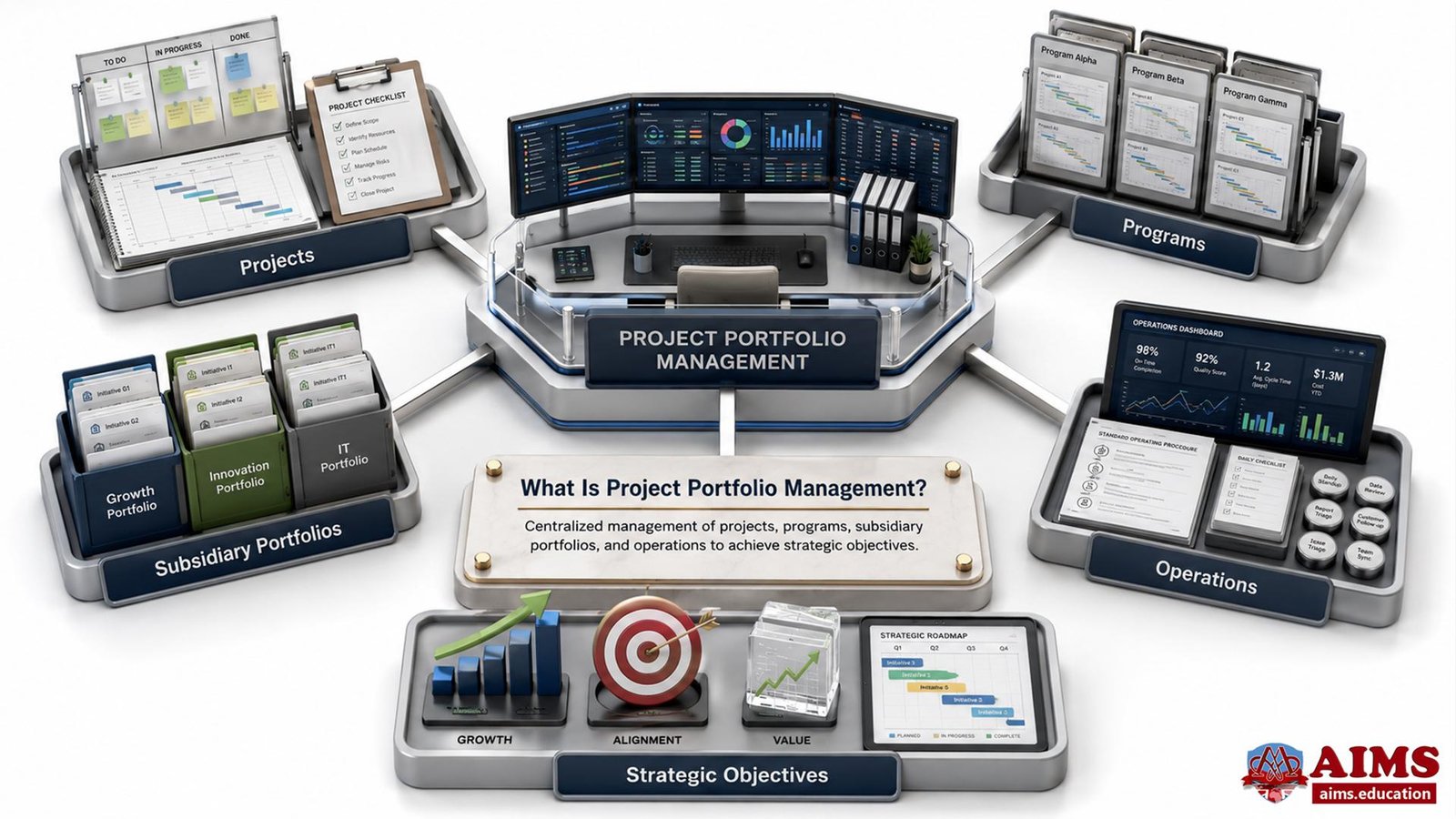
Project Portfolio Management may be defined as a management system that helps an organization decide which project work deserves investment and how that project work should be governed as conditions change. It is not merely the supervision of many projects. It is an investment discipline, a governance discipline, and a value-delivery discipline.
A project portfolio may include related or unrelated projects.
Some may belong to programs, some may support ongoing operations, and
Some may be future proposals waiting for approval.
What unites them is not necessarily technical similarity, but their contribution to strategic objectives and their competition for limited resources.
Project Portfolio Management – Standards and Frameworks
Standards-based portfolio management treats a portfolio as a set of components managed as a group to achieve strategic objectives.
- Those components can include projects, programs, subsidiary portfolios, and operational work.
- The portfolio view allows leaders to compare different kinds of initiatives through common decision criteria rather than through isolated project enthusiasm.
This standards-aware view also makes one point very clear: portfolio management is a guide to better decision-making, not a rigid methodology.
- Different organizations may use different scoring models, governance boards, review cycles, and software platforms, but the discipline remains focused on strategic alignment, business value, transparency, and responsible resource allocation.
- For organizations comparing international guidance, the wider standards environment can be reviewed through ISO Standards, especially when portfolio management needs to align with broader quality, governance, and organizational management practices.
Common Types of Project Portfolios
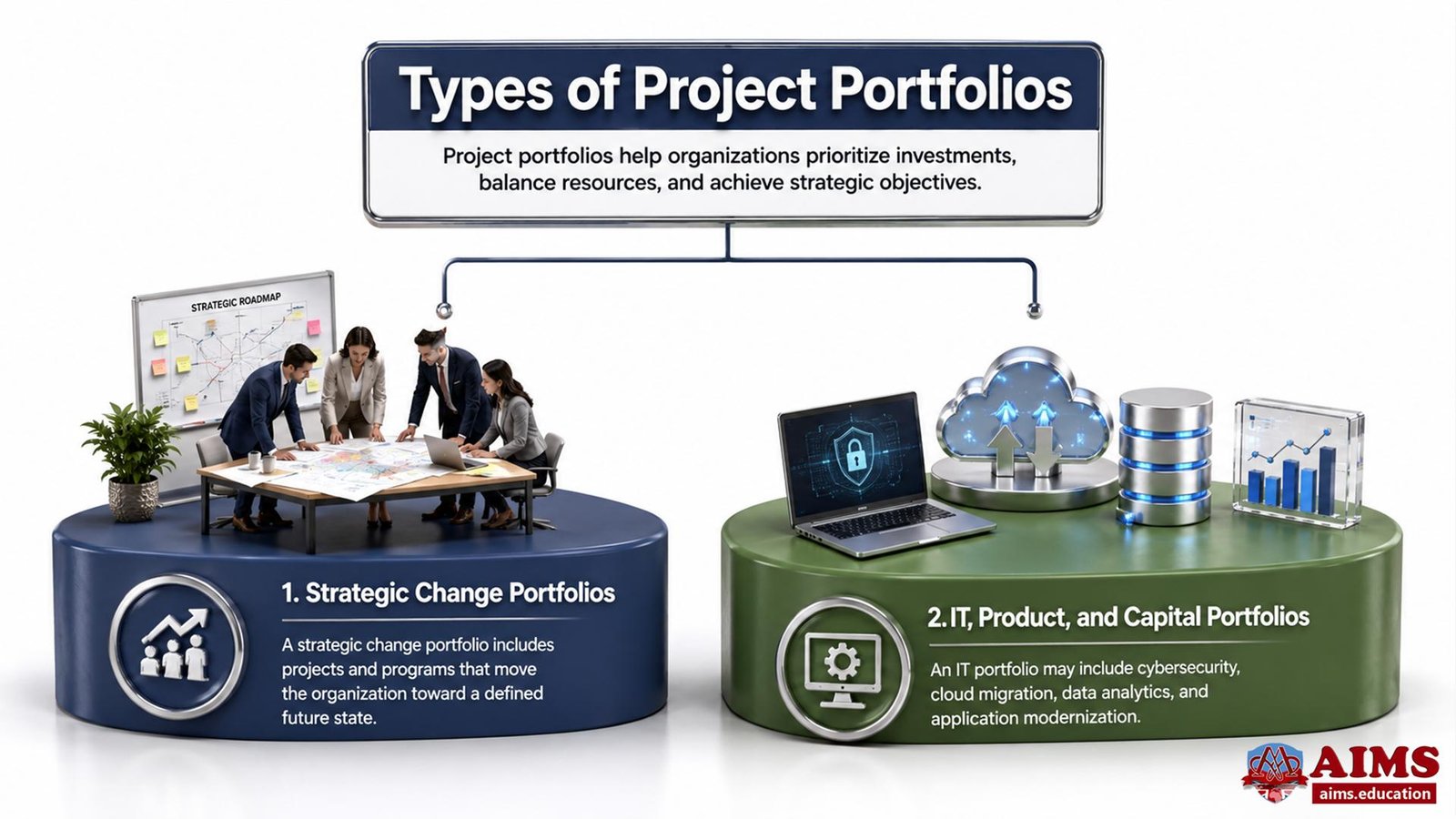
Project portfolios are commonly grouped by strategy, business unit, product line, technology domain, capital investment, regulatory requirement, or organizational change need. Before each type is explained, it is useful to recognize that a portfolio is created because leaders need a structured way to compare competing initiatives.
Strategic Change Portfolios
A strategic change portfolio includes projects and programs that move the organization toward a defined future state. For example, a university may approve a digital learning portfolio containing a learning platform upgrade, faculty training, online assessment redesign, and student support automation. These initiatives may differ technically, but they serve the same strategic direction.
IT, Product, and Capital Portfolios
- IT Portfolio may include cybersecurity, cloud migration, data analytics, and application modernization.
- Product Portfolio may include new product launches, product improvements, and product retirements.
- Capital Portfolio may include buildings, equipment, infrastructure, and long-term asset investments.
In each case, portfolio governance helps leaders compare expected value, funding needs, timing, and risk exposure.
The Project Portfolio Management Process
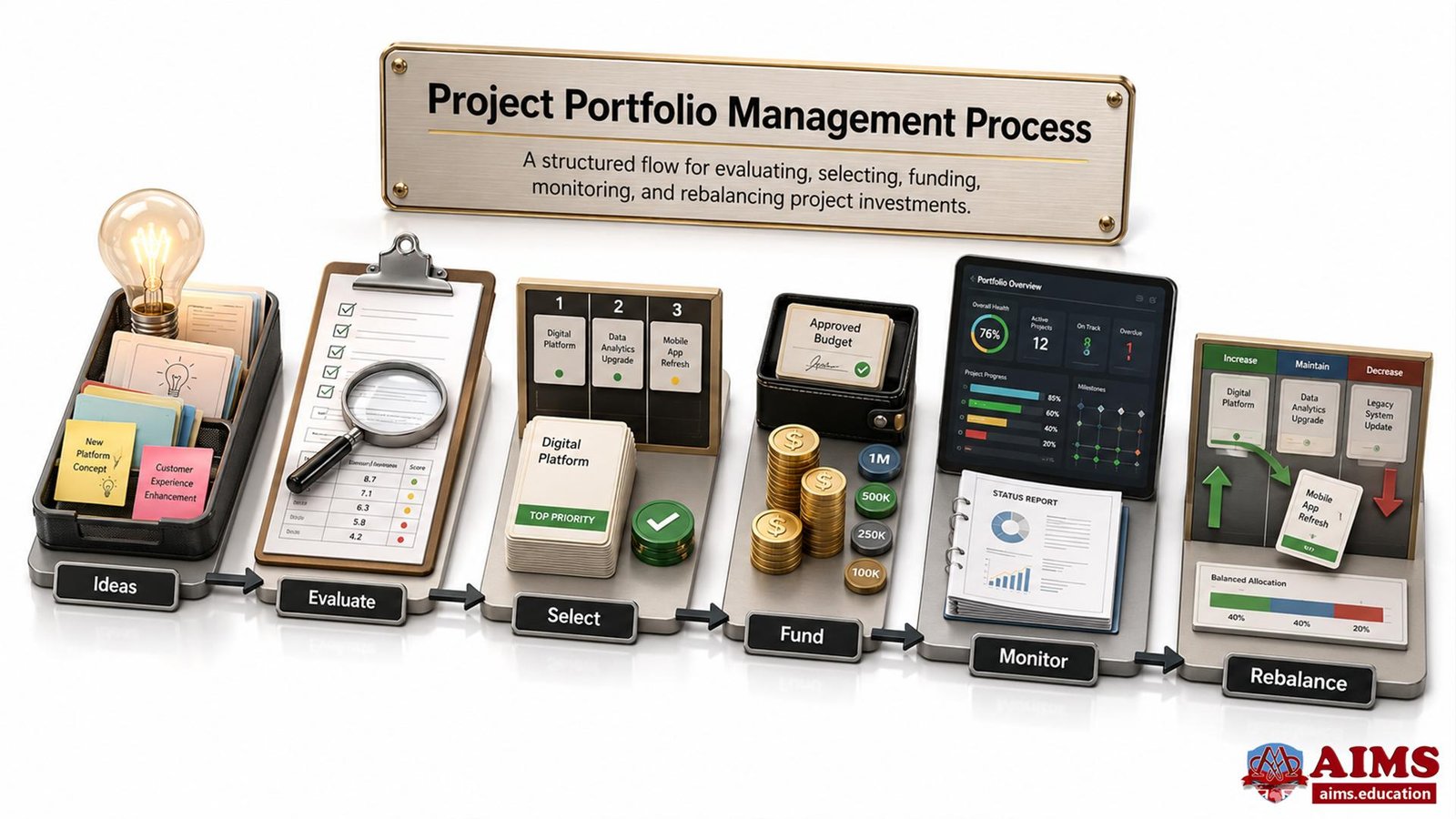
The project portfolio management process is the structured flow through which ideas become evaluated, selected, funded, monitored, and rebalanced portfolio components.
- It usually includes intake, business case review, scoring, prioritization, authorization, capacity planning, execution oversight, performance reporting, risk review, benefits tracking, and continuous improvement.
- A mature project portfolio management process creates a repeatable path from demand to decision.
- It prevents informal influence from replacing evidence, but it should not become slow bureaucracy.
- The process must be disciplined enough to protect value and flexible enough to respond when strategic conditions change.
Idea Intake, Business Cases, and Demand Management
Intake is the controlled entry point for new ideas, requests, proposals, and mandatory work. A good intake form asks for the business problem, strategic link, expected benefits, rough cost, resource needs, risks, dependencies, and consequences of not acting. Demand management then compares incoming work against capacity and priority.
Project Portfolio Managment Process Example
Suppose
- A business unit proposes a customer analytics project costing GBP 180,000 and requiring four months of data science support.
- The intake review confirms that the project supports the growth strategy, but it depends on a data-quality upgrade that has not yet been approved.
- The governance group delays final approval until the dependency is scheduled, which prevents a high-value project from starting before it can realistically succeed.
The practical impact is that the portfolio avoids false starts and protects scarce specialist resources.
Resource Capacity Planning
Resource capacity planning examines whether the organization has enough people, skills, funding, technology, and management attention to deliver the selected portfolio. It is not enough to approve ten projects because each one has a persuasive business case. The portfolio must be deliverable as a whole.
Funding Constraints
Funding constraints are closely related to Project Cost Management. Project-level cost estimates help the portfolio compare affordability, but portfolio-level decisions must also consider cash flow, opportunity cost, benefit timing, and the cost of delaying other initiatives.
Portfolio Governance and Decision Rights
- Project portfolio governance defines who can approve, reject, pause, reprioritize, or terminate initiatives. Clear portfolio governance and decision rights reduce confusion because decision-makers know which criteria matter and project teams know how decisions will be made.
- Governance should include senior sponsorship, transparent criteria, decision logs, escalation routes, and review cycles. It should also distinguish between project-level change control and portfolio-level investment decisions. A change request inside one project may affect the whole portfolio if it consumes shared funding or scarce experts.
Project Portfolio Risk Management
Portfolio risk management looks beyond the risks of one project. It examines aggregate exposure across the whole set of initiatives. The portfolio may be too dependent on one vendor, one technology, one regulatory assumption, one funding stream, or one overloaded department.
This is where project-level risk discipline remains essential. Teams that understand Project Risk Management provide better risk data to the portfolio, and that data allows leaders to model scenarios. For example, what happens if a supplier is delayed by three months, or if the budget is reduced by 15 percent?
Review Cycles, Stage Gates, and Portfolio Rebalancing
Review cycles keep the portfolio alive. A quarterly or monthly review may examine performance, benefits, resource pressure, risk, new demand, and strategic changes. Stage gates create formal decision points where work can continue, pivot, pause, or stop.
A practical five-step project portfolio management process may look like this:
- The organization collects proposals through a common intake route.
- The portfolio team evaluates each proposal using strategy, value, risk, dependency, and capacity criteria.
- The governance body authorizes the highest-priority and most feasible mix of work.
- Portfolio dashboards track progress, cost, benefits, resources, risks, and dependencies.
- Review meetings rebalance the portfolio by accelerating, pausing, reshaping, or terminating initiatives.
This cycle turns portfolio management into continuous strategic control rather than an annual approval exercise.
The Project Portfolio Management Process Step by Step
The project portfolio management process begins when ideas enter a controlled demand pipeline and ends only when value, risk, capacity, and strategic relevance are reviewed again. The process is cyclical because portfolios must change when strategy, budgets, markets, technologies, or resource constraints change.
Intake and Portfolio Governance Criteria.
The first step is intake. New ideas, business cases, regulatory requirements, improvement proposals, and innovation requests enter a portfolio pipeline. The project portfolio manager checks whether each request contains enough information for fair comparison.
Governance criteria usually include strategic alignment, expected value, affordability, feasibility, risk, urgency, dependencies, resource demand, and stakeholder impact. These criteria should be understood before decisions are made, not invented after a preferred project appears.
Evaluation, Scoring, and Project Selection and Prioritization.
Scoring models help structure project selection and prioritization, but they should support judgment rather than replace it. A weighted model may score each initiative against strategic fit, expected benefits, risk, capacity demand, cost, urgency, and dependency impact.
| SCORING FACTOR | DECISION QUESTION | EXAMPLE WEIGHT |
|---|---|---|
| Strategic Fit | Does the initiative directly support current organizational objectives? | 25% |
| Expected Benefits | Will the initiative create measurable financial, operational, customer, or capability value? | 20% |
| Risk Exposure | Can the organization accept the uncertainty, complexity, and potential negative impact? | 15% |
| Capacity Demand | Does the organization have the people, skills, systems, and time to deliver it? | 15% |
| Cost and Funding | Is the required investment realistic compared with available budget and expected value? | 15% |
| Urgency and Dependency | Does timing affect compliance, market opportunity, operational continuity, or other initiatives? | 10% |
Balancing Value, Cost, Risk, Capacity, and Timing.
After scoring, the portfolio must be balanced. A portfolio containing only high risk innovation may be too unstable. A portfolio containing only safe maintenance may fail to transform the organization. A balanced portfolio may include compliance work, growth initiatives, customer improvements, operational efficiency, and capability development.
The project portfolio manager also tests whether the approved work is deliverable. A portfolio is not balanced if every initiative depends on the same small group of people, the same executive sponsor, or the same technology platform at the same time.
Monitoring, Benefits Realization, and Portfolio Rebalancing.
Monitoring includes performance, benefits, risk, cost, schedule, dependency, and capacity review. Benefits realization checks whether approved initiatives are producing the intended value during and after delivery. Rebalancing adjusts the portfolio when evidence changes.
For example, an organization may approve four initiatives: a customer portal, a compliance upgrade, a data analytics platform, and an internal training system. If the budget is reduced by 20%, the project portfolio manager may recommend protecting the compliance upgrade, delaying the training system, reducing scope on the portal, and keeping the analytics platform only if its first phase produces measurable savings.
The practical impact is that leaders protect strategic value instead of cutting every project equally.
Project Portfolio Manager
A Project Portfolio Manager helps the organization choose, balance, monitor, and adjust the portfolio so it remains aligned with strategic objectives. The role is more strategic than project delivery because it focuses on investment choices, aggregate risk, resource allocation, governance recommendations, executive visibility, and portfolio value. You may refer to Guide on Project Portfolio Manager Roles and Responsibilities.
Professionals building project management expertise with Certified Project Management Expert (CPME) can use that foundation to understand delivery realities. Portfolio leadership then adds the ability to compare multiple delivery realities at once and recommend the best organizational choice.
Project Portfolio Management Tools (or PPM Tools)
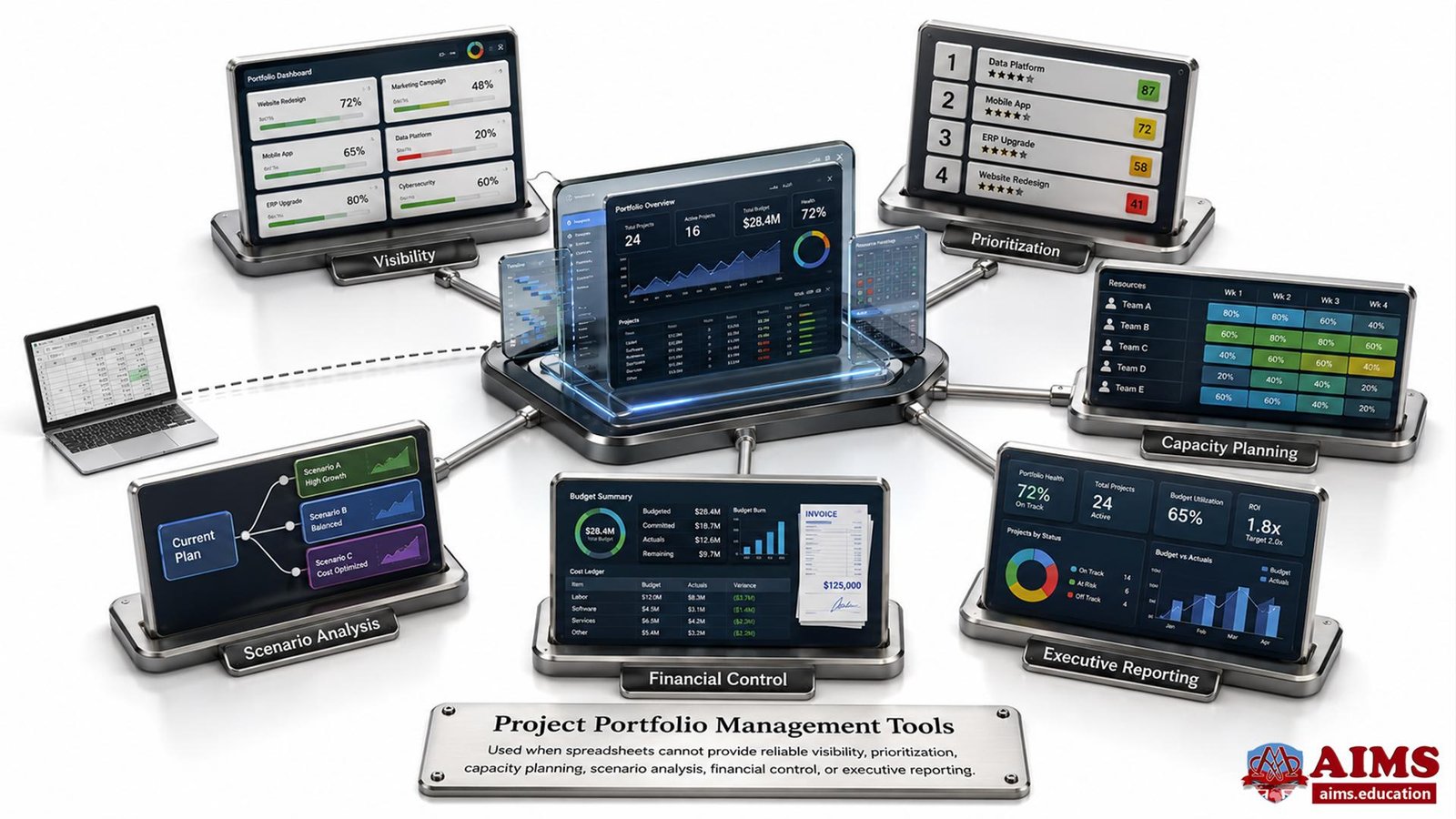
Project Portfolio Management Tools (PPM Tools) are software platforms used to evaluate, prioritize, plan, monitor, and govern multiple projects and programs as a single portfolio.
- They help portfolio managers compare strategic value, allocate budgets and resources, track risks and performance, manage dependencies, and decide which initiatives should be approved, delayed, changed, or stopped.
- They are used when spreadsheets cannot provide reliable portfolio visibility, prioritization, capacity planning, scenario analysis, financial control, or executive reporting.
- They are most useful when many initiatives compete for shared resources and leaders need fast, evidence-based portfolio decisions.
Project Portfolio Management Tools should not be purchased as a substitute for governance. Software can display data, automate workflows, and model scenarios, but leaders must still define decision criteria, ownership, review cadence, benefit measures, and escalation rules.
What Project Portfolio Management Tools Actually Do
- Project Portfolio Management Tools help organizations capture demand, compare proposals, rank initiatives, plan capacity, monitor progress, track risks, review benefits, and produce executive dashboards.
- They give leaders a portfolio-level view that ordinary task-management tools rarely provide.
Dedicated platforms may support portfolio dashboards and KPIs, prioritization matrices, financial tracking, scenario planning, dependency maps, roadmap views, and resource heat maps. When assessing dashboard quality, leaders should define what they need to measure before building reports. For related measurement guidance, see KPI in project management.
How to Evaluate Features in Project Portfolio Management Tools (PPM Tools)
PPM Tools should be evaluated by their ability to improve decisions, not by the length of their feature lists. Useful features include intake workflows, scoring models, scenario analysis, capacity views, budget controls, dependency tracking, benefits reporting, risk aggregation, and configurable dashboards.
| MATURITY LEVEL | BEST-FIT TOOLING | WHEN IT IS APPROPRIATE |
|---|---|---|
| Early Portfolio Discipline | Spreadsheets and simple reporting may be enough. | This works when there are few projects, limited dependencies, and stable resource demand. |
| Growing Multi-Project Environment | Standard project software with portfolio reporting may be enough. | This works when teams need stronger visibility but decisions are not yet highly complex. |
| Enterprise Portfolio Management | Dedicated PPM Tools are usually justified. | This works when leaders need prioritization, capacity planning, scenario analysis, financial control, and executive reporting across many initiatives. |
Prioritization Matrices, Scenario Analysis, Resource Views, Financial Controls, and Reporting
The most valuable features are the ones that reveal trade-offs. A prioritization matrix shows why one project outranks another. Scenario analysis shows the effect of budget cuts or staffing shortages. Resource views show overload before projects fail. Financial controls connect approval decisions with affordability. Reporting turns portfolio complexity into executive insight.
Project Portfolio Management Tools vs General Project Management Tools
- General Project Management Software usually helps teams plan tasks, schedules, collaboration, and delivery.
- Portfolio platforms focus on initiative intake, selection, strategic alignment, capacity, benefits, aggregate risk, and investment decisions.
The difference is not only scale. It is decision level.
- Project Portfolio Management Tools are appropriate when leaders need to compare initiatives before and during execution.
- Basic project software is appropriate when teams mainly need to deliver already-approved work.
- A small organization can often begin with spreadsheets, but a complex organization should not allow spreadsheet comfort to hide portfolio risk.
AI-Assisted Project Portfolio Analysis
The next stage of portfolio practice is not simply prettier dashboards. It is decision intelligence.
- AI-assisted analysis can help detect dependency patterns, forecast resource bottlenecks, summarize risk signals, compare alternative portfolio scenarios, and highlight projects whose expected value may be declining.
- Human governance remains essential. AI can strengthen the evidence base, but it should not replace accountable decision rights. The best future portfolio systems will combine transparent criteria, reliable data, scenario modeling, and experienced judgment.
Project Portfolio Management Examples
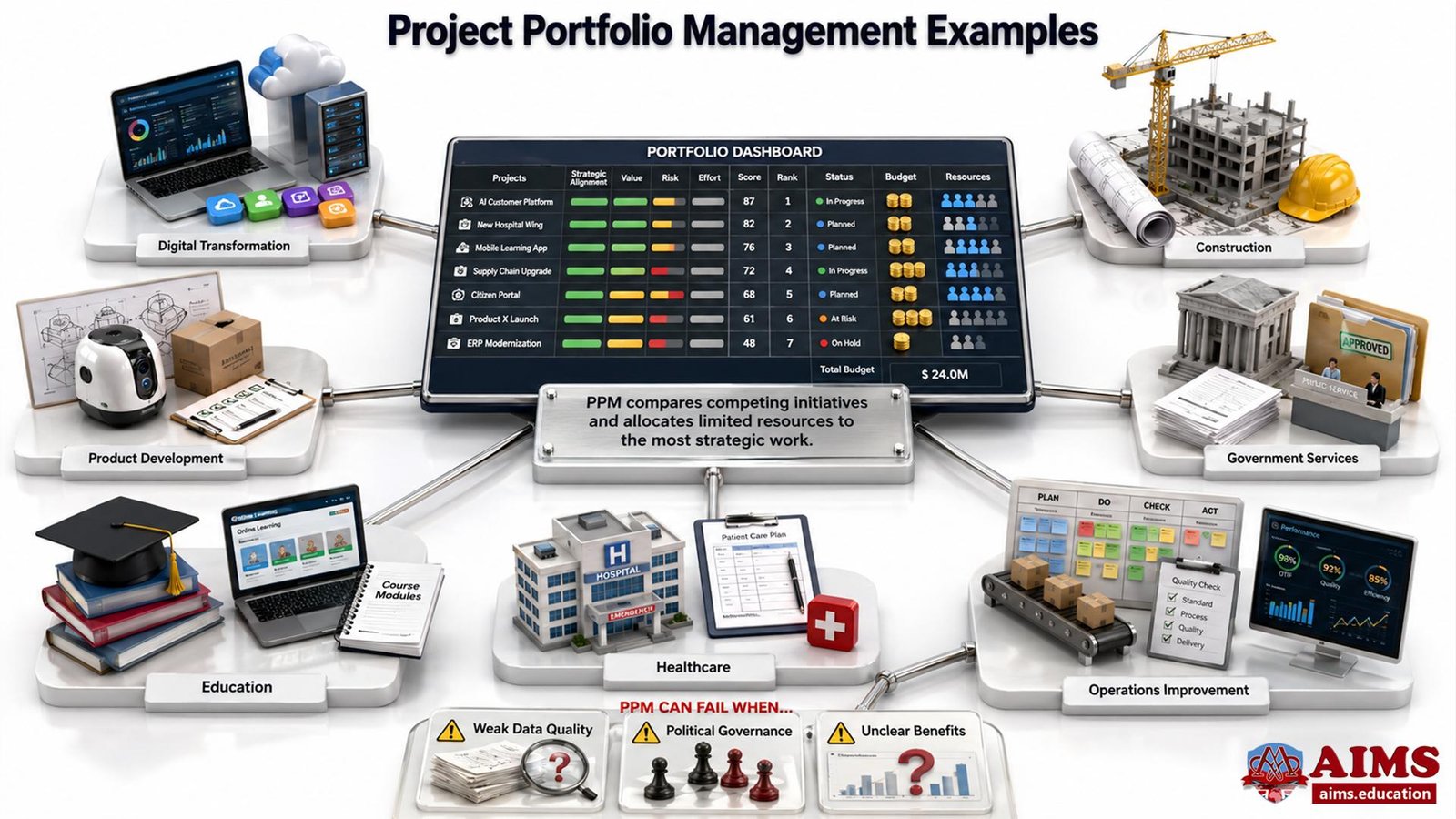
Project Portfolio Management applies wherever leaders must compare competing initiatives and allocate limited resources. It is useful in digital transformation, construction, product development, government services, education, healthcare, and operations improvement, but it can fail when data quality is weak, governance is political, or benefits are unclear.
Digital Transformation Portfolio Example
Imagine Noor Digital Services has GBP 900,000 for transformation and five proposals: a mobile app upgrade, a cybersecurity program, a CRM replacement, an AI chatbot pilot, and a data governance project. Each proposal has value, but the organization has only three senior architects and one cybersecurity lead.
- The cybersecurity program receives priority because it reduces enterprise risk and supports regulatory expectations.
- The data governance project is approved because it enables the CRM replacement and future AI work.
- The chatbot pilot is delayed because it depends on cleaner data and has lower current strategic urgency.
The portfolio decision improves sequencing because the organization funds enabling work before visible innovation.
Capital and Construction Portfolio Example
A construction firm may manage a portfolio covering retail, single-family residential, and multifamily residential projects. Some projects may offer higher margins, while others may reduce risk, support long-term client relationships, or maintain operational continuity. Portfolio management helps the firm compare projects across business units rather than approving them in isolation.
For Example
- A retail expansion project may have strong revenue potential, but it may require the same site managers needed for a safety-critical residential upgrade.
- The portfolio view allows leadership to stage work sensibly, protect safety obligations, and still pursue profitable growth.
Portfolio Management in Project Management, Program Management, and PMO
Portfolio management in project management clarifies where individual project delivery fits within wider organizational investment decisions. Projects deliver specific outputs, programs coordinate related benefits, Project Portfolio Management governs the overall mix of work, and PMO governance often provides standards, reporting, methods, and visibility across those levels.
Portfolio management in project management is often misunderstood.
- It does not mean that every project manager becomes responsible for the full enterprise portfolio.
- It means that project work should be selected, monitored, and judged in relation to strategic priorities, shared resources, risk appetite, benefits, and competing initiatives.
The distinction between portfolio management vs project management is especially important.
- Project management asks whether a defined project is being delivered within scope, time, cost, quality, resource, and risk constraints; whereas;
- Portfolio management asks whether the organization should continue investing in that project compared with other possible uses of the same resources.
| COMPARISON AREA | PROJECT MANAGEMENT | PROGRAM MANAGEMENT | PROJECT PORTFOLIO MANAGEMENT | PMO GOVERNANCE |
|---|---|---|---|---|
| Primary Purpose | It delivers one defined project output or result. | It coordinates related projects to achieve shared benefits. | It selects and balances the best mix of initiatives for strategy execution. | It supports standards, reporting, control, and governance discipline. |
| Main Question | Are we delivering the project correctly? | Are related initiatives producing the intended benefits? | Are we investing in the right work at the right time? | Do decision-makers have reliable methods, data, and oversight? |
| Time Horizon | It usually has a temporary life cycle with a defined end. | It lasts as long as coordinated benefits need active management. | It often continues as strategy, demand, and investments evolve. | It may continue as an organizational support and governance function. |
| Success Measure | Success is measured by deliverables, quality, schedule, budget, and stakeholder satisfaction. | Success is measured by benefit realization and coordinated outcomes. | Success is measured by aggregate value, strategic contribution, balance, and investment performance. | Success is measured by decision quality, transparency, compliance, and delivery visibility. |
The relationship between project program and portfolio management can be summarized as a hierarchy of decision focus. Projects create outputs, programs coordinate related outcomes and benefits, and portfolios guide the total investment mix. A PMO may support any of these levels. For readers who need the governance distinction, see Project Management Office.
This distinction also helps clarify the difference between program and project leadership. A project manager may manage a software implementation, while a program manager coordinates several related initiatives such as software, training, process redesign, and benefits transition. For a deeper comparison, see Program Manager VS Project Manager.
Project Portfolio Management Functions: Strategic Alignment, Prioritization, and Portfolio Balancing
Project Portfolio Management functions help organizations select, prioritize, govern, balance, and review projects and programs so the overall portfolio supports strategic objectives and delivers maximum value.
- Strategic alignment: Ensures that projects and programs support organizational objectives.
- Project selection: Evaluates which proposed initiatives should receive investment.
- Portfolio prioritization: Ranks projects according to value, risk, urgency, resources, and strategic fit.
- Resource capacity planning: Balances project demand against available people, skills, funding, and technology.
- Portfolio balancing: Maintains the right mix of risk, return, mandatory work, innovation, and operational improvement.
- Portfolio optimization: Adjusts, delays, accelerates, merges, or terminates initiatives to improve total portfolio value.
Importance of Project Portfolio Management
Project Portfolio Management protects strategic alignment and business value when many initiatives compete for limited resources. It helps leaders choose the right projects, balance risk and return, control demand, avoid resource overload, and redirect investment when priorities, markets, funding, or organizational capability changes.
The central logic is simple: organizations need to do the right work, not only deliver work right. A project can be professionally managed, on schedule, and within budget, yet still fail to justify continued investment if it no longer supports strategic priorities or if higher-value work is waiting for the same people and budget.
Doing the Right Work, Not Only Delivering Work Right
Project managers are trained to deliver approved work effectively. Portfolio managers and governance bodies decide whether the approved work still deserves priority. This is the heart of strategic alignment and business value. The organization must continuously compare demand against capacity and compare project-level enthusiasm against portfolio-level value.
The strongest portfolio decision is not always the approval of a new project. Sometimes it is the discipline to pause, merge, redesign, or terminate work that no longer contributes enough value.
Project Selection and Prioritization Criteria in Project Portfolio Management
Project portfolio prioritization works best when decisions are made through explicit criteria. Common criteria include strategic fit, expected value, risk exposure, urgency, dependency impact, regulatory importance, customer value, resource demand, funding requirement, and timing. These criteria help decision-makers compare very different initiatives using a shared logic.
Example
For example, a healthcare organization may compare three initiatives:
- A patient portal upgrade, a compliance reporting project, and an internal scheduling system.
- The patient portal may have the highest customer value, the compliance project may have the highest regulatory urgency, and the scheduling system may offer operational savings.
- Project selection and prioritization forces leaders to explain which value matters most now.
Strategic Fit, Value, Risk, Dependency, and Timing in Project Portfolio Management
A balanced scoring model may assign points to each factor. Strategic fit may receive 30 percent weight, expected value 25 percent, risk 15 percent, resource demand 15 percent, and timing 15 percent. The weights should reflect the organization’s current strategy, not a generic template copied from another company.
| CRITERION | WEIGHT | PROJECT A: CUSTOMER PORTAL | PROJECT B: COMPLIANCE REPORTING | PROJECT C: INTERNAL SCHEDULING |
|---|---|---|---|---|
| Strategic Fit | 30% | 5 out of 5 because it supports the digital service strategy. | 4 out of 5 because it protects regulatory credibility. | 3 out of 5 because it supports internal efficiency. |
| Expected Value | 25% | 4 out of 5 because it may improve retention and satisfaction. | 3 out of 5 because it avoids penalties rather than creating new revenue. | 4 out of 5 because it reduces staff overtime costs. |
| Risk and Complexity | 15% | 3 out of 5 because integration risk is moderate. | 4 out of 5 because requirements are clear and stable. | 2 out of 5 because user adoption risk is high. |
| Resource Capacity | 15% | 2 out of 5 because it needs scarce developers. | 4 out of 5 because it needs a smaller specialist team. | 3 out of 5 because it needs operational staff participation. |
| Timing and Dependency | 15% | 4 out of 5 because it enables future digital initiatives. | 5 out of 5 because the deadline is fixed. | 3 out of 5 because it has flexible timing. |
This example shows why the highest standalone value does not automatically win. If Project A needs the same developers who are required for a fixed compliance deadline, the portfolio may approve Project B first and stage Project A later. Portfolio balancing and optimization are about the best total decision, not the most exciting individual proposal.
Project Portfolio Balancing and Optimization
- Portfolio balancing compares short-term and long-term initiatives, high-risk and low-risk work, mandatory and discretionary projects, revenue growth and cost reduction, innovation and operational stability.
- A portfolio overloaded with urgent maintenance may starve innovation. A portfolio overloaded with innovation may expose operations to unacceptable risk.
Portfolio Balancing Example for Project Portfolio
Consider a construction firm with a yearly change budget of GBP 2 million and two senior planning engineers.
- Project X has an estimated return of GBP 700,000 but uses both engineers for eight months.
- Project Y has an estimated return of GBP 420,000 and uses one engineer for three months.
- Project Z is a safety compliance project with low financial return but high risk reduction.
A sensible portfolio may approve Y and Z first, then defer X until resource capacity improves.
Project Porfolio Management Benefits and Challenges
Benefits
The main benefits include better strategic alignment, stronger resource capacity planning, more transparent governance, improved risk visibility, better funding discipline, and clearer executive dashboards. These benefits depend on honest data and active leadership support.
Trade-Offs
The trade-offs are real. Portfolio transparency can expose weak business cases, political projects, duplicated work, unrealistic schedules, and resource overcommitment. Some sponsors may resist because portfolio management limits informal influence. Some teams may see review cycles as bureaucracy if leaders do not explain the value of disciplined decisions.
Implementation Problems
The most common implementation problems include unclear strategy, inconsistent business cases, low data quality, weak benefits tracking, overloaded governance meetings, and failure to stop projects that no longer deserve investment. The strongest remedy is a simple but firm governance model that starts with a few meaningful criteria and improves over time.
FAQs About Project Portfolio Management
What Is Project Portfolio Management in Simple Terms?
Project Portfolio Management is the practice of choosing and managing the best mix of projects and programs so they support organizational strategy. It helps leaders compare value, risk, cost, timing, dependencies, and resources before deciding what to approve, continue, delay, or stop.
What Does a Project Portfolio Manager Do?
A Project Portfolio Manager supports selection, alignment, and oversight. The role helps evaluate proposals, compare competing initiatives, monitor portfolio performance, highlight risks and dependencies, recommend rebalancing decisions, and give executives reliable visibility into whether the portfolio is still delivering strategic value.
What Are Project Portfolio Management Tools?
Project Portfolio Management Tools are software systems that help organizations manage demand, prioritize initiatives, plan resources, track budgets, model scenarios, monitor risks, and report portfolio performance. They are most useful when leaders need more than task tracking and require evidence for investment decisions.
Are PPM Tools the Same as Project Management Software?
No. PPM Tools are not the same as ordinary project management software because they focus on portfolio-level selection, prioritization, capacity, benefits, risk, and executive reporting. Project management software usually focuses on planning and delivering approved project work.
What Is the Project Portfolio Management Process?
The project portfolio management process usually includes five practical steps: collect proposals, evaluate them against strategy and value, prioritize and authorize the best mix, monitor delivery and benefits, and rebalance the portfolio when capacity, risk, funding, or strategic direction changes.
What Is the Difference Between Project Portfolio Management and Project Management?
Project management delivers one approved project within agreed constraints. Project Portfolio Management decides whether that project belongs in the organization’s investment mix, how it ranks against other initiatives, and whether it should continue receiving resources as strategy and conditions change.
How Are Projects Prioritized Across a Portfolio?
Projects are prioritized by comparing strategic fit, expected value, risk, urgency, dependency impact, funding needs, and resource capacity. A mature portfolio does not automatically approve the highest-ROI project if it creates unacceptable risk, blocks essential work, or overloads scarce resources.
Does Every PMO Need Project Portfolio Management?
Not every PMO needs a complex portfolio system, but every PMO benefits from some portfolio awareness. A small PMO may use simple prioritization and reporting, while an enterprise PMO may support full portfolio governance, demand management, capacity planning, and executive decision cycles.
What KPIs Belong on a Portfolio Dashboard?
Useful portfolio dashboard KPIs include strategic alignment, approved budget versus forecast, resource capacity, project health, benefit realization, risk exposure, dependency status, decision backlog, and portfolio balance. The best dashboard shows decisions that need action, not just colorful status reports.
When Should a Company Adopt Dedicated PPM Tools?
A company should adopt dedicated PPM Tools when the number of initiatives, dependencies, funding decisions, resource conflicts, and reporting needs exceed what spreadsheets or basic project software can manage reliably. The threshold is decision complexity, not company size alone.
Conclusion: Building a Portfolio That Can Execute Strategy
Project Portfolio Management turns strategy into a governed, balanced, and adaptable investment system. It helps organizations select the right initiatives, protect scarce resources, monitor value, manage portfolio risk, and make difficult trade-offs before delivery problems become strategic failures.
The strongest portfolio organizations are not the ones that approve the most projects. They are the ones that maintain the clearest link between strategy, funding, resources, risk, and benefits. That requires disciplined governance, honest data, capable managers, useful tools, and the willingness to rebalance work when reality changes.
About AIMS’ Project Management Academy
AIMS’ Project Management Academy has delivered project management education since 2005 through internationally accredited, career-focused curricula, qualified faculty, industry-oriented teaching, practical skill development, 3D interactive learning content, and real-world case studies. Its academic materials support job-ready qualifications in project, program, and project portfolio management.
This content, as well as AIMS’ study content and curriculum, is collaboratively developed and rigorously peer-reviewed by an academic board of qualified industry practitioners. To explore structured learning pathways, visit AIMS’ career-focused project management programs for portfolio-ready professionals.