
What Is Project Procurement Management?
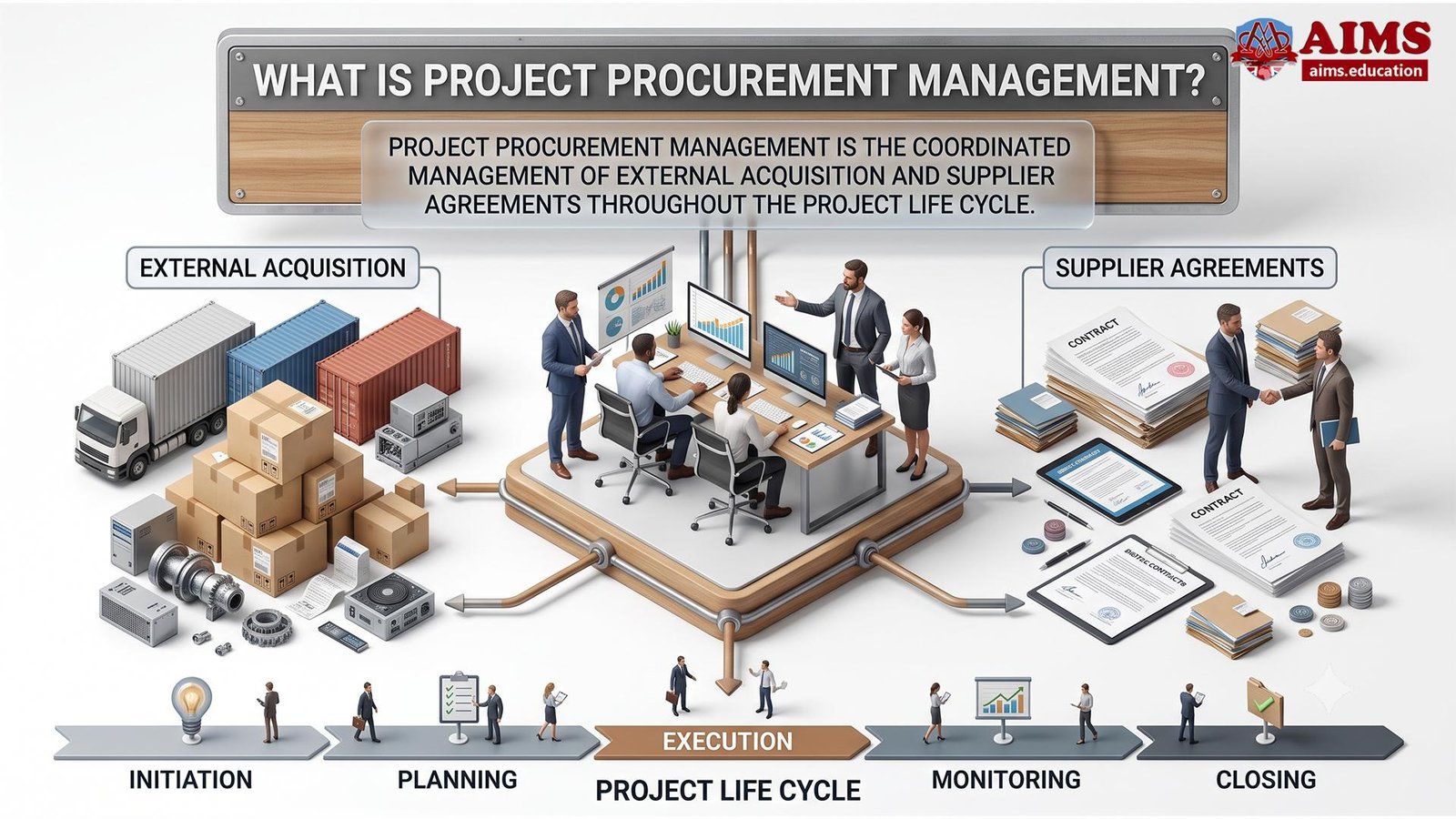
Project procurement management is the structured process of acquiring and managing goods, services, expertise, or results from external suppliers so a project can meet its requirements. It covers deciding what to outsource, preparing procurement documents, selecting vendors, awarding contracts, monitoring supplier performance, controlling changes, accepting deliverables, and formally closing each agreement.
- Effective procurement management in project management protects cost, schedule, quality, compliance, and risk objectives. It also helps the project team obtain capabilities that are unavailable internally.
- The organization may act as the buyer acquiring project inputs or as the seller delivering work under contract. In either position, procurement creates obligations that must be planned, authorized, monitored, changed, and closed carefully.
- Procurement may involve physical materials, specialist services, software, equipment, professional advice, construction work, outsourced project activities, insurance, or complete deliverables.
The process therefore extends beyond ordering an item. It connects project requirements with market capability and converts that relationship into a controlled commercial agreement.
Project procurement is not a single purchase. It is a managed relationship that links external capability to project value.
Procurement and Purchasing in Project Management
Procurement manages the complete external acquisition life cycle, while purchasing mainly performs the transaction of ordering and paying for goods or services. Purchasing is therefore one activity within the broader procurement function.
| ATTRIBUTE | PROJECT PROCUREMENT | PURCHASING |
|---|---|---|
| Primary purpose | Secure and manage external capability that satisfies project requirements. | Place orders and complete commercial transactions. |
| Typical scope | Planning, market analysis, solicitation, vendor selection, contracting, performance control, claims, and closure. | Purchase requisitions, purchase orders, receipts, invoices, and payments. |
| Decision focus | Best overall value, risk allocation, supplier capability, compliance, and project outcomes. | Correct item, quantity, price, delivery, and payment. |
| Time horizon | From early planning to contract closure and lessons learned. | Usually concentrated around the transaction and fulfilment period. |
Project Procurement and General Organizational Procurement
Project procurement is temporary, deliverable-focused, and closely linked to project baselines, while general procurement supports continuing organizational operations. Both use commercial controls, but project procurement must respond to a defined project end date and changing project conditions.
| ATTRIBUTE | PROJECT PROCUREMENT | GENERAL PROCUREMENT |
|---|---|---|
| Demand source | A unique project scope, deliverable, milestone, or risk response. | Recurring operational demand across the organization. |
| Schedule relationship | Supplier lead times can directly change the project critical path and completion date. | Delivery is normally managed against operational service levels or replenishment cycles. |
| Governance | Uses project change control, acceptance criteria, baselines, and stakeholder approvals. | Uses standing procurement policies, category strategies, and operational budgets. |
| Closure | Contracts are closed when project obligations and deliverables are completed. | Supplier relationships may continue indefinitely through renewals or framework agreements. |
Importance of Procurement Management in Project Management
Procurement management in project management is important because external suppliers can directly determine whether a project achieves its cost, schedule, quality, risk, and value objectives. A technically strong project plan can still fail when essential equipment arrives late, a vendor misunderstands the scope, or a contract allocates risk poorly.
- Cost control: Procurement planning establishes realistic estimates, commercial limits, payment conditions, and approval thresholds.
- Schedule protection: The project team coordinates tender periods, supplier mobilization, manufacturing time, delivery dates, and acceptance activities with the project schedule.
- Quality assurance: Specifications, service levels, inspections, testing procedures, and acceptance criteria define what satisfactory delivery means.
- Risk allocation: Contract terms assign selected responsibilities to the party best able to manage them, although a contract does not eliminate project risk.
- Compliance: Formal procurement supports organizational policy, legal requirements, licensing, confidentiality, ethical sourcing, and auditability.
- Capability access: External suppliers can provide specialist skills, technology, facilities, capacity, or intellectual property that the project team does not possess.
- Accountability: Written responsibilities, milestones, reporting expectations, payment conditions, and dispute procedures reduce ambiguity between buyer and seller.
In practice, procurement decisions should support the project business case rather than pursue the lowest visible price. Total cost, delivery reliability, technical capability, risk exposure, maintenance, support, and long-term value may be more important than the initial quotation.
Main Stages of the Project Procurement Management Process
The project procurement management process moves from deciding what the project should acquire to closing the supplier agreement after satisfactory completion. A practical procurement life cycle normally contains four management stages:
- Plan procurement management.
- Conduct procurements and award agreements.
- Control procurements and supplier performance.
- Close procurements and capture lessons learned.
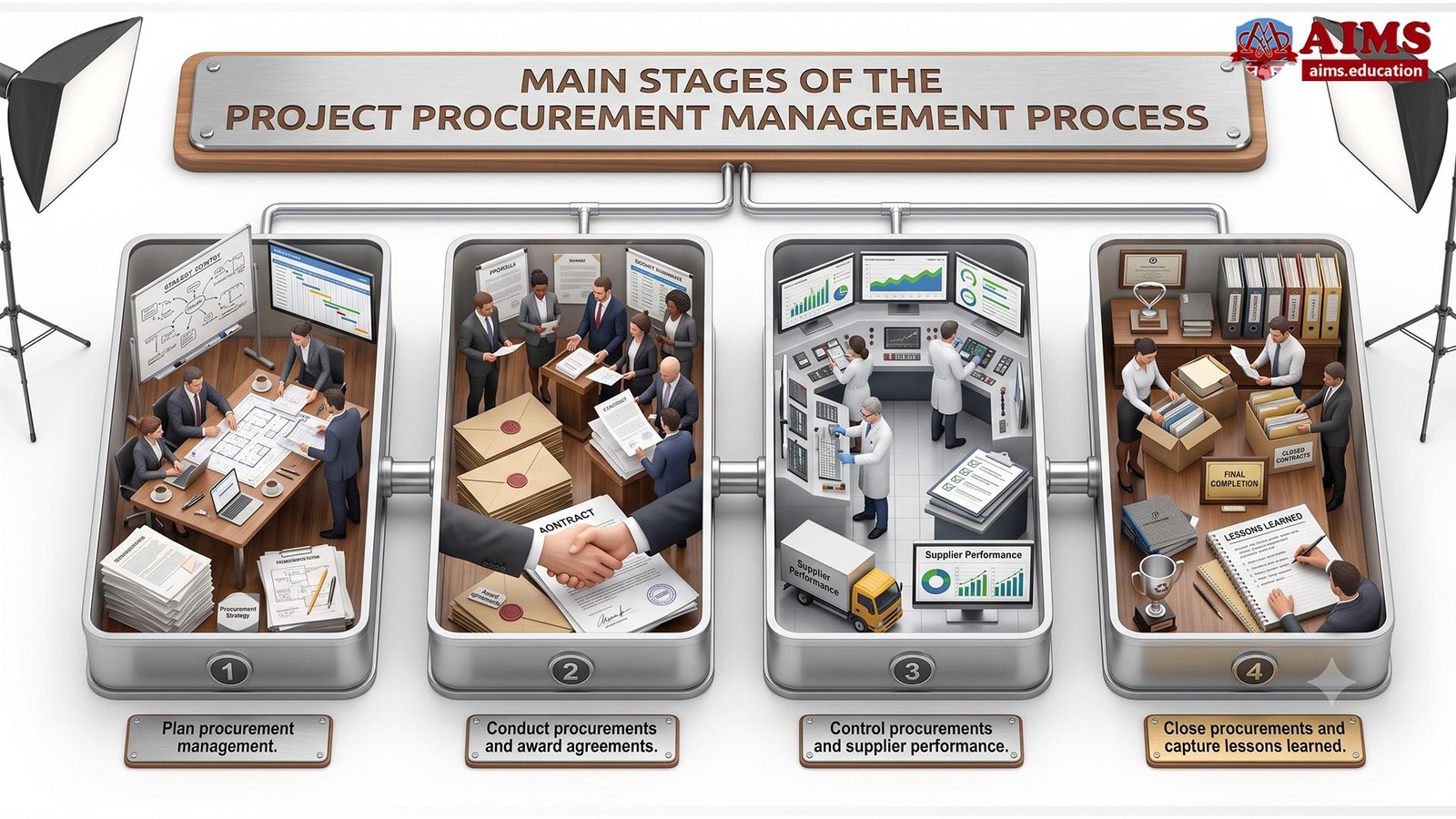
These stages provide a useful teaching and management structure, but organizations may combine, rename, repeat, or tailor them. The current PMI guidance on the PMBOK Guide and modern project delivery expands procurement coverage and presents process guidance in an evolved, non-prescriptive form. Therefore, the project team should apply the logic of the life cycle without treating one sequence as universal for every industry or delivery approach.
1. Plan Procurement Management
Plan procurement management determines what the project should obtain externally, why it is needed, when it is required, how sellers will be approached, and how each agreement will be governed. Effective project procurement planning starts before the request for quotation or proposal is issued.
The team first connects procurement needs to the approved project requirements. A clear project scope management approach for defining deliverables helps prevent suppliers from pricing incomplete or ambiguous work. The team can then use the work breakdown structure to identify contractable work packages, interfaces, milestones, and acceptance points.
Key Inputs to Procurement Planning
- The scope baseline describes deliverables, boundaries, assumptions, constraints, and acceptance criteria.
- Requirements documentation identifies technical, performance, safety, security, environmental, licensing, and legal needs.
- The project schedule identifies required dates, lead times, dependencies, and supplier mobilization windows.
- Resource requirements show which people, equipment, facilities, or specialist capabilities the project cannot provide internally.
- Cost estimates support bid evaluation and should-cost comparisons. A sound project cost management framework for estimates and baselines improves commercial decision-making.
- The risk register identifies threats that may be transferred, shared, reduced, or retained through procurement decisions. These choices should remain aligned with the wider project risk management process and response strategy.
- Organizational policies define approval limits, authorized signatories, preferred contract forms, ethical rules, and prequalified suppliers.
- Market conditions indicate supplier availability, capacity, pricing pressure, geographic constraints, and technology maturity.
How to Create a Project Procurement Management Plan
A project procurement management plan explains how procurement decisions and supplier agreements will be prepared, executed, controlled, and closed. The following steps create a practical plan:
- Define the external requirement. Describe the product, service, result, quantity, quality level, location, and required date.
- Complete the make-or-buy decision. Compare internal delivery, outsourcing, leasing, and mixed options using cost, capability, capacity, risk, and strategic criteria.
- Choose the procurement approach. Decide whether to use competitive bidding, quotations, proposals, negotiation, a framework supplier, or another authorized method.
- Select the contract strategy. Match the contract type to scope clarity, uncertainty, market conditions, delivery method, and risk allocation.
- Prepare the procurement statement of work. State outputs, specifications, milestones, reporting, service support, acceptance criteria, and exclusions clearly.
- Define roles and authority. Identify who prepares documents, evaluates offers, negotiates, approves, signs, inspects, accepts, and authorizes payment.
- Set the procurement schedule. Include document preparation, advertising, bidder questions, proposal submission, evaluation, negotiation, award, mobilization, delivery, and closure.
- Establish evaluation criteria. Define technical, commercial, risk, capacity, experience, quality, and sustainability factors before receiving bids.
- Plan supplier control. Specify reports, meetings, inspections, metrics, payment gates, change control, escalation, claims, records, and closure procedures.
A strong procurement plan gives the project team a repeatable decision framework instead of forcing improvised commercial choices under schedule pressure.
2. Conduct Procurements and Award Agreements
Conduct procurements is the stage in which the buyer requests seller responses, evaluates offers, negotiates acceptable terms, selects the preferred supplier, and awards the agreement. The objective is not merely to obtain bids. It is to identify the seller most capable of delivering the required value under manageable risk.
Typical Conduct Procurement Activities
- The buyer issues an RFI, RFQ, invitation for bid, RFP, or another approved solicitation document.
- Prospective sellers review the requirement and submit questions or clarification requests.
- A bidder conference may give all sellers the same information and reduce inconsistent assumptions.
- Sellers prepare technical and commercial responses based on the procurement statement of work.
- The evaluation team applies screening requirements, weighted criteria, independent estimates, demonstrations, references, and due diligence.
- The buyer ranks proposals, identifies a negotiation range, and resolves commercial or technical qualifications.
- Authorized representatives negotiate responsibilities, price, schedule, payment, change procedures, warranties, liabilities, intellectual property, acceptance, and dispute resolution.
- The organization completes required approvals before signing and communicating the award.
All bidders should receive fair and consistent treatment. Evaluation criteria must be defined before proposals are scored, and conflicts of interest should be disclosed and managed.
3. Control Procurements and Supplier Performance
Control procurements means managing the buyer-seller relationship, measuring performance against the agreement, approving valid changes, resolving issues, and confirming that payments correspond to accepted work. Procurement does not end when the contract is awarded.
- Review supplier progress against scope, schedule, cost, quality, safety, and service commitments.
- Inspect deliverables and audit processes where the agreement permits or requires verification.
- Track milestones, risks, issues, dependencies, nonconformities, decisions, and corrective actions.
- Compare invoices with completed and accepted work before authorizing payment.
- Process contract changes through the agreed change control system and the
project’s integrated change control process. - Document contested changes, claims, appeals, and settlement discussions carefully.
- Coordinate interfaces between multiple suppliers whose outputs depend on one another.
- Maintain complete correspondence, technical records, commercial records, approvals, and performance evidence.
Supplier communication should be timely, factual, and traceable. A defined project communication management structure for reporting and escalation helps the project manager prevent informal instructions from becoming disputed commitments.
4. Close Procurements
Close procurements confirms that contractual obligations have been completed, accepted, settled, documented, and formally concluded. Closure may occur for one contract before the overall project finishes, especially when several suppliers have different delivery periods.
- Verify that all contracted products, services, results, documentation, warranties, and support obligations have been delivered.
- Confirm that acceptance criteria and quality requirements have been satisfied.
- Resolve outstanding changes, claims, deductions, retentions, credits, and final payments.
- Issue formal acceptance or rejection documentation according to the agreement.
- Complete supplier performance evaluations and record eligibility for future work.
- Archive the contract, correspondence, invoices, inspection records, approvals, and closure evidence.
- Conduct a procurement audit and record lessons that should improve future sourcing and contract management.
Formal closure protects both parties by creating a clear record that obligations were completed or that remaining exceptions were deliberately settled.
Make-or-Buy Analysis in Project Procurement
Make-or-buy analysis compares delivering a requirement internally with purchasing, outsourcing, leasing, or otherwise obtaining it from an external provider. The decision should consider total value and strategic consequences, not only the
supplier’s quoted price.
Factors Used in a Make-or-Buy Decision
- Direct cost: Compare internal labor, materials, equipment, and overhead with purchase price, delivery, setup, contract administration, and taxes.
- Indirect and life-cycle cost: Consider training, maintenance, upgrades, support, disposal, transition, and supplier management.
- Capacity: Determine whether internal teams can perform the work without delaying existing priorities.
- Capability: Assess technical skills, experience, certifications, tools, intellectual property, and quality systems.
- Schedule: Compare internal development time with supplier lead time, onboarding, mobilization, and integration.
- Risk: Examine dependency, confidentiality, cybersecurity, supply continuity, performance uncertainty, and switching difficulty.
- Strategic control: Retain work internally when it protects core capability, competitive knowledge, sensitive data, or essential governance.
- Market conditions: Consider supplier availability, competition, price volatility, location, currency, and long-term support.
Make-or-Buy Analysis Example for an IT Project
An IT implementation team can use make-or-buy analysis to decide whether to build a specialist integration internally or contract an experienced vendor.
- Nova Retail needs an interface between its new cloud platform and a legacy inventory system.
- The internal team estimates four months of work at $96,000, but its developers are committed to other critical releases.
- A specialist vendor proposes $112,000 and can deliver in ten weeks, including testing and 60 days of support.
- The team identifies data-security risk and requires controlled access, code review, documentation, and knowledge transfer.
- Management selects the vendor because the schedule benefit and specialist capability outweigh the $16,000 price difference.
- The contract links payments to approved design, tested integration, user acceptance, and completed knowledge transfer.
Structured analysis allows the project to buy external speed without surrendering technical control or operational knowledge.
Types of Procurement Contracts in Project Management
Types of procurement contracts define how price, performance obligations, uncertainty, and financial risk are distributed between buyer and seller. The three broad contract families are:
- Fixed-price contracts.
- Cost-reimbursable contracts.
- Time-and-materials contracts.
The correct choice depends on scope clarity, market conditions, delivery duration, technical uncertainty, change likelihood, and each
party’s ability to control risk. Contract terminology and enforceability vary by jurisdiction, so high-risk agreements require review by authorized procurement and legal specialists.
| CONTRACT FAMILY | BEST USED WHEN | PRIMARY COST RISK | MANAGEMENT PRIORITY |
|---|---|---|---|
| Fixed price | The scope, deliverables, quantities, and acceptance criteria are sufficiently defined. | The seller generally carries more cost-overrun risk within the agreed scope. | Prevent scope ambiguity and control changes formally. |
| Cost reimbursable | The work is uncertain, innovative, research-based, or difficult to estimate accurately. | The buyer generally carries more total-cost uncertainty. | Define allowable costs, audit rights, incentives, reporting, and spending controls. |
| Time and materials | Specialist effort is needed quickly, but the full quantity of work is not yet known. | The buyer carries exposure as hours and material quantities increase. | Use rate cards, ceilings, work authorizations, timesheet controls, and frequent reviews. |
Fixed-Price Contracts
A fixed-price contract sets an agreed price for defined products, services, or results. It works best when the buyer can describe the requirement precisely and the seller can estimate the effort with reasonable confidence.
- Firm fixed price: The seller agrees to deliver the defined scope for a set amount and generally absorbs additional internal cost caused by inefficiency or underestimation.
- Fixed price with incentive: The contract adds a measurable reward for meeting or exceeding specified cost, schedule, quality, or technical targets.
- Fixed price with economic adjustment: The contract permits defined adjustments for exceptional economic changes over a longer delivery period.
Fixed price does not protect the buyer from vague requirements. When the scope is unclear, the seller may price a large contingency, submit frequent change requests, or deliver a technically compliant result that does not meet the underlying need.
Cost-Reimbursable Contracts
A cost-reimbursable contract pays the seller for allowable costs and normally adds an agreed fee, incentive, or award mechanism. It is useful when uncertainty prevents reliable fixed pricing, but it requires strong financial governance.
- Cost plus fixed fee: The seller receives allowable costs plus a fixed fee that does not increase merely because actual costs rise.
- Cost plus incentive fee: The seller receives allowable costs plus an incentive linked to objective performance targets and an agreed sharing formula.
- Cost plus award fee: The buyer determines an additional award based on stated performance criteria and the evaluation method defined in the agreement.
The buyer should define allowable costs, reporting frequency, audit rights, authorization limits, and performance controls before work begins.
Time-and-Materials Contracts
A time-and-materials contract pays agreed labor rates for actual time worked and reimburses or prices materials according to the contract. It combines fixed unit rates with variable total quantities.
This form is useful for urgent specialist support, short assignments, discovery work, and situations where the exact effort cannot be determined in advance. However, the buyer should apply a not-to-exceed ceiling, short authorization periods, approved roles, timesheet verification, deliverable checkpoints, and clear termination rights.
Documents Used in the Project Procurement Process
Procurement documents translate project requirements into instructions, offers, agreements, performance evidence, and closure records. Clear documentation improves competition, evaluation consistency, contract enforceability, auditability, and supplier performance.
| DOCUMENT | PRIMARY PURPOSE |
|---|---|
| Procurement management plan | Defines the procurement approach, authority, schedule, contract strategy, controls, metrics, and closure method. |
| Procurement statement of work | Describes required outputs, specifications, quantities, milestones, work location, support, and acceptance criteria. |
| Request for information | Collects market information when the buyer needs to understand available solutions or supplier capability. |
| Request for quotation | Requests price and delivery information for a requirement that can be described consistently. |
| Invitation for bid | Invites competitive bids when award can be based mainly on compliance and price. |
| Request for proposal | Requests a technical and commercial solution when approach, capability, and value matter alongside price. |
| Source selection criteria | Defines how seller responses will be screened, scored, compared, and approved. |
| Seller proposal or bid | Explains the seller’s solution, resources, assumptions, schedule, price, risks, and contractual qualifications. |
| Contract or purchase order | Creates the binding obligations, commercial terms, responsibilities, acceptance rules, and remedies. |
| Performance and closure records | Document reports, inspections, changes, invoices, acceptance, claims, supplier evaluations, and lessons learned. |
Vendor Selection in Project Management
Vendor selection in project management is the disciplined evaluation of seller capability, value, risk, and contractual suitability against predefined project criteria. The cheapest supplier is not automatically the best supplier, especially when technical failure or late delivery would create greater project losses.
Common Vendor Evaluation Criteria
- Understanding of the procurement statement of work and project objectives.
- Technical solution, methodology, tools, and quality approach.
- Relevant experience, references, past performance, and contract compliance.
- Availability and competence of the proposed team.
- Delivery schedule, production capacity, and supply-chain resilience.
- Total evaluated cost, payment profile, and life-cycle cost.
- Financial stability, insurance, licenses, and legal eligibility.
- Risk exposure, assumptions, exclusions, warranties, and support commitments.
- Data protection, cybersecurity, intellectual property, and confidentiality controls.
- Project management, communication, reporting, and escalation capability.
Weighted Vendor Selection Example
A weighted scoring model converts multiple evaluation criteria into a consistent comparative score. In this simplified example, both suppliers passed the mandatory requirements before weighted scoring began.
| CRITERION | WEIGHT | VENDOR A SCORE | VENDOR B SCORE |
|---|---|---|---|
| Technical capability | 30% | 4 out of 5 | 5 out of 5 |
| Delivery confidence | 20% | 4 out of 5 | 3 out of 5 |
| Total evaluated cost | 20% | 3 out of 5 | 4 out of 5 |
| Risk and compliance | 15% | 4 out of 5 | 3 out of 5 |
| Relevant experience | 10% | 5 out of 5 | 4 out of 5 |
| Support model | 5% | 3 out of 5 | 4 out of 5 |
| Weighted total | 100% | 3.85 out of 5 | 3.95 out of 5 |
Vendor B receives the higher weighted score, but the evaluation team should still validate assumptions, references, capacity, commercial terms, and negotiation outcomes before award.
How Procurement Risks and Supplier Performance Are Controlled
Procurement risk control identifies threats in the buyer-seller relationship and applies contractual, technical, financial, operational, and communication controls throughout delivery. The contract allocates responsibility, but active management determines whether that allocation works in practice.
Common Project Procurement Risks
- Incomplete requirements or ambiguous acceptance criteria.
- Supplier insolvency, capacity shortage, or key-person dependency.
- Late delivery, poor quality, or repeated rework.
- Uncontrolled changes, constructive changes, or unclear instructions.
- Price escalation, currency exposure, or inaccurate estimates.
- Cybersecurity, confidentiality, data protection, or intellectual property failures.
- Dependence on a sole supplier or difficult replacement arrangements.
- Subcontractor failure and weak visibility below the prime contractor.
- Regulatory, licensing, safety, environmental, or ethical noncompliance.
- Disputes over scope, payment, delay responsibility, warranty, or termination.
Supplier Performance Control Methods
- Performance baselines: Measure the seller against contractual scope, milestone, cost, quality, and service commitments.
- Key performance indicators: Track on-time delivery, defect rates, response time, issue closure, cost variance, and acceptance results.
- Progress reviews: Use scheduled meetings to examine evidence, decisions, risks, dependencies, and recovery actions.
- Inspections and audits: Verify products, processes, documentation, facilities, controls, and compliance where authorized.
- Payment gates: Link payment to verified progress, accepted deliverables, or agreed milestones rather than elapsed time alone.
- Change control: Require written impact analysis, approval authority, updated terms, and traceable implementation.
- Corrective action: Record deficiencies, responsible owners, due dates, verification steps, and escalation thresholds.
- Claims administration: Preserve facts, correspondence, notices, schedules, cost evidence, and decisions for negotiated settlement or formal resolution.
Good control is firm but collaborative. The objective is to protect the agreement while helping both parties resolve problems early enough to preserve project value.
The Project Manager’s Role in Procurement Management
The project manager integrates procurement decisions with the project plan and ensures that external work supports the required outcomes. The project manager may not hold legal signing authority, but remains accountable for coordinating scope, schedule, cost, quality, risk, communication, and supplier interfaces.
Core Responsibilities of the Project Manager
- Identify external resource and deliverable needs with the project team.
- Provide clear requirements, work-package information, estimates, schedules, risks, and acceptance criteria.
- Support make-or-buy analysis and contract strategy decisions.
- Coordinate procurement, legal, finance, technical, security, quality, and operational specialists.
- Participate in bidder clarification, proposal evaluation, due diligence, and negotiations where authorized.
- Monitor supplier delivery and coordinate dependencies between internal teams and multiple vendors.
- Document performance issues, decisions, changes, approvals, and lessons learned.
- Confirm whether deliverables satisfy project requirements before acceptance and payment authorization.
Specialists add essential commercial, legal, financial, and technical expertise. However, the project manager must keep procurement integrated with the whole project rather than allowing the contract to operate as an isolated administrative activity.
Common Misunderstandings and Procurement Mistakes
Procurement mistakes usually arise when teams treat external acquisition as a clerical purchase instead of a project management decision. Four misunderstandings deserve particular attention.
Misunderstanding 1: Procurement Is the Same as Purchasing
Purchasing processes the transaction. Procurement determines the need, sourcing strategy, supplier, agreement, controls, acceptance, and closure. A purchase order may be simple, but the decisions supporting it can still affect project risk and value.
Misunderstanding 2: The Lowest Bid Is the Best Bid
A low bid may exclude essential work, depend on unrealistic assumptions, use weak resources, or create higher operating and change costs. The project should compare total evaluated value, not price in isolation.
Misunderstanding 3: Procurement Ends at Contract Award
Award begins the most operationally important period. The team must monitor performance, manage interfaces, verify invoices, control changes, resolve claims, accept deliverables, and close the agreement formally.
Misunderstanding 4: The Project Manager Works Alone
Complex procurement needs coordinated expertise. Procurement professionals manage sourcing and commercial controls, legal advisers review enforceability and liability, finance controls budgets and payments, while technical specialists evaluate solution quality and acceptance.
Frequent Practical Mistakes
- Issuing an RFP before requirements and acceptance criteria are stable enough for fair comparison.
- Selecting a contract type that conflicts with the level of uncertainty in the work.
- Allowing bidders to use different assumptions without normalizing their offers.
- Beginning work before authorization, insurance, security access, or contract execution is complete.
- Giving informal instructions that change supplier effort without approved contractual modification.
- Paying invoices without verifying deliverables, evidence, and acceptance conditions.
- Failing to coordinate dependencies between several suppliers.
- Waiting until closure to report quality defects or performance failures.
- Closing the project without settling claims, archiving records, or evaluating supplier performance.
Project Procurement Management Example: Construction Project
This project procurement management example shows how a construction team can connect requirements, sourcing, contract award, performance control, and closure.
Scenario
Orion Developments is delivering a $2.4 million regional office extension. The internal team can manage design coordination and site governance, but it must procure structural steel fabrication and installation from an external specialist.
Step-by-Step Procurement Decisions
- Define the requirement. The structural package specifies drawings, steel grades, fabrication tolerances, coatings, delivery sequence, lifting responsibilities, inspection points, and completion dates.
- Complete make-or-buy analysis. Orion lacks fabrication facilities, certified welders, and transport capability, so outsourcing is necessary.
- Prepare procurement documents. The buyer issues an RFP containing the statement of work, drawings, schedule milestones, safety requirements, quality records, and proposal instructions.
- Evaluate vendors. The team screens licenses and capacity, then scores technical approach, delivery plan, safety performance, experience, price, and financial stability.
- Select the contract. A fixed-price agreement is chosen because the design is sufficiently defined, with a narrowly written adjustment mechanism for approved design changes.
- Award and mobilize. The selected seller submits the detailed fabrication schedule, method statements, insurance evidence, quality plan, and key personnel for approval.
- Control performance. Weekly reviews track design queries, material certification, fabrication progress, delivery readiness, inspections, safety actions, and interface dates with the concrete contractor.
- Manage change. A revised loading requirement increases two beam sizes. The supplier submits a documented cost and schedule impact, which is reviewed and approved before fabrication changes begin.
- Accept and close. The team verifies installation, inspection records, as-built drawings, warranties, final account, and outstanding defects before issuing formal completion.
Disciplined procurement keeps the specialist package commercially controlled while protecting the construction sequence, quality, safety, and final acceptance.
Project Procurement Management Example: IT Implementation
An IT procurement combines technical solution evaluation with commercial, security, implementation, support, and knowledge-transfer controls.
Scenario
Meridian Health Services plans a $180,000 customer relationship management implementation across six locations. Its internal team can own business requirements and user adoption, but needs an external partner for configuration, integration, data migration, and deployment support.
Step-by-Step Procurement Decisions
- Define outcomes. The statement of work specifies workflows, integrations, data volumes, security controls, testing, training, cutover, support, and measurable acceptance criteria.
- Research the market. An RFI confirms which suppliers have relevant platform capability, regulated-sector experience, and local support capacity.
- Issue the RFP. Shortlisted vendors submit solution designs, project plans, proposed teams, assumptions, risk registers, support models, and commercial offers.
- Evaluate the solution. The buyer uses weighted scoring, reference checks, a technical demonstration, and security due diligence rather than choosing the lowest price.
- Structure the agreement. A short time-and-materials discovery phase validates requirements, followed by fixed-price implementation work packages with milestone acceptance.
- Control delivery. The project manager reviews sprint demonstrations, defects, data-quality results, resource use, decision logs, risks, invoices, and milestone evidence.
- Protect continuity. The agreement requires documentation, administrator training, source configuration records, and knowledge transfer to reduce supplier dependency.
- Close the procurement. Final acceptance follows successful user testing, cutover, stabilization, documentation delivery, and resolution of priority defects.
A blended procurement strategy gives the project flexibility during discovery and stronger cost certainty once requirements become stable.
How Procurement Integrates with Other Project Management Areas
Procurement is an integrated project management activity because every supplier decision can affect several project baselines and stakeholder commitments.
- Scope: The contract statement of work must align with project deliverables, exclusions, and acceptance criteria.
- Schedule: Tendering, approvals, manufacturing, mobilization, delivery, testing, and supplier dependencies must appear in the project schedule.
- Cost: Estimates, bids, contingency, payment timing, currency, taxes, changes, and claims influence the cost baseline and cash flow.
- Quality: Specifications, inspections, testing, service levels, warranties, and defect correction translate quality requirements into supplier obligations.
- Risk: Contract clauses can allocate responsibilities, but residual and secondary risks still require active project responses.
- Resources: External personnel must be integrated with internal roles, access controls, facilities, tools, and reporting arrangements.
- Stakeholders: Users, sponsors, procurement, legal, finance, operations, regulators, and suppliers may hold different acceptance and governance responsibilities.
- Communication: Formal notices, reports, instructions, approvals, decisions, and escalation routes preserve shared understanding and evidence.
- Change: Project and contract change systems must work together so technical changes receive commercial and schedule authorization.
Professional Relevance of Project Procurement Skills
Project procurement skills help professionals convert external market capability into controlled project results. These skills are valuable in construction, engineering, technology, energy, healthcare, supply chains, finance, public services, consulting, and any project that depends on suppliers or contractors.
A capable project professional should understand requirements definition, market engagement, make-or-buy analysis, solicitation documents, vendor evaluation, negotiation support, contract risk, performance control, claims awareness, and closure. Learners who want a structured foundation can explore online project management certification for agile & waterfall skills. Professionals seeking broader planning, governance, risk, and delivery depth may consider advanced online diploma in project management.
Successful Procurement Management in Project Management
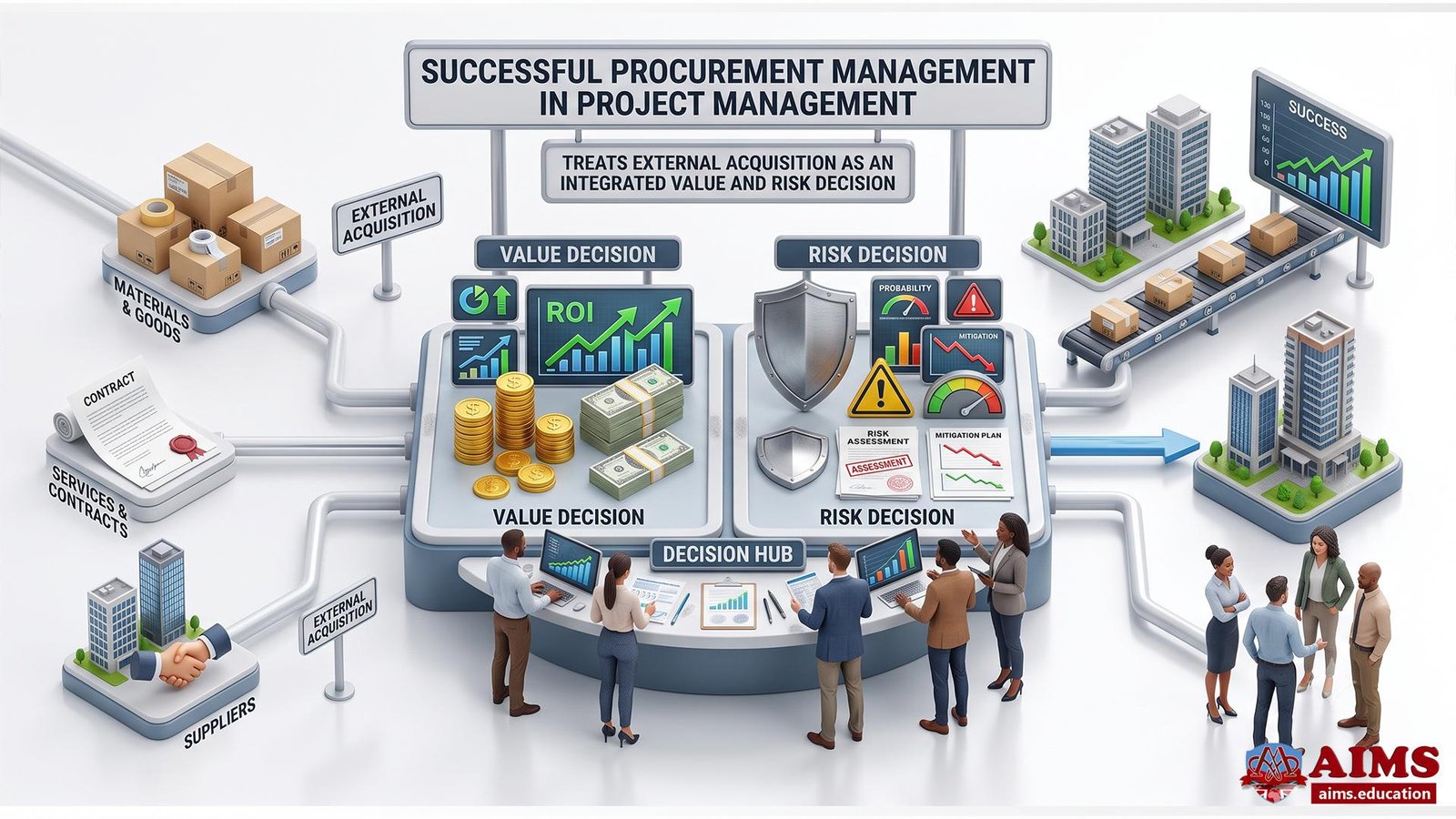
Procurement management in project management succeeds when the project team treats external acquisition as an integrated value and risk decision. The work begins with a clear need, continues through make-or-buy analysis, sourcing, vendor selection, contracting, and performance control, and ends only after obligations are accepted, settled, documented, and learned from.
The most effective procurement approach is not automatically the cheapest or most detailed. It is the approach that matches project uncertainty, market capability, organizational governance, and the consequences of supplier performance. Clear requirements, suitable contracts, objective evaluation, disciplined communication, and active control turn a supplier agreement into a dependable contributor to project success.
Frequently Asked Questions
What is project procurement management?
Project procurement management is the process of planning, sourcing, contracting, controlling, and closing goods, services, expertise, or results obtained from external suppliers. It ensures that outside contributions meet project scope, schedule, cost, quality, risk, compliance, and acceptance requirements.
Why is procurement management important in a project?
Procurement management is important because supplier performance can directly affect project cost, delivery dates, quality, safety, compliance, and value. Structured procurement also clarifies responsibilities, improves competition, controls changes, supports auditability, and reduces the risk of selecting an unsuitable supplier.
What are the main stages of project procurement management?
The practical stages are planning procurement, conducting the sourcing and award process, controlling supplier performance and contract changes, and closing the procurement. Organizations may tailor or combine these stages according to project size, industry, delivery approach, regulation, and internal governance.
How do you create a project procurement management plan?
Define the external requirement, complete make-or-buy analysis, choose the sourcing method and contract type, prepare the statement of work, assign authority, establish the procurement schedule, set evaluation criteria, and define performance, payment, change, records, claims, and closure controls.
What is the difference between procurement and purchasing in project management?
Procurement covers the complete external acquisition life cycle, including strategy, market engagement, vendor selection, contracts, performance control, claims, acceptance, and closure. Purchasing is narrower and mainly handles ordering, receiving, invoicing, and payment transactions within that broader process.
What are the main types of contracts used in project procurement?
The main contract families are fixed price, cost reimbursable, and time and materials. Fixed price suits well-defined work, cost reimbursable suits uncertain work requiring flexible effort, and time and materials suits situations where unit rates are known but the total quantity is not.
How does make-or-buy analysis support procurement decisions?
Make-or-buy analysis compares internal delivery with outsourcing, purchasing, leasing, or mixed options. It considers total cost, capability, capacity, schedule, risk, strategic control, confidentiality, market conditions, maintenance, support, and life-cycle value before the organization commits to a sourcing approach.
How are vendors evaluated and selected for a project?
Vendors are screened against mandatory requirements and then compared using predefined technical, commercial, schedule, risk, capacity, experience, quality, and support criteria. Weighted scoring, demonstrations, reference checks, independent estimates, due diligence, and negotiations help identify the best overall value.
What is the project manager’s role in procurement management?
The project manager defines and integrates project requirements, schedules, risks, acceptance criteria, and supplier dependencies. The role also includes supporting evaluation and negotiation, monitoring delivery, coordinating specialists, documenting changes and issues, verifying performance, and confirming readiness for acceptance and closure.
How are procurement risks and supplier performance controlled?
Teams control procurement risk through clear specifications, suitable contracts, due diligence, performance indicators, progress reviews, inspections, payment gates, written change control, corrective actions, claims records, escalation procedures, and formal acceptance. Controls should be proportionate to contract value, complexity, and potential project impact.
What documents are used in the project procurement process?
Common documents include the procurement management plan, statement of work, RFI, RFQ, invitation for bid, RFP, selection criteria, seller proposals, evaluation records, contracts, purchase orders, performance reports, change records, invoices, inspection results, acceptance notices, supplier evaluations, and closure files.
About AIMS Project Management Academy
Since 2005, AIMS’ Project Management Academy has delivered internationally accredited, globally accessible education through career-focused curricula, qualified faculty, and industry-oriented teaching. Its internationally standardized qualifications develop practical skills through 3D interactive learning content and real-world case studies. AIMS study content and curricula are collaboratively developed and rigorously peer-reviewed by an academic board of qualified industry practitioners. Project procurement knowledge strengthens professional competence in sourcing, contracts, supplier risk, and value delivery. Explore practical and flexible project management qualifications.