
What Is Islamic Monetary Policy?
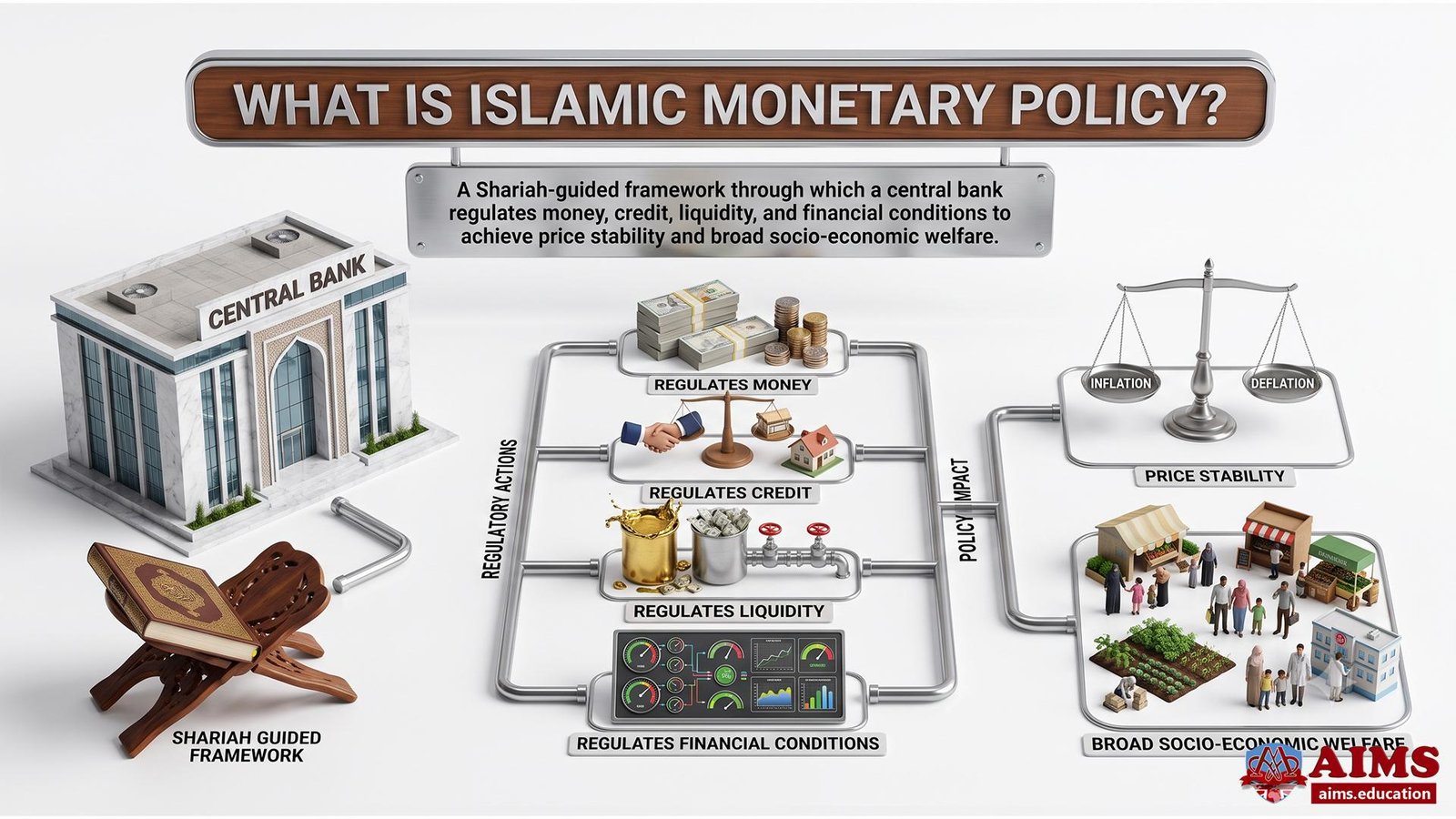
Islamic monetary policy is a Shariah-guided framework through which a central bank regulates money, credit, liquidity, and financial conditions to achieve price stability and broad socio-economic welfare. It operates within the wider values of an Islamic economic system built around justice and real economic activity.
- In practice, an interest-free monetary policy does not mean that a central bank becomes passive. It means that the bank replaces interest-rate manipulation with carefully designed quantitative, liquidity, prudential, and Shariah-compliant market instruments.
- The central question is therefore not whether monetary policy can function without riba, but how money creation, public deficits, bank financing, and liquidity support can be governed responsibly.
The Islamic monetory policy framework begins with the prohibition of riba. A conventional central bank commonly changes a policy interest rate to influence borrowing, saving, investment, asset prices, and aggregate demand. Under a fully Islamic system, that policy lever cannot be the organising principle because predetermined interest is prohibited.
“Allah has permitted trade and forbidden interest (riba).” Qur’an, Surah Al-Baqarah, Verse 275.
Trade, leasing, and partnership involve ownership, risk, productive activity, or identifiable services. Riba fixes a return on lending regardless of the financed activity’s outcome. The underlying distinction is explained in AIMS’ guide to the meaning and forms of riba in Islamic finance.
Core Principles of an Islamic Monetary Policy Framework
The framework rests on several connected principles:
- The central bank must avoid interest-bearing policy instruments and transactions that violate Shariah.
- Monetary expansion should correspond broadly with the economy’s capacity to produce goods and services.
- Credit should support productive, socially useful, and widely beneficial activity rather than speculation or artificial asset inflation.
- Monetary and fiscal authorities must coordinate because uncontrolled public borrowing can undermine price stability.
- Liquidity support must preserve stability without guaranteeing unjustified private gains.
- Policy must combine market discipline with ethical and prudential safeguards.
Money is therefore treated as a means of exchange and public trust, not an asset that automatically earns a risk-free return.
Objectives of Islamic Monetary Policy
The main objectives of Islamic monetary policy are price stability, adequate money growth, sustainable output, financial stability, equitable credit allocation, and protection of the currency’s internal and external value. These objectives are economic and moral because monetary disorder affects employment, purchasing power, debtors, savers, and the distribution of wealth.
- Preserve money’s purchasing power.
- Support sustainable output, employment, and productive enterprise.
- Maintain bank liquidity and financial stability.
- Promote equitable financing and confidence in the currency.
| OBJECTIVE | MONETARY POLICY MEANING | PRACTICAL POLICY QUESTION |
|---|---|---|
| Price stability | Money supply should not grow persistently faster than the economy’s capacity to produce real output. | Is new liquidity financing production, or merely increasing prices? |
| Sustainable growth | The system should provide enough liquidity for viable investment without creating an inflationary boom. | Is monetary growth adequate, excessive, or restrictive? |
| Financial stability | Banks need Shariah-compliant access to short-term liquidity and emergency support under disciplined conditions. | Can a sound institution meet temporary cash obligations without interest-based borrowing? |
| Equitable allocation | Credit policy should not systematically exclude small firms, farmers, or socially necessary activities. | Who receives newly created financing, and what does it produce? |
| Currency confidence | Domestic stability supports the external value of money and reduces destabilising capital flight. | Are fiscal, monetary, and external policies mutually consistent? |

How Does Islamic Monetary Policy Work Without Interest?
Islamic monetary policy works without interest by regulating the quantity and allocation of money, the supply of central-bank reserves, bank credit creation, and access to Shariah-compliant liquidity. The policy focus shifts from changing the price of interest-bearing credit to controlling monetary conditions at their source.
1. Money Demand Is Linked Mainly to Transactions and Precaution
In the source framework, money demand arises mainly from transaction and precautionary needs. The speculative motive is expected to be smaller because investors cannot switch between cash and interest-bearing securities in anticipation of changing rates.
Idle cash earns no return, may lose purchasing power, and may remain subject to zakat. Surplus funds therefore have an incentive to enter permissible investment, trade, leasing, or partnership arrangements.
2. The Central Bank Targets Money and High-Powered Money
Money supply in Islamic economics can be managed by setting a desired growth path for broad money and then regulating high-powered money, commonly represented by currency in circulation plus commercial-bank deposits at the central bank. The target should reflect expected real output growth, changes in money demand, price stability, and the wider objectives of the economy.
“The variable in terms of which monetary policy should be formulated in an Islamic economy is the stock of money rather than the level of interest rates.”
Targets still require review because velocity, capital flows, fiscal activity, and shocks can change. Their purpose is to prevent political or banking pressure from turning money creation into unrestricted finance.
3. Policy Is Transmitted Through Liquidity, Credit, Profits, and Expectations
The Islamic monetary policy transmission mechanism operates through several channels:
- Bank liquidity: Central-bank reserves affect the capacity of Islamic banks to finance customers.
- Credit allocation: Limits, incentives, and guarantees influence which sectors receive funds.
- Profit and investment: Expected profitability affects partnership-based financing.
- Assets and sukuk: Eligible market and collateral operations alter liquidity.
- Exchange rates and expectations: Credible policy influences prices, capital flows, investment, and saving.
The framework therefore relies heavily on liquidity management, prudential regulation, fiscal coordination, and sound market infrastructure.
Example: Expanding Productive Financing Without Cutting Interest Rates
Assume the economy is growing below capacity, inflation is moderate, and viable small manufacturers cannot obtain sufficient working capital.
- The central bank confirms that a controlled increase in base money is consistent with stable prices.
- It provides approved Shariah-compliant funding to participating Islamic banks.
- Eligibility rules direct financing toward productive sectors and qualified small firms.
- The central bank monitors output, prices, defaults, and liquidity before extending the programme.
Productive capacity can expand without making a predetermined interest rate the contractual foundation of monetary support.
3 Major Sources of Islamic Monetary Expansion
Monetary expansion in an Islamic economy comes mainly from government deficit financing, commercial-bank credit creation, and the monetisation of external surpluses. Effective policy must monitor all three because controlling only one source may leave inflationary pressure unchecked.
Government Budget Deficits
A fiscal deficit becomes inflationary when the government obtains real resources through money creation faster than the economy can increase real output. The source paper therefore treats monetary and fiscal coordination as indispensable, not optional.
Normal recurring expenditure should ordinarily rely on public revenue. Productive projects may use equity, leasing, sukuk, or other permissible structures supported by assets or cash flows. Emergency measures should remain transparent, limited, and consistent with stability.
This is why fiscal discipline in an Islamic policy framework is central to monetary credibility. A central bank cannot maintain stable money if public authorities continually require it to monetise excessive or wasteful expenditure.
“Each of you is a shepherd, and each of you is responsible for his flock.” Narrated by Abdullah ibn Umar, Sahih al-Bukhari, Book of Friday Prayer.
Government resources are an amanah, and excessive monetary financing transfers real costs to society through lost purchasing power.
Commercial-Bank Credit Creation
Islamic commercial banks create deposit money when they extend financing, just as conventional banks expand deposits through lending. The contractual form may be different, but an excessive increase in bank-created money can still become inflationary when production does not rise correspondingly.
The central bank must regulate reserves, financing growth, liquidity, capital, and concentration. Shariah compliance does not remove credit risk, moral hazard, or the inflationary effect of excessive financing.
Balance-of-Payments Surpluses and Capital Flows
An external surplus expands domestic money when foreign-exchange receipts are converted and spent without adequate offset. Persistent inflation and weak fiscal discipline can instead trigger capital outflows. Stable external value therefore depends substantially on stable internal purchasing power.
Islamic Monetary Policy Instruments
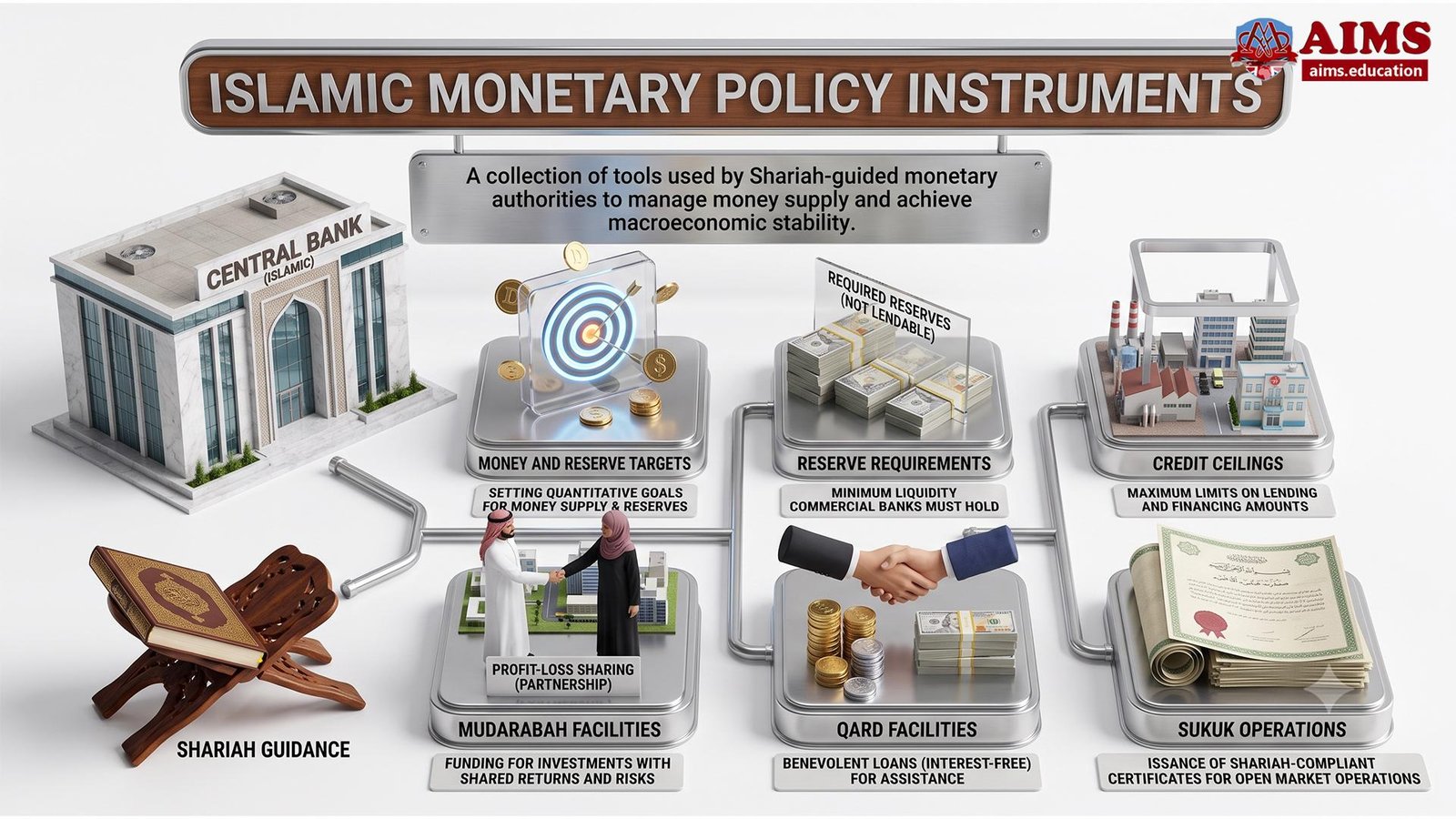
Islamic monetary policy instruments are Shariah-compliant tools used to regulate reserves, liquidity, financing growth, monetary expansion, and the direction of credit. Some instruments control quantity, some influence allocation, and others provide temporary liquidity or absorb surplus funds.
| INSTRUMENT | PRIMARY FUNCTION | SHARIAH AND POLICY CONSIDERATION |
|---|---|---|
| Money and reserve targets | Set a disciplined path for monetary expansion. | Targets must be reviewed when output, velocity, or external conditions change materially. |
| Reserve requirements | Change the proportion of eligible deposits that banks must hold at the central bank. | The treatment of demand and investment accounts should reflect their legal and risk characteristics. |
| Credit ceilings | Prevent aggregate financing from exceeding monetary targets. | Allocation should preserve sound competition and avoid arbitrary political favouritism. |
| Mudarabah facilities | Provide investment-based central-bank funding to institutions or priority activities. | Profit-sharing terms must be contractually clear, while genuine losses follow Shariah rules. |
| Qard facilities | Absorb surplus liquidity or provide limited non-interest liquidity support. | The facility should not become a disguised guaranteed return or a permanent subsidy. |
| Sukuk operations | Provide tradable or collateral-eligible assets for liquidity management. | The sukuk structure, ownership rights, tradability, and underlying assets must be Shariah-compliant. |
The Role of Mudarabah and Profit-Sharing Facilities
Mudarabah can support central-bank financing when one party supplies funds and another manages productive use. Profit shares are agreed in advance, while losses follow the capital contribution unless misconduct or breach is established.
The central bank should not manipulate private profit-sharing ratios as policy rates. Profitability differs by firm and sector, while contractual ratios require legal stability.
What Role Does Sukuk Play in Islamic Monetary Policy?
Sukuk can support Islamic monetary policy by giving central banks and financial institutions Shariah-compliant assets for liquidity absorption, collateral, investment, and market-based operations. Their usefulness depends on sufficient issuance, suitable maturities, active secondary markets, reliable pricing, and structures that permit lawful trading.
Short-term sovereign or central-bank sukuk may absorb liquidity or serve as collateral. They are not automatically interchangeable with treasury bills because assets, ownership, cash flows, tradability, and Shariah approval matter. See AIMS’ guide to sukuk structures, meanings, and principal types.
Modern Shariah-Compliant Liquidity Operations
Central banks may use qard, murabahah, wakalah, sukuk, reserves, and standing facilities, depending on national law and Shariah governance. Bank Negara Malaysia’s Islamic money market operations provide a practical example. These arrangements extend, rather than replace, the source paper’s focus on monetary control and liquidity support.
Islamic Monetary Policy vs Conventional Monetary Policy
The main difference is that conventional monetary policy normally transmits policy through an interest-rate structure, whereas Islamic monetary policy must use Shariah-compliant quantity, liquidity, credit, market, and prudential channels. Both systems may pursue price and financial stability, but their contractual foundations and permissible instruments differ.
| DIMENSION | ISLAMIC MONETARY POLICY | CONVENTIONAL MONETARY POLICY |
|---|---|---|
| Legal foundation | Shariah principles, including the prohibition of riba in Islam and requirements governing contracts, risk, and assets. | Secular monetary law and interest-bearing financial contracts. |
| Typical policy anchor | Money, reserves, liquidity conditions, financing growth, and approved market instruments. | A short-term policy interest rate, often supported by open-market operations. |
| Liquidity tools | Qard, sukuk, murabahah, wakalah, reserves, deposit transfers, swaps, and approved standing facilities. | Interest-bearing loans, repos, treasury securities, discount windows, and deposit facilities. |
| Transmission | Bank liquidity, financing availability, expected profits, asset markets, exchange rates, and expectations. | Interest rates, bank credit, asset prices, exchange rates, and expectations. |
| Credit allocation | May explicitly consider productive use, social welfare, inclusion, and Shariah eligibility. | Usually relies more heavily on market pricing, risk, collateral, and regulatory constraints. |
| Government financing | Taxes, equity, leasing, sukuk, asset-linked structures, and limited non-interest borrowing. | Taxation and interest-bearing sovereign debt are standard instruments. |
Islamic policy is not conventional policy with Arabic labels. Ownership, risk, assets, profit entitlement, and loss allocation have legal consequences, although every central bank must still manage reserves, inflation, expectations, and systemic liquidity.
How Islamic Monetary Policy Helps Control Inflation
Islamic monetary policy controls inflation by limiting excessive money creation, restraining unsustainable credit expansion, coordinating public expenditure with real resources, and directing finance toward productive supply. It addresses both the monetary causes of inflation and the structural conditions that prevent output from responding.
The policy sequence is straightforward:
- Estimate sustainable output growth and money demand.
- Set a monitored path for broad money and central-bank money.
- Restrict excessive deficit monetisation and bank financing.
- Adjust reserves, liquidity facilities, ceilings, or eligible market operations.
- Support essential supply and review exchange-rate pressures.
Monetary policy cannot solve supply disruption, monopoly, conflict, imported costs, or weak infrastructure alone. These causes require complementary policies, as explained in AIMS’ study of inflation and price stability in an Islamic economy.
Example: Absorbing Excess Liquidity Without an Interest-Bearing Deposit Facility
Assume banks hold large surplus balances, financing is expanding rapidly, and consumer prices are accelerating.
- The central bank increases the amount of liquidity it absorbs through an approved qard or sukuk-based facility.
- It may raise reserve requirements on eligible demand deposits or reduce new central-bank funding.
- It tightens financing-growth limits for speculative or non-essential activities.
- It coordinates with the treasury to postpone non-essential spending and avoid new deficit monetisation.
- It monitors whether financing growth and inflation expectations begin to moderate.
Excess purchasing power is reduced while the policy avoids paying or charging a predetermined interest return.
Can Islamic Monetary Policy Respond to a Recession?
Islamic monetary policy can respond to recession by expanding Shariah-compliant liquidity, supporting viable bank financing, accelerating productive public investment, and protecting solvent institutions from temporary liquidity stress. The response must address weak demand without financing waste, insolvent projects, or politically favoured losses.
If expected profits are weak, liquidity alone may not create investment. Government may need to advance essential infrastructure or employment projects using revenue, sukuk, leasing, partnerships, guarantees, or limited monetary support consistent with price stability.
A lender-of-last-resort facility can prevent forced sales and avoidable failures, but it requires permissible contracts, safeguards, access limits, and corrective action for weak institutions.
Example: Supporting an Islamic Bank Facing a Temporary Liquidity Shortage
Suppose Amanah Bank is solvent and holds sound financing assets, but an unexpected deposit outflow creates a three-day liquidity gap.
- The bank first uses its own liquid assets and available interbank arrangements.
- It presents eligible sukuk or other approved assets to the central bank as collateral.
- The central bank provides short-term liquidity through a Shariah-compliant standing facility.
- The facility includes a fixed maturity, reporting duties, liquidity-restoration steps, and penalties for misconduct rather than interest on money.
- The bank repays the facility when expected cash inflows arrive.
Temporary support prevents disorderly failure while preserving accountability and limiting moral hazard in the banking system.
Monetary Policy in the Presence of Islamic Banking
In a dual banking system, Islamic and conventional banks operate under the same macroeconomic conditions but may respond differently to policy instruments. This creates operational challenges because the central bank must maintain a coherent policy stance while providing both sectors with fair access to suitable liquidity and risk-management tools.
Can Conventional Interest-Rate Decisions Affect Islamic Banks?
Yes. Even when Islamic contracts do not charge interest, conventional policy-rate changes can affect Islamic banks indirectly through market benchmarks, deposit competition, customer expectations, exchange rates, asset prices, funding conditions, and the pricing of comparable financial products.
This does not automatically make an Islamic contract interest-based. It shows that legal form cannot isolate a bank from its environment. A robust Islamic central banking and monetary policy framework needs deeper Islamic money markets, suitable benchmarks, sufficient sukuk, and equal access to central-bank facilities.
Implementation Challenges in Dual Banking Systems
- Instrument scarcity: Islamic banks may lack short-term, high-quality liquid assets.
- Benchmark dependence: Pricing may still reference conventional rates.
- Uneven transmission: One policy action can affect the two banking sectors differently.
- Shariah variation: Jurisdictions may disagree about tradability or particular structures.
- Fiscal and market weakness: Government financing pressure and thin markets can undermine policy.
- Data and cross-border gaps: Weak information and inconsistent standards restrict effective operations.
The solution is a coherent framework connecting Shariah contracts, monetary objectives, markets, treasury operations, supervision, and crisis facilities.
Value-Oriented Credit Allocation and Financial Inclusion
Value-oriented credit allocation means directing financial resources toward productive and socially beneficial uses while maintaining commercial discipline. It does not require the central bank to decide every financing transaction or replace professional risk assessment.
Small firms may create employment yet remain excluded by collateral and evaluation costs. Partial guarantees, shared due diligence, accounting support, specialised institutions, and incentives can improve access. Guarantees must not erase genuine business losses or transfer predictable private risk to the public.
Common Misconceptions About Islamic Monetary Policy
Islamic monetary policy is often misunderstood because people either reduce it to a ban on interest or assume that Shariah compliance automatically guarantees economic stability. Both views are incomplete.
- Misconception 1: Islamic banks do not create money. Bank financing can expand deposits and purchasing power, so central-bank regulation remains necessary.
- Misconception 2: Profit-sharing ratios are Islamic policy rates. Contractual profit shares depend on negotiated risk and expected profitability and should not be manipulated mechanically.
- Misconception 3: Sukuk solve every liquidity problem. Sukuk require suitable assets, issuance, maturities, tradability, pricing, and market depth.
- Misconception 4: Removing interest removes inflation. Deficits, supply shocks, credit booms, and weak production can still raise prices.
- Misconception 5: Shariah form is enough. Policy must also consider substance, justice, public welfare, and systemic risk.
Professional Relevance of Islamic Monetary Economics
Islamic monetary economics is professionally relevant to central bankers, regulators, Islamic-bank treasurers, economists, Shariah scholars, risk managers, public-debt officials, and financial-market policymakers. Each group must understand how legal structures and macroeconomic effects interact.
Professionals must test whether instruments are both Shariah-compliant and effective, credit supports output, public financing is sustainable, and emergency support limits moral hazard.
Structured academic preparation can strengthen this decision-making. AIMS provides an advanced diploma covering Islamic banking and finance practice and career-focused Islamic finance certification courses if you are seeking applied knowledge of Shariah contracts, banking operations, risk, and financial policy.
Final Words
Islamic monetary policy is not merely the removal of an interest-rate announcement. It requires disciplined money creation, responsible fiscal policy, sound bank regulation, credible liquidity facilities, and productive credit allocation.
Its central lesson is that money creation is a social prerogative. Modern instruments are legitimate and effective only when they preserve Shariah principles while managing inflation, liquidity, and financial stability.
Frequently Asked Questions
What is Islamic monetary policy?
Islamic monetary policy manages money supply, liquidity, credit, inflation, and financial stability through Shariah-compliant instruments. It avoids interest-based policy transactions and uses money targets, reserves, financing controls, qard, sukuk, prudential rules, and fiscal coordination.
How does Islamic monetary policy work without interest?
It influences the quantity, availability, and allocation of money rather than relying on an interest rate. The central bank can regulate reserves, financing limits, liquidity facilities, sukuk operations, government deposits, and fiscal coordination.
What instruments are used in Islamic monetary policy?
Instruments include money targets, reserve requirements, credit ceilings, qard, mudarabah funding, sukuk operations, collateralised facilities, government-deposit transfers, swaps, liquidity pools, guarantees, and moral suasion. The exact set depends on law, market depth, and Shariah governance.
How is Islamic monetary policy different from conventional monetary policy?
Conventional policy normally centres on an interest rate and interest-bearing securities. Islamic policy avoids riba and uses permissible contractual and quantitative tools, with explicit attention to Shariah compliance, productive activity, risk allocation, and welfare.
How does Islamic monetary policy help control inflation?
It limits money and financing growth that exceeds real output, coordinates with fiscal policy, absorbs surplus liquidity, and supports productive supply. Inflation caused by shortages or external shocks still requires complementary policies.
What role does sukuk play in Islamic monetary policy?
Sukuk provide tradable or collateral-eligible Shariah-compliant assets for liquidity absorption, market operations, treasury funding, or temporary central-bank facilities. Their effectiveness depends on lawful structure, sufficient issuance, reliable pricing, and liquid markets.
Can conventional interest-rate decisions affect Islamic banks?
Yes. Policy-rate changes can affect Islamic banks indirectly through benchmarks, deposit competition, customer expectations, exchange rates, asset prices, and general liquidity conditions, especially where Islamic and conventional institutions share the same markets.
What challenges arise in a dual banking system?
Challenges include instrument scarcity, benchmark dependence, uneven transmission, Shariah differences, thin sukuk markets, weak data, and unequal access to central-bank facilities. The framework must serve both sectors without forcing Islamic institutions into prohibited transactions.
Islamic Monetary Policy Education at AIMS
Since 2005, AIMS’ Institute of Islamic Banking and Finance has delivered internationally accredited, career-focused education to learners worldwide. Its internationally standardised curriculum combines qualified faculty, industry-oriented teaching, practical skill development, 3D interactive learning content, and real-world case-study-based qualifications. AIMS educational resources, study content, and curricula are collaboratively developed and rigorously peer-reviewed by an academic board of qualified industry practitioners. Understanding monetary policy strengthens professional competence in Islamic banking, regulation, treasury, and financial stability. Explore practical and flexible Islamic banking and finance programs.