
What Is an Engineering Project Manager?
An engineering project manager is responsible for coordinating the technical and managerial activities required to deliver an engineering project successfully. The manager oversees how engineers, designers, manufacturers, contractors, suppliers, and other specialists work together from project initiation through final delivery.
- An engineering project manager leads engineering projects from planning through completion, coordinating technical teams while controlling scope, schedule, budget, quality, risk, resources, and deliverables.
- The role combines engineering understanding with project leadership, helping engineers, designers, suppliers, clients, and other stakeholders turn technical requirements into a coordinated plan and a completed, usable outcome.
In practice, engineering project management sits between technical engineering work and professional project delivery. Titles such as project management engineer, project manager engineer, and project engineering manager may also appear in job descriptions, although their exact responsibilities vary between employers, engineering disciplines, industries, and project structures.
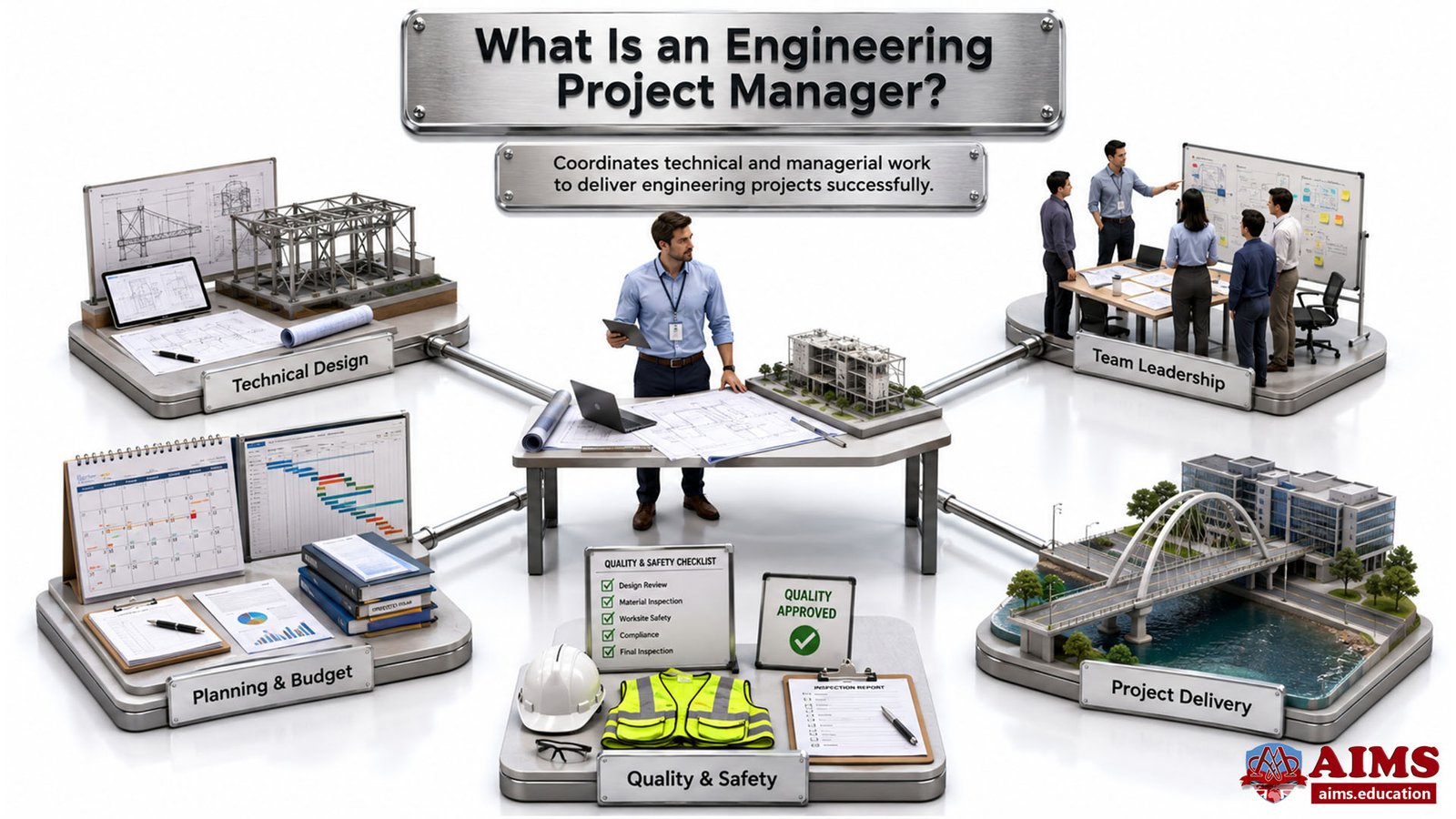
The engineering project manager role commonly includes reviewing technical proposals, translating project objectives into manageable work packages, coordinating resources, monitoring schedules, controlling costs, managing changes, and ensuring that engineering outputs satisfy agreed requirements.
- The engineering project manager connects technical teams with clients, sponsors, contractors, suppliers, and other stakeholders.
- The manager translates complex engineering objectives into planned activities, milestones, responsibilities, and measurable deliverables.
- The manager coordinates scope, schedule, budget, resources, risks, quality requirements, technical dependencies, and approved changes.
- The manager helps ensure that engineering decisions remain aligned with project objectives and wider organizational goals.
- The manager supports collaboration between specialists whose work must integrate into one complete engineering solution.
An engineering project manager is therefore not simply the most senior engineer on a project. The position requires enough technical understanding to manage engineering work intelligently, combined with the broader project leadership skills required to coordinate delivery.
Engineering Project Manager vs Project Engineer vs Engineering Manager vs Project Manager
The main difference is the focus of responsibility: an engineering project manager manages the delivery of an engineering project, while a project engineer concentrates more heavily on technical coordination, an engineering manager manages an engineering function or team, and a general project manager may manage projects without engineering-specific responsibility.
Job titles are not standardized across industries. A project engineer in one organization may perform substantial project management duties, while another company may assign those duties to a dedicated engineering project manager. The most reliable distinction is therefore the responsibility attached to the position, not the job title alone.
| ATTRIBUTE | ENGINEERING PROJECT MANAGER | PROJECT ENGINEER | ENGINEERING MANAGER | PROJECT MANAGER |
|---|---|---|---|---|
| Primary focus | Delivery of an engineering project | Technical engineering execution and coordination | Engineering people, capability, standards, and technical function | Overall project delivery across any suitable industry |
| Technical involvement | Moderate to high, depending on project and industry | Usually high | Usually high at functional or technical leadership level | Varies according to project type |
| Scope and schedule | Usually accountable for coordinating both | Supports technical activities within the project plan | May oversee departmental priorities rather than one project schedule | Usually accountable for coordinating both |
| Budget responsibility | Commonly manages or monitors project costs | May monitor costs related to technical work packages | May manage engineering department or resource budgets | Commonly manages the overall project budget |
| Team responsibility | Coordinates multidisciplinary project teams | Coordinates engineers and technical contributors | Develops and manages engineering personnel or functions | Coordinates the wider project team |
| Success measure | Engineering deliverables achieve required project outcomes | Technical work is accurate, integrated, and completed correctly | Engineering capability, performance, standards, and team effectiveness | Project objectives and agreed outcomes are achieved |
Readers who want to understand the broader management position can also review the core roles and responsibilities of a professional project manager.
Engineering Project Manager Job Description: 7 Key Responsibilities
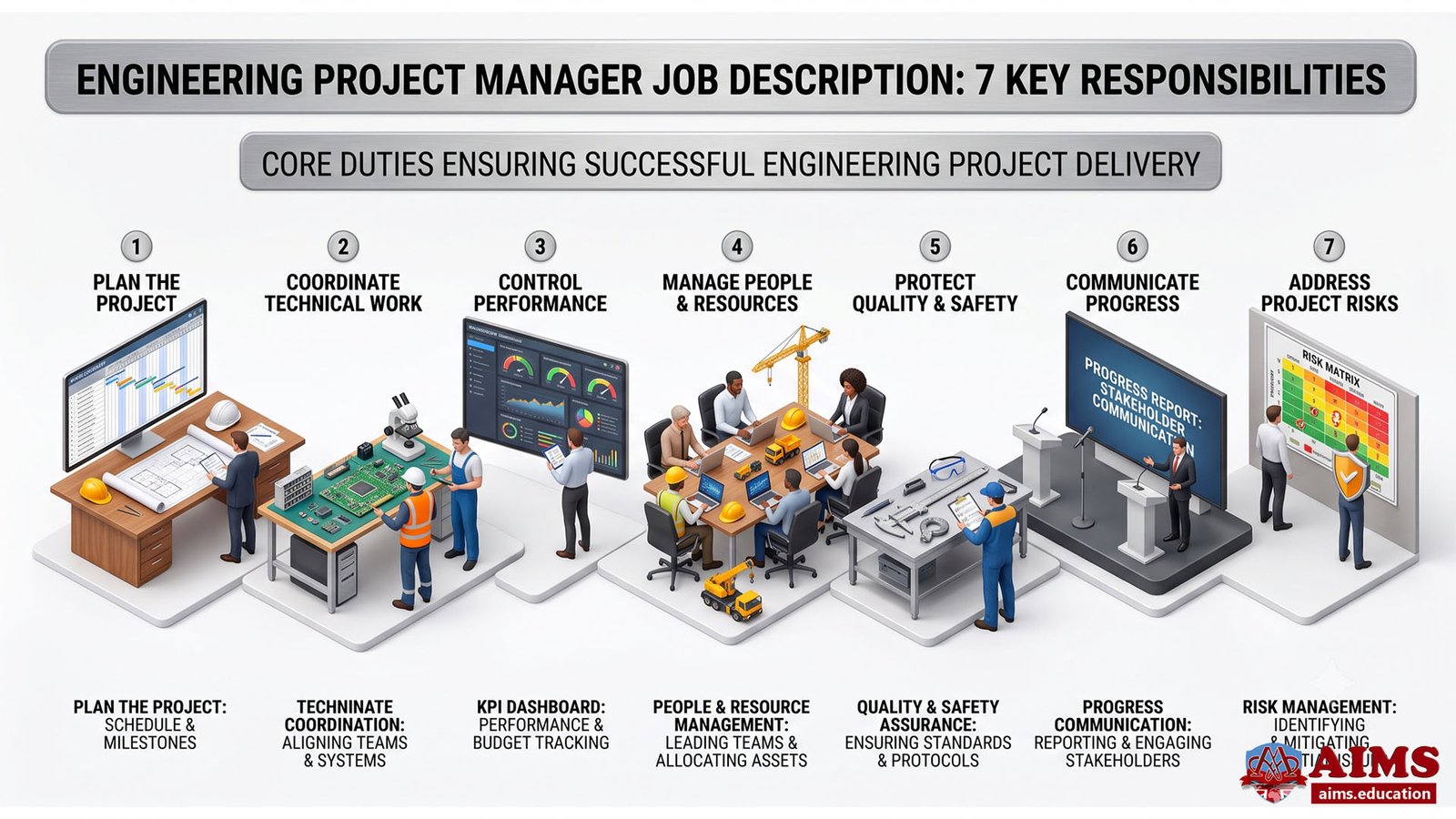
The main responsibilities of an engineering project manager are to plan the project, coordinate technical work, control performance, manage people and resources, protect quality and safety, communicate progress, and address project risks.
1. Safety and Quality Control
Engineering project managers help ensure that project work satisfies applicable safety requirements, technical specifications, quality expectations, and organizational procedures. They coordinate with engineers and quality specialists to identify deficiencies before those problems affect the final deliverable.
This includes reviewing inspection results, monitoring corrective actions, checking acceptance criteria, and ensuring that quality requirements remain visible throughout delivery. A deeper understanding of quality planning, assurance, and control in projects helps managers distinguish preventive quality management from final inspection alone.
2. Progress Reporting
Engineering project managers communicate project performance to clients, sponsors, engineering teams, contractors, and other decision-makers. Reporting frequency depends on project size, duration, governance requirements, and stakeholder needs.
Useful progress reports normally address:
- Milestones and major deliverables completed during the reporting period.
- Current schedule performance and important upcoming activities.
- Budget status, forecasts, and significant cost changes.
- Technical issues, risks, assumptions, and unresolved decisions.
- Approved or proposed changes affecting project baselines.
- Quality, safety, procurement, or resource concerns requiring management attention.
3. Delegation and Cross-Functional Collaboration
Engineering projects often involve several technical disciplines and external organizations. The project manager must therefore clarify responsibilities, coordinate dependencies, and ensure that each contributor understands what must be delivered and when.
Effective delegation does not mean transferring accountability without oversight. The manager assigns appropriate responsibility, confirms authority, monitors progress, and intervenes when dependencies or constraints threaten delivery.
4. Tracking and Analyzing Project Progress
Engineering project managers continually compare actual performance against approved plans. They should identify variance early enough for corrective action rather than waiting until a deadline has already been missed.
- They track key deliverables, milestones, and technical dependencies.
- They establish measurable objectives and suitable project KPIs.
- They compare planned progress with actual progress.
- They review schedule, cost, quality, resource, and risk information.
- They conduct coordination meetings with team members and stakeholders.
- They document issues, decisions, actions, and approved changes.
5. Planning and Budgeting Engineering Projects
Engineering project managers work with clients and technical specialists to understand project objectives, scope, requirements, constraints, and acceptance criteria. They then translate those requirements into a practical project plan.
The plan typically establishes activities, dependencies, milestones, resources, responsibilities, procurement requirements, cost assumptions, communication arrangements, quality requirements, and risk responses. Plans and budgets should be reviewed as better information becomes available and formally updated when approved changes affect the project baseline.
Example of Planning an Engineering Installation Project
Suppose Nova Manufacturing plans to install an automated production line in an operating factory.
- The engineering project manager confirms production requirements, space constraints, technical specifications, and the required completion date.
- The team divides the project into design, procurement, site preparation, equipment installation, integration, testing, and handover activities.
- Engineers identify dependencies such as electrical upgrades that must be completed before equipment commissioning.
- The project manager develops the schedule, resource plan, procurement timeline, budget, risk register, and reporting process.
- During execution, the manager monitors supplier delivery, installation progress, costs, technical changes, safety issues, and testing results.
The structured plan allows technical teams to coordinate their work while protecting the project’s cost, schedule, quality, and operational objectives.
6. Leadership and Team Management
An engineering project manager must provide direction without attempting to perform every specialist task personally. Engineers, administrators, contractors, procurement teams, and other contributors depend on clear priorities and timely decisions.
Effective managers create an environment where technical specialists can raise concerns early, challenge assumptions professionally, and coordinate their work without unnecessary barriers. This requires strong project leadership, communication, organization, and problem-solving skills.
7. Risk Management
Engineering projects can involve financial, technical, commercial, schedule, environmental, safety, supply-chain, and operational risks. The project manager should identify significant uncertainties early and coordinate appropriate responses before they become major project problems.
Effective risk management throughout the project lifecycle involves identifying risks, assessing probability and impact, selecting responses, assigning owners, monitoring triggers, and updating the risk register as conditions change.
Example of Engineering Project Risk Management
A power-system upgrade depends on a specialized component with a long supplier lead time.
- The project team records supplier delay as a schedule risk.
- The manager evaluates how a late component would affect installation and commissioning.
- The procurement and engineering teams investigate alternative suppliers and compatible substitute components.
- The manager assigns a risk owner and establishes dates for supplier confirmation.
- If warning indicators appear, the agreed response is activated before the delay affects critical project activities.
Early risk action gives the team more response options and reduces the likelihood that one supplier problem controls the entire project outcome.
Key Engineering Project Manager Skills
An engineering project manager needs communication, organization, problem-solving, analytical, leadership, listening, and technical coordination skills. The role requires the manager to understand both project information and the implications of technical decisions.
1. Communication Skills
Engineering project managers must communicate complex information clearly between technical specialists and non-technical stakeholders. This includes presenting progress, explaining risks, clarifying responsibilities, documenting decisions, and resolving misunderstandings before they affect delivery.
2. Organizational and Planning Skills
Engineering projects contain interconnected activities, documents, approvals, resources, and technical dependencies. Strong organization helps the manager maintain control over schedules, priorities, information, decisions, and outstanding actions.
3. Problem-Solving and Decision-Making Skills
Unexpected engineering, supplier, resource, cost, or schedule problems are common. A manager must diagnose the problem, understand its project impact, evaluate options, involve appropriate experts, and make or escalate decisions promptly.
4. Mathematical and Analytical Skills
Budgeting, forecasting, schedule analysis, cost estimation, performance measurement, and technical trade-offs require numerical confidence. The manager does not need to perform every engineering calculation personally, but must be able to interpret quantitative project information intelligently.
5. Listening and Stakeholder Skills
Good listening helps managers identify technical concerns, competing stakeholder expectations, hidden assumptions, and emerging risks. It also improves collaboration because specialists are more likely to raise problems early when their input is taken seriously.
6. Technical Literacy
The required depth varies by discipline. A mechanical engineering project manager may need different technical knowledge from a software, civil, electrical, aerospace, or manufacturing project manager. The goal is not to replace specialist engineers, but to understand enough technical context to coordinate decisions responsibly.
7. Leadership Skills
Engineering project managers must set priorities, manage conflict, maintain accountability, support teamwork, and keep participants focused on the intended project outcome. Leadership becomes particularly important when schedule pressure, technical uncertainty, or changing requirements create competing priorities.
Engineering Project Manager Qualifications
There is no single universal qualification route for becoming an engineering project manager because requirements vary by engineering discipline, employer, jurisdiction, and level of technical responsibility. Most successful candidates combine a technical foundation with progressively stronger project management experience.
Common qualification expectations include:
- Relevant technical education: Many employers prefer a degree or formal education in engineering, computer science, technology, construction, or another discipline related to the projects being managed.
- Engineering or technical experience: Practical experience helps managers understand technical workflows, constraints, terminology, and decision-making.
- Project delivery experience: Employers commonly value experience coordinating schedules, work packages, budgets, suppliers, risks, changes, and stakeholders.
- Project management education: Structured study can strengthen knowledge of planning, scheduling, risk, quality, leadership, project controls, and delivery methodologies.
- Professional certification: Suitable certifications can demonstrate formal project management knowledge, although certification does not replace engineering experience or technical competence.
- Industry-specific requirements: Regulated engineering work may require appropriately licensed or authorized professionals to approve particular technical outputs.
If you need formal development, you can explore online project management certification for practical project leadership. Those seeking broader study across projects, programs, and portfolio management may consider advanced online diploma in project management.
How to Become an Engineering Project Manager
To become an engineering project manager, build technical competence first, gain experience delivering engineering work, develop formal project management capability, and gradually take responsibility for larger project decisions.
- Build a technical foundation. Study or gain practical experience in the engineering or technical discipline related to the projects you want to manage.
- Gain project experience. Work on engineering projects and learn how design, procurement, scheduling, quality, technical reviews, suppliers, testing, and delivery interact.
- Take responsibility for work packages. Begin coordinating small scopes, milestones, budgets, suppliers, or technical teams.
- Develop formal project management knowledge. Strengthen capability in scope, schedule, cost, quality, risk, stakeholder management, leadership, and project controls.
- Progress into project leadership. Move from supporting individual technical activities to coordinating multidisciplinary engineering outcomes.
- Continue developing professionally. Larger engineering projects require stronger commercial awareness, negotiation, leadership judgment, governance, and strategic understanding.
A professional engineering project management career path therefore usually develops progressively rather than beginning with full responsibility for a complex engineering project.
Engineering Project Manager Salary Overview
Engineering project manager salaries vary substantially by country, engineering discipline, industry, project complexity, experience, employer, and level of responsibility. For this reason, one worldwide salary range can be misleading.
The title itself also creates comparison problems. Some employers classify the position as a project manager, some as an engineering manager, and others as a project engineering manager. Compensation can therefore differ even when two professionals perform similar work.
Salary is commonly influenced by:
- The country, region, and local labor market.
- The engineering discipline and level of technical specialization.
- The size, value, risk, and complexity of projects being managed.
- The manager’s years of engineering and project leadership experience.
- Responsibility for budgets, contracts, suppliers, and multidisciplinary teams.
- Industry conditions in sectors such as energy, infrastructure, aerospace, technology, and manufacturing.
- Professional qualifications, certifications, and specialized technical knowledge.
For context, the U.S. Bureau of Labor Statistics data for architectural and engineering managers reported a median annual wage of $167,740. This occupational category is broader than engineering project manager, so the figure should be treated as contextual labor-market information rather than a direct salary figure for every engineering project manager.
Engineering Project Management Process
The engineering project management process moves a technical objective through definition, planning, engineering execution, monitoring and control, verification, handover, and closure. The exact lifecycle depends on the engineering discipline and project delivery model.
- Initiation and requirements: Define the problem, objectives, stakeholders, technical requirements, constraints, feasibility assumptions, and expected outcomes.
- Planning: Develop scope, schedule, budget, resources, responsibilities, procurement strategy, risk responses, quality arrangements, and communication processes.
- Engineering execution: Coordinate design, analysis, procurement, fabrication, construction, configuration, installation, or development activities as required.
- Monitoring and control: Measure performance, control changes, manage risks and issues, verify quality, update forecasts, and resolve dependencies.
- Testing and acceptance: Confirm that engineering outputs satisfy specifications, acceptance criteria, performance requirements, and applicable standards.
- Handover and closure: Transfer the completed solution, finalize documentation, close contracts and actions, capture lessons, and confirm formal acceptance.
The process is rarely a simple administrative sequence. Engineering decisions can affect cost, schedule, safety, quality, procurement, and operational performance simultaneously, so coordination between technical and project controls is essential.
Project Management Methodologies for Engineering Projects
Engineering project managers may use predictive, Agile, Hybrid, or other structured delivery approaches depending on requirements, uncertainty, technical dependencies, regulatory constraints, and the type of engineering work involved.
Managers should understand how major project management methodologies differ in practice rather than selecting one approach simply because it is popular.
1. Waterfall or Predictive Approach
A predictive approach organizes work around defined stages and planned sequences. It is particularly useful where requirements are relatively stable, technical approvals occur at specific stages, physical work depends on completed designs, or changes become expensive after implementation begins.
For example, an infrastructure project may move through requirements, engineering design, procurement, construction, testing, and handover with formal approval points between major stages.
2. Agile Approach
Agile approaches emphasize iterative development, regular feedback, and the ability to adapt as understanding improves. They are particularly relevant to software engineering, digital systems, product development, control systems, prototypes, and other environments where solutions can be developed incrementally.
However, Agile does not remove the need for scope control, technical governance, cost awareness, or engineering discipline. The project manager must still establish boundaries and manage changes responsibly.
3. Hybrid Approach
A Hybrid model combines predictive governance with iterative delivery. This can be highly practical in engineering projects because different parts of the same project may have different levels of uncertainty.
For example, a manufacturing facility expansion may use predictive planning for civil works, equipment procurement, and regulatory approvals while using iterative development for automation software and operator interfaces.
4. Scrum Framework
Scrum is an iterative framework commonly associated with complex product and software development. It may be useful for suitable engineering work that can be organized into short development cycles with frequent review and feedback.
A traditional project manager role does not map directly onto Scrum responsibilities. In organizations using Scrum, project-level coordination may coexist with Scrum roles while broader responsibilities such as commercial management, external dependencies, governance, and integrated schedules remain outside an individual Scrum team.
Tools Used by Engineering Project Managers
Engineering project managers use a combination of project controls, collaboration systems, technical platforms, and management documents to coordinate work and maintain visibility.
- Scheduling tools support Gantt charts, milestones, dependencies, resource planning, and critical-path analysis.
- Cost-control systems support budgeting, commitments, forecasts, actual costs, and variance analysis.
- Risk and issue registers document uncertainties, problems, owners, responses, and escalation actions.
- Document-control systems manage drawings, specifications, technical submissions, approvals, and revision histories.
- Collaboration platforms support communication, task coordination, meetings, decisions, and shared project information.
- Engineering systems may include CAD, BIM, PLM, simulation, configuration-management, or other discipline-specific tools.
- Change-control records help teams evaluate and approve changes affecting technical requirements, cost, schedule, or scope.
The best toolset depends on project scale and technical environment. Good management comes from disciplined processes and reliable information, not from software alone.
6 Career Paths for Engineering Project Managers
Engineering project managers can specialize in industries ranging from construction and manufacturing to software, aerospace, environmental engineering, and energy. Each path combines project leadership with different technical knowledge, regulations, stakeholders, and delivery risks.
1. Construction Engineering Project Manager
Construction engineering project managers coordinate projects involving buildings, infrastructure, civil works, utilities, or industrial facilities. They typically work closely with designers, contractors, consultants, procurement teams, regulators, and clients.
2. Software Engineering Project Manager
Software engineering project managers coordinate technical development involving software architecture, development, integration, testing, deployment, and stakeholder requirements. They often work in iterative or Hybrid project environments.
3. Manufacturing Engineering Project Manager
Manufacturing engineering project managers lead projects involving production systems, factory layouts, automation, new equipment, process improvement, capacity expansion, product industrialization, and quality improvement.
4. Aerospace Engineering Project Manager
Aerospace engineering project managers coordinate complex projects involving aircraft, spacecraft, satellites, components, systems integration, testing, production, or supporting technologies. These projects typically require strong configuration, quality, risk, and technical coordination.
5. Environmental Engineering Project Manager
Environmental engineering project managers coordinate projects related to environmental protection, water, waste, remediation, sustainability, pollution control, or environmental infrastructure. They must balance technical objectives with stakeholder and regulatory requirements.
6. Energy Engineering Project Manager
Energy engineering project managers may work on renewable energy, power generation, transmission, distribution, efficiency improvement, industrial energy systems, or related installations. These projects often combine significant technical, commercial, safety, procurement, and stakeholder complexity.
Is PMP Certification Useful for an Engineering Project Manager?
PMP certification can be useful for an experienced engineering professional who wants to demonstrate structured project leadership capability, but it does not replace engineering competence or relevant project experience.
Its value is greatest when the individual’s role includes responsibility for project planning, leadership, stakeholders, risks, schedules, delivery decisions, and business outcomes. Technical engineers who primarily perform specialist engineering work may benefit more from building project leadership experience before pursuing an advanced project management credential.
Certification should therefore be viewed as one part of professional development rather than a substitute for engineering education, technical judgment, industry knowledge, or practical delivery experience.
Final Words on the Engineering Project Manager Role and Responsibilities
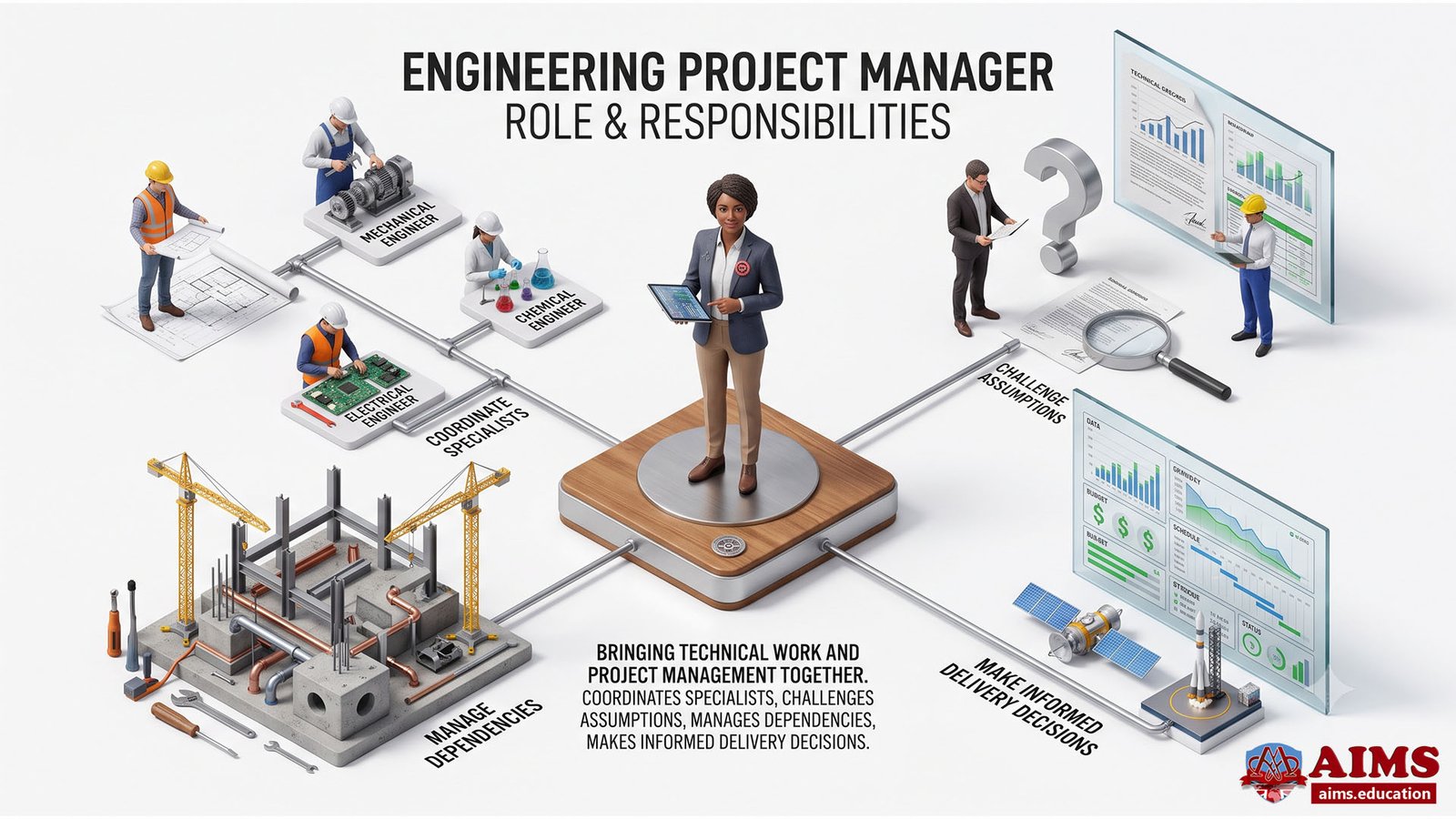
An engineering project manager brings technical work and project management together. The manager does not need to be the deepest technical specialist in every discipline, but must understand engineering work well enough to coordinate specialists, challenge assumptions, manage dependencies, and make informed delivery decisions.
Strong engineering project managers combine technical literacy with planning, communication, leadership, commercial awareness, quality management, risk management, and disciplined project control. As projects increase in complexity, this ability to connect engineering decisions with project outcomes becomes increasingly important.
Frequently Asked Questions
What is an engineering project manager?
An engineering project manager leads engineering projects from planning through completion while coordinating technical teams and managing scope, schedule, budget, quality, risks, resources, stakeholders, and project deliverables.
What are the main responsibilities of an engineering project manager?
Main responsibilities include project planning, budgeting, technical coordination, schedule control, quality management, risk management, progress reporting, stakeholder communication, resource coordination, change control, and leadership of multidisciplinary project teams.
What skills does an engineering project manager need?
An engineering project manager needs communication, planning, organization, leadership, problem-solving, analytical, listening, stakeholder-management, and technical coordination skills. The required depth of technical knowledge depends on the engineering discipline and project environment.
What qualifications do you need to become an engineering project manager?
Requirements vary, but employers commonly look for relevant technical education or experience, practical engineering-project exposure, project management knowledge, leadership ability, and experience coordinating schedules, budgets, risks, resources, and stakeholders.
How do you become an engineering project manager?
Begin by building technical expertise, gain practical engineering-project experience, take responsibility for work packages or smaller projects, develop formal project management knowledge, strengthen leadership skills, and progressively move into responsibility for complete multidisciplinary projects.
What is the difference between an engineering project manager and a project engineer?
A project engineer generally concentrates more heavily on technical engineering execution and coordination, while an engineering project manager has broader responsibility for integrating technical work with scope, schedule, cost, risk, resources, stakeholders, and overall project delivery. Actual responsibilities vary between organizations.
What is the difference between an engineering project manager and a project manager?
Both manage project delivery, but an engineering project manager normally works in a technical engineering environment and therefore requires stronger understanding of engineering activities, technical dependencies, design decisions, specifications, testing, and specialist coordination.
What is the difference between engineering management and engineering project management?
Engineering management often focuses on managing an engineering function, technical capability, people, standards, and long-term departmental performance. Engineering project management focuses on delivering a defined engineering project with specific objectives, resources, constraints, milestones, and completion criteria.
Do engineering project managers need an engineering degree?
Not every position has the same requirement. Many employers prefer or require relevant engineering education, particularly when the manager needs substantial technical authority. Other roles may accept strong technical experience combined with project management competence. Regulated technical approvals must remain with appropriately qualified or authorized professionals where required.
How much does an engineering project manager earn?
Salary varies considerably by country, industry, engineering discipline, experience, employer, project complexity, and level of responsibility. Because job titles differ between organizations, local salary data for comparable engineering and project-management positions is usually more useful than one universal salary range.
Is PMP certification useful for an engineering project manager?
It can be useful for experienced professionals whose responsibilities include substantial project leadership. It demonstrates formal project management capability, but it should complement rather than replace relevant engineering knowledge, practical experience, and leadership competence.
Professional Project Management Education at AIMS
Since 2005, AIMS’ Project Management Academy has delivered internationally accredited, career-focused education to a global learner community through qualified faculty, industry-oriented teaching, practical skill development, 3D interactive learning content, and real-world case studies. Its internationally standardized curriculum and study content are collaboratively developed and rigorously peer-reviewed by an academic board of qualified industry practitioners. Engineering project management develops the disciplined leadership needed to coordinate complex technical work successfully. Explore AIMS’ career-focused project management qualifications for industry-ready skills.