
What is Earned Value Management?
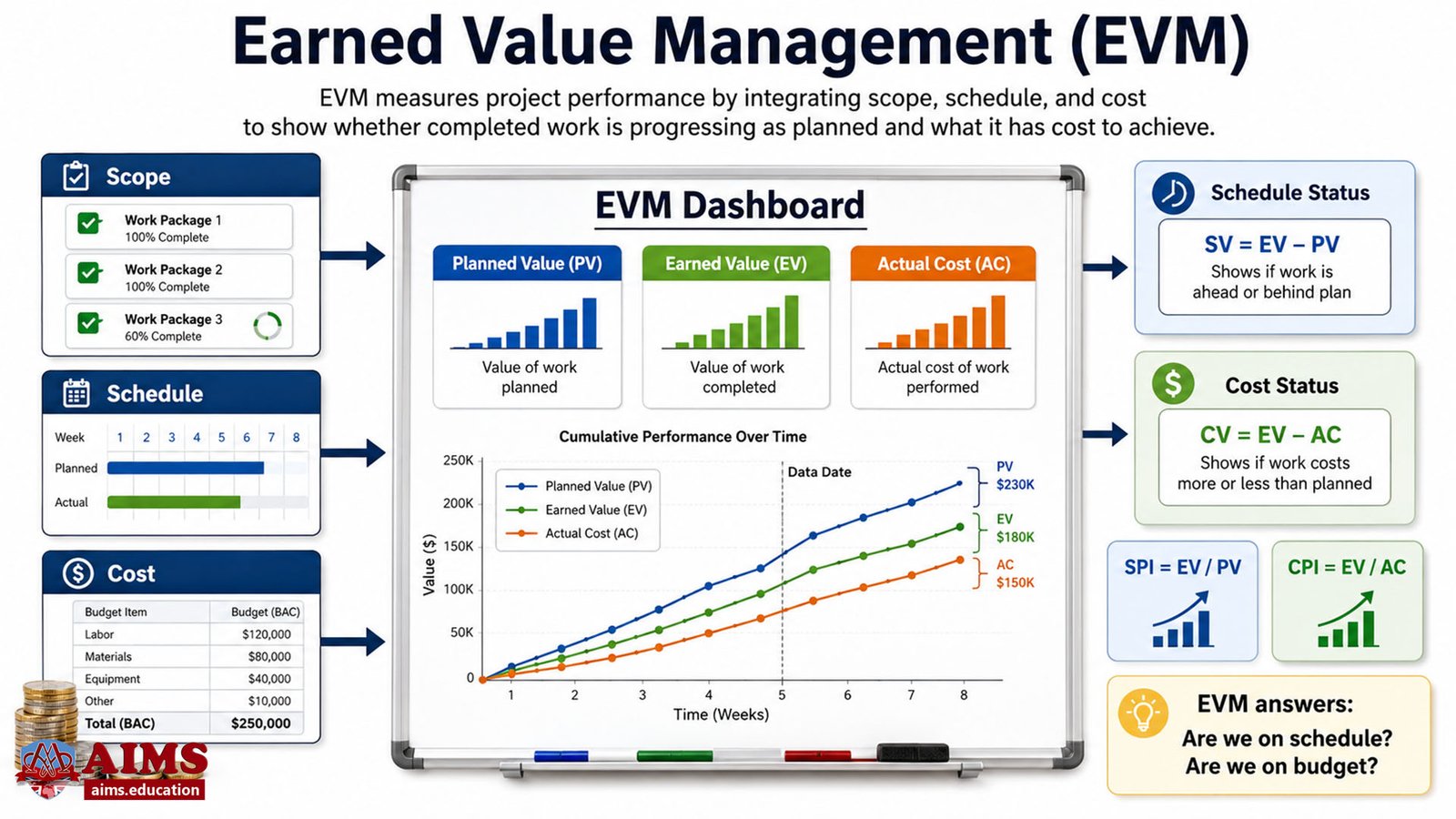
Earned value management (EVM) is a project performance measurement approach that integrates scope, schedule, and cost to show whether completed work is progressing as planned and what it has cost to achieve. By comparing planned value, earned value, and actual cost, project managers can measure variances, evaluate efficiency, and forecast likely final project costs.
- In practice, earned value management in project management provides more insight than simply asking whether the project has spent its budget or reached a scheduled date.
- It connects expenditure with the amount of authorized work actually accomplished.
This allows managers to identify performance problems earlier and make more informed project control decisions.
Why Is Earned Value Management Important?
EVM is important because it connects project spending and schedule expectations with the actual amount of work completed. Traditional reports can show how much money has been spent or how much time has passed, but neither measure alone tells you whether that spending produced the expected progress.
Suppose a project has spent 50% of its budget. That fact alone does not tell management whether performance is satisfactory. If 60% of the planned work has been completed, cost performance may be favorable. If only 30% has been completed, the same spending level signals a serious cost problem.
This integration makes EVM particularly useful within project cost management and performance control. It helps managers:
- Measure whether completed work is costing more or less than its approved budgeted value.
- Determine whether progress is ahead of or behind the planned level of accomplishment.
- Identify unfavorable performance trends before they become more difficult to correct.
- Forecast the probable final cost of the project using current performance information.
- Communicate project status through objective and comparable performance measures.
For this reason, EVM should be understood as a management and decision-support method, not merely as a collection of formulas.

Foundations of Earned Value Management in Project Management
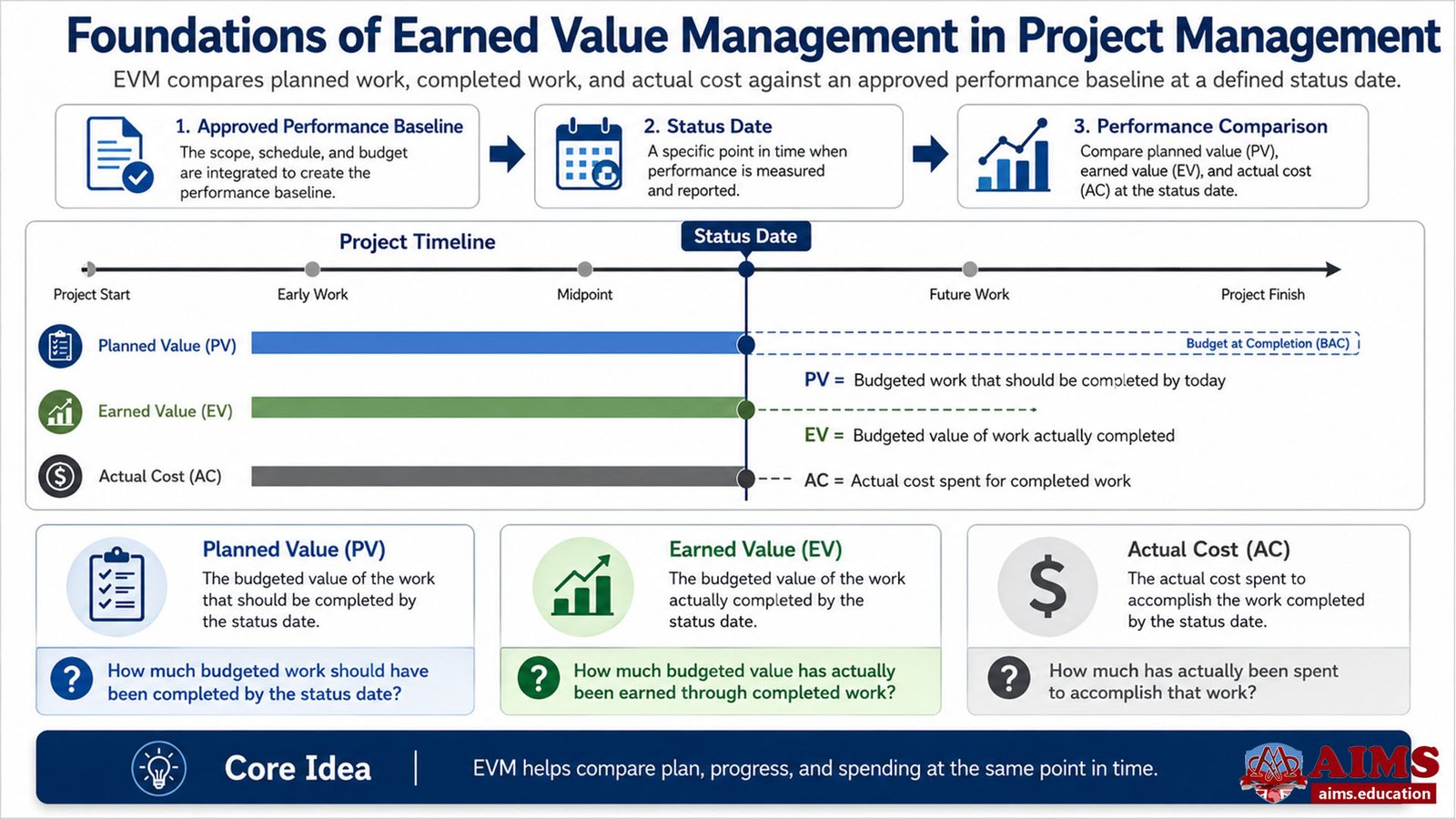
Earned value management works by establishing an approved performance baseline and then comparing planned work, completed work, and actual expenditure at a defined status date. The three fundamental measurements are Planned Value (PV), Earned Value (EV), and Actual Cost (AC).
EVM is normally connected to defined project scope and control points within the work breakdown structure. Understanding how a work breakdown structure supports project control is therefore useful because performance must be measured against clearly defined work rather than vague estimates of progress.
What Are Planned Value, Earned Value, and Actual Cost?
The three core EVM measurements answer three different questions:
- Planned Value (PV) asks: How much budgeted work should have been completed by the status date?
- Earned Value (EV) asks: How much budgeted value has actually been earned through completed work?
- Actual Cost (AC) asks: How much has actually been spent to accomplish that work?
| MEASURE | DEFINITION | SIMPLIFIED CALCULATION OR MEANING | MANAGEMENT QUESTION |
|---|---|---|---|
| Planned Value (PV) | The authorized budget assigned to work scheduled to be completed by a particular date. | For a simple project-level example: BAC — planned percentage complete. | How much budgeted work should be complete by now? |
| Earned Value (EV) | The budgeted value of the authorized work actually completed by the status date. | For a simple project-level example: BAC — actual percentage complete. | How much budgeted value have we actually produced? |
| Actual Cost (AC) | The actual cost incurred for the work performed by the status date. | Obtained from actual project cost records rather than an earned value formula. | How much did the completed work actually cost? |
Planned Value (PV)
Planned Value is the approved budget assigned to the work that should have been completed by a specified status date. It represents the project’s budgeted expectation at that point in time.
For example, assume a project has a budget at completion (BAC) of £100,000. If the approved schedule indicates that 50% of the project should be complete today, the simplified planned value is:
- PV = £100,000 — 50%
- PV = £50,000
The project should therefore have accomplished £50,000 worth of budgeted work by the status date.
Earned Value (EV)
Earned Value is the approved budgeted value of the work that has actually been accomplished. It does not mean revenue earned, profit generated, or money spent.
Using the same £100,000 project, suppose only 40% of the authorized work has actually been completed:
- EV = £100,000 — 40%
- EV = £40,000
This earned value calculation tells the project manager that £40,000 of budgeted project value has been accomplished.
A common misunderstanding is that earned value cannot be higher than planned value. EV can exceed PV at a particular status date when more work has been completed than was scheduled. However, earned value for a work component should not exceed the total authorized budget for that work.
Actual Cost (AC)
Actual Cost is the amount actually incurred for the work performed by the status date. Unlike PV and EV, it is normally obtained from accounting, time-recording, procurement, or other project cost systems.
If £60,000 has been spent to complete the £40,000 of earned work in the example above, AC equals £60,000. Comparing EV with AC now reveals whether the completed work has been performed efficiently from a cost perspective.
Earned Value Management Formulas
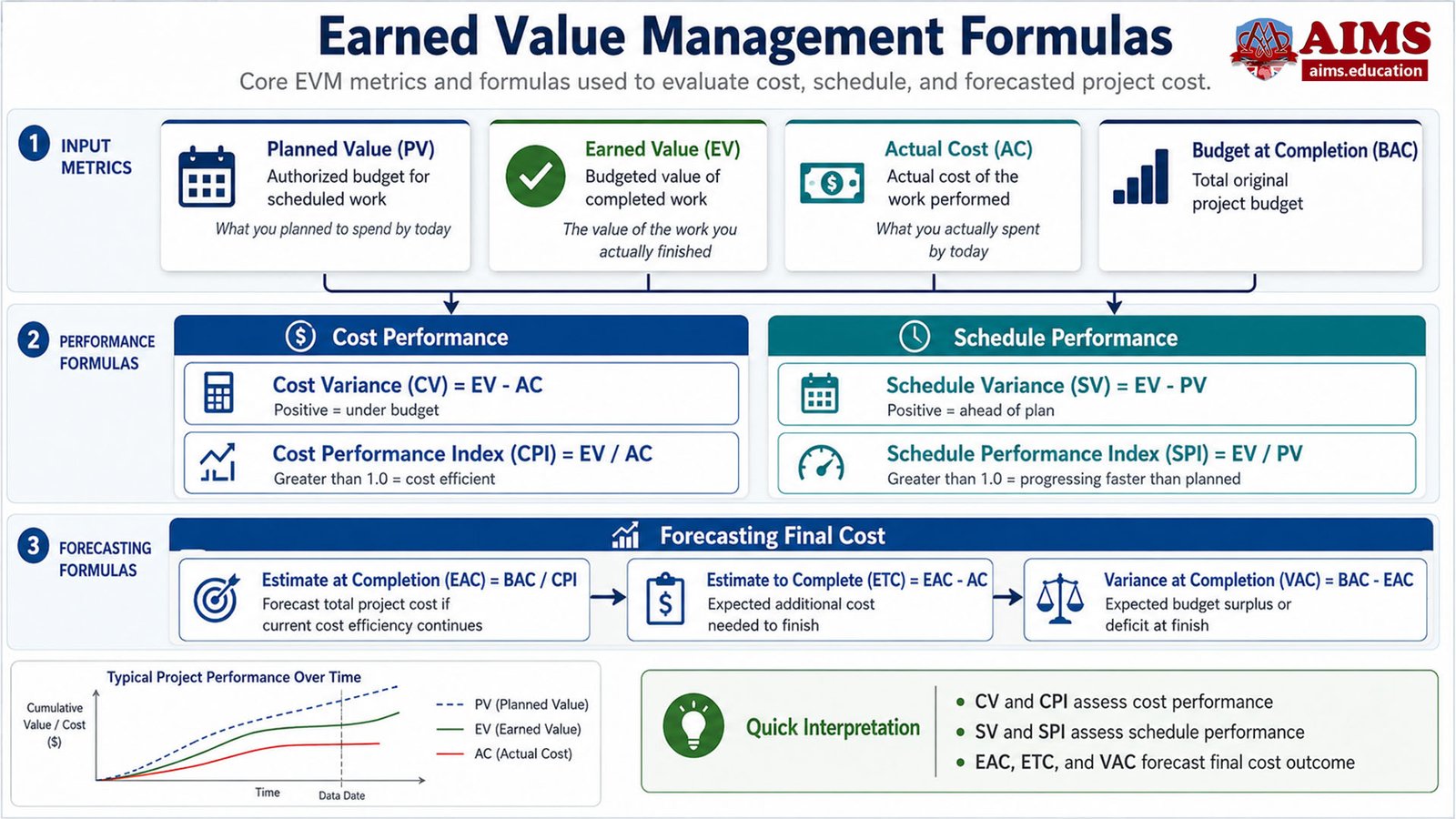
The main earned value management formulas convert PV, EV, AC, and BAC into indicators of cost performance, schedule performance, and expected final project cost. Understanding the logic behind each earned value formula is more useful than memorizing equations without knowing what the results mean.
| METRIC | FORMULA | WHAT IT MEASURES | INTERPRETATION |
|---|---|---|---|
| Cost Variance (CV) | CV = EV – AC | Difference between earned value and actual spending. | Positive = under budget; negative = over budget. |
| Schedule Variance (SV) | SV = EV – PV | Difference between accomplished and planned budgeted work. | Positive = ahead in earned value terms; negative = behind. |
| Cost Performance Index (CPI) | CPI = EV · AC | Cost efficiency of completed work. | Above 1 = favorable; below 1 = unfavorable. |
| Schedule Performance Index (SPI) | SPI = EV · PV | Progress efficiency against the plan. | Above 1 = ahead; below 1 = behind in earned value terms. |
| Budget at Completion (BAC) | Approved total performance budget | Budgeted value of all authorized project work. | Provides the overall budget reference for EVM forecasting. |
| Estimate at Completion (EAC) | EAC = BAC · CPI | Forecast final cost when current cost efficiency is expected to continue. | Compare EAC with BAC to assess expected cost overrun or underrun. |
| Estimate to Complete (ETC) | ETC = EAC – AC | Expected additional cost required to finish the project. | Shows the forecast cost of remaining work. |
| Variance at Completion (VAC) | VAC = BAC – EAC | Expected final budget variance. | Positive = forecast underrun; negative = forecast overrun. |
| To-Complete Performance Index (TCPI) | TCPI = (BAC – EV) · (BAC – AC) | Cost efficiency needed on remaining work to achieve BAC. | A higher value means stronger future cost performance is required. |
Cost Variance and Schedule Variance
Cost Variance measures whether completed work has cost more or less than its budgeted value, while Schedule Variance measures whether the budgeted value of accomplished work is ahead of or behind the planned value.
The two cost variance and schedule variance formulas are:
- CV = EV – AC
- SV = EV – PV
If EV is £75,000, AC is £80,000, and PV is £85,000:
- CV = £75,000 – £80,000 = -£5,000, so the completed work is over budget.
- SV = £75,000 – £85,000 = -£10,000, so less budgeted work has been completed than planned.
Schedule variance deserves an important clarification. SV is expressed in budget units, not days or weeks. It indicates schedule performance through earned value, but it does not tell you directly how late a critical milestone will be. Detailed project time management and schedule control are still required to evaluate activity dates and schedule consequences.
What Do CPI and SPI Mean in Project Management?
CPI measures cost efficiency, while SPI measures the efficiency of progress compared with the approved plan. These ratios make CPI and SPI in project management especially useful because performance can be compared across reporting periods and, with appropriate context, across projects.
Cost Performance Index (CPI)
CPI is calculated as:
CPI = EV · AC
- CPI = 1.00 means the project has earned exactly £1 of budgeted value for each £1 spent.
- CPI > 1.00 indicates favorable cost efficiency.
- CPI < 1.00 indicates unfavorable cost efficiency.
For example, if EV is £40,000 and AC is £60,000:
- CPI = £40,000 · £60,000
- CPI = 0.67
The project is therefore earning approximately £0.67 of budgeted value for every £1 spent.
Schedule Performance Index (SPI)
SPI is calculated as:
SPI = EV · PV
- SPI = 1.00 indicates progress is aligned with planned value.
- SPI > 1.00 indicates more budgeted work has been completed than planned.
- SPI < 1.00 indicates less budgeted work has been completed than planned.
If EV is £40,000 and PV is £50,000:
- SPI = £40,000 · £50,000
- SPI = 0.80
The project has achieved 80% of the budgeted progress planned for the status date.
CPI and SPI are valuable project management KPIs for monitoring performance, but they need managerial interpretation. A favorable index does not automatically mean that quality, risk exposure, stakeholder satisfaction, or critical-path performance is satisfactory.
Forecasting Project Cost with EAC, ETC, VAC, and TCPI
EVM forecasting uses current performance information to estimate what the project may ultimately cost and how efficiently the remaining work must be performed. The correct forecasting formula depends on the assumption management makes about future performance.
Estimate at Completion (EAC)
Estimate at completion (EAC) is the forecast total project cost when all authorized work is finished.
A commonly used formula is:
EAC = BAC · CPI
This formula is appropriate when management believes the cost efficiency experienced so far is reasonably representative of future cost performance.
Other forecasting situations require different logic:
- If remaining work is expected to perform at the original budgeted rate: EAC = AC + (BAC – EV).
- If current cost efficiency is expected to continue: EAC = BAC · CPI.
- If both cost and schedule performance are expected to influence remaining work: EAC = AC + (BAC – EV) · (CPI — SPI).
The formula should therefore follow the forecasting assumption, not the other way around.
Estimate to Complete (ETC)
Estimate to Complete is the expected additional cost required from the status date until project completion.
ETC = EAC – AC
If the forecast EAC is £150,000 and £60,000 has already been spent, the remaining work is forecast to cost:
ETC = £150,000 – £60,000 = £90,000
Variance at Completion (VAC)
Variance at Completion shows the expected difference between the original budget and the forecast final cost.
VAC = BAC – EAC
If BAC is £100,000 and EAC is £150,000:
VAC = £100,000 – £150,000 = -£50,000
The negative result indicates a forecast £50,000 budget overrun.
To-Complete Performance Index (TCPI)
TCPI shows the cost efficiency that must be achieved on the remaining work to meet a specified financial target. The to-complete performance index (TCPI) is especially useful when management wants to test whether the original budget is still realistic.
To achieve the original BAC:
TCPI = (BAC – EV) · (BAC – AC)
If management has accepted a revised EAC as the new financial target, TCPI may instead be calculated as:
TCPI = (BAC – EV) · (EAC – AC)
A TCPI considerably higher than the project’s historical CPI should prompt a practical management question: can the remaining work genuinely be delivered at the much stronger efficiency now required?
Earned Value Management Example: Step-by-Step Calculation
A complete earned value management example begins with a budget, a planned completion percentage, an actual completion percentage, and actual spending at the same status date. Using one consistent scenario makes the relationships between all major EVM calculations easier to understand.
Example: £100,000 Project at the Six-Month Status Date
Assume a project has the following information:
- The total project budget, or BAC, is £100,000.
- The planned project duration is 12 months.
- Six months have passed.
- The approved schedule expected 50% of the work to be complete.
- Only 40% of the work has actually been completed.
- Actual expenditure to date is £60,000.
Step 1: Calculate Planned Value
PV = BAC — planned percentage complete
PV = £100,000 — 50% = £50,000
The project should have completed £50,000 worth of budgeted work.
Step 2: Calculate Earned Value
EV = BAC — actual percentage complete
EV = £100,000 — 40% = £40,000
The project has actually earned £40,000 of budgeted value.
Step 3: Identify Actual Cost
AC = £60,000
Management has spent £60,000 to accomplish £40,000 of budgeted work.
Step 4: Calculate Cost Variance
CV = EV – AC
CV = £40,000 – £60,000 = -£20,000
The negative cost variance indicates that the work completed to date is £20,000 over its budgeted value.
Step 5: Calculate Schedule Variance
SV = EV – PV
SV = £40,000 – £50,000 = -£10,000
The project has completed £10,000 less budgeted work than planned for this status date.
Step 6: Calculate CPI
CPI = EV · AC
CPI = £40,000 · £60,000 = 0.67
The project is earning approximately £0.67 of budgeted value for every £1 spent.
Step 7: Calculate SPI
SPI = EV · PV
SPI = £40,000 · £50,000 = 0.80
The project has achieved 80% of the budgeted progress expected by this date.
Step 8: Forecast EAC if Current Cost Performance Continues
EAC = BAC · CPI
EAC = £100,000 · 0.67 ‰ˆ £149,254
Using the unrounded CPI of 0.6667 gives an EAC of approximately £150,000. If the present cost efficiency continues, the project could therefore finish about £50,000 above its original budget.
Step 9: Calculate the TCPI Required to Meet the Original Budget
TCPI = (BAC – EV) · (BAC – AC)
TCPI = (£100,000 – £40,000) · (£100,000 – £60,000)
TCPI = £60,000 · £40,000 = 1.50
The remaining work would need to achieve a CPI of 1.50 to finish within the original £100,000 budget. Compared with the current CPI of approximately 0.67, that represents a major required improvement.
This example shows why EVM is more useful than reviewing spending alone: the project is simultaneously behind its planned progress and experiencing poor cost efficiency.
Earned Value Management vs Earned Value Analysis vs EVMS
Earned Value Management, earned value analysis, and an Earned Value Management System are related concepts, but they are not completely interchangeable. Distinguishing them improves both professional communication and practical implementation.
Earned Value Management (EVM)
EVM is the broader management methodology used to integrate project scope, schedule, cost, performance measurement, and forecasting. It provides the conceptual framework within which earned value data is planned, measured, analyzed, and acted upon.
Earned Value Analysis (EVA)
Earned value analysis in project management refers more specifically to analyzing EVM information such as CV, SV, CPI, SPI, trends, and forecasts. In other words, EVM is the broader management approach, while earned value analysis is an analytical activity performed using EVM data.
Earned Value Management System (EVMS)
An Earned Value Management System is the organized set of processes, responsibilities, controls, data, and supporting tools used to implement earned value management consistently. An earned value management system (EVMS) is therefore more than a spreadsheet or software dashboard.
An effective EVMS may include:
- Defined work breakdown structures and control accounts.
- Integrated scope, schedule, and cost baselines.
- Documented methods for measuring work performance.
- Reliable collection of actual costs.
- Variance analysis and forecasting procedures.
- Management thresholds and escalation processes.
- Change-control procedures for maintaining an authorized baseline.
- Reporting systems and assigned management responsibilities.
The distinction matters because an organization can calculate CPI and SPI without having a mature EVMS. A true management system requires disciplined integration of the broader project-control environment.
PMI also provides professional guidance through its standard for applying earned value management to project performance.
Using EVM in Predictive, Agile, and Hybrid Projects
EVM is most straightforward when project scope, schedule, and budget are baselined, but its underlying measurement principles can also be adapted to iterative and hybrid environments. The essential requirement is a credible method for defining planned work and objectively determining completed work.
Predictive Projects
In predictive environments, project scope is often decomposed into work packages, scheduled, and assigned time-phased budgets. This creates a natural foundation for PV, EV, and AC measurement.
EVM is particularly useful where management requires formal baseline control, structured reporting, and periodic performance forecasting.
Agile and Adaptive Projects
In adaptive environments, teams may organize work around iterations, features, backlog items, or other measurable increments. EVM principles can still be applied when the organization establishes consistent rules for assigning budgeted value and recognizing completed work.
For example, iteration-level performance can compare planned work with work that satisfies the team’s agreed completion criteria. However, teams should avoid treating effort alone as earned value. Work should be credited according to an established performance measurement method.
Readers working in iterative environments may also benefit from understanding how Agile project management works.
Hybrid Projects
Hybrid projects can combine predictive control for stable components with adaptive delivery for evolving components. EVM may therefore operate at different levels of detail across the project while still maintaining an integrated management view.
The central principle remains unchanged: performance must be measured against an approved and meaningful basis rather than subjective statements such as “we are almost finished.”
Benefits of Earned Value Management
The main benefit of EVM is that it transforms separate scope, schedule, and cost information into an integrated picture of project performance. This gives managers a stronger basis for identifying problems, explaining performance, and forecasting outcomes.
1. Objective Performance Measurement
EVM replaces vague percentage-complete statements with budgeted measures of accomplished work. When progress measurement rules are properly defined, managers can compare planned performance with actual performance more consistently.
2. Early Identification of Cost and Schedule Problems
Negative CV or SV results and declining CPI or SPI trends can provide early warning that project performance is moving away from the baseline. This allows investigation before the deviation becomes larger.
3. Better Forecasting
EAC, ETC, VAC, and TCPI turn historical performance data into forward-looking management information. Instead of reporting only what has happened, managers can evaluate where the project may finish if particular assumptions continue.
4. Stronger Management Decisions
EVM helps management move from observation to diagnosis. When poor performance appears, managers can investigate its causes, evaluate corrective options, and determine whether formal change management in project management is required.
5. Clearer Stakeholder Communication
Metrics such as CPI, SPI, and EAC provide concise indicators for sponsors, project managers, control teams, and other decision-makers. Trends can also be presented through dashboards and periodic performance reports.
6. Comparable Performance Information
Standardized ratios can help management compare performance over time. However, comparisons between different projects should consider differences in project type, risk, measurement methods, and lifecycle.
Challenges and Limitations of Earned Value Management
EVM provides powerful quantitative information, but its conclusions are only as reliable as the baseline, progress measurements, and cost data behind them. It should therefore complement professional judgment rather than replace it.
Data Quality
Incorrect actual costs, outdated schedules, weak progress reporting, or inconsistent status dates can produce misleading indicators. Reliable EVM requires disciplined data collection and clearly assigned responsibilities.
Weak Progress Measurement
Subjective percentage-complete estimates can make earned value appear more precise than it really is. Projects should establish appropriate measurement techniques for different types of work before performance reporting begins.
Baseline Quality
EVM cannot repair an unrealistic plan. If the project’s scope, schedule, or budget baseline was poorly developed, precise calculations may still produce misleading management conclusions.
Schedule Interpretation
SV and SPI measure schedule performance through budgeted work. They do not directly express delay in calendar days and do not replace activity-level schedule analysis, milestone review, or critical-path evaluation.
Quality, Risk, and Stakeholder Outcomes
A project can display favorable cost and schedule indicators while experiencing quality problems, rising technical risk, or dissatisfied stakeholders. EVM should therefore be interpreted alongside other project information.
Earned Value Is Not Business Value
Earned value represents the budgeted value assigned to accomplished project work. It does not automatically represent customer value, revenue, strategic benefit, profit, or return on investment.
Implementation Effort
A sophisticated EVMS can require significant planning, training, data integration, governance, and reporting discipline. The level of control should therefore be proportionate to project complexity and organizational requirements.
Best Practices for Implementing Earned Value Management
Effective EVM begins before the first performance report because the project needs clearly defined scope, a realistic schedule, an approved budget, and objective rules for measuring progress.
- Define the scope clearly. Work should be decomposed sufficiently to support planning, budgeting, assignment of responsibility, and objective measurement.
- Build an integrated schedule. Activities, milestones, dependencies, and control points should reflect how the project will actually be delivered.
- Establish a time-phased budget. Planned Value depends on knowing when budgeted work is expected to occur.
- Define progress measurement methods in advance. The project team should know exactly when and how work earns value.
- Use a consistent status date. PV, EV, and AC must represent the same reporting point for meaningful comparison.
- Collect actual costs consistently. AC should correspond to the work represented by EV and use an appropriate, consistent cost basis.
- Analyze causes, not only numbers. A negative variance is a signal for investigation, not an explanation of why the problem occurred.
- Review performance trends. Movement in CPI, SPI, EAC, and other indicators over successive periods can be more informative than a single measurement.
- Control baseline changes. Approved changes should be incorporated through disciplined change control rather than altering the baseline simply to hide unfavorable performance.
- Combine quantitative and qualitative information. EVM should be interpreted alongside risk, quality, technical, resource, and stakeholder information.
Professionals who want broader academic grounding can examine online and flexible diploma in project management for working professional, while focused learners may explore CPME – job-focused online project management certification. Practitioners seeking a broader professional development route can also review the Research based Doctorate in Project Management online.
Earned Value Management in Digital Project Control
Digital project management systems can make EVM faster and more visible, but software does not replace the management discipline required to produce reliable earned value information.
Modern project-control environments can automate activities such as:
- Importing schedule and cost information.
- Calculating PV, EV, AC, CV, SV, CPI, and SPI.
- Updating forecasts as performance data changes.
- Displaying trends through dashboards and performance charts.
- Highlighting exceptions that require management attention.
However, automation cannot compensate for an unrealistic baseline, incorrectly measured progress, poor cost data, or uncontrolled scope changes. Technology improves the speed of analysis, but management judgment determines what the information means and what action should follow.
Final Words on Earned Value Management
Earned Value Management gives project managers a disciplined way to answer three fundamental questions: what work should have been completed, what work has actually been completed, and what did that completed work cost?
Once PV, EV, and AC are understood, formulas such as CV, SV, CPI, SPI, EAC, and TCPI become practical management tools rather than abstract calculations. Their real value lies in identifying performance problems early, testing forecasts, supporting corrective action, and communicating project status with greater objectivity.
EVM is therefore most effective when it is used as part of an integrated project-control process. Reliable baselines, objective progress measurement, accurate cost information, disciplined change control, and professional interpretation are what turn earned value data into better project decisions.
Frequently Asked Questions
What is earned value management in project management?
Earned value management is a project performance measurement approach that integrates scope, schedule, and cost. It compares Planned Value, Earned Value, and Actual Cost to determine whether completed work is ahead or behind the plan, over or under budget, and what the project’s future cost performance may look like.
How does earned value management work?
EVM works by establishing an approved performance baseline and measuring project status against it at defined reporting dates. Project managers determine the planned value of scheduled work, the budgeted value of work actually completed, and the actual cost incurred. These measurements are then used to calculate variances, performance indices, and forecasts.
What are Planned Value, Earned Value, and Actual Cost?
Planned Value is the authorized budget for work that should have been completed by the status date. Earned Value is the budgeted value of work actually completed. Actual Cost is the amount actually spent to accomplish that work. Together, PV, EV, and AC form the foundation of earned value analysis.
How do you calculate earned value in project management?
In a simple project-level example, earned value can be calculated by multiplying the approved project budget by the objectively determined percentage of work actually completed. If BAC is £100,000 and 40% of the authorized work is complete, EV is £40,000. More detailed projects may calculate EV at work-package or control-account level and aggregate the results.
What are the main earned value management formulas?
The main formulas include Cost Variance, CV = EV – AC; Schedule Variance, SV = EV – PV; Cost Performance Index, CPI = EV · AC; and Schedule Performance Index, SPI = EV · PV. Forecasting measures commonly include EAC, ETC, VAC, and TCPI.
What do CPI and SPI mean in earned value management?
CPI measures cost efficiency by comparing earned value with actual cost, while SPI measures earned progress against planned value. A result of 1.00 indicates alignment with the relevant baseline measure. Values below 1.00 indicate unfavorable performance, while values above 1.00 indicate favorable performance in that dimension.
What is the difference between cost variance and schedule variance?
Cost Variance compares Earned Value with Actual Cost and shows whether completed work is over or under its budgeted value. Schedule Variance compares Earned Value with Planned Value and shows whether the amount of budgeted work accomplished is ahead of or behind the plan. Schedule Variance is expressed in budget units rather than calendar time.
What is the difference between earned value management and earned value analysis?
Earned value management is the broader methodology for planning, measuring, analyzing, forecasting, and controlling project performance. Earned value analysis is the analytical activity within that methodology, including examination of variances, performance indices, trends, and forecasts derived from EVM data.
How is Estimate at Completion calculated using EVM?
One common EAC formula is EAC = BAC · CPI when current cost performance is expected to continue. If remaining work is expected to perform according to the original budgeted rate, EAC may instead be calculated as AC + (BAC – EV). The chosen formula should reflect management’s assumption about future performance.
What is an example of earned value management?
Suppose a £100,000 project should be 50% complete but is only 40% complete after spending £60,000. PV is £50,000, EV is £40,000, and AC is £60,000. The resulting CPI is approximately 0.67 and SPI is 0.80, indicating unfavorable cost efficiency and progress below the planned level.
What are the benefits and limitations of earned value management?
EVM provides objective performance measurement, early warning of variances, cost forecasting, and clearer management reporting. Its limitations include dependence on reliable baselines and data, implementation effort, and the fact that EVM does not directly measure quality, stakeholder satisfaction, business benefits, or calendar delay on the critical path.
What is the difference between EVM and an Earned Value Management System?
EVM is the management methodology used to measure and control project performance. An EVMS is the broader organizational system used to implement that methodology consistently, including processes, responsibilities, baseline controls, data collection, progress measurement rules, analysis procedures, reporting, and supporting tools.
Project Management Education at AIMS
Since 2005, AIMS’ Project Management Academy has supported a global community of learners through internationally accredited, career-focused project management education. Its internationally standardized curriculum combines qualified faculty, industry-oriented teaching, practical skill development, 3D interactive learning content, and qualifications based on real-world case studies. Educational articles, study content, and curricula are collaboratively developed and rigorously peer-reviewed by an academic board of qualified industry practitioners. Understanding EVM strengthens professional competence in project planning, control, forecasting, and decision-making. Explore AIMS’ globally recognized project management qualifications.