
Predictive vs adaptive project management compares two ways of organizing project work. Predictive project management relies on greater upfront definition of scope, requirements, schedule, and cost, while adaptive project management uses iterative planning, frequent feedback, and evolving requirements. The right choice depends on uncertainty, changeability, delivery needs, stakeholder involvement, risk, and the
organization’s ability to support the chosen way of working.
Understanding these project management approaches is important because projects do not all face the same level of certainty.
- A construction project with approved specifications may benefit from structured planning and controlled change.
- A digital product whose users are still discovering what they need may require frequent feedback and progressive refinement.
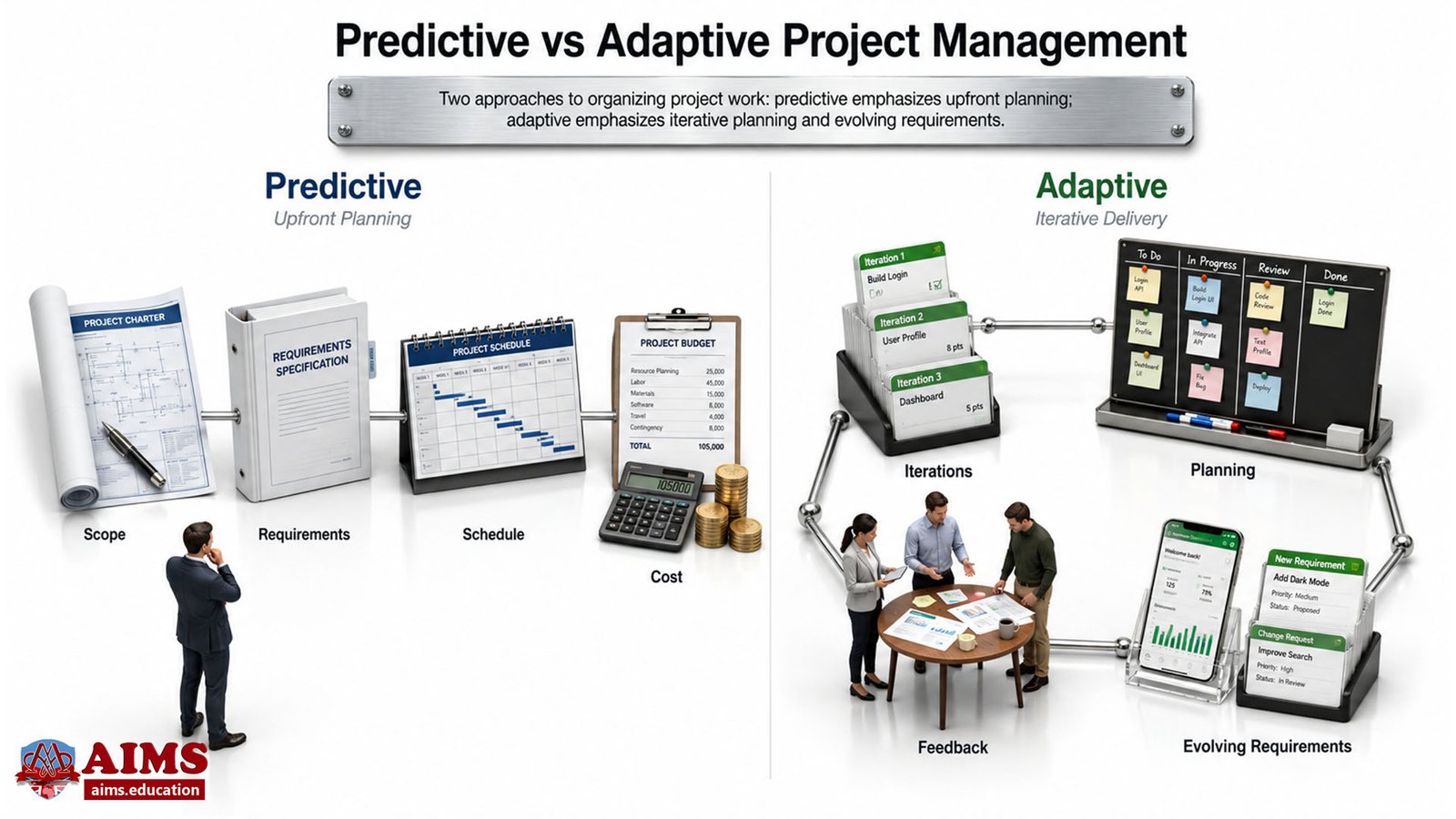
Predictive and adaptive project management should not be treated as competing philosophies in which one must always defeat the other. They represent different positions on a spectrum of development approaches. Contemporary Project Management Institute guidance similarly presents predictive, adaptive, and hybrid approaches as choices that project managers and teams should select according to project circumstances.
Predictive and Adaptive Project Management Approaches
Predictive and Adaptive project management approaches describes how a project creates and evolves its product, service, or result throughout the project life cycle. It should not be confused with a development phase. A development phase is a particular stage in which deliverables are created or tested, while an approach defines the broader way the work is managed and executed.
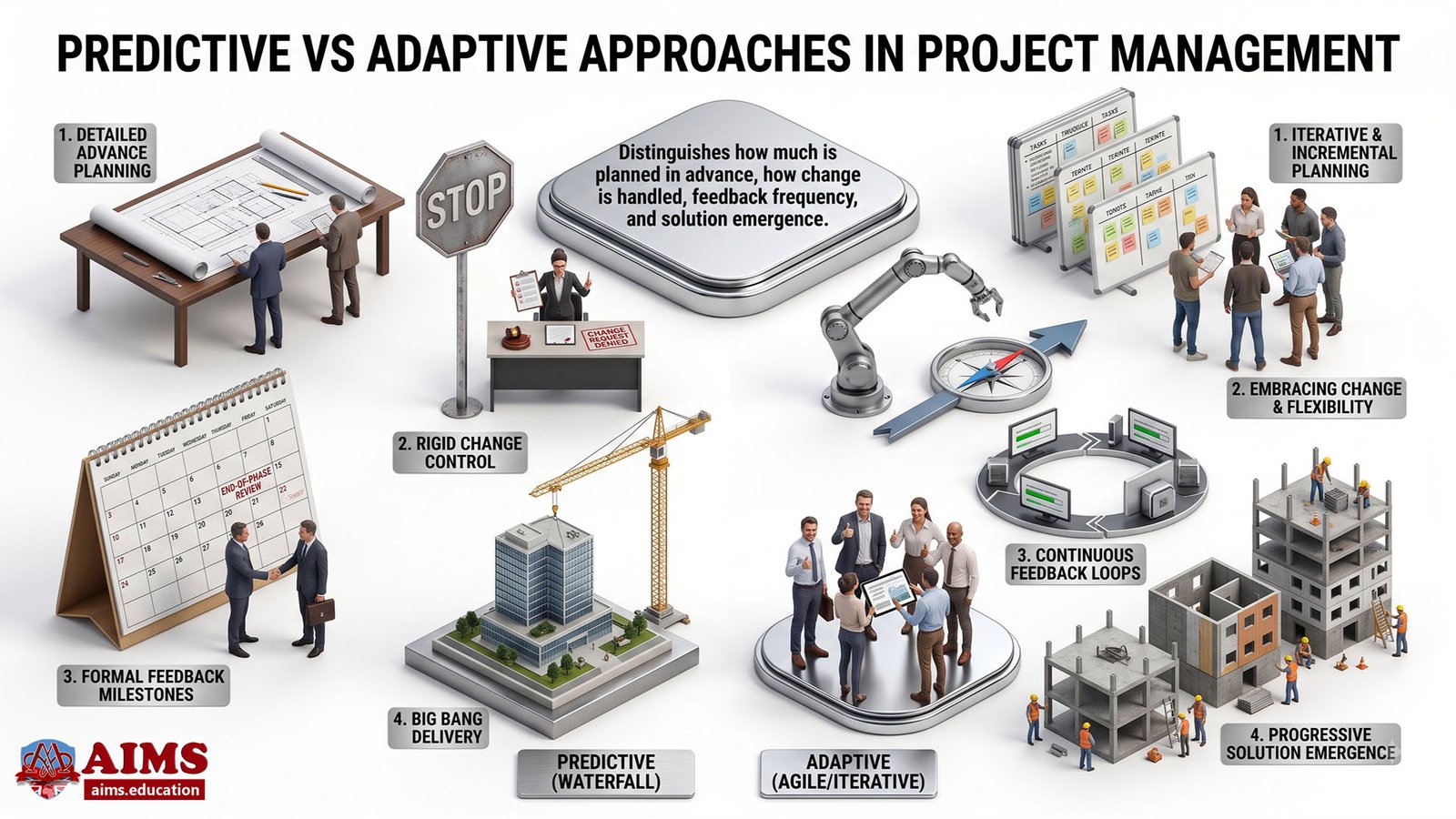
The predictive vs adaptive approaches distinction therefore concerns how much can reasonably be planned in advance, how change will be handled, how frequently stakeholders provide feedback, and how progressively the solution will emerge. These ideas sit within the wider study of project management methodologies and frameworks used for different delivery environments.
What Is Predictive Project Management?
A predictive approach plans the project around requirements and scope that can be defined with reasonable confidence early in the life cycle. It is commonly associated with traditional project management, plan-driven methods, and Waterfall-style delivery.
In a predictive environment, the team normally establishes a substantial portion of the plan before intensive execution begins. Important characteristics include:
- The project team defines the expected scope and requirements relatively early.
- The team develops schedule and cost plans from the scope that must be delivered.
- Scope, schedule, and cost may be integrated into baselines against which performance is assessed.
- Changes usually pass through structured evaluation and change-control processes.
- Planning places greater emphasis on anticipating work before it is performed.
- Deliverables may be produced once at the end or incrementally when phased delivery is beneficial.
This final point is important. Predictive does not necessarily mean that stakeholders receive nothing until the entire project finishes. A well-understood solution can still be divided into planned increments while the overall scope and major timeline remain relatively stable.
Predictive Project Management Example: Commercial Building Construction
Consider a company called Northfield Properties that plans a new office building after the design and regulatory requirements have been approved.
- The project team confirms architectural requirements, safety standards, budget constraints, and the intended completion date.
- The team establishes the scope, schedule, procurement plan, cost baseline, and construction sequence.
- Construction proceeds through planned stages such as foundations, structural work, services, internal finishing, inspection, and handover.
- Any major requested design change is evaluated for its effect on cost, schedule, quality, and contractual commitments before approval.
Predictive planning provides strong control when late physical changes would be expensive, disruptive, or difficult to reverse.
What Is Adaptive Project Management?
An adaptive approach organizes work so that requirements and solutions can evolve through repeated planning, delivery, review, and feedback. It is particularly useful when uncertainty is high, customer needs are likely to change, or the team cannot realistically define the complete solution at the beginning.
Agile project management commonly operates adaptively, but adaptive thinking is broader than simply attaching the word Agile to a project. Teams may use iterative, incremental, timeboxed, or flow-based practices depending on the nature of the work. A detailed introduction is available in AIMS’ guide to adaptive and Agile project management practices.
Typical adaptive characteristics include:
- The project begins with a clear overall vision while detailed requirements continue to evolve.
- The team plans near-term work in greater detail than distant work.
- Stakeholders review outcomes frequently and provide feedback that influences subsequent work.
- Priorities can be revised as new information, risks, technologies, or customer expectations emerge.
- Teams may deliver usable increments instead of waiting for the entire solution to be completed.
- Progress depends heavily on collaboration, rapid learning, and responsiveness to change.
Adaptive Project Management Example: Mobile Application Development
Imagine that BrightPath Digital is creating a new personal-finance application but does not yet know which features users will value most.
- The team establishes the product vision and creates an initial prioritized backlog of requirements.
- The developers build a small usable set of features during the first iteration.
- Users test the increment and indicate that automated expense categorization is more valuable than several originally planned features.
- The team reprioritizes upcoming work and develops the higher-value capability in a later iteration.
Adaptive delivery reduces the risk of completing a technically successful product that no longer matches actual user priorities.
Predictive vs Adaptive Project Management: Key Differences
The fundamental difference is the degree to which the project can rely on early certainty. Predictive work converts relatively stable requirements into detailed plans and controlled execution. Adaptive work accepts that important information will emerge during delivery and therefore creates regular opportunities to learn, revise priorities, and adjust the solution.
| COMPARISON AREA | PREDICTIVE APPROACH | ADAPTIVE APPROACH |
|---|---|---|
| Scope | Defined substantially in advance and expected to remain comparatively stable. | Can evolve as the team learns more about the required solution. |
| Requirements | Best suited to requirements that are known and can be specified early. | Suitable when requirements are uncertain, volatile, or progressively elaborated. |
| Planning | A substantial amount of planning occurs before execution. | Planning continues throughout repeated cycles of work. |
| Schedule | Activities and milestones are usually planned against a defined schedule baseline. | Near-term work may be planned through iterations, timeboxes, or continuous flow. |
| Change | Change is evaluated and controlled against established plans and baselines. | Change is expected and incorporated through prioritization and feedback. |
| Stakeholder Involvement | Engagement is planned around approvals, reviews, milestones, and defined decisions. | Frequent stakeholder participation helps guide requirements and priorities. |
| Delivery Frequency | May involve a single final delivery or planned incremental deliveries. | Often uses periodic or continuous delivery of usable increments. |
| Uncertainty | Works well when uncertainty is manageable and major variables can be anticipated. | Works well when uncertainty requires experimentation, feedback, and learning. |
| Documentation | Usually emphasizes documented requirements, plans, baselines, controls, and approvals. | Documentation is tailored to support delivery, collaboration, governance, and learning. |
| Suitable Projects | Often appropriate for stable, regulated, capital-intensive, or costly-to-change work. | Often appropriate for innovative, digital, design-oriented, or rapidly changing work. |
These differences should be interpreted as tendencies rather than rigid rules. A predictive project can deliver incrementally, and an adaptive project can still operate under budgets, deadlines, governance controls, quality standards, and organizational policies.
Predictive vs Adaptive Project Life Cycle
The predictive vs adaptive project life cycle differs mainly in when detailed decisions are made and how frequently planning is revisited. Understanding the underlying project management life cycle helps explain why the two approaches behave differently. AIMS provides additional context on project management life cycle structures and delivery.
How a Predictive Life Cycle Works
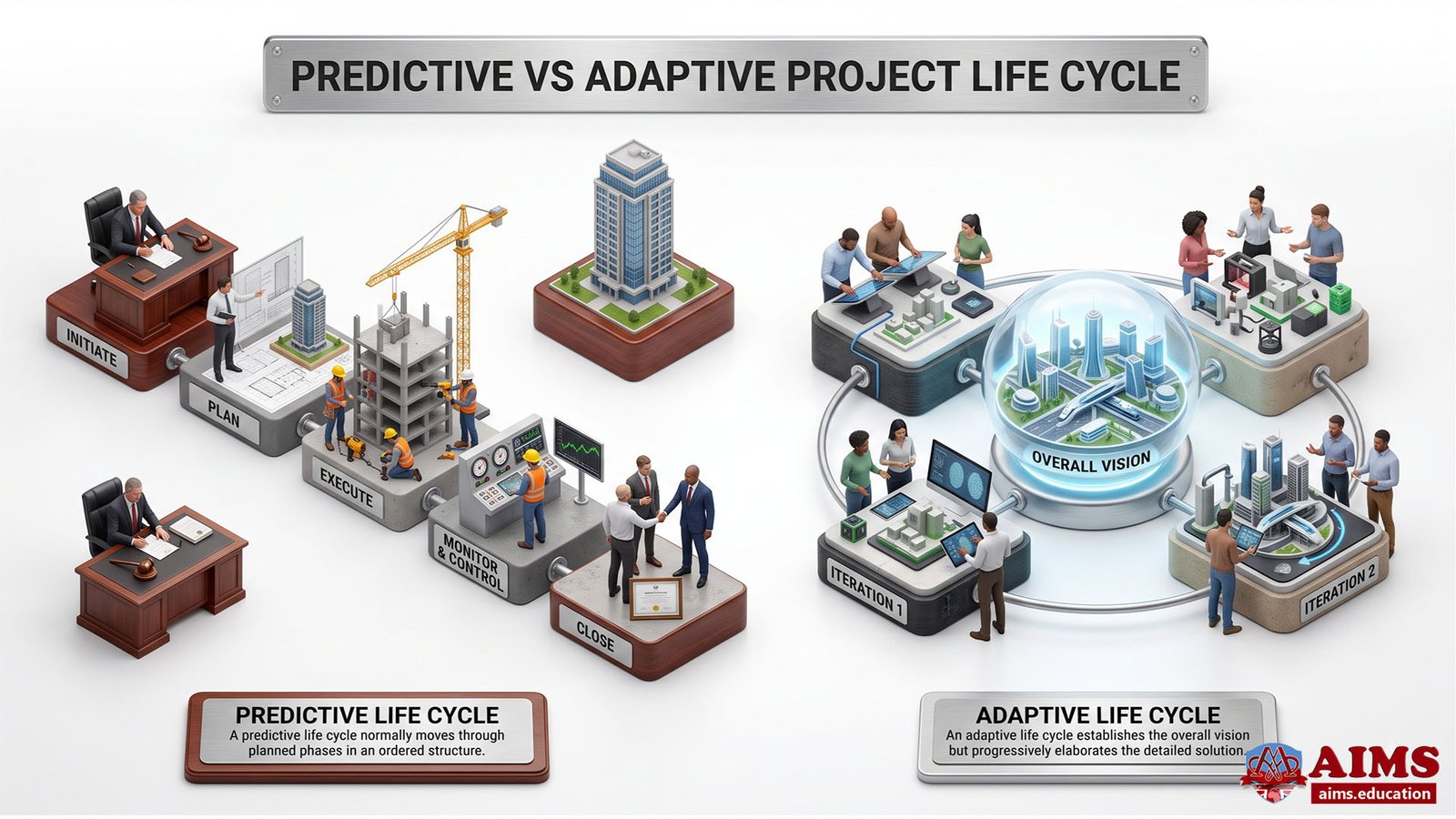
A predictive life cycle normally moves through planned phases in an ordered structure. Feasibility may lead to design, design to build, build to verification, and verification to transfer and closure. The exact stages vary by industry, but substantial dependencies are identified before execution.
Scope, schedule, and cost can form an integrated baseline. Once established, these baselines provide reference points for monitoring performance. Significant deviations are assessed through structured project change management and controlled evaluation rather than being incorporated informally.
Predictive work can also use planned increments. For example, a large solution may be divided into several releases when stakeholders can gain value from partial delivery, even though the overall requirements remain substantially known in advance.
How an Adaptive Life Cycle Works
An adaptive life cycle establishes the overall vision but progressively elaborates the detailed solution. Work is reviewed regularly, and feedback influences the next cycle. Some Agile methods use short timeboxes, while other adaptive methods manage work through continuous flow.
Two concepts are particularly important:
- Iteration: The team repeatedly revisits and improves the solution through cycles of development, review, and learning.
- Increment: The team delivers a usable portion of the overall solution that provides value and contributes to the final product.
Adaptive methods can be iterative, incremental, or both. Flow-based approaches such as Kanban focus less on fixed iterations and more on maintaining an efficient movement of work while limiting excessive work in progress.
How Constraints Behave Differently
Predictive projects often establish scope and then derive schedule and cost baselines from it. Adaptive environments may deliberately hold some constraints stable while allowing another to vary.
For example, when budget and schedule are fixed, the team may adjust lower-priority scope to protect the deadline and spending limit. Conversely, when a critical scope commitment cannot change, additional time or budget may be required. This decision logic is sometimes described as an inverted constraint triangle.
Advantages and Disadvantages of Predictive and Adaptive Approaches
Neither approach has universal advantages or disadvantages because the value of each characteristic depends on project circumstances. A strength in one environment can become a limitation in another.
Advantages of the Predictive Approach
- Early planning can provide clear expectations for scope, schedule, cost, resources, quality, and major risks.
- Baselines make performance measurement and formal governance easier when commitments must be controlled.
- Structured documentation supports projects with regulatory, contractual, audit, safety, or approval requirements.
- The approach can reduce expensive rework when physical or technical changes become increasingly costly later in execution.
Limitations of the Predictive Approach
- Early plans can lose value when important requirements remain uncertain or change substantially.
- Late discovery of misunderstood customer needs can make corrections expensive.
- Formal change processes can reduce responsiveness when rapid experimentation is strategically important.
Advantages of the Adaptive Approach
- Frequent feedback allows the solution to respond to changing customer or stakeholder needs.
- Incremental delivery can create useful outcomes before every desired feature has been completed.
- Continuous prioritization helps teams concentrate effort on the most valuable or urgent work.
- Repeated review supports learning when uncertainty makes complete upfront planning unrealistic.
Limitations of the Adaptive Approach
- The approach requires sustained collaboration and timely stakeholder feedback to work effectively.
- Evolving scope can create governance difficulties when contracts or approvals demand fixed specifications.
- Teams need the skills and organizational support to make decentralized decisions and manage changing priorities responsibly.
How to Choose Between Predictive and Adaptive Project Management
Choose the approach by evaluating the deliverable, the project environment, and the organization rather than selecting a method because it is fashionable or familiar. The most useful question is not “Which approach is better?” but “Which way of working best matches the uncertainty, constraints, risks, feedback needs, and delivery characteristics of this project?”
1. Evaluate the Deliverable
The nature of what the project must create is the first major decision area.
- Requirements certainty: Stable and clearly defined requirements generally support predictive planning. Uncertain requirements favor adaptation.
- Scope stability: The more frequently scope is expected to evolve, the more useful adaptive planning can become.
- Innovation: New products, unfamiliar technologies, and experimental business models often require learning before the final solution can be defined.
- Cost of change: When changes become extremely expensive after execution begins, greater upfront planning may be justified.
- Safety and regulation: Strong compliance, validation, documentation, or phase-gate requirements can increase the value of predictive control.
- Feedback value: When frequent end-user feedback can materially improve the solution, adaptive delivery becomes more attractive.
These considerations are closely related to disciplined project risk management when uncertainty affects delivery decisions and the ability to define, validate, and control project scope.
2. Evaluate the Project Environment
Project characteristics also influence the decision.
- Stakeholder availability: Adaptive work normally benefits from continuous access to people who can review results and clarify priorities.
- Schedule constraints: A fixed completion date may favor strong predictive scheduling, while the need to release useful capabilities early can favor incremental or adaptive delivery.
- Financing uncertainty: Progressive investment may benefit from an approach that creates learning and value in smaller steps.
- Complexity: Complex projects with evolving information may need flexible planning rather than a single detailed plan created too early.
- Interdependencies: Dependencies on other projects, departments, suppliers, or external decisions can affect how easily work can be reorganized.
Stakeholder participation deserves particular attention because adaptive work can fail when decisions are delayed or feedback is unavailable. Effective stakeholder management throughout the project helps teams determine whether the required level of participation is realistic.
3. Evaluate the Organization
An approach must fit the environment in which people will actually use it.
- Structure: Hierarchical organizations with formal authority lines may naturally support predictive governance, while network-oriented structures may accommodate adaptive or hybrid working more easily.
- Culture: Organizations centered on detailed direction and baseline control may prefer prediction. Cultures that accept uncertainty, experimentation, and self-managed teams may support adaptation more readily.
- Capability: Policies, reporting systems, governance processes, skills, and leadership behavior must support the selected approach.
- Team characteristics: Adaptive environments depend strongly on communication, collaboration, problem solving, and the ability to make timely decisions.
A Practical Decision Checklist
Before selecting an approach, ask the following questions:
- Can the essential requirements be defined with confidence before major execution begins?
- How likely are customers, regulations, technologies, or market conditions to change those requirements?
- What is the financial or operational cost of making a change later?
- Will frequent partial deliveries create meaningful value or reduce uncertainty?
- Can decision-makers and users provide regular feedback throughout development?
- Which constraints must remain fixed, and which can reasonably vary?
- Does the organization have the culture, governance, skills, and systems needed for the selected approach?
The strongest development approach is the one that matches the project’s real conditions while preserving enough control to deliver value responsibly.
Predictive, Adaptive, and Hybrid Project Management
Hybrid project management combines predictive and adaptive practices when different parts of the project require different levels of certainty and flexibility. It is especially useful when treating the whole project as entirely predictive or entirely adaptive would ignore important differences among deliverables, phases, risks, or constraints.
This relationship is explored further in AIMS’ comparison of Agile vs Waterfall vs hybrid delivery models in project management.
Common Hybrid Patterns
Hybrid arrangements can take several forms:
- Adaptive development can occur first, followed by a more predictable rollout or implementation phase.
- Predictive and adaptive workstreams can operate simultaneously within the same project.
- A primarily predictive project can contain a smaller adaptive component.
- A primarily adaptive project can retain a predictive component for governance, infrastructure, compliance, or another stable area.
Hybrid Project Management Example: Smart Building Development
Suppose MetroCore Developments is delivering a smart commercial building.
- The structural construction follows approved drawings, contractual milestones, safety requirements, and a predictive schedule.
- The digital building-management interface is developed adaptively because user requirements are still evolving.
- Software teams test functions with facilities managers and refine the interface through repeated feedback.
- Both workstreams are coordinated through shared milestones so that the evolving technology is ready for installation when the physical infrastructure becomes available.
Hybrid management allows stable construction work and uncertain digital development to use different controls within one coordinated project.
Is Predictive Project Management the Same as Waterfall?
Not exactly. Waterfall is commonly associated with a predictive, sequential way of working, and predictive approaches are also described as plan-driven or traditional. However, prediction is the broader concept. A predictive project may still use planned incremental delivery rather than a single final release.
Is Adaptive Project Management the Same as Agile?
Adaptive and Agile are closely related, but they should not be treated as perfect synonyms. Agile approaches operate adaptively because they emphasize learning, feedback, collaboration, and responsiveness to change. At the same time, agility represents a broader mindset and family of practices, while adaptive describes how the development approach responds to uncertainty and evolving requirements.
This is why a search for predictive vs agile does not describe the comparison as precisely as predictive versus adaptive. Agile and Waterfall remain useful related concepts, but the central management decision concerns how much the project should predict, adapt, or combine both behaviors.
How Delivery Cadence Relates to Predictive and Adaptive Approaches
Delivery cadence describes how frequently a project releases completed outcomes or usable increments. The development approach influences cadence, but it does not determine it mechanically.
Four common patterns are:
- Single delivery: The project releases its main outcome near completion.
- Multiple deliveries: Different components or planned increments are delivered at different points.
- Periodic deliveries: Usable results are released according to a regular cadence, which is common in adaptive environments.
- Continuous delivery: Tested increments are maintained in a deployable state and released frequently through an ongoing delivery flow.
A predictive project can therefore have multiple planned deliveries, while adaptive work can use periodic or continuous delivery. The practical objective is to choose a cadence that supports value, risk control, technical feasibility, and stakeholder needs.
Professional Relevance of Predictive and Adaptive Project Management
Professional project managers need to understand both approaches because effective project leadership increasingly depends on tailoring rather than applying one method mechanically. A manager must diagnose uncertainty, constraints, stakeholder expectations, governance requirements, organizational capability, and delivery needs before deciding how the project should operate.
Professionals who want structured development across these areas can build broader capability through an advanced project management diploma covering practical project leadership. Those preparing for wider business and management responsibilities may also consider an MBA in project management for strategic and organizational leadership.
The professional skill is therefore not simply knowing the characteristics of predictive or adaptive methods. It is knowing when to use them, how far to tailor them, and when a hybrid arrangement creates a better fit.
Final Words
Predictive project management emphasizes planning and control where important requirements can be known in advance, while adaptive project management emphasizes learning and responsiveness where uncertainty makes continual adjustment necessary. Neither approach is inherently superior.
The correct choice depends on the deliverable, project environment, organizational context, cost of change, regulatory expectations, stakeholder participation, uncertainty, and delivery strategy. Where these conditions differ across a project, combining approaches may provide a more practical solution than forcing all work into a single methodology.
Frequently Asked Questions
What is the difference between predictive and adaptive project management?
Predictive project management defines more of the scope, requirements, schedule, and cost before major execution begins. Adaptive project management develops the solution through repeated planning, delivery, review, and feedback so requirements and priorities can evolve as the team learns.
What is predictive project management?
Predictive project management is a plan-driven approach suited to projects whose essential requirements and scope can be stabilized relatively early. It emphasizes upfront planning, baselines, structured execution, monitoring, and controlled change.
What is adaptive project management?
Adaptive project management is a change-responsive approach suited to uncertain or evolving requirements. Teams work iteratively, incrementally, or through continuous flow and use frequent feedback to refine priorities and the developing solution.
When should a predictive approach be used in project management?
A predictive approach is often suitable when requirements are stable, the cost of change is high, strong regulatory or contractual controls exist, and the project can benefit from detailed early planning and defined baselines.
When should an adaptive approach be used in project management?
An adaptive approach is often suitable when requirements are uncertain, innovation is significant, stakeholders can provide regular feedback, and the project gains value from experimentation, progressive refinement, or early incremental delivery.
What are examples of predictive and adaptive projects?
A commercial building constructed from approved specifications is a common predictive example because late physical changes can be costly. A new digital application with evolving user requirements is a common adaptive example because feedback can continually refine features and priorities.
Is predictive project management the same as Waterfall?
Waterfall is commonly used as a predictive method, but predictive project management is a broader concept. Predictive projects can use sequential phases, planned increments, formal phase gates, or other structures while still relying on relatively stable requirements and substantial upfront planning.
Is adaptive project management the same as Agile?
Agile approaches are generally adaptive, but adaptive is the broader description of a development approach that responds to uncertainty and change. Agile also refers to a wider mindset, principles, methods, and practices used to improve responsiveness and value delivery.
How do you choose between predictive and adaptive project management?
Evaluate requirements certainty, scope stability, innovation, cost of change, risk, regulatory requirements, feedback needs, delivery cadence, stakeholder availability, organizational culture, and team capability. Choose the approach that best matches those conditions rather than assuming one method is universally better.
What is the difference between predictive, adaptive, and hybrid project management?
Predictive management relies more heavily on early planning and stable requirements. Adaptive management expects requirements and priorities to evolve through feedback. Hybrid management intentionally combines predictive and adaptive practices when different phases, deliverables, or workstreams require different ways of working.
Can predictive and adaptive approaches be combined in one project?
Yes. A project may use predictive controls for stable work such as infrastructure, compliance, or contractual milestones while using adaptive practices for uncertain work such as software, design, or product development. This combination is generally described as a hybrid approach.
About AIMS Project Management Academy
Since 2005, AIMS’ Project Management Academy has supported global learners through internationally accredited, career-focused education built on an internationally standardized curriculum. Qualified faculty combine industry-oriented teaching, practical skill development, 3D interactive learning content, and real-world case studies. This educational content, together with AIMS’ study materials and curriculum, is collaboratively developed and rigorously peer-reviewed by an academic board of qualified industry practitioners. Understanding predictive and adaptive approaches strengthens professional project decision-making. Explore AIMS’ practical and career-focused project management qualifications.