
Halal investment options are financial assets and business opportunities that comply with Shariah by avoiding riba, excessive gharar, maysir, prohibited industries, and unjust contractual terms. Common options include Shariah-compliant stocks, halal mutual funds, halal ETFs, sukuk investment, real estate, gold and silver, Shariah-compliant REITs, Islamic crowdfunding, and equity participation in halal businesses.
In practice, Sharia-compliant investing combines financial analysis with ethical and contractual screening. A product is not halal merely because its label says “Islamic.” Investors must review the underlying activity, financing, ownership, income sources, fees, governance, and continuing compliance. This guide retains the original article’s useful treatment of Islamic funds while strengthening comparisons, beginner guidance, risk warnings, and screening steps.
“But Allah has permitted trade and has forbidden interest.” Surah Al-Baqarah, 2:275.
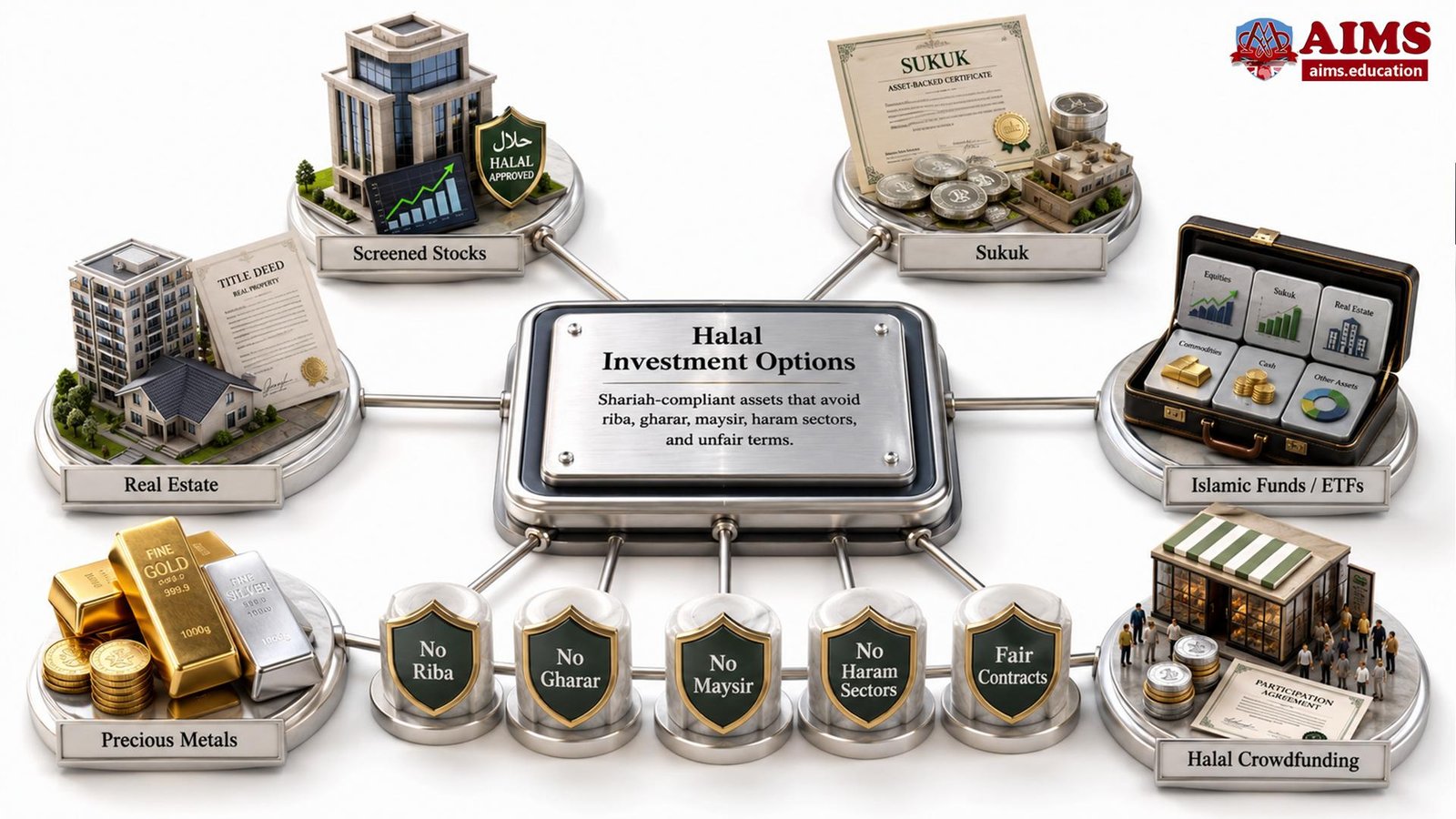
What Makes an Investment Halal or Shariah-Compliant?
An investment is halal when its underlying business, contract, financing method, income, and trading process comply with Islamic commercial principles. The assessment therefore concerns more than the product name. It examines how the return is generated, what the investor owns, which risks are accepted, and whether prohibited income is involved.
The main Islamic banking and finance principles governing Shariah-compliant investment decisions include the following:
- The investment must avoid riba. A fixed return arising purely from an interest-bearing loan is prohibited. Investors should understand how riba differs from lawful trade and investment profit.
- The contract must avoid excessive gharar. The asset, price, obligations, ownership, and delivery terms should be sufficiently clear. Excessive contractual uncertainty can make an arrangement non-compliant. A deeper explanation is available in this guide to gharar in Islamic financial transactions.
- The arrangement must avoid maysir. Investment should not become a wager based mainly on chance, price guessing, or speculative behaviour resembling gambling. This distinction is explained further through the Islamic prohibition of maysir (games of chance).
- The underlying activity must be permissible. The business should not derive its principal activity from alcohol, gambling, pork products, conventional interest-based finance, adult entertainment, or other prohibited sectors.
- Ownership and risk must be genuine. A lawful investment normally involves ownership, usufruct, trade, partnership, or another recognized contractual basis rather than a disguised interest-bearing loan.
- Returns must not be presented as guaranteed investment profit. Profit may be expected or projected, but investment risk cannot be eliminated by relabelling a guaranteed return.
“O you who have believed, do not consume one another’s wealth unjustly but only [in lawful] business by mutual consent.” Surah An-Nisa, 4:29.
Islamic Investment Funds and Halal Mutual Funds
Islamic investment funds pool money from multiple investors and place it in assets or activities approved under a defined Shariah mandate. An equity fund may invest in screened shares, while other funds may hold sukuk, leased assets, commodities, real estate, or a permitted combination of investments. Investors usually receive units or shares representing their participation in the fund.
Subscribers should clearly understand that the returns are tied up with the sharing of actual profit or loss.
This useful principle from the original article should be retained with one clarification. The exact legal and financial exposure depends on the fund structure. Investors should therefore read the prospectus, understand whether the manager acts as a mudarib or agent, and check whether any capital protection comes from a separate lawful mechanism rather than an unconditional profit guarantee.
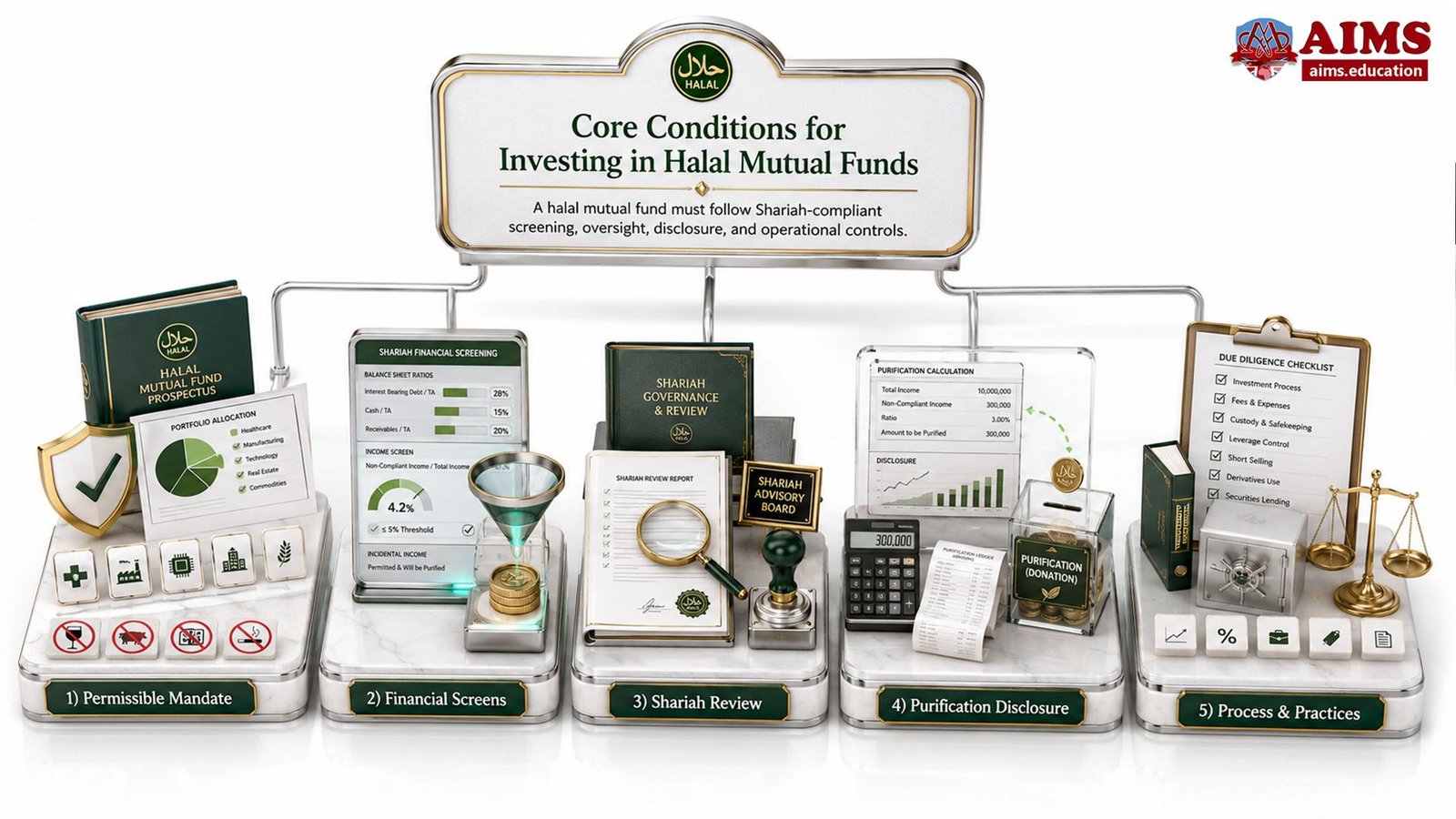
Core Conditions for Investing in Halal Mutual Funds
A halal mutual fund must satisfy both business-screening and structural-compliance requirements.
- The fund’s mandate should restrict investment to permissible businesses and assets.
- The fund should apply recognized financial screens to companies that have mixed balance-sheet items or incidental non-permissible income.
- A qualified Shariah board or adviser should review the methodology, contracts, and continuing operations.
- The fund should disclose how purification is calculated when incidental non-compliant income arises.
- The investment process, fees, custody, leverage, short selling, derivatives, and securities-lending practices should also be assessed.

Types of Islamic Investment Funds
The original article identifies four useful structural categories:
- Ijarah funds
- Commodity funds
- Murabahah funds
- Mixed Islamic funds
Ijarah Funds
An Ijarah fund invests in assets that are leased to users for an agreed rental. The fund may own real estate, vehicles, machinery, or other leasable assets, and investors earn income from the rentals after permitted expenses. The assets, leases, maintenance responsibilities, and ownership risks must be clearly documented.
Commodity Funds
A commodity fund purchases permissible commodities for genuine ownership and resale. Profit arises from lawful trading rather than interest. The fund must avoid prohibited commodities, fictitious trades, excessive speculation, and transactions in which possession or delivery requirements are not properly satisfied.
Murabahah Funds
A Murabahah fund finances disclosed cost-plus sales. The financier first purchases an identified asset and then sells it to the customer at cost plus an agreed profit, often with deferred payment. Because Murabahah receivables represent debt after the sale, the tradability of fund units requires careful Shariah review and cannot be assumed.
Mixed Islamic Funds
A mixed Islamic fund combines asset classes such as equities, sukuk, leased assets, commodities, cash, and receivables. The original article used a fixed 51 percent tangible-asset threshold. That figure should not be treated as a universal rule because tradability tests and financial ratios differ across standards, jurisdictions, and Shariah methodologies. Investors should follow the fund’s approved standard and current Shariah ruling.
How Are Islamic Funds Managed?
Islamic funds are commonly managed through Mudarabah or Wakala arrangements.
- Mudarabah management: The investors provide capital, while the manager acts as mudarib and receives an agreed share of actual profit. Financial loss is generally borne by capital providers unless the manager commits negligence, misconduct, or breach of mandate.
- Wakala management: The manager acts as an investment agent and receives a disclosed fee. A performance incentive may also be structured, but the manager’s compensation and obligations should be clearly agreed.
Halal Mutual Funds Versus Conventional Mutual Funds
The main difference is not whether a fund seeks profit, but which assets, contracts, and financial practices it permits while pursuing that profit.
| FACTOR | HALAL MUTUAL FUND | CONVENTIONAL MUTUAL FUND |
|---|---|---|
| Business activities | Excludes prohibited sectors under the approved Shariah methodology. | May invest across sectors permitted by its commercial mandate and law. |
| Financial screening | Applies Shariah screens to debt, cash, receivables, and non-permissible income. | Uses financial criteria selected by the fund without a Shariah requirement. |
| Interest-based instruments | Avoids conventional interest-bearing bonds and prohibited lending structures. | May hold conventional bonds, interest-bearing deposits, or related instruments. |
| Governance | Normally includes Shariah supervision, compliance review, and purification rules. | Uses regulatory and investment governance without a religious-compliance mandate. |
| Risk | Remains exposed to market, liquidity, credit, operational, and compliance risks. | Remains exposed to market, liquidity, credit, and operational risks. |
11 Best Halal Investment Options for Muslims
The best halal investments are those that combine verified Shariah compliance with suitability for the investor’s goals, risk tolerance, time horizon, liquidity needs, and knowledge. “Best” does not mean guaranteed or universally appropriate. The leading options are listed below before each is explained.
- Halal mutual funds
- Shariah-compliant stocks
- Halal ETFs
- Sukuk
- Gold and silver
- Direct real estate
- Halal REITs
- Shariah-compliant start-up and private-equity investments
- Islamic crowdfunding
- Shariah-compliant peer-to-peer financing
- Islamic investment accounts and cash-management funds
1. Halal Mutual Funds
Halal mutual funds provide professionally managed diversification across Shariah-compliant assets. They can suit investors who lack the time or expertise to screen individual companies. Before investing, examine the fund mandate, Shariah board, fees, holdings, purification policy, risk level, and performance benchmark.
Example: Mariam invests monthly in a diversified Islamic equity fund rather than selecting ten individual companies. She still reviews the fund’s documents and accepts that unit prices can rise or fall.
2. Shariah-Compliant Stocks
Shariah-compliant stocks represent ownership in companies that pass both business-activity and financial-ratio screens. A company may operate in a permissible sector but still fail a methodology because of excessive interest-bearing debt or material non-permissible income. Investors should also monitor continuing compliance because a company’s activities and financial ratios can change.
The practical process is explained in AIMS’ guide to checking whether investing in stocks is halal or haram.
3. Halal ETFs
Halal ETFs are exchange-traded funds that track a Shariah-compliant index or follow an approved Islamic investment mandate. They can offer diversification, transparent holdings, and convenient trading, but the label alone is insufficient. Check the index methodology, fund holdings, Shariah adviser, purification approach, replication method, securities-lending policy, and total fees.
4. Sukuk Investment
Sukuk are certificates structured around ownership, usufruct, assets, services, or investment activity rather than a conventional interest-bearing loan. They are often called Islamic bonds for convenience, but the legal structure and source of distributions differ from conventional bonds. Sukuk can still carry issuer, asset, market, liquidity, currency, and restructuring risk.
Investors can study the distinction through this explanation of sukuk meaning, structures, and major types.
5. Gold and Silver Investment in Islam
Gold and silver can be halal investments when ownership, payment, possession, and trading practices satisfy the relevant Shariah rules. Investors should prefer clearly allocated or genuinely owned metal, avoid interest-bearing financing and excessive leverage, and understand custody, storage, authenticity, fees, and liquidity. Gold prices fluctuate, so precious metals are not guaranteed stores of profit.
“If these classes differ, then sell as you wish if payment is made hand to hand.” Narrated by ‘Ubadah ibn al-Samit, Sahih Muslim, Book of Musaqah, Hadith 1587c.
A detailed treatment is available in this discussion of gold investment rules and standards in Islamic finance.
6. Halal Real Estate Investment
Real estate investment is generally permissible when the property, financing, lease terms, and use of the premises comply with Shariah. Income may arise from rent or a lawful sale. Investors must consider location, maintenance, vacancies, taxes, financing obligations, tenant use, legal title, and the low liquidity of direct property ownership.
Example: Yusuf purchases a small warehouse through permissible financing and leases it to a halal food distributor under a clear rental agreement. His return depends on occupancy, expenses, and eventual resale value.
7. Halal Real Estate Investment Trusts
A halal REIT gives investors exposure to an income-producing property portfolio that has passed Shariah screening. Investors should check the nature of the properties, tenant activities, debt levels, cash holdings, non-permissible income, distribution policy, and independent Shariah oversight. A property label does not automatically make every REIT halal.
8. Shariah-Compliant Start-Up and Private-Equity Investments
Start-up and private-equity investment can be structured through genuine ownership and profit-and-loss participation. Musharakah and Mudarabah structures can align capital with entrepreneurial activity, but these investments are usually illiquid and high risk. Investors should conduct commercial, legal, financial, and Shariah due diligence before committing capital.
9. Islamic Crowdfunding
Islamic crowdfunding raises money for a permissible business, asset, or social project through a clearly identified Shariah contract. The arrangement may use equity participation, reward-based funding, Murabahah, Ijarah, or another approved structure. Investors must examine platform governance, investor rights, use of funds, fees, default procedures, and exit terms.
10. Shariah-Compliant Peer-to-Peer Financing
Shariah-compliant peer-to-peer financing connects funders and customers without using a conventional interest-bearing loan. A platform may use Murabahah, Ijarah, Wakala, Musharakah, or another approved contract. The original article treated Murabahah as the general model, but the correct structure depends on the transaction. Platform failure, delayed payments, default, fraud, and weak documentation remain material risks.
11. Islamic Investment Accounts and Cash-Management Funds
Islamic investment accounts and cash-management funds place money in Shariah-compliant financing, sukuk, commodities, or other approved short-term assets. Some use Mudarabah profit sharing, while others use Wakala investment agency. Investors must distinguish an investment account from a guaranteed deposit and review withdrawal terms, expected returns, capital risk, fees, and any applicable protection scheme.
Why Leveraged Retail Forex Is Not Listed as a Leading Halal Investment
Currency exchange can be permissible when the currencies are exchanged on a valid spot basis with possession and without riba, but leveraged retail forex is not automatically halal. Many products involve margin interest, rollover charges, contracts for difference, delayed constructive possession, excessive speculation, or unclear counterparty arrangements. For this reason, a “swap-free” label alone does not establish Shariah compliance.
Comparison of Major Halal Investment Options
Halal investments differ significantly in risk, liquidity, diversification, income pattern, and the effort required from the investor. The comparison below describes typical characteristics, not guaranteed outcomes.
| OPTION | TYPICAL RISK | LIQUIDITY | DIVERSIFICATION | INCOME OR RETURN | BEGINNER SUITABILITY |
|---|---|---|---|---|---|
| Individual halal stocks | Medium to high | Usually high for listed shares | Low unless several companies are selected | Dividends and capital gains or losses | Moderate, because screening and research are required |
| Halal ETFs | Medium to high | Usually high during market hours | Usually high within the tracked market | Distributions and market-price movement | Often suitable after methodology and fees are checked |
| Halal mutual funds | Varies by fund | Medium to high, subject to redemption rules | Usually medium to high | Fund distributions and unit-price movement | Often suitable for investors seeking professional management |
| Sukuk | Low to high, depending on issuer and structure | Low to medium in some markets | Medium when held through a diversified fund | Periodic distributions and price movement | Suitable when credit, structure, duration, and liquidity are understood |
| Direct real estate | Medium to high | Low | Low without substantial capital | Rent and capital gain or loss | Less suitable without capital, due diligence, and management capacity |
| Gold | Medium, with price volatility | Medium to high, depending on form | Useful as one portfolio component | Price appreciation or decline, usually without regular income | Relatively accessible when ownership and custody are clear |
How to Check If an Investment Is Halal
To check whether an investment is halal, examine the business activity, contract, financial structure, ownership, trading method, Shariah governance, and continuing compliance. Use the following sequence rather than relying on a marketing label.
- Identify the underlying asset or business. Determine what you actually own or finance and how the enterprise earns revenue.
- Exclude prohibited core activities. Reject businesses whose principal operations involve clearly prohibited goods or services.
- Review the contract. Check the purchase price, ownership, delivery, profit formula, loss allocation, fees, collateral, default provisions, and exit rights.
- Test for riba, excessive gharar, and maysir. Look beyond terminology to the economic substance of the transaction.
- Apply the relevant financial screens. Recognized methodologies such as those used by MSCI and S&P examine business activities and financial ratios, but their definitions and thresholds can differ.
- Confirm Shariah supervision. Review the names, qualifications, independence, reports, and continuing role of the Shariah board or adviser.
- Check purification and review frequency. Find out how incidental non-permissible income is identified, purified, disclosed, and reassessed.
- Assess ordinary investment risk. Shariah compliance does not replace analysis of valuation, volatility, liquidity, creditworthiness, fees, regulation, custody, and fraud risk.
Practical conclusion: A halal decision should be based on documented evidence, not only the product name or a social-media opinion.
Example of a Diversified Halal Investment Portfolio
A diversified halal portfolio combines asset classes with different return patterns while keeping every holding within an approved Shariah framework. Consider the following educational example for an investor with GBP 10,000 and a medium-to-long time horizon:
- GBP 4,500 is placed in a diversified global halal equity ETF for long-term growth exposure.
- GBP 3,000 is placed in a diversified sukuk fund to add income-oriented and credit exposure.
- GBP 1,500 is held in allocated gold as a separate real-asset component.
- GBP 1,000 remains in a Shariah-compliant cash-management account for liquidity and emergencies.
The investor reviews the portfolio periodically, confirms ongoing Shariah compliance, rebalances when allocations move materially, and does not treat historical performance as a promise of future return.
This example shows how halal equities, sukuk, gold, and liquid assets can serve different portfolio functions without eliminating risk.
Risks and Common Misconceptions About Halal Investing
Halal does not mean risk-free, profitable, protected from loss, or automatically certified. It means that the investment has been assessed against relevant Shariah principles under a stated methodology.
- Market risk remains. Stocks, funds, sukuk, property, gold, and private investments can lose value.
- Compliance can change. A company may enter a prohibited activity, increase conventional debt, or fail a financial screen.
- Shariah opinions can differ. Scholars and standard-setting bodies may use different interpretations, ratios, or purification methods.
- Liquidity can disappear. A product that appears tradable may become difficult to sell during stressed markets.
- Concentration can increase losses. Investing only in one company, country, property, or sector can create avoidable exposure.
- Fraud can use religious language. Investors should verify regulation, custody, ownership, governance, and documentation rather than relying on Islamic branding.
Purification and Zakat on Halal Investment Profits
Purification and zakat are separate obligations and should not be treated as the same calculation. Purification removes an identified portion of incidental non-permissible income according to the applicable Shariah methodology. Zakat is an act of worship calculated according to the investor’s assets, liabilities, ownership period, intention, nisab, and the scholarly method followed.
For shares and funds, the treatment may differ between an active trading portfolio and a long-term investment portfolio. Fund providers may publish a purification amount, but they do not always calculate an investor’s personal zakat liability. Investors should keep records and obtain advice from a qualified Shariah scholar when the position is material or uncertain.
Shariah Standards, Screening Methodologies, and Ongoing Review
Reliable halal investing depends on documented standards, independent review, and continuing compliance rather than a one-time label. The AAOIFI Shariah standards provide an important reference for Islamic financial contracts and instruments. Global index providers also publish formal screening methodologies, while fund-level Shariah boards review products under their approved mandates.
The original article’s accounting discussion remains relevant in principle. Islamic funds should provide clear financial statements and disclosures covering assets and liabilities, portfolio investments, financing and receivables, operations, changes in net assets or cash flows, investment policies, objectives, material risks, and comparative information. Transparent reporting helps investors assess both financial performance and Shariah governance.
Professionals who require structured mastery may explore AIMS’ globally recognized Islamic finance course or its AAOIFI-Compliant diploma in Islamic banking and finance.
Final Words on Choosing the Best Halal Investment
The best halal investment is a verified Shariah-compliant option that also fits your financial objective, risk capacity, time horizon, liquidity needs, and level of understanding. Begin with the underlying asset and contract, compare risks and costs, confirm the screening methodology, and monitor continuing compliance. Diversification can reduce concentration risk, but no investment structure can remove every possibility of loss.
This article provides educational information rather than personal investment, tax, legal, or individual Shariah advice.
Frequently Asked Questions
What are the best halal investment options?
The leading halal investment options include screened stocks, Islamic mutual funds, halal ETFs, sukuk, direct real estate, Shariah-compliant REITs, gold and silver, Islamic crowdfunding, private-equity participation, and Islamic investment accounts. The best choice depends on verified compliance, risk, liquidity, costs, diversification, and the investor’s objectives.
What makes an investment halal or Shariah-compliant?
An investment is halal when its underlying activity, contract, financing, ownership, income, and trading process comply with Shariah. It should avoid riba, excessive gharar, maysir, prohibited industries, unjust terms, and transactions that disguise an interest-bearing loan as trade or investment.
How can beginners start halal investing?
Beginners can define their goal and time horizon, build an emergency reserve, learn the main Shariah principles, and compare regulated halal funds or ETFs with transparent methodologies. They should start with an affordable amount, diversify, review fees and risks, and verify ongoing Shariah supervision.
Are stocks halal to invest in?
Stocks can be halal when the company’s core business is permissible and it passes the financial screens used by the selected Shariah methodology. Investors must also consider non-permissible incidental income, purification, trading practices, and continuing compliance because a company’s status can change.
What is the difference between sukuk and conventional bonds?
A conventional bond normally represents an interest-bearing debt obligation. Sukuk are structured around ownership, usufruct, assets, services, or investment activity and distribute returns according to the approved contract. Sukuk nevertheless carry credit, market, liquidity, currency, and structural risks.
Are halal ETFs and mutual funds Shariah-compliant?
They can be Shariah-compliant when their holdings, contracts, index methodology, cash management, securities practices, and purification process follow an approved Islamic mandate. Investors should verify the Shariah adviser or board and should not rely solely on words such as halal or Islamic in the product name.
Is investing in gold and silver halal?
Gold and silver investment can be halal when the investor obtains valid ownership and the exchange satisfies the relevant rules for payment and possession. Leveraged products, interest-bearing financing, unclear custody, fictitious ownership, and highly speculative trading can create serious Shariah concerns.
Is real estate investment halal in Islam?
Real estate investment is generally halal when the property is acquired and financed through permissible means, the ownership and lease are valid, and the property is not knowingly used for prohibited activities. Investors must still assess price, title, maintenance, vacancies, tenants, and liquidity risk.
How can investors check whether a company is Shariah-compliant?
Investors should examine the company’s principal business, prohibited revenue, interest-bearing debt, cash and receivables, and the screening ratios used by a recognized methodology. They should also review the latest compliance status, purification guidance, and any opinion issued by a qualified Shariah board.
Are halal investments risk-free?
No. Halal investments can face market loss, default, liquidity constraints, currency movements, operational failures, fraud, and changes in Shariah status. Compliance determines whether the structure and activity are permissible; it does not guarantee capital, income, or profit.
What types of businesses are excluded from halal investing?
Common exclusions include conventional interest-based financial services, gambling, alcohol, pork-related products, adult entertainment, and other activities prohibited under the applicable Shariah methodology. Some methodologies also screen additional sectors and apply limits to incidental non-permissible income.
Do profits from halal investments require purification or zakat?
Incidental non-permissible income may require purification when identified under the relevant methodology. Zakat is a separate obligation based on the investor’s assets, ownership, intention, nisab, holding period, and scholarly approach. A purification figure supplied by a fund does not automatically determine personal zakat.
Professional Islamic Finance Education at AIMS
Since 2005, AIMS’ Institute of Islamic Banking and Finance has delivered internationally accredited, career-focused education to learners worldwide. Its internationally standardized curriculum is taught by qualified faculty through industry-oriented explanations, practical skill development, 3D interactive learning content, and qualifications supported by real-world case studies. AIMS educational content, study resources, and curricula are collaboratively developed and rigorously peer-reviewed by an academic board of qualified industry practitioners. Understanding halal investment options strengthens responsible financial decision-making. Explore accredited institute for practical Islamic finance learning.