
Maysir Meaning
Maysir (الميسر), also written Maisir, comes from the arabic root word يسر, and it refers to gambling or any chance-based arrangement in which one party gains at another’s loss without real trade, work, or productive value. Literally, maysir carries the sense of easy gain, wealth obtained too easily, or profit without effort. In simple terms, it is money made by wagering on uncertain outcomes rather than earning through lawful exchange.
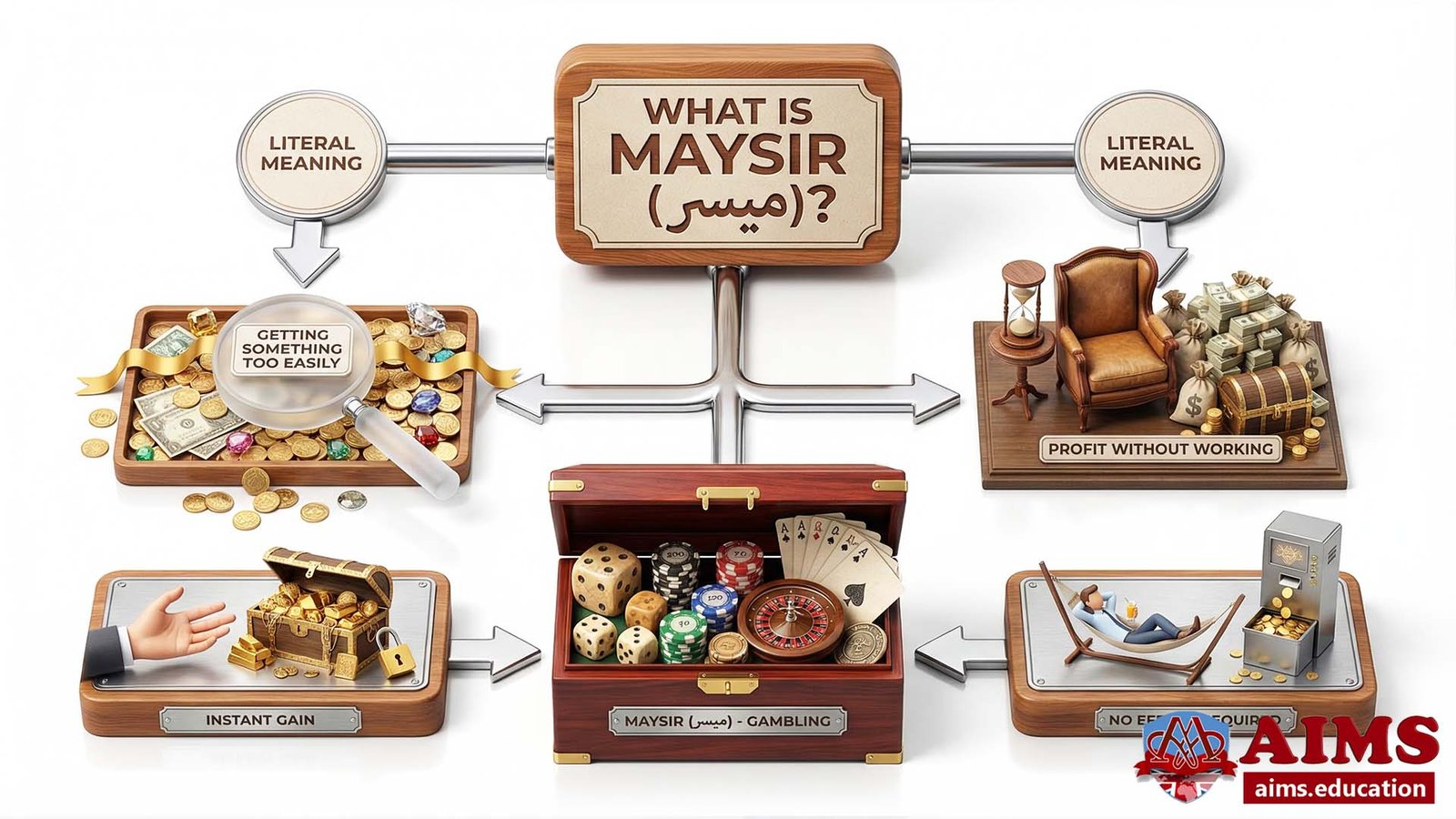
- Maysir is important prohibited element in Islamic banking because the Islamic financial system is built on fairness, transparency, productive activity, and shared responsibility.
- A transaction that transfers wealth merely through chance can harm individuals, families, institutions, and society.
- Understanding maysir helps distinguish lawful risk-taking from prohibited gambling, speculation, and zero-sum wealth transfer.
Historically, the word maysir was associated with games involving arrows, including divining arrows used in pre-Islamic Arabia. Over time, Muslim jurists and commentators applied the concept more broadly to gambling games, wagers, prize schemes, and commercial arrangements where gain is based mainly on chance and conjecture.
What Is Maysir in Islam (ماهو الميسر)
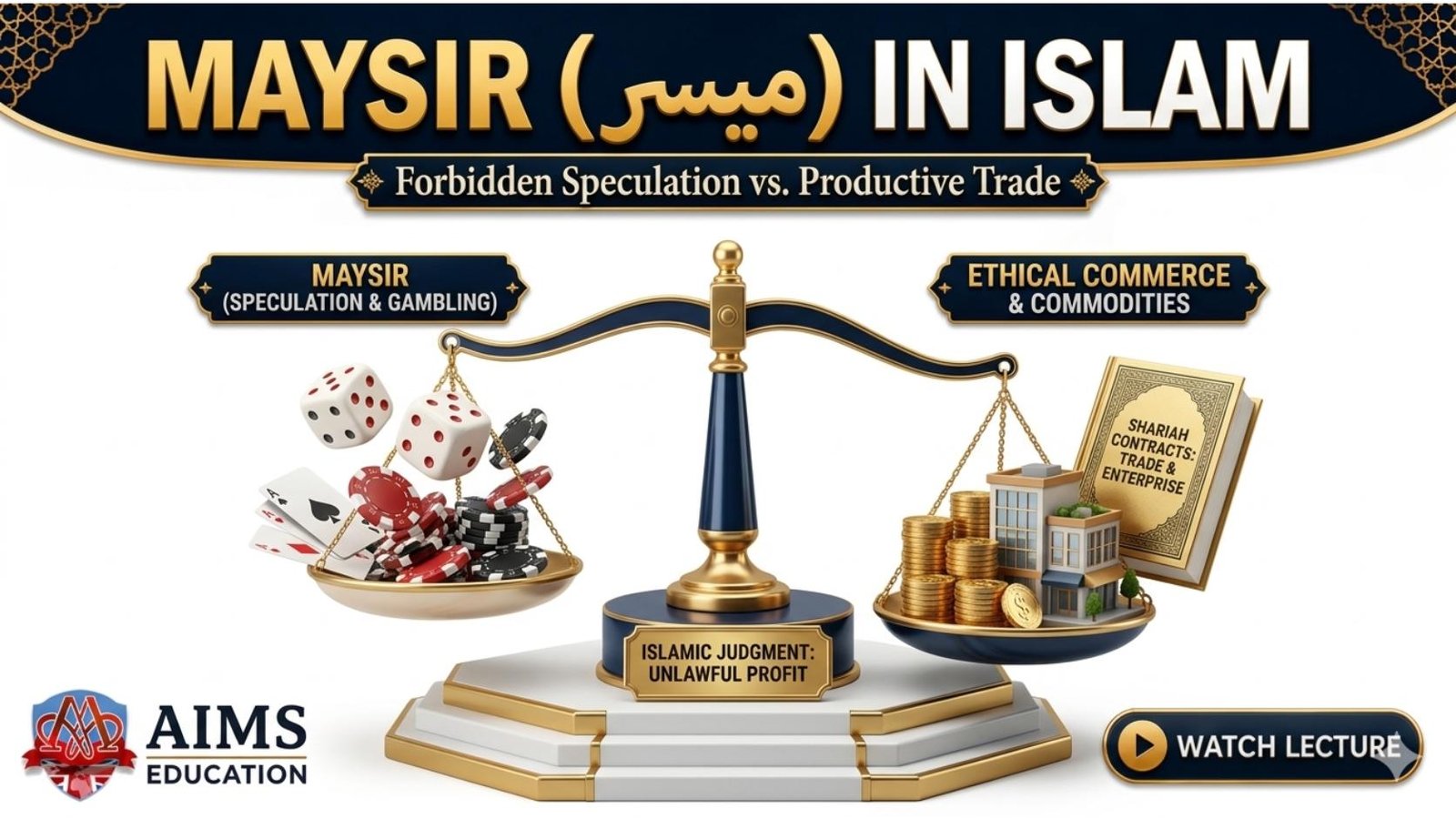
Maysir in Islam is the pursuit of gain through gambling, wagering, or games of chance where wealth is transferred without lawful exchange, productive work, or genuine commercial value. The prohibition is not limited to one ancient game. It applies to any arrangement that reproduces the same harmful structure, even if the form is modern, digital, or financially sophisticated.
- The prohibition of gambling in Islam protects people from financial exploitation, addiction, social conflict, and the illusion that wealth can be created without real effort or responsibility.
- Islamic law does not reject all commercial risk. Trade, leasing, partnership, and investment all involve risk. The problem begins when the risk is detached from real economic activity and becomes a wager.
Prohibition of Maisir (Gambling) in Quran and Hadith:
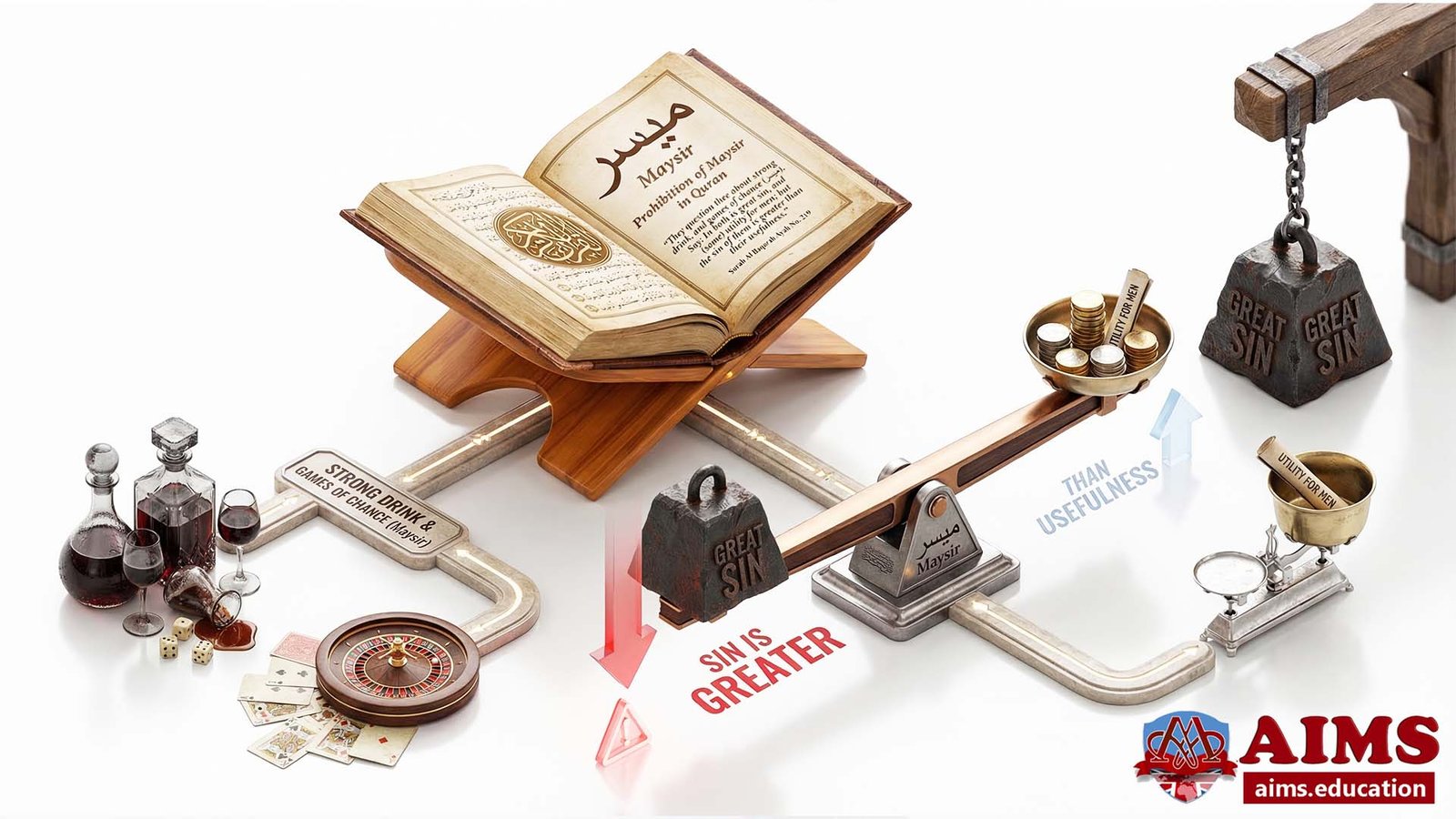
The Quran places games of chance beside intoxicants and divining arrows because these practices weaken judgment, create hostility, and distract people from worship and social responsibility.
Prohibition of Maysir in Quran
“O ye who believe! Strong drink and games of chance and idols and divining arrows are only an infamy of Satan’s handiwork. Leave it aside in order that ye may succeed. Satan seeketh only to cast among you enmity and hatred by means of strong drink and games of chance, and to turn you from remembrance of Allah and from (His) worship. Will ye then have done?”.
Surah Al Maidah Ayah No. 90 & 91!
“They question thee about strong drink, and games of chance. Say: In both is great sin, and (some) utility for men; but the sin of them is greater than their usefulness.”
Surah Al Baqarah Ayah No. 219!
Prohibition of Maysir in Hadith
“The Messenger of Allah prohibited intoxicants, games of chance, card playing and Gobairah.”
Reported by Abdullah bin Amr Abu Daud!
“The Prophet Mohammad (PBUH) forbade wine (Khamr), the game of chance (Maisir), drum (Kubah) and wine made from millet (Ghubairah) saying: Every intoxicant is forbidden”.
Reported by Abdullah bin Amr Abu Daud!
When Does a Transaction Become Maysir?
A transaction becomes maysir when valuable consideration is placed at risk for a chance-based payoff where one party’s gain is caused by another party’s loss, without a genuine sale, service, usufruct, partnership, or productive asset activity.
The main signs of maysir are:
- A participant stakes money, property, or another valuable right on an uncertain outcome.
- The result depends mainly on chance, conjecture, or a future event that neither party controls in a productive way.
- One party wins at the direct expense of another party.
- The gain is not earned through real trade, labor, asset ownership, service, leasing, or partnership.
- The arrangement creates unnecessary risk, resentment, addiction, or social harm.
Simple Example of Maysir
Consider a simple betting arrangement between two people.
- Ahmed and Bilal each place £100 on the result of a horse race.
- If Ahmed’s selected horse wins, he takes Bilal’s £100 in addition to his own stake.
- If Bilal’s selected horse wins, he takes Ahmed’s £100 in the same way.
- No product is sold, no service is delivered, and no partnership creates real economic value.
The gain comes only from chance and the loss of the other party. This is the central structure that makes the arrangement maysir.
Differences Between Maysir, Gharar, Qimar and Speculation
Maysir is often discussed together with gharar, qimar, and speculation, but these terms are not identical. Understanding the distinction will help you avoid treating every uncertainty as gambling or every market risk as prohibited.
| CONCEPT | CORE MEANING | MAIN SHARIAH CONCERN | SIMPLE EXAMPLE |
|---|---|---|---|
| Maysir | Maysir is gambling or chance-based gain without lawful productive exchange. | Wealth is transferred through wagering, not earned through trade or work. | A person bets £50 on a lottery ticket hoping to win a prize. |
| Gharar | Gharar is excessive uncertainty in the basic elements of an agreement. | The parties may not know the wording, subject matter, consideration, delivery, or liability clearly. | A seller sells fish that may or may not be caught later. |
| Qimar | Qimar is a wager where one party may suffer total loss while another gains. | It contains gharar and creates a zero-sum transfer of wealth. | Two players stake money on the result of a card game. |
| Speculation | Speculation seeks profit from expected price movements in assets or commodities. | It becomes problematic when it contains excessive gharar, wagering, or detachment from real assets. | A trader enters a purely price-based bet without owning or intending to use the asset. |
For a deeper treatment of excessive contractual uncertainty, see AIMS’ detailed explanation of how gharar affects Islamic banking contracts. This distinction is important because every maysir contains harmful uncertainty, but every uncertainty is not automatically maysir.
Maysir in Islamic Banking and Finance
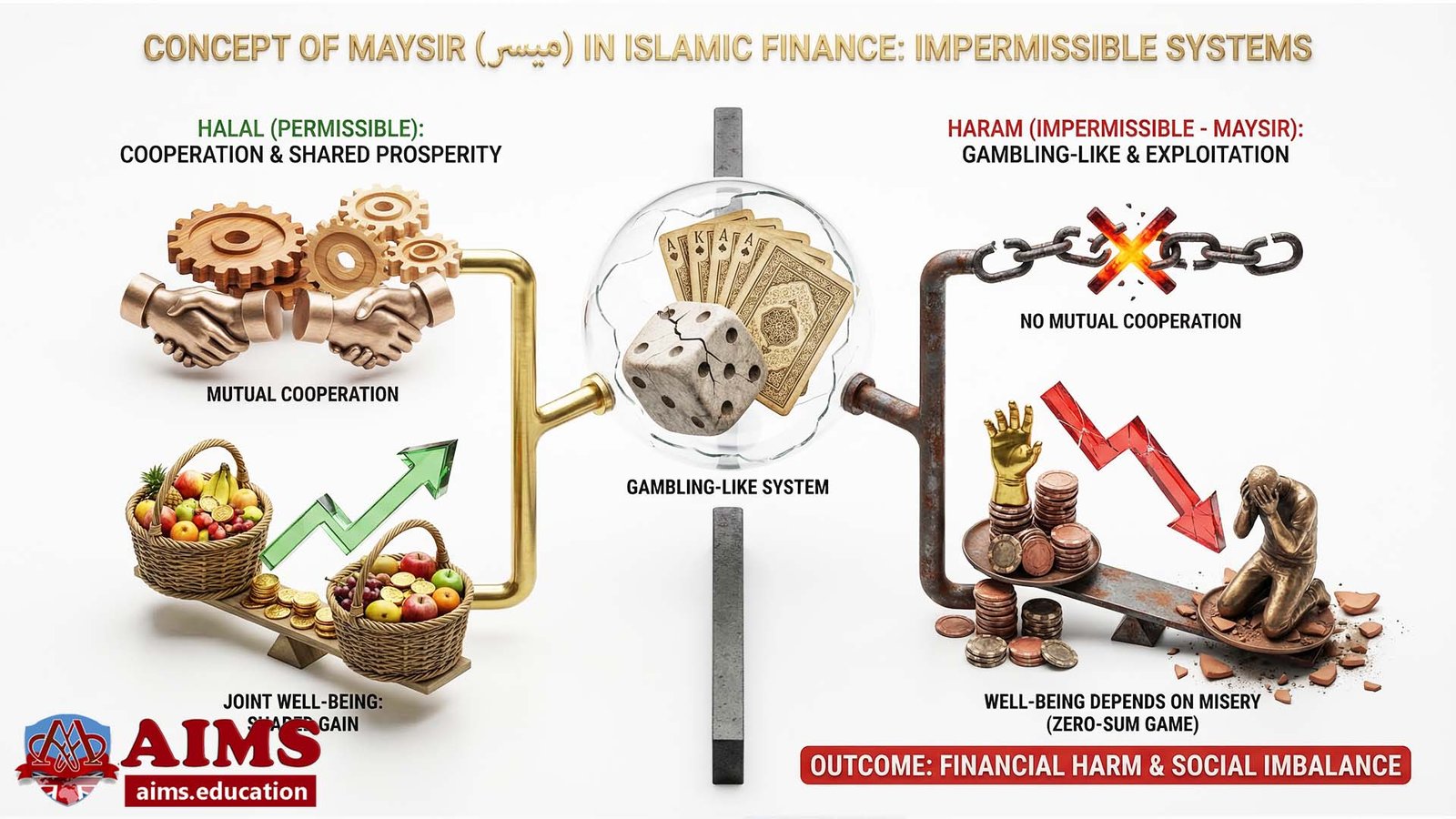
Maysir in Islamic finance refers to any financial structure where profit is generated through wagering, pure chance, or zero-sum uncertainty instead of real assets, lawful services, trade, leasing, partnership, or risk-sharing. Islamic finance therefore avoids products that resemble gambling even when they appear in formal financial language.
The Islamic economic system does not support arrangements where one person’s well-being depends on another person’s misery. This is why maysir is linked with broader concerns such as riba, gharar, bribery, hoarding, and profiteering. A useful companion reading is AIMS’ practical guide to why riba and unjust financial gain are prohibited in Islamic banking.
- Islamic finance controls maysir by requiring transactions to be tied to recognizable assets, lawful services, real ownership, clear liability, and transparent contractual terms.
- Institutions also use Shariah governance to review whether a product’s legal form and economic substance are both acceptable.
- For standards-based industry practice, financial institutions may also consult the AAOIFI Shariah standards for Islamic financial institutions.
Examples of Maysir in Modern Finance
Modern maysir may appear in simple gambling or in complex financial structures. If the gain is mainly a wager on chance, the Shariah concern remains.
Lotteries, Betting and Prize Schemes
Lotteries, betting pools, paid raffles, and prize schemes become maysir when participants pay valuable consideration for a chance to win a prize while most participants lose their stake. A promotional gift is different when the customer does not pay extra for the chance and the prize is not structured as a wager.
Conventional Insurance and Takaful
Conventional insurance structures contain gharar and maysir concerns because the policyholder pays premiums in exchange for an uncertain future payout that may or may not occur. The issue is not the idea of protection itself, but the bilateral exchange of premium for uncertain compensation.
Islamic insurance, or Takaful, uses a cooperative model in which participants contribute to a common fund and mutually assist one another when covered losses occur. This is why AIMS explains Takaful through the principles of mutual risk sharing and participant cooperation.
Options, Futures and Pure Price Betting
Options and futures may become problematic when they are used as pure speculative bets on price movement without genuine ownership, delivery, hedging need, or Shariah-approved commercial purpose. Their value may depend heavily on future price guesses, which can resemble a game of chance when disconnected from real trade.
Not every market forecast is maysir. A merchant who buys inventory expecting market demand is taking commercial risk linked to real goods. By contrast, a trader who merely bets on price movement without productive exposure may be entering a prohibited zone. This distinction is also relevant when assessing whether stock investment is halal or haram under Shariah screening.
“It is the duty of the King (that is, the government) to take various steps for the welfare and economic prosperity of the people, ban unlawful means of income and undertake planning to eliminate gambling, interest, bribery, hoarding and profiteering and work for the prosperity of the people. For example, a situation should not be allowed to develop where most people change their occupation from agriculture to industry and apiculture is neglected or where the industry starts producing unnecessary goods leading to a shortage of basic necessities and an economic crisis in the country”.
According to Shah WaliUllah!
How Islamic Finance Avoids Maysir
Islamic finance avoids maysir by replacing chance-based gain with lawful economic activity. The key idea is simple: profit should be connected to ownership, liability, service, trade, leasing, or partnership, not a wager.
- Islamic banks structure returns through real transactions such as sale, lease, partnership, agency, or service.
- Asset-backed financing connects financial claims to identifiable goods, assets, or usufruct.
- Partnership contracts require risk and reward to be shared according to agreed Shariah principles.
- Leasing contracts link rental income to the use of an owned asset.
- Shariah governance reviews whether the product avoids riba, excessive gharar, and maysir.
- Transparent documentation reduces ambiguity in subject matter, price, delivery, liability, and rights.
These controls are part of the wider principles of Islamic banking that reject chance-based wealth transfer and promote fairness in commercial dealings.
Example of a Lawful Alternative
A lawful alternative changes the transaction from a wager into a real exchange.
- A customer needs equipment worth £10,000 for a small business.
- An Islamic bank purchases the equipment and sells it to the customer at a disclosed profit under a valid trade contract.
- The price, asset, payment schedule, ownership transfer, and delivery terms are clearly agreed.
- The bank’s profit is linked to a real sale, not to a bet on an uncertain event.
The practical impact is that income comes from lawful trade and asset transfer, not from gambling or another party’s speculative loss.
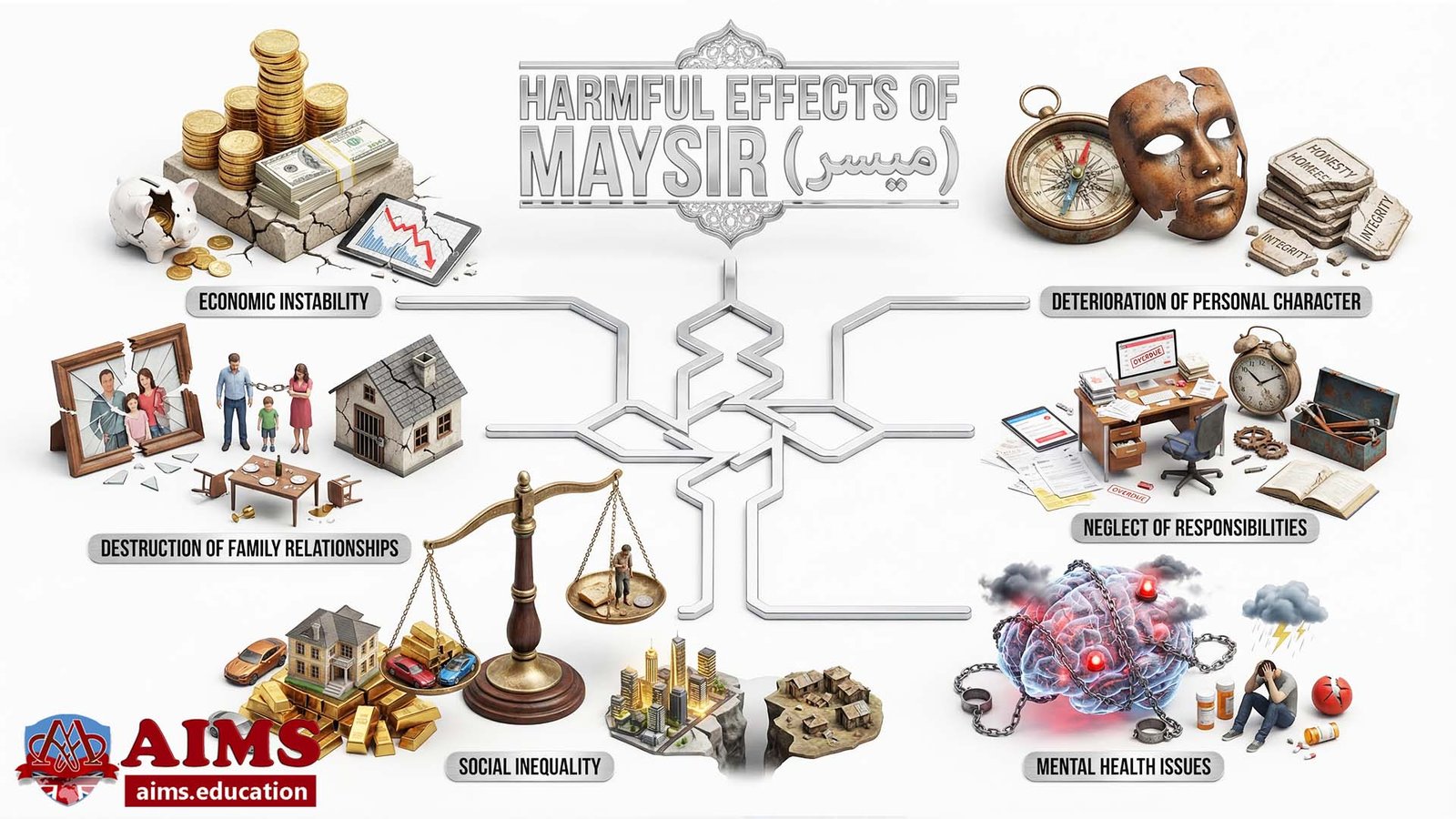
Harmful Effects of Maysir
The prohibition of maysir is not only a technical legal rule. It protects personal discipline, family stability, social trust, and economic justice.
- Economic instability can occur when people lose savings, income, or borrowed money through gambling.
- Personal character may deteriorate when greed, impatience, and reckless risk-taking become normal.
- Family relationships may suffer when gambling creates debt, conflict, secrecy, and financial distress.
- Work and social responsibilities may be neglected because gambling can become addictive.
- Social inequality may increase when wealth is transferred from many losing participants to a few winners.
- Mental distress may follow when financial loss, guilt, anxiety, and family pressure accumulate.
These harms explain why Islam does not merely ban a few named games. It blocks the wider mechanism of wealth transfer by chance whenever it appears in personal life, business, or finance.
Common Misunderstandings About Maysir
Maysir Is Not the Same as Every Risk
Islamic finance allows commercial risk when it is connected to real economic activity. A trader may profit or lose because market demand changes. A partner may receive more or less profit because the business performs differently. These risks are part of lawful enterprise when the contract is valid and transparent.
Mutual Consent Does Not Make Gambling Halal
Both parties may agree to a wager, but consent alone does not make the arrangement lawful. Islamic commercial law requires consent, but it also requires the subject matter, method of earning, liability, and outcome structure to be Shariah-compliant.
Speculation Requires Careful Assessment
Speculation in assets, commodities, shares, or derivatives must be assessed by substance. A transaction linked to real ownership, genuine exposure, and lawful business purpose is different from a pure price bet. Where excessive gharar or wagering dominates, the maysir concern becomes stronger.
Professional Relevance for Students and Practitioners
- For students, maysir explains why Islamic finance is not simply interest-free finance. It also requires contracts to avoid gambling, excessive uncertainty, and unjust enrichment.
- For bankers, product managers, Shariah auditors, and compliance officers, the concept helps identify whether a structure creates genuine value or merely transfers wealth through chance.
Professionals studying through a diploma pathway in Islamic banking and finance should be able to test financial products against three practical questions:
- Does the transaction involve a real asset, service, usufruct, partnership, or lawful commercial purpose?
- Are the price, subject matter, delivery, liabilities, and rights sufficiently clear?
- Is the expected gain earned through productive activity, or is it created mainly by a wager on chance?
If the answer points toward chance-based gain, zero-sum loss, and unnecessary uncertainty, the structure requires serious Shariah review.
Final Words
Maysir is prohibited because it turns wealth creation into a game of chance. Islamic finance replaces gambling-based gain with real trade, transparent contracts, asset-backed activity, and shared responsibility. The practical lesson is clear: lawful profit must be earned through value, ownership, service, risk-bearing, or partnership, not through wagering on another person’s loss.
Frequently Asked Questions
What Is Maysir in Islam?
Maysir is gambling or chance-based gain in which money or another valuable stake is placed at risk for an uncertain payoff. It is prohibited because wealth is transferred by wagering rather than lawful trade, work, service, ownership, or partnership.
ما هو الميسر؟
ما هو الميسر means “What is maysir?” Maysir is not merely entertainment or ordinary uncertainty. It becomes prohibited when valuable money, assets, or rights are staked on an uncertain result so that one party’s gain is created by another party’s loss.
What Is the Difference Between Maysir and Maisir?
Maysir and Maisir refer to the same Arabic concept. The spelling differs because Arabic words can be transliterated into English in more than one way. Both terms refer to gambling, games of chance, and unlawful gain through wagering.
Why Is Maysir Prohibited in the Quran?
The Quran links games of chance with sin, enmity, hatred, and distraction from the remembrance and worship of Allah. The prohibition protects individuals and society from financial harm, addiction, conflict, and unjust wealth transfer.
How Is Maysir Different from Gharar?
Maysir is wagering-based gain or loss, while gharar is excessive uncertainty in a contract. Maysir usually contains harmful uncertainty, but not every uncertain contract is gambling. Gharar focuses on unclear contractual elements, while maysir focuses on chance-based wealth transfer.
Is Every Speculative Transaction Maysir?
No. Speculation becomes a Shariah concern when it resembles a wager, contains excessive gharar, or is detached from real ownership and genuine commercial purpose. Lawful trade can involve risk, but pure price betting may fall under maysir.
What Are Examples of Maysir in Modern Finance?
Examples include lotteries, betting schemes, paid games of chance, and speculative financial transactions that operate like wagers. Certain uses of options, futures, or prize schemes may also raise maysir concerns when gain depends mainly on chance.
Is Conventional Insurance Considered Maysir?
Some conventional insurance structures may involve maysir and gharar concerns because payment and compensation depend on uncertain future events. Takaful reduces this concern by using mutual contribution and cooperative risk sharing among participants.
How Do Islamic Banks Avoid Maysir?
Islamic banks avoid maysir by using asset-backed contracts, trade, leasing, partnership, agency, and service-based structures. Their profits must come from lawful commercial activity rather than gambling, pure chance, or another party’s speculative loss.
About AIMS’ Institute of Islamic Banking and Finance
Since 2005, AIMS’ Institute of Islamic Banking and Finance has delivered internationally accredited, career-focused Islamic finance education to learners worldwide through qualified faculty, standardized curricula, 3D interactive learning content, practical skill development, and real-world case studies. This article and AIMS’ study content and curriculum are collaboratively developed and rigorously peer-reviewed by an academic board of qualified industry practitioners, supporting job-ready qualifications for Islamic banking and finance professionals. Explore AIMS’ career-focused Islamic finance programs.