
Gold in Islam is treated as valuable wealth, lawful adornment for women, a zakatable asset, and a ribawi item that must follow strict Shariah rules when exchanged. Islamic guidance does not prohibit gold itself. Rather, it regulates how gold is owned, worn, traded, financed, and purified through zakat.
This is why gold Islam discussions should not be reduced to one simple question of halal or haram. Gold may be permissible in one context, restricted in another, and financially sensitive when it is bought, sold, borrowed, pledged, or used as an investment. A Muslim therefore needs to distinguish jewelry rules, zakat rules, trading rules, and Islamic finance controls.

What Does Islam Say About Gold?
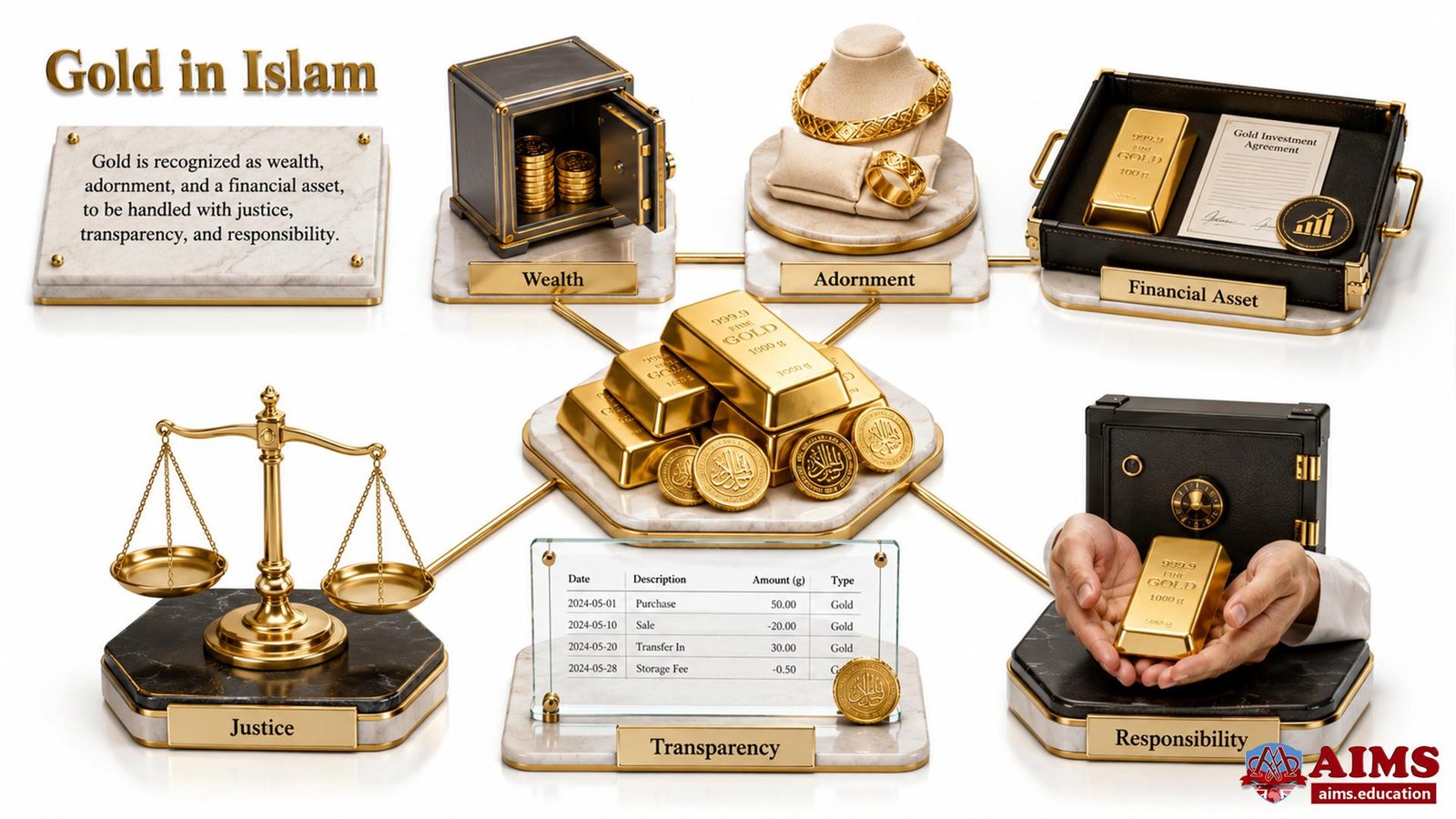
Islam recognizes gold as wealth, adornment, and a serious financial asset that must be handled with justice, transparency, and responsibility. Gold is not inherently forbidden. Its ruling depends on the person using it, the purpose of use, and the structure of the transaction.
In Islamic teaching, gold carries three connected meanings:
- Gold may represent personal wealth that requires zakat when it reaches the nisab and remains in ownership for a lunar year.
- Gold may be used as lawful adornment for women, subject to modesty, local custom, and scholarly discussion on zakat.
- Gold may function as a medium of exchange or investment asset, which means its sale and purchase must avoid riba, gharar, deception, and delayed exchange where Shariah requires spot settlement.
Gold as Wealth, Adornment, and Medium of Exchange
Gold is wealth because it stores value, can be owned, and can be converted into money. It is adornment because jewelry has long been used for personal and family use. It is also treated with currency-like sensitivity in Islamic commercial law because gold belongs to the category of ribawi items.
This distinction matters. A bracelet worn by a woman, a gold bar kept for investment, and a gold contract traded through an online platform are not judged in exactly the same way. The Shariah concern is not the metal alone. The concern is how the metal is acquired, used, valued, exchanged, and purified.
Gold and Silver in Islamic Tradition
Gold and silver historically played an important monetary role in Muslim societies. Dinar and dirham coins were used in trade, savings, settlement, and public finance. Early Islamic markets also operated without modern banking intermediaries, which meant trade, partnership, agency, trust, and sale contracts carried much of the financial activity.
The old discussion of Islamic gold standards is therefore better understood as a discussion of monetary discipline, trust, weight, purity, and fair exchange. Coins were valuable because people trusted their metal content, standard weight, and market acceptability.
Gold in Islamic finance is not merely a precious metal. It is a value-bearing asset that requires ethical ownership, clear possession, fair measurement, and Shariah-compliant exchange.
Gold Rules in Islam: A Simple Overview
The main gold rules in Islam can be summarized in three areas: what is allowed, what is restricted, and what requires zakat or special transactional care. This simple structure prevents a common mistake: mixing the rule for wearing gold with the rule for trading gold.
The most useful way to understand gold rules in Islam is to separate them into the following categories:
- Rules for personal use and adornment.
- Rules for zakat on owned gold.
- Rules for buying, selling, and exchanging gold.
- Rules for gold investment and Islamic finance products.
- Rules for pledging gold as collateral in a Shariah-compliant financing arrangement.
What Is Allowed
Gold ownership is allowed in Islam when it is acquired through halal means and used lawfully. Women may wear gold jewelry according to mainstream Islamic teaching. Gold may also be bought for savings or investment when the transaction avoids interest, deception, excessive uncertainty, and non-compliant delayed exchange.
A Muslim may also keep gold as part of family wealth, business assets, or long-term savings. However, ownership is not the end of the matter. If the gold reaches the zakat threshold and the other zakat conditions are met, zakat must be considered.
What Is Restricted
Gold is restricted in several important situations:
- Men are prohibited from wearing gold jewelry according to mainstream Islamic scholarship.
- Gold-for-gold exchange must avoid unequal exchange when the same genus is exchanged.
- Gold trading must avoid riba, hidden charges that change the exchange substance, and settlement structures that create unlawful delay.
- Speculative paper exposure to gold without ownership, possession, or Shariah-compliant structure is not automatically halal.
- Conventional gold loans that charge interest are not permissible because the interest element is riba.
What Requires Zakat or Special Care
Gold requires special care when it is held as wealth, traded commercially, or used in financing. Investment gold, business inventory, and gold held for savings are normally zakatable when they reach nisab and remain in ownership for one lunar year. Women’s worn jewelry has scholarly differences, which should be handled with knowledge rather than assumption.
| GOLD USE | BASIC ISLAMIC TREATMENT | KEY CONDITION |
|---|---|---|
| Women’s jewelry | Generally permitted as adornment. | Zakat treatment depends on scholarly view, amount, intention, and local practice. |
| Men’s gold jewelry | Prohibited according to mainstream Islamic scholarship. | The restriction applies to wearing gold as adornment, not owning gold as wealth. |
| Investment gold | Permissible when Shariah trading rules are observed. | Ownership, possession, price clarity, and avoidance of riba are essential. |
| Gold-backed loan | A pledge may be permissible, but interest-based lending is not. | The arrangement must avoid riba and must be reviewed as a proper rahn or financing structure. |
Example: Applying Gold Rules in Daily Life
Consider a simple household situation.
- Amina owns 120 grams of gold jewelry, some worn regularly and some kept in a locker as savings.
- Her brother Yusuf owns a gold ring but does not wear it because men should not wear gold jewelry.
- Amina’s family wants to buy an additional 50 grams of investment gold through an online platform.
- They must check whether the platform gives real ownership, clear price, and immediate possession or valid constructive possession.
- They must also calculate whether Amina’s gold reaches nisab and whether zakat applies according to the scholarly view they follow.
The practical result is simple: one family may face different Islamic rulings for wearing, owning, investing, and paying zakat on gold.
Gold for Men and Women in Islam
Gold is generally permitted for women as adornment but prohibited for men to wear as jewelry. This is one of the clearest distinctions in Islamic rulings on gold, and it should not be confused with the permissibility of owning gold as wealth or trading gold lawfully.
Why Gold Is Prohibited for Men
The prohibition of gold for men is based on prophetic guidance understood by mainstream scholars to restrict men from wearing gold as adornment. This includes gold rings, chains, bracelets, and similar jewelry items.
The wisdom is often explained through discipline, modesty, distinction between male and female adornment, and avoidance of luxury that conflicts with Islamic restraint. To be honest, the practical rule is more important than speculative reasoning: a Muslim man should avoid wearing gold jewelry.
Can Women Wear Gold in Islam?
Women may wear gold in Islam as jewelry and personal adornment. This includes rings, bangles, necklaces, earrings, and other ornaments, provided the use remains within Islamic standards of modesty, lawful ownership, and responsible spending.
However, permission to wear gold does not automatically remove zakat discussion. If the gold reaches the nisab, the question of zakat must still be considered, especially when the amount is large, stored as wealth, excessive beyond normal use, or intended partly as savings.
Gold Rings, Jewelry, Watches, and Ornaments
The ruling follows the substance of the item, not only its name. A gold ring is still gold jewelry. A gold watch may also fall under the prohibition for men if it contains real gold as wearable adornment. Gold-plated or gold-colored items may require a separate assessment depending on whether actual gold is present and whether the object is customarily treated as gold jewelry.
For women, the same items may be permissible as adornment, but extravagance and zakat should not be ignored. Actually, many zakat mistakes begin when people assume jewelry is only decoration and never wealth.
Zakat on Gold in Islam
Zakat on gold in Islam is normally due when a Muslim owns gold equal to or above the nisab for one lunar year, at the standard zakat rate of 2.5%. The exact application depends on ownership, intention, amount, and the scholarly treatment of worn jewelry.
Zakat gives spiritual and economic discipline to gold ownership. It reminds the owner that wealth is not only a private possession. It carries a social responsibility, especially when it is stored, invested, or accumulated beyond personal need. Students studying Islamic public finance often connect this with the wider role of zakat as a public and ethical institution; AIMS discusses this wider role in its explanation of zakat as part of Islamic fiscal responsibility.
Nisab for Gold
Nisab for gold is commonly measured at 85 grams of gold. If a person owns gold equal to or above this amount, and it remains in ownership for one lunar year, zakat must be assessed.
The nisab should be calculated using the value of gold at the relevant zakat date. Some people calculate their zakat on Ramadan each year, while others use the exact date their wealth first reached nisab. The important point is consistency and accuracy.
How to Calculate Zakat on Gold
Zakat on gold is usually calculated at 2.5% of the zakatable value. The calculation is simple, but the discipline must be careful.
- Identify the total grams of gold owned.
- Separate gold held for investment, savings, business, or personal jewelry where relevant.
- Check whether the total reaches the nisab threshold.
- Use the current market value on the zakat calculation date.
- Calculate 2.5% of the zakatable value.
- Pay the zakat to eligible recipients according to Islamic rules.
Example: Zakat on Gold Calculation in Islam
Assume Fatima owns 100 grams of gold and the market value is GBP 55 per gram on her zakat date.
- Her gold value is 100 grams x GBP 55 = GBP 5,500.
- The gold is above the common 85-gram nisab threshold.
- If the gold is zakatable according to the view she follows, zakat is 2.5% of GBP 5,500.
- The zakat amount is GBP 137.50.
This example shows why gold zakat should be calculated by value, not guessed from memory or family habit.
Zakat on Worn Gold Jewelry
Zakat on worn gold jewelry is an area of recognized scholarly difference. The Hanafi view generally requires zakat on gold jewelry if it reaches nisab, even if it is worn. Other scholars distinguish between normal personal jewelry and gold kept for savings, investment, excessive display, or trade.
For practical purposes, a Muslim should not treat this difference casually. The careful approach is to ask a qualified scholar or follow a reliable zakat policy consistently. If the jewelry is clearly stored as wealth or rarely worn, the case for zakat becomes stronger.
Scholarly Differences on Women’s Jewelry
The difference on women’s jewelry comes from how scholars classify jewelry: is it primarily personal use, or is it still stored wealth? Both positions aim to preserve the integrity of zakat. The disagreement is not about whether zakat matters, but about how zakat applies to a lawful adornment item.
A balanced teaching rule is this: normal worn jewelry may be treated differently by different schools, but investment gold, stored gold, business gold, and excessive gold should not be ignored.
Buying, Selling, and Trading Gold in Islam
Buying and selling gold in Islam is permissible when the transaction is clear, immediate where required, free from riba, and supported by real ownership and possession. Because gold is a ribawi item, its exchange rules are stricter than ordinary commodity sales.
This is where many modern mistakes occur. A person may ask whether gold trading in Islam is halal, but the real question is: what exactly is being traded, when is payment made, when is possession transferred, and does the buyer own actual gold?
Spot Exchange Requirement
In gold transactions, spot exchange is a central Shariah concern. When gold is bought with currency, payment and possession should occur without unlawful delay. Possession may be physical, such as receiving coins or bars, or constructive, such as a legally recognized allocation where the buyer has ownership rights and can withdraw or dispose of the gold.
A delayed promise, unsettled contract, or synthetic exposure is not the same as owning gold. This is why a simple online gold purchase must be examined carefully.
Riba Concerns in Gold Transactions
Gold creates riba concerns because it belongs to a category of items that require strict exchange discipline. If gold is exchanged for gold, equality and spot exchange matter. If gold is exchanged for currency, spot settlement and possession matter. For a wider explanation of this principle, students may study how riba affects Islamic banking and finance transactions.
The rule protects both sides from hidden interest, unfair delay, and artificial profit from money-like exchange. It also keeps the gold market connected to real ownership, not mere speculation.
Physical Gold vs Paper Gold
Physical gold is easier to understand because ownership and possession are visible. Paper gold, pooled gold, exchange-traded products, digital gold, and gold certificates require closer review because the investor may not own specific gold or may only have a claim against an issuer.
A paper or digital gold product is not automatically haram, but it is not automatically halal either. The Shariah review must examine:
- whether the gold exists;
- whether it is allocated or merely pooled;
- whether the buyer has real ownership;
- whether possession is physical or valid constructive possession;
- whether delivery or withdrawal is possible;
- whether fees, penalties, and settlement terms avoid riba and gharar.
Example: Buying Gold Online in a Shariah-Compliant Way
Suppose Omar wants to buy 20 grams of gold through an online platform.
- He checks whether the platform sells real gold, not only price exposure.
- He confirms the price, weight, purity, storage fee, and delivery terms before purchase.
- He pays immediately through a permitted payment method.
- The platform allocates specific gold to him or gives recognized constructive possession.
- He receives a record showing ownership and the right to sell, transfer, or withdraw the gold.
The transaction becomes stronger when the buyer owns real gold, pays clearly, and receives valid possession without unlawful delay.
Is a Gold Loan Allowed in Islam?
A conventional gold loan is not allowed in Islam if it charges interest. The presence of gold as collateral does not make an interest-bearing loan halal. The gold only secures the debt; it does not remove riba from the loan contract.
A Shariah-compliant alternative may use a pledge arrangement, known as rahn, where gold is held as collateral for an interest-free loan or as part of a properly structured Islamic financing arrangement. Any storage fee must reflect a genuine service cost and must not become disguised interest. This is also why the wider rules of Shariah-compliant financing without interest are important for understanding gold-backed facilities.
Gold Investment in Islamic Finance
Gold investment in Islamic finance is halal when it is based on real gold ownership, valid possession, transparent pricing, and avoidance of riba, gharar, and speculative contracts. The investor must examine the structure, not only the name of the product.
Gold investment in Islamic finance has become more important because Muslim investors want inflation protection, portfolio diversification, and asset-backed alternatives. Still, Islamic finance does not permit every product simply because gold is involved. The asset may be halal, while the contract structure may be defective.
Shariah-Compliant Gold Investment
A Shariah-compliant gold investment should normally meet these conditions:
- The gold must exist and must be identified or properly allocated.
- The investor must obtain ownership and possession, whether physical or valid constructive possession.
- The purchase price, weight, purity, fees, and settlement terms must be clear.
- The structure must avoid interest-based lending, futures-style speculation, gambling, and excessive uncertainty.
- The investor should be able to verify storage, withdrawal, sale, or transfer rights.
This real-asset discipline is connected to the broader Islamic finance preference for asset-backed activity. AIMS explains this principle further in its discussion of asset-backed financing in Islamic banking.
AAOIFI Shariah Standard on Gold
The AAOIFI Shariah Standard on Gold is Shari’ah Standard No. 57 on Gold and its Trading Controls. It provides guidance on types and forms of gold, Shariah parameters for gold trading, and rulings for gold-based financial products in Islamic financial institutions. Readers may refer to the official AAOIFI guidance on Shariah Standard No. 57 for gold trading controls for institutional context.
This corrects an outdated understanding sometimes found in older articles. The AAOIFI gold standard should not be described as merely a future draft. It has been issued and is now an important reference point for Islamic gold products, especially where institutions structure gold accounts, gold investment products, or gold-backed arrangements.
Gold-Backed Products and Islamic Finance Controls
Gold-backed products can support Islamic finance when they are genuinely backed by real gold and not by debt, leverage, or synthetic price exposure. In Islamic finance, the label “gold-backed” must be tested against substance.
A strong Shariah review asks the following questions:
- Does the institution actually hold the gold?
- Is the gold allocated to the investor or mixed in a general pool?
- Can the investor take delivery or otherwise exercise ownership rights?
- Are returns generated from lawful trade, lease, or investment activity rather than interest?
- Does the product avoid short selling, futures speculation, and non-deliverable contracts?
These controls are also relevant to Islamic capital markets, where asset-based and asset-backed instruments must be carefully distinguished. For comparison, AIMS explains related market structures in its resource on Islamic capital market instruments and products.
Example: Shariah Review of a Gold Investment Product
Imagine an Islamic investment platform offers “Digital Muslim Gold Savings.” A Shariah reviewer would not approve it from the name alone.
- The reviewer checks whether every customer’s gold is actually purchased.
- The reviewer confirms whether the gold is allocated, stored, insured, and auditable.
- The reviewer examines whether customers receive ownership after payment.
- The reviewer studies whether withdrawal or sale rights are real, not only promised.
- The reviewer checks whether the platform earns only disclosed service fees, not interest or speculative spread manipulation.
The practical lesson is clear: Islamic gold investment depends on ownership substance, not marketing language.
Historical Role of Gold in Islamic Monetary Practice
Gold and silver historically supported trade because their value was linked to weight, purity, recognizability, and public trust. This historical role helps explain why Islamic finance takes gold transactions seriously.
In earlier Muslim commercial life, markets operated through direct trade, partnership, sale, agency, and trust-based relationships. Modern banks were not the center of economic life. Savers, traders, merchants, and investors often dealt through real commercial contracts.
Gold, Silver, Dinar, and Dirham
Gold dinars and silver dirhams were not merely symbolic. They served practical functions in payment, savings, zakat calculation, and public finance. Their acceptance depended on recognized standards of weight and metal content.
This is why historical monetary discipline focused on coin integrity. If the coin’s weight, purity, or stamp could not be trusted, trade became uncertain and unfair.
Role of Mints in Bullion to Coin Conversion
Mints converted bullion into standardized coins. Their function was not to create value from nothing, but to certify and standardize metal for circulation. This process gave traders confidence because the coin’s form, weight, and mark could be recognized in the market.
- Mints helped define the unit of account used in trade.
- Mints supported standard weights and shapes for circulating coins.
- Mints reduced uncertainty by making coins identifiable and acceptable.
- Mints strengthened trust between buyers and sellers in ordinary markets.
This historical lesson remains relevant. Islamic finance still values transparency, asset reality, measured exchange, and trust in market instruments.
Gold, Murabaha, Musawamah, and Islamic Trade Contracts
Gold can be connected to Islamic trade contracts only when the contract respects the special rules of gold exchange and avoids interest-based financing.
Murabaha is a cost-plus sale where the seller discloses cost and profit. Musawamah is a negotiated sale where the seller is not required to disclose cost. AIMS provides separate guidance on Murabaha financing as a cost-plus Islamic sale structure and Musawamah as a negotiated Islamic sale contract.
Why Gold Needs Extra Care in Sale Contracts
Gold cannot always be treated like ordinary inventory. If gold is exchanged in a way that resembles currency exchange, Shariah rules on riba and spot possession become central.
For example, selling a car through Murabaha may involve deferred payment if the structure is valid. Selling gold on deferred payment raises a different concern because gold has special ribawi rules. Therefore, scholars and Shariah boards examine gold sale structures more carefully than ordinary asset sales.
Example: Gold and Ordinary Murabaha Are Not the Same
Consider two transactions handled by an Islamic finance provider.
- In the first transaction, the provider buys machinery and sells it to a business on a disclosed cost-plus basis.
- In the second transaction, the provider buys gold and attempts to sell it on deferred payment.
- The machinery transaction may be structured as Murabaha if all ownership and sale conditions are met.
- The gold transaction requires additional review because deferred exchange involving gold can create riba concerns.
The same contract name may not produce the same ruling when the underlying asset has special Shariah exchange rules.
Common Mistakes About Gold in Islam
The most common mistakes about gold in Islam come from treating all gold questions as one issue. In reality, jewelry, zakat, investment, trading, and loans each require separate analysis.
Confusing Jewelry Rules with Investment Rules
Some people assume that if women may wear gold, all gold activity is automatically halal. That is not correct. Wearing gold and trading gold are separate matters. A woman’s bracelet may be lawful adornment, but an online gold derivative may still be problematic if it lacks ownership, possession, or Shariah-compliant settlement.
Ignoring Zakat
Gold is often stored quietly in homes, lockers, and family accounts. Because it is not always visible like cash in a bank account, people forget zakat. This is a serious mistake. Gold held as wealth must be reviewed every zakat year.
Treating All Gold Transactions as Automatically Halal
Gold is a halal asset, but not every gold transaction is halal. A contract may involve interest, non-delivery, excessive uncertainty, short selling, leverage, or a claim that does not represent real ownership. The Shariah ruling follows the actual contract structure.
Assuming a Gold Loan Becomes Halal Because Gold Is Collateral
This is another common misunderstanding. If a lender gives cash against pledged gold and charges interest, the transaction remains riba-based. The gold collateral does not purify the loan. A permissible structure must be interest-free or built through a valid Shariah-compliant financing model.
Final Words on Gold in Islam
Gold in Islam is neither rejected nor left unregulated. It is respected as wealth, permitted as adornment for women, restricted as adornment for men, purified through zakat, and controlled carefully in trade and finance.
The best approach is to ask the right question. Are we discussing jewelry, zakat, buying and selling, investment, collateral, or institutional Islamic finance? Once the category is clear, the ruling becomes easier to understand. Gold remains valuable, but in Islam, value must always be governed by justice, transparency, and obedience to Shariah.
Frequently Asked Questions
What does Islam say about gold?
Islam allows gold as wealth, trade asset, and adornment for women, but it regulates its use. Gold must be acquired lawfully, zakat may apply when it reaches nisab, men should not wear gold jewelry, and gold trading must avoid riba, gharar, and unlawful delay.
Is gold halal or haram in Islam?
Gold itself is halal, but some uses of gold are restricted or prohibited. Women may wear gold jewelry, while men are prohibited from wearing gold as adornment. Gold investment and trading are halal only when the transaction follows Shariah rules on ownership, possession, price clarity, and avoidance of riba.
Why is gold prohibited for men in Islam?
Gold is prohibited for men to wear as jewelry according to mainstream Islamic scholarship based on prophetic guidance. The restriction applies to wearing gold as adornment, such as rings, chains, and bracelets. It does not mean a man may never own gold as wealth or business property.
Can women wear gold in Islam?
Yes, women can wear gold in Islam as lawful adornment, including rings, necklaces, earrings, bangles, and ornaments. The use should remain modest, lawfully acquired, and not wasteful. Zakat on women’s jewelry is a separate issue where recognized scholarly differences exist.
Is zakat required on gold in Islam?
Yes, zakat is required on gold when it reaches the nisab and remains in ownership for one lunar year, subject to the applicable zakat rules. Investment gold, stored gold, and business gold are normally zakatable. Worn women’s jewelry has scholarly differences that should be handled carefully.
How much gold is nisab for zakat?
The commonly used nisab for gold is 85 grams. If a Muslim owns gold equal to or above this amount for one lunar year, zakat should be calculated. The usual zakat rate is 2.5% of the zakatable value on the zakat calculation date.
Is zakat due on gold jewelry that is worn?
Scholars differ on zakat for worn women’s gold jewelry. The Hanafi view generally requires zakat if it reaches nisab, while other scholars may exempt normal personal jewelry that is worn and not excessive. Gold kept for savings, trade, or investment should not be treated as merely personal adornment.
Is gold investment halal in Islam?
Gold investment is halal when the investor owns real gold, payment and possession meet Shariah requirements, and the arrangement avoids riba, gharar, gambling, leverage, and synthetic exposure. Physical gold is simpler, while digital gold, paper gold, and gold funds need careful Shariah review.
What are the Shariah rules for buying and selling gold?
Gold buying and selling must involve clear price, known weight and purity, lawful payment, and possession without unlawful delay. Gold-for-gold exchange requires equality and spot exchange. Gold bought with currency must avoid riba, uncertainty, non-delivery, and speculative contracts without real ownership.
What is the AAOIFI Shariah Standard on Gold?
The AAOIFI Shariah Standard on Gold is Shari’ah Standard No. 57 on Gold and its Trading Controls. It explains gold forms, Shariah parameters for gold trading, and rulings for gold-based financial products used by Islamic financial institutions.
Institute of Islamic Banking and Finance at AIMS
AIMS’ Institute of Islamic Banking and Finance has delivered career-focused Islamic finance education since 2005, supported by international accreditations, qualified faculty, 3D interactive learning content, and real-world case-study-based qualifications for learners worldwide. Its study content and curriculum are collaboratively developed and rigorously peer-reviewed by an academic board of qualified industry practitioners. Understanding gold rules strengthens professional judgment in Shariah-compliant finance. Explore practical, accredited, AAOIFI compliant and flexible Islamic finance qualifications.