
The advantages of Islamic banking arise from a Shariah-compliant model that prohibits riba, links financing to lawful assets or services, promotes contractual transparency, and assigns risk according to ownership and agreed responsibilities. Its main benefits include ethical investment, financial inclusion, asset-linked finance, disciplined risk management, customer confidence, and funding structures suited to households, investors, entrepreneurs, and SMEs.
The benefits of Islamic banking are not limited to avoiding interest. Islamic finance uses sales, leases, partnerships, agency arrangements, and benevolent loans to meet different financial needs. It is available to Muslims and non-Muslims, although the suitability, cost, and legal treatment of a product depend on its contract, provider, jurisdiction, and Shariah governance. If you need to understand the foundation, you may first review how Islamic banking and finance works in practice.
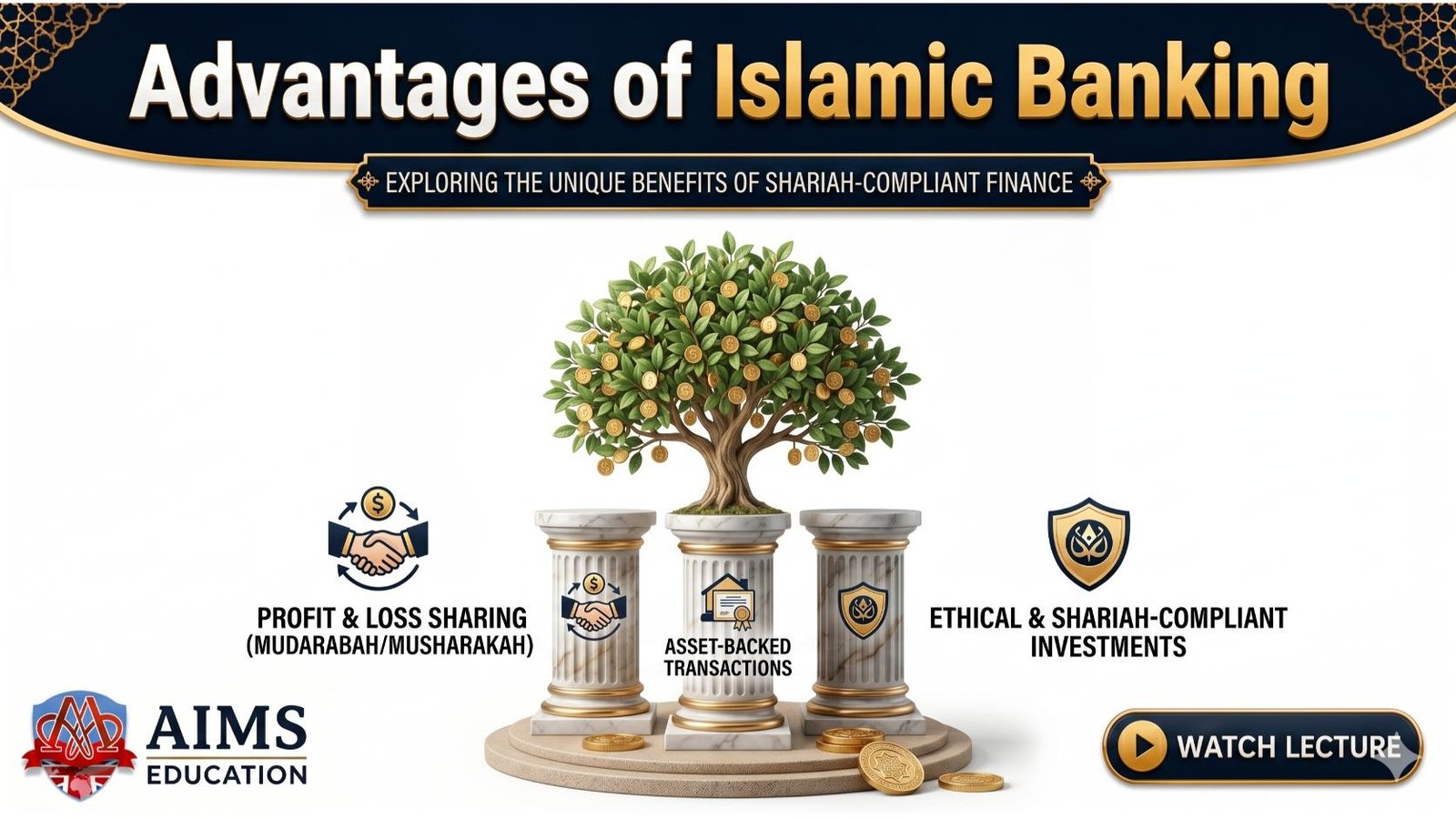
Why Does Islamic Banking Offer Distinct Benefits?
Islamic banking offers distinct benefits because it treats finance as part of lawful trade, investment, leasing, and shared economic activity rather than as a guaranteed return on money alone. Its commercial structures must also observe Shariah rules concerning ownership, consent, disclosure, permissible activities, and contractual risk.
The main foundations behind these benefits include:
- Prohibition of riba: A lender cannot earn a predetermined return merely because time has passed on a loan.
- Lawful commercial purpose: Financing must not support prohibited sectors or transactions.
- Avoidance of excessive gharar: Material uncertainty about price, subject matter, delivery, ownership, or obligations must be controlled.
- Avoidance of maysir: Gambling and games of chance cannot form the basis of financial gain.
- Connection to assets or services: Sale and lease contracts must involve identifiable economic value rather than artificial debt trading.
- Transparency and mutual consent: Parties should understand the price, responsibilities, risks, and contractual consequences before agreeing.
These foundations are explained further in the core principles of Islamic banking and finane.
“Allah has permitted trade and forbidden interest.”
Surah Al-Baqarah, Verse 275
“Allah’s Messenger cursed the accepter of interest and its payer, and one who records it, and the two witnesses.”
Narrated by Jabir, Sahih Muslim, Book 22, Hadith 132-1598
These sources establish the religious basis for distinguishing lawful trade from riba. A fuller explanation is available in AIMS’ study resource on the meaning and forms of riba in Islamic finance.
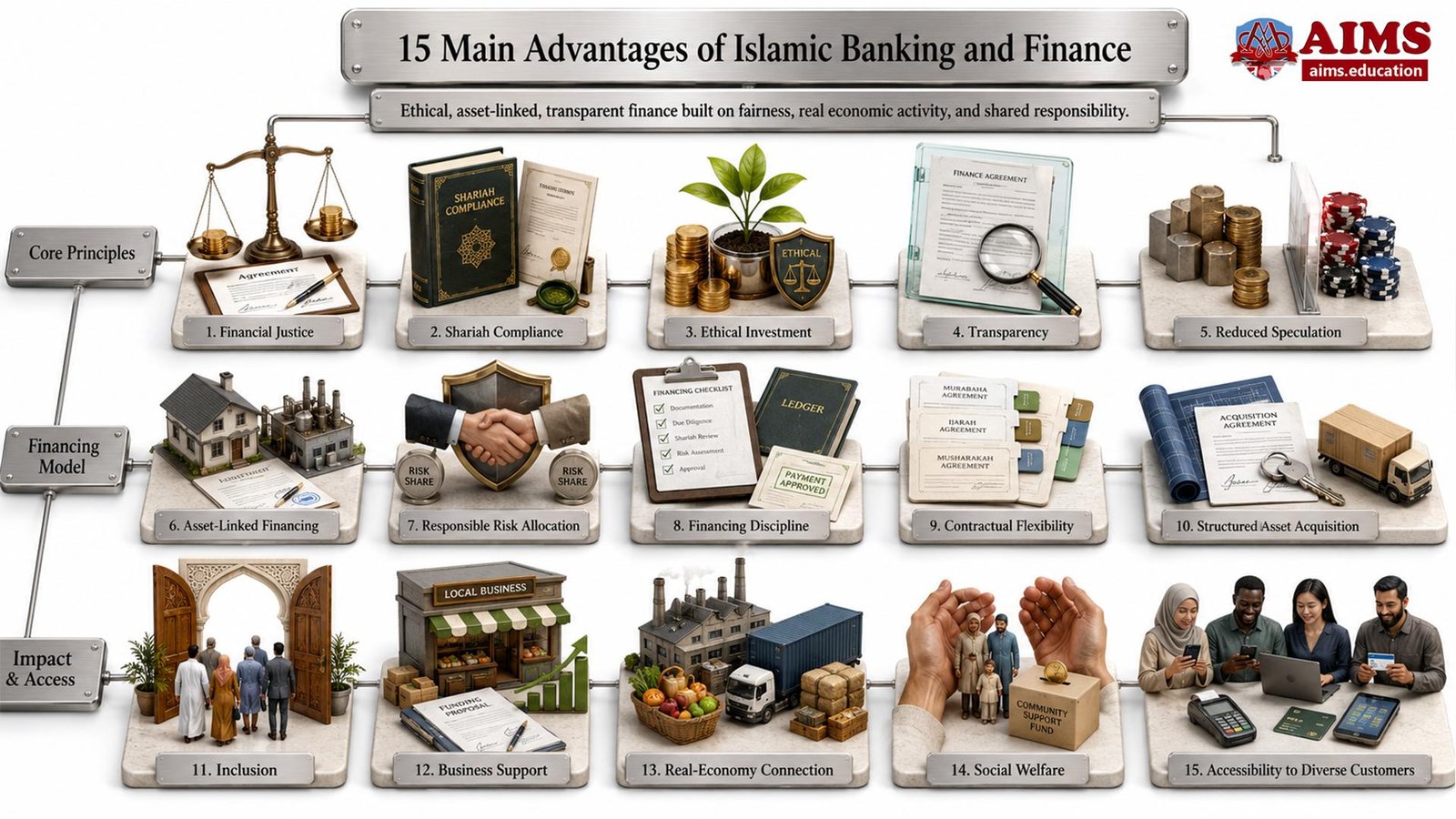
15 Main Advantages of Islamic Banking and Finance
The main advantages of Islamic banking and finance are financial justice, Shariah compliance, ethical investment, transparency, inclusion, asset-linked financing, responsible risk allocation, business support, reduced speculation, financing discipline, contractual flexibility, structured asset acquisition, real-economy connection, social welfare, and accessibility to diverse customers.
These Islamic banking advantages can be grouped into three broad categories:
- Customer and ethical benefits
- Financing, investment, and risk-management benefits
- Economic, business, and social benefits
1. Promotes Financial Justice
“Financial justice is the main principle of the Islamic finance model.”
Key insight preserved from the original article
Financial justice means that a financial contract should allocate rights, rewards, obligations, and risks fairly. Islamic banking does not permit a party to receive an unjustified gain while transferring every commercial burden to another party.
In partnership contracts such as Musharakah, profits are distributed according to an agreed ratio, while financial losses are generally borne according to capital contribution. In Mudarabah, the capital provider bears financial loss unless the manager has acted negligently, fraudulently, or outside the agreed mandate.
Example: A bank and a manufacturing company jointly invest in a new production line through Musharakah. Both share the agreed profit, while any genuine capital loss is allocated according to their investment shares.
This structure aligns financial reward with ownership exposure and encourages both parties to assess the business carefully.
2. Provides Shariah Compliance and Religious Confidence
Shariah compliance means that a banking product is structured and supervised according to recognised Islamic commercial principles. This provides religious confidence to customers who avoid conventional interest-based finance.
The bank must examine the contract, transaction sequence, asset, purpose, and income source. A Shariah-compliant label alone is not sufficient. Proper documentation, execution, governance, and ongoing review are also necessary.
Example: A customer who needs home finance may use a diminishing Musharakah arrangement in which the bank’s ownership share reduces as the customer gradually acquires it.
The practical benefit is access to formal finance without requiring the customer to abandon deeply held religious principles.
3. Encourages Ethical Investment
Ethical investment directs funds toward lawful commercial activity and excludes prohibited sectors such as gambling, alcohol, pork-related businesses, and other impermissible activities.
The benefits of Shariah-compliant banking therefore include both negative screening and positive commercial discipline. Banks must consider what is being financed, not only whether the customer can repay.
Example: An Islamic investment fund may screen out prohibited industries and select Shariah-compliant companies that meet its financial and business-activity criteria.
This approach helps investors connect financial decisions with moral responsibility and social impact.
4. Improves Transparency and Informed Consent
Transparency means that the parties should know the contract type, price, profit margin, rental basis, payment schedule, ownership responsibilities, and material risks.
For example, Murabaha requires the seller to identify the acquisition cost and agreed profit before completing the sale. Ijarah requires clarity about the leased asset, rent, lease period, use, and maintenance responsibilities.
Example: A bank buys equipment for GBP 50,000 and sells it to a business for GBP 56,000 through Murabaha, payable over an agreed period. The cost and profit are disclosed before signing.
Clear disclosure helps customers compare products, understand obligations, and reduce avoidable contractual disputes.
5. Expands Financial Inclusion
Financial inclusion means giving individuals and businesses practical access to suitable payments, savings, financing, and investment services.
Some customers remain outside conventional finance because interest-based products conflict with their beliefs. Islamic banking can remove this religious barrier by providing Shariah-compliant alternatives. However, affordability, documentation, digital access, consumer protection, and geographical availability still affect inclusion.
Example: A small trader who avoids interest-bearing loans may obtain inventory through a transparent Murabaha purchase arrangement.
Islamic banking improves inclusion most effectively when religious compatibility is combined with affordable and accessible product design.
6. Links Financing to Assets, Services, or Productive Activity
Asset-linked financing means that a transaction is connected to an identifiable asset, service, usufruct, or commercial venture. Money is not treated as a commodity that automatically generates a return through lending.
This connection can make the transaction purpose clearer and discourage financing that has no genuine economic substance. It is important, however, to distinguish asset-based structures from fully asset-backed structures because the investor’s legal recourse and ownership exposure may differ.
Example: Under Ijarah, a bank acquires machinery and leases its use to a manufacturer for an agreed rent and period.
You can examine this distinction in more detail through asset-backed and asset-based financing in Islamic banking.
7. Promotes Responsible Risk Sharing and Risk Allocation
Risk sharing means that a party seeking profit must accept the commercial responsibilities associated with its contractual role. Islamic finance therefore links entitlement to return with ownership, effort, liability, or investment exposure.
Not every Islamic banking product is a profit-and-loss-sharing partnership. Murabaha, Salam, Istisna, and Ijarah allocate different risks through sale, advance purchase, manufacturing, and leasing rules. The real advantage is appropriate risk allocation, not identical sharing in every contract.
Example: In an Ijarah arrangement, the owner generally bears ownership-related risk, while the lessee is responsible for damage caused by misuse or negligence.
This principle discourages parties from claiming profit while contractually avoiding every related responsibility.
8. Supports Entrepreneurs and SMEs
Business support means providing financing structures that match the purpose and cash-flow pattern of an enterprise. Islamic banks can finance inventory, equipment, construction, agriculture, trade, and business expansion through different contracts.
- Murabaha can finance identifiable goods or inventory.
- Ijarah can provide access to vehicles, machinery, or equipment.
- Salam can provide advance funding for standardised future goods.
- Istisna can finance manufacturing or construction.
- Musharakah and Mudarabah can support investment partnerships where suitable.
Example: A logistics company leases delivery vehicles through Ijarah instead of taking an interest-bearing vehicle loan.
The practical value is the ability to match financing with the asset or activity that generates business income.
9. Discourages Excessive Speculation
Speculation becomes problematic when financial gain depends primarily on prohibited gambling, excessive contractual uncertainty, or trading without legitimate ownership and delivery conditions.
Islamic finance restricts maysir and excessive gharar and requires genuine contractual substance. These rules can reduce certain highly speculative practices, although they do not eliminate normal business risk or market-price volatility.
Example: A transaction that merely bets on price movement without valid ownership, delivery, or hedging purpose would face serious Shariah concerns.
This discipline encourages finance to support identifiable needs rather than purely artificial risk creation.
10. Encourages More Careful Financing Decisions
Financing discipline means that the institution must assess the customer, asset, transaction purpose, legal structure, and Shariah requirements before committing funds.
Ownership transfers, purchase evidence, lease responsibilities, and partnership terms often require additional due diligence. This can improve transaction quality, although it can also increase processing time and cost.
Example: Before financing industrial equipment through Murabaha, the bank verifies the asset, supplier, purchase sequence, price, delivery, and customer’s repayment capacity.
Careful structuring is beneficial when it reflects genuine risk assessment rather than documentation created only for formality.
11. Offers Flexible Contractual Solutions
Contractual flexibility means that Islamic finance can address different commercial needs through more than one lawful structure.
A sale contract suits a purchase, a lease suits the use of an asset, a partnership suits investment participation, and an agency contract suits delegated management. This variety allows the financing method to follow the economic purpose of the transaction.
Example: A business may use Murabaha for raw materials, Ijarah for machinery, and Istisna for a purpose-built warehouse.
Using the right contract can improve commercial clarity and align payment obligations with the financed activity.
12. Facilitates Structured Asset Acquisition
Structured asset acquisition allows a customer to purchase or use an asset through instalments, rent, or gradual ownership transfer without using an interest-bearing loan.
Murabaha provides a disclosed deferred sale price. Ijarah provides use of an asset for rent. Diminishing Musharakah allows one partner gradually to purchase the other’s ownership units. These structures differ legally and should not be treated as interchangeable.
Example: A clinic may lease diagnostic equipment under Ijarah and acquire ownership later through a separately documented transfer arrangement.
The benefit is a payment structure tied to a recognised sale, lease, or partnership relationship.
13. Connects Finance with the Real Economy
Real-economy connection means that finance supports trade, services, production, construction, agriculture, infrastructure, or other identifiable economic activity.
Because many Islamic contracts require assets, services, or ventures, financing is more visibly linked to how value is created. This can support productive investment, but the outcome still depends on sound underwriting, governance, and market conditions.
Example: Istisna financing may fund the construction of a school, factory, or transport asset according to agreed specifications and delivery stages.
The economic benefit is strongest when the structure finances useful capacity rather than merely replicating debt through unnecessary transactions.
14. Supports Social Welfare and Responsible Conduct
Social welfare refers to financial practices that consider fairness, hardship, charitable responsibility, and the wider consequences of commercial behaviour.
Islamic banks may provide Qard Hasan, support charitable initiatives, and transfer impermissible income or certain late-payment amounts to approved charitable purposes under applicable Shariah governance. Such amounts are not normally treated as ordinary bank profit.
Example: A bank may charge a deterrent amount for unjustified late payment but donate the collected amount to charity, subject to its Shariah policy and local rules.
This principle can discourage deliberate delay while preventing the bank from profiting automatically from a customer’s hardship.
15. Serves Muslims and Non-Muslims
Universal accessibility means that Islamic banking products are commercial services, not religious membership arrangements. Non-Muslims may use them when they value ethical screening, transparent asset finance, predictable payment structures, or portfolio diversification.
Customers should compare total cost, legal rights, early-settlement terms, asset responsibilities, deposit protection, and service quality rather than choosing a product solely because of its label.
Example: A non-Muslim entrepreneur may choose Ijarah because it gives the business long-term use of equipment without purchasing it immediately.
Islamic banking is most valuable when Shariah integrity is accompanied by competitive pricing, clear documentation, and strong consumer protection.
Islamic Banking Benefits Compared with Conventional Banking
The main difference is not that one system finances economic activity and the other does not. The difference lies in the contractual basis used to generate return, allocate ownership risk, screen activities, and govern the transaction. The following table summarises the benefits of Islamic banking over conventional banking without presenting either system as risk-free.
| COMPARISON AREA | ISLAMIC BANKING APPROACH | PRACTICAL BENEFIT OR LIMIT | CONVENTIONAL BANKING APPROACH |
|---|---|---|---|
| Return on finance | Return arises through a lawful sale, lease, investment, service, or partnership structure. | Links earnings to a recognised contract, but the total customer cost may still be comparable with market finance. | Return commonly arises through interest charged on a loan or debt balance. |
| Asset relationship | Many products require an identifiable asset, service, usufruct, or venture. | Creates clearer transaction purpose, but legal ownership and recourse must be examined carefully. | A loan may be secured or unsecured and does not always require the lender to own the financed asset. |
| Business screening | Prohibited sectors and activities are excluded through Shariah screening. | Supports values-based finance, although screening standards may vary across jurisdictions and institutions. | Financing is generally subject to law, credit policy, and institutional ESG or ethical policies where adopted. |
| Risk allocation | Risk follows the rules of ownership, sale, lease, agency, or partnership. | Can align return with responsibility, but not every product shares business losses with the customer. | Credit risk is primarily managed through repayment obligations, collateral, pricing, guarantees, and covenants. |
| Contract transparency | Price, profit, rent, asset, ownership, and responsibilities must be sufficiently clear. | Supports informed consent, although multiple contracts may make documentation more complex. | Interest rate, fees, repayment terms, collateral, and borrower obligations must be disclosed under applicable rules. |
| Religious accessibility | Designed to comply with Islamic commercial law and Shariah governance. | Enables participation by customers who avoid interest-based finance. | May not meet the religious requirements of customers who regard interest as prohibited. |
A detailed concept-by-concept comparison is available in AIMS’ guide to the differences between Islamic and conventional banking systems.
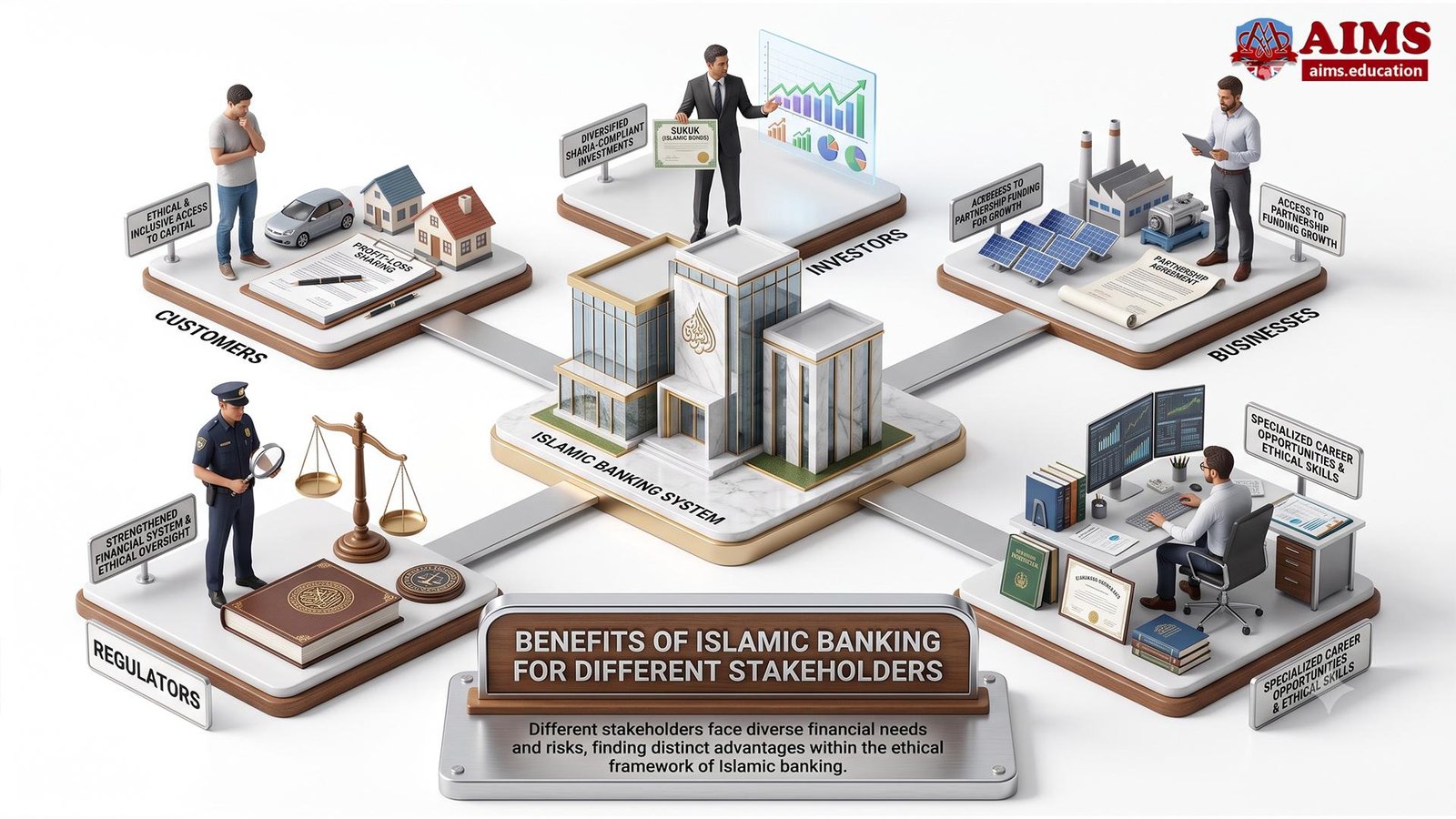
Benefits of Islamic Banking for Different Stakeholders?
Islamic banking benefits each stakeholder differently because customers, investors, businesses, regulators, and finance professionals face different financial needs and risks.
- Banking customers may gain access to Shariah-compliant deposits, payments, home finance, vehicle finance, and investment services.
- Investors may use ethical screening and asset-linked investment structures to align portfolios with Islamic principles.
- Entrepreneurs and SMEs may finance stock, equipment, construction, and expansion through purpose-specific contracts.
- Regulators gain a framework that can widen financial participation, but they must address liquidity, consumer protection, governance, and cross-border standardisation.
- Finance professionals require combined knowledge of banking, law, accounting, risk, product structuring, and Shariah governance.
The importance of Islamic banking therefore extends beyond religious compliance. It also concerns product diversity, ethical allocation of capital, commercial accountability, and access to finance.
Is Islamic Banking More Financially Stable?
Islamic banking can reduce some sources of financial fragility, but it is not automatically more stable and it is not immune to banking crises, recessions, defaults, liquidity shortages, or poor governance.
Asset linkage, restrictions on excessive speculation, limits on interest-based leverage, and ownership-related risk can support discipline. On the other hand, Islamic banks may face concentrated exposures, limited Shariah-compliant liquidity instruments, displaced commercial risk, benchmark risk, legal uncertainty, and operational complexity.
For this reason, stability should be assessed through capital adequacy, liquidity, asset quality, earnings, governance, market concentration, and supervisory quality. Current regulatory analysis can be reviewed in the 2025 Islamic financial services industry stability report.
The balanced conclusion is that Islamic principles can strengthen financial discipline, but actual resilience depends on implementation and regulation.
Disadvantages Islamic Banking
The main disadvantages are product availability, contractual complexity, higher structuring costs, inconsistent standards, liquidity constraints, and the possibility that form may be prioritised over genuine economic substance. A fair assessment of the advantages and disadvantages of Islamic banking must consider both principles and market practice.
Limited Product Availability
Some markets offer fewer Shariah-compliant options for pensions, hedging, working capital, long-term savings, complex trade finance, or specialist corporate transactions. Availability varies significantly by country.
Greater Documentation and Operational Complexity
Islamic transactions may require purchases, ownership transfers, agency appointments, leases, undertakings, or multiple agreements. Poor coordination can create legal, tax, accounting, or execution risk.
Potentially Higher Costs
Shariah review, legal structuring, asset transfers, additional documentation, technology, and compliance controls may increase cost. Competition and standardisation can reduce this disadvantage, but customers should compare the total payable amount rather than focusing only on terminology.
Differences in Shariah Interpretation
A structure accepted in one jurisdiction may be questioned in another because scholars, regulators, and standard-setting approaches may differ. This can complicate cross-border transactions and product comparison.
Liquidity and Risk-Management Constraints
Islamic banks may have fewer eligible short-term instruments and hedging tools in some markets. This can make liquidity and balance-sheet management more difficult.
Risk of Formal Compliance Without Substantive Value
One of the most important Islamic banking disadvantages arises when documentation satisfies a technical form but the transaction does not deliver meaningful transparency, ownership responsibility, fairness, or real economic purpose.
These limitations do not invalidate Islamic banking. They show why strong governance, competent professionals, regulatory coordination, and informed customers are essential.
Professional Opportunities in Islamic Banking and Finance
The growth and technical complexity of Islamic finance create opportunities for professionals who can combine commercial banking expertise with Shariah, governance, risk, accounting, law, and product knowledge.
Relevant roles include Islamic banking officers, relationship managers, product developers, Shariah auditors, compliance specialists, risk analysts, investment professionals, takaful specialists, Sukuk professionals, legal advisers, researchers, and regulators.
Professionals seeking structured technical development may explore CIFE – job-oriented Islamic finance certification online. Those preparing for strategic, managerial, or senior industry roles may consider an accredited MBA in Islamic banking and finance.
Final Words on the Advantages of Islamic Banking
The benefits and advantages of Islamic banking come from its attempt to combine finance with lawful trade, ethical screening, transparent contracts, ownership responsibility, and social purpose. Its strongest contribution is not a claim that every Islamic product is cheaper, safer, or more profitable. Rather, it provides a distinct framework for organising finance around Shariah principles and real commercial relationships.
Customers and businesses should still compare price, risk, legal rights, product execution, Shariah governance, and service quality. Islamic banking delivers its greatest value when ethical principles are translated into authentic contracts, competent management, and fair customer outcomes.
Frequently Asked Questions
What are the main advantages of Islamic banking?
The main advantages include Shariah compliance, prohibition of riba, ethical investment screening, transparent contracts, asset-linked financing, responsible risk allocation, financial inclusion, support for businesses, and a stronger connection between finance and real economic activity.
How does Islamic banking benefit customers?
It gives customers access to financing, deposits, payments, and investments structured around Islamic commercial principles. Customers may also benefit from clear asset relationships, disclosed sale prices or rents, ethical screening, and alternatives to interest-based borrowing.
What are the benefits of Islamic banking compared with conventional banking?
Islamic banking generates returns through recognised sales, leases, services, investments, or partnerships rather than interest on loans. It also applies Shariah screening and links entitlement to profit with contractual responsibility. However, it may involve greater documentation and similar or higher total costs.
How does risk sharing benefit Islamic banks and customers?
Risk sharing can align incentives because a party seeking investment profit must accept relevant commercial exposure. It encourages stronger project assessment and monitoring. However, not every Islamic contract shares business losses because sale and lease contracts allocate risk differently from partnerships.
What are the benefits of asset-backed financing?
Asset-backed financing connects investor rights and returns to identifiable assets and their cash flows. It can improve transaction clarity, limit purely artificial debt creation, and support productive activity. Customers must still examine ownership, legal recourse, valuation, and asset risk.
How does Islamic banking promote ethical investment?
Islamic banks and funds screen out prohibited business activities and assess whether the transaction itself complies with Shariah. This allows capital to be directed toward lawful trade, services, infrastructure, and investment while maintaining commercial due diligence.
Can non-Muslims benefit from Islamic banking?
Yes. Islamic banking is available to customers of any faith. Non-Muslims may value ethical screening, transparent asset finance, fixed sale prices, leasing structures, or portfolio diversification. Suitability should be judged through cost, risk, legal protection, and service quality.
How can Islamic banking improve financial inclusion?
It can bring individuals and firms into formal finance when religious concerns prevent them from using interest-based products. The impact is greater when Shariah-compliant services are affordable, digitally accessible, understandable, and supported by effective consumer protection.
Does Islamic banking support businesses and economic development?
Yes. Murabaha can finance goods, Ijarah can finance asset use, Salam can support certain producers, Istisna can fund construction or manufacturing, and partnership contracts can provide investment capital. Effective development still depends on sound projects and responsible underwriting.
Is Islamic banking more financially stable than conventional banking?
It may reduce some risks through asset linkage, limits on speculation, and ownership-based responsibility, but it is not automatically more stable. Capital, liquidity, governance, asset quality, regulation, and economic conditions remain decisive for every bank.
What are the limitations or disadvantages of Islamic banking?
Common limitations include fewer products in some markets, complex documentation, higher structuring costs, differences in Shariah interpretation, liquidity constraints, and weak execution. These challenges can be reduced through standardisation, regulation, professional competence, and transparent product design.
Develop Professional Competence with the AIMS Institute of Islamic Banking and Finance
Since 2005, AIMS’ Institute of Islamic Banking and Finance has delivered internationally accredited, career-focused education to learners across more than 178 countries. Its internationally standardised curriculum combines qualified faculty, industry-oriented teaching, practical skill development, 3D interactive learning content, and real-world case-based qualifications. This educational article, AIMS study content, and its curriculum are collaboratively developed and rigorously peer-reviewed by an academic board of qualified industry practitioners. Understanding Islamic banking advantages supports competent product evaluation, governance, and customer advice. Explore AIMS’ practical and flexible Islamic banking educational programs.